

Grete Jalk
Grete Juel Jalk (1920-2006) was born in Copenhagen. After graduating from high school in modern languages and philosophy, she pursued an impressive list of academic qualifications, starting with law and philosophy studies, which she chose to abandon halfway through. Instead, she commenced her design career in 1939 at the Drawing and Applied school for Women (1940–43), followed by an apprenticeship as a cabinetmaker, supervised by Karen Margrethe Conradsen. She completed her studies at the Danish Design School in 1946, while receiving additional instruction from Kaare Klint at the Royal Academy's Furniture School. While consolidating contacts with numerous furniture designers, she took part in the annual competitions of the Design Museum and the Design School's furniture department where she also taught from 1950 to 1960.
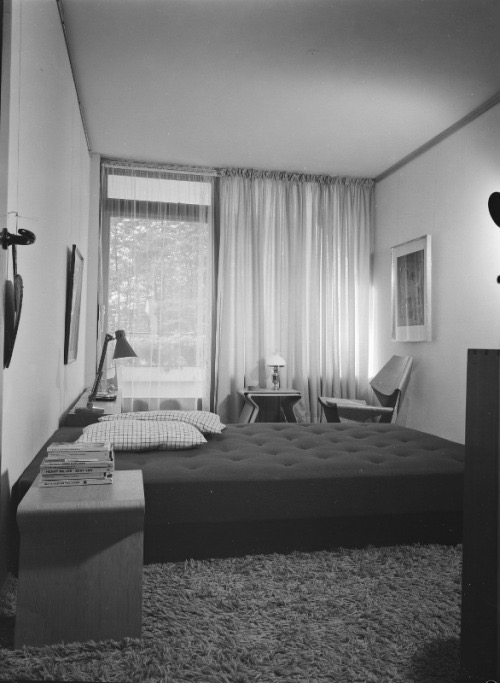
Grete Jalk was a furniture designer at a time when it was largely an exclusively male profession. As one of the first women shattering the glass ceiling of design. One of her earliest projects was a 1947 furniture set for the “modern professional woman”, that consisted of a sofa bed, desk, and wall mounted storage system. In 1953 Jalk opened her own design studio, shortly after she had successfully exhibited at the ninth Milan Triennale. In the same year she won the first prize in the Georg Jensen Competition in Copenhagen.
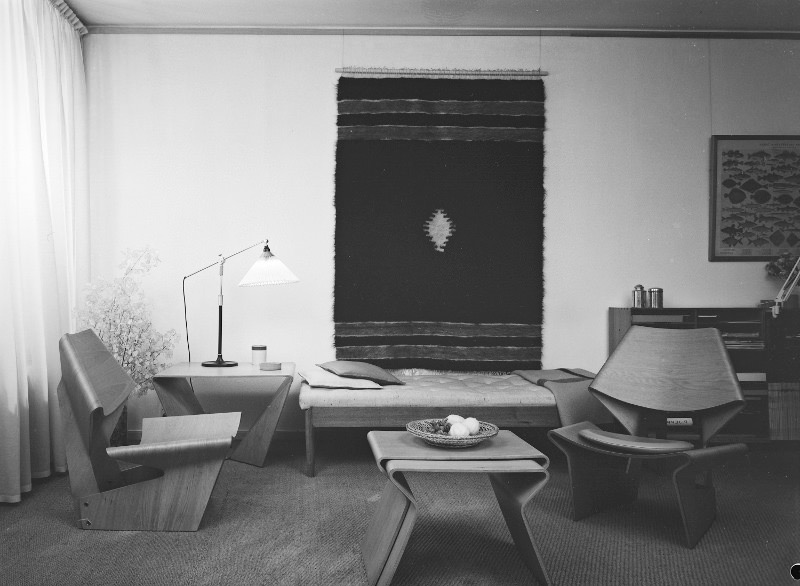
As a true student of Kaare Klint, Jalk’s designs were at first largely concerned with the reworking of traditional furniture designs and anthropometrics. It was a rational design approach combined with traditional craft skills. Jalk’s work was highly praised, and quickly she was widely respected for her furniture’s distinctive feminine lining and elegant hidden joints. Soon her designs were being produced by leading manufacturers such as Henning Jensen, Poul Jeppesen and Fritz Hansen. By the 1960s Jalk had developed her own distinctive style and unlike other students of Klint, she gradually abandoned the anthropometrics style. This led to a new, consciously modern style that reflected the era and social changes.
While Jalk’s work was acclaimed, most of her designs were only produced in limited numbers, likely because of the relative unpopularity of plywood furniture that was favoured by Jalk. During the 1960s Jalk created several sets for the new modern home, with the goal to design furniture that could create completely unique spaces and environments in tune with the needs of its inhabitants. Her 1963 "Watch and Listen" living room unit was designed with the concept of making the television the centrepiece of the room and had space for an elaborate home entertainment system. Despite placing modern life at the heart of her work, Jalk continued to use traditional craftwork and regularly worked with traditional Danish cabinetmakers.
Later in life, Jalk became a jury member of the prestigious ID prize and expanded into the design of exhibitions, including travelling exhibitions for the Danish Ministry of Foreign Affairs. From the 1960s, she did much to enhance Denmark's reputation for modern furniture design with her clear, comfortable lines. She also edited the Danish magazine Mobilia, and compiled a four-volume work on Danish furniture. Grete Jalk was bold and experimental with new and innovative ways of using materials and forms. Her honesty and genuine interest in quality and experimental design has made her a Danish design icon. ~H.
Summary Block