
Guillerme et Chambron Sculpted Oak Lounge Chair for Votre Maison, France 1950s (sold)


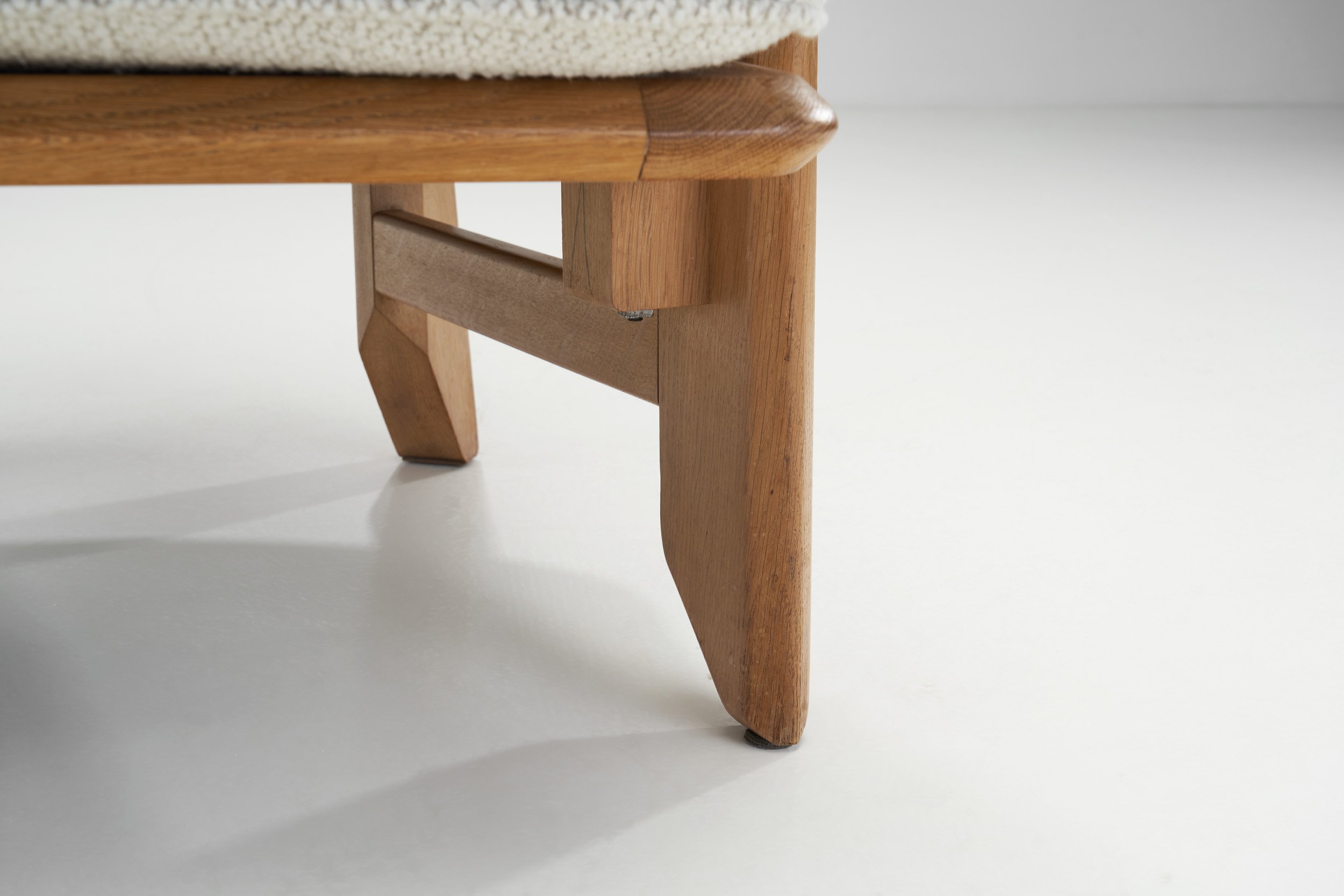


Guillerme et Chambron Sculpted Oak Lounge Chair for Votre Maison, France 1950s (sold)
The collaboration of Robert Guillerme and Jacques Chambron was destined to be as influential as prolific. As this lounge chair testifies, Votre Maison - the duo’s own company - left an indelible stamp on the design of the 1950s, 60s and 70s as a result of the visual and material quality and distinctiveness of their designs.
This lounge chair has an open oaken construction, featuring masterfully crafted curved and diagonal lines. As this model’s features show, the designers’ focus was as keenly attuned to functionality — furniture’s use in daily life — as to the creation of innovative design. From the duo’s trademark oak frame to the sculptural legs, arms and backrest, this model is characteristic of the designers’ unique style, while also featuring details that are one-of-a-kind. Such a detail is the back that is composed of sculpted oak slats. Uniquely, the back is unattached to the body apart from the seat. The freely standing back is therefore very apparent, even among the numerous other design elements. One such design element is legs’ construction with sharp as well as rounded edges arranged in a sharp angle. Much like the back, the arms are also unattached to the body apart from the seat, which contributes to the airy, sculptural look that defines this lounge chair. To deserve its title, this model is excellent for lounging as its back is slightly reclined and like the seat, is covered by a thick, upholstered cushion. The bouclé’s texture stands out next to the smooth surface of the oak.
Not only did Votre Maison produce over two thousand models during the latter half of the twentieth century, its output also served as a model for a vast field of liveable contemporaneous design. This steady output of beautiful furniture bucked convention not merely in the equal emphasis Guillerme placed on function and aesthetics, but in the almost paradoxical creation of a consistent style that was as staid as it was arresting.
SOLD
Condition:
In good vintage condition. Wear consistent with age and use. The chair has been reupholstered recently in a premium bouclé
fabric.
Dimensions:
28.93 in W x 32.67 in D x 36.22 in H; Seat height 16.53 in
73.5 cm W x 83 cm D x 92 cm H; Seat height 42 cm
About the Designer:
Robert Guillerme graduated in 1934 from the École Boulle where he excelled in architecture and furniture design. After the Second World War he moved to Lille, in the north of France, where he decorated homes and designed furniture for the well regarded Rogier workshops.
In 1948, Guillerme was joined by his long-time friend, decorator Jacques Chambron in Lille. The following year Guillerme and Chambron met master cabinetmaker Émile Dariosecq, owner of a woodworking shop and the company Votre Maison was born. Together, they defined and imposed a new furniture concept. Thanks to their distinctive creativity, originality, and quality, the Votre Maison quickly became well-known.
The Votre Maison marked the history of French design. Guillerme drew the furniture designs while Chambron played the part of salesman, welcoming and advising clients. The power duo was complemented by Dariosecq, whose workshop took charge of the manufacturing. Together, they defined new furnishings concepts. Well-crafted chair back, polished wood and thick cushions make the reputation of their armchairs and sofas. Votre Maison continued to produce furniture right into the 20th century, with Jacques’s son Hervé Chambron, a designer and graduate of the École Boulle, having taken the over in 1983. ~H.
REQUEST PRICE HERE
Price category: 7,500 - 10,000 usd / eur
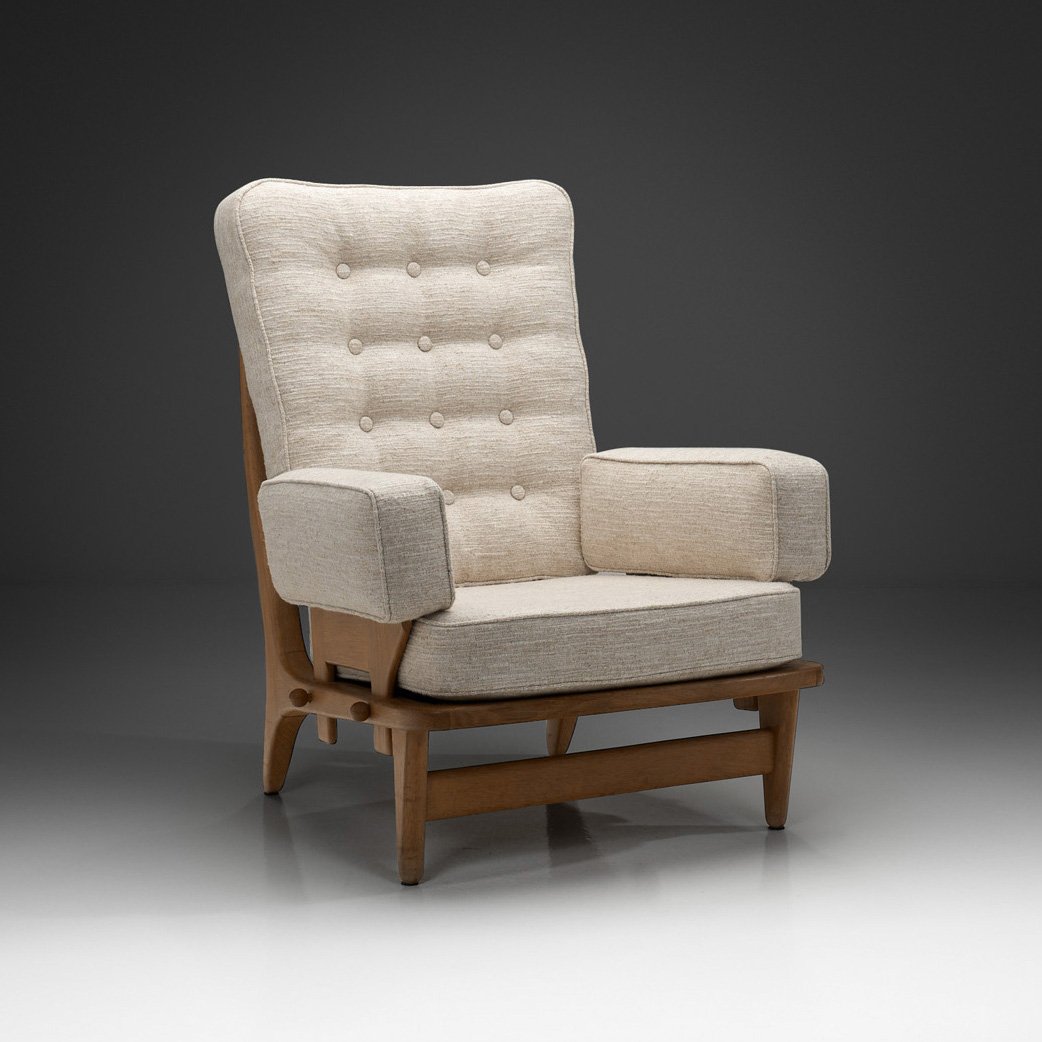
This stunning armchair, designed by the renowned French duo Guillerme et Chambron, showcases an exquisite blend of elegant aesthetics and rustic design elements. Crafted in the mid-20th century by Votre Maison, the model reminds us how form and elegance blend together in the duo's exceptional distinctive craftsmanship style.
The solid oak wood frame provides a sturdy yet elegant structure, showcasing the beautiful material. The sculptural form allows for a dynamic visual movement between the different accents of this model. The back is composed of seven oak spindles, standing detached from the arms. The armrests are carved with great precision to serve a double purpose: an aesthetic role, and a functional one thanks to the cushioning. The frame is striking through its composition, yet the look is enhanced even further thanks to the upholstered cushions, which immediately draw the eye with their playful geometry. Like most of their designs, this chair model displays a beautiful contrast between the wooden frame and the elegant light fabric. The material is not only visually appealing but also selected for its comfort and durability, ensuring that the chair is as practical as it is beautiful. This model also shows how Guillerme et Chambron pieces possess an unusual flare.
Guillerme et Chambron’s work not only represents the fusion of function and form, but also exemplifies the mid-century modern and brutalist aesthetic - which they played a pivotal role in shaping. Their emphasis on quality craftsmanship and the use of noble materials like oak has undeniably left a lasting imprint in the world of furniture making, solidifying their legacy in the French design landscape during the mid-century era.
Condition:
In good vintage condition. Wear consistent with age and use. The item has been reconditioned. Due to the nature of the materials, the item may have some marks, scratches, and discolouration. The chair has recently been reupholstered in a premium fabric. Each of our items can be reupholstered by our in-house atelier in a fabric of choice. Please reach out for more information.
Dimensions:
29.92 in W x 35.03 in D x 37.79 in H; Seat height 15.35 in; Seat depth 20.86 in; Arm height 22.24 in
76 cm W x 89 cm D x 96 cm H; Seat height 39 cm; Seat depth 53 cm; Arm height 56.5 cm
REQUEST PRICE HERE
Price category: 2,500 - 5,000 usd / eur
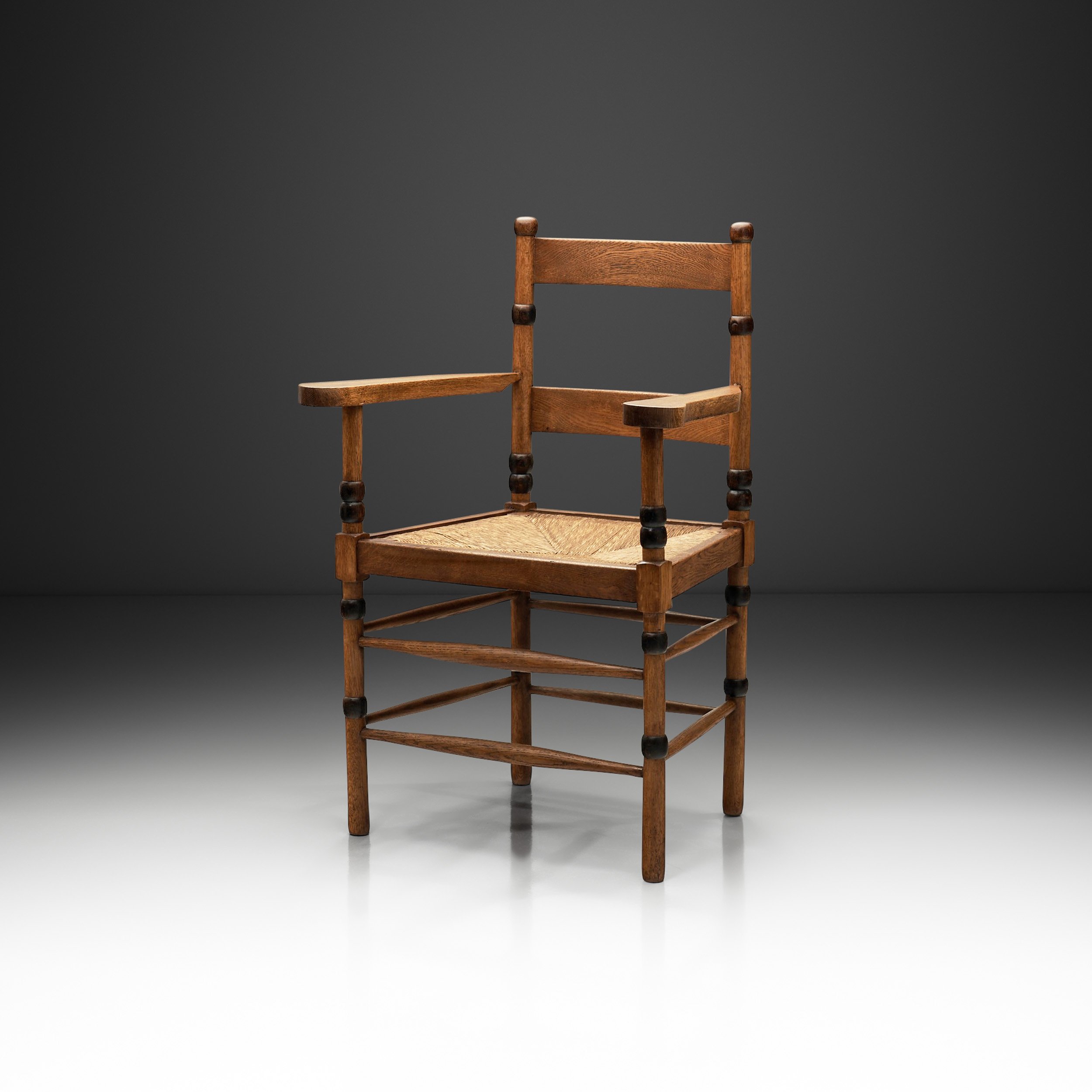
The Amsterdamse School movement arose in response to the influence of Art Nouveau and Jugendstil in the late 19th and early 20th centuries. This movement, which took root in Amsterdam, sought to create a uniquely Dutch style that embraced traditional craftsmanship and celebrated the spirit of the current times. The Amsterdamse School extended its influence across various artistic disciplines, including architecture, decorative arts, and furniture design.
The styles’ main characteristics are reflected in the design of this chair beautifully: expressive, art deco-reminiscent, and functional. Amsterdamse School furniture is renowned for its sculptural qualities. Designers like Jac Levee sought to integrate form and functionality seamlessly, resulting in furniture pieces that were not only visually striking but also practical. The craftsmanship of Amsterdamse School furniture is exemplified by its intricate woodwork and joinery. Pieces often showcased decorative detailing through carvings, inlays, and geometric patterns. These elements add a touch of individuality and artistry to a piece, setting them apart from the mass-produced furniture of the time. In this chair, the backrest’s clean, symmetrical lines reflect the simple, yet sophisticated aesthetics of the era. The use of black round accents not only adds an element of visual interest to the design, but also serve to reinforce the structure and enhance the overall strength. To further add to the charm of the piece, the woven seat, made from durable natural fibres, highlights the attention to both function and form, by creating visual and textural interest. The beautifully symmetrical pattern showcases the timeless artistry of artisanal furniture.
Whether placed in a farmhouse or used to add an organic element to a modern interior, this chair provides both history and utility. More than just functional seating, this chair represents a moment in design history where furniture was built to last, to be used daily, and to shape the atmosphere of a room.
Condition:
In good vintage condition. Wear consistent with age and use. The chair has recently been reconditioned. Minor scratches and discolouration. Due to the nature of the wood, the item may have some additional marks.
Dimensions:
25.59 in W x 20.86 in D x 37.40 in H; Seat height 18.50 in; Seat depth 16.92 in; Arm height 28.14 in
65 cm W x 53 cm D x 95 cm H; Seat height 47 cm; Seat depth 43 cm; Arm height 71.5 cm
REQUEST PRICE HERE
Price category: 5,000 - 7,500 usd / eur
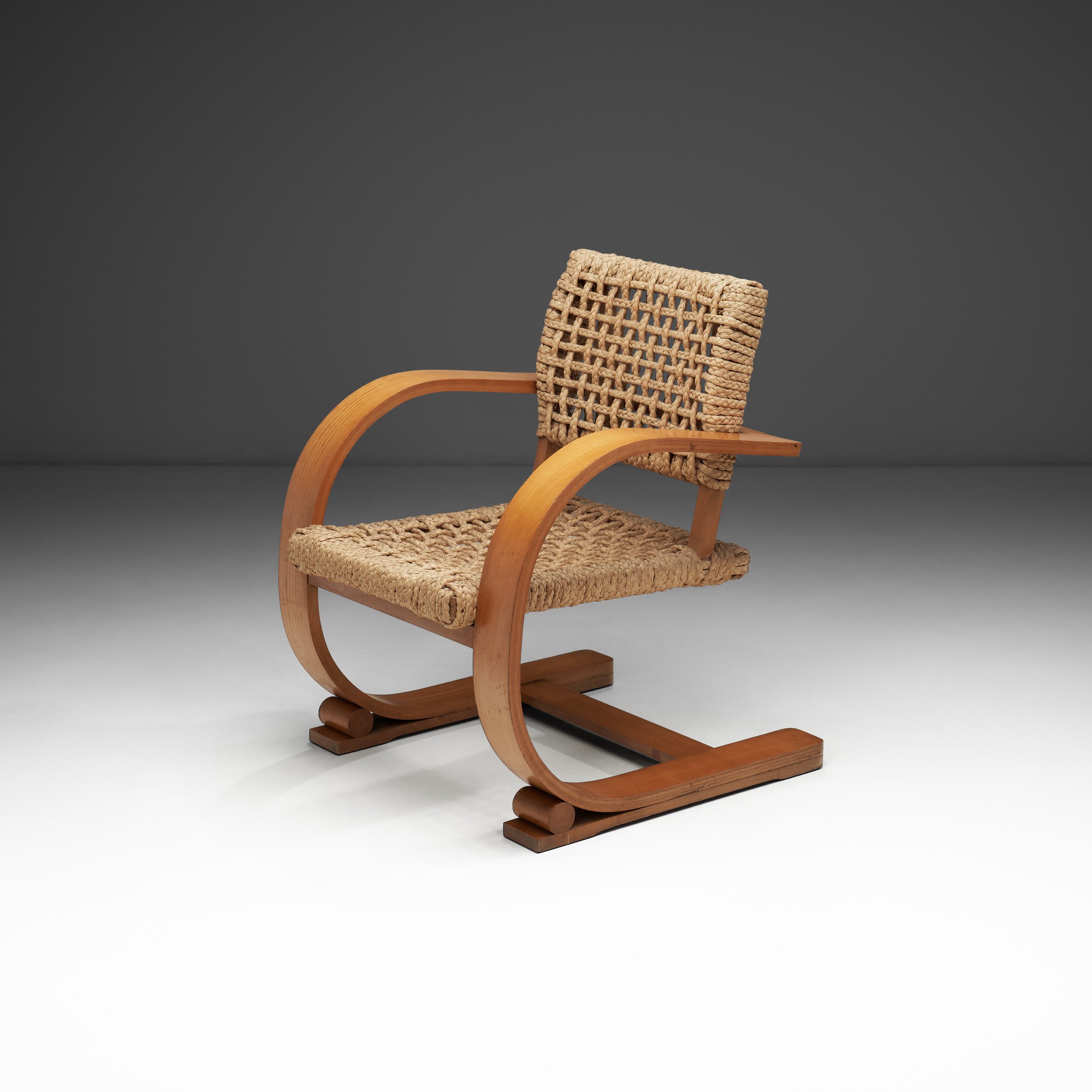
This armchair is a compelling embodiment of the French design duo Adrien Audoux and Frida Minet. Their design philosophy was centered around a commitment to accessible furnishing made out of natural materials that suit the rhythms of modern life. Active in mid-20th century France, they played a crucial role in shaping post-war design. Drawing inspiration from modernist movements, they steered the view of design towards a more functional, refined, and streamlined aesthetic.
This chair showcases excellent craftsmanship, care, and precision, visible in the smallest details of the design. The woven seat and backrest, composed of finely braided natural fibres, offer both support and comfort, gently adapting to the shape of the body for a relaxed resting experience. Unlike most chairs, this unique design does not utilise the typical four legs - instead, the structure flows seamlessly into a wide curve that comprises the frame and is the visual highlight of the chair’s form. The armrests appear to be curving down and back in two smooth lines, partially creating a supporting base. The structure of the base is further enforced by a stretcher between the two pieces of bentwood, enhancing stability. Another interesting design detail are the cylinder supports at the front where the arms and base meet, which act as a reinforcement while still maintaining harmony with the rest of the piece. This clever element helps to create a scooped base that supports the entire seat. The bent wood creates a fluid connection, giving the seat a sense of suspension - a light, almost floating presence - with the open surface of the seating and back further enhancing the airy characteristic of the armchair. Though the back rail is a separate piece between the two large curved elements it visually continues the line of the arms, creating the sense of a frame that gracefully encloses the seat.
The impressive silhouette of the armchair is defined by the choice of solid bentwood and woven rope as materials, and techniques that require expert skill, all poured into the final result to create this graceful form. The timeless appeal of this piece complements a wide range of interior styles, capable of transforming any environment with its organic appearance in both form and medium.
Condition:
In good vintage condition. Wear consistent with age and use.
Dimensions:
25 in W x 27.55 in D x 31.88 in H; Seat height 16.14 in
63.5 cm W x 70 cm D x 81 cm H; Seat height 41 cm
REQUEST PRICE HERE
Price category: 7,500 - 10,000 usd / eur
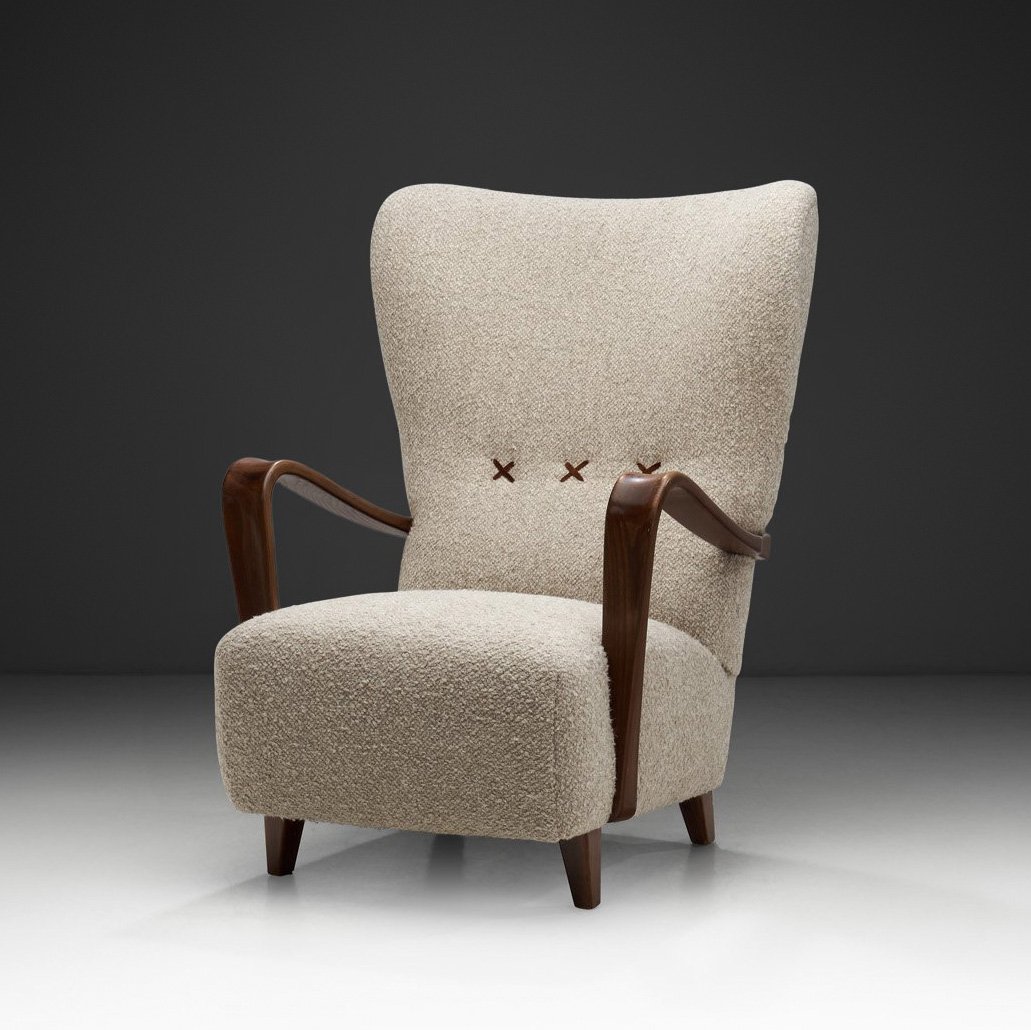
In Sweden, “svensk design” in particular operates as a set of relations linking objects, spaces, people to the cultural ideologies that motivate the persistence of a social democratically infused “way of life.” Thanks to this sentiment, the cabinetmaker of this chair put an emphasis on soft elegance and functionality, making it timeless in every sense of the word.
The Swedish design movement has exercised a wide influence on modern architecture and interior furnishings internationally since the early twentieth century. As this beautiful high-back lounge chair shows, early mid-century modern designers and cabinetmakers not only prioritised outstanding craftsmanship, but also an aesthetic quality that honours the materials and their users alike. Swedish proponents of modern design ideals were able to cultivate their principles in a climate of relative calm with the long-term persistence of crafts traditions being especially formative. This craftsmanship is apparent in this lounge chair with a sinuous body that is as artistic as it is functional. The main principles of Swedish Modernism centre around minimalism, simplicity, and functionalism. This chair achieves to follow these principles while offering plenty of visually arresting qualities, including the high, curved back and exposed, sculptural arms that claw into the upholstery. The rich texture of the bouclé fabric accentuates the expressive shape of the frame that praises the maker’s sense of proportions. The short wood legs don’t take away from the robust, cosy appearance, instead they keep the design grounded and perfectly stable while also providing contrast with the beautiful colour. The expert Swedish craftsmanship is clearly visible throughout this piece, with impeccable woodworking and construction.
This beautiful, inviting lounge chair lives up to its Swedish heritage both in terms of visual and material quality. While its aesthetic is clean and functional, it has an eye-catching look with luxurious upholstery and cross stitches that make it an ideal accent piece as well.
Condition:
In good vintage condition. Wear consistent with age and use. Due to the nature and age of the materials, the item may have some mark, scratches, and discolouration. The chair has been reupholstered recently in a premium bouclé fabric. Each of our items can be re-upholstered by our in-house atelier in a fabric of choice. Please reach out for more information.
Dimensions:
29.13 in W x 37.79 in D x 39.96 in H; Seat height 14.76 in; Arm height 24.21 in
74 cm W x 96 cm D x 101.5 cm H; Seat height 37.5 cm; Arm height 61.5 cm
REQUEST PRICE HERE
Price category: 5,000 - 7,500 usd / eur
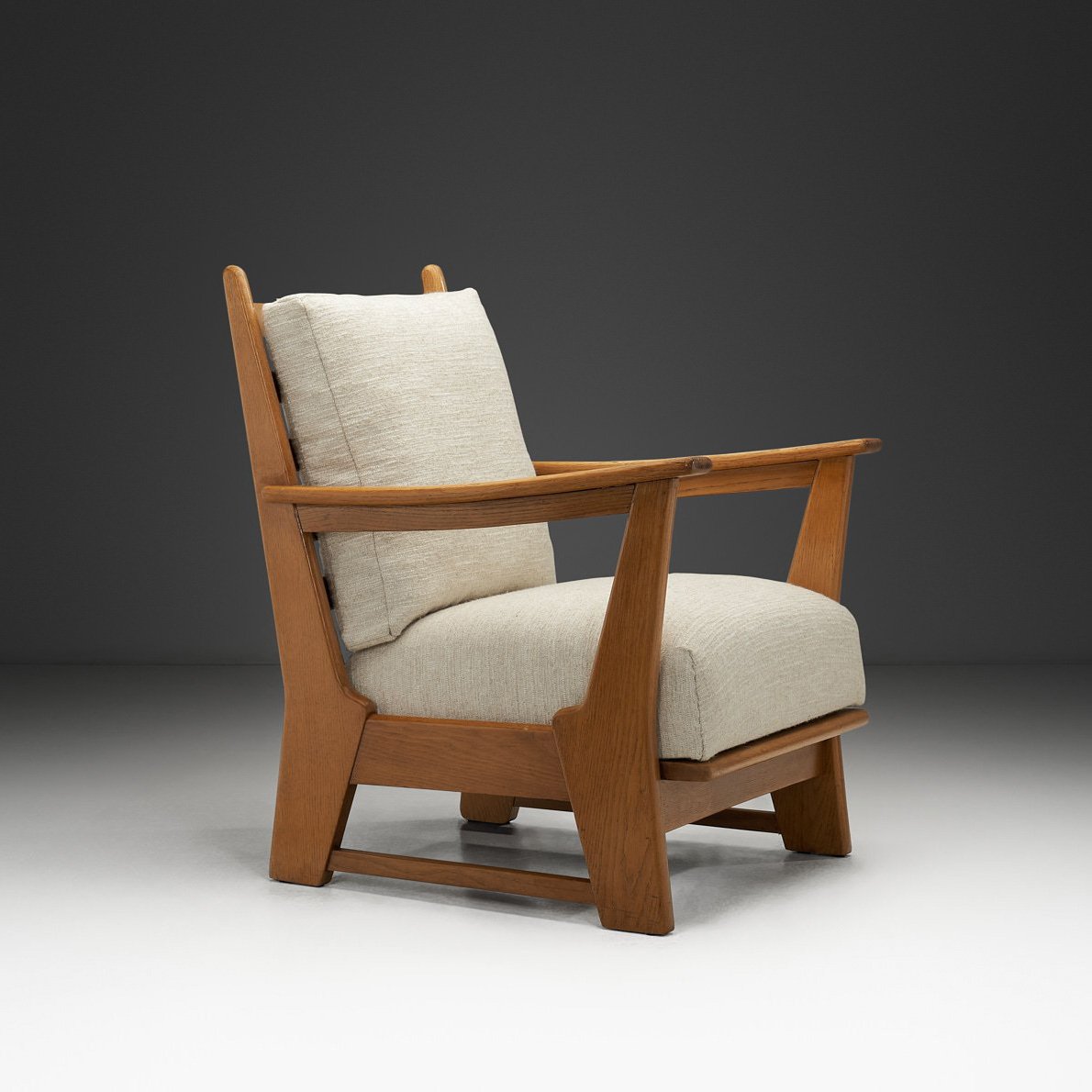
Bas Van Pelt (1900-1945) was a well-known Dutch interior and furniture designer, known for the clarity and quality of his designs. His works created in the 1930s are regarded for their progressive design and quality.
While Bas Van Pelt's creative work was primarily influenced by the 1920s’ straight lines dominated by The Hague School, this armchair is the result of his more mature design era, which was primarily dominated by natural materials and more curvature. While made of solid oak, this armchair has an open feel to it. The arms and backrests showcase a sense of airiness, highlighted by the slats on the back. This neat detail accentuates the high level of woodworking and creates an effortless look. The arms’ angles are slightly inclined, resulting in a harmonious look while also being ergonomic, with solid support for the spine. The sitting comfort is pleasant, aided by the upholstered cushions. The textured upholstery of the seat and back cushion beautifully complements the frame. The chair embodies comfort and cosiness through the mix of proportions and expertly selected materials. The rich shade of the wood pairs perfectly with the cream upholstery.
Haagse School furniture wasn’t flashy but instead focused on being well-made and to fit a warm, comfortable and welcoming home. As this chair exemplifies, blending functionality, good quality natural materials and organic colours with excellent craftsmanship is the key to the success of this design period.
Condition:
In good vintage condition. Wear consistent with age and use. Due to the nature and age of the wood, the chair may have minor marks, scratches, and discolouration. The chair has been reupholstered recently in a premium fabric. Each of our items can be reupholstered by our in-house atelier in a fabric of choice. Please reach out for more information.
Dimensions:
25.59 in W x 29.92 in D x 34.25 in H; Seat height 17.32 in; Seat depth 17.71 in; Arm height 24.40 in
65 cm W x 76 cm D x 87 cm H; Seat height 44 cm; Seat depth 45 cm; Arm height 62 cm
REQUEST PRICE HERE
Price category: 5,000 - 7,500 usd / eur
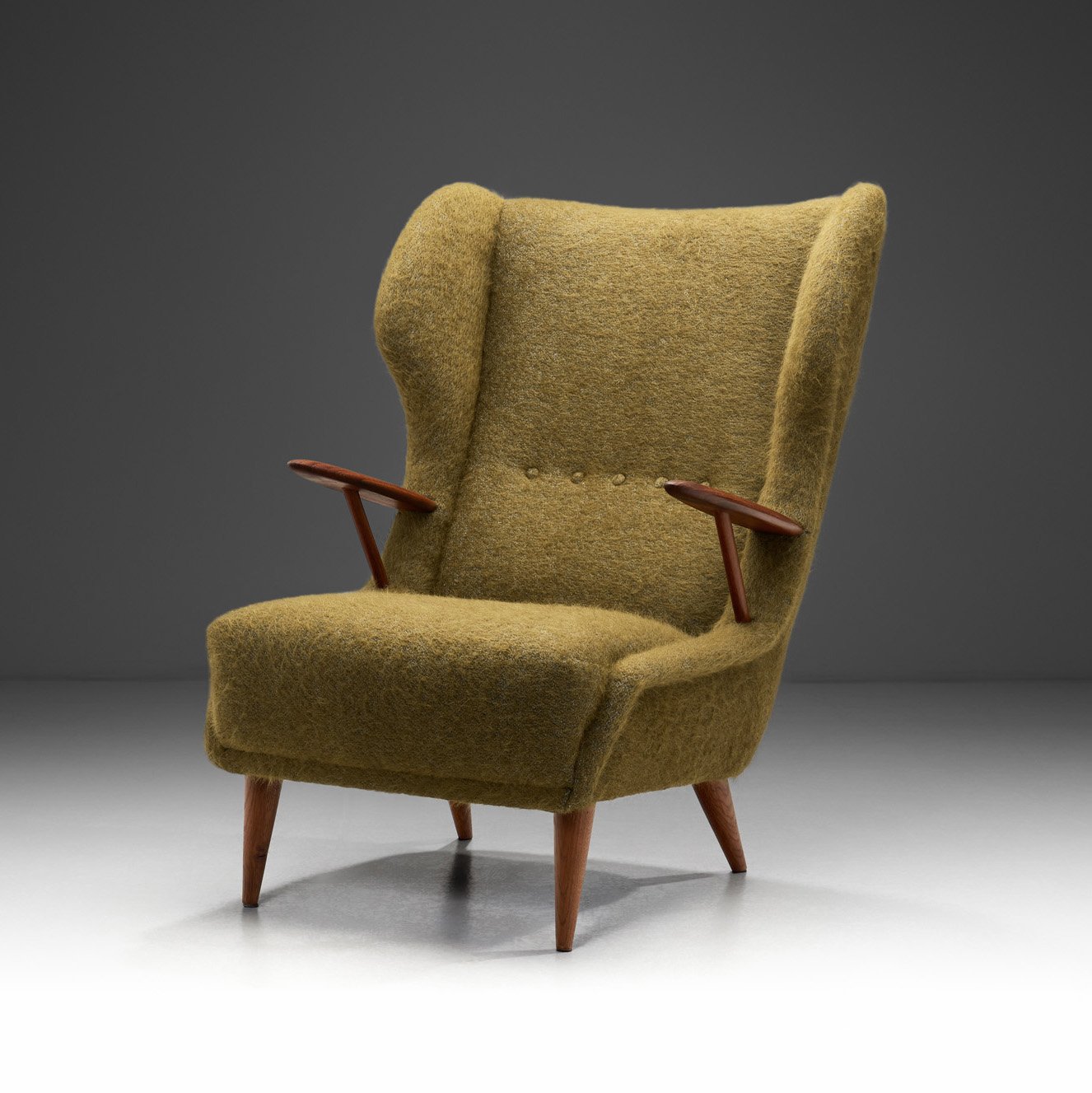
During the 1950s, Danish designers led the way in furniture design, with Danish mid-century seating pieces to this day being some of the most iconic of their time.
This armchair embodies the characteristics and ethos of its period. Georg Thams designed this chair in line with his minimalistic, yet functional style for Danish manufacturer Vejen Polstermøbelfabrik, showcasing attention to detail through qualities such as the shape and mix of materials used in the construction. Oak and teak wood are amongst the most durable and naturally beautiful choices of material, making this armchair into a long-lasting and classically elegant piece. Originally, wingback chairs were designed to protect occupants from drafts and offer a touch of privacy, and have since become synonymous with comfort and timeless style. The traditional wingback design is reinterpreted in the mid-century fashion of this piece, moving from the classic rounded and closed structure to a more modern silhouette. The curved sides of the chair maintain their winged look, while the teak armrests feature an open construction. The high, curved back of this piece ensures comfort, transforming the chair into a statement piece of decor with additional subtle details such as the five tufted buttons placed horizontally on the backrest. The brown tones of the angled teak arms and tapered oak legs combine with the soft green coloured upholstery to give the piece a natural, earthy feel.
The quality materials of this armchair ensure durability, while the shape intertwines the traditional design with a quintessential Danish mid-century touch. The beauty of this piece is evident through both its form and function, making it a great addition to a modern interior.
Condition:
In good vintage condition. Wear consistent with age and use. This chair has been reupholstered recently in a premium fabric. Each of our items can be re-upholstered by our in-house atelier in a fabric of choice. Please reach out for more information.
Dimensions:
30.31 in W x 37.80 in D x 39.37 in H; Seat height 17.12 in; Seat depth 21.26 in; Arm height 23.42 in
77 cm W x 96 cm D x 100 cm H; Seat height 43.5 cm; Seat depth 54 cm; Arm height 59.5 cm
Literature:
Mobilia no. 2, February 1956, p. 10, in the advertisement.
REQUEST PRICE HERE
Price category: 12,500 - 15,000 usd / eur
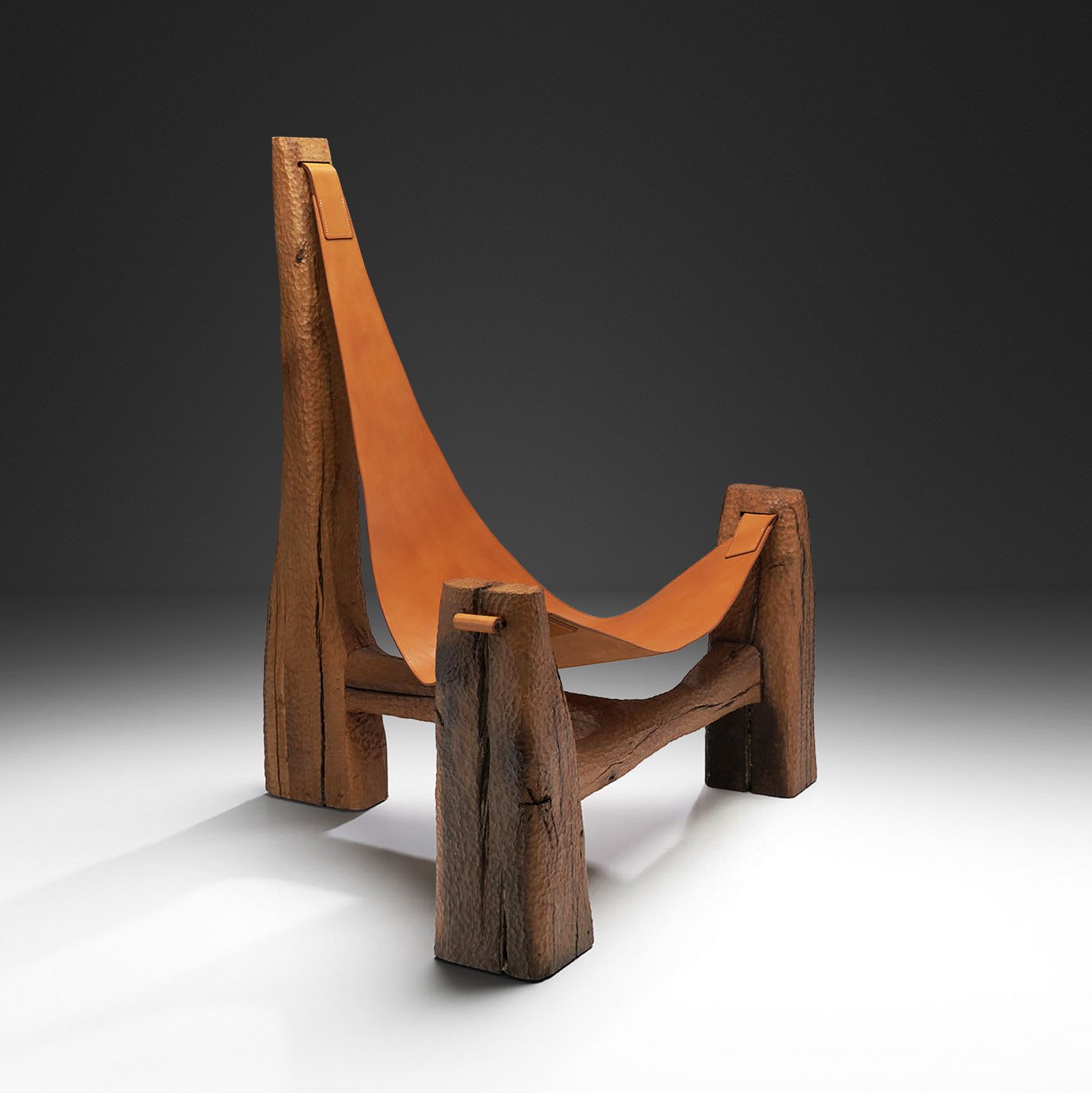
Generally, Czech mid-century modern designs tend to be more sober than their French, German, American, and even Scandinavian counterparts. However, works by Pavel Novak are an exception - as evidenced by chair. The Czech designer’s repertoire is finally starting to surface, and as this chair shows, we are lucky to witness it.
Novak often worked with a gouge, that originally never had any other vocation than to furnish his farm. This piece is made of hand gouged oak, which is in itself a time-consuming and rare woodcarving technique. While most woodworkers offer help with fixing gouges in wood, Novak used the technique to create this rustic looking body that can be considered to be a functional sculpture. Thanks to the unique, hand-carved texture, the lounge chair is one of a kind, with a unique pattern. The leather seat is suspended between the three legs, one of which is elongated to serve as a backrest. The joinery technique is seamless and shows the outstanding craftsmanship and vision of Novak. The leather straps are inset into the legs in a rough, yet sophisticated way.
In fact, rough yet sophisticated are the adjectives that best define the overall aesthetic of this chair, reflected in the pairing of the materials as well. The patinated leather’s smooth surface contrasts beautifully with the gouged, coarse look of the oak. With its straightforward design, this oiece is a seminal work of Pavel Novak.
Condition:
In good vintage condition. Wear consistent with age and use. Some minor cracks. Due to the nature and age of the materials, the chair may have some marks, scratches, and discolouration.
Dimensions:
40.94 in W x 30.71 in D x 48.82 in H; Seat depth 20.08 in
104 cm W x 78 cm D x 124 cm H; Seat height 51 cm
REQUEST PRICE HERE
Price category: 5,000 - 7,500 usd / eur
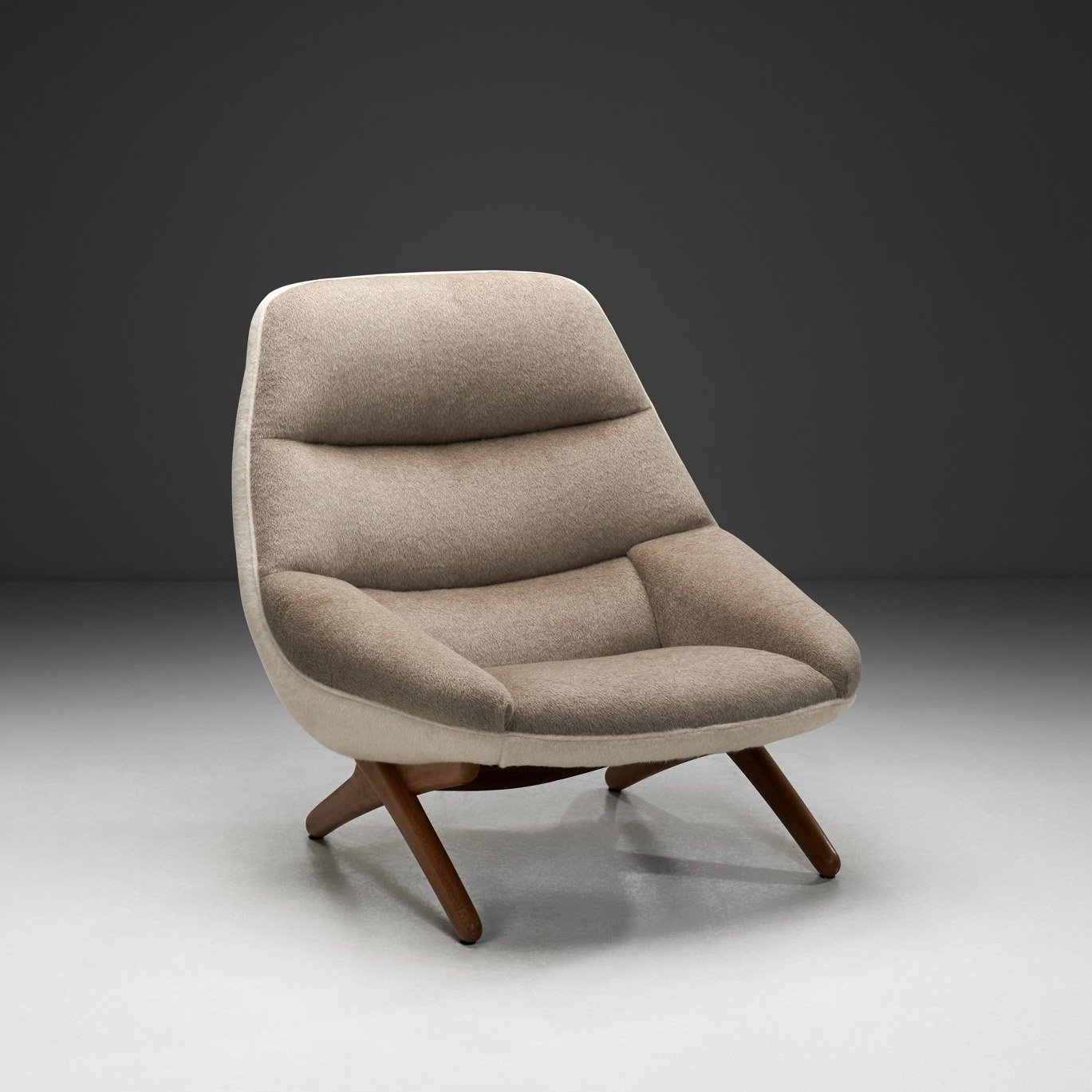
Danish designer Illum Wikkelsø believed that furniture should be built to last, to indulge the body, and to please the eye. He belonged to a group of cabinetmakers who represented the Golden Age of Danish design during the 1950s and 1960s. With his clear design aesthetic and deep understanding of materials, he was one of the key protagonists in making Danish design style an international phenomenon.
The model “ML 91" effortlessly combines function and aesthetic, keeping the form in service of the user while maintaining an elegant and modern look. The union of the shell-shaped, upholstered body and the crossed wooden legs create a timeless form. While the design is organic and not broken by any heavy ornamentation, the beautifully textured upholstery is utilised to highlight the modern and cosy shape of the piece. This lounge chair also embodies the concept of "hygge," a Danish term that refers to a sense of cosiness, comfort, and well-being. The chair's form promotes relaxation and contentment, inviting one to sit back and enjoy a moment of peace. Its understated elegance creates an alluring atmosphere, making it a perfect piece for the purpose of evoking a hyggelig (cosy) environment in any home.
The Danish modern movement, rooted in the mid-20th century, was not a fleeting trend but a lasting shift in design philosophy. Its principles, grounded in simplicity, functionality, and a deep appreciation for natural elements, have not only withstood the test of time but have become foundational for many contemporary design approaches.
Condition:
In good vintage condition. Wear consistent with age and use. Due to the nature of the wood, the frame of the chair may have some marks, scratches, and discolouration. The chair has recently been reconditioned and reupholstered in a premium fabric. Each of our items can be reupholstered by our in-house atelier in a fabric of choice. Please reach out for more information.
Dimensions:
35.82 in W x 34.25 in D x 35.43 in H; Seat height 15.55 in; Seat depth 20.07 in
91 cm W x 87 cm D x 90 cm H; Seat height 39.5 cm; Seat depth 51 cm
REQUEST PRICE HERE
Price category: 2,500 - 5,000 usd / eur
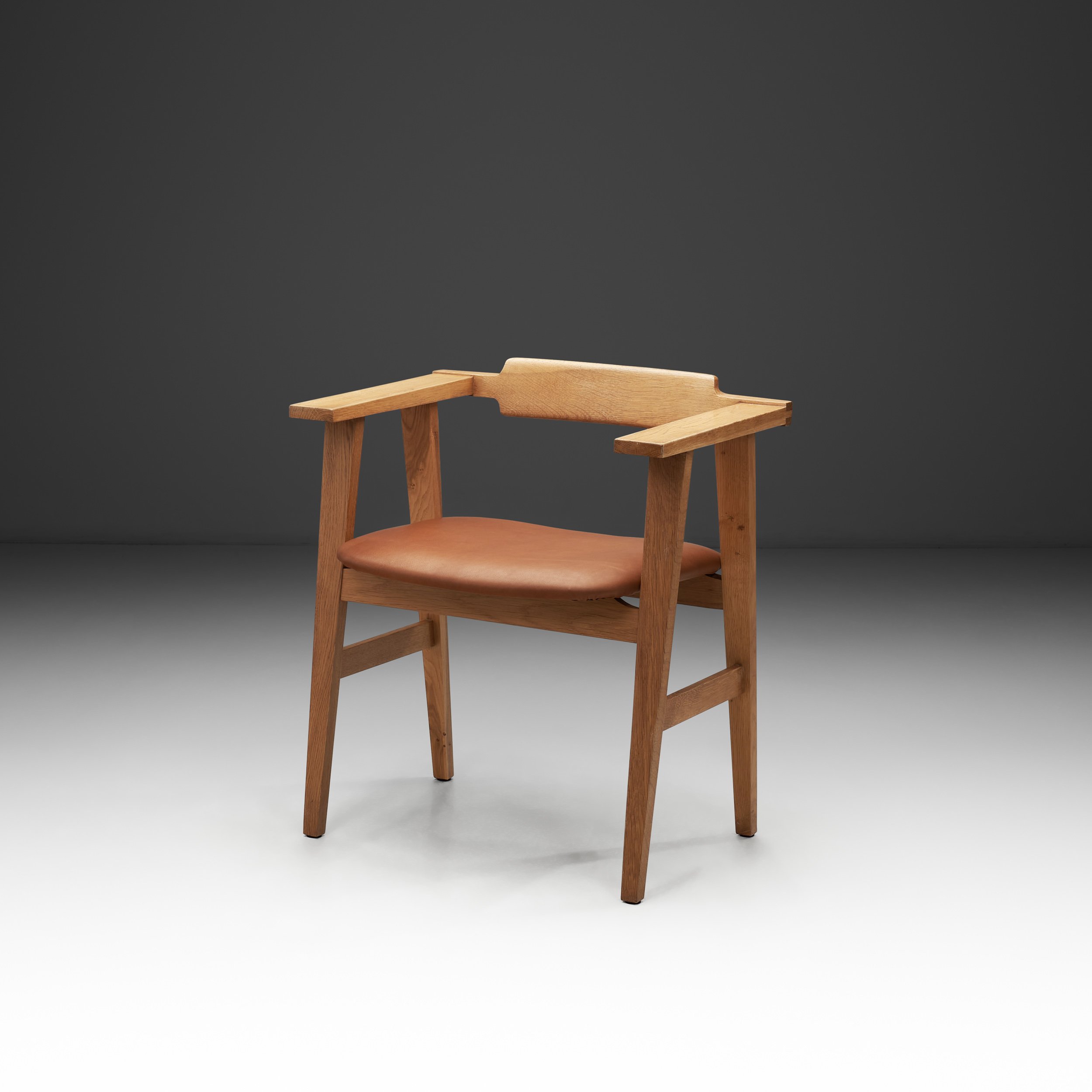
Saying mid-century modernism had a revival would be a serious understatement. In reality, the designs have never gone out of style completely, especially in Scandinavia. Danish cabinetmaker pieces are timeless thanks to their expert craftsmanship, their visual, and the material quality. This armchair showcases this timelessness with its modern form.
This elegantly constructed chair combines comfort with style. From as early as the 1920s, cabinetmakers and architects frequently collaborated to produce exceptional pieces like this. The chairs’ elegant curves, precise angles and structure all testify of this partnership’s success. Thanks to its low back the design appears very grounded. With straight and curving lines following each other, the model has a dynamism rooted in organicity. Unlike pieces from outside the continent, Danish designers’ products weren’t flashy but rather well-made to fit a warm, comfortable and welcoming home. As this armchair exemplifies, blending functionality, good quality natural materials and organic colours with excellent craftsmanship is the key to the success of mid-century modernism. As an object, the chair reflects the mid-20th century Danish pursuit of everyday beauty, objects designed not just to serve, but to enrich domestic environments.
The classic charm and versatility of this design allows it to be used as a desk chair, an occasional piece in a curated corner, or part of a formal dining set, this chair can bring quiet sophistication to any setting. It is an ideal choice for a range of interior styles thanks to its thoughtful materials, and subtle craftsmanship.
Condition:
In good vintage condition. Wear consistent with age and use. Due to the nature and age of the materials, the chair may have some marks, scratches, and discolouration. The chair has recently been reconditioned and reupholstered in premium leather. Each of our items can be reupholstered by our in-house atelier in a fabric of choice. Please reach out for more information.
Dimensions:
25.19 in W x 18.89 in D x 28.14 in H; Seat height 19.09 in; Seat depth 17.32 in; Arm height 26.57 in
64 cm W x 48 cm D x 71.5 cm H; Seat height 48.5 cm; Seat depth 44 cm; Arm height 67.5 cm
REQUEST PRICE HERE
Price category: 2,500 - 5,000 usd / eur
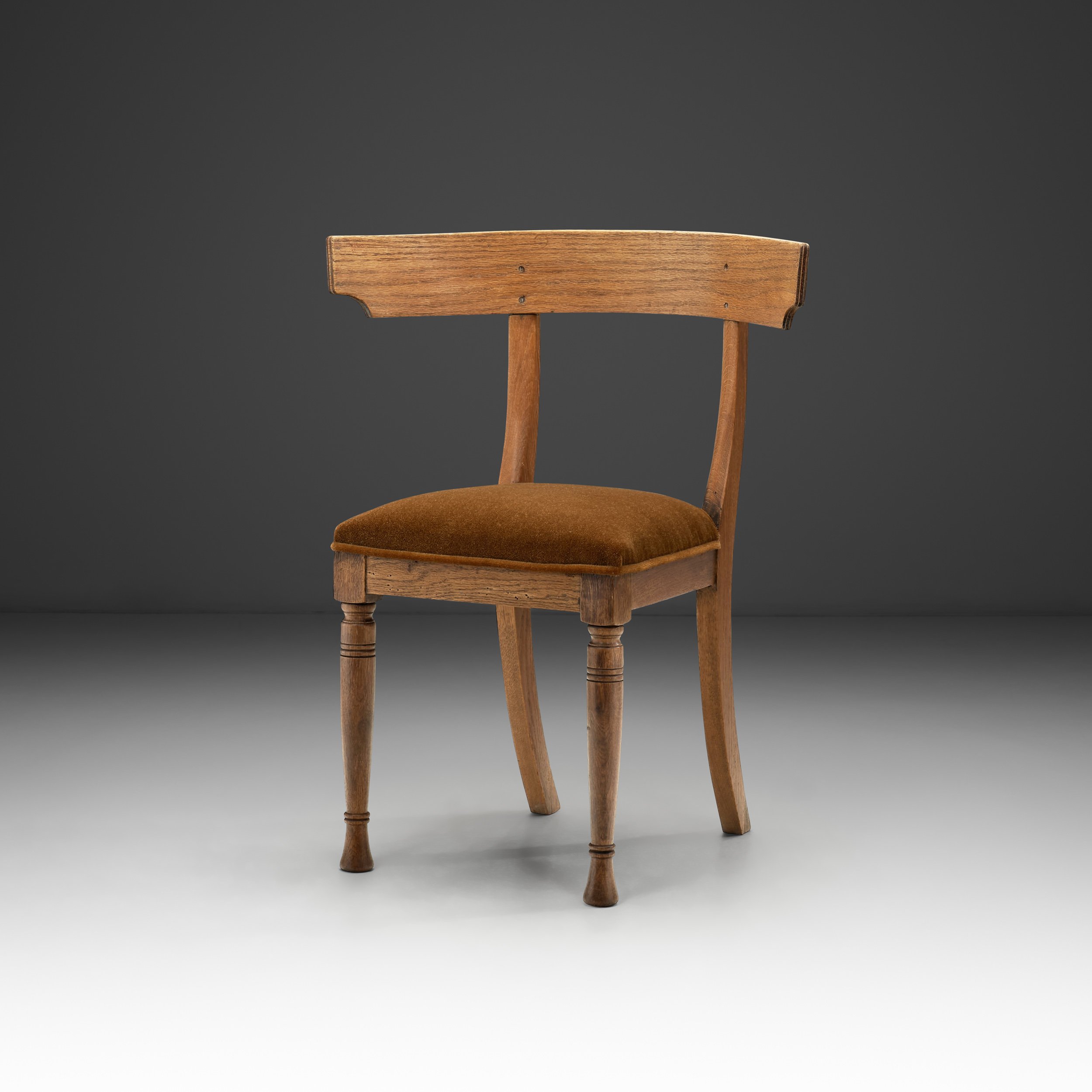
While the Klismos chair model originated in ancient Greece, the style made its way throughout the globe, being revived in several design movements and eras. This particular Klismos-inspired chair is a beautiful reflection of the Nordic interpretation of the ancient Greek form.
This chair model boasts a functional, well-thought-out structure, crafted from quality materials. The openness of the piece is highlighted by the frame, which is quite distinctive; the wide backrest shows an interesting curvature that is characteristic of the Klismos style. The back legs also retain the design’s distinctive stance - splayed and curved. The upholstered seat, designed for comfort, is finished in a warm, earthy fabric that complements the natural wood tones, emphasizing the organic and utilitarian principles of the early 20th-century era. Chairs from this period also often appeared as accent pieces, however, thanks to their blend of neoclassical influences and Scandinavian restraint, they became versatile enough with their timeless appeal to stand out. This chair’s simple yet refined structure allows it to integrate into various interior styles, from vintage-inspired rooms to more contemporary settings, where it adds a touch of old-world charm.
The Danish design idiom was centred on warm woods, quality fabrics, and gentle yet robust support for the spine - qualities that engender contentment and well-being, a defining characteristic of Danish culture. These aspects are evident in this chair, allowing the piece to be extremely modest and confident at the same time.
Condition:
In good vintage condition. Wear consistent with age and use. The chair has been reconditioned. Due to the nature and age of the wood, the frame may have some marks, scratches, and discolouration. The seat has recently been reupholstered in a premium fabric. Each of our items can be reupholstered by our in-house atelier in a fabric of choice. Please reach out for more information.
Dimensions:
28.54 in W x 19.29 in D x 32.87 in H; Seat height 19.68 in; Seat depth 16.33 in
72.5 cm W x 49 cm D x 83.5 cm H; Seat height 50 cm; Seat depth 41.5 cm
REQUEST PRICE HERE
Price category: 2,500 - 5,000 usd / eur
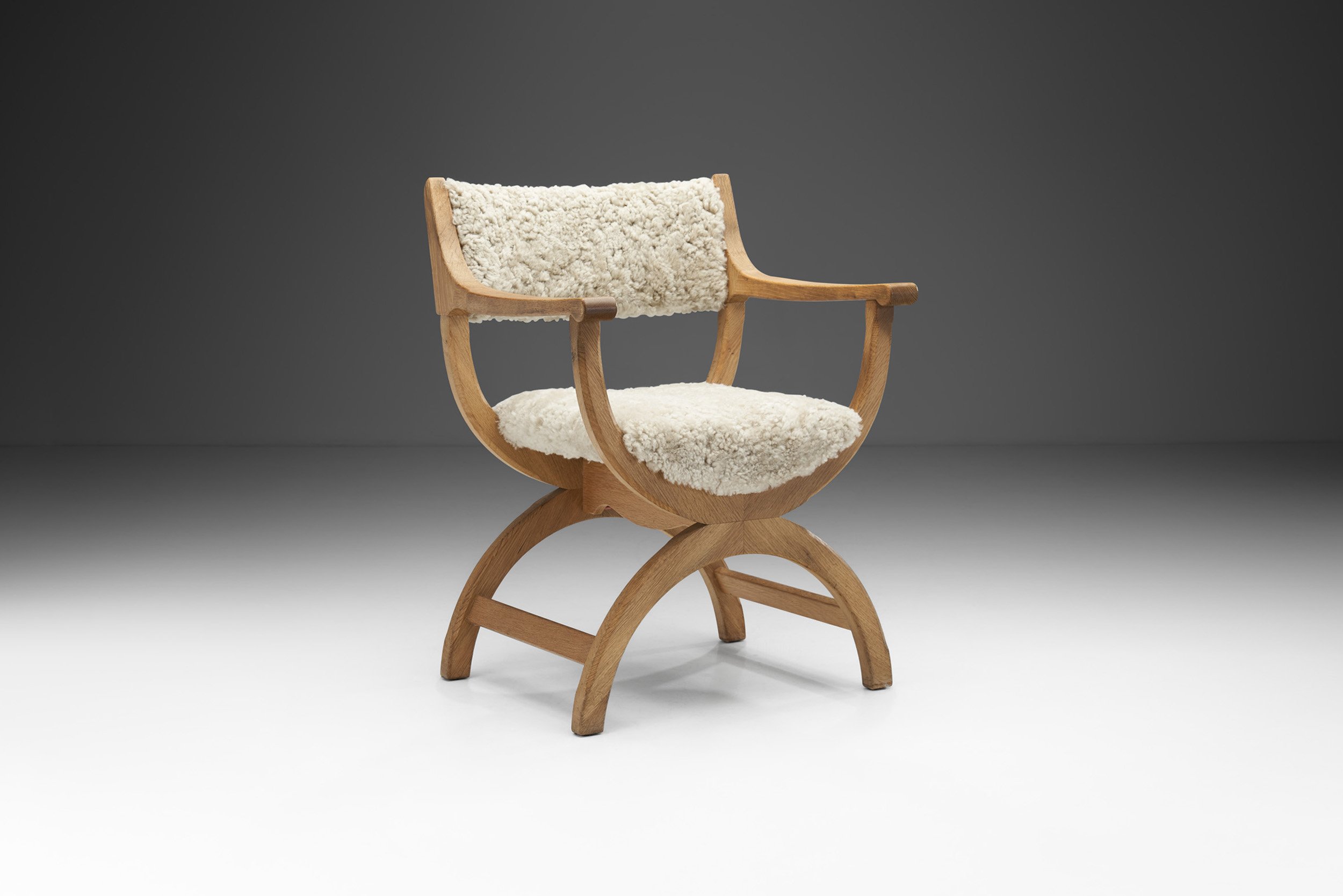
Designed by Henning Kjaernulf, this so-called “kurulstol” or kurul chair, is an iconic model by Danish designer, Henning Kjærnulf. The Kurul chair is an ancient folding chair, originally a folding stool with straight or curved legs. Among the Romans, in addition to being an ordinary utility chair, it was symbolically linked to officials, often within the judiciary.
This armchair combines the traditional kurul structure with a rounded and curved appearance with an upholstered seat and backrest that gives the historic look a modern edge. The oak frame is carved and sculpted in an unmistakeable way, showing the skills of both the designer and the manufacturer. The body is composed of two slats of wood of equal length in the front and back, fastened together in a saltire formation (resembling the letter X) which are extended up at the top and back to form the armrests and the backs as well. The seat, upholstered in soft sheepskin, is stretched between the front and back slats connecting the two. Kjærnulf removed the folding function of the historic design, giving his model a more stable, organic look. This impression is further enhanced by the solid oak, which is carved with great precision into straight and curving lines. The rich sheepskin melts these carved and straight lines together, contrasting to the oak’s smoothness. While the historic kurul chair was often decorated with intarsia, this model only showcases subtle decor elements such as the scalloped bridge under the seat, and the curving armrests.
While the kurulstol is a Renaissance classic originating from ancient Rome, thanks to Kjaernulf, Scandinavian modernism remains at the core of the design. Kjærnulf’s designs are easy to spot in a crowd thanks to his originality, making his pieces like the razorblade chair and this model eternally unique. This chair was manufactured by EG Kvalitetsmobel in Denmark during the 1960s.
Condition:
In good vintage condition. Wear consistent with age and use. Some minor scratches and marks on the wood. The chair has been reupholstered recently in premium sheepskin.
Dimensions:
24.8 in W x 26.77 in D x 31.29 in H; Seat height 17.32 in; Arm height 26.18 in
63 cm W x 68 cm D x 79.5 cm H; Seat height 44 cm; Arm height 66.5 cm
About the designer:
Danish mid-century designer and architect, Henning Kjaernulf is somewhat of a mystery. A lot more is known about his designs than Kjaernulf himself. His wooden designs, crafted to perfection, speak for themselves. Kjaernulf mainly designed for the Danish manufacturers EG Kvalitetsmøbel, Nyrup Møbelfabrik, and Vejle Stole Møbelfabrik. The latter produced the designer’s well-known teak extending dining table design. The historic archives of the Danish municipality, Stenlille, reveal the history of Nyrup Møbelfabrik, mentioning Kjaernulf’s architectural designs for the company’s factory, referring to him as an architect based in Odense, Denmark.
Kjaernulf’s works reveal quality craftsmanship throughout, featuring clean Danish modern era lines with sculpted edges and shapes. The unique shapes, like his razorblade chair backrests, distinguish the designer from other Danish mid-century designers.
In light of how sought after his dining sets and lounge chairs are, it remains a mystery why so little is known about the designer. The curious background of Kjaernulf if anything, adds more charm to his pieces. ~H.
REQUEST PRICE HERE
Price category: 2,500 - 5,000 usd / eur
Danish armchairs reflect a strand of mid-20th century design that is expressive while also maintaining the minimal decor of the period. While much Scandinavian furniture from this period is associated with restraint and lightness, artists such as Henning often introduced a more sculptural character, combining solid oak construction with carved or shaped elements. His “razorblade” backrests became a defining feature, giving otherwise simple chairs a distinctive identity.
This armchair, in the manner of Kjærnulf’s work, follows that direction through its solid oak frame and clearly defined silhouette. The structure is built with thick elements, with the legs and arm supports featuring turned details. The backrest is composed of three horizontal slats with gently curving edges, creating a layered effect that adds depth without complicating the form. The woven seat introduces a counterpoint to the rigid wooden frame. Made from natural fibres, it has an organic texture that contrasts with the smoother surfaces of the oak. This material choice offers breathability while remaining durable over time. The combination of solid wood and woven seating reflects traditional craftsmanship, where each material is valued, and comes together to create enduring pieces.
What makes the chair stand out is the way it balances weight and detail within Danish design. It feels solid and deliberate, able to anchor a space, while still being functional for everyday use.
Condition:
In good vintage condition. Wear consistent with age and use. The item has recently been reconditioned. Minor dents and scratches are present. Due to the nature of the materials, the item may have some marks and discolouration.
Dimensions:
25.19 in W x 26.37 in D x 36.61 in H; Seat height 14.96 in; Seat depth 20.47 in; Arm height 24.80 in
64 cm W x 67 cm D x 93 cm H; Seat height 38 cm; Seat depth 52 cm; Arm height 63 cm