
“Berg” Coffee Table with Floral Inlay by Carl Malmsten for Erik Johansson, Sweden 1950s (sold)

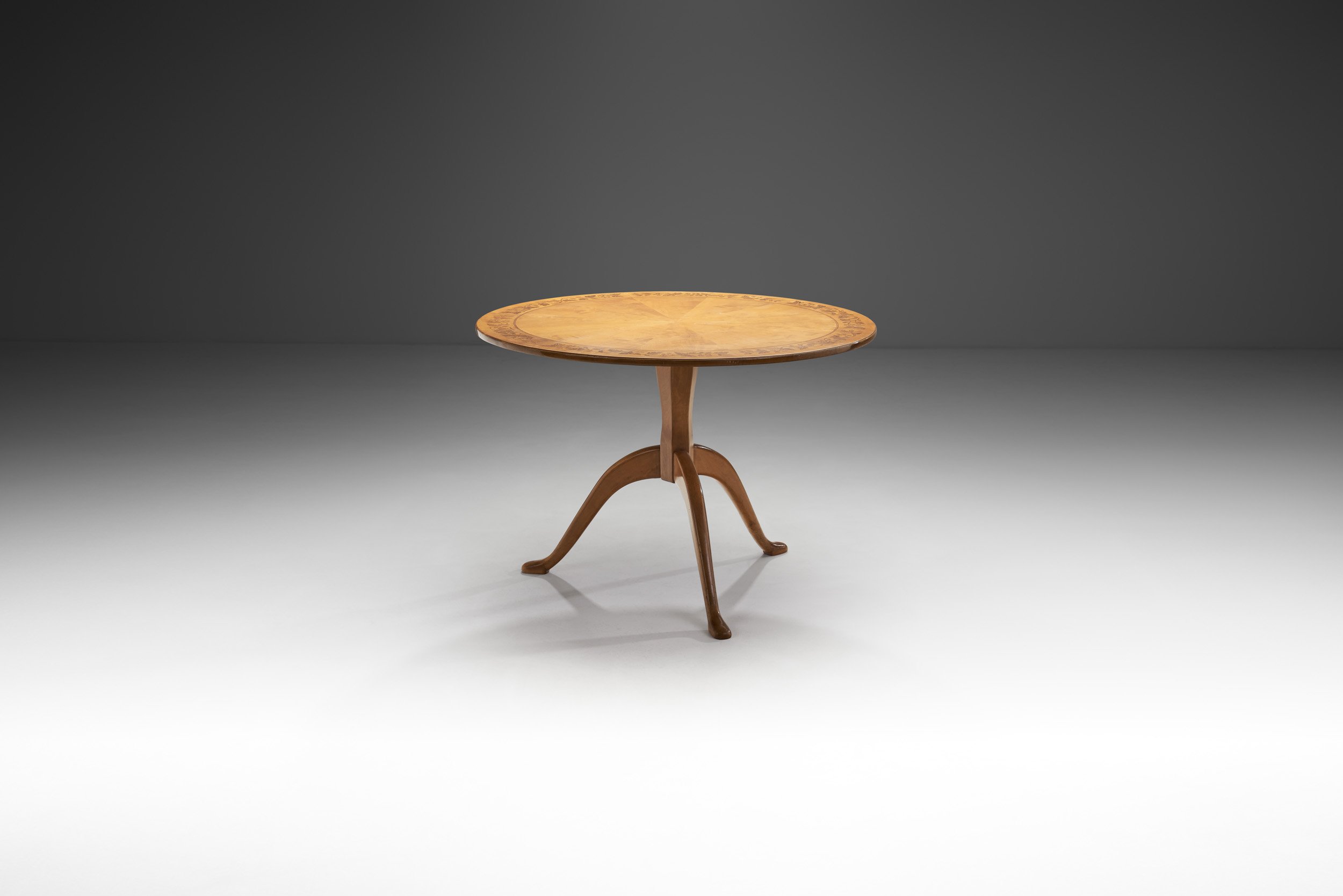


“Berg” Coffee Table with Floral Inlay by Carl Malmsten for Erik Johansson, Sweden 1950s (sold)
All edges are thoroughly broken, Carl Malmsten often wrote in his drawings. It was nature that was his great source of inspiration and in nature there are hardly any sharp edges or corners. This “Berg” table, designed in 1936, is one of the greatest examples of this sentiment.
This elegant table was designed as part of the 'Berg' series of three-legged tables. Neither the light, the eye nor the person likes to turn against sharp corners, Malmsten explained once. Therefore, edges should be rounded so that they become friendlier to touch and look at. Carl Malmsten was not only one of Sweden's most famous furniture designers, he was also one of the last century's great cultural personalities with a strong influence on the home environment, public environment and the contemporary public debate. His personality shines through the design of this Berg coffee table as well. The design is dominated by the tripod base and the large, round tabletop. The sculpted base consists of a central leg stand supported by three legs that visually recall the ‘cabriole’ style legs of the 18th century. Since this table was made in the heyday of the mid-century, the legs, and the design as a whole lacks heavy ornamentation and instead focuses on the natural beauty of wood and the rounded edges. The wood is the most attention grabbing on the remarkable tabletop, decorated with floral inlays forming a ring.
Carl Malmsten’s design was materialized by Swedish master cabinetmaker Erik Johansson at Eskilstuna Möbelhantverk during the 1950s. The beautifully sculpted edges and inlay testify of his artistry, especially the tri-symmetrical legs that give the table an elegant look. Thanks to the expert design and craftsmanship, this Berg table is sure to stand out whether used as a side or centre table.
SOLD
Condition:
In good vintage condition. Wear consistent with age and use. Small marks on the wood.
Dimensions:
35.62 in ø x 24.8 in H
90.5 cm ø x 63 cm H
About the designer:
Carl Malmsten (December 7, 1888 – August 13, 1972) was a Swedish furniture designer, architect, and educator. Malmsten was born in Stockholm, Sweden. Malmsten's career took off when he won a competition in 1916 to design furniture for the Stockholm City Hall and shortly after in 1917, he exhibited alongside well-known Swedish architects such as Gunnar Asplund and Uno Åhrén.
In the 1920s he was invited to furnish a room for the crown prince, Gustaf VI Adolf, and his wife Louise in Ulriksdal Palace. He was honoured with an inaugural Prince Eugen Medal for design in 1945. Already as a young designer in the early 20th century, Carl Malmsten advocated an artisanal furniture design based on local ingredients and traditions, available to a wide audience at a reasonable price.
Nature was Carl Malmsten's foremost teacher and source of inspiration. He conveyed his love of craftsmanship as a teacher in his own schools, at Olofskolan in Stockholm, Capellagården on Öland and the Carl Malmsten school on Lidingö, today a branch of Linköping University and one of the country's leading design colleges. As a debater, Malmsten stormed against functionalism, but in retrospect it can be seen that his ideas often coincided with the rational and frugal style ideals of function.
Malmsten has had a lasting influence on Swedish furniture design through the two schools he founded—the Carl Malmsten Furniture Studies (Carl Malmstensskolan), which has been a part of Linköping University since 2000, is situated on the island of Lidingö on the outskirts of Stockholm. Carl Malmsten spoke about the importance of tradition, craftsmanship and the nation. His furniture was in many ways a product of the thoughts and ideals of the time, they have a timeless quality that makes them just as relevant and loved today. ~H.

REQUEST PRICE HERE
Price category: 40,000 - 50,000 usd / eur
This peculiar “T22” table model is also referred to as the “Eye”. While the name needs no further explanation, the ingenious design certainly does. Pierre Chapo always paired his creative and elegant designs with impeccable craftsmanship that gained him worldwide fame and love.
The “T22” is formed by two arcs, each resting on three cylindrical leg and a central oval module attached to one of the arcs by a sliding system. Placed together, the design forms an “eye”. Not a lot of designs receive a nickname by which they are immediately recognised, but this table is one of those. With its distinctive structure, it epitomises Chapo's research for new systems of joinery, in which the material and the design would be the lead factors in achieving stability, durability, and of course, an aesthetically pleasing outcome. Here, the smaller middle module can be adjusted or removed freely, allowing the table’s modules to be arranged in a variety of ways, for example, it can also be arranged to form a long undulating console. The immense functionality is accompanied by Chapo’s precise joinery techniques and woodworking. Pierre Chapo worked largely in elm wood and has a couple of signature design elements like the visible spline joint and the cylindrical legs as seen here as well. The solid elm has a stunning grain and various patterns that especially stand out on the curvatures of the table.
Chapo’s organic approach to arts and crafts and both designers resisted the stark industrial look that was dominant in the post-war period under the influence of socialism. This coffee table is undoubtedly an emblematic model of post-war French decorative arts and design.
Condition:
In good vintage condition. Wear consistent with age and use. Some small marks. The elm wood has a beautiful patina. Due to the nature and age of the material, the item may have some additional scratches, and discolouration.
Dimensions:
69.48 in W x 51.18 in D x 12.99 in H
176.5 cm W x 130 cm D x 33 cm H
About the designer:
Pierre Chapo, born in Paris in July 1927, was initially interested in becoming a professional painter. However, after a chance meeting with a shipbuilder who introduced him to wood and wood crafts, Chapo changed his focus and decided to study architectural studies at the prestigious École Nationale Supérieure des Beaux-Arts in Paris.
After graduation, Chapo and his wife, the sculptor, and painter Nicole Lormier, started to travel extensively through Scandinavia and Central America. Among the many places the couple visited was the home and studio of Frank Lloyd Wright in Taliesin West. A visit that had a lasting influence on Chapo’s future work and designs. Read more about Pierre Chapo. ~H.