
Norwegian Solid Pine Coffee Table by Krogenæs, Norway 1960s (sold)





Norwegian Solid Pine Coffee Table by Krogenæs, Norway 1960s (sold)
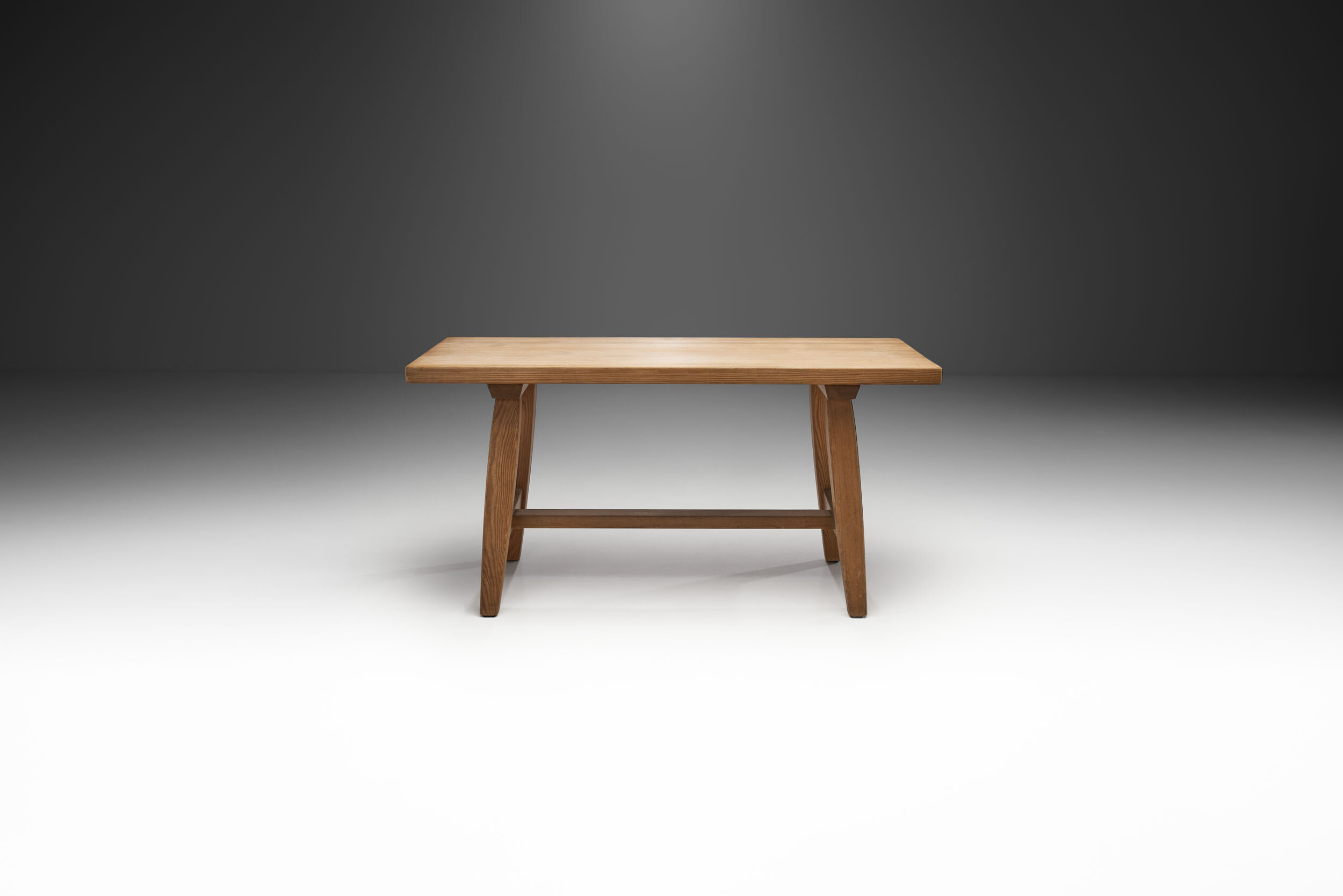
This impressive Norwegian table is defined by its natural material, seamless joinery and distinctive, but soft ornamentation on the bottom. The Norwegian manufacturer, Krogenæs is well-known for their high-quality pine furniture. This coffee table is a great example with its simple and robust design.
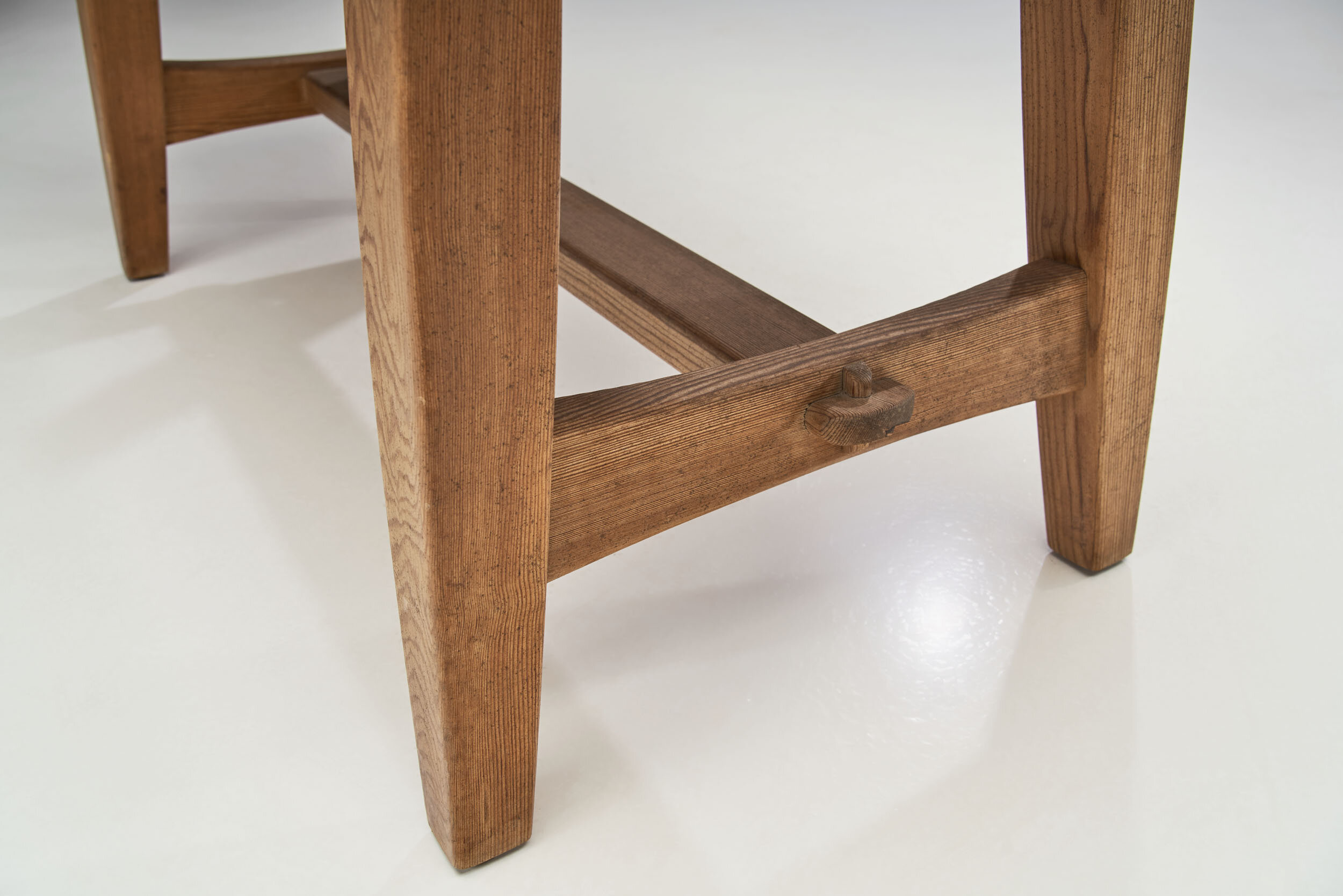
Albeit the table is made of solid wood, the pine’s light colour and the slender lines create an airy feeling, while also retaining an overall impression of strength and durability. This is enhanced by the careful mixture of the tapered legs and the Asian-inspired Scandinavian-style joinery that uses nothing, but the wood itself. This is an expression of cultural exchange between traditional Scandinavian materials and traditional Asian craftsman techniques. Marked by pale colours, natural materials and lean furniture, the Scandinavian aesthetic was largely a response to the region’s short days and long winters, which called for bright, practical interiors. While Scandinavian pieces are generally free of ornamentation, this table features a horizontal stretcher that serves a dual purpose, namely structural stability and an aesthetic role.
This table doesn’t depend on its details, rather, it is just as arresting from afar as from a proximity. The joinery and woodworking reveal the quality craftsmanship of the experts at Krogenæs. The most charming thing about this Norwegian table however, is that it has classic elements, and there is so much history there, but it lends itself easily to a modern interior.
SOLD
Condition:
In good vintage condition. Wear consistent with age and use.
Dimensions:
47.24 in W x 21.65 in D x 23.42 in H
120 cm W 55 cm D 59.5 cm H

REQUEST PRICE HERE
Price category: 2,500 - 5,000 usd / eur
This extraordinary sculptural round dining table has strong lines and proportions and was made in very small numbers.
The table consists of eight beech elements that have a petal like shape. The elements are connected with eight black metal round inlays to which the eight legs are connected at the bottom side. This table is the luxury model that holds a "Lazy Susan" (turntable) in the middle; the large black lacquered metal disc in the centre runs on ball bearings and is rotatable so that you can, for example, share food without having to rise. The slender cylindrical legs are made out of black lacquered metal with tapered solid beech feet.
Manufactured and marked by Nissen, Langå Denmark.
Condition:
In good vintage condition. Wear consistent with age and use. Item has some small marks and scratches. The table can be purchased with two additional legs.
Dimensions:
53.54 in Ø x 29.33 in H
136 cm Ø x 74.5 cm H

REQUEST PRICE HERE
Price category: 7,500 - 10,000 usd / eur
This rare “AT-309” dining table was designed by Hans Wegner in 1955 and its title of ‘iconic’ is well deserved. As it is no longer produced, this model has become a collector’s item created by a designer who is credited as one of the main driving forces of the mid-century Danish modern movement.
The “AT-309” model is also commonly referred to as the “saw-horse” for its trestle base. In woodworking, a saw-horse is a trestle structure used to support a board similarly to this model’s case. While Hans J. Wegner became world-renowned for his chairs, he also designed a broad range of tables, where he was just as thorough and artistic about the proportions, construction, function, and style. With a clear statement of simplicity, quality and respect for materials, this table is a great example of Danish Modern design. The massive teak tabletop with drop-leafs is stunning on its own, showcasing the wood’s grain and offering plenty of space with the extendable solution. However, to Wegner, the most important part of his tables was not the top, but rather what was underneath. For the supporting structure he used the distinctive saw-horse look with crossed legs and brass braces. The diagonal brass reinforcement is not only a significant structural feature, it is also a visually appealing detail that gives character to this dining table. Looking beneath the top, the elaborate oak structure becomes visible, showing both Wegner’s and the manufacturer’s expert skill and knowledge.
Over the course of his career, the designer collaborated with several renowned manufacturers, including Andreas Tuck. The company was one of the greatest Danish furniture design companies of the mid-20th century, producing pieces that epitomize classic Danish craftsmanship. Wegner worked with the company for many years, creating iconic designs such as this “AT-309” table.
Condition:
In good vintage condition. Wear consistent with age and use. The tabletop has been refinished.
Dimensions:
51.96 in W (89.76 in when extended) x 33.66 in D x 28.14 in H
132 cm W (228 cm when extended) x 85.5 cm D x 71.5 cm H
About the designer:
Hans Wegner (1914–2007) is considered as one of the most influential designers of Scandinavian design. Danish-born Wegner became a national and international design idol for shaping the history of design in the 1950s and ‘60s.
In his designs, the sharp edges defining Modernism were smoothened, creating his iconic chairs. As a pioneer of the modernist style, often described as “organic functionality”, Wegner described his method as “stripping the old chairs of their outer style and letting them appear in their pure construction.”.
At 14 years old, he began his apprenticeship with Danish master cabinetmaker H. F. Stahlberg. After serving in the military he moved to Copenhagen, and attended the School of Arts and Crafts, before setting out as a furniture designer. In 1943, he established his own studio, producing designs for manufacturers like AP Stolen, Fredericia Stolefabrik, and in later years, PP Møbler.
Wegner designed more than 500 chairs in his lifetime, refining an approach that combined a variety of natural materials and pushed traditional joinery techniques to extreme tolerances and distillations. Wegner’s background as a cabinetmaker gave him a deep understanding of how to integrate exacting joinery techniques with exquisite form, realizing the perfect combination with form and purpose.
The core of Wegner’s legacy remains his focus on showing the inner soul of furniture pieces through a simple and functional exterior. ~H.

REQUEST PRICE HERE
Price category: 7,500 - 10,000 usd / eur
Giuseppe Scapinelli was known as a designer who successfully combined “the classic” with “the modern”, and this table stands as evidence. Scapinelli was a Brazilian designer from São Paulo who did not use any means of mass production. His furniture alternated and combined elements from Italian classicism, innovative aerodynamic lines, and biomorphic shapes.
This rare circular table has an amazing construction that praises the firm, Angelini & Delneri. Upon first sight, this model is an elegant circular table made of beautifully grained wood. However, when the table is extended, the elaborate system is revealed by which the extra wooden leaves can be added to extend the length. The artisanal level craftsmanship is as stunning as the design itself, with traditional joinery techniques such as pegs and so-called ‘biscuit’ joints. Besides the extension system, the craftsmanship is also evident in every edge and angle, such as the legs’ curve and the ring strengthening them. This table is very successful at balancing large volumes with clean lines. The legs have rounded edges and are slightly splayed below the wooden ring.
This memorable design is from a designer committed to pushing the boundaries of modernist design in Brazil. The form is functional and elegant with subtle flourishes like intricate wooden details and the evident emphasis on functionality. This dining table is a grand piece that will stand out and add character to any interior.
Condition:
In good vintage condition. Wear consistent with age and use.
Dimensions:
47.24 in Ø x 28.34 in H
120 cm Ø x 72 cm H
About the designer:
Giuseppe Scapinelli was born in Reggio Emilia in Italy on the 2nd of July 1911 and was the 6th of thirteen sons. He graduated after studying architecture in 1941. However, just as his career was starting, it was abruptly interrupted by WW2, and he was forced to live in seclusion in an antique furniture shop, where he further studied the styles and production methods of old furniture. After the devastations of the war, the promise of a better life in South America oriented Scapinelli towards the continent. Finally, in 1948, Scapinelli decided to leave for Brazil, more specifically to the metropolis of São Paulo.
At first Scapinelli worked for the architect and well-known “Paulista” Francesco Matarazzo, who opened many doors for him and other Italian refugees. Later, in 1950, Scapinelli opened his own studio. Because of his modern and complete style in interior decoration, he soon settled as an architect / decorator backed by a great team of skilled Italian woodworkers.
Scapinelli was constantly studying all forms of visual arts and frequently integrated ceramics in his works. He was described in Brazil’s Casa e Jardim magazine at the time as: "{…} a classic who does not forget to be modern - or if you prefer - a modernist who does not forget to be classic". After a fruitful life, Giuseppe Scapinelli died in São Paulo in 1982, at the age of 71.
Today Scapinelli's style is still easily recognizable because of the curvy lines and soft sensual shapes, very much away from the mainstream works of his fellow designers at the time. With works beautifully crafted from traditional Brazilian woods like caviuna and jacaranda, he is remembered for his unique works combining the classic with the modern. ~H.

REQUEST PRICE HERE
Price category: 2,500 - 5,000 usd / eur
This oak and teak “AT-312” dining table was designed by Hans Wegner in the 1950s and its title of ‘iconic’ is well deserved. Created by a designer who is credited as one of the main driving forces of the mid-century Danish modern movement, this table is the epitome of functional modernity.
While Hans J. Wegner became world-renowned for his chairs, he also designed a broad range of tables, where he was just as thorough and artistic about the proportions, construction, function, and style. With a clear statement of simplicity, quality and respect for materials, this table is a great example of Danish Modern design, and is a reference in Scandinavian table design on a broader scale. The design of this table model boasts an ingeniously functional and well-thought-out structure crafted from quality wood. Two pull-out leaves “hide” under the teak top and integrate beautifully with it until extended; not only is this a highly functional solution, it also contributes to delineate the characteristic profile of the design. The extension mechanism also serves as a decorative element, which shows why Wegner is in many ways in his own league in Danish Modern design. The massive teak tabletop with drop-leafs is stunning on its own, showcasing the wood’s grain and offering plenty of space even without the extensions. The lower oak structure received just as much attention with elegant slim legs that are slightly tapered and splayed, balancing the large rectangular top.
Looking beneath the top is also a special experience, the elaborate oak structure becomes visible, showing both Wegner’s and the manufacturer’s expert skill and knowledge. Andreas Tuck created several of Wegner’s table models, but the company closed down in 1972, making original models such as this table collectors’ pieces. This table is stamped: “Fabrikat: Andr Tuck Arkitekt: Hans J Wegner Denmark”.
Condition:
In good vintage condition. Wear consistent with age and use. Some marks and scratches.
Dimensions:
94.48 in W (when extended) x 35.43 in D x 28.34 in H
240 cm W (when extended) x 90 cm D x 72 cm H
About the designer:
Hans Wegner (1914–2007) is considered as one of the most influential designers of Scandinavian design. Danish-born Wegner became a national and international design idol for shaping the history of design in the 1950s and ‘60s.
In his designs, the sharp edges defining Modernism were smoothened, creating his iconic chairs. As a pioneer of the modernist style, often described as “organic functionality”, Wegner described his method as “stripping the old chairs of their outer style and letting them appear in their pure construction.”.
At 14 years old, he began his apprenticeship with Danish master cabinetmaker H. F. Stahlberg. After serving in the military he moved to Copenhagen, and attended the School of Arts and Crafts, before setting out as a furniture designer. In 1943, he established his own studio, producing designs for manufacturers like AP Stolen, Fredericia Stolefabrik, and in later years, PP Møbler.
Wegner designed more than 500 chairs in his lifetime, refining an approach that combined a variety of natural materials and pushed traditional joinery techniques to extreme tolerances and distillations. Wegner’s background as a cabinetmaker gave him a deep understanding of how to integrate exacting joinery techniques with exquisite form, realizing the perfect combination with form and purpose.
The core of Wegner’s legacy remains his focus on showing the inner soul of furniture pieces through a simple and functional exterior. ~H.

REQUEST PRICE HERE
Price category: 2,500 - 5,000 usd / eur
The “C35 FDB” table series was designed by Poul M. Volther in 1957 for Danish Furniture co-operative FDB. The company, FDB Møbler was founded in 1942 with architect, Børge Mogensen heading the studio. According to their philosophy, every new piece of FDB Møbler is born as an heirloom. This ash dining table is no exception.
First trained as a cabinetmaker, Poul Volther studied furniture design at the Arts and Crafts School in Copenhagen. A believer in Functionalism, he avoided short-lived aesthetic trends, concentrating on the simple crafting with quality materials. This dining table is characterized by its functionalism combined with a modern expression – the epitome of FDB Furniture’s design philosophy. The table frame is made of solid ash wood, which has a light shade and spectacular pattern. However, this model’s standout feature is definitely its large, green laminated top. This rectangular inlay is framed by the ash frame. The legs of the table slope slightly outward, providing optimal legroom and a more stable surface. The lower structure also features stretchers and cross railing, assuring structural stability. These elements also serve an aesthetic role, adding to the clean, architectural precision of the table.
FD Møbler’s philosophy was focused on creating beautiful, functional and exceptionally crafted furniture that makes room for everyday living at home and can withstand everyday wear and tear to age gracefully with those who use them. Accordingly, this C35 table perfectly complements different interiors and styles with its classic, quality design. Today it remains as contemporary as it was 60 years ago.
Condition:
In good vintage condition. Wear consistent with age and use. The top has some scratches and marks of wear.
Dimensions:
70.86 in W x 35.43 in D x 28.74 in H
180 cm W x 90 cm D x 73 cm H
About the designer:
Born in 1923, designer Poul M. Volther belonged to a generation of Danish creatives rooted in Scandinavian functionalism. Volther’s work is characterized by a mastery of form, as evidenced by his iconic EJ5 Corona Chair for Erik Jørgensen (1961/64). Highly collectible today, this singular piece has left an indelible mark on design history.
Volther originally trained as a cabinetmaker before studying at the Royal Danish Academy School of Arts & Crafts in Copenhagen. Over the years, Volther also taught at the Royal Danish Academy School of Design, influencing hundreds of young designers along the way. In 1949, legendary architect-designer Hans Wegner introduced Volther to the FBD, a Danish national cooperative association for producers of consumer goods. There, Volther worked under another Danish design great, Børge Mogensen, and went on to become FDB’s design director when Mogensen left in 1959. During his tenure at FDB, Volther created a range of chairs and sofas that can still be found in homes across Denmark.
In 1962, Volther found a partner in the then-new furniture manufacturer Erik Jørgensen. The company agreed to produce the Corona Chair with a chrome-plated steel frame. Despite the investment, this chair would not find a significant audience until 1997, when Erik Jørgensen re-launched it at the Cologne Furniture Fair in Germany, followed by the Scandinavian Furniture Fair in Denmark. One year after Volther’s death in 2001, the chair was used at the EU Summit in Copenhagen.
Volther’s designs have been produced by many design companies, such as Munch Furniture and Frem Røjle. However, his Corona Chair is considered his most memorable design contribution. It’s been featured in countless movies, fashion shoots, and music videos. ~H.

REQUEST PRICE HERE
Price category: 1,000 - 2,500 usd / eur
This gorgeous extendable dining table model by the Danish furniture maker, Bernhard Pedersen og Søn was inspired by classic Danish furniture design and simplicity. The period between 1950 and 1970 in particular was characterized by some of the most stunning and well-executed pieces in the company’s history, including this table.
This elegant dining table features two large leaves, stored underneath the tabletop, that slide out and allow the table to be easily extended to accommodate extra diners. This clever design element makes the table not only greatly functional, it is also a design element that is aesthetically pleasing. When extended, the veneered exotic wood becomes visible with a much darker colour and distinct pattern variation. The gently rounded edges complement the display of the patterns, while also providing contrast to the sleek, tapered legs. However, the most interesting part of the design remains invisible as it is right under the tabletop. The metal rods and the elaborate wooden system that allows the top to almost double in size shows why many of the era’s most renowned Danish designers worked together with Bernhard Pedersen & Son. The family owned furniture maker has had an exceptionally strong tradition in high quality cabinetmaking since their start in 1902.
This dining table has the characteristics of the prized Scandinavian idea of “honest” design that Bernhard Pedersen and Son is also known for. The sleek look resulting from the clean lines, functional design and expert craftsmanship makes this table a perfect functional piece and stylish addition to any dining area.
Condition:
In good vintage condition. Wear consistent with age and use.
Dimensions:
55.11 in W x 37.4 in D x 28.85 in H
140 cm W x 95 cm D x 73.3 cm H
About the designer:
Bernhard Pedersen & Søn, is a Danish furniture maker company with a long and strong tradition in furniture and cabinetmaking, stretching all the way back to the company’s start in 1902. Through three generations the family firm has created and sold classic Danish furniture to many parts of the world.
The period between 1950 and 1970 in particular was characterized by some of the most stunning and well-executed pieces in Bernh. Pedersen & Søn’s history. Especially the classic mid-century sideboards and daybeds designed by Danish furniture designers, including the world-renowned Johannes Andersen, Svend Aage Madsen and Kurt Østervig who were – and still are – highly valued by customers worldwide.
Every piece of furniture is made in the same factory that was built by the Bernhard Pedersen family in 1902, located in a small community in the Danish countryside. The workshop and its skilled cabinetmakers are known for their exquisite and dedicated work based on strong Danish craft traditions; traditions recognized around the world for timeless design, high-quality craftsmanship and outstanding longevity. Unique techniques, special tools and original machinery are maintained and used to produce the sideboards in keeping with the first original pieces. The sum of it all is captured in the phrase: Made in Denmark.
Today, the fourth generation in the family, Thomas Bernhard Pedersen is focusing on an exclusive selection of the company’s most exquisite sideboards designed by Danish furniture designers, including the world-renowned architect Johannes Andersen. Every piece of furniture is made in Denmark by skilled cabinetmakers and in keeping with the strong Danish craft traditions. In 2015, great-grandson Thomas Bernhard Pedersen re-established the company and started focusing exclusively on relaunching some of the exquisite furniture designed in the 1950s and 1960s. ~H.
REQUEST PRICE HERE
Price category: 2,500 - 5,000 usd / eur
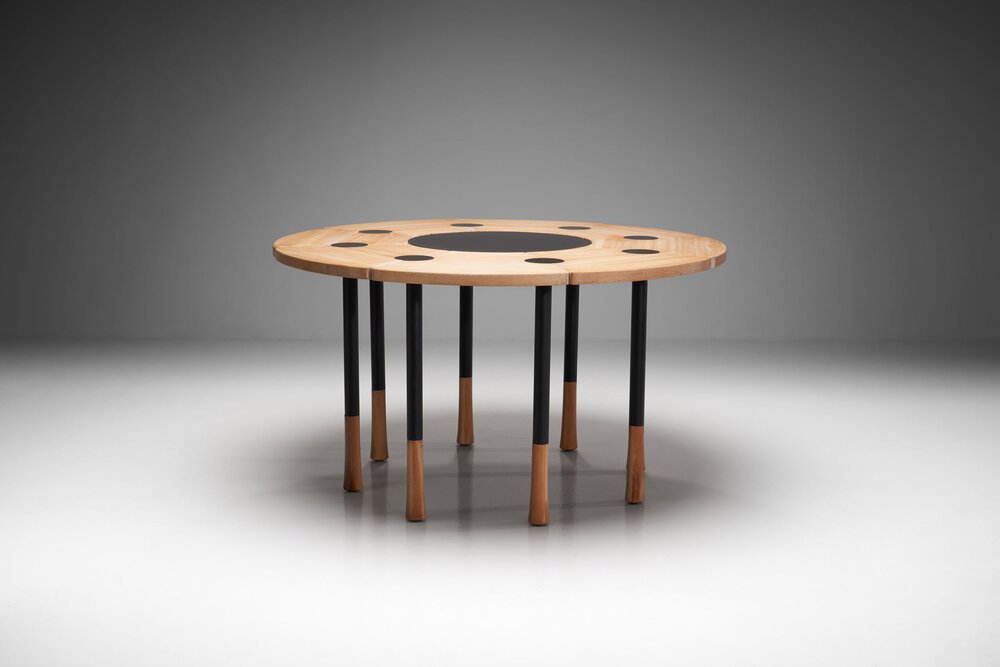
This extraordinary sculptural round dining table has strong lines and proportions and was made in very small numbers.
The table consists of eight beech elements that have a petal like shape. The elements are connected with eight black metal round inlays to which the eight legs are connected at the bottom side. This table is the luxury model that holds a "Lazy Susan" (turntable) in the middle; the large black lacquered metal disc in the centre runs on ball bearings and is rotatable so that you can, for example, share food without having to rise. The slender cylindrical legs are made out of black lacquered metal with tapered solid beech feet.
Manufactured and marked by Nissen, Langå Denmark
Condition:
In good vintage condition. Wear consistent with age and use. Item has some small marks and scratches.
Dimensions:
53.54 in Ø x 29.33 in H
136 cm Ø x 74.5 cm H
REQUEST PRICE HERE
Price category: 50,000+ usd / eur
"I can't live well with too much rigidity. The 90-degree angle, for example, is something I love, but I can't do it. The things I do end up being a little lyrical, a little sensual, in short, there is always an element that does not come from purity or cleanliness."
This beautiful pedestal table visualizes the above quote from Jorge Zalszupin. It was designed in 1959 and produced by his own company, L'atelier. Essentially, the sizeable top rests on one concrete base finished with soft leather. The solid wood patchwork on the tabletop is mesmerizing, showcasing the many shades of Brazilian hardwood. This was not a purely aesthetic choice, but also an initiative for the rationalization and use of leftover scraps of wood available at the factory, allowing at the same time a combination of their different colourings. The way the large top is supported by the thick metal structure shows architectural precision and the use of materials of the highest quality. At the time of its creation, this table was presented as a dynamic piece that could be used in both the corporate and the domestic places thanks to its casual elegance. Today, its versatility is still recognized, a mark of good design. Zalszupin’s L’Atelier was a design collective comprised of architects, engineers, craftsmen and a full-scale team of professionals who did everything from researching materials to finalizing the product. Therefore, the quality of L’Atelier furniture has transcended time and his pieces have become timeless.
The name is said to be a reference to the famous Baia de Guanabara, a traditional postcard image of Rio de Janeiro. Zalszupin's production established a dialogue very close to the artisanal traditions of working with wood, ensuring quality in the aesthetics and manufacturing of his work.
Condition:
In good vintage condition. Wear consistent with age and use. Some minor scratches on the wooden tabletop. The leather covering on the base is a later replacement.
Dimensions:
98.82 in W x 49.21 in D x 29.13 in H
251 cm W x 125 cm D x 74 cm H
Literature :
Jorge Zalszupin, Design Moderno no Brasil – Maria Cecilia Loschiavo dos Santos, Olhares Edition, São Paulo, 2014, p. 142
About the designer:
Jorge Zalszupin was born in Warsaw, Poland, in 1922. He graduated as an architect in Romania in 1945. His importance for Brazilian design has been articulated in several publications so far. In addition to being the owner of the l'Atelier furniture factory of modern furniture, Zalszupin led a unique initiative: he coordinated a team of designers working for four different factories in the same business group, the Forsa Group.
Zalszupin immigrated to Brazil in 1949 and after a brief stay in the capital, he settled in São Paulo, a city that was then entering a cycle of great industrial growth and great cultural transformations. In the first half of the 1950s, he opened an architecture office, having José Gugliota as a partner. When he got tired of designing exclusive furniture manufactured for his clients' homes, he decided to join a group of woodworkers and started to produce smaller series. This was how l'Atelier came into being, which eventually began to manufacture office furniture and went from a carpentry shop with handcrafted products to an industry with serial production. The first piece in this series was an armchair nicknamed 'Danish' by employees. It was first created in 1959.
After the crisis of the 1980s, Jorge Zalszupin dedicated himself exclusively to architecture, an activity he had never abandoned. From 2005, the company Etel Marcenaria started to produce several of the items designed by Zalszupin for l'Atelier - among them the 'Danish' armchair -, privileging the objects of the company's artisanal phase. ~H.