
Stone and Iron Pedestal Coffee Table, Europe ca 1950s (sold)


Stone and Iron Pedestal Coffee Table, Europe ca 1950s (sold)
Among many other innovations, the mid-century modern movement brought new materials and shapes into existence. Utilizing the natural qualities of stone and combining it with the expertise of its master craftsman, this coffee table is a unique piece that can both dominate and complement a modern space.
The design of this coffee table distils the classic pedestal table down to its striking essentials in charcoal coloured stone. The coffee table's bold round top is made from stone with an appealing pattern and textural surface. As a result, the impression is quite elemental and striking. In comparison, the iron pedestal has a dramatically simple shape and appearance not to avert the attention from the top. The stone surface shows the handwork that shaped it, making it one-of-a-kind. Thanks to the technique, the different colours of the stone are showed off, with the earthly tones creating more depth and visual interest. While uneven, the top still remains functional as it can hold glasses or plates. Overall, this coffee table is striking in balancing large volumes with clean geometrical lines.
The combination of materials and rough surface makes this table a stylish example of modern design’s versatility. It is ideal to set the tone of a space serving as an accent piece or to complement a modern interior.
SOLD
Condition:
In good vintage condition. Wear consistent with age and use. Some scratches and marks on the tabletop.
Dimensions:
39.37 in ⌀ x 13.18 in H
100 cm ⌀ x 33.5 cm H
REQUEST PRICE HERE
Price category: 12,500 - 15,000 usd / eur
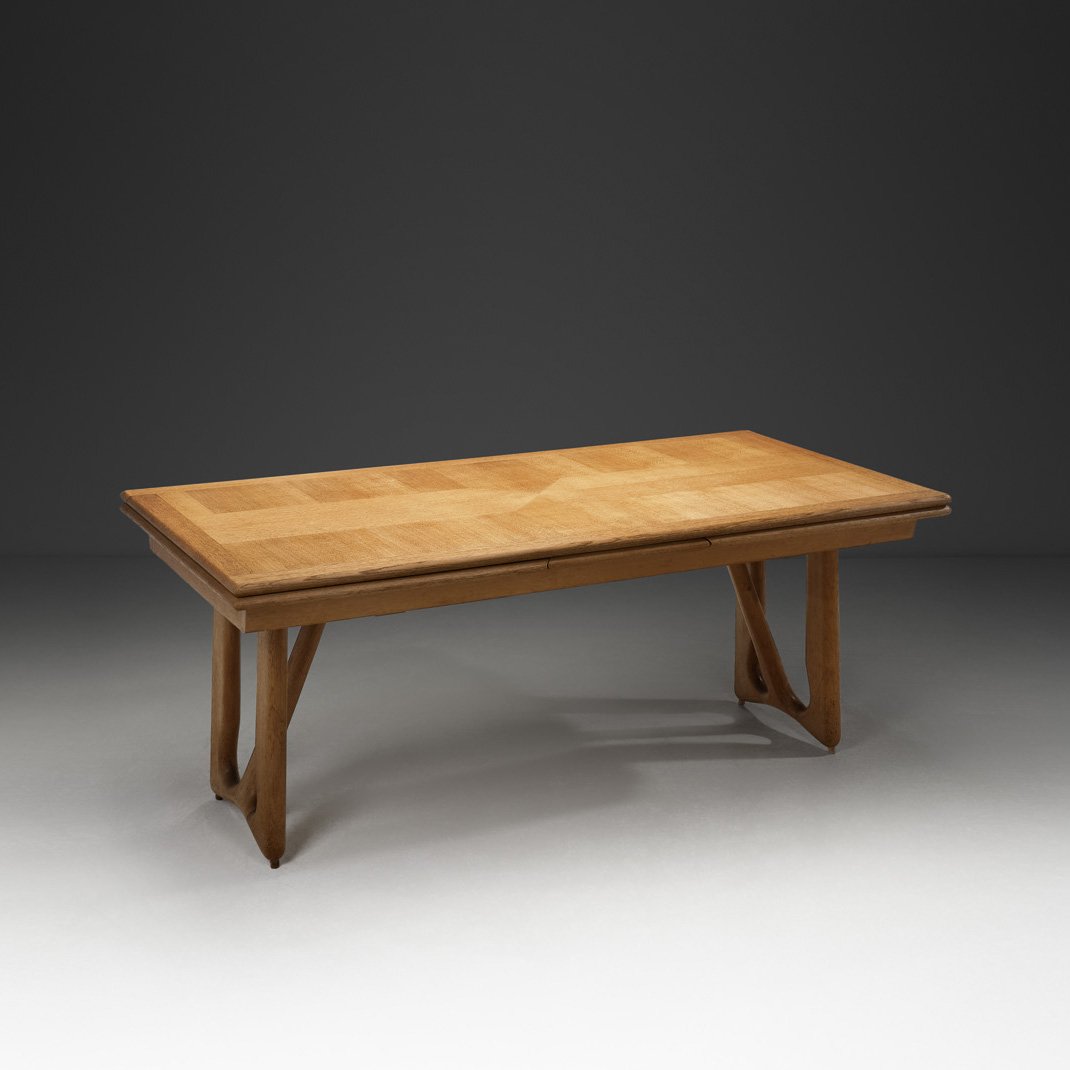
This stunning "L'Italienne" dining table, designed by the renowned French duo Guillerme et Chambron, showcases an exquisite blend of elegant aesthetics and rustic design elements. Crafted in the 1960s by Votre Maison, the table reminds us how form and elegance blend together in the duo's exceptional distinctive craftsmanship style.
At the heart of the construction of this model is the use of oak, a material renowned for its durability and timeless aesthetic qualities. Oak was the preferred material for Guillerme et Chambron, and this piece expertly showcases its rich and robust character, resulting in a solid, functional, and visually captivating work of art. Compared to the duo’s other models, this table is more pared down, relying mostly on the natural appeal of the oak, and its decorative legs. Unlike in most mid-century models, ornamentation was an important part of the duo’s creations, and while apparent, they were never overwhelming. This balance kept the pieces’ elegance, like in the case of this dining table. Furthermore, this piece is full of character and offers expressive and sculptural functionalism. Guillerme et Chambron’s table designs are well-known for their distinctive appearance and multi-functionality; this model is extendable and shows how decorative design and functionality were equally important for the designers, being as sensitive to the use of furniture in everyday life as to the creation of innovative design.
The table's form is clean, geometric, and is a testament to Guillerme et Chambron's dedication to modernism, while staying rooted in traditional craftsmanship and joinery techniques. Their work not only represents the fusion of function and form, but also exemplifies the mid-century modern aesthetic, which they played a pivotal role in actively shaping. Their emphasis on quality craftsmanship and the use of noble materials - like oak - has undeniably left a lasting imprint in the world of furniture making, solidifying their legacy in the French design landscape during the mid-century era.
Condition:
In good vintage condition. Wear consistent with age and use. The item has recently been reconditioned. Due to the nature and age of the wood, the item may have some marks, scratches, and discolouration.
Dimensions:
70.87 in W x 34.45 in D x 28.54 in H
180 cm W x 87.5 cm D x 72.5 cm H
REQUEST PRICE HERE
Price category: 12,500 - 15,000 usd / eur
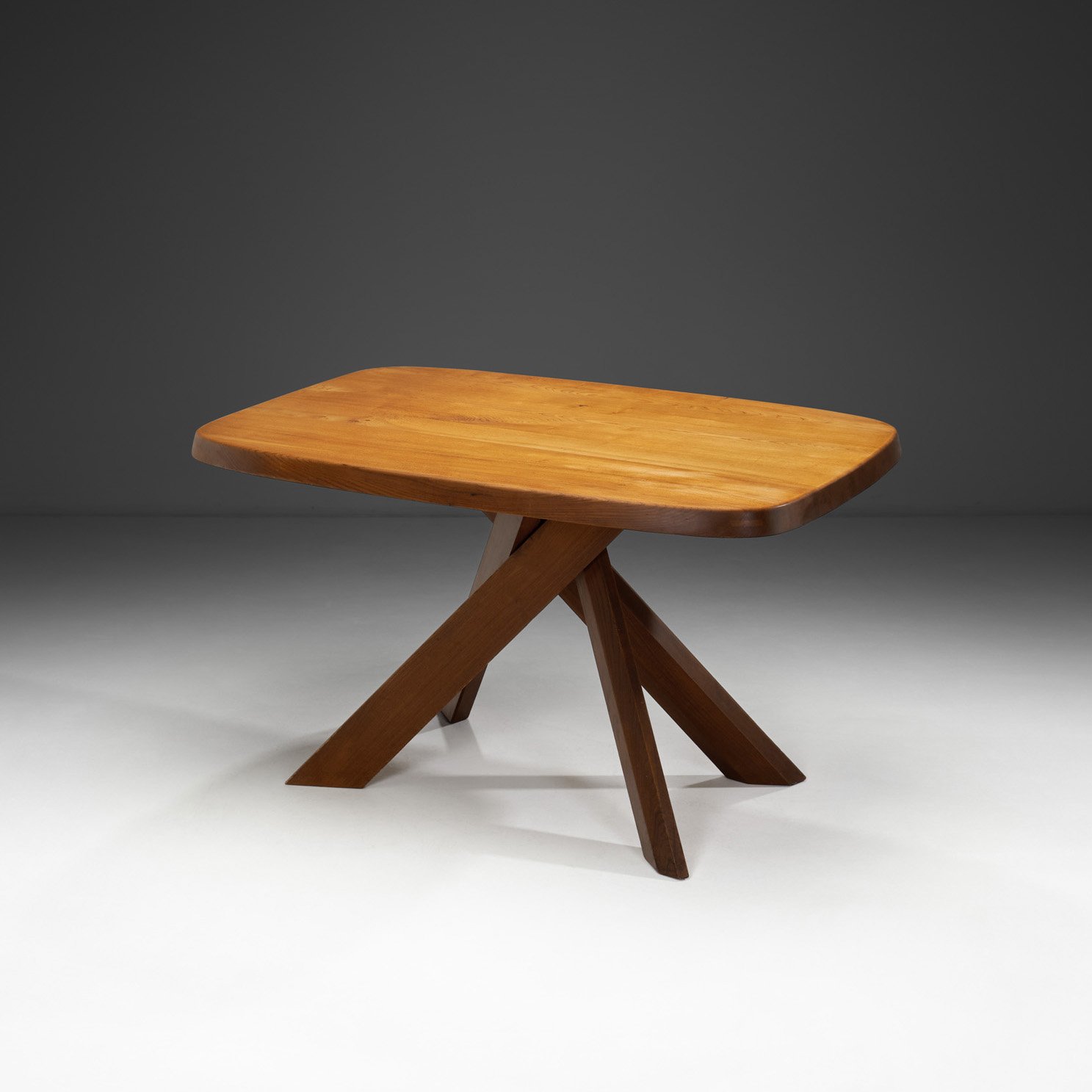
This dining table is a compelling embodiment of Pierre Chapo’s distinctive style. He always paired his creative and elegant designs with impeccable craftsmanship that gained him worldwide fame and love. This model “T35A” is a rare and beautiful example of Chapo’s designs, a piece that truly stands the test of time, bringing lasting form and quality to any interior.
Crafted entirely from solid elm, this dining table demonstrates exceptional craftsmanship and masterful joinery. Renowned for its striking grain patterns and long-lasting durability, elm is an ideal choice for larger pieces of furniture. This table’s vast flat surface, composed of carefully selected elm planks, beautifully highlights the wood's natural beauty, allowing the material to take center stage and speak for itself. The generous shape coupled with its warm honey tones, ensures that this table will be a focal point in any style of dining room or other large gathering area and is sure to be a conversation starter. The central quadripode base was designed with Chapo’s signature architectural legs, arranged in a dynamic way with the four pillars collapsing and balancing on each other at the same time, creating a striking visual rhythm.
Chapo’s designs reflect the architectural philosophies of Le Corbusier, as well as the commitment to the honest use of quality materials of Frank Lloyd Wright. His work is grounded in the simple harmony of form, function, and material, principles carried out in his works, enabling him to produce grand scale items, while preserving an underlying sense of warmth and simplicity. This dining table adds character to any interior with its uniquely structured leg composition, reflecting the influence of mid-century modernism.
Condition:
In good vintage condition. Wear consistent with age and use.
Dimensions:
50.19 in W x 32.67 in D x 28.74 in H
127.5 cm W x 83 cm D x 73 cm H

REQUEST PRICE HERE
Price category: 50,000+ usd / eur
"I can't live well with too much rigidity. The 90-degree angle, for example, is something I love, but I can't do it. The things I do end up being a little lyrical, a little sensual, in short, there is always an element that does not come from purity or cleanliness."
This beautiful pedestal table visualizes the above quote from Jorge Zalszupin. It was designed in 1959 and produced by his own company, L'atelier. Essentially, the sizeable top rests on one concrete base finished with soft leather. The solid wood patchwork on the tabletop is mesmerizing, showcasing the many shades of Brazilian hardwood. This was not a purely aesthetic choice, but also an initiative for the rationalization and use of leftover scraps of wood available at the factory, allowing at the same time a combination of their different colourings. The way the large top is supported by the thick metal structure shows architectural precision and the use of materials of the highest quality. At the time of its creation, this table was presented as a dynamic piece that could be used in both the corporate and the domestic places thanks to its casual elegance. Today, its versatility is still recognized, a mark of good design. Zalszupin’s L’Atelier was a design collective comprised of architects, engineers, craftsmen and a full-scale team of professionals who did everything from researching materials to finalizing the product. Therefore, the quality of L’Atelier furniture has transcended time and his pieces have become timeless.
The name is said to be a reference to the famous Baia de Guanabara, a traditional postcard image of Rio de Janeiro. Zalszupin's production established a dialogue very close to the artisanal traditions of working with wood, ensuring quality in the aesthetics and manufacturing of his work.
Condition:
In good vintage condition. Wear consistent with age and use. Some minor scratches on the wooden tabletop. The leather covering on the base is a later replacement.
Dimensions:
98.82 in W x 49.21 in D x 29.13 in H
251 cm W x 125 cm D x 74 cm H
Literature :
Jorge Zalszupin, Design Moderno no Brasil – Maria Cecilia Loschiavo dos Santos, Olhares Edition, São Paulo, 2014, p. 142
About the designer:
Jorge Zalszupin was born in Warsaw, Poland, in 1922. He graduated as an architect in Romania in 1945. His importance for Brazilian design has been articulated in several publications so far. In addition to being the owner of the l'Atelier furniture factory of modern furniture, Zalszupin led a unique initiative: he coordinated a team of designers working for four different factories in the same business group, the Forsa Group.
Zalszupin immigrated to Brazil in 1949 and after a brief stay in the capital, he settled in São Paulo, a city that was then entering a cycle of great industrial growth and great cultural transformations. In the first half of the 1950s, he opened an architecture office, having José Gugliota as a partner. When he got tired of designing exclusive furniture manufactured for his clients' homes, he decided to join a group of woodworkers and started to produce smaller series. This was how l'Atelier came into being, which eventually began to manufacture office furniture and went from a carpentry shop with handcrafted products to an industry with serial production. The first piece in this series was an armchair nicknamed 'Danish' by employees. It was first created in 1959.
After the crisis of the 1980s, Jorge Zalszupin dedicated himself exclusively to architecture, an activity he had never abandoned. From 2005, the company Etel Marcenaria started to produce several of the items designed by Zalszupin for l'Atelier - among them the 'Danish' armchair -, privileging the objects of the company's artisanal phase. ~H.
REQUEST PRICE HERE
Price category: 2,500 - 5,000 usd / eur
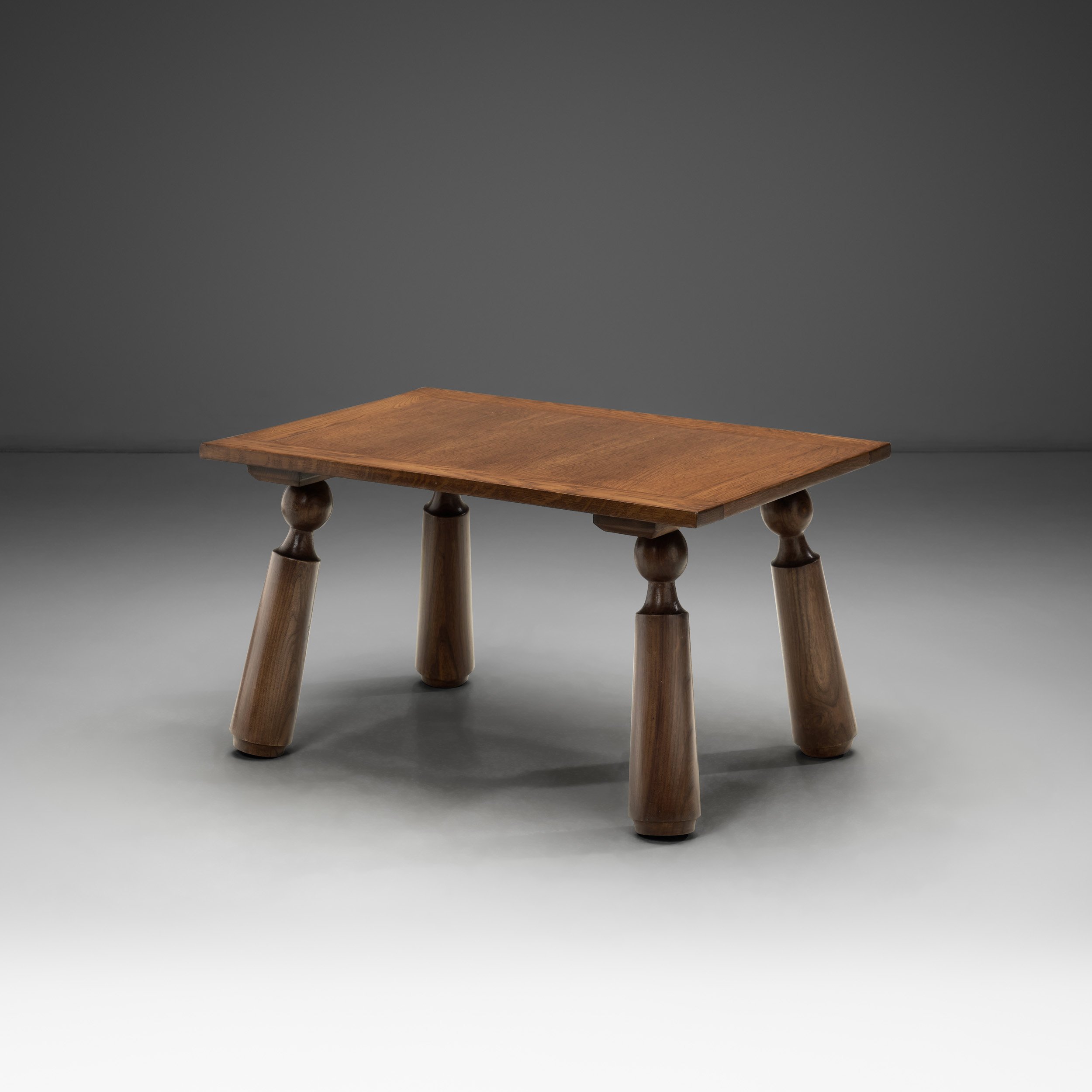
This wooden coffee table, crafted in France in the first half of the 20th century, is designed in the manner of Charles Dudouyt, one of the most distinctive figures in French decorative arts of the interwar period. Dudouyt’s work is often celebrated for its rustic charm, and masterful handling of wood, bridging tradition with the evolving aesthetics of Art Deco and modern design.
This table embodies those qualities through its sculptural presence and confident use of material. The piece is defined by its sturdy rectangular top and striking turned legs, which taper outward with bold, geometric proportions. Each leg features carved and rounded detailing, lending rhythm and visual weight to the structure. This play between solidity and ornamentation is characteristic of French designs of the era, where pieces were not only functional but also a statement of craftsmanship and artistic individuality. The warm stain of the wood enhances the visual richness of the table, highlighting its grain and natural imperfections. Its compact scale makes it ideal for daily use, while not overpowering a room. At the same time, the architectural quality of the legs gives it a charmingly unique character that anchors a space.
The essence of early 20th century French design is beautifully captured by this table. Functional yet sculptural, rustic yet refined, this piece stands as an enduring testament of the striking balance only master woodworkers are able to create.
Condition:
In good vintage condition. Wear consistent with age and use. The surface of the wood has been refurbished. Item may have some marks, scratches, and discolouration.
Dimensions:
31.29 in W x 21.45 in D x 17.71 in H
79.5 cm W x 54.5 cm D x 45 cm H

REQUEST PRICE HERE
Price category: 5,000 - 7,500 usd / eur
The period between 1950 and 1970 was characterised by some of the most stunning and well-executed furniture designs of the 20th century. As with the UK and much of Europe, there was something of a design renaissance in France in the 1950s, due to developments in materials and technology after the war. In France, designers were often also architects, whose focus on functionality and quality resulted in pieces such as this stunning dining table.
This model is all about the gorgeous wooden structure. The discreet joinery and seamless construction reflect the French emphasis on detail and quality, elevating the piece beyond just functional to an object of aesthetic value. The design is dominated by the rectangular tabletop; it features a rich, dark wood veneer that showcases the grain and deep tones of the wood, which can add a sense of warmth and sophistication to any dining space. To support the top are four legs with impeccable joinery that is visible under the tabletop. Since this piece was made in the heyday of mid-century design, the legs - and the table as a whole - lack heavy ornamentation, and instead the focus is on the beauty of the material. The mid-century pieces that appeal to most are the models that were designed with both nature and function in mind, which appear completely contemporary and undated, making this dark wood dining table an exceptional example of the ideals of the era. Overall, the clean lines and balanced proportions create a streamlined silhouette, while the dark finish lends a timeless quality that complements both classic and contemporary interiors.
Wood has never gone out of style, and interior design with an emphasis on natural materials is only gaining popularity today. This dining table will make a striking addition to a variety of interiors.
Condition:
In good vintage condition. Wear consistent with age and use.
Dimensions:
66.93 in W x 33.46 in D x 29.92 in H
170 cm W x 85 cm D x 76 cm H

REQUEST PRICE HERE
Price category: 7,500 - 10,000 usd / eur
Giuseppe Scapinelli was known as a designer who successfully combined “the classic” with “the modern”, and this table stands as evidence. Scapinelli was a Brazilian designer from São Paulo who did not use any means of mass production. His furniture alternated and combined elements from Italian classicism, innovative aerodynamic lines, and biomorphic shapes.
This rare circular table has an amazing construction that praises the firm, Angelini & Delneri. Upon first sight, this model is an elegant circular table made of beautifully grained wood. However, when the table is extended, the elaborate system is revealed by which the extra wooden leaves can be added to extend the length. The artisanal level craftsmanship is as stunning as the design itself, with traditional joinery techniques such as pegs and so-called ‘biscuit’ joints. Besides the extension system, the craftsmanship is also evident in every edge and angle, such as the legs’ curve and the ring strengthening them. This table is very successful at balancing large volumes with clean lines. The legs have rounded edges and are slightly splayed below the wooden ring.
This memorable design is from a designer committed to pushing the boundaries of modernist design in Brazil. The form is functional and elegant with subtle flourishes like intricate wooden details and the evident emphasis on functionality. This dining table is a grand piece that will stand out and add character to any interior.
Condition:
In good vintage condition. Wear consistent with age and use.
Dimensions:
47.24 in Ø x 28.34 in H
120 cm Ø x 72 cm H
About the designer:
Giuseppe Scapinelli was born in Reggio Emilia in Italy on the 2nd of July 1911 and was the 6th of thirteen sons. He graduated after studying architecture in 1941. However, just as his career was starting, it was abruptly interrupted by WW2, and he was forced to live in seclusion in an antique furniture shop, where he further studied the styles and production methods of old furniture. After the devastations of the war, the promise of a better life in South America oriented Scapinelli towards the continent. Finally, in 1948, Scapinelli decided to leave for Brazil, more specifically to the metropolis of São Paulo.
At first Scapinelli worked for the architect and well-known “Paulista” Francesco Matarazzo, who opened many doors for him and other Italian refugees. Later, in 1950, Scapinelli opened his own studio. Because of his modern and complete style in interior decoration, he soon settled as an architect / decorator backed by a great team of skilled Italian woodworkers.
Scapinelli was constantly studying all forms of visual arts and frequently integrated ceramics in his works. He was described in Brazil’s Casa e Jardim magazine at the time as: "{…} a classic who does not forget to be modern - or if you prefer - a modernist who does not forget to be classic". After a fruitful life, Giuseppe Scapinelli died in São Paulo in 1982, at the age of 71.
Today Scapinelli's style is still easily recognizable because of the curvy lines and soft sensual shapes, very much away from the mainstream works of his fellow designers at the time. With works beautifully crafted from traditional Brazilian woods like caviuna and jacaranda, he is remembered for his unique works combining the classic with the modern. ~H.

REQUEST PRICE HERE
Price category: 12,500 - 15,000 usd / eur
Made upon order. Lead time ca 8-10 weeks
This Água table by contemporary artist Domingos Tótora, is an exceptional piece. The name, meaning water in Portuguese speaks for itself as the sight of this table’s design is akin to the process of sediment settling into a riverbed. There may be no artist who demonstrates sustainability as wholly as Tótora. His masterworks have journeyed full circle, narrating the story of sustainable earth without uttering a single word.
Designed by Domingos Tótora, the Água Table demonstrates lightness through heavy elements. With his special but traditional technique, this table was created with recycled cardboard with added graphite pigment. A smooth, matte surface and the organic shape characterize the designer’s work and are witness to his extensive experience in object design. During the creation process Tótora reduces the cardboard to a semi-liquid pulp, hand moulds it into the desired shape and dries the almost finished product in the Brazilian sun. With a smooth finish, the three large “stones” and the glass top evoke the image of a river with crystal clear waters. Sustainability is essential for the Brazilian artist and accordingly, this table was made in a certified sustainable way. In this beautiful and labour-intensive process, the cardboard that originated as wood is essentially brought back a full cycle by taking on a wood-like quality again. For Tótora “sustainability happens through actions and not words”.
In 2008, this table-sculpture won first place and an honourable mention in Craft + Design and second place in the Brazilian Object. A year later, it was ranked first in the Sustainable Design category at Top XXI and won the Brazil Design Awards, in the furniture category. In 2010, recognition came at the Ibero-American Design Biennial in Spain.
Condition:
New.
Dimensions:
61.02 in ⌀ x 12.99 in H
155 cm ⌀ x 33 cm H
About the designer:
Domingos Tótora (1960-) is a contemporary Brazilian designer whose work falls between art and design. Born and raised in the mountainous region of Maria da Fé, nature is an essential part of Tótora’s aesthetic. Being true to nature means that imperfections are a welcome part of Tótora’s designs, embracing asymmetry and unevenness in the spirit of wabi-sabi.
Following his studies in São Paulo, Tótora found inspiration on the streets in the form of discarded cardboards. He created a process in which cardboard can be recycled by breaking it down to small pieces, transforming it to cellulose plaster. With the addition of water, glue and natural pigments, the cardboard can be shaped into new forms. Through this sustainable process, waste cardboards are turned into a wood-like material. Tótora and his small team believe sustainability happens through actions and not words.
His studio, Domingos Tótora Estúdio de Artes Design, was founded in 2005 in his hometown, Maria da Fé. The beauty of his work manifests itself in its philosophy of creation and respect for the environment. The production process of Tótora’s designs is 100% manual and the cardboard he uses is fully recycled. Domingos Tótora is a true mixture of artist, designer, and craftsman. In recent years, the originality and elegance of his creations have been recognized in several exhibitions. ~H.
REQUEST PRICE HERE
Price category: 40,000 - 50,000 usd / eur
This peculiar “T22” table model is also referred to as the “Eye”. While the name needs no further explanation, the ingenious design certainly does. Pierre Chapo always paired his creative and elegant designs with impeccable craftsmanship that gained him worldwide fame and love.
The “T22” is formed by two arcs, each resting on three cylindrical leg and a central oval module attached to one of the arcs by a sliding system. Placed together, the design forms an “eye”. Not a lot of designs receive a nickname by which they are immediately recognised, but this table is one of those. With its distinctive structure, it epitomises Chapo's research for new systems of joinery, in which the material and the design would be the lead factors in achieving stability, durability, and of course, an aesthetically pleasing outcome. Here, the smaller middle module can be adjusted or removed freely, allowing the table’s modules to be arranged in a variety of ways, for example, it can also be arranged to form a long undulating console. The immense functionality is accompanied by Chapo’s precise joinery techniques and woodworking. Pierre Chapo worked largely in elm wood and has a couple of signature design elements like the visible spline joint and the cylindrical legs as seen here as well. The solid elm has a stunning grain and various patterns that especially stand out on the curvatures of the table.
Chapo’s organic approach to arts and crafts and both designers resisted the stark industrial look that was dominant in the post-war period under the influence of socialism. This coffee table is undoubtedly an emblematic model of post-war French decorative arts and design.
Condition:
In good vintage condition. Wear consistent with age and use. Some small marks. The elm wood has a beautiful patina. Due to the nature and age of the material, the item may have some additional scratches, and discolouration.
Dimensions:
69.48 in W x 51.18 in D x 12.99 in H
176.5 cm W x 130 cm D x 33 cm H
About the designer:
Pierre Chapo, born in Paris in July 1927, was initially interested in becoming a professional painter. However, after a chance meeting with a shipbuilder who introduced him to wood and wood crafts, Chapo changed his focus and decided to study architectural studies at the prestigious École Nationale Supérieure des Beaux-Arts in Paris.
After graduation, Chapo and his wife, the sculptor, and painter Nicole Lormier, started to travel extensively through Scandinavia and Central America. Among the many places the couple visited was the home and studio of Frank Lloyd Wright in Taliesin West. A visit that had a lasting influence on Chapo’s future work and designs. Read more about Pierre Chapo. ~H.