
Nordic Modern Lounge Chairs in Mongolian Shearling, Finland ca 1950s


Nordic Modern Lounge Chairs in Mongolian Shearling, Finland ca 1950s
REQUEST PRICE HERE
Price category: 12,500 - 15,000 usd / eur
From early on, a dialogue with nature became the prime force in the ongoing evolution of Finnish design. This relationship with nature was much in evidence in early 20th century Finnish design, which actively expanded on the metaphors and motifs therein. This stunning chair revolves around high-quality materials, comfort, and the mastery of the era’s European cabinetmakers.
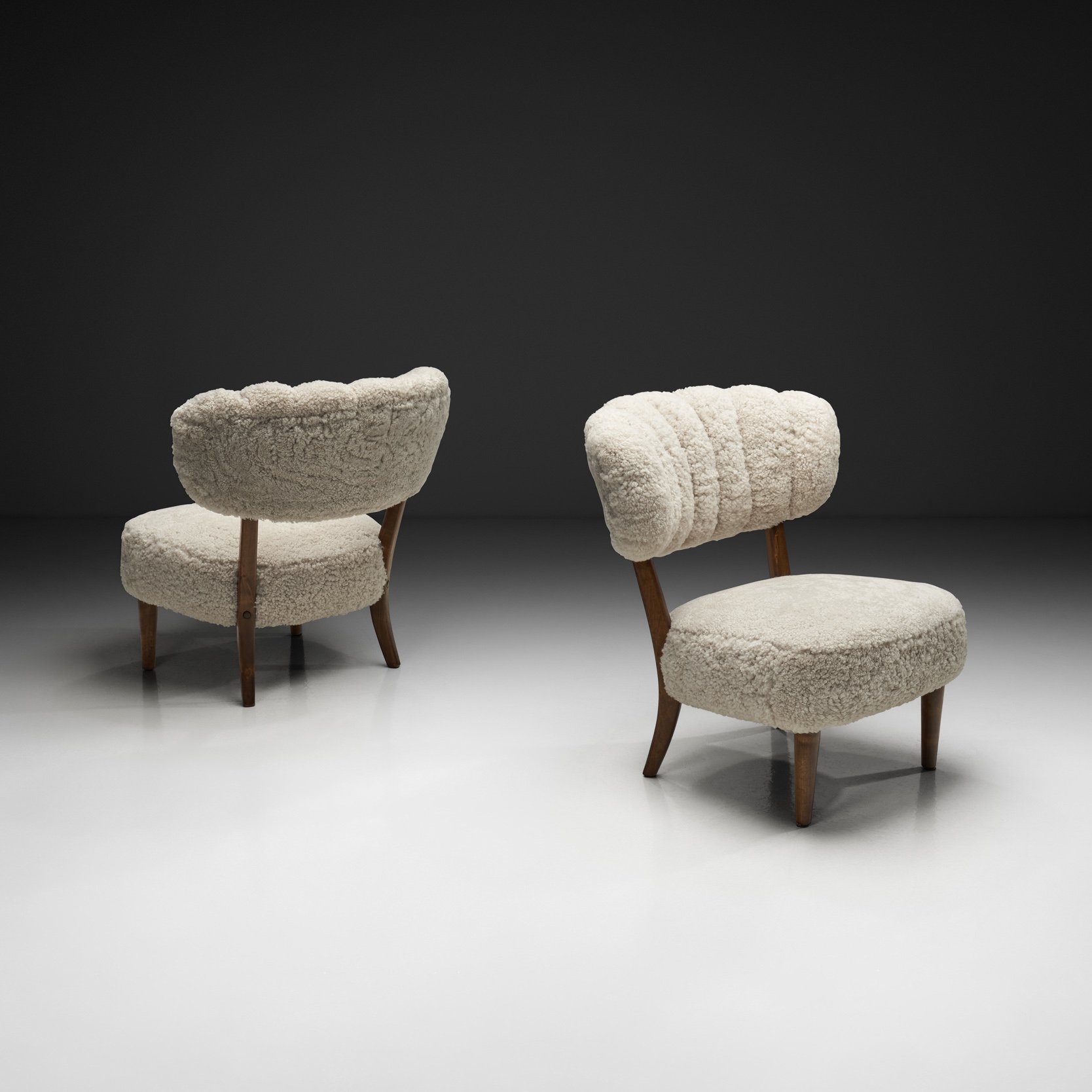
The design is focused on the aesthetics of modernism whilst employing the exquisite qualities of the upholstery. In many ways this chair transcends the word ‘modern’ thanks to its unique look. The outstanding look is the result of the brilliant pairing of materials. The solid wood structures’ smooth lines stand out even under the highly textural shearling while also accentuating the individuality of the upholstery. The soft fibres of the lightweight, curly Mongolian shearling drape beautifully over the lounge chairs, while the light greyish colour provides a lot of depth. As opposed to traditional shearling, Mongolian lamb/shearling (also known as shag) is a long, flouncy fur celebrated for its softness and luxurious volume. As it can be expected from Nordic pieces, functionality, and comfort are still kept at the core of the design. This is especially evident in the gently curved, enveloping backs and the tapered legs. The lacquered solid wood legs’ dark colour and smoothness further highlight the upholstery, creating a balanced look. Thanks to its visual qualities, mainly the shearling’s lush texture and colour, this pair of infinitely cosy lounge chairs can also be used as accent pieces to break the restrained aesthetic of any minimalistic space.
The use of exquisite materials, the combination of crafts with industrial production, and the obvious influence of the organic in Finnish design all created a stir of excitement during the 20th century. This excitement carries on today thanks to pieces such as these exceptional lounge chairs.
Condition:
In good vintage condition. Wear consistent with age and use. The chairs have been reupholstered recently in Mongolian shearling. Each of our items can be re-upholstered by our in-house atelier in a fabric of choice. Please reach out for more information.
Dimensions:
30.31 in W x 34.25 in D x 30.7 in H; Seat height 18.11 in
77 cm W x 87 cm D x 78 cm H; Seat height 46 cm
REQUEST PRICE HERE
Price category: 20,000 - 30,000 usd / eur
Finland and Helsinki are extremely important in mid-century modern design history, and one of the most famous designers of the period was Alvar Aalto. In contrast with the functionalism of the international style, Aalto brought a refreshing breath of humanism to modern design, as evidenced by this pair of Model “400” armchairs.
There is a saying that “Functionalism is a Finnish thing”, and it is hard to argue with that when looking at this pair of chairs. Functionality is without a doubt one of the most important aspects of Finnish design, however, there is also a demand for the highest quality, both in design and materials. Alvar Aalto is the Finnish icon of functionalism, and through this “400” or “Tank” model it is easy to see why. The design is first and foremost functional, combining practicality and aesthetics. These chairs feature a solid wooden frame with a striking silhouette. The arms are particularly distinctive thanks to their geometric look. They create a sculptural line that complements the simplicity of the overall form. The wood is painted black and pairs beautifully with the green upholstery, offering a restrained yet sophisticated material contrast. The choice of green allows for a sense of luxury and richness while still remaining grounded.
Aalto's free-form designs, in harmony with human needs and nature, anticipated the organic modernism of the 1950s and 1960s. This model can be a design statement in any space while also serving its functional purpose.
Condition:
In good vintage condition. Wear consistent with age and use. The armchairs have recently been reconditioned. Due to the nature and age of the materials, the items may have some marks, scratches, and discolouration. The pair has recently been reupholstered in a premium fabric. Each of our items can be reupholstered by our in-house atelier in a fabric of choice. Please reach out for more information.
Dimensions:
30.51 in W × 34.64 in D × 25.98 in H; Seat height 15.35 in; Seat depth 23.62 in; Arm height 19.29 in
77.5 cm W x 88 cm D x 66 cm H; Seat height 39 cm; Seat depth 60 cm; Arm height 49 cm