
Danish Cabinetmaker Upholstered Armchair, Denmark 1930s

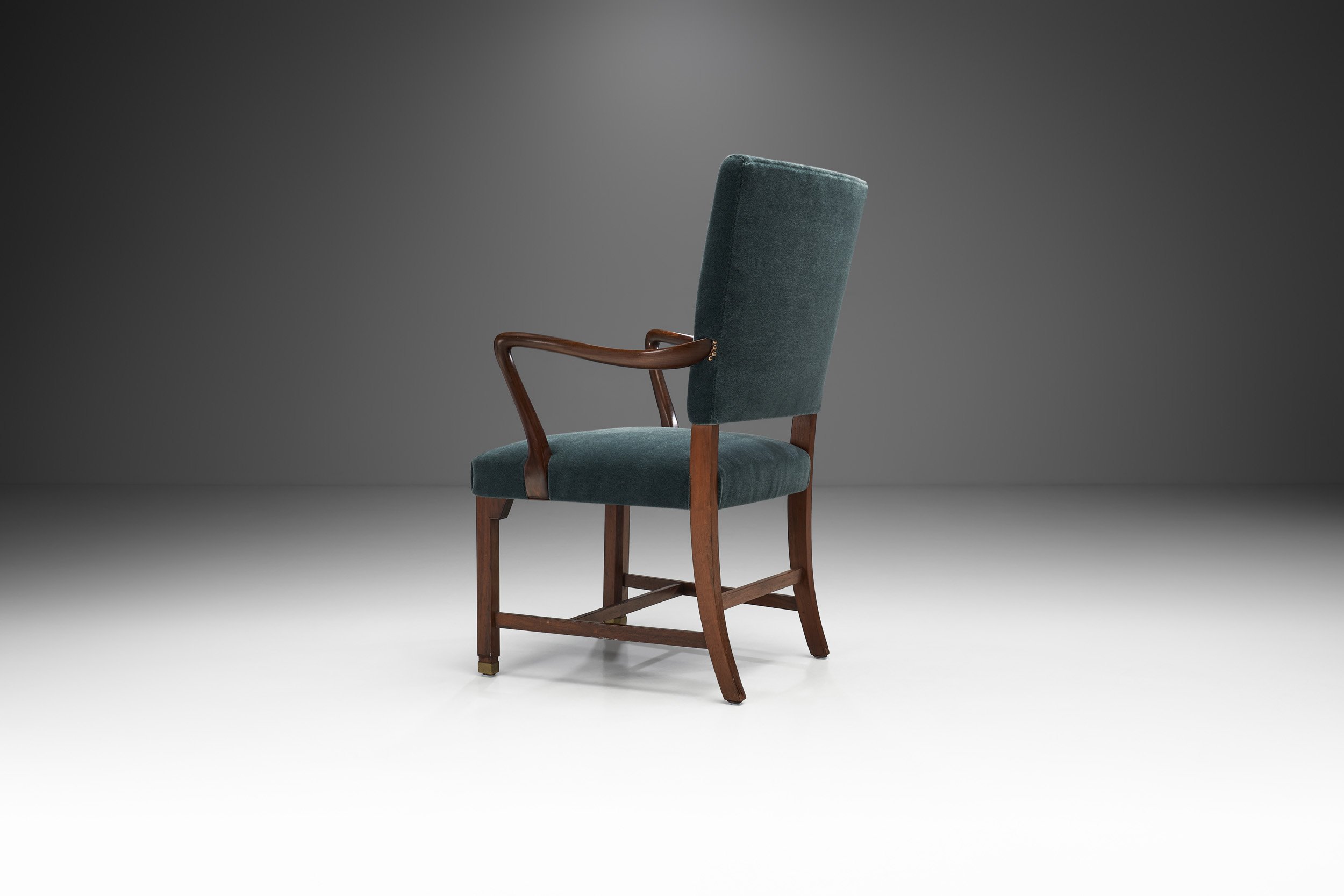


Danish Cabinetmaker Upholstered Armchair, Denmark 1930s
REQUEST PRICE HERE
Price category: 500 - 2,500 usd / eur
This unique easy chair is a great representation of the quality and craftsmanship of Danish master cabinetmakers and the immediately recognizable characteristics of Scandinavian design. Particularly visible here is the Danish designers’ predilection for curvilinear shapes and architectural precision.
The expert woodworking of the elaborate wooden structure paired with the upholstered back and seat is a signature characteristic of Danish Modernism. The outstanding visual characteristic of this chair are the curved arms and the lower structure that dominate the overall design. The arms appear to be clasping the seat, while the straight lines of the legs and back are broken by the flowing shape of the armrests. The backrest is unattached to the seat which creates a feeling of weightlessness, which is further amplified by the slim wooden parts. Another distinctive feature are the two pairs of stretchers set parallel. These stretchers brace and hold together the two side sections of the legs giving structural firmness. The front legs hold the sole decorative element, the small brass “shoes” that are a delightful detail. The blue fabric of the upholstery complement the dark wood elegantly, highlighting its grain.
Danish Modernism has influenced Scandinavian furniture to a great degree, defined by minimalism, simplicity, and functionality. The muted colours and gentle designs make Danish mid-century furniture an ideal addition to contemporary living spaces. Additionally, master cabinetmakers were highly aware of body proportions, prioritizing comfort just as much as the visual qualities.
Condition:
In good vintage condition. Wear consistent with age and use. Some scratches and marks on the wood. The chair has been upholstered recently in a premium fabric. Each of our items can be re-upholstered by our in-house atelier in a fabric of choice. Please reach out for more information.
Dimensions:
24.01 in W x 24.01 in D x 34.25 in H; Seat height 18.5 in
61 cm W x 61 cm D x 87 cm H; Seat height 47 cm

REQUEST PRICE HERE
Price category: 7,500 - 10,000 usd / eur
This rare oak easy chair showcases the homely curviness that defined the design of the 1950s in the Nordic countries. Hiort af Ornäs developed the model for his own furniture company, ‘Hiort Tuote Valmistaja Puunveisto Helsinki’, or ‘Hiort Product Manufacturer Puunveisto (woodcarver) Helsinki’.
The body has a soft, sculptural shape paired with an ergonomic and firm construction. Hiort af Ornäs was very firm about two things regarding his chair designs: the sitting comfort and that the model must look good from every single angle. Much like the “Pedro” model, this easy chair easily fulfils these principles, as even from the bottom, it showcases the expertly carved oak structure. The removable seat cushion, framed by the open body, ensures the sitting comfort. The seat, back- and armrests are all formed from a single piece that has an organic, outward curving look that is highly inviting and stylish. Especially on the armrests, the curves highlight the texture of the velvet upholstery and vice versa. The fabric is most appealing on rounded, curving forms, therefore it is a perfect match for this easy chair. The legs on the other side have a more straightforward design, creating an interesting contrast with the upholstered body. They are gently splayed and bent to support the seat and display the oak’s beautiful, darker shade. The craftsmanship and quality of Hiort af Ornäs is very visible in this easy chair.
The seating designs of the architect/designer have been gradually more and more recognized world-wide, which resulted in a recent exhibition titled “Forgotten Ornäs”. Form follows function is a principle of design associated with early and mid-20th century architecture and furniture design, stating that the shape of a building or object should primarily relate to its intended function or purpose. This was evidently an important principle for the designer, seen in the design of both the structure and aesthetic elements.
Condition:
In good vintage condition. Wear consistent with age and use. This chair has been reupholstered recently in premium velvet. Each of our items can be re-upholstered by our in-house atelier in a fabric of choice. Please reach out for more information.
Dimensions:
34.05 in W x 31.49 in D x 30.31 in H; Seat height 18.11 in
86.5 cm W x 80 cm D x 77 cm H; Seat height 46 cm
About the designer:
Carl-Gustaf Vilhelm (nicknamed “Nalle”) Hiort of Ornäs was born on 27 February 1911 and lived most of his life in Tapiola/Espoo in Finland and in his later life moved to Spain. He is remembered as a Finnish interior architect and designer known to be uncompromising.
Before the Finnish wars (1939-1944), Hiort af Ornäs spent his time in Pori, working at Björneborgs Mekaniska Verkstad. He studied at the Helsinki University of Technology to become an architect but never graduated. He did, however, become known as an interior designer, and eventually even more known as a furniture designer.
In 1945, Hiort af Ornäs founded the furniture company Puunveisto Oy, for which he developed versatile techniques for shaping plywood. He started the furniture manufacturing shop on Lauttasaari in Helsinki (Veneentekijäntie 14) together with his brother. The wood shop, showroom and office were all located in the same building in Helsinki. Rolf Mesterton was the man in charge of producing the furniture but there were several other carpenters at work in the woodshop. Hiort af Ornäs’s furniture was exhibited and sold by the shop Nupponen who also distributed Olavi Hänninen’s designs, while Puunveisto’s furniture were also sold by Gösta Westerbergs Möbler in Stockholm, Sweden but, in spite of a good selection of chairs, tables and shelves, did not do too well. Since production costs were high, Hiort af Ornäs faced economic troubles. The company was later sold to Nupponen after which Hiort af Ornäs’s interest in the company waned.
Hiort af Ornäs spent his retirement in Spain, and designed several buildings for Fuengirola’s Los Pacos neighbourhood, which has a large Finnish population. His house that he drew and built in Tapiola, Espoo, Finland, ‘Villa Hiort’, still stands and houses some of the designer’s original drawings. It is a beautiful example of 1950s Modernism and the talent of Hiort af Ornäs that brought him recognition that lasts to this day. ~H.