Art Deco Stool in Bookmatched Zebrawood, Europe 1930s (sold)


Art Deco Stool in Bookmatched Zebrawood, Europe 1930s (sold)
Most of Europe has a long history of furniture-making. Through the 19-20th century, the continent also had a very strong tradition of cabinetmaking, or producing traditional furniture by hand. In the early 20th century, these cabinetmaking traditions began to merge with modern forces to create simple and refined pieces showcasing an amazing level of woodworking like this stool.
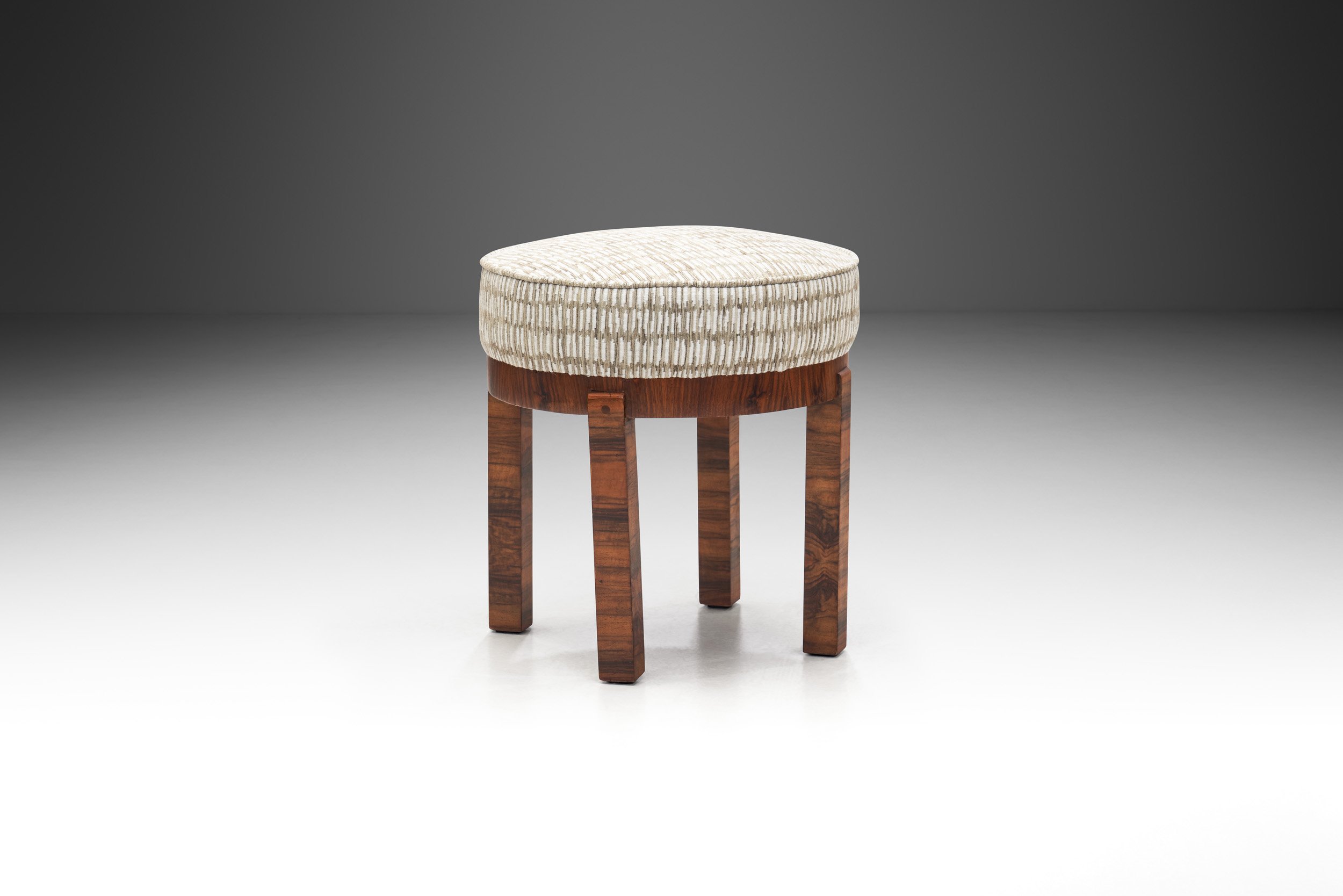
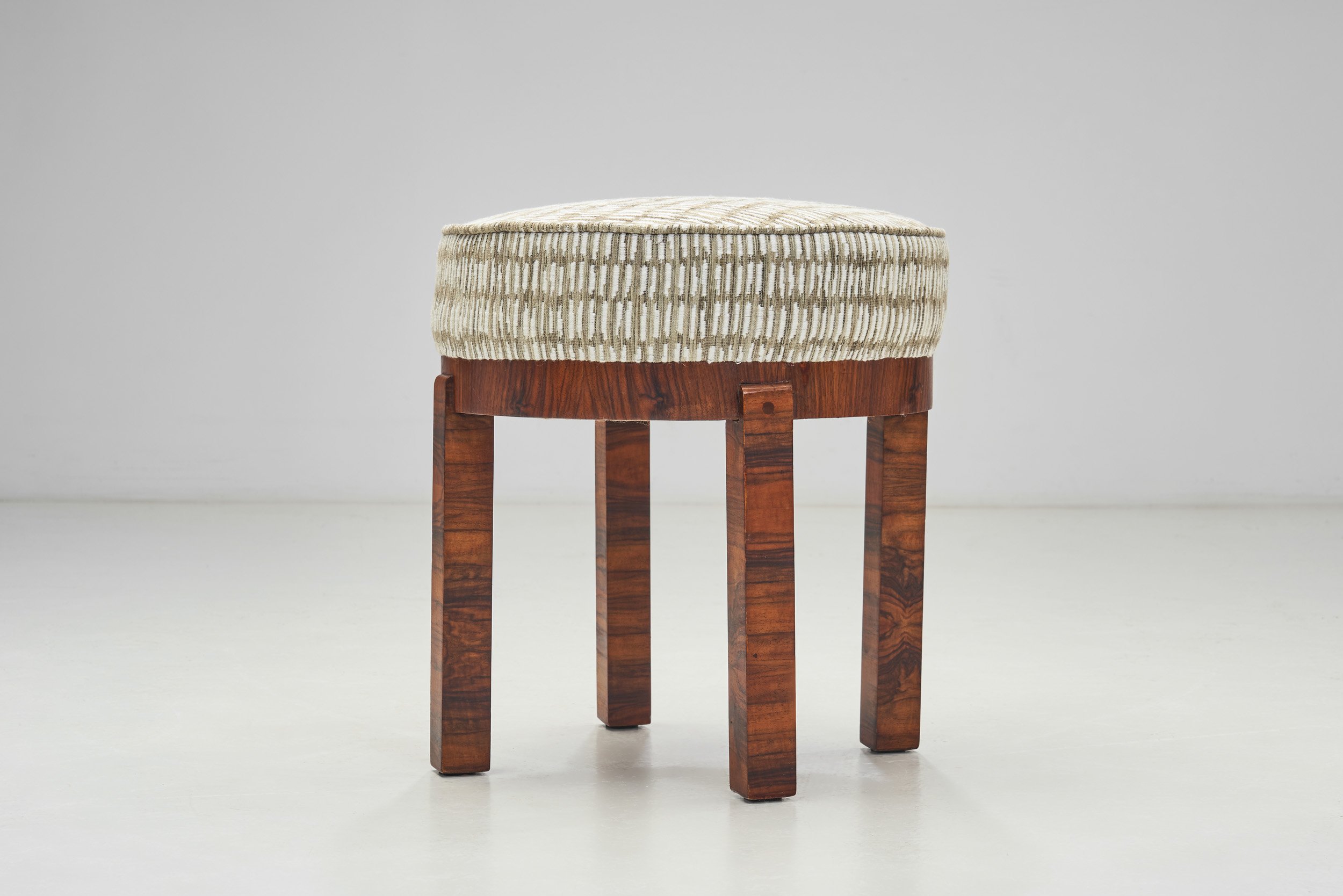
In the heady days of the 1930s’ Europe, an era marked by unprecedented cultural dynamism and bold artistic expressions, the Art Deco movement emerged as a testament to modernity and sophistication. This period witnessed the creation of exquisite furniture pieces that epitomized the union of form and function, this Zebrawood Art Deco Stool standing out as a prime example. The term "bookmatched zebrawood" refers to a meticulous woodworking technique where veneers are carefully sliced from a single piece of wood, creating mirrored patterns resembling the pages of an open book. Zebrawood, aptly named for its striking resemblance to the stripes of a zebra, was a favoured choice during the Art Deco era due to its distinctive grain patterns and rich, contrasting colours. The unique visual appeal of bookmatched zebrawood played a pivotal role in defining the luxurious and opulent aesthetic of Art Deco furniture and consequently, that of this stool. Art Deco design was characterized by geometric shapes, bold colours, and lavish ornamentation, reflecting the spirit of progress and innovation of the time. Zebrawood, with its inherent elegance and dynamic patterns, perfectly complements the sleek lines and angular forms prevalent in Art Deco furniture. The wood's warm tones and distinct grain add a touch of natural beauty to the otherwise modern impression of the design . The 1930s also marked a golden age of furniture design in Europe, with influential designers such as Jacques-Émile Ruhlmann and Jules Leleu contributing to the burgeoning Art Deco movement. These visionaries embraced new materials and innovative techniques while maintaining a commitment to craftsmanship and artistic integrity seen in this four-legged model. Stools, typically overlooked in comparison to larger furniture pieces, played a crucial role in the Art Deco interior. Their compact size and versatility made them ideal for multifunctional spaces, embodying the modern ethos of efficiency and adaptability. Today, stools are experiencing a resurgence in popularity as contemporary design embraces the concept of versatile and space-saving furniture.The upholstered seat in a premium patterned fabric highlights the round shape while quite literally also adding a functional layer to the stool.
This Art Deco Stool in bookmatched zebrawood serves as a captivating keepsake of an era marked by bold design and unparalleled craftsmanship. As a testament to the enduring allure of Art Deco furniture, this stool showcases the marriage of form and function, exquisite materials, and masterful woodworking. In a world where nostalgia meets modern sensibilities, the resurgence of stools as coveted design pieces highlight their timeless appeal and adaptability in contemporary living spaces.
SOLD
Condition:
In good vintage condition. Wear consistent with age and use. The stool’s seat has been upholstered recently in premium patterned fabric. Each of our items can be re-upholstered by our in-house atelier in a fabric of choice. Please reach out for more information.
Dimensions:
16.73 in ⌀ x 17.71 in H
42.5 cm ⌀ x 45 cm H
REQUEST PRICE HERE
Price category: 12,500 - 15,000 usd / eur
Despite being long misattributed to Axel Einar Hjorth, this “Pall” or “Palle” stool was designed and manufactured by K. J. Pettersson & Söner Storvreta in the second half of the 20th century. The stool is a striking example of Scandinavian design of the 1970s. It represents the Swedish brand's commitment to high-quality and sustainable design that would seamlessly blend into both modern and traditional interiors.
The model embodies principles of the mid-century and Scandinavian modern movements, where functionality, simplicity, and the use of natural materials take precedence. Visually, the piece features a bold and almost sculptural form, with clean lines and smooth surfaces that reflect the organic beauty of the wood. Its silhouette is minimalist yet distinctive, with a gently curved seat to provide ergonomic comfort. In the absence of heavy ornamentation, this stool takes pride in its material’s natural qualities. Pine wood became the bamboo of the north in the sense that it lasts for decades. The stool is constructed from several slats of pine wood, with the grain clearly visible, adding texture and warmth. Thanks to the individual blocks, which are visible from the side, the pattern and grain differs throughout, thus increasing the visual appeal. The base of the stool is open on each side, emphasizing its sculptural look and providing a sense of airiness. This thoughtful craftsmanship not only highlights the beauty of the material but also ensures stability and practicality in use. This sort of northern minimalism allows people to invite peace into their home without creating a space that is uninviting or cold. Similarly, this stool is full of vitality without being chaotic or overworked.
The stool is a testament to the timeless quality of Scandinavian design, which continues to resonate in contemporary interiors. Its unadorned elegance make it a perfect piece for modern homes, offering both style and utility. With its durable construction and inviting form, this piece is more than just a stool—it is a work of art that would bring a sense of natural beauty and practicality to any space.
Condition:
In good vintage condition. Wear consistent with age and use. Item has some small chips and marks. The wood has a nice patina.
Dimensions:
23.42 in W x 23.62 in D x 11.15 in H
59.5 cm W x 36 cm D x 36 cm H
About the designer:
The “Pall” or “Palle” tabouret has long been associated with Hjorth, however, many with knowledge in the field suspected it to be a misattribution both in terms of period and designer. Swedish auction house, Uppsala Auktionskammare finally put an end to the mystery surrounding this stool design in early January 2020, when in their Decorative Sale auction catalogue a model of the previously misattributed Pall stool was for the first time attributed to K.J. Pettersson & Söner.
The Swedish town of Storvreta was known for its many furniture manufacturers and the largest among them was Karl Julius Pettersson and Sons (Gösta, Nils, Karl-Erik and Birger respectively) furniture manufactory. Pettersson & Söner started as a small-scale manufacturing business in 1933 in a building at the address Fullerövägen 9. Production grew rapidly, resulting in a larger factory and furniture shop, now under the company’s name, AB K. J. Pettersson & Söner. In 1948 a separate furniture store / exhibition hall was started on the property next to the furniture factory, which a few years later was moved to more suitable premises. In 1953 the expansion continued with another, even larger factory building which still survives.
The furniture company specialised primarily in sofa beds with patented constructions. In low season the company employed around fifty to sixty people, while in high season, the number grew to around a hundred. As Karl-Erik Pettersson reminisced:
“A good thing was that we didn't have to ask any authority for permission to build during the first 10-12 years. It was just putting the shovel in the ground and building as we wished. And we really built. We expanded the factory and we built it privately. But, as the municipal bureaucracy expanded, more and more people wanted to be involved in deciding what we should do and how we would do it. We continued to specialize in sofa beds, corner beds and countertops. And it went well and time and time again we got our sofas jury-selected at the big furniture fairs.” K. J. Pettersson & Söner worked in Storvreta for 48 years until closing down in 1980.
REQUEST PRICE HERE
Price category: 1,000 - 2,500 usd / eur
This stool is aesthetically, a tempered Modernism in design: clean forms without exaggeration with the high-quality work of Danish cabinetmakers. Humble in its material and size, this pine stool still draws attention thanks to its distinctive look and personality.
In the absence of heavy ornamentation, this stool takes pride in its material’s natural qualities. Pine wood became the bamboo of the north in the sense that it lasts at least a hundred years — that’s how long it takes for a pine tree to grow into the lengths when it’s ready to harvest. With its restrained, light colour palette peppered with gnarly knots, pine furniture have been favoured in Scandinavia for centuries and there is a contemporary renewal of interest and appreciation as well. This tripod stool shows why: standing on tapered legs, the seat displays the beautiful patterns of the wood and the simple, elemental joinery technique. The distinguishing feature however, is the shape of the seat. The front side is scalloped with gently rounded edges, creating a modern, stylish look. The construction strips back the unnecessary, showcasing only the essential elements of it. The wood is left in its natural form as much as possible, while also prioritizing functionality and longevity.
Alongside the touchstones of simplicity, functionality, and comfort, Danish design utilizes light, creates use of natural materials, and integrates with nature. This sort of northern minimalism allows people to invite peace into their home without creating a space that is uninviting or cold. Similarly, this stool is full of vitality without being chaotic or overworked.
Condition:
In good vintage condition. Wear consistent with age and use. Some small scratches and marks on the wood.
Dimensions:
16.73 in W x 13.18 in D x 14.17 in H
42.5 cm W x 33.5 cm D x 36 cm H
REQUEST PRICE HERE
Price category: 2,500 - 5,000 usd / eur
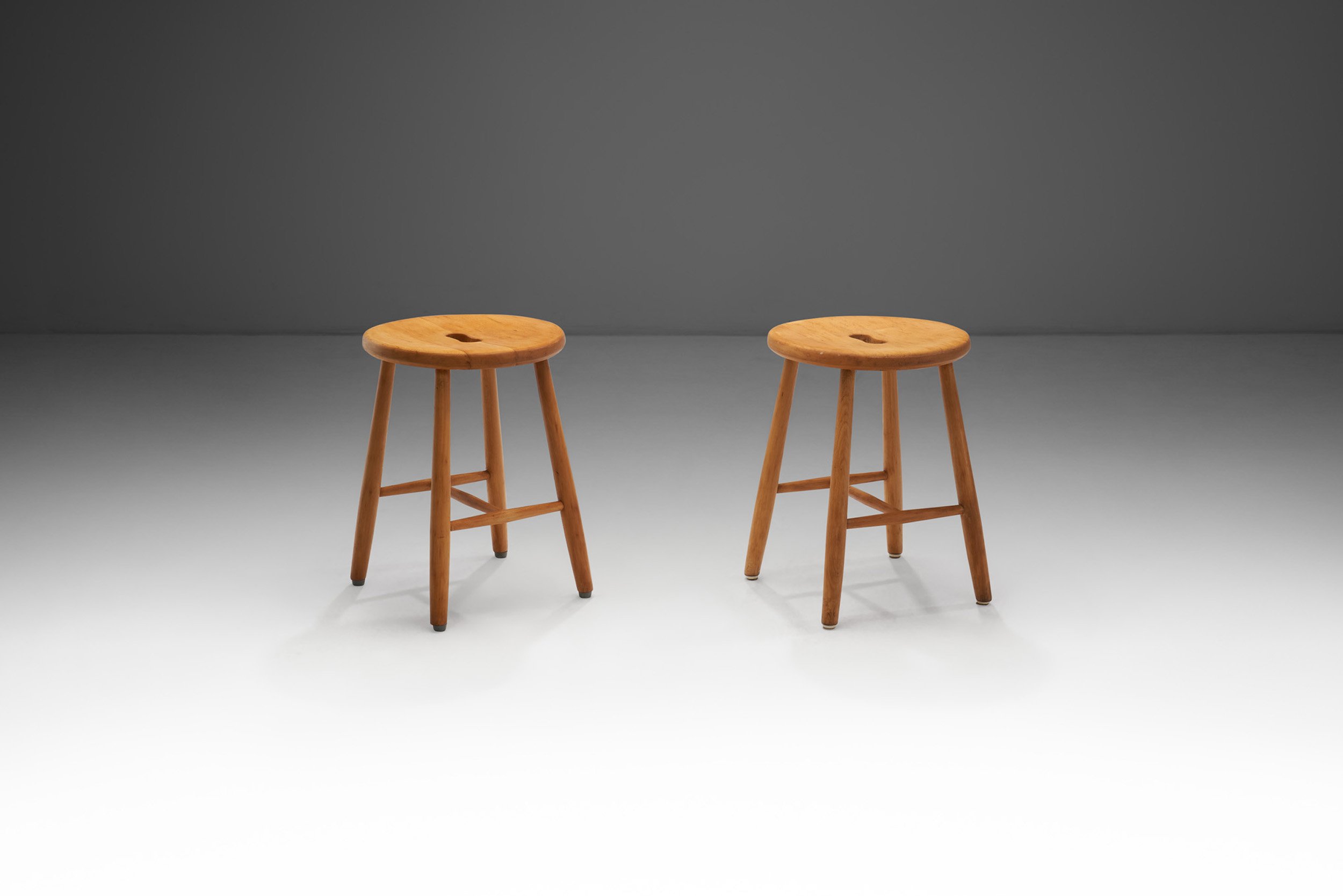
Designed by Børge Mogensen in 1955, the “J27” stool remains a solid and practical piece. With a multitude of purposes, form and function remain at the forefront of this design. Almost everyone in Denmark has experienced Børge Mogensen’s designs – from the well-known, modern FDB furniture - like these stools - to countless classics that have furnished both homes and public spaces in Denmark.
This pair of solid beech stools by Danish master, Børge Mogensen, has an outstanding balance with a classic, timeless design. These “J27” models mirror Mogensen’s ideal, which was to create furniture with a restrained aesthetic that serve people. With a clear statement of simplicity, quality and respect for materials, this pair of stools is a great example of Danish Modern design. The functional elements converted into decorative features is characteristic of Mogensen’s design aesthetic. As such, the holes on the seats and stretchers are not only important utilitarian and structural features, they are also visually appealing details that give plenty of character to these stools. Mogensen’s present design was executed by FDB Møbler, the Danish manufactory established in 1942, with a heritage of unfaltering dedication to the perfection and progression of the design craft.
Børge Mogensen believed that furniture should fit the human being, rather than the other way around and that functional quality furniture is paramount. For the book by the bed or when an extra guest needs to be squeezed in at the dining table, this pair of stools is perfect as it is both practical, decorative and thoroughly well-designed.
Condition:
In good vintage condition. Wear consistent with age and use. Some scratches and marks on the wood.
Dimensions:
13.77 in W x 13.38 in D x 18.11 in H
35 cm W x 34 cm D x 46 cm H
REQUEST PRICE HERE
Price category: 1,000 - 2,500 usd / eur
Minimalism may be currently in fashion, but there is one iteration of clean design that will never go out of style which is Scandinavian Modernism. It is no small achievement to be able to exercise restraint in décor choices, while still managing to make a space feel cosy.
The Swedish Modern style is so popular because it speaks to both our tidy tendencies and our desire to live in inviting and comfortable settings. Warm wood tones and sepia hues are popular in Scandinavian interior design because they make a room feel sunny and bright without using overwhelmingly bright colours. Pinewood is perhaps the most defining natural material of traditional Swedish cabinetmaking. “Furu” (pine) is a wood that creates healthy and sustainable interiors with modern expressions, which contributes to the wood's strong progress even nowadays. When world-class designers choose to work with pine, it is a sign that it is a type of wood that has an obvious place in modern interiors. This stool has a perfectly understated design that lets the material stand out. While the structure evidently serves functionality at its core, there is a feature that serves a purely aesthetic role. The carved parts connecting the seat and the legs are - in a way - the most Swedish feature of the design, showing that there needs to be balance, not just structural, but also visual.
Pinewood is comfortable and tactile. Wood interiors not only smell good, they also have a calming effect on us humans. That wood contributes to healthier indoor environments is an added bonus. This has been well-known for centuries in Scandinavia, and luckily, the rest of the world has been catching on.
Condition:
In good vintage condition. Wear consistent with age and use.
Dimensions:
18.11 in W x 10.23 in D x 17.32 in H
46 cm W x 26 cm D x 44 cm H
REQUEST PRICE HERE
Price category: 500 - 1,000 usd / eur
Functional design is the evident guiding principle of many Scandinavian pieces from the early mid-century, and there is hardly a better example than this oak stool. In earlier days, similar “shoemaker” stools were often used in the home for informal seating, and this tradition is making a comeback.
The design is principally simple and functional, letting the natural beauty of the oak wood and simple artistry be in the focus. From Mogens Lassen to Arne Hovmand-Olsen, multiple Danish designers created tripod stools during the mid-20th century. Nonetheless, the stool as a piece of furniture is often still underestimated, even though it can be a statement piece in any interior. Form and function collide in this model, and it resembles the beloved ‘Shoemaker Chair’ by Form & Refine, the genuine Danish design classic that was released in 1936. Just like in that model’s case, the three-legged design is inspired by the traditional cobbler’s stool. The most important was the seat’s ergonomic design, as the user spent a considerable amount of time sitting on it, therefore this stool has an ergonomic so-called tractor seat. The legs are tapered and connected by stretchers to provide a firm base for the seat and the sitter. Each separated element of this stool is rendered out of one large, solid piece of wood, showcasing the maker’s skills in woodworking, which is also very apparent in the smoothness of the surfaces and the joinery.
This early mid-century piece has the main characteristics Danish design is famous for. From the sculptural shape to the functional design and the great craftsmanship, this stool is a great accent to any space, and could become an heirloom piece thanks to its visual and material qualities.
Condition:
In good vintage condition. Wear consistent with age and use. The wood has a nice patina.
Dimensions:
19.29 in W x 11.61 in D x 18.89 in H
49 cm W x 29.5 cm D x 48 cm H
REQUEST PRICE HERE
Price category: 1,000 - 2,500 usd / eur
Functional design is the evident guiding principle of many Scandinavian pieces from the early mid-century, and there is hardly a better example than this milking stool. In earlier days, similar stools were often used in the home for informal seating, and this tradition is making a comeback.
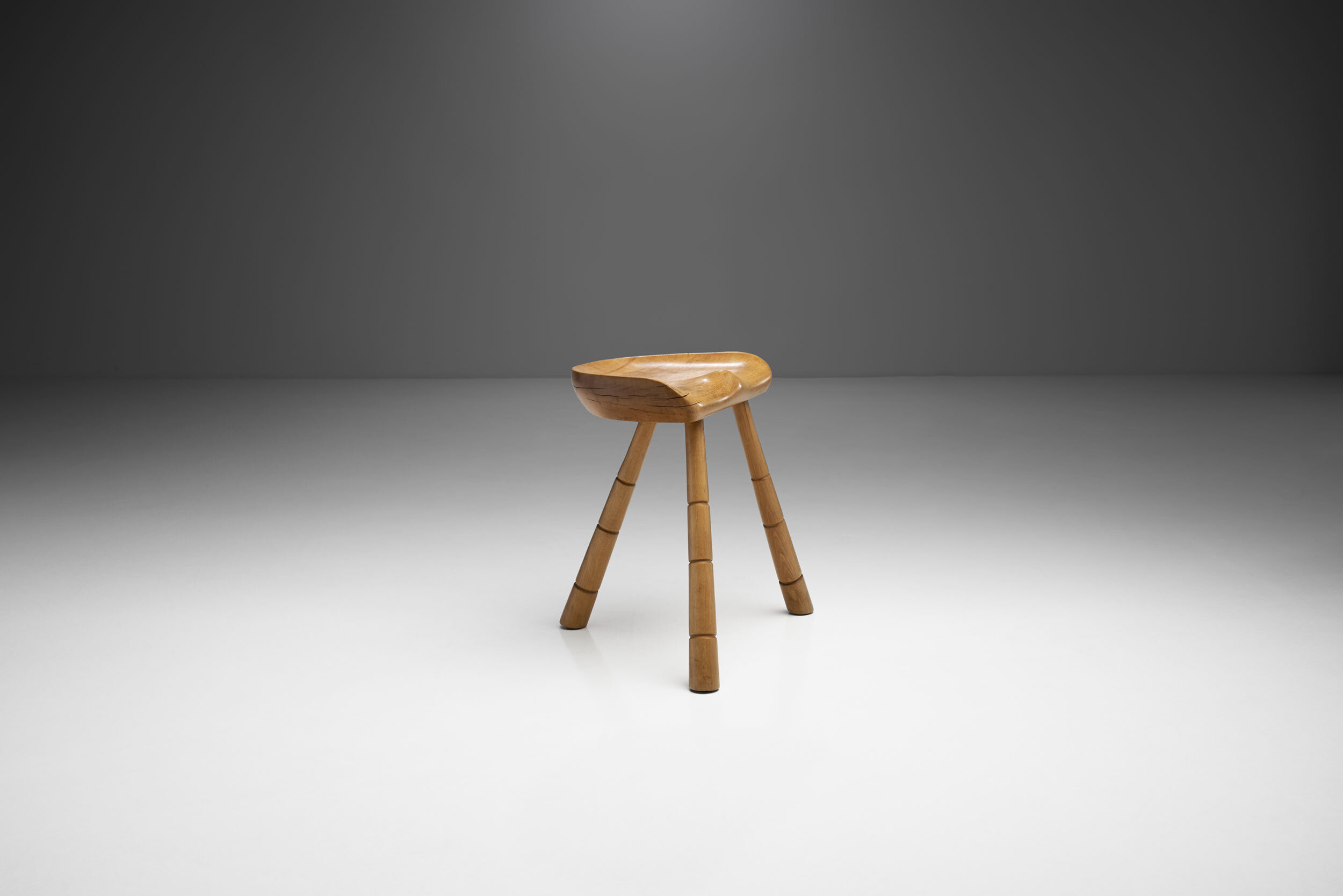
The design is simple, yet stylish, letting the natural beauty of beech wood and simple artistry be in the focus. From Mogens Lassen to Arne Hovmand-Olsen, multiple Danish designers created tripod stools in the mid-20th century. Despite this, the stool is often still underestimated as a piece of furniture, while it can be a statement piece in an interior. Form and function collide in this stool, as the three-legged design was inspired by a traditional cobbler’s stool. The most important was the seat’s ergonomic design, as the user spent a considerable amount of time sitting on it. The legs are tapered, providing a firm base for the seat and the sitter. The visual element that makes this particular stool distinct is the carving on the legs. Each leg has three “rings” carved into them, which is an elementary form of decoration, yet very effective in this case. Furthermore, it showcases the maker’s skills in woodworking, which is also very apparent in the smoothness of the seat.
This mid-century piece has the main characteristics Danish design is famous for. From the sculptural shape to the functional design and the great craftsmanship, this stool is a great accent to any space.
Condition:
In good vintage condition. Wear consistent with age and use. The wood has some cracks and marks.
Dimensions:
19.68 in W x 13.77 in D x 15.74 in H
50 cm W x 35 cm D x 40 cm H
REQUEST PRICE HERE
Price category: 500 - 1,000 usd / eur
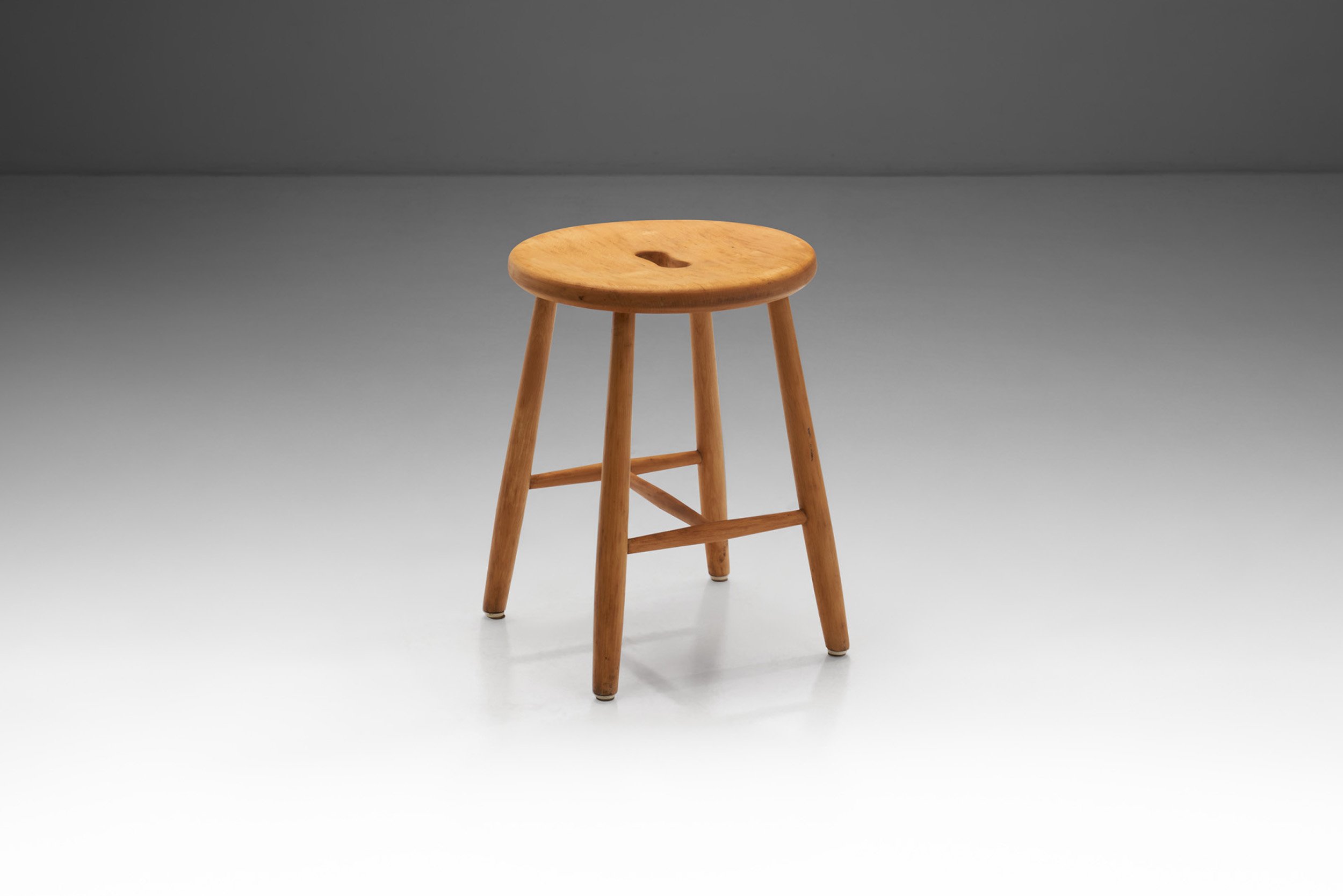
Designed by Børge Mogensen in 1955, the “J27” stool remains a solid and practical piece. With a multitude of purposes, form and function remain at the forefront of this design. Almost everyone in Denmark has experienced Børge Mogensen’s designs – from the well-known, modern FDB furniture - like this stool - to countless classics that have furnished both homes and public spaces in Denmark.
This solid beech stool by Danish master, Børge Mogensen, has an outstanding balance with a classic, timeless design. This “J27” model mirrors Mogensen’s ideal, which was to create furniture with a restrained aesthetic that serve people. With a clear statement of simplicity, quality and respect for materials, this stool is a great example of Danish Modern design. The functional elements converted into decorative features is characteristic of Mogensen’s design aesthetic. As such, the hole on the seat - for easy lifting - and stretchers are not only important utilitarian and structural features, they are also visually appealing details that give plenty of character to the design. Mogensen’s present design was executed by FDB Møbler, the Danish manufactory established in 1942, with a heritage of unfaltering dedication to the perfection and progression of the design craft.
Børge Mogensen believed that furniture should fit the human being, rather than the other way around and that functional quality furniture is paramount. For the book by the bed or when an extra guest needs to be squeezed in at the dining table, this stool is perfect as it is both practical, decorative and thoroughly well-designed.
Condition:
In good vintage condition. Wear consistent with age and use. Some scratches and marks on the wood.
Dimensions:
13.77 in W x 13.38 in D x 18.11 in H
35 cm W x 34 cm D x 46 cm H
REQUEST PRICE HERE
Price category: 1,000 - 2,500 usd / eur
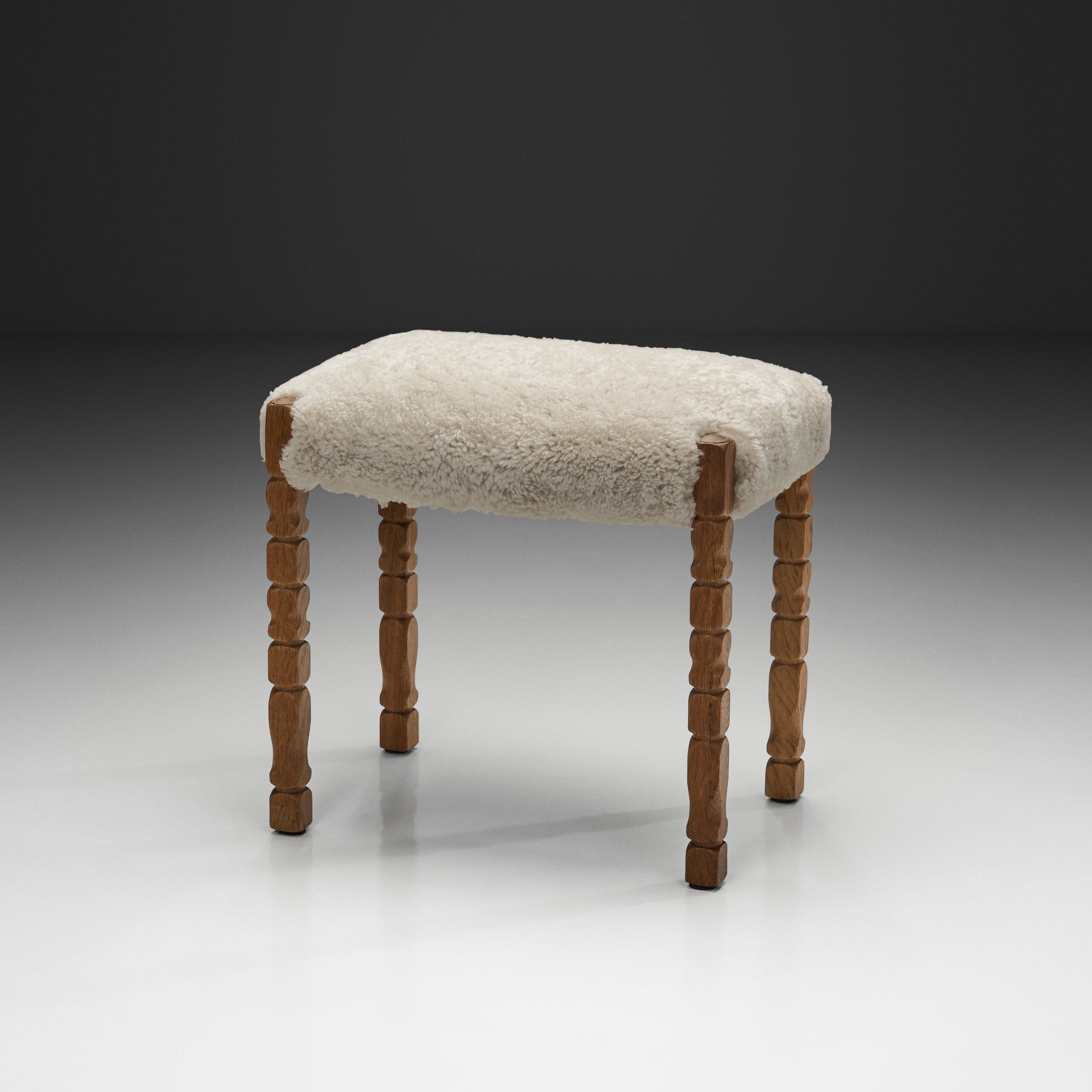
Danish furniture from the 1970s saw an interest in craftsmanship and natural materials, moving away from strict industrial modernism toward pieces with a more tactile and handmade character. This oak stool reflects the cabinetmakers’ interest in highlighting the texture of wood through carving, turning, and exposed grain, while materials such as sheepskin and wool were introduced to soften otherwise simple constructions.
Rather than concealing elements of the construction process, pieces from this period embraced it, allowing hand-worked details to become part of the final expression. This stool showcases the contrast between its heavily carved legs and soft sheepskin seat. The frame is constructed through essential elements: four turned legs supporting a thick upholstered top. Each leg is individually worked with rounded carvings that create a rhythmic appearance, giving the otherwise compact stool a strong sculptural quality. The oak retains a warm natural tone that highlights the carving and the variation in the grain. Above, the padded seat is upholstered in cream sheepskin, introducing a different texture to the composition. The wool surface softens the geometry of the wooden structure and gives the piece a tactile warmth. Thanks to the upholstery, the stool gains a fuller and more relaxed silhouette despite its minimal construction.
The balance between rough carved wood and soft sheepskin gives the piece its timeless appeal. This piece functions as extra seating, a footstool, or as a small accent, while still carrying the material richness and presence of Scandinavian furniture of the period.
Condition:
In good vintage condition. Wear consistent with age and use. The stool has recently been reconditioned. Due to the age and nature of the wood, the item may have some marks, scratches, and discolouration. The piece has recently been reupholstered in premium sheepskin. Each of our items can be reupholstered by our in-house atelier in a fabric of choice. Please reach out for more information.
Dimensions:
19.69 in W x 13.78 in D x 18.51 in H
50 cm W x 35 cm D x 47 cm H