French Natural Wood and Woven Rope Armchair, France 1950s (sold)


French Natural Wood and Woven Rope Armchair, France 1950s (sold)
This mid-century French armchair combines a visually stunning structural body with an expert rope waving technique and high quality materials.
As with the UK and much of Europe, there was something of a design renaissance in France in the 1950s, due to developments in materials and technology after the war. In France, designers were often also architects, whose focus on functionality and quality resulted in sculptural models, such as this chair. Among many others, top French interior designer, François Catroux, also collected outstanding models, including this chair that comes from the designer’s private collection. This chair is dominated by its solid, natural wood frame. Thanks to its dark colour, the elaborate structure is more pronounced, framing the woven rope panels of the back and seat beautifully. The wooden lines are wide and thick, allowing the wood’s pattern and natural appeal to stand out. The thick, club legs lend a distinctive look to the design, which is further enhanced by the cross stretchers connected by a ball in the middle. The light back- and seat rest bring balance to the design with the twisted rope carefully woven around the wood.
This chair shows François Catroux’s eye for quality design. The design is of the type that doesn’t show up at every corner, making it a stunning piece of French design history. Catroux was known for his ability to transform any space into a fine, warm, and comfortable place to be, an ability that he and this chair share.
SOLD
Condition:
In good vintage condition. Wear consistent with age and use. The chair has its original rope woven seat and back.
Dimensions:
26.77 in W x 25.19 in D x 30.11 in H; Seat height 14.56 in; Arm height 21.65 in
68 cm W x 64 cm D x 76.5 cm H; Seat height 37 cm; Arm height 55 cm
REQUEST PRICE HERE
Price category: 2,500 - 5,000 usd / eur
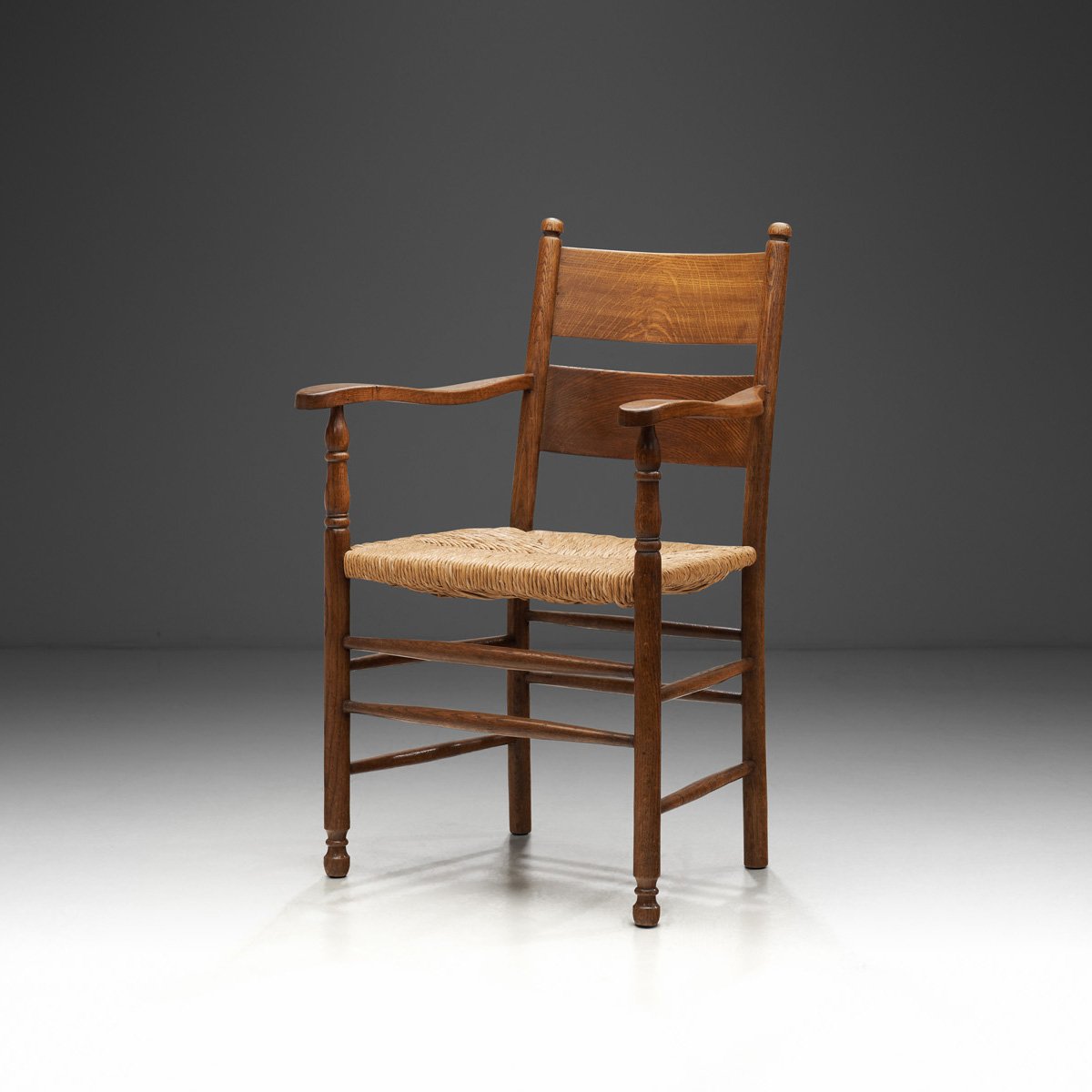
This rustic armchair embodies the aesthetic, practicality and functional design that was valued in European homes of the early 20th century. Displaying artisanal techniques such as weaving and beautifully carved details, pieces such as this chair showcase the expert craftsmanship of 20th century woodworkers and furniture designers.
This armchair showcases a timeless blend of simplicity and craftsmanship. Constructed from solid oak, the chair features a sturdy frame with a warm, natural finish that highlights the wood's grain and durability. Oak was the favoured material in this period for its resilience and beautiful grain pattern, thus increasing the visual depth of the chair. The seat is made of tightly woven rush, which adds beautiful texture and a traditional look, while still maintaining comfort through its natural flexibility. By being entirely constructed from natural materials, this piece maintains its classic charm typical of early 20th century furniture, while adding versatility through its unpretentious, organic character. The armrests feature a subtle curve, providing ergonomic support, highlighting the chair's understated elegance. Two wooden stretchers are positioned between each pair of legs, creating symmetry within the design. These additions go beyond their aesthetic purpose - not only do they complete the design but they also reinforce the structure, lending it additional stability.
This armchair showcases the inherent beauty of natural materials, as well as the simple honesty of 20th century design. Its balanced proportions and natural materials make it an indisputably valuable piece, equally suited for a cozy kitchen or a modern rustic interior.
Condition:
In good vintage condition. Wear consistent with age and use.
Dimensions:
23.22 in W x 23.62 in D x 37 in H; Seat height 15.94 in; Seat depth 16.53 in; Arm height 27.95 in
59 cm W x 60 cm D x 94 cm H; Seat height 40.5 cm; Seat depth 42 cm; Arm height 71 cm
REQUEST PRICE HERE
Price category: 2,500 - 5,000 usd / eur
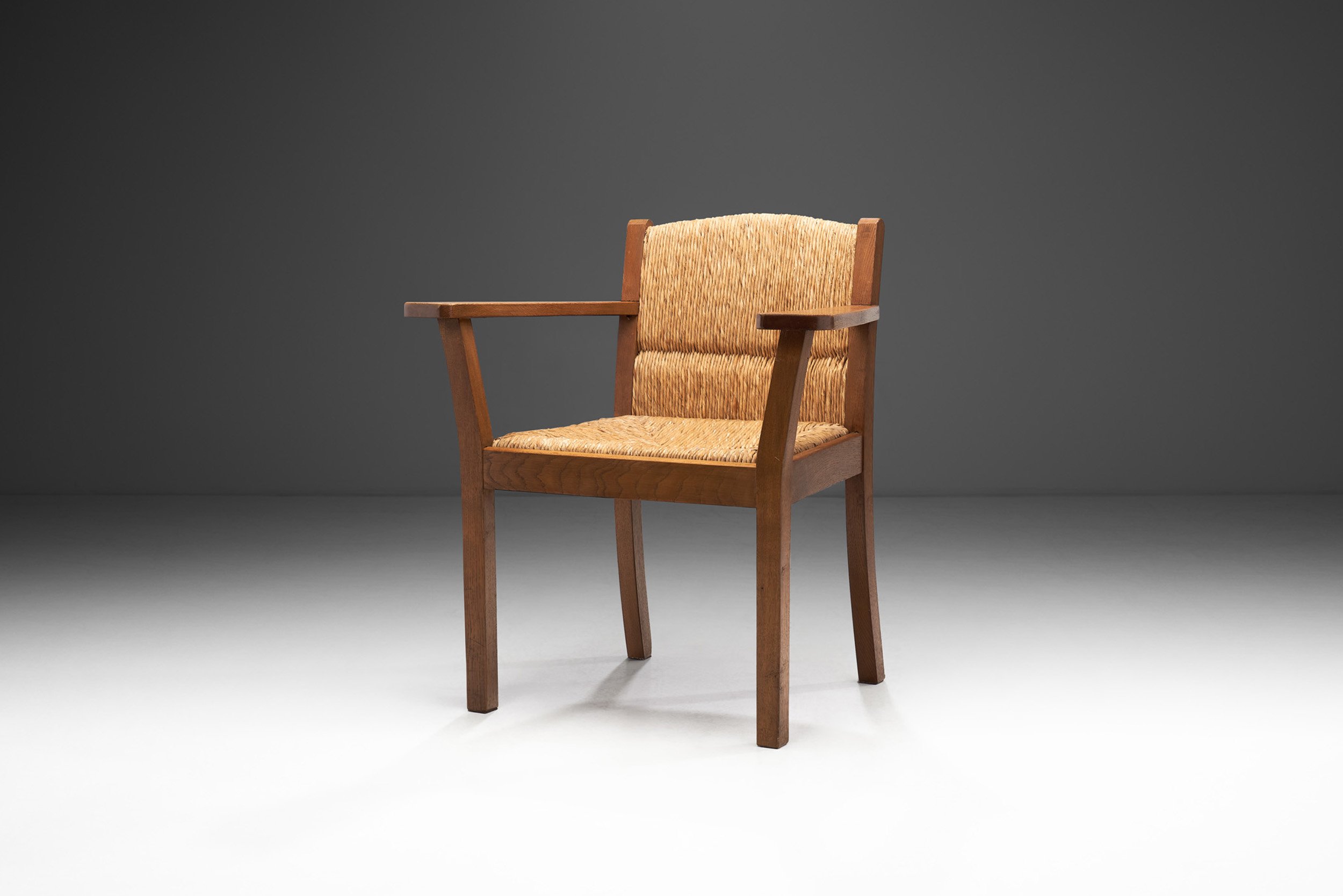
This beautiful 'Worpsweder' armchair was designed in the 1920s by German artist, Willi Ohler and was manufactured by Erich Schultz in Germany. The so-called “Worpsweder” either denote chairs made at the Worpsweder Kunsthütten (Worpsweder arts huts) in Germany, or a specific style of German chairs with solid wood frames, broad armrests, often from tall wood, with woven seats and backs.
The “Worpsweather” style’s design language and materiality is embodied in this pair: the structures are made up of solid oak elements. The seats and backs are woven braided from rush. This chair carries with it the same beloved modernist characteristics applied to American, Scandinavian, and Italian mid-century design – simple, functional – and shows the generally less known early 20th century rustic side of German design. The woven rush seat and back define the armchair’s aesthetic. The straight wooden lines of the minimalist wooden frame serve as the perfect canvas to showcase the appealing and artistic rush weaving. The structure has an airy impression despite being sturdy that is further enhanced by the absence of stretchers between the legs. With the additional organic charm provided by the woven rush seats, this chair is an ideal accent piece. The expert rush weaving pairs beautifully with the solid wood body, and gives this Worpsweder chair its rustic and organic charm.
Worpswede in Lower Saxony is famous nationwide for its long tradition as an artists' colony. Nowadays, about 130 artists and craftsmen and women live there permanently. The artists who created the so called "Worpsweder Kuentlerkolonie" were looking for the simple and original in art and life. One of the most famous members of this colony was Paula Modersohn-Becker. The traditional reed and rush woven chairs of this region were greatly appreciated by the artists of the colony, and some of them were still produced around 1900-1920. They have become collectors’ pieces thanks to the craftsmanship that went into each chair’s creation.
Condition:
In very good vintage condition. Wear consistent with age and use. Some marks and scratches on the wood and rush panels.
Dimensions:
30.51 in W x 25 in D x 32.87 in H; Seat height 18.5 in; Arm height 27.17 in
77.5 cm W x 63.5 cm D x 83.5 cm H; Seat height 47 cm; Arm height 69 cm
REQUEST PRICE HERE
Price category: 2,500 - 5,000 usd / eur
In mid-century Danish design, timeless elegance and craftsmanship dominated the era, combined with the use of organic materials such as wood and papercord. Crafted from the warm brown hues of wood, this armchair showcases the inherent beauty, versatility, and timeless charm of handmade furniture defined by highly skilled craftsmanship.
Wood’s natural lustre and ability to develop a beautiful patina over time make it an ideal material for crafting enduring and appealing pieces. This armchair boasts gracefully curved armrests and linear back slats, showcasing the artisan's keen attention to form and detail. The curved arms not only provide a comfortable resting surface, but also contribute to the overall aesthetic appeal of the chair. The backrest, with its gentle curve, adds a touch of individual character and refinement to the design. Each element of the chair reflects the organic sensibility that defined Danish mid-century cabinetmakers’ designs, where form and function seamlessly converged. However, what truly injects these chairs with their organic appeal is their seats woven from papercord. This choice of material adds an organic and tactile dimension to the design. Papercord, made from twisted and woven paper fibres, offers a natural and eco-friendly alternative to traditional seating materials. Its rich texture and earthy tones complement the warmth of the wood, creating a harmonious balance in both visual and tactile aspects. The meticulous craftsmanship of the joinery further enhances the chairs' allure; impeccably constructed with no visible screws, the seamless connections speak volumes about the artisan's dedication to precision and quality. The absence of visible hardware not only contributes to the chair’s aesthetic purity, but also underscores the skilled craftsmanship that went into its creation.
This Danish wooden armchair embodies the essence of mid-century design, where natural materials, graceful forms, and meticulous craftsmanship come together. The marriage of wood and woven papercord not only highlights the organic side of this design but also ensures that the chair remains not just functional, but also an enduring heirloom piece.
Condition:
In good vintage condition. Wear consistent with age and use.
Dimensions:
22.05 in W x 22.44 in D x 32.09 in H; Seat height 18.11 in; Seat depth 17.52 in; Arm height 25.79 in
56 cm W x 57 cm D x 81.5 cm H; Seat height 46 cm; Seat depth 44.5 cm; Arm height 65.5 cm
REQUEST PRICE HERE
Price category: 2,500 - 5,000 usd / eur
In 1944, Niels Otto Møller founded J.L. Møllers Møbelfabrik in Denmark, a company that has received many awards, including the Danish Furniture Prize in 1974 and 1981. Møller is an important representative of Danish postwar design and had always been committed to excellence and the use of the finest materials.
Clean, simple designs and the quality of materials and workmanship are why Nordic design is timeless. This “model 67” chair is an appealing example of the above statement. The organically moulded solid wood frame and the woven straw seat make this model a classic. Noteworthy for its beautiful pattern, rush weaving is beloved for its functional and aesthetic qualities. The woven seat of this chair has a tight, visually pleasing pattern in great condition. The frame has exciting curves, especially visible in the front arm supports and armrests that visually complement the frame’s curves as well. The two materials pair very well, the smoothness of the wood highlights the texture of the straw’s fibre.
When Niels Otto Møller designed a chair, he would find the materials and then design the furniture. It is said that each design took him five years to complete. This work ethic - exemplified by this “model 67” chair - is why the Møller collection is relatively small for a company that’s been around for more than 70 years, but that’s what makes Møller so special.
Condition:
In good vintage condition. Wear consistent with age and use. The seat has some marks and scratches and beautiful patina.
Dimensions:
22.44 in W x 20.47 in D x 31.1 in H; Seat height 18.11 in
57 cm W x 52 cm D x 79 cm H; Seat height 46 cm
About the designer:
Niels O. Møller (1920 - 1982) is an important representative of Danish postwar design and had always been committed to excellence and the use of the finest materials.
In 1939, he finished his apprenticeship as a cabinetmaker and continued his studies at the Århus School of Design. In 1944, he founded his own furniture factory, J. L. Møllers Mobelfabrik and became an independent designer and producer. Along with the production of classical tradition furniture, Niels Møller worked for two years in a small workshop of the factory to design his first chair: N° 1. From there on, the company produced all models of Niels O. Møller. Over the years J.L. Møllers Mobelfabrik grew and began to export to Germany, the US and Japan.
In 1981, the company was awarded with a "Dansk MøbelIndustri Furniture Prize" with a special mention for its ability to combine quality craftsmanship and modern production. Niels O. Møller remained famous for his elegant teak and rosewood furniture as the iconic series 78, a model of lightness and purity. It is a reference in Scandinavian design. Today, J.L. Møllers remains family property and continues to produce all models of Niels O. Møller.
REQUEST PRICE HERE
Price category: 2,500 - 5,000 usd / eur
In 1920, the term "Nieuwe Haagse School" was first mentioned by the architect C.J. Blaauw. And not in a positive way. Blaauw thought nothing of the latest developments in modern architecture. "Typical of The Hague" - that was how the designer spoke of the style. The movement blossomed between 1925 and 1940 and brought uniformity to the cityscape. The Hague School style is closely related to the Amsterdam School and the Bauhaus movement, but has more-so been influenced by Art Deco, and it drew a great deal of inspiration from Berlage's rationalism, the Arts and Crafts movement, and De Stijl.
Standing as evidence of the reason many Dutch architects succeeded at the craft of furniture design; the precision of the structure is evident at first glance, showing great geometric order. Driven by function, the maker’s focus was evidently on practicality, structural stability, and a design in favour of these principles. The construction of this chair is traditional and robust - it features a solid yet graceful frame, crafted from a warm, rich wood, which highlights the natural grain of the material. The arms and backrests showcase a sense of airiness. This neat detail accentuates the high level of woodworking and creates an effortless look. The arms’ angles are aligned with the seats and backs’ angles, resulting in a harmonious look while also being ergonomic, with solid support for the spine. The sitting comfort is pleasant, further aided by the stability the sturdy wooden legs provide. The frame is complemented by the elegant rope seat woven tightly in the wood, with the material of the seat giving the piece a warm and cosy feel all while staying very functional. The chair’s simplicity and honest elegance makes it an exceptional piece of furniture.
Haagse School furniture wasn’t flashy but instead focused on being well-made and to fit a warm, comfortable and welcoming home. As this chair exemplifies, blending functionality, good quality natural materials and organic colours with excellent craftsmanship is the key to the success of this design period.
Condition:
In good vintage condition. Wear consistent with age and use. Item may have some marks, scratches, and discolouration.
Dimensions:
22.04 in W x 21.85 in D x 33.66 in H; Seat height 17.12 in; Seat depth 19.48 in; Arm height 26.57 in
56 cm W x 55.5 cm D x 85.5 cm H; Seat height 43.5 cm; Seat depth 49.5 cm; Arm height 67.5 cm