
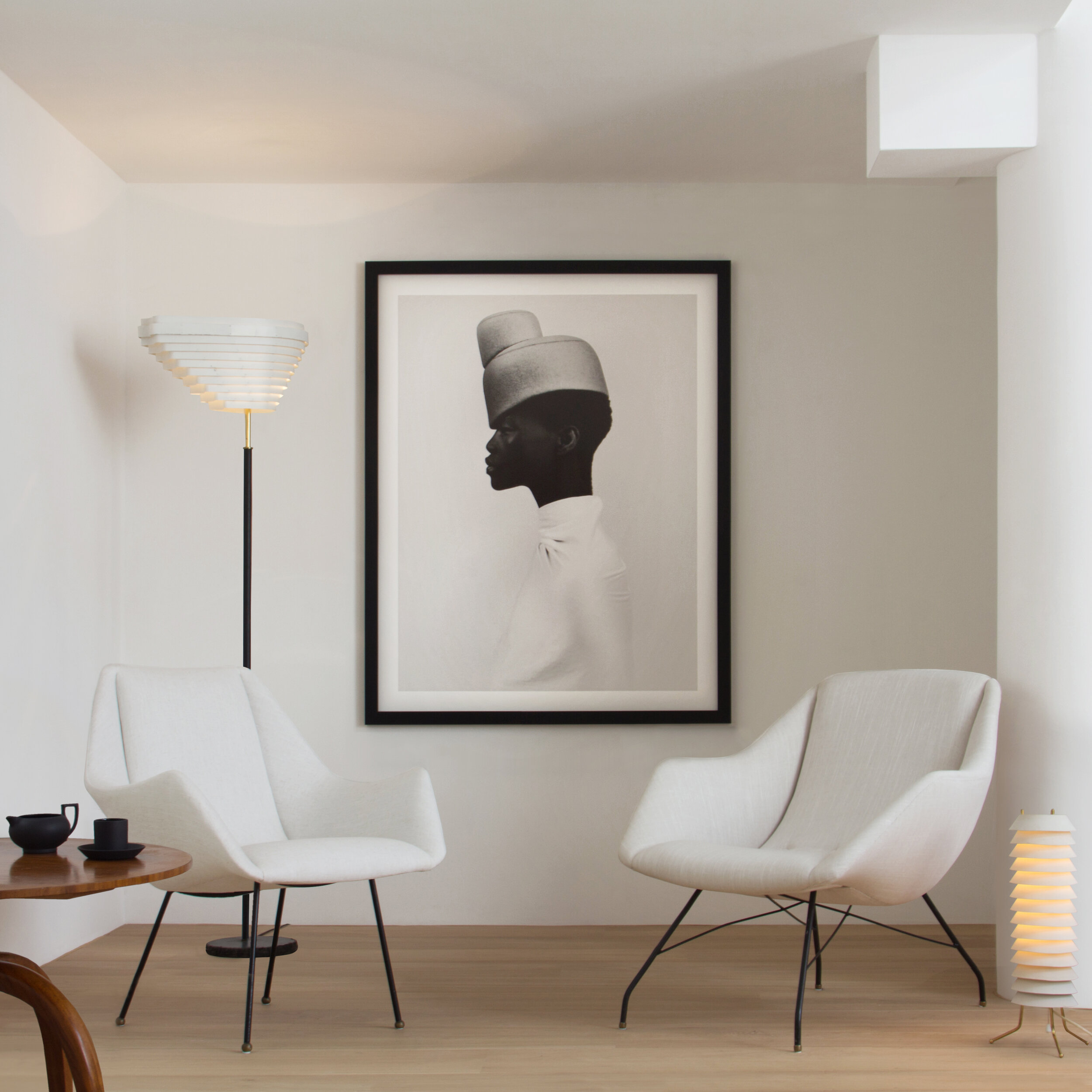
Living in a
monochrome
world
01 april - 31 may 2019
FEATURED WORKS
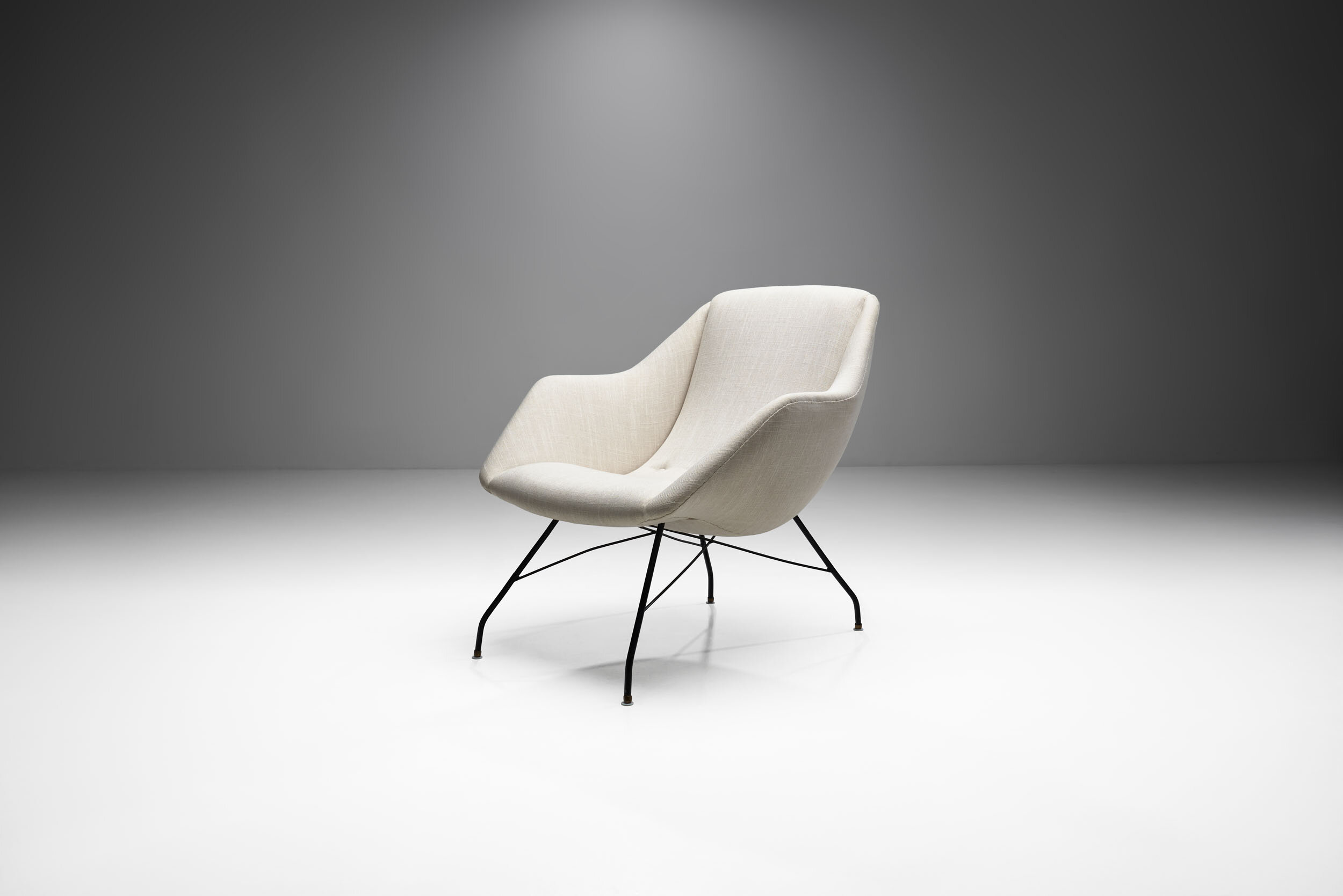
“Shell” lounge chair designed by Carlo Hauner and Martin Eisler, ca 1955. The frame is made of black painted iron. The upholstery is in a light linen blend fabric. Due to the diagonal lines and the thinness of the frame, the shell has an almost floating appearance. Especially outside of Brazil these chairs are quite rare.
SOLD
Condition:
In very good vintage condition. Original brass caps. The chair has been reupholstered recently in a premium fabric. Each of our items can be re-upholstered by our in-house atelier in a fabric of choice. Please reach out for more information.
Dimensions:
29.14 in W x 30.52 in D x 30.71 in H; seat height 14.96 in
74 cm W x 77.5 cm D x 78 cm H; seat height 38 cm
Literature:
Móvel moderno Brasileiro, Marcelo Vasconcellos, Aeroplano, P. 201
Desenho da Utopia, Brazilian Modern Furnitures, Éditions Olhares, São Paulo 2016, p 20.
Brazil Modern, the rediscovery of 20th century Brazilian furniture - Aric Chen, 2016
About the designer:
Born in Brescia in 1927, Carlo Hauner studied technical drawing and drawing at the Brera Academy in Milan, Italy. In 1948 he successfully participated in the Venice Biennale after which he moved to Brazil, where he dedicated himself to the design of textile, ceramics, furniture and architecture. In only a very short time he founded a furniture production company and purchased a factory from Lino Bo Bardi and her husband Pietro Bardi, renaming it to Móveis Artesanal.
In 1953 Hauner met Martin Eisler and the rest is history. The two connected and opened Galeria Artesanal on a busy street in São Paulo. Móvies Artesanal later changed into Forma and together with Oca, it became one of the biggest names in Brazilian furniture production.
Hauner and Eisler’s designs are characterized by the use of Brazilian woods, thin tubular frames and range from furniture, to ceramics and textiles. Forma prospered during the 60’s and 70’s. Although Hauner and Eisler designed and produced many pieces, the depth and quality of their work that is reaching the waterfront is still only the tip of the iceberg. We are sure many more interesting pieces will find the spotlight during the coming years. ~H.

Originally designed by Alvar Aalto for the National Pensions Institute in Helsinki in 1954, the A805 model, better known as the “Angel Wing” floor lamp, is a true modern icon.
The A805's asymmetrical louvred shade is reminiscent of wings, which is why it became commonly known as the “Angel Wing” floor lamp. The cascading shade is even more emphasized when the lamp is lit. The hand-riveted shade is formed from lacquered, thin metal strips, diffusing the light evenly, both upwards and through its white painted strips. The white painted shade is contrasted by the polished brass collar and the black leather-wrapped stand which was hand-sewn in Finland.
Founded in 1952 in Helsinki, Valaistustyö Ky has been the main manufacturer of luminaires designed by Alvar Aalto since its establishment. The stem of the lamp is engraved with the mark: Valaistustyö A805, which shows that this is on older version of the lamp and not a later reproduction by Artek.
SOLD
Condition:
In vintage condition. Wear consistent with age and use. The shade has its original paint with some small retouches, some small stains. Leather and brass have minor wear.
Dimensions:
20.48 in W x 13.78 in D x 67.72 in H
52 cm W x 35 cm D x 172 cm H
Literature:
Alvar & Aino Aalto Design, Collection Bischofsberger, Kellein, Hatje Cantz, 2005, p. 186 and 187
About the designer:
Hugo Alvar Henrik Aalto, (1898, Kuortane, Fin., Russian Empire - 1976, Helsinki, Fin.) was a Finnish architect, city planner, and furniture designer. Aalto achieved an international reputation as a furniture designer and architect. Through his more than 200 buildings and projects, ranging from factories to churches, (a number of them built outside Finland), Aalto remains the most renowned Finnish architect and designer.
Alvar Aalto’s architectural studies at the Technical Institute of Helsinki were disrupted by the Finnish War of Independence, in which he also participated. Ultimately, he graduated in 1921 and began working in Jyväskylä, in central Finland. In 1927 Aalto moved his studio to Turku, and in 1933 to Helsinki, where he collaborated with his wife, Aino Marsio until 1949.
The first experiments with furniture date from the early 1930s, when he took charge of the interior of the Paimio Sanatorium. At the time, Aalto’s furniture was known for its use of laminated wood and original, structural forms. In 1935 the Artek Company was established by Aalto and Maire Gullichsen, the wife of the industrialist and art collector Harry Gullichsen, to manufacture and market his furniture. His distinctive style is a blend of modernist refinement and indigenous materials, which eventually earned him world-wide recognition.
Throughout his long career, Alvar Aalto received several prizes and honours. He was a member of the Academy of Finland (Suomen Aketemia) and was its president from 1963 to 1968 as well as a member of the Congrès Internationaux d’Architecture Moderne from 1928 to 1956. In 1957, he received the Royal Gold Medal for Architecture from the Royal Institute of British Architects and the Gold Medal from the American Institute of Architects (1963).
Today, the Alvar Aalto Museum keeps the legacy of the designer alive. It was designed by Aalto himself, and is located in the Finnish town of Jyväskylä. ~H.
Carlo Hauner and Martin Eisler Costela (“Rib”) Chair, Brazil 1950s
This characteristic chair by Carlo Hauner and Martin Eisler is one of the icons of Brazilian Mid-Century Modern Design. The name ‘Costela’ which translates as rib, is apparent in the design with it’s eight dark stained wooden slats that resemble a rib structure. The slats are rhythmically positioned and curve upwards on the sides, gently embracing the softly padded cushions. A curved black coated steel frame with short legs and wooden shoes create the necessary support. The comfortable cushions are re-upholstered in a high-quality off white linen fabric, and are tufted with buttons and kept in place by tied strings at the back and bottom.
About the designers:
Born in 1913 in Vienna, Austria, Martin Eisler received his architecture degree in 1936. However, as in the life of so many Brazilian designers, it was the looming thundercloud of the second world war that made him move just after his studies where finished. First to Czechoslovakia (where his parents lived) and later, in 1938, to Argentina. Here Eisler began to exercise his profession as an architect and interior designer and opened up his interior design firm, later named Interieur Forma. In the early 1950’s he decided to move to Brazil. Read more about Carlo Hauner and Martin Eisler.
Condition:
In good vintage condition. Wear consistent with age and use.
Dimensions:
27.96 in. W x 28.35 in. D x 31.89 in. H; seat height 15.34 in.
71 cm W x 72 cm D x 81 cm H; seat height 39 cm
Literature:
Brazilian Modern Design (Móvel Moderno Brasileiro), Olhares 2018, p. 234 and 235
Brazil Modern: The Rediscovery of Twentieth-Century Brazilian Furniture, Aric Chen, The Monacelli Press, New York 2016, p. 205
Móvel Brasileiro Moderno, FGV Projetos, Rio de Janeiro 2012