
MASTERPIECE COLLECTION
REQUEST PRICE HERE
Price category: 20,000 - 30,000 usd / eur
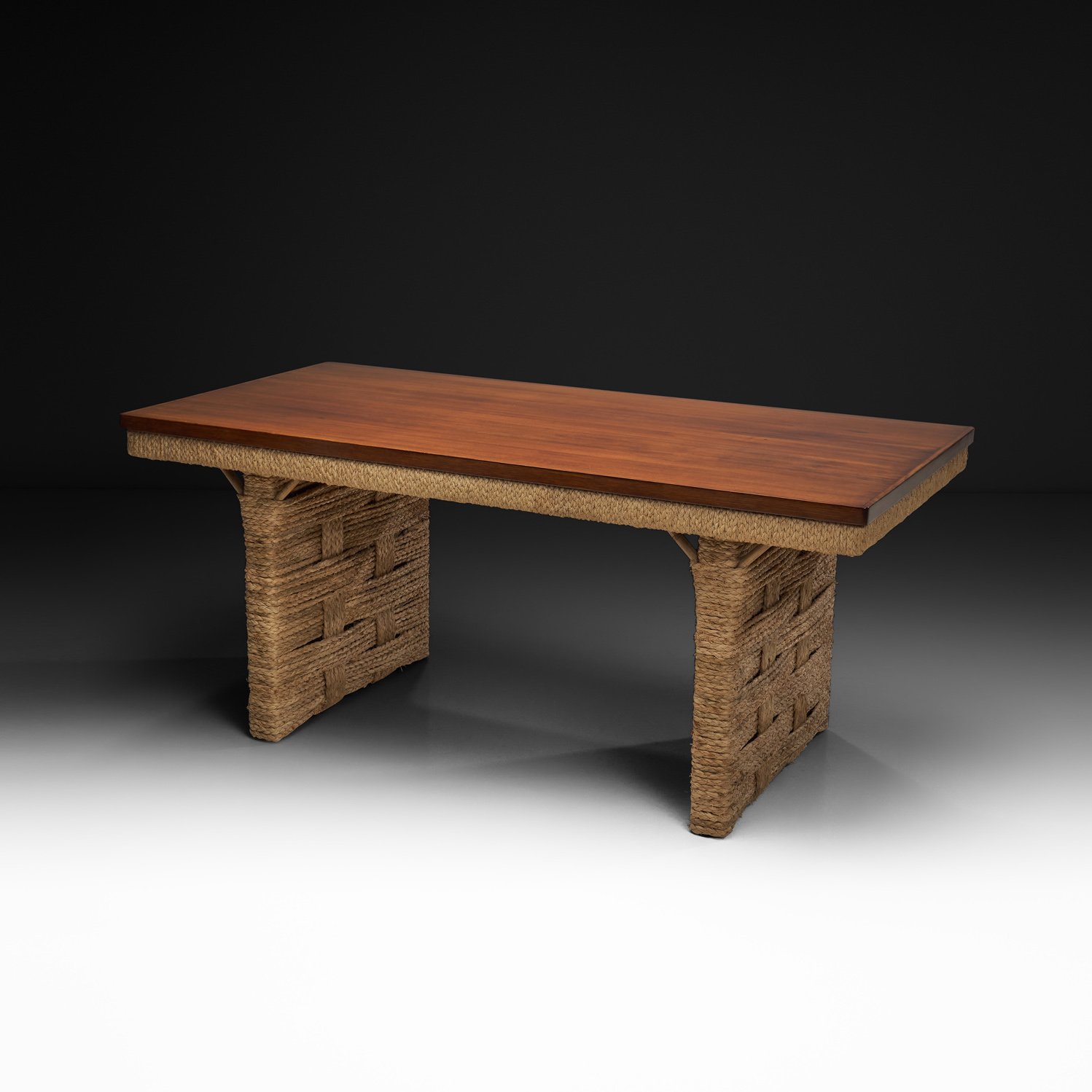
Adrien Audoux and Frida Minet were a French design duo who worked together during the 20th century. They were known for their innovative use of natural, sustainable materials, including rope, wicker, and bamboo. The duo’s work was heavily influenced by the Modernist movement, which sought to create functional and streamlined designs that were accessible to a wider audience.
Audoux & Minet’s pieces are characterised by a strong sense of craftsmanship, with each piece being handmade by the designers themselves or by skilled artisans. This dining table showcases a long rectangular top finished in warm wood veneer, its broad uninterrupted surface displays the grain. The top sits above thick base covered in a tightly woven natural fibre that introduces an immediate depth of tone and texture. The fibre flows across the supports in beautiful braided patterns, emphasising the bold and solid look. The rope is made into a geometric pattern which breaks up the woven surface to create a beautiful rhythm within the structure. The contrast of materials is central to the table’s character: the smooth, richly grained wooden top stands out against the coarse, rough and natural fibre below, allowing two very different surfaces to define the piece.
Today, Audoux and Minet's designs are highly sought after by collectors and are considered important examples of mid-century modern design. Furniture pieces like this table stand out through their unique textures, and their materials, as well as their classic charm.
Condition:
In good vintage condition. Wear consistent with age and use. The table has recently been reconditioned. Due to the nature and age of the material, the item has some marks and scratches on the tabletop. Additional imperfections like chips, dents or discolouration may be present.
Dimensions:
67.12 in W x 33.46 in D x 29.13 in H
170.5 cm W x 85 cm D x 74 cm H
REQUEST PRICE HERE
Price category: 20,000 - 30,000 usd / eur
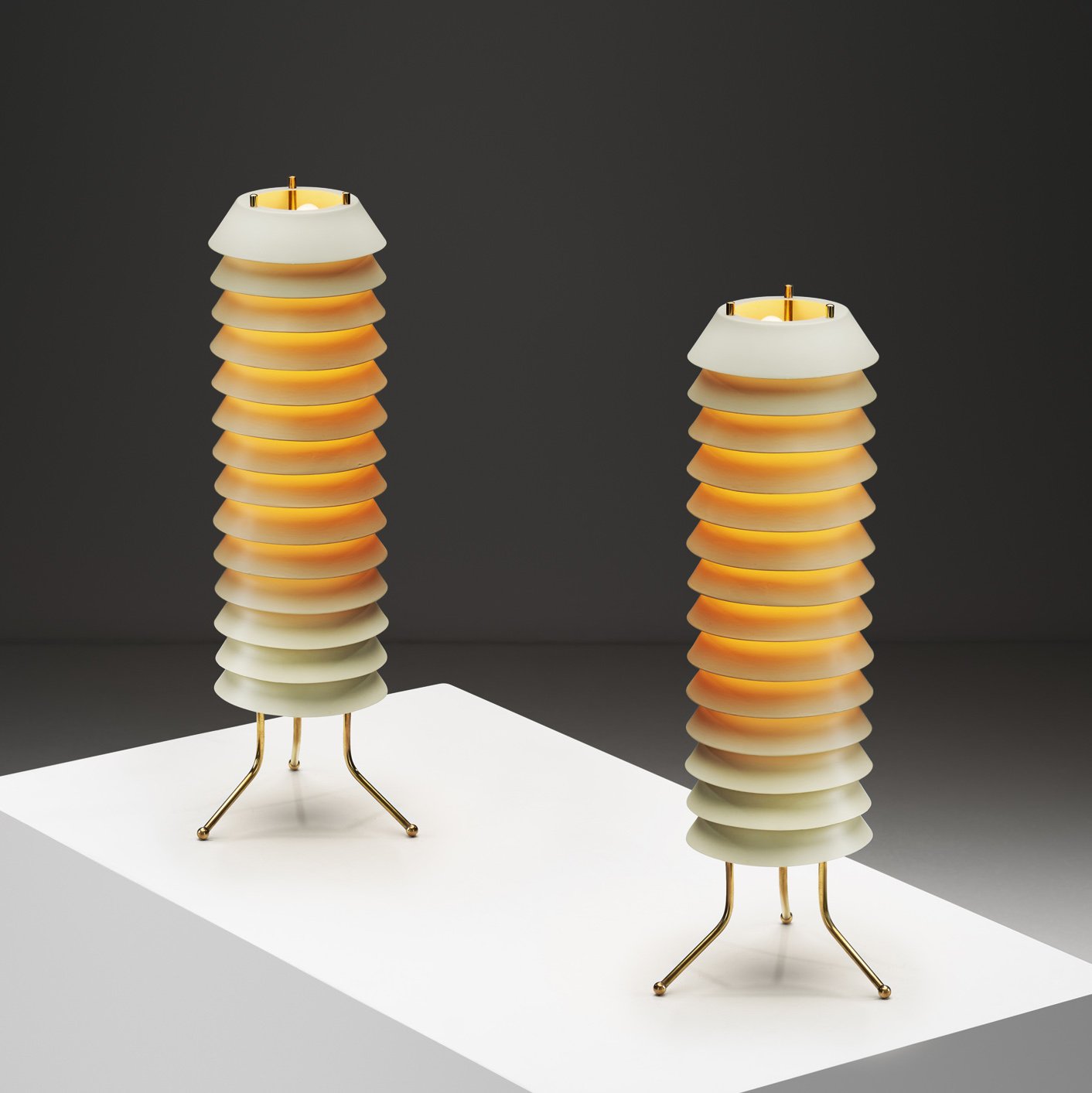
With pieces inspired by nature and the tranquility of everyday life, Ilmari Tapiovaara was able to showcase designs that captured the essence of Finnish identity. In a region where darkness dominates much of the year, lighting offers more than illumination - it evokes warmth, optimism and emotional connection. In the case of this pair of sculptural table lamps made of painted metal layers, the comforting resemblance to the beloved character of “Maija Mehiläinen” brings a sense of joy and familiarity into Nordic homes.
Recalling the lovable German children’s book character published in 1912, “Maija Mehiläinen” - meaning Maya the Bee - this model carries undeniable charisma, with Maya’s stripes recognisable in the lamp’s structure. The shades are made up of a tall cylindrical forms of slender metal layered discs, each layer delicately floating above the next, emitting a soft and diffused glow. Resembling the abdomen part of a honeybee, it stands on three elegant brass legs, running up through the fourteen slates, and finally poking out from the top, bearing a resemblance to delicate bee-like antennae. While having the appearance of the insect itself, the design also gives the impression of a beehive - especially when they are switched on and the warm light seeps out in between the gaps of the layers, like drizzling honey from the cracks of honeycomb walls.
This lighting model stands out in the most wholesome and comforting way, capable of evoking dear childhood memories as well as keeping spirits up during the long winter months for those longing for the lightness of spring, full of flowers and life.
Condition:
In good vintage condition. Wear consistent with age and use. The lamps have recently been rewired and reconditioned. The items have been repainted. Due to the nature and age of the materials, the items may have marks, scratches, and discolouration. These table lamps are compatible with E26 / E27 standard fittings. All lighting can be converted for US usage.
Dimensions:
7.28 in W x 6.69 in D x 19.48 in H
18.5 cm W x 17 cm D x 49.5 cm H
REQUEST PRICE HERE
Price category: 20,000 - 30,000 usd / eur
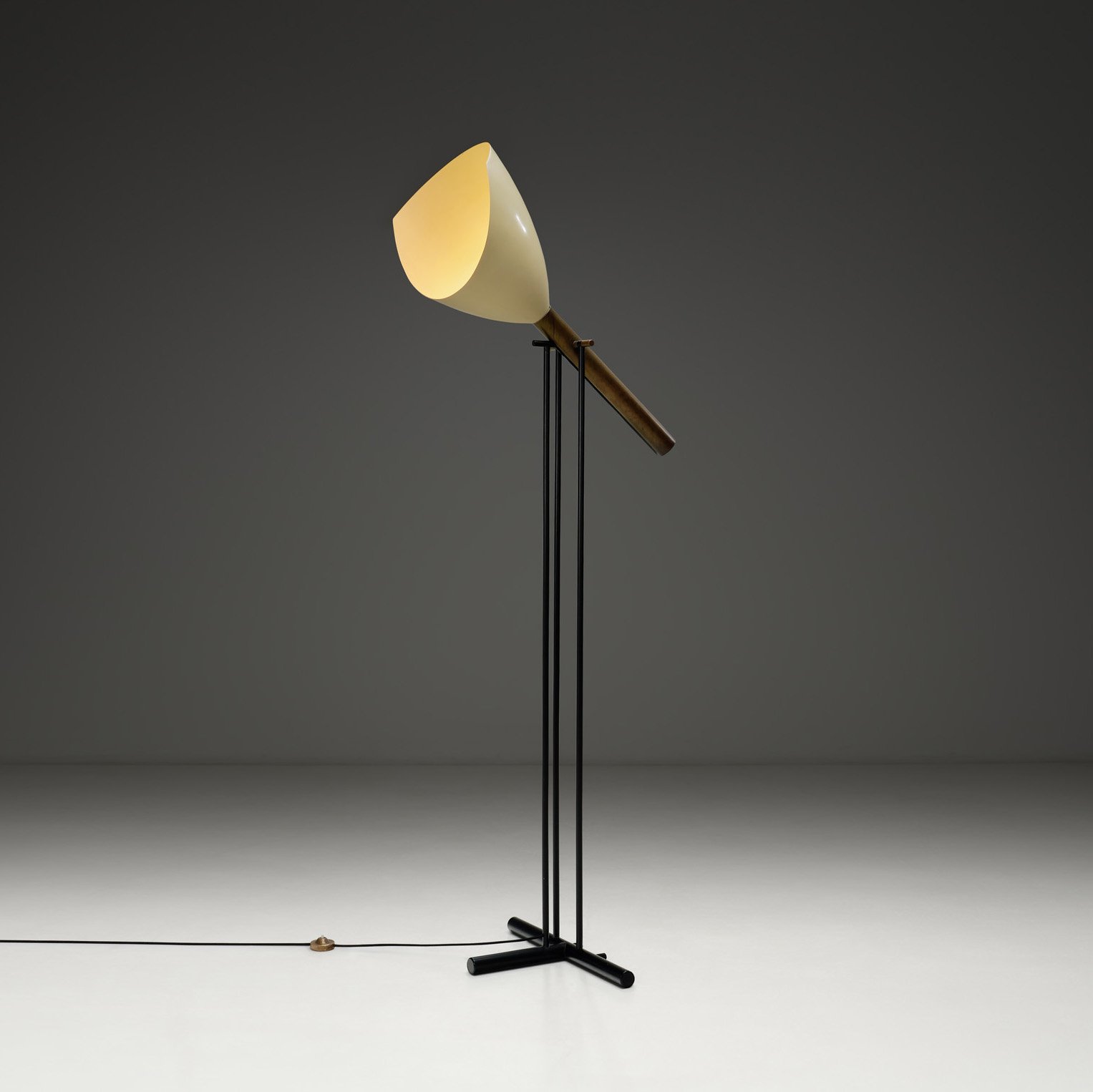
Italian designers and manufacturers were true pioneers of mid-century lighting design. Angelo Lelii, the 20th century Italian designer, created never-before-seen shapes and forms, and this unique floor lamp is a stunning example.
In Italy, the evolution of lighting fixtures happened side by side with the post-war recovery. Designer lamps became more accessible, and the aesthetics and materials turned towards a more experimental approach. This floor lamp’s design shows this interesting and unique era’s marks in its clever solutions and use of materials. The lacquered white shade stands out against the black body, functioning as the focal point of the design. The lamp’s proportions are carefully considered, tall enough to complement seating areas, yet visually unobtrusive making it as much an architectural element as a source of light. With its focus on quality, innovation, and timeless design, Arredoluce has consistently demonstrated its ability to create products that are both timeless and contemporary.
The marriage of straight and round lines and versatile materials and shapes in perfect harmony truly shows the Lelii’s skill. This lamp has many qualities that make it ideal to blend a stroke of modernity to any space, serving both a functional and a purely aesthetic role.
Condition:
In good vintage condition. Wear consistent with age and use. The lamp has recently been rewired.
Dimensions:
26.77 in W x 19.68 in D x 70.47 in H
68 cm W x 50 cm D x 179 cm H
REQUEST PRICE HERE
Price category: 20,000 - 30,000 usd / eur
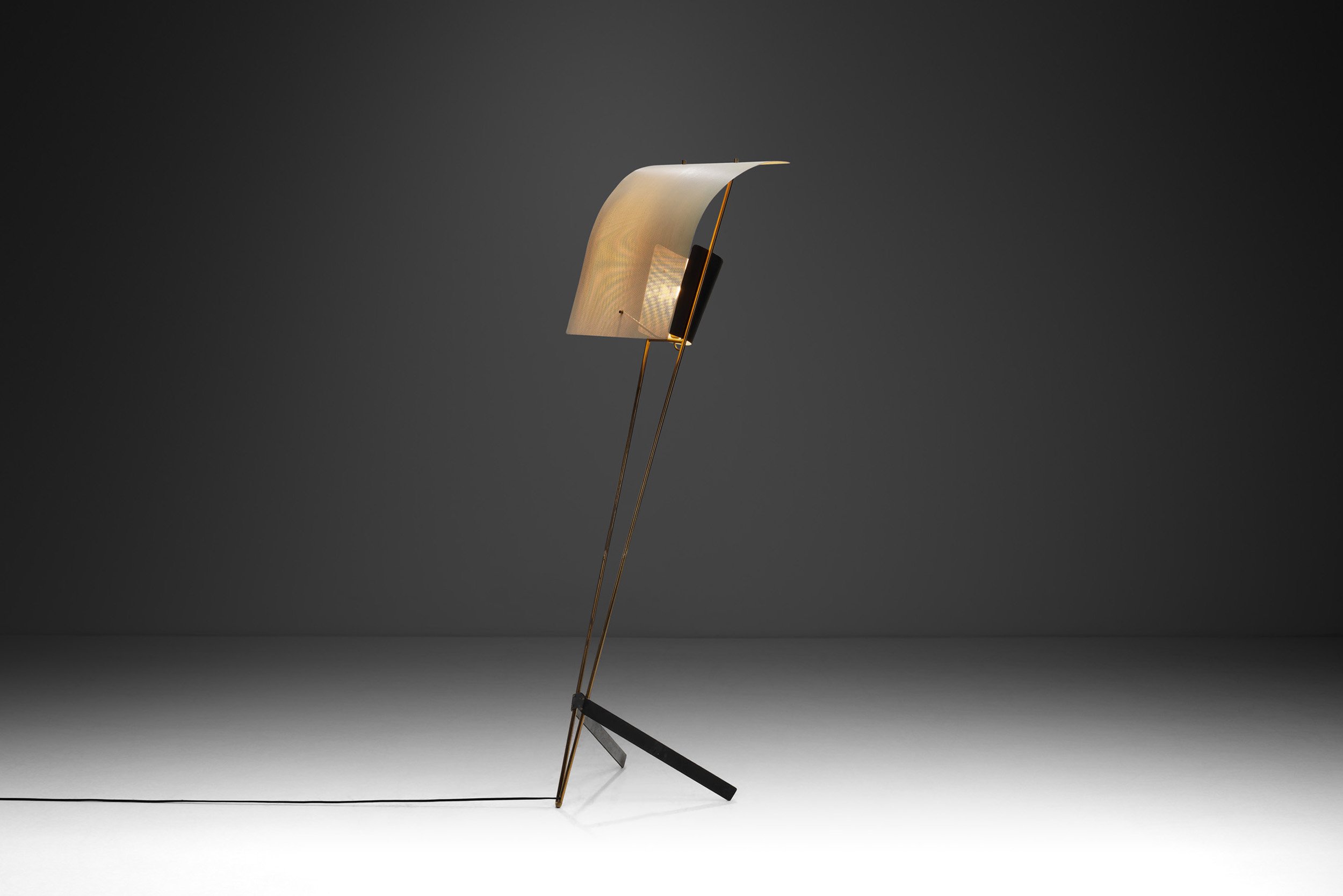
Pierre Guariche is one of the most important designers of the French post-war period. Guariche is best known for the luminaires he designed, many of which feature details like hidden light sources, perforated metal surfaces and slender leg structures. With its clever construction, the “Kite” is a great example of the designer’s endless interest in technological innovation.
Officially called model “G30”, this floor lamp was designed in the early 1950s. Guariche’s mid-century lights were created between 1951 and 1959, and are innovatively designed with a visible joy of experimentation. This is especially apparent in this model, featuring elements that may appear purely decorative, but on closer inspection turn out to be absolutely functional. The design is defined by the reflector, which also inspired the model’s nickname. Its white lacquered, perforated sheet metal reflector resembles a boat’s sail, and creates a filtered and soft light. This hidden illuminant and the glare-free light flow by means of the clever reflector provides atmospheric ambient light, while also giving the lamp a sculptural appearance. The light “sail” is balanced by the smaller black reflector embracing the lightbulb and grounded by two brass masts. The triangular metal pedestal is lacquered black and has sharp, straight edges to complete the visual and the literal balance of the design. Every small detail, from the pierced reflector to the smaller one that “glows” from inside, shows the artistic and visionary prowess of Guariche.
The “G30” is one of those models where the term ‘iconic’ might even be an understatement (especially with the term’s generous use nowadays). From its year of creation to this day, it is still a pioneering piece that is a perfect source of aesthetic pleasure, and of course, of an indirect, pleasant mood lighting.
Condition:
In good vintage condition consistent with age and use. The brass has some weather marks and a beautiful patina.
Dimensions:
19.68 in W x 14.17 in D x 59.05 in H
50 cm W x 36 cm D x 150 cm H
About the designer:
Designer Pierre Guariche was born in 1926. He studied at the Ecole Nationale Supérieure des Arts Décoratifs, graduating in 1949. He then worked in the studio of Marcel Gascoin and presented his first designs at the Salon des Artistes Décorateurs and the Salon des Arts Ménagers.
In 1953, he designed the mythical “Tonneau” chair for Steiner, first in plastic (1953) and then in bent plywood (1954). In 1954, he founded the Atelier de Recherché Plastique with Joseph-André Motte and Michel Mortier. Three years later in 1957, he was named Artistic Director of furniture manufacturer Meurop. As a teacher, he shared his knowledge with the students of the Ecole Supérieure d’Architecture de Tournai and the Ecole Nationale Supérieure des Arts Décoratifs de Paris.
He knew how to bring a personal, innovative touch to design, combining aestheticism and series production. His heart’s desire was to respond to the requirements of his era by making use of series production techniques. His creations, such as the Tonneau chair (1953 and 1954), the Tulipe chair (1956) and the Président desk (1961), have become legendary pieces.
Along with his furniture pieces, his innovative lighting models brought him much success and renown. Today, Guariche's interior lights are being produced by traditional French manufacturer Sammode.
REQUEST PRICE HERE
Price category: 20,000 - 30,000 usd / eur
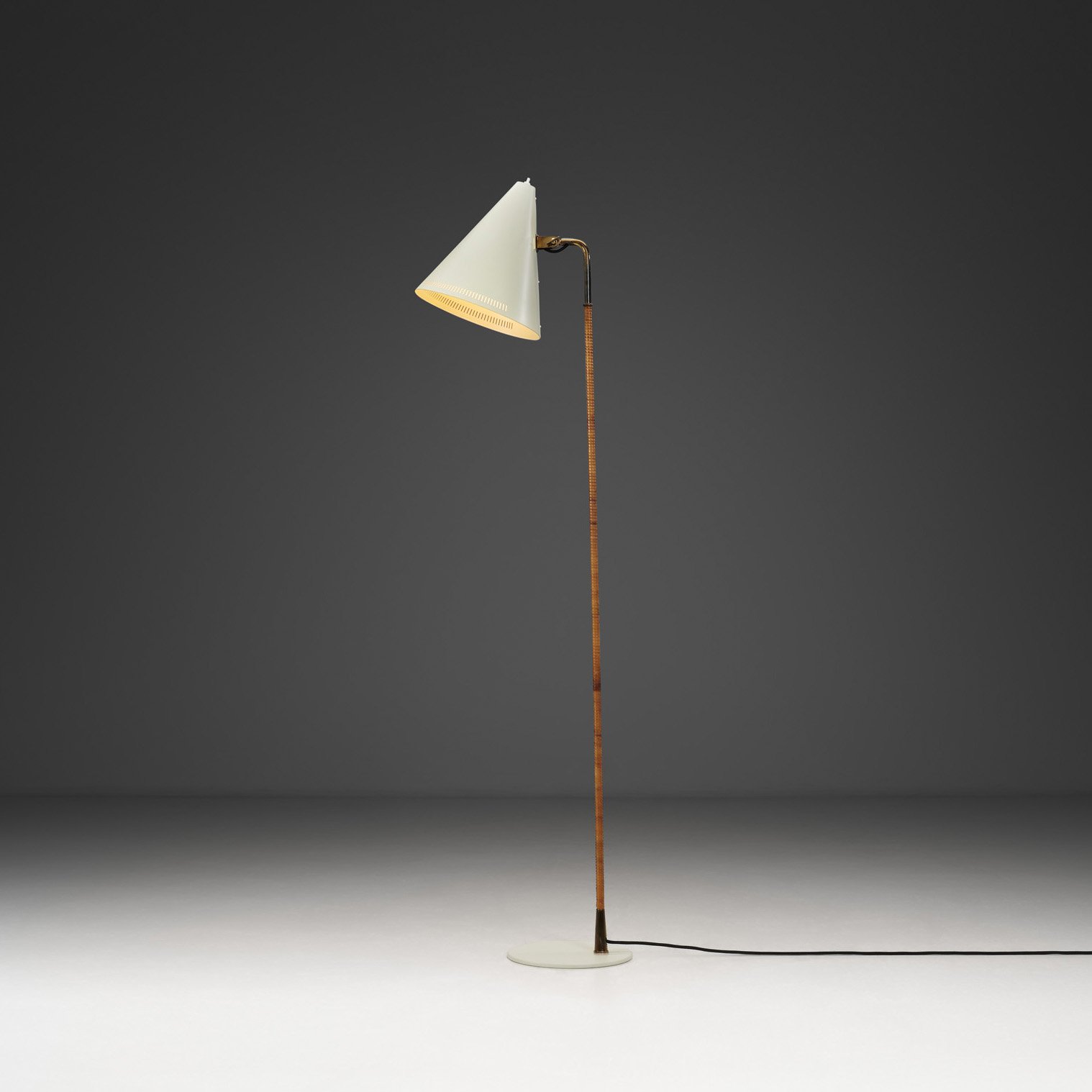
Paavo Tynell, the “man who illuminated Finland”, was known for designs that carried functional elements that show his consideration for the user as well as the lamp’s utilitarian role. Combining different materials and techniques, he found the delicate balance between practicality and ornamentation.
Model “K10-10” is a piece that carries the finest mid-century marks of elegance: quiet in its nature, yet striking in its role as a useful design object. Known for its characteristic conical shade, the design creates a subtle harmony in proportions. This distinctive detail gives the design its nickname, commonly known as the “Nun’s hat” due to its striking resemblance to the head covering. Made out of a white metal sheet with a small decorative - as well as functional - design element, the rim features a finely perforated finish. The small incisions allow the light to escape and break the otherwise centred focus of the reflector cone. For a more upward or downward facing ray of light, the lampshade can be adjusted at the neck. On this joint a fine engraving is visible, noting the manufacturer’s mark of Idman. The lamp’s rod is covered with meticulously arranged rattan fibres, ascending down in a precise alignment, twisting and turning in a gradient of brown tones along the whole vertical stem. Due to its organic appearance, the addition of this natural material breaks the metallic finish of the lamp, creating harmony in the complementary tones and colours of the rattan and brass elements. The simple circular base is a crucial element in terms of stability, while also giving the design a modern look. The stem is situated slightly off-centre on the round base, creating even more visual interest. The beauty in its simplicity and gracious form can light up any interior where it is placed.
In the 1950s, Idman played a crucial role in shaping the Finnish design landscape. The company collaborated with renowned designers, resulting in a portfolio of iconic pieces that continue to be cherished today. This model, with its blend of materials, impeccable craftsmanship, and timeless design remains a testament to the company's dedication to creating objects of enduring beauty.
Condition:
In good vintage condition. Wear consistent with age and use. The brass has developed patina over time. Some signs of wear on the rattan. The outside of the shade and the base have been later repainted.
Dimensions:
10.03 in W x 14.56 in D x 58.26 in H
25.5 cm W 37 cm D x 148 cm H
REQUEST PRICE HERE
Price category: 9,000 - 12,500 usd / eur
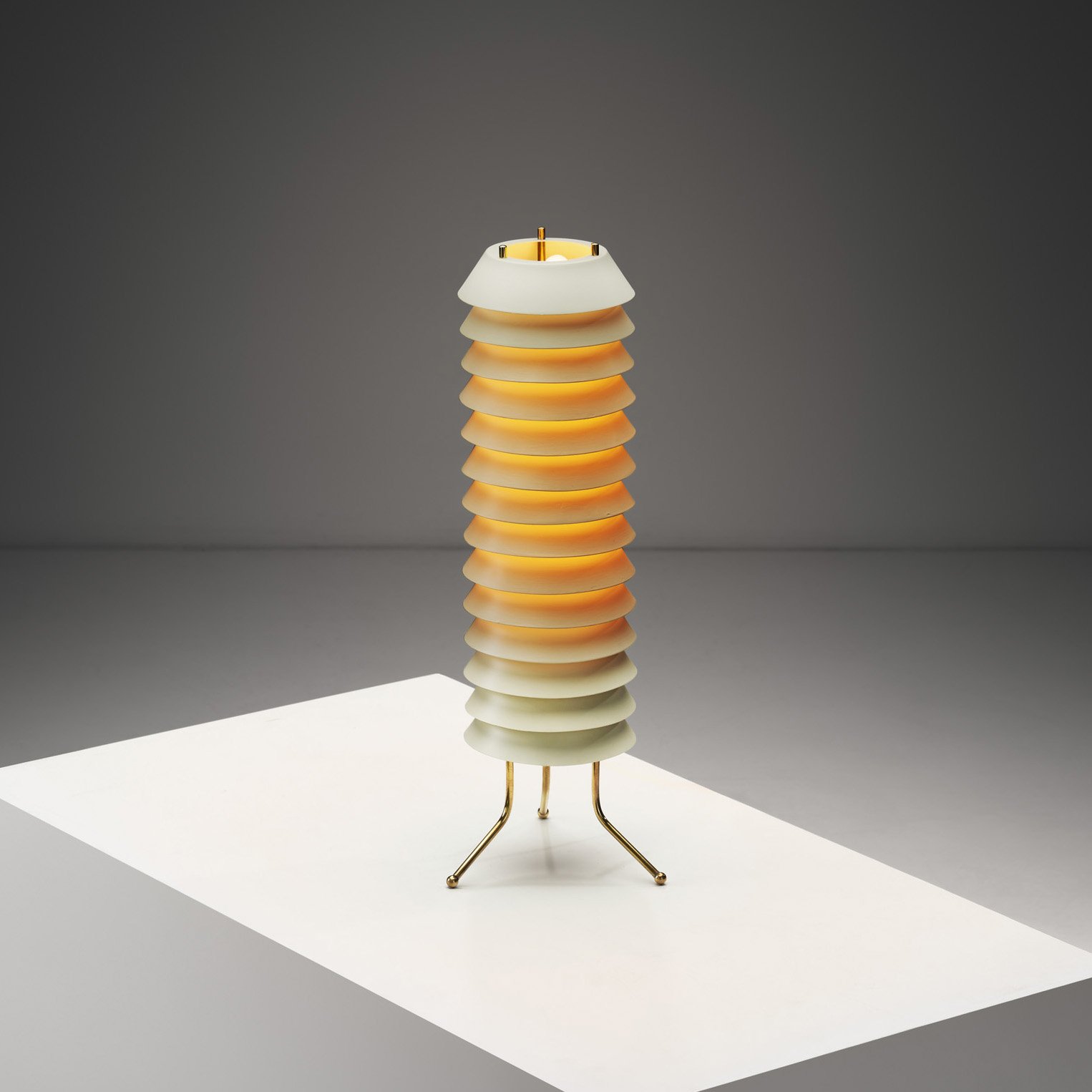
With pieces inspired by nature and the tranquility of everyday life, Ilmari Tapiovaara was able to showcase designs that captured the essence of Finnish identity. In a region where darkness dominates much of the year, lighting offers more than illumination - it evokes warmth, optimism and emotional connection. In the case of this sculptural table lamp made of painted metal layers, the comforting resemblance to the beloved character of “Maija Mehiläinen” brings a sense of joy and familiarity into Nordic homes.
Recalling the lovable German children’s book character published in 1912, “Maija Mehiläinen” - meaning Maya the Bee - this lamp carries undeniable charisma, with Maya’s stripes recognisable in the lamp’s structure. The shade is made up of a tall cylindrical form of slender metal layered discs, each layer delicately floating above the next, emitting a soft and diffused glow. Resembling the abdomen part of a honeybee, it stands on three elegant brass legs, running up through the fourteen slates, and finally poking out from the top, bearing a resemblance to delicate bee-like antennae. While having the appearance of the insect itself, it also gives the impression of a beehive - especially when the lamp is switched on and the warm light seeps out in between the gaps of the layers, like drizzling honey from the cracks of honeycomb walls.
This light stands out in the most wholesome and comforting way, capable of evoking dear childhood memories as well as keeping spirits up during the long winter months for those longing for the lightness of spring, full of flowers and life.
Condition:
In good vintage condition. Wear consistent with age and use. The lamp has recently been rewired. The lamp has been later repainted.
Dimensions:
7.28 in W x 6.69 in D x 19.48 in H
18.5 cm W x 17 cm D x 49.5 cm H
REQUEST PRICE HERE
Price category: 15,000 - 20,000 usd / eur
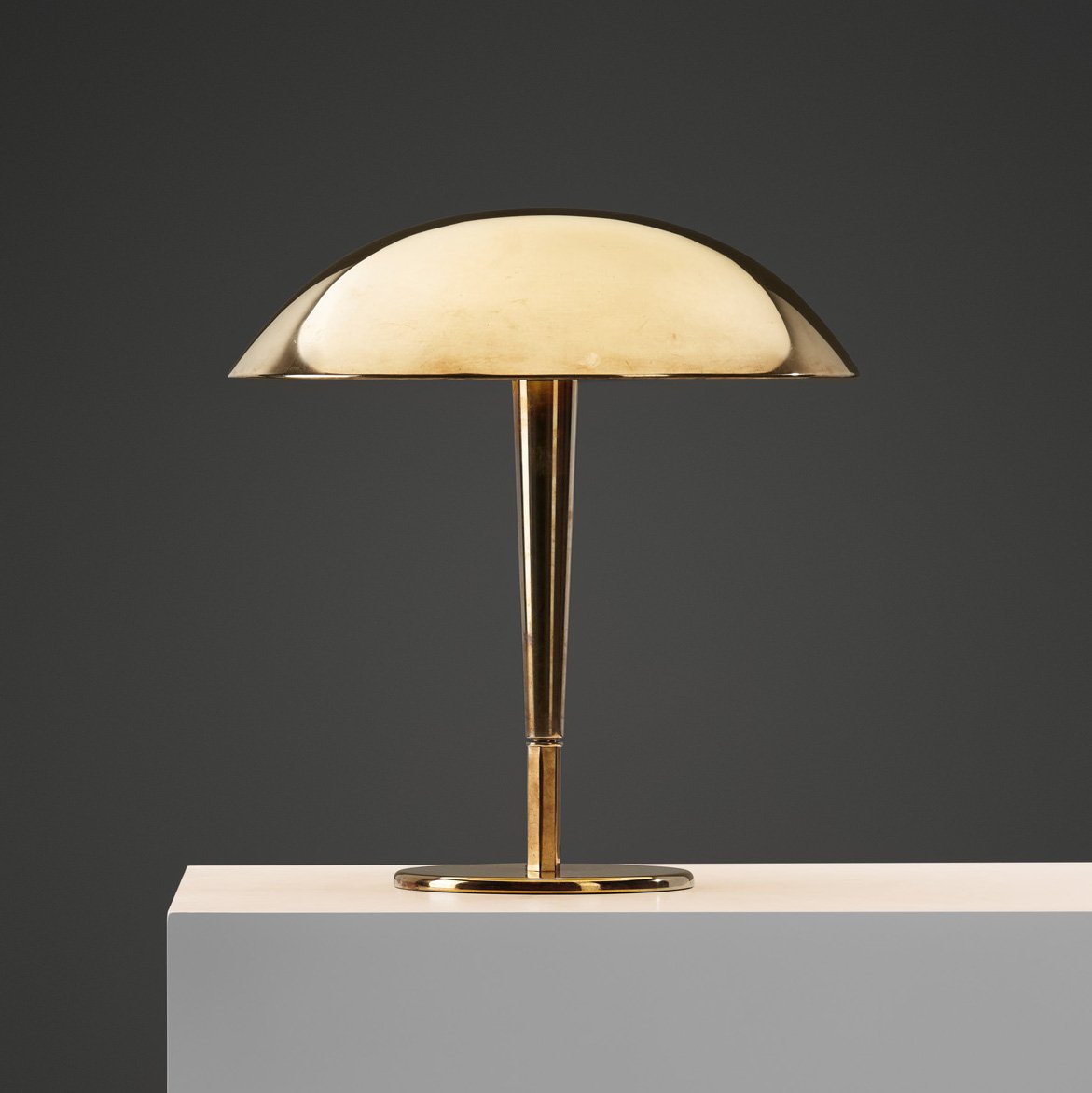
Paavo Tynell is widely regarded as one of the most important figures of Finnish lighting design from the twentieth century. From recognition at the Barcelona World Exhibition (1929) and Milan’s Triennale (1933), to the first prize for Best Lighting Design at the American Interior Decorator’s Competition (1950), Tynell earned his nickname as “the man who illuminated Finland”. After studying at the University of Art and Design in Helsinki, he founded his own manufacturing company named Taito Oy, later merging with Idman. This collaboration resulted in the development of lighting fixtures that balanced craftsmanship, functionality, and a strong sculptural presence.
Model “5061” or “Umbrella” reflects these qualities through its distinctive use of polished brass and its elegantly proportioned silhouette. The lamp is constructed entirely from brass, a material that Tynell favoured for its warmth, durability, and reflective properties. The gently domed shade spreads outward in a smooth, continuous curve, creating a wide canopy that both conceals the light source and directs illumination downward. This form allows the metal surface to catch and reflect light subtly, enhancing the lamp’s glow while emphasizing the richness of the metal. The slender central stem tapers as it rises from the circular base, creating a sense of vertical balance that contrasts with the broader shade above. The circular base anchors the design without drawing attention away from the dynamic between stem and shade. This piece exemplifies the essence of Tynell’s designs: careful treatment of metal, soft diffusion of light, and forms that feel both restrained and expressive.
The 1950s were a time of great innovation in Finnish design, as designers like Tynell pushed the boundaries of what was possible with new materials and manufacturing techniques. Today, Paavo Tynell’s lighting designs remain highly sought after for their ability to combine technical clarity with subtle detail. Model “5061” shows this approach, demonstrating how a designer can transform a practical object into a refined piece of design.
Condition:
In good vintage condition. Wear consistent with age and use. The item has recently been reconditioned and rewired. The brass has a beautiful patina. Item has some marks and discolouration. Due to the nature and age of the material, the item may have some additional marks and scratches. This lamp is compatible with an E26 / E27 (standard) fitting. All lighting can be converted for US usage.
Dimensions:
14.56 in ø x 15.55 in H
37 cm ø x 39.5 cm H
REQUEST PRICE HERE
Price category: 15,000 - 20,000 usd / eur
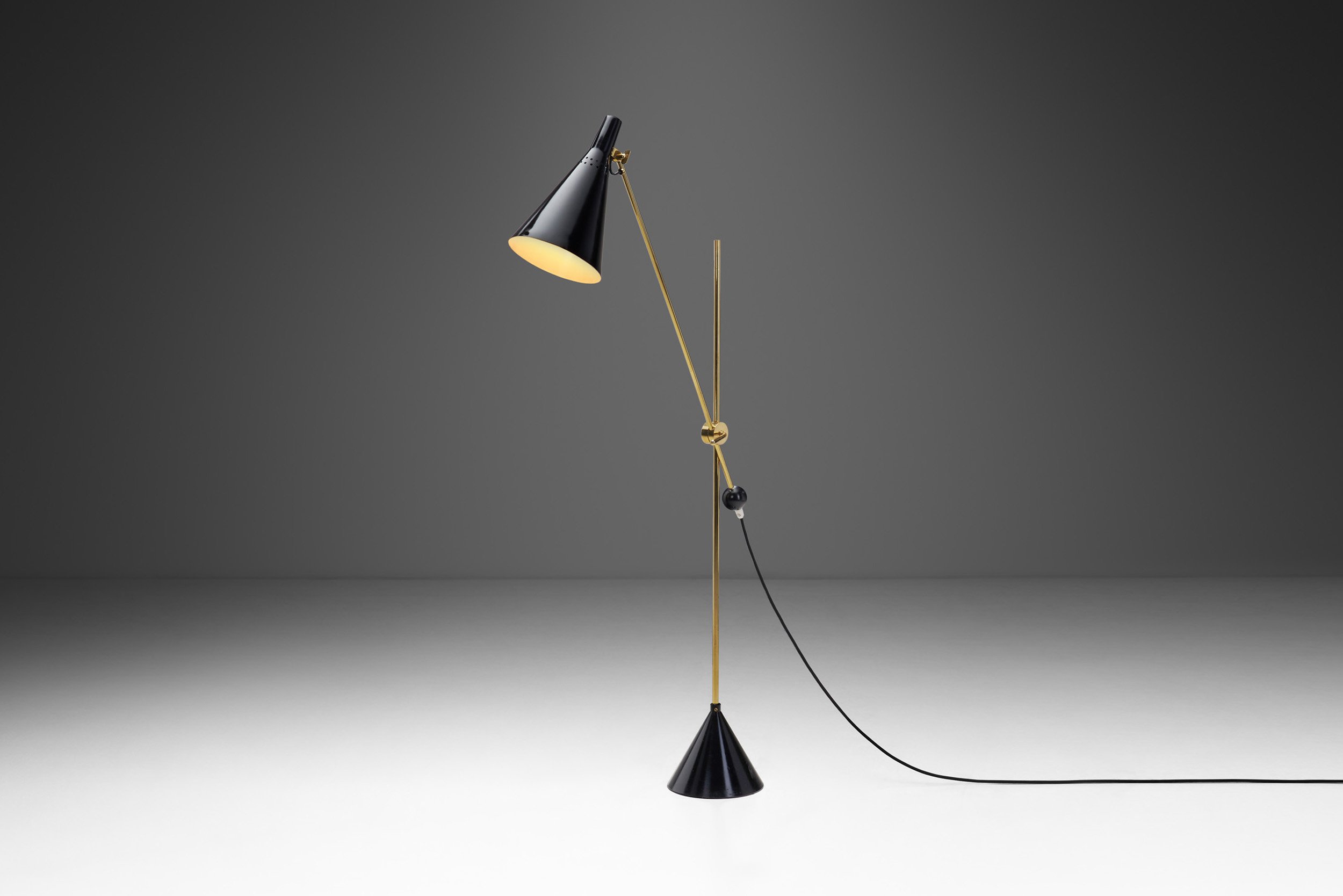
The “Crane” is evidence why Tapio Wirkkala can be described as one of the icons of Finnish design and a symbol of the international success of postwar Finnish design. He was a versatile designer and artist who could shift fluently between different materials and crossed established professional boundaries.
Wirkkala’s far-reaching career spanned multiple fields, from furniture design to sculpture and other art objects, and this can be clearly traced in this floor lamp. It functions as an art object just as much as a utilitarian lamp. With its slender shape and a brass and black lacquered body, this lamp is a great modernist piece that stands out in any space. The ingenious structure allows the height to be adjustable, and the design customizable. The main design elements are placed around the main functional parts, namely the shade, the adjusting rod, and the base. The sculptural brass rods cross each other similarly to a crane, and inspired the nickname of this model. The black lacquered conical shade and base, as well as the spherical counterweight stand out against the bright brass and add a modern edge to the design. The shade is lacquered white inside, creating a pleasant effect when the lamp is lit. Idman’s label engraved on the brass handle. Idman produced the models of some of the most renowned Finnish lighting designers of the time, including Tapio Wirkkala, Mauri Almari and Maria Lindeman.
Unlike other aesthetic movements, mid-century modern design was streamlined, while highlighting the materials used. The vibe of this “Crane” floor lamp is fresh, retro-tinged, and completely alluring with its dedication to quality and practicality wrapped up in beautiful design that will never go out of style.
Condition:
In good vintage condition. Wear consistent with age and use. The brass has a beautiful patina.
Dimensions:
26.37 in W x 7.08 in D x 51.39 in H (height is adjustable)
67 cm W x 18 cm D x 128 cm H (height is adjustable)
Literature:
Tuula Sakalari, Katri Lehtova, Werner Söderström, “Suomalaisia Tuolej”, Osakeyhtio, Helsinki, 2012, pp. 96 & 97
About the designer:
Tapio Wirkkala (1915-1985) can be described as one of the icons of Finnish design and a symbol of the international success of postwar Finnish design. He was a versatile designer and artist who could shift fluently between different materials and crossed established professional boundaries: he worked on everything from refrigerators to banknotes and from furniture to striking jewels. The most important materials for Wirkkala were wood and glass – he never ceased to explore the possibilities they offer.
Tapio Wirkkala studied sculpture at the Helsinki Central School of Industrial Design from 1933 until 1936, but he was also a self-studied artist in many areas, including glass design. His success as a glass artist began in 1946 when he designed one of his most famous works, the Kantarelli vase, for Iittala. Wirkkala gained worldwide success in 1951 at the Milan Triennial, where he received three Grand Prix awards: for the exhibition architecture, glass design and wooden sculptures. Many of his glass works for Iittala were also awarded later in the 1950s at the Milan Triennial. In the years 1951-1954, Wirkkala worked as the artistic director of Helsinki Central School of Industrial Design. In 1955, he received a Pro Finlandia medal and in 1972 the Academy of Finland's honorary title of academician.
The first mass-production glassware range designed by Wirkkala was the Tapio series launched in 1954. The popular Ultima Thule glassware range, created in 1968, was based on the so-called ice glass technique, and the designer himself was involved in developing it at the Iittala glass factory. Wirkkala also received important commissions from abroad: in the mid-1960s he started to design glass objects for Venini Glassworks in Italy, where he created the Bolle bottles for the Venice Biennale collection in 1966. One of Wirkkala’s most significant commissions abroad was the work at the Rosenthal porcelain factory in Germany: he worked as a freelance designer for Rosenthal for almost 30 years, and the most influential result was the Paper Bag vase (1977), still today one of Rosenthal’s best-selling products.
Tapio Wirkkala was also a furniture designer and a sculptor. He started his career as a sculptor in the 1930s, but abandoned the traditional sculpture in the post-war years. The result was a series of unique plywood sculptures which combined form and movement in the vibrant, densely lineated surface of plywood. Wirkkala’s sculptures represented exceptional abstractionism and gave Finnish sculpture art a new direction at a time when the official line preferred monuments and heroic sculptures.
REQUEST PRICE HERE
Price category: 15,000 - 20,000 usd / eur
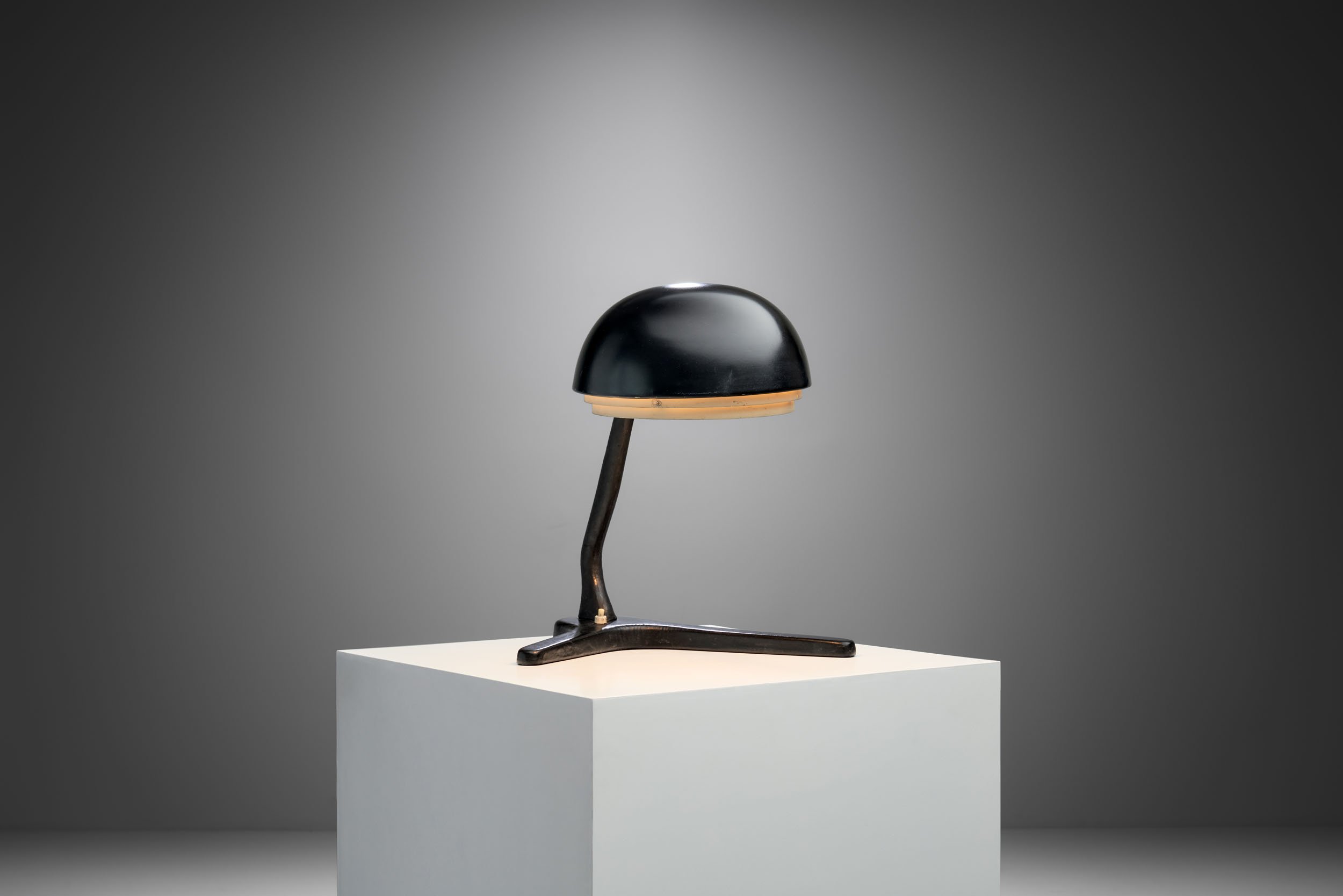
Finland and Helsinki were extremely important in the Mid-Century Modern design history, and one of its most famous designers was Alvar Aalto. In contrast with the functionalism of the International, Aalto brought a refreshing breath of humanism to modern design.
There is a saying that “Functionalism is a Finnish thing”, and it is hard to argue with that when looking at this table lamp. Functionality is without a doubt one of the most important aspects of Finnish design, however, there is also a demand for the highest quality, both in design and materials. Alvar Aalto is the Finnish icon of functionalism, and through this “A704” model it is easy to see why. The design is first and foremost functional, combining practicality and aesthetics. The body consists of a metal frame that is uniquely covered in black leather, and a painted metal shade. The shape resembles a figure leaning forward, which is reinforced by the “two-toed” base and the sizeable shade, which is perforated towards the neck. The shade has two additional white layers that are especially appealing when the lamp is turned on. When lit, the textural interest of the lamp’s structure becomes even more apparent. In the inside of the shade, the manufacturer’s mark can be found with the model’s name.
In contrast with the functionalism of the international scene, Alvar Aalto brought a refreshing breath of humanism to modern design. Aalto's free-form designs, in harmony with human needs and nature, anticipated the organic modernism of the 1950s and 1960s. This model can be a design statement in any space while also serving its functional purpose.
Condition:
In good vintage condition. Wear consistent with age and use. Some minor scratches and marks on the metal and leather. The lamp has its original leather cover.
Dimensions:
13.58 in W x 15.74 in D x 14.96 in H
34.5 cm W x 40 cm D x 38 cm H
Literature:
Eva B Ottillinger, Alvar Aalto, Furniture: The Kossdorff Collection, Vienna, 2002, p. 53, fig. 50.
Thomas Kellein, ed. Alvar & Aino Aalto, Design Collection Bischofberger, exh. cat., Kunsthalle Bielefeld, Zurich, 2005, page 190.
Charlotte and Peter Fiell, eds., 1000 Lights, Vol. 1: 1879 to 1959, Cologne, 2005, p. 492.
About the Designer:
Hugo Alvar Henrik Aalto, (1898, Kuortane, Fin., Russian Empire - 1976, Helsinki, Fin.) was a Finnish architect, city planner, and furniture designer. Aalto achieved an international reputation as a furniture designer and architect. Through his more than 200 buildings and projects, ranging from factories to churches, (a number of them built outside Finland), Aalto remains the most renowned Finnish architect and designer.
Alvar Aalto’s architectural studies at the Technical Institute of Helsinki were disrupted by the Finnish War of Independence, in which he also participated. Ultimately, he graduated in 1921 and began working in Jyväskylä, in central Finland. In 1927 Aalto moved his studio to Turku, and in 1933 to Helsinki, where he collaborated with his wife, Aino Marsio until 1949.
The first experiments with furniture date from the early 1930s, when he took charge of the interior of the Paimio Sanatorium. At the time, Aalto’s furniture was known for its use of laminated wood and original, structural forms. In 1935 the Artek Company was established by Aalto and Maire Gullichsen, the wife of the industrialist and art collector Harry Gullichsen, to manufacture and market his furniture. His distinctive style is a blend of modernist refinement and indigenous materials, which eventually earned him world-wide recognition.
Throughout his long career, Alvar Aalto received several prizes and honours. He was a member of the Academy of Finland (Suomen Aketemia) and was its president from 1963 to 1968 as well as a member of the Congrès Internationaux d’Architecture Moderne from 1928 to 1956. In 1957 he received the Royal Gold Medal for Architecture from the Royal Institute of British Architects and the Gold Medal from the American Institute of Architects (1963).
Today, the Alvar Aalto Museum keeps the legacy of the designer alive. It was designed by Aalto himself, and is located in the Finnish town of Jyväskylä. ~H.
REQUEST PRICE HERE
Price category: 20,000 - 30,000 usd / eur
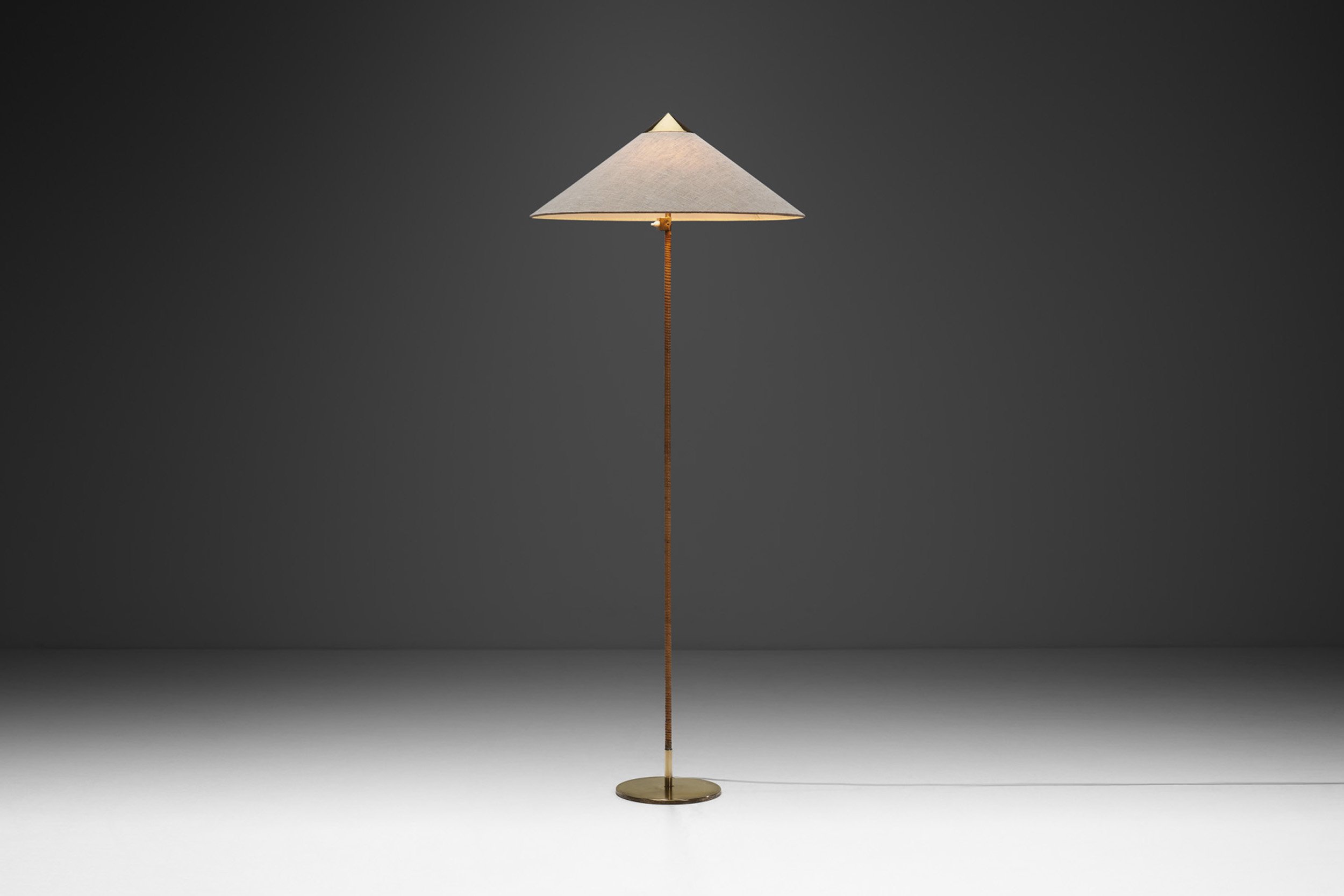
Paavo Tynell is one of Finland’s best known and collected mid-century designers. Tynell was a pioneer of lighting design and a founder of the first lighting manufacturing company in Finland, Taito Oy. The model “9602” floor lamp is a well known design famous for its large Chinese hat style shade.
This model “9602” floor lamp, also known as the “Chinese Hat” was originally designed for Hotel Aulanko in Finland. While Tynell’s company collaborated with up-and-coming talent as well as established names such as Alvar Aalto, Tynell’s own designs are the most collected for their elegant brass forms, beautiful detailing and exquisite quality. These material qualities are showcased beautifully in this model “9602“ lamp. The design features an interesting play of materials. The base is made of brass, while the lampshade is in an off-white fabric with a brass “crown” on top. However, the most fascinating part in terms of materials, is undoubtedly the stem, which is covered in twisted rattan. The top - that inspired the nickname of this model - has a playful and light quality with a subdued texture on the shade. The brass cap and base are simple, yet important design elements that give this floor lamp its modern look. The sheen of the brass cap contrast beautifully against the organic look of the fabric. The top is balanced by the elegant, but static form of the base. The light uses two bulbs that provide warm ambient light to any environment.
A master craftsman himself, Tynell’s design is derivative of a traditional aesthetic with a modern sensibility, mixed with an extensive use of perforated and polished brass as material. This floor lamp showcases the beautiful structural elements that landed this model on the cover of several magazines.
Condition:
In good vintage condition consistent with age and use. The brass parts have some weather marks.
Dimensions:
24.01 in Ø x 60.23 in H
61 cm Ø x 153 cm H
Literature:
Idman: Koristevalaisinluettelo ("Idman lighting catalogue"), sales catalogue, Helsinki 1954, n° 136. Similar item, p. 58
"Finland House Lighting: harmony in lighting for harmony in living, original designs by Paavo Tynell", New York. Similar item, p. 11 and p. 26.
T. Poutasuo, "Paavo Tynell ja Taito Oy", Helsinki, 2005. Similar item, p. 22.
About the designer:
Paavo Tynell (1890-1973) was an industrial designer, known as the great pioneer of Finnish lighting design and fondly dubbed as “the man who illuminated Finland”.
Tynell was one of the founders and chief designers of Taito Oy – the first industrial producer of lighting fixtures in Finland. With the innovation of electricity in the beginning of the 20th century, Taito Oy and Tynell expanded the thinking and manufacturing of modern lighting solutions in Europe and abroad.
Paavo Tynell rose to prominence in the 1930s and 40s when he collaborated with some of the most renowned Finnish architects, Alvar Aalto being the most notable one. Working to incorporate artificial lighting into modern environments, Tynell’s company Taito Oy produced fixtures for all of Alvar Aalto’s major projects. Tynell was especially appraised through his involvement with the Finland House, a design atelier in New York that showcased the work of Finnish designers and craftspeople. His elegant brass designs became an instant success in North America, and he began creating lighting designs for the prestigious American company, Lightolier.
Marked by delicacy and softness, his most famous forms in lightning echo the structures of nature; he adroitly created sculptural shapes reminiscent of the branches of trees, swirling snowflakes and seashells.
REQUEST PRICE HERE
Price category: 7,500 - 10,000 usd / eur
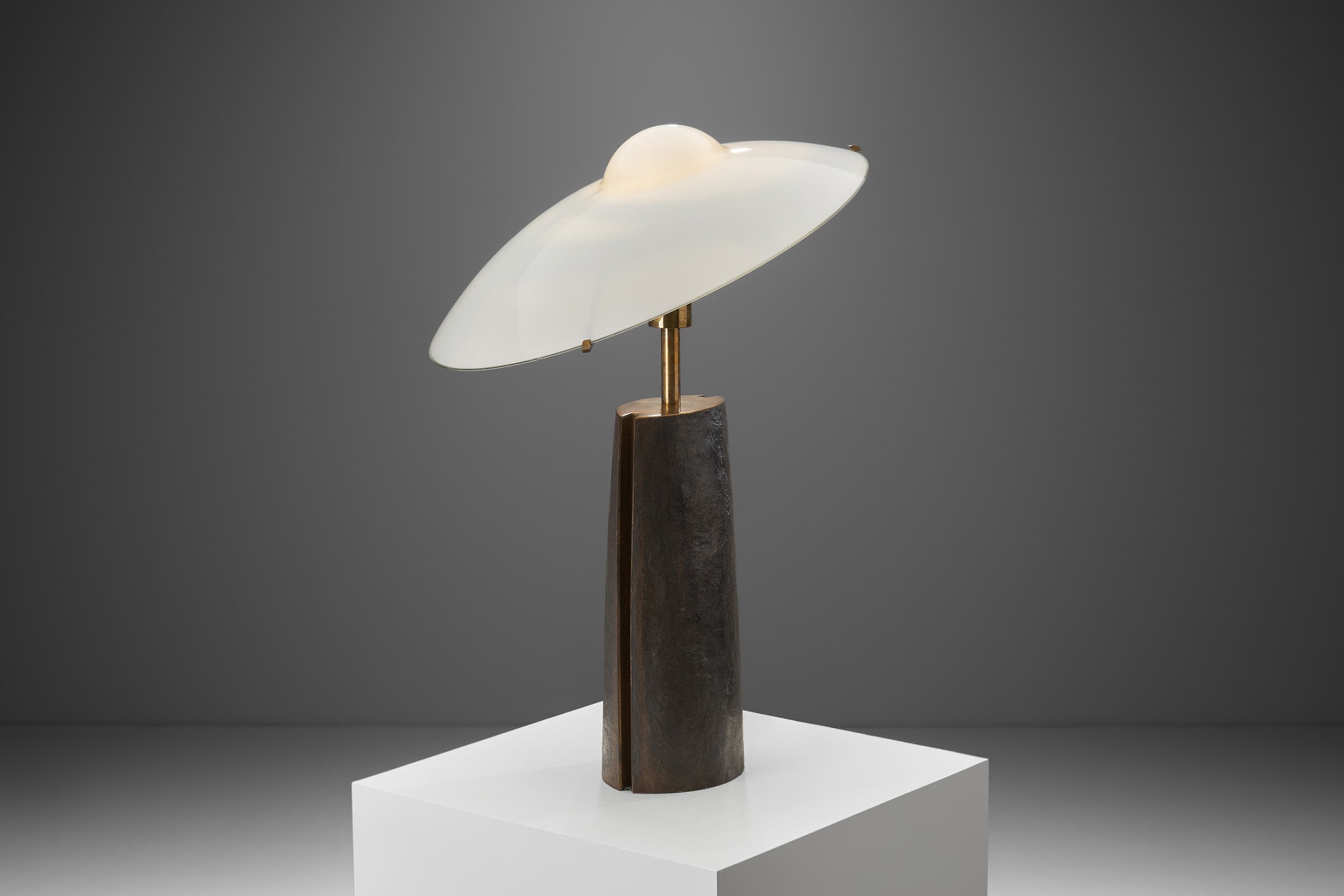
‘Kallisto’ is part of the first Tobias Grau lighting collection that combines sculptural and delicate forms with classical materials and a pioneering use of halogen technology. The collection brought the company much acclaim and established key hallmarks of Tobias Grau design: dynamic shapes, smooth surfaces, and cutting-edge technology.
Tobias Grau lamps follow not only visual requirements, but also possess an outstanding technical quality. This large ‘Kallisto’ table lamp could easily be mistaken for a sculpture, where the materials are combined in different and unusual ways. This model is a draft from 1990, therefore, production was highly limited - making it a rare collectible. The design has a certain extravagance and comes across as incredibly aesthetic and is an eye-catcher in any room. The diffuser is made of opal Murano glass, standing on a brass stand with a highly structured surface completed by the elaborate brass frame around the lightbulb. The technical aspect of the design is most apparent in this structure, utilising an adjustable system that allows the diffuser to be turned and rotated. Whether a chic hat or an alien ship comes to mind, the diffuser is undeniably unique. It then says a lot that the base doesn’t fall short either aesthetically or technically; its surface adds more textural interest to the design and contrasts cleverly to the smooth Murano glass. Further, the beautifully patinated brass lights up against the other materials.
Tobias Grau states that the best product brings human-oriented innovations into a simple, intuitive and artful form. This ‘Kallisto’ table lamp visualises this sentiment in a material form that offers outstanding quality and craftsmanship.
Condition:
In good vintage condition. Wear consistent with age and use. The brass has a beautiful patina.
Dimensions:
15.35 in W x 19.29 in D x 27.95 in H
39 cm W x 49 cm D x 71 cm H
REQUEST PRICE HERE
Price category: 30,000 - 40,000 usd / eur
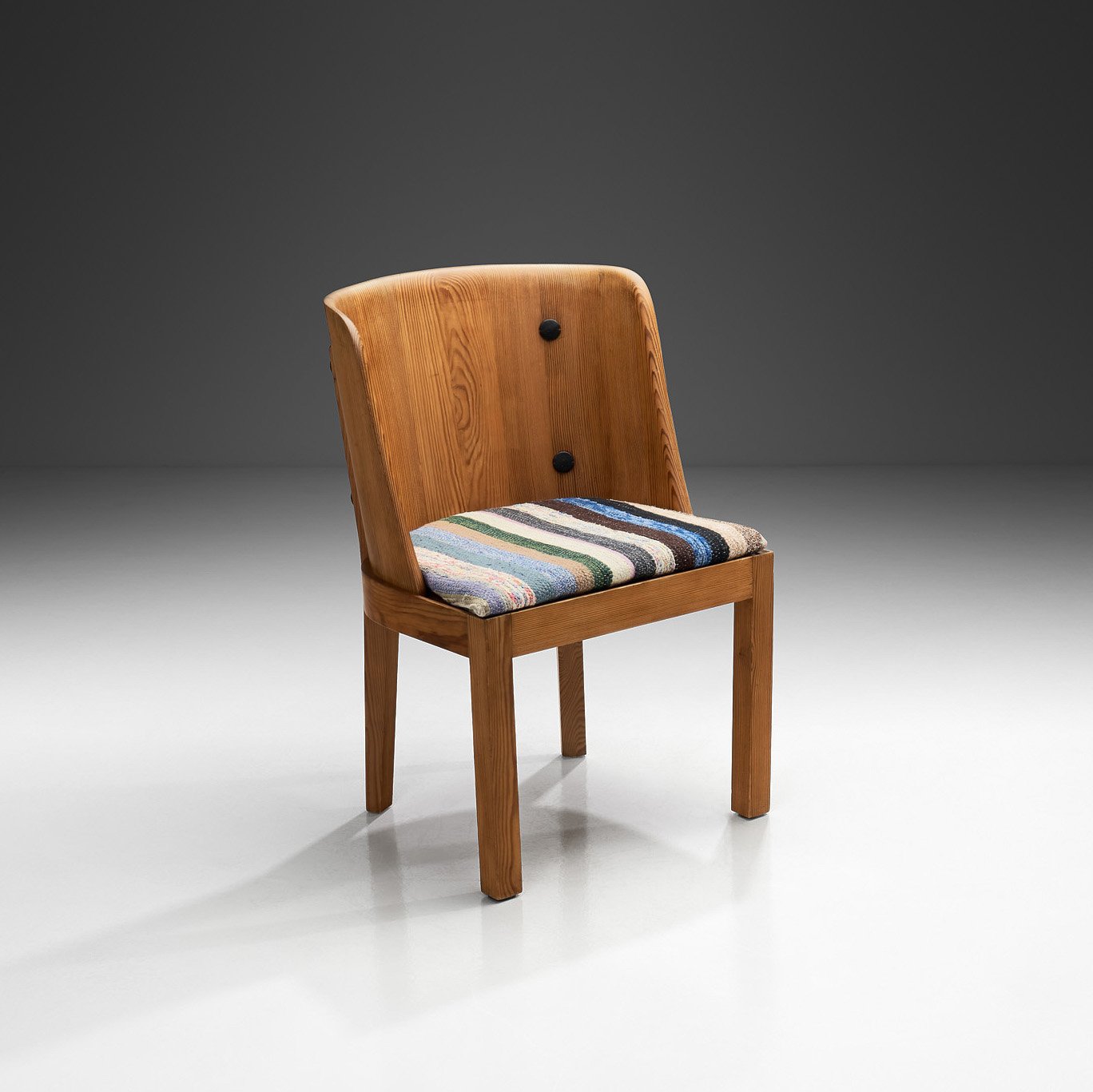
Swedish architect and furniture maker Axel Einar Hjorth worked as the lead designer for Sweden’s Nordiska Kompaniet department store from 1926 to 1938. During this time, Hjorth designed the “Sportstugemöbler” series, (which translates to “sports cabin furnishings”) a collection of wooden furniture designed for country homes. The various models in the sportstugemöbler series took their names from locations in the Stockholm archipelago – including Blidö, Lovö, and Utö.
The “Lovö” model, designed within the series of chalet furnishings, was initially launched by Nordiska Kompaniet in 1932. The series was a response to a new and growing demand for furnishings for leisure houses where the style was more informal. This chair is crafted from local pine wood, while the backrest features iron rivets. The juxtaposition between the pine and iron provides a rustic, sturdy and resilient feel, elevating the timeless look of the model. The chair combines a simple and honest form of the handcrafted style of traditional Nordic “allmoge” furniture, and the international 20th century Modernist movement. The result is a modest yet visually interesting design with a strong silhouette. The pine body is composed of a low, curved back that is slightly tilted in order to increase the sitter’s comfort - highlighting the functional nature of the chair. The seat features a loose, removable cushion, upholstered in a textural, striped fabric. Not only is the design of this model unique, but the colourful, cushion further increases the special character, ensuring remarkable charm. The design is completed by four square, straight legs, offering sturdiness.
The “Sportstugemöbler” series had a lasting influence on Hjorth’s contemporaries, inspiring other big names within Nordic design, such as Carl Malmsten. From an international perspective, this series is the forerunner of later pioneering designs, so it comes as no surprise that these “Lovö” chairs became part of modernist design history.
Condition:
In good vintage condition. Wear consistent with age and use. This chair comes with its original upholstery or has been reupholstered by a previous owner. Each of our items can be re-upholstered by our in-house atelier in a fabric of choice. Please reach out for more information.
Dimensions:
20.86 in W x 20.07 in D x 31.49 in H; Seat height 18.50 in; Seat depth 16.92 in
53 cm W x 51 cm D x 80 cm H; Seat height 47 cm; Seat depth 43 cm
About the designer:
Axel Einar Hjorth was born in a small Swedish village named Krokek, just outside Norrköping, on March 7, 1888. At the age of 20, he moved to Stockholm to study architecture and design at the Högre Konstindustriella Skolan.
Although he never graduated, in the 1920s Hjorth started working as a furniture designer for various manufacturers, such as H. Joop & Co., Myrestedt & Stern, Jonssons, and Nordiska Kompaniet. Hjorth’s designs from this period had neoclassical features combined with Swedish Grace. This romantic national style of Sweden was elegant and refined, yet simple. The anniversary exhibition of 1923 in Gothenburg marked the breakthrough of Swedish decorative arts, and made Axel Einar Hjorth a well-respected artist. From October 1926, Hjorth became the chief designer and architect of Nordiska Kompaniet department store in Stockholm. In the 1930s, Hjorth designed a furniture collection out of pine meant for serial production known as Sportstugemöbler (furniture for holiday houses).
Hjorth’s designs, from the luxury of neoclassicism to the severity of functionalism, are sharply distinctive in style, materials, and character. Unlike many of his contemporaries, Hjorth did not conform to the socially oriented ideas produced by Svensk Form (the Swedish Society of Crafts and Design). He played a significant role in the development of Swedish society as a whole, and particularly in Swedish industrial art.
Today Hjorth is often viewed as a precursor to the modern designs popularised by Charlotte Perriand, Jean Royére, Pierre Chapo, or Josef Frank. Recently, there has been a revival of appreciation for his work, showing his genius in a new light.

REQUEST PRICE HERE
Price category: 15,000 - 20,000 usd / eur
This beloved José Zanine Caldas lounge chair from the “Linha Z” or “Z Line” is an exceptional example of Brazilian design of the 1950s. The design dates to 1949, The woven leather straps and the organic shape is unmatched.
This chair model is made of plywood and features a distinctive shape, distinguished by its legs. The legs and arms are connected and form one unit and their shape inspired the name of the line, “Linea Z”. The edges are softly rounded, which matches the versatile curvature of the body, which enhances the organic feel of the chair. Besides the plywood frame, the original leather upholstery is the stand-out element of this chair both in terms of visual and technical terms. The leather strap seat and back are tightly secured to the plywood, completing the great graphic expression this is widely known for. The bolts of the joinery are left visible, a detail that adds to the rawness of the design. The bent seat is perfectly angled for lounging, supporting the sitter’s whole body.
The pioneering Brazilian designer, José Zanine Caldas’s present design was created by Mòveis Artisticos Z, the factory Zanine Caldas founded in São José dos Campos in 1948. Most of Zanine Caldas’s designs - especially this armchair - tap into the modernist aesthetic while bearing exceptionally unique shapes: form and function revisited with a twist.
Condition:
In good vintage condition. Wear consistent with age and use. Some scratches and discoloration on the wood. This chair comes with its original leather or has been reupholstered by a previous owner.
Dimensions:
24.21 in W x 40.94 in D x 32.48 in H; Seat height 12.4 in
61.5 cm W x 104 cm D x 82.5 cm H; Seat height 31.5 cm
Literature:
Movel Moderno Brasileiro, published by Olhares editores, São Paulo 2017 by Alberto Vicente and Marcelo Vasconcellos
Aric Chen, Brazil Modern, Monaclli Press, New York City 2016
Ruy Teixeira e Jayme Vargas, Desenho da Utopia, Olhares, São Paulo 2016
About the designer:
José Zanine Caldas was born in Belmonte, at the southern coast of Bahia, in 1919. Son of a doctor, Zanine was an autodidact who, from a young age, was fascinated with his environment, especially with trees.
While most architects of his generation studied extensively, Zanine developed his own style through doing and making, and at the age of 20 decided to exchange Bahia for Rio de Janeiro. There he opened up a workshop for architectural scale-models and had the chance to work with pioneering modern architects like Lucio Costa and Oscar Niemeyer.
Large scale furniture with modern design and affordable prices. This was the great advantage of the joinery Móveis Artístico Z founded in 1948 by the architect Zanine Caldas, in partnership with Sebastião Pontes and Paulo Mello, was a great success at the time. Headquartered in São José dos Campos (SP), it maintained its production for almost two decades. The form of creation, idealized by Zanine, was opposed to the market of the time, which was either based on the production of handmade furniture, in solid wood, or in pieces produced in series with an unattractive design. Breaking these paradigms, Móveis Artísticas Z revolutionized manufacturing pieces with improved design and great popular appeal.
Inspired by the local craftsmen who carved boats and furniture from fallen trees, Zanine began experimenting with chiselling and carving large, sculptural works, which became the focus of his later career. Zanine became a big advocate for preservation and in the 1980s, he established the Foundation Center for the Development of the Application of Brazilian Woods (DAM), in an effort to educate and attempt to reverse the rampant destruction of Brazilian rainforests.
Up until his death in 2001, Zanine kept his natural visions alive, and would plant a new tree in place of any tree that was taken down for one of his projects. ~H.
REQUEST PRICE HERE
Price category: 12,500 - 15,000 usd / eur
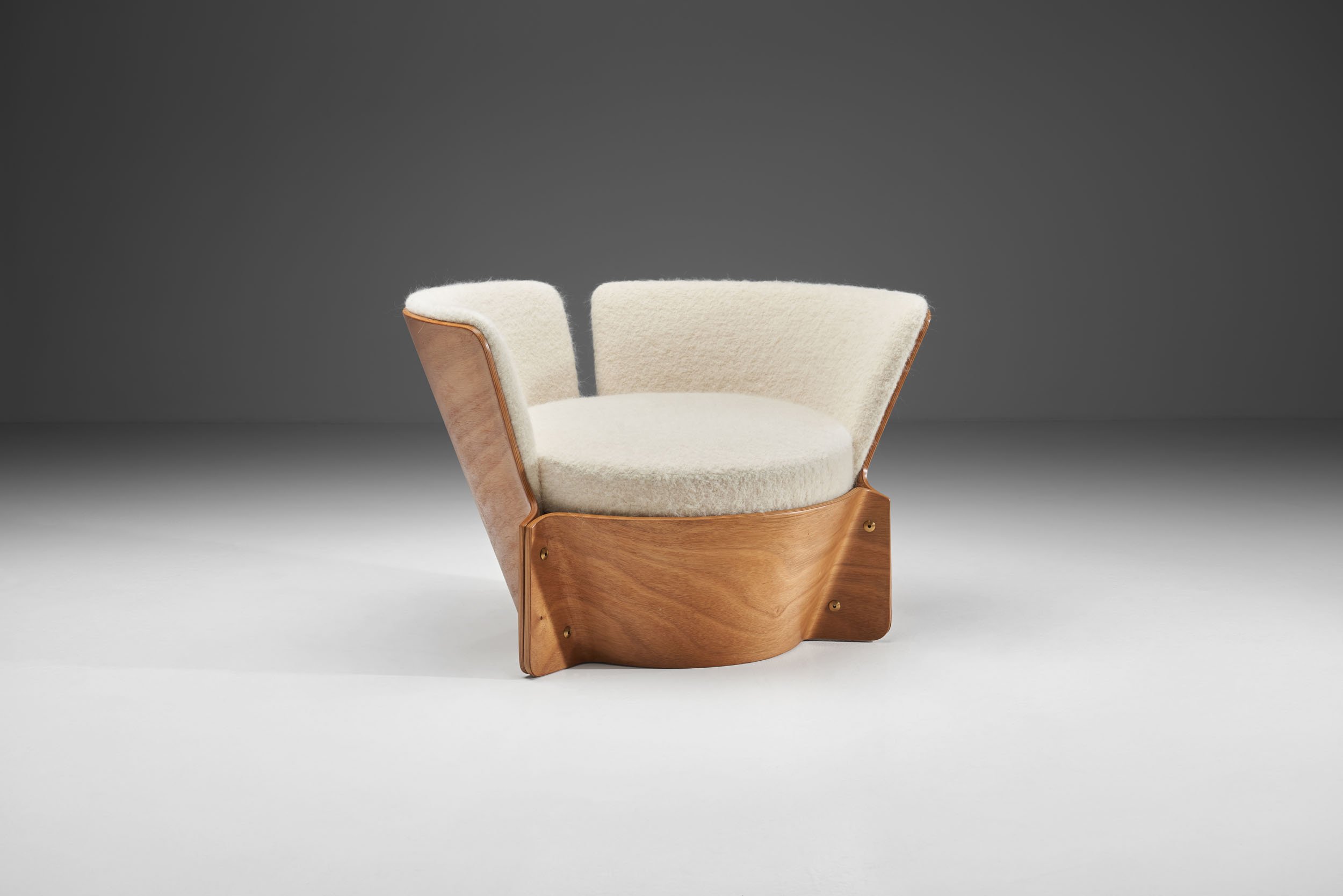
This rare "Roset" chair is a striking creation by the Danish designer duo Ole Gjerløv-Knudsen and Torben Lind, manufactured by Mogens Kold in Denmark in the early 1970s. Introduced in 1972, the “Roset” model stands out for its sculptural form and innovative construction, embodying the spirit of Danish modernism with a playful and organic twist.
The chair’s design is both functional and deeply expressive. Its unusual shape evokes the comfort of a nest, welcoming the sitter into a softly embracing form. The chair’s broad circular seat and gently curved split backrest encourage a relaxed lounging posture, creating an intimate and cocoon-like experience for the user. The feet, resembling fins, not only provide visual dynamism but also ensure stability, giving the piece a grounded yet airy presence. The body is constructed from three laminated plywood panels, precisely joined with visible brass screws that lend a subtle industrial touch while highlighting the craftsmanship and attention to structural detail. The model is upholstered in a premium wool and alpaca blend fabric, chosen for its softness, warmth, and luxurious texture. The light, tactile quality of the upholstery enhances the chair's inviting character and complements the warm natural tones and grain of the plywood shell.
The “Roset” model remains a rare piece that offers both sculptural impact and everyday warmth. It is an ideal statement chair capturing the balance between innovation, comfort, function, and aesthetics, that defines the best of Danish design from the period.
Condition:
Wear due to age and use. Some scratches and marks. Recently reupholstered in premium alpaca - wool blend fabric.
Dimensions:
35.63 in W x 31.50 in D x 23.43 in H; Seat Height 14.17 in
90.5 cm W x 80 cm D x 59.5 cm H; Seat Height 36 cm
About the designer:
Ole Gjerløv-Knudsen (1930-2009) was a Danish furniture architect. He studied at the School of Crafts, graduating in 1952 and then at the Academy of Fine Arts in Copenhagen until 1955. Gjerløv-Knudsen designed furniture series for both carpentry and industrial production in collaboration with fellow Danish furniture designer Torben Lind (1928-2016) from 1962.
Lind’s works showed a commitment to using the finest materials and extraordinary precision to create one-of-a-kind designs. Together, they became well-known for their light furniture in beech and plywood. The duo worked together at PP Møbler, creating furniture that became a trademark of Danish design.
During their long collaboration, Gjerløv-Knudsen and Lind designed numerous successful chair designs representing Danish mid-century modern, with special attention to outstanding comfort and ensuring long-lasting value by using quality materials. Many of their designs were produced by France & Son and Mogens Kold Møbelfabrik. The latter produced some of the most coveted furniture of the mid- 20th century. ~H.

REQUEST PRICE HERE
Price category: 9,000 - 12,500 usd / eur
Designed in the early phase of what we know today as mid-century modern, this charming armchair is unique evidence of how traditional Swedish craftsmanship was brought into modernism. Berga Möbler, later called Berga Form, began manufacturing furniture of the highest quality in 1896.
This armchair holds all the characteristics that define the manufacturer's style: soft, organic, playful, and sophisticated. The model is slightly tilted backwards allowing for a pleasant sitting experience. The tapered wooden legs add a touch of mid-century modern flair apart from being structurally integral, while the two front legs have a precise curvature towards the end; a feature which has become a distinctive feature of Berga Möbler's designs. The rounded backrest and armrests are just some of the elements that define the elegance of the chair. Slightly inclined towards the backrest, the armrests enhance the excellent seating experience, making this piece a great choice for any contemporary living space. The back is tufted with two large buttons that allow for a friendly and welcoming appearance. The cushioning is firm yet plush, perfectly balancing comfort and support. This attention to detail ensures that the armchair is beautiful and practical for everyday use.
Crafted with precision and finished with attention to detail and care for the aesthetic dimension, this armchair stands the test of time thanks to both their visual and material quality.
Condition:
In good vintage condition. Wear consistent with age and use. The chair has been reupholstered recently in a premium fabric. Each of our items can be reupholstered by our in-house atelier in a fabric of choice. Please reach out for more information.
Dimensions:
29.52 in W x 33.46 in D x 33.07 in H; Seat height 17.71 in; Seat depth 20.86 in; Arm height 23.62 in
75 cm W x 85 cm D x 84 cm H; Seat height 45cm; Seat depth 53 cm; Arm height 60 cm
REQUEST PRICE HERE
Price category: 7,500 - 10,000 usd / eur
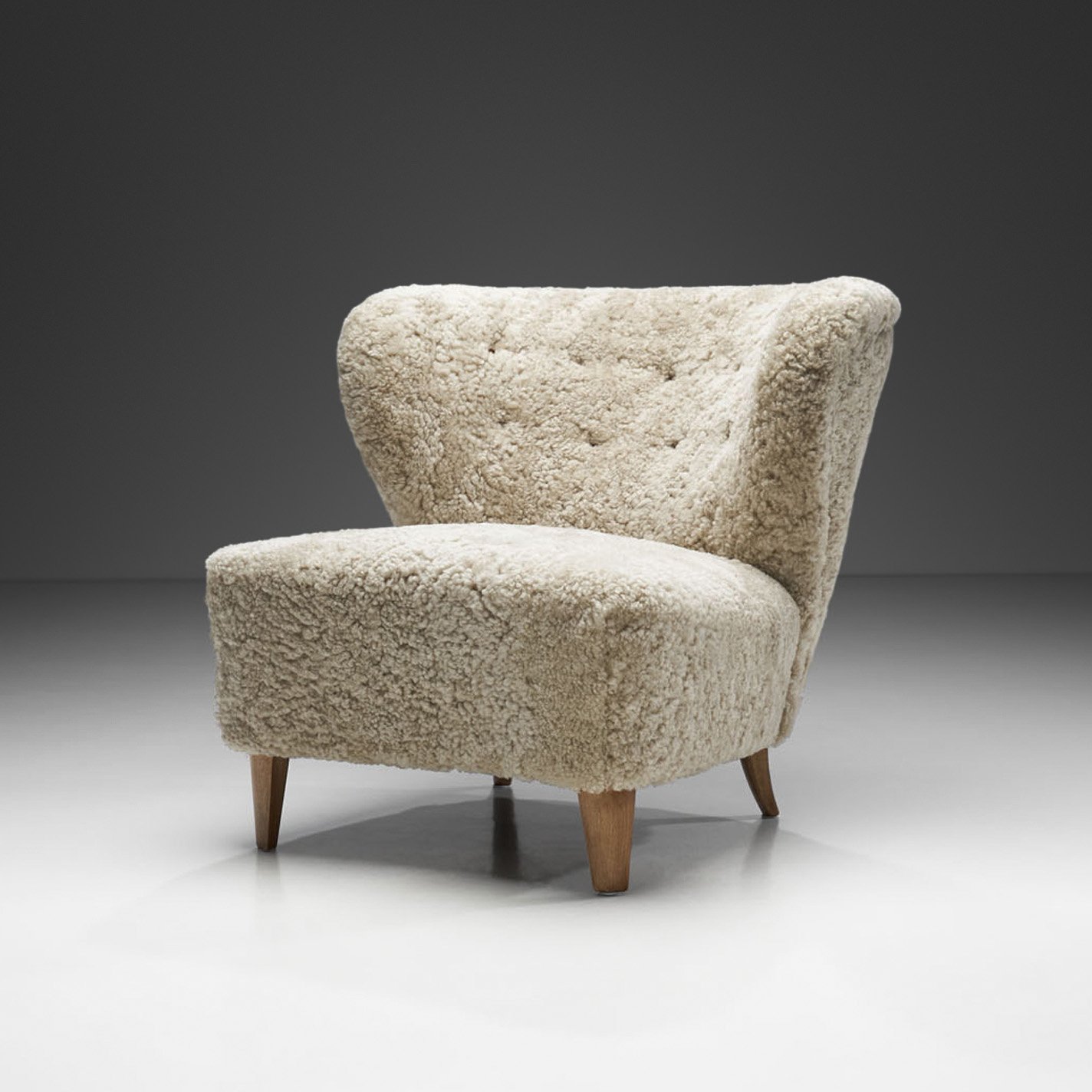
This lounge chair by Swedish designer, Gösta Jonsson, exudes quality and personality from all angles, and is the designer’s most famous model. The basic Swedish design principles are all present and upholstered in soft and stylish sheepskin.
With organic forms and harmonious proportions, this model is an excellent example of great Swedish design from the era. Designed in the early phase of what we know today as mid-century modern, this lounge chair has a classic shape, paired with a modern edge. The generous seat and back are welcoming, with the latter curving in such an angle that the sitter is “hugged”. The large, curved backrest features tufted buttons and follows the curve of the equally generous seat, creating a harmonious look. The backside of this chair is quite striking, as it is created from a single piece stemming from the base. The sheepskin used for the upholstery is the ultimate material for comfort, warm in the winter and cool in the summer. It elevates the sheer size and shape of the chair, especially its back, beautifully. At the same time, the wood also remains in the focus, as it is the most important material in Swedish mid-century design. The solid, stained wood legs are tapered to lighten the look, but are thick enough at the top to provide adequate joinery strength.
The artisanal production quality shows throughout this chair and takes the Swedish idea of furniture that last for generations seriously. The harmony of craftsmanship, the materials and the design makes this lounge chair ideal for any interior and style.
Condition:
In good vintage condition. Wear consistent with age and use. Item may have some marks, scratches, and discolouration. The chair has been reupholstered recently in premium sheepskin. Each of our items can be reupholstered by our in-house atelier in a fabric of choice. Please reach out for more information.
Dimensions:
30.7 in W x 34.64 in D x 27.95 in H; Seat height 16.14 in
78 cm W x 88 cm D x 71 cm H; Seat height 41 cm
REQUEST PRICE HERE
Price category: 12,500 - 15,000 usd / eur
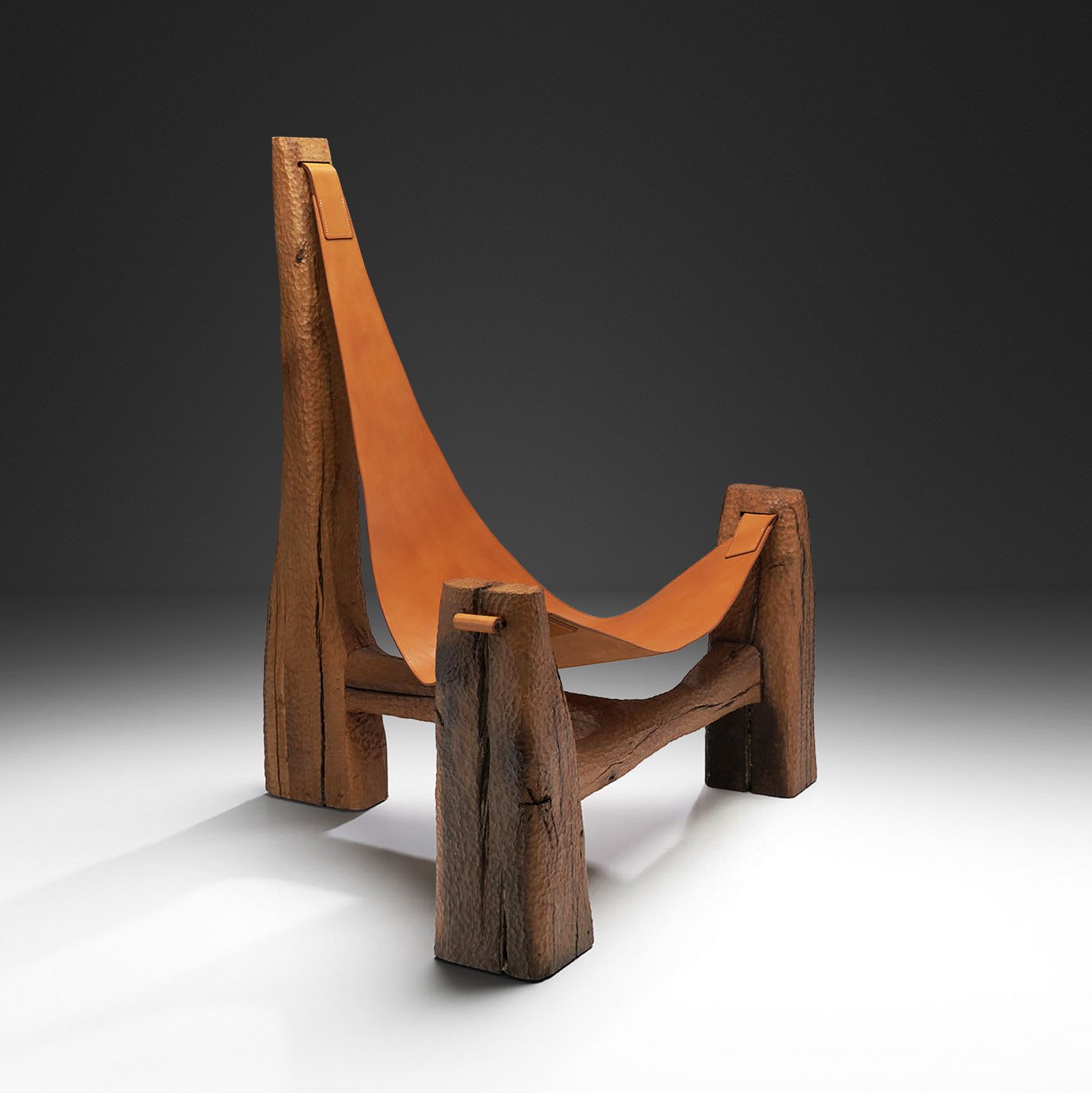
Generally, Czech mid-century modern designs tend to be more sober than their French, German, American, and even Scandinavian counterparts. However, works by Pavel Novak are an exception - as evidenced by chair. The Czech designer’s repertoire is finally starting to surface, and as this chair shows, we are lucky to witness it.
Novak often worked with a gouge, that originally never had any other vocation than to furnish his farm. This piece is made of hand gouged oak, which is in itself a time-consuming and rare woodcarving technique. While most woodworkers offer help with fixing gouges in wood, Novak used the technique to create this rustic looking body that can be considered to be a functional sculpture. Thanks to the unique, hand-carved texture, the lounge chair is one of a kind, with a unique pattern. The leather seat is suspended between the three legs, one of which is elongated to serve as a backrest. The joinery technique is seamless and shows the outstanding craftsmanship and vision of Novak. The leather straps are inset into the legs in a rough, yet sophisticated way.
In fact, rough yet sophisticated are the adjectives that best define the overall aesthetic of this chair, reflected in the pairing of the materials as well. The patinated leather’s smooth surface contrasts beautifully with the gouged, coarse look of the oak. With its straightforward design, this oiece is a seminal work of Pavel Novak.
Condition:
In good vintage condition. Wear consistent with age and use. Some minor cracks. Due to the nature and age of the materials, the chair may have some marks, scratches, and discolouration.
Dimensions:
40.94 in W x 30.71 in D x 48.82 in H; Seat depth 20.08 in
104 cm W x 78 cm D x 124 cm H; Seat height 51 cm
REQUEST PRICE HERE
Price category: 12,500 - 15,000 usd / eur
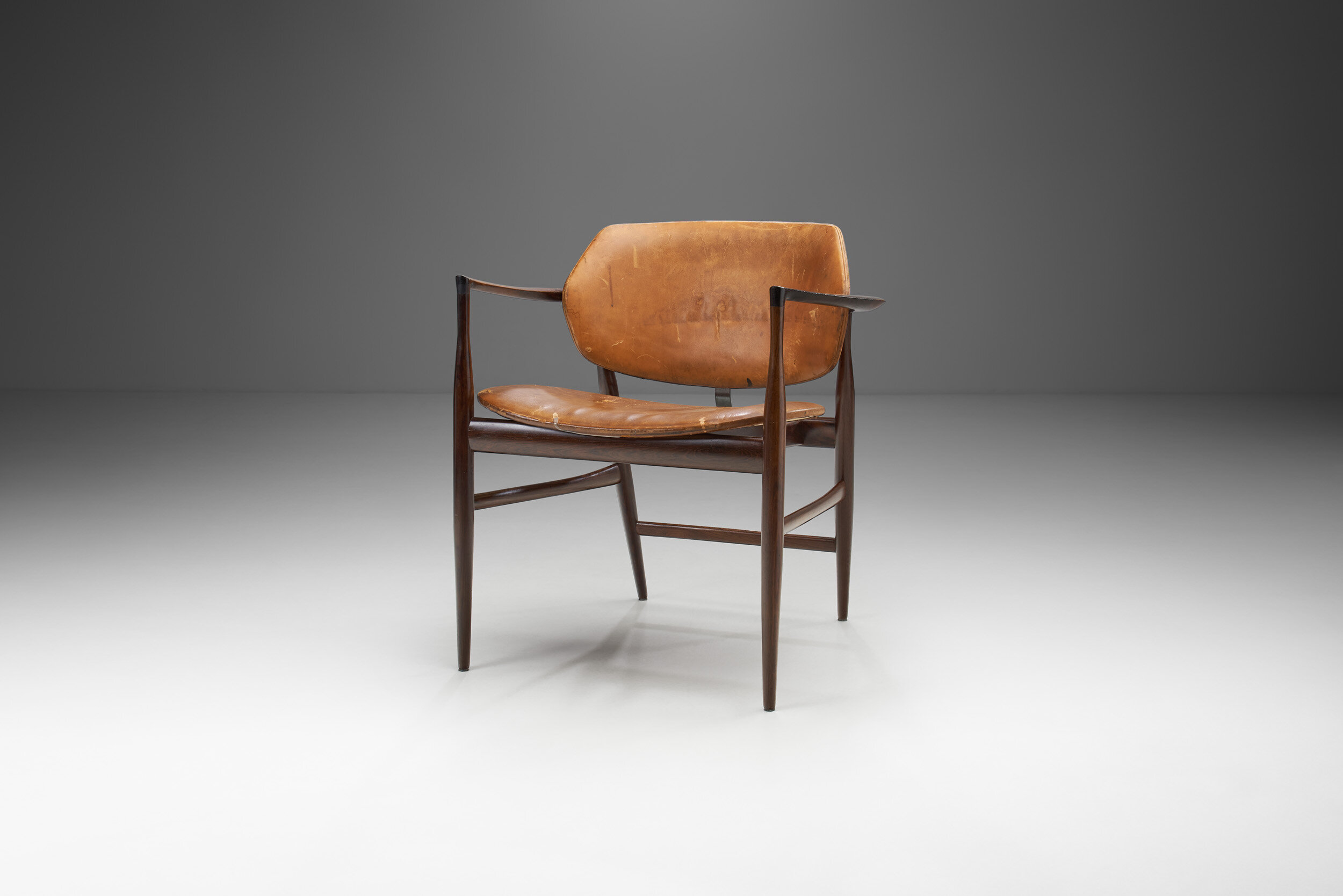
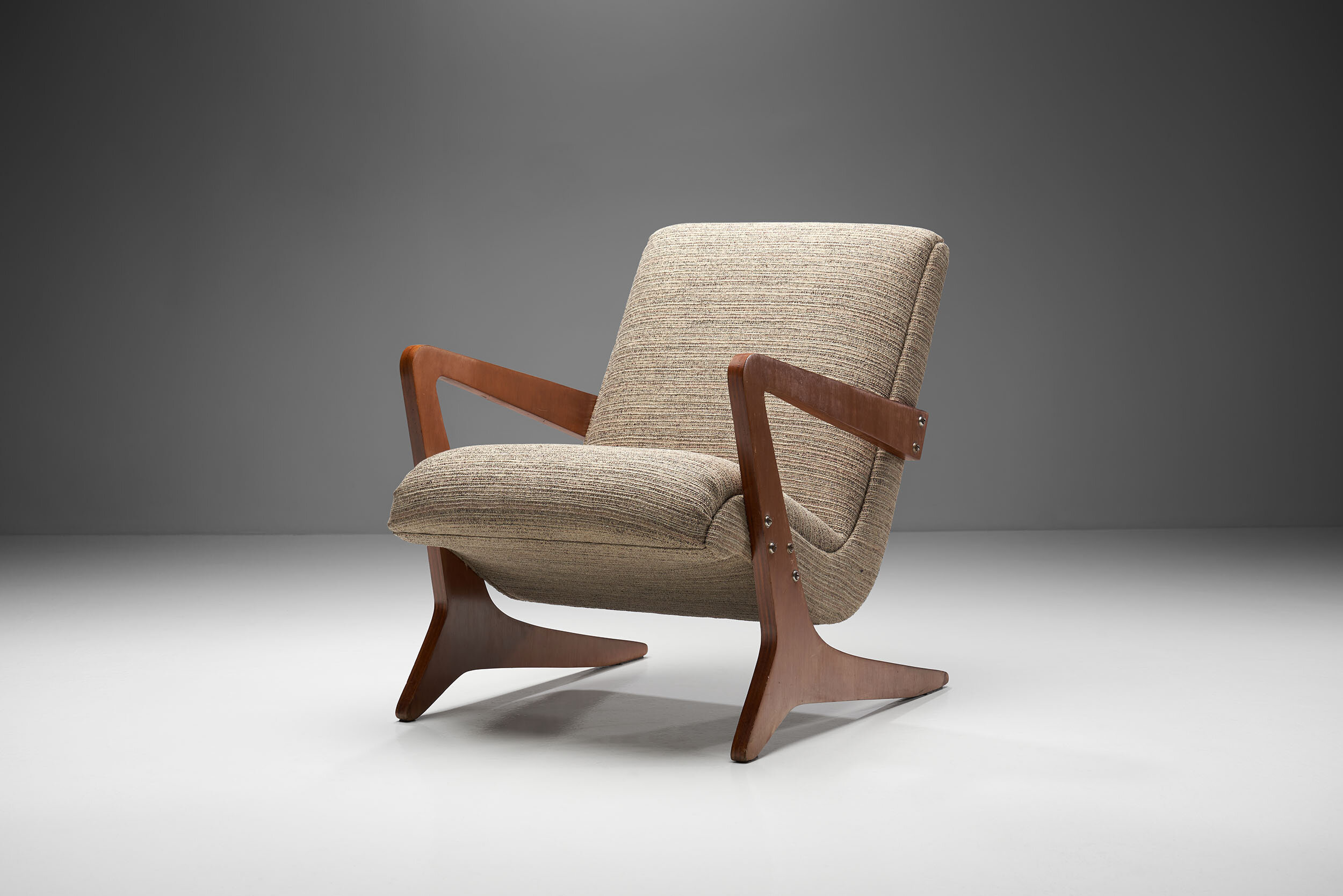
This chair by Danish design icon, Ib Kofod-Larsen, was designed and launched in 1958 as a writing chair to be coordinated with the equally famous model IL-01. Produced by Christensen & Larsen in Denmark, this “Elizabeth” armchair is a rare and prized classic. This model was presented at ‘The Copenhagen Cabinetmakers' Guild Exhibition at Designmuseum Danmark’ in 1958.
Furniture designer, Ib Kofod-Larsen had a background as an architect and carpenter, which is clearly visible in this model. The structure shows architectural knowledge, while the tight leather backrest and seat is perfectly fitted to the frame. The pure sculptural lines are the most characteristic of the design, especially in the armrests and the stretchers between the legs. Ib Kofod-Larsen often worked in various fine woods - including teak and rosewood in this case, and combined them with genuine leather. This combination is exceptionally stylish, and the beautiful patina of the leather adds character to this armchair.
This “Elizabeth” armchair reflects the original and classic design that characterized the Danish Modern era. The present model was created in Ib Kofod-Larsen's spirit and design approach, and has been popular ever since its introduction to the world. It shall come as no surprise then, that today this model has been relaunched by the licensed Japanese producer company, Kitani, as the “IL-07 Writing Chair 1958”.
Condition:
In good vintage condition. Wear consistent with age and use. The chair has its original leather back and seat with marks and scratches and beautiful patina.
Dimensions:
27.55 in W x 23.62 in D x 29.33 in H; Seat height 17.32 in
70 cm W x 60 cm D x 74.5 cm H; Seat height 44 cm
Literature:
Grete Jalk [ed.]: “40 Years of Danish Furniture Design”, vol. 4, p. 48–49.
About the designer:
Ib Kofod-Larsen was born in 1921 in Denmark. Kofod-Larsen was trained as a cabinetmaker with the highest honours in 1944, and later completed his education as an architect from the Royal Danish Academy of Fine Arts in 1948.
His first recognition as a designer came when he won the Holmegaard Glass Competition and received the Danish Cabinetmakers Guild’s annual award. These awards attracted the attention of the Danish furniture manufacturer Faarup Møbelfabrik.
During his time at Faarup, he created some of his most beautiful works, like the rosewood Model 66 sideboard, and established himself as a furniture designer. Learn more about Ib Kofod-Larsen. ~H.
REQUEST PRICE HERE
Price category: 15,000 - 20,000 usd / eur
This characteristic “Zeca” armchair was designed by the pioneering Brazilian designer, Jose Zanine Caldas. Made of solid wood, this armchair was named after the childhood nickname of the designer.
Zanine Caldas is often referred to as the “Master of Wood” for the promotion and integration of traditional Brazilian crafts and modernism in a unique way, which is very visible in this lounge chair. Designed in the early 1960s for Móveis Artísticas Z, a factory he founded in São José dos Campos in 1948, the “Zeca” chair brings some of the unmistakable marks of the work of the master of wood.
The beautiful plywood frame (Móveis Artísticas Z specialised in the material) has an organic shape, characterised by the distinctive curve of the armrests that extend into the legs. The sinuous structural curves and apparent screws provide lightness to this piece. The design is complemented by the light upholstery in a premium bouclé fabric.
Condition:
In good vintage condition. The legs and armrests have minor scratches and marks. Item has been re-upholstered in a premium fabric. Each of our items can be re-upholstered by our in-house atelier in a fabric of choice. Please reach out for more information.
Dimensions:
24. 60 in W x 34.25 in D x 31.88 in H; seat height 16.53 in
62.5 cm W x 87 cm D x 81 cm H; seat height 42 cm
Literature:
Movel Moderno Brasileiro by Alberto Vicente and Marcelo Vasconcellos, published by Olhares editores, Sao Paulo 2017.
Aric Chen, Brazil Modern, Monaclli Press, New York city 2016.
Ruy Teixeira e Jayme Vargas, Desenho da Utopia, Olhares, Sao Paulo 2016.
About the designer:
José Zanine Caldas was born in Belmonte, at the southern coast of Bahia, in 1919. Son to a doctor, Zanine was an autodidact who, from a young age, was fascinated with his environment, especially with trees.
While most architects of his generation studied extensively, Zanine developed his own style through doing and making, and at the age of 20 decided to exchange Bahia for Rio de Janeiro. There he opened up a workshop for architectural scale-models and had the chance to work with pioneering modern architects like Lucio Costa and Oscar Niemeyer.
Large scale furniture with modern design and affordable prices. This was the great advantage of the joinery Móveis Artístico Z founded in 1948 by the architect Zanine Caldas, in partnership with Sebastião Pontes and Paulo Mello, was a great success at the time. Headquartered in São José dos Campos (SP), it maintained its production for almost two decades. The form of creation, idealized by Zanine, was opposed to the market of the time, which was either based on the production of handmade furniture, in solid wood, or in pieces produced in series with an unattractive design. Breaking these paradigms, Móveis Artísticas Z revolutionized manufacturing pieces with improved design and great popular appeal.
Inspired by the local craftsmen who carved boats and furniture from fallen trees, Zanine began experimenting with chiselling and carving large, sculptural works, which became the focus of his later career. Zanine became a big advocate for preservation and in the 1980's, he established the Foundation Center for the Development of the Application of Brazilian Woods (DAM), in an effort to educate and attempt to reverse the rampant destruction of Brazilian rainforests.
Up until his death in 2001, Zanine kept his natural visions alive, and would plant a new tree in place of any tree that was taken down for one of his projects. ~H.

REQUEST PRICE HERE
Price category: 30,000 - 40,000 usd / eur
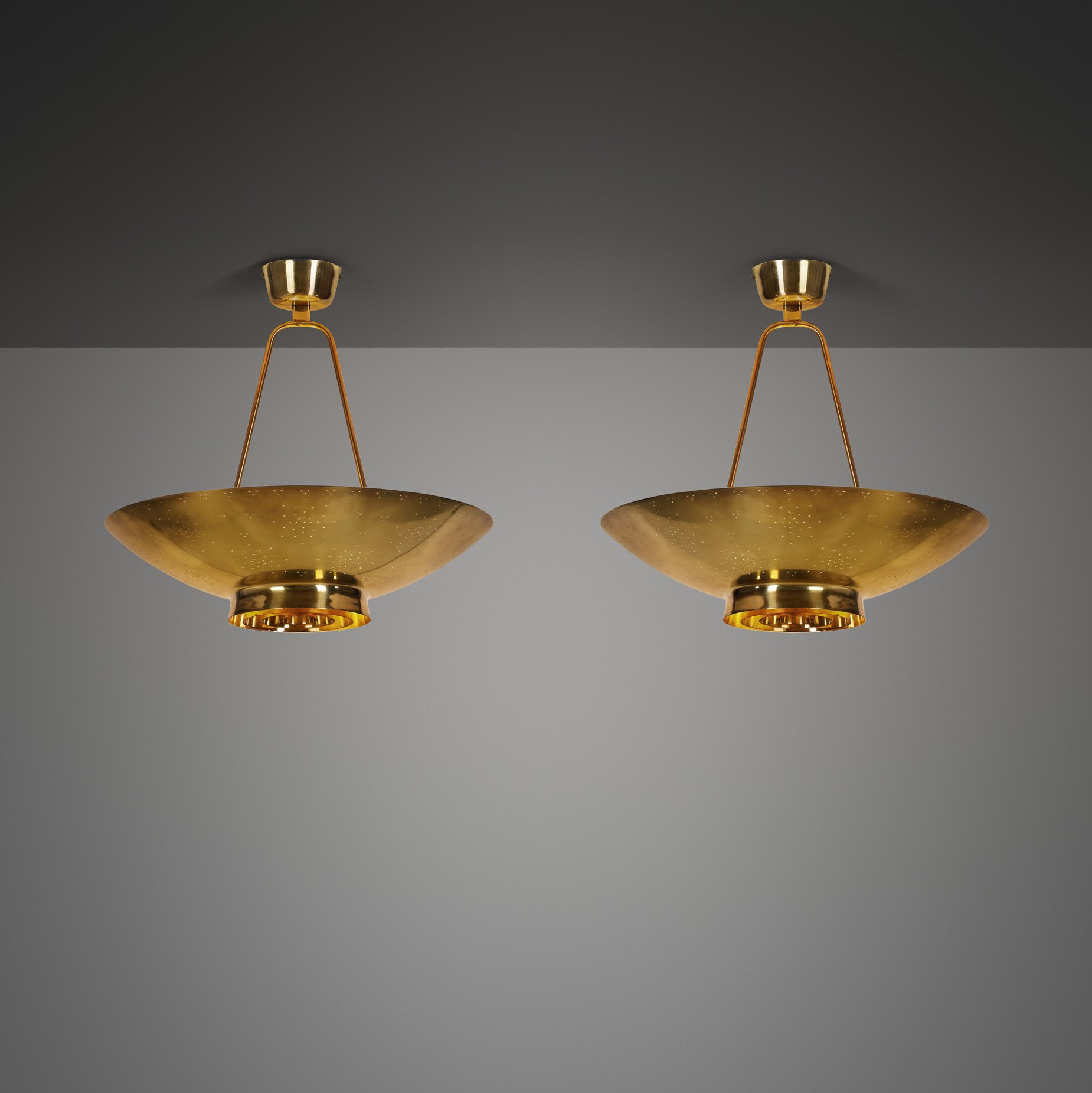
These marvellous chandeliers are a rarity from Swedish designer, Holger Johansson, who created them for his own company, Westal. With a brass frame holding 12 translucent bubble glass shades, grandiose and stylish are the words to describe these models by.
Each chandelier has a brass frame consisting of a long, straight brass pole holding 12 shades arranged on three levels; three on the top and bottom, and six on the middle level. This airy arrangement allows the glass spheres to stand out without making the design look cluttered. The shades each sit at the end of a curved brass pole and face upwards unlike most other models from Johansson, making this particular model stand out in the designer’s impressive repertoire. Thanks to the arrangement of the brass poles and bulbs, the chandeliers divide the light over three levels, illuminating their surroundings in golden light. When switched on, the light coming from the shades brighten the yellow brass and highlight the glass bubbles beautifully. Commonly associated with old glass, the modern bubble glass techniques consist of intentionally creating bubbles for artistic effect. Controlled bubble glass as seen here, also known as “Bolle” or “Bullicante”, is glass that’s embedded with bubbles. The chandeliers’ manufacturer, the Swedish company Westal, is a historic company founded by Holger Johansson in 1947, the same year the first TV test broadcast happened in Sweden. These chandeliers have all the characteristics Johansson was famous for: they are elegant and stylish and while the design allows them to be big and shiny, they never become tacky.
The best qualities of Swedish mid-century designers’ light fixtures are most often their atmospheric light, disciplined, functionalist design completed by unique solutions and design elements. Exemplified by these chandeliers, these qualities are not only timeless, but also ever so eye-catching.
Condition:
In good vintage condition. Wear consistent with age and use.The brass has some minor marks and scratches.
Dimensions:
29.13 in W x 27.95 in D x 56.1 in H
74 cm W x 71 cm D x 142.5 cm H
REQUEST PRICE HERE
Price category: 50,000+ usd / eur
The "9060" is one of those models that lighting design enthusiasts recognize immediately, as truly iconic. Paavo Tynell designed these model “9060” lamps in 1950-52 for the secretariat's room at the United Nations building in New York City.
Paavo Tynell, “the man who illuminated Finland,” was the founder and chief designer of Taito Oy - the first industrial producer of lighting fixtures in Finland. A master craftsman himself, Tynell’s elegant brass designs were derivative of a traditional aesthetic with a modern sensibility. This model is in many ways his most famous ceiling lamp model and not solely for its impressive story. The design has entirely unique elements such as the glass inside the reflector, the unusual circular finial, and the perforated shade, to name a few. All of these features are in service of the unique distribution of the light, provided by the four bulbs sitting above the glass inside the white lacquered reflector of each lamp. The light shines in all directions thanks to the open, hanging brazier-like shades, the open bottom with brass circles, and the patterned, perforated brass. The result is bordering the realm of art, with the brass dressed in golden light. The bodies are held by two brass rods connected to the rounded canopies. Despite their many distinctive elements, the design is united and cohesive through the beautiful polished brass, Tynell’s preferred material to work with.
Tynell’s international design influence grew thanks to the Finland House located in New York City and resulted in prestigious commissions both for public buildings such as the United Nations HQ but also for important private collections. Model “9060” is a historic testament of his design prowess and craftsmanship, remaining one of the most coveted lighting pieces to this day.
Condition:
In good vintage condition consistent with age and use. The brass has some weather marks and a beautiful patina.
Dimensions:
21.45 in ⌀ x 20.86 in H
54.5 cm ⌀x 53 cm H
Literature:
Idman, sales catalogues, no. 135, 136, 140, 142, 1953-1959, n.p.
Finland House Lighting: Harmony in lighting for harmony in living, original designs by Paavo Tynell, sales catalogue, New York, p. 23.
About the designer:
Paavo Tynell (1890-1973) was an industrial designer, known as the great pioneer of Finnish lighting design and fondly dubbed as “the man who illuminated Finland”.
Tynell was one of the founders and chief designers of Taito Oy – the first industrial producer of lighting fixtures in Finland. With the innovation of electricity in the beginning of the 20th century, Taito Oy and Tynell expanded the thinking and manufacturing of modern lighting solutions in Europe and abroad.
Paavo Tynell rose to prominence in the 1930s and 40s when he collaborated with some of the most renowned Finnish architects, Alvar Aalto being the most notable one. Working to incorporate artificial lighting into modern environments, Tynell’s company Taito Oy produced fixtures for all of Alvar Aalto’s major projects. Tynell was especially appraised through his involvement with the Finland House, a design atelier in New York that showcased the work of Finnish designers and craftspeople. His elegant brass designs became an instant success in North America, and he began creating lighting designs for the prestigious American company, Lightolier.
Marked by delicacy and softness, his most famous forms in lightning echo the structures of nature; he adroitly created sculptural shapes reminiscent of the branches of trees, swirling snowflakes and seashells.
REQUEST PRICE HERE
Price category: 30,000 - 40,000 usd / eur
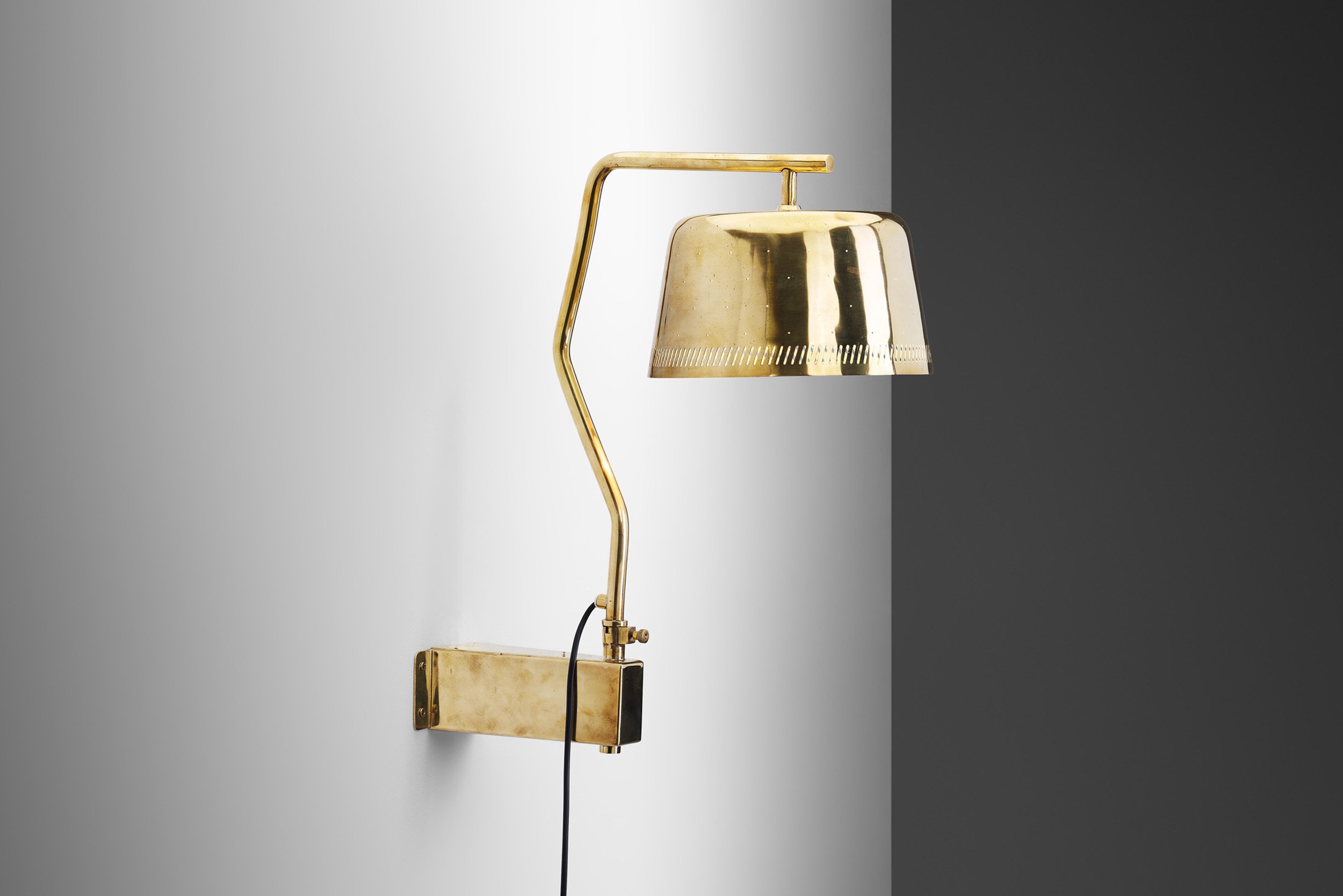
Finnish mid-century design is characterized by simple, elegant forms that Paavo Tynell was a master of. Like Finnish culture he embraced timeless beauty, sustainability and a deep connection to the natural world. His favourite material to work with was brass, and he formed the material into shapes that are very characteristic and unique.
Paavo Tynell is one of Finland’s best known and most collected mid-century designers, he was a pioneer of European lighting design and a founder of the first lighting manufacturing company in Finland, Taito Oy. Functionality, a pared down, simple style and a thoughtful colour palette are key principles for the Finnish icon, whose present wall lamp model features modern solutions and focuses on the characteristics of brass itself. The design features Tynell’s unique perforated shade with a ring of perforated, tilted lines and holes all over the brass shade. They make for a lovely effect when the light is lit and can easily confirm Tynell as the designer. The lampshade hangs from the brass rod which has interesting angles that outline the shape of the shade and showcase the craftsmanship by bending the brass seemingly effortlessly. The neck can be adjusted freely at the bottom on the horizontal axis, which is also a typical Tynell consideration in his designs. The backplate is especially unusual with an elongated, rectangular construction that allows the lamp to stand organically and freely. In the spirit of Finnish mid-century design and culture, this lamp takes on exciting, free forms adjusted to the user needs.
This lamp was manufactured by the famous Finnish manufactory Taito Oy, one of the most innovative Scandinavian lighting design companies of the mid-century era. Paavo Tynell was the co-founder and chief designer of the company until 1953. The company’s lighting designs define the Finnish mid-century era, and the models of the period, including this wall lamp, are greatly sought after to this day.
Condition:
In good vintage condition consistent with age and use. The brass has some weather marks and a beautiful patina.
Dimensions:
9.84 in W x 17.51 in D x 20.86 in H
25 cm W x 44.5 cm D x 53 cm H
About the designer:
Paavo Tynell (1890-1973) was an industrial designer, known as the great pioneer of Finnish lighting design and fondly dubbed as “the man who illuminated Finland”.
Tynell was one of the founders and chief designers of Taito Oy – the first industrial producer of lighting fixtures in Finland. With the innovation of electricity in the beginning of the 20th century, Taito Oy and Tynell expanded the thinking and manufacturing of modern lighting solutions in Europe and abroad.
Paavo Tynell rose to prominence in the 1930s and 40s when he collaborated with some of the most renowned Finnish architects, Alvar Aalto being the most notable one. Working to incorporate artificial lighting into modern environments, Tynell’s company Taito Oy produced fixtures for all of Alvar Aalto’s major projects. Tynell was especially appraised through his involvement with the Finland House, a design atelier in New York that showcased the work of Finnish designers and craftspeople. His elegant brass designs became an instant success in North America, and he began creating lighting designs for the prestigious American company, Lightolier.
Marked by delicacy and softness, his most famous forms in lightning echo the structures of nature; he adroitly created sculptural shapes reminiscent of the branches of trees, swirling snowflakes and seashells. ~H.
REQUEST PRICE HERE
Price category: 30,000 - 40,000 usd / eur
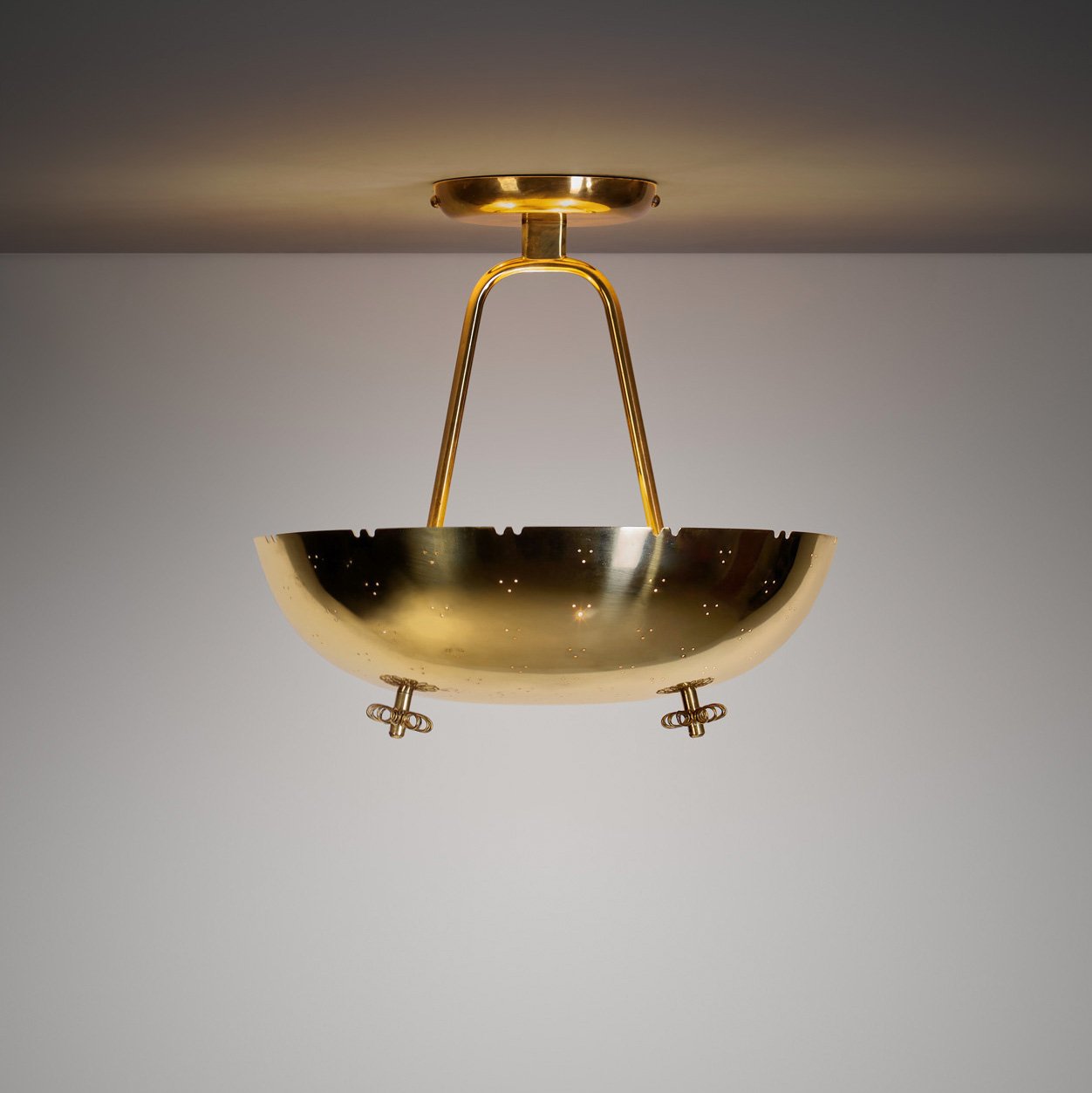
In 1918, Paavo Tynell, “the man who illuminated Finland” co-founded the metalwork and lighting company Taito Oy, the first industrial producer of lighting fixtures in Finland. He worked as the company’s CEO and chief designer until 1953, during which time his creativity brought the world numerous iconic designs. Tynell created lighting models for various public spaces, such as Helsinki’s Parliament House and the office of the Secretary-General of the United Nations.
A master craftsman himself, Tynell’s elegant brass designs were derivative of a traditional aesthetic with a modern sensibility. During the mid-century period, Paavo Tynell designed various lighting fixtures leading to the establishment of his iconic style. Like this “9161” ceiling lamp highlights, his designs merge together simple and decorative shapes, as well as sculptural and natural elements to create a work of art. This lamp combines all of these design choices to arrive at a stunning product. The ‘9161’ model is both functional and stylish and provides a warm brassy glow. The light emits in all directions thanks to the open, hanging shade and the perforated brass. The floral-like elements added to the shade offer the lamp an organic character, a decorative element is often found in Tynell’s work. The body is held by two brass rods connected to the rounded canopy. Despite its many distinctive elements, the design is united by its material, the beautiful polished brass, Tynell’s preferred material to work with. The brass body shines un-apologetically with its warm golden hue. The lamp's clean lines and harmonious proportions highlight the quality of its construction, and the design prowess of Tynell.
Finnish designers like Paavo Tynell and manufacturers like Taito pushed the boundaries of what was possible with new materials and manufacturing techniques. His international design influence grew thanks to the Finland House located in New York City and forever marked the world of lighting design through timeless pieces such as this model “9161” lamp.
Condition:
In good vintage condition. Wear consistent with age and use.
Dimensions:
13.77 in Ø x 13.38 in H
35 cm Ø x 34 cm H

REQUEST PRICE HERE
Price category: 7,500 - 10,000 usd / eur
This exceedingly rare model by Swedish designer and sculptor, Harald Notini. He was the artistic leader at Böhlmarks and is represented at the ‘Nationalmuseum’ in Stockholm.
Between the 1920s and 1950s, Böhlmarks was a significant player in the Swedish design movement. Notini drove the company forward, producing what were considered pioneering and distinctive luminaires for the time. With an unmistakeable design, this pair of model “8772/5” wall sconces belongs to a historic collection of luminaires from a golden era. At Arvid Böhlmarks Lampfabrik the 1940s and 50s represented an era with undulating forms and organic material choices in a fundamental Swedish Modern manner. This model is no exception with a stunning brass structure and unique additional features. The five symmetrically arranged brass arms branch out from the bottom of the sconce into a more organic, curved arrangement. The lamp sockets stand out for their sheer size, showcasing the brass’s beauty. The most distinctive design element however, is the large white lacquered metal reflector that is in the shape of a non-folding fan. This ingenious addition not only provides a clean backdrop against which the organic brass structure stands out, but also reflects the light to create a cosy effect. It also serves as a backplate, therefore the sconces appear as if they were not even fixed to the wall.
Today we consider the mid-century era a golden age for Swedish design and craftsmanship. During these decades, some of the country's most significant luminaires were designed and produced at Böhlmarks, including these exceptionally rare wall sconces.
Condition:
In good vintage condition consistent with age and use. The metal reflectors have some scratches. The brass bodies have some weather marks and beautiful patina.
Dimensions:
11.41 in W x 3.93 in D x 17.32 in H
29 cm W x 10 cm D x 44 cm H
About the designer:
Harald Elof Notini (1879-1959), son of the sculptor Axel Notini, was a trained sculptor and interior designer who studied in his early years at the 'Högre konstindustriella skolan' - now known as Konstfack. Notini worked at Böhlmarks throughout his active career and came to play a significant role in lighting design in Sweden during the first half of the 20th century.
Notini joined Böhlmarks in 1916 and was hired as artistic director, leading Böhlmarks in a modern and innovative direction that would particularly characterize the company's range of luminaires and glass. Notini drove the company forward, producing what were considered pioneering and distinctive luminaires for the time. His expression ranged from the most ornate Swedish Grace of the 1920s and strictly functionalist luminaires, presented at the 1930 Stockholm Exhibition - to the now highly regarded Swedish Modern aesthetic of the 1940s and 1950s.
Harald remained faithful to his company for the rest of his life; at the age of 79 (1958), he still had his office and a wide range of duties. A commemorative publication of Böhlmark's 75th anniversary, published in 1947, notes that Notini was active as an artistic director with a continuing significant role in the design of luminaires and household glass. Given Böhlmark's extensive product catalogues, Notini must have had a drawing office with several designers employed.
REQUEST PRICE HERE
Price category: 20,000 - 30,000 usd / eur
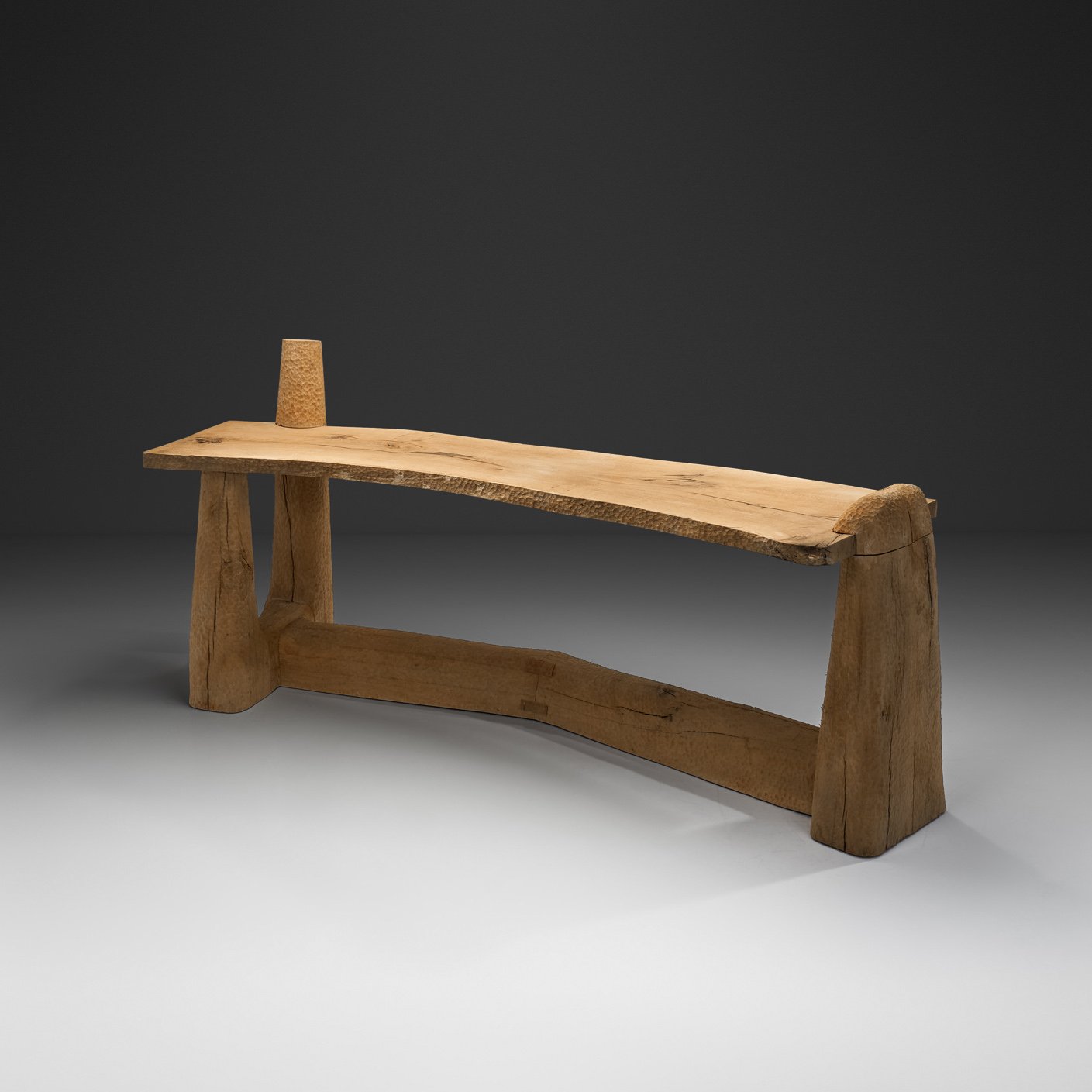
Generally, Czech mid-century modern designs tend to be more sober than their French, German, American, and even Scandinavian counterparts. However, works by Pavel Novak are an exception - as evidenced by this large desk. While his genius is evident in his work, the Czech designer’s repertoire is finally starting to surface, and as this piece shows, we are lucky to witness it.
Novak often worked with a gouge, that originally never had any other vocation than to furnish his farm. Part of this table is made of hand gouged oak, which is in itself a time-consuming and rare woodcarving technique. While most woodworkers offer help with fixing gouges in wood, Novak used the technique to create this rustic looking body that can be considered to be a functional sculpture. Thanks to the unique, hand-carved texture, the table is one of a kind, with an inimitable pattern .
This solid wood table, with its natural finish, exemplifies the enduring charm and warmth that mid-century design continues to bring to contemporary interiors, underscoring the timeless appeal of this iconic design era.
Condition:
In good vintage condition. Wear consistent with age and use. The desk has recently been reconditioned. Due to the nature and age of the wood, the item may have some marks, scratches, and discolouration.
Dimensions:
88.98 in W x 26.78 in D x 39.97 in H
226 cm W x 68 cm D x 101.5 cm H
REQUEST PRICE HERE
Price category: 30,000 - 40,000 usd / eur
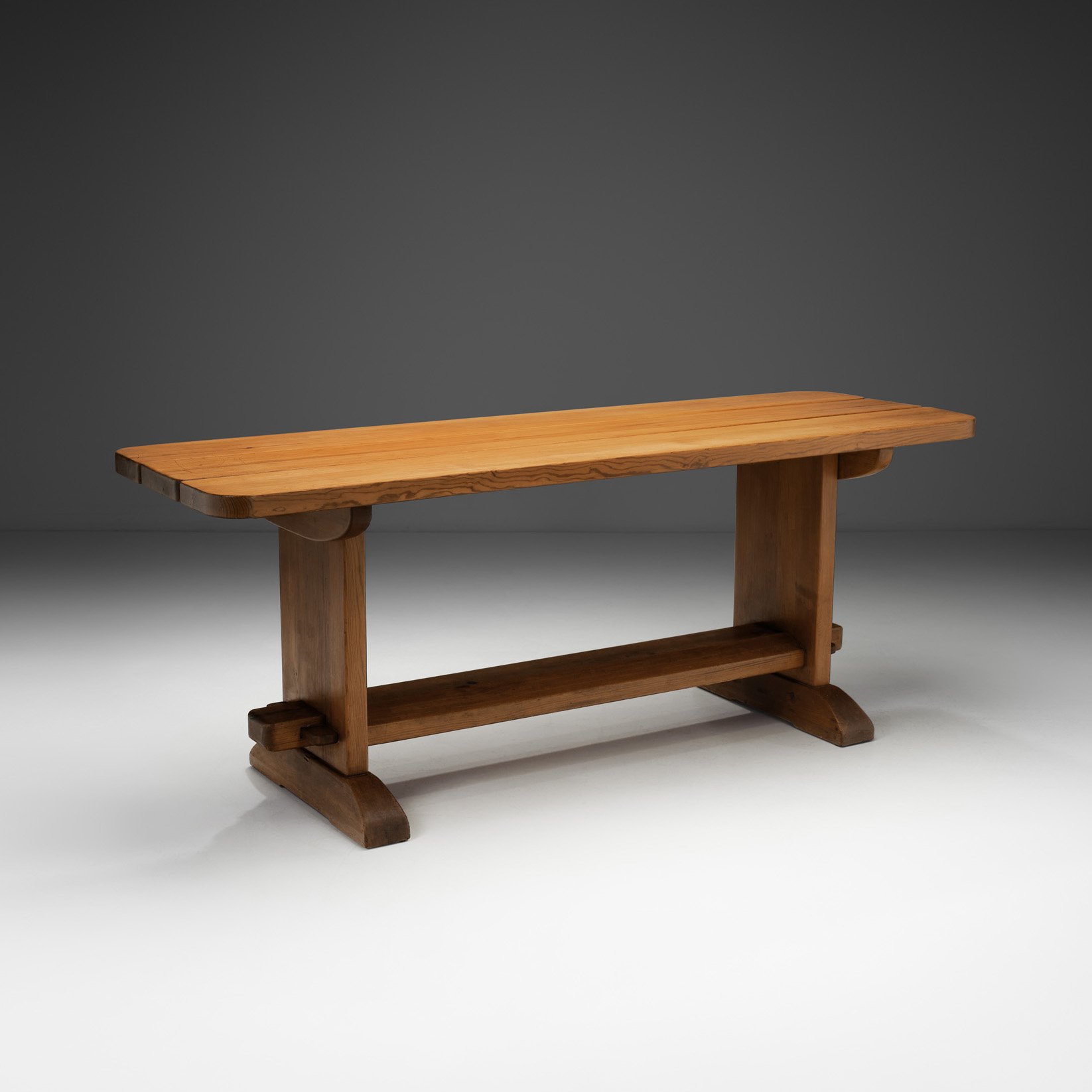
Swedish architect and furniture designer Axel Einar Hjorth served as the lead designer for Nordiska Kompaniet from 1926 to 1938. During this time, Hjorth designed the “Skoga” series in the early 1930s.
The “Skoga” series was crafted as part of a broader collection of summer-house furniture, intended to be both practical and aesthetically harmonious with the rugged beauty of the Swedish landscape. Despite its utilitarian roots, the series, as well as this table, exudes quiet sophistication and a timeless appeal focusing on simple lines and the material itself. Made of pine wood, this table is strong, reflecting Hjorth’s principles according to which he mixed the ideals of the modernist movement with provincial Swedish traditions, producing a unique and primitive modernism. It is quite robust without being intrusive, naturally standing to be the centre of the room. The legs and stretch-bar base emphasize structural clarity and durability, while the rounded corners and visible joinery express a handcrafted, almost sculptural quality. The rectangular tabletop is comprised of three planks of wood, yet it has a light impression. The large surface shows off the pattern of the wood and colour variation. The absence of heavy ornamentation is also in service of enhancing the organic, simple look that defined Swedish design of the era. Each element, joint and line is well crafted and solid, the attention given to every construction and finishing detail is obvious.
This table doesn’t depend on its details, rather, it is just as arresting from afar as from a proximity. The joinery and woodworking reveal the quality craftsmanship of the experts at Nordiska Kompaniet. The most charming thing about this table however, is that it showcases classic elements and so much history, but it lends itself easily to a modern interior.
Condition:
In good vintage condition. Wear consistent with age and use. Some marks and scratches on the wood.
Dimensions:
70.86 in W x 23.62 in D x 27.55 in H
180 cm W x 60 cm D x 70 cm H

REQUEST PRICE HERE
Price category: 40,000 - 50,000 usd / eur
This peculiar “T22” table model is also referred to as the “Eye”. While the name needs no further explanation, the ingenious design certainly does. Pierre Chapo always paired his creative and elegant designs with impeccable craftsmanship that gained him worldwide fame and love.
The “T22” is formed by two arcs, each resting on three cylindrical leg and a central oval module attached to one of the arcs by a sliding system. Placed together, the design forms an “eye”. Not a lot of designs receive a nickname by which they are immediately recognised, but this table is one of those. With its distinctive structure, it epitomises Chapo's research for new systems of joinery, in which the material and the design would be the lead factors in achieving stability, durability, and of course, an aesthetically pleasing outcome. Here, the smaller middle module can be adjusted or removed freely, allowing the table’s modules to be arranged in a variety of ways, for example, it can also be arranged to form a long undulating console. The immense functionality is accompanied by Chapo’s precise joinery techniques and woodworking. Pierre Chapo worked largely in elm wood and has a couple of signature design elements like the visible spline joint and the cylindrical legs as seen here as well. The solid elm has a stunning grain and various patterns that especially stand out on the curvatures of the table.
Chapo’s organic approach to arts and crafts and both designers resisted the stark industrial look that was dominant in the post-war period under the influence of socialism. This coffee table is undoubtedly an emblematic model of post-war French decorative arts and design.
Condition:
In good vintage condition. Wear consistent with age and use. Some small marks. The elm wood has a beautiful patina. Due to the nature and age of the material, the item may have some additional scratches, and discolouration.
Dimensions:
69.48 in W x 51.18 in D x 12.99 in H
176.5 cm W x 130 cm D x 33 cm H
About the designer:
Pierre Chapo, born in Paris in July 1927, was initially interested in becoming a professional painter. However, after a chance meeting with a shipbuilder who introduced him to wood and wood crafts, Chapo changed his focus and decided to study architectural studies at the prestigious École Nationale Supérieure des Beaux-Arts in Paris.
After graduation, Chapo and his wife, the sculptor, and painter Nicole Lormier, started to travel extensively through Scandinavia and Central America. Among the many places the couple visited was the home and studio of Frank Lloyd Wright in Taliesin West. A visit that had a lasting influence on Chapo’s future work and designs. Read more about Pierre Chapo. ~H.

REQUEST PRICE HERE
Price category: 30,000 - 40,000 usd / eur
Ib Kofod-Larsen was one of the pioneers of the Danish modern in the 1950s. Rather than a regional phenomenon, Kofod-Larsen saw Scandinavian design as part of international modernism, and he became one of the best-selling Danish architects in the United States in the 1950s. This rare palisander sideboard was produced by Swedish manufacturer Säffle Möbelfabrik in cooperation with the Danish designer in 1958.
This very sought after model features distinctive V-shaped legs that complement the otherwise strict lines. The veneer has a grain that has come out beautifully over time, and gives the sideboard a striking look. This means that each model is different and unique, the pattern always varying. It praises the designer that the body is in an understated, rectangular shape that lets the wood and the legs stand out. Functionality also plays an important role in this model; with its sheer size and four doors, this piece offers a lot of shelving space. The first three doors cover space for height adjustable shelves, while the fourth covers four white, unevenly sized drawers. Each door has a small oval notch on the top, enabling easy opening while maintaining a clean and uncluttered front. Presumably only 40 or 50 of these models have been made when the Säffle factory bought a leftover stack of veneer from another factory. This sideboard is made with outstanding production quality and attention to detail.
Ib Kofod-Larsen's work became increasingly sought-after during the 1950s and 1960s, typically featuring organic and minimal pieces made specifically for the Scandinavian market. This “Trol” sideboard is a beautiful and elegant evidence of Kofod-Larsen’s graphic purity and artistic expression. He was a purist. A man of detail. At first glance, his furniture may seem simple, but at closer inspection it is full of detail.
Condition:
In good condition. Wear consistent with age and use. The veneer has some minor marks.
Dimensions:
95.86 in W x 18.51 in D x 28.3 in H
243.5 cm W x 47 cm D x 72 cm H
Literature:
Mobilia Magazine n°106, May 1964
About the designer:
Ib Kofod-Larsen was born in 1921 in Denmark. Kofod-Larsen was trained as a cabinetmaker with the highest honours in 1944, and later completed his education as an architect from the Royal Danish Academy of Fine Arts in 1948.
His first recognition as a designer came when he won the Holmegaard Glass Competition and received the Danish Cabinetmakers Guild’s annual award. These awards attracted the attention of the Danish furniture manufacturer Faarup Møbelfabrik.
During his time at Faarup, he created some of his most beautiful works, like the rosewood Model 66 sideboard, and established himself as a furniture designer. Learn more about Ib Kofod-Larsen. ~H.

REQUEST PRICE HERE
Price category: 7,500 - 10,000 usd / eur
Swedish architect David Rosén worked alongside renowned designers such as Axel Einar Hjorth and Josef Frank at Nordiska Kompaniet (NK), one of Sweden’s most respected design houses. Rosén crafted this beautiful table for NK in 1938.
Made from pine, this table exudes a lovely charm and robust aesthetic that is characteristic of the era. In early 20th century design, the use of wood held a special significance; it was not merely a material choice, but a philosophy that emphasized the natural and organic over the ornate and extravagant. Moreover, in a rather distinctive way, softness and tradition merge in this coffee table. While it is elemental thanks to the solid pine and interesting construction, the roundness of its top and its elegantly sculpted base still provide a sense of gentleness. It is this well measured tension between the shapes that make the design eye-catching and infinitely interesting. Organic and natural materials often take pride of place in Swedish design, reflecting the Scandinavian and Nordic countries’ relationship to nature. The solid pine wood of this table is not overworked, its natural grain stands out and serves as ornamentation in itself. With minimalism comes timelessness, a guarantee that this coffee table will never go out of style.
With its strong and distinctive details, this table model is a perfect accent table, while also being capable to complement its surroundings. This piece could fit well in a modern interior, as well as in a minimalist or rustic space.
Condition:
In good vintage condition. Wear consistent with age and use.
Dimensions:
28.74 in W x 21.65 in D x 23.62 in H
73 cm W x 55 cm D x 60 cm H

REQUEST PRICE HERE
Price category: 50,000+ usd / eur
"I can't live well with too much rigidity. The 90-degree angle, for example, is something I love, but I can't do it. The things I do end up being a little lyrical, a little sensual, in short, there is always an element that does not come from purity or cleanliness."
This beautiful pedestal table visualizes the above quote from Jorge Zalszupin. It was designed in 1959 and produced by his own company, L'atelier. Essentially, the sizeable top rests on one concrete base finished with soft leather. The solid wood patchwork on the tabletop is mesmerizing, showcasing the many shades of Brazilian hardwood. This was not a purely aesthetic choice, but also an initiative for the rationalization and use of leftover scraps of wood available at the factory, allowing at the same time a combination of their different colourings. The way the large top is supported by the thick metal structure shows architectural precision and the use of materials of the highest quality. At the time of its creation, this table was presented as a dynamic piece that could be used in both the corporate and the domestic places thanks to its casual elegance. Today, its versatility is still recognized, a mark of good design. Zalszupin’s L’Atelier was a design collective comprised of architects, engineers, craftsmen and a full-scale team of professionals who did everything from researching materials to finalizing the product. Therefore, the quality of L’Atelier furniture has transcended time and his pieces have become timeless.
The name is said to be a reference to the famous Baia de Guanabara, a traditional postcard image of Rio de Janeiro. Zalszupin's production established a dialogue very close to the artisanal traditions of working with wood, ensuring quality in the aesthetics and manufacturing of his work.
Condition:
In good vintage condition. Wear consistent with age and use. Some minor scratches on the wooden tabletop. The leather covering on the base is a later replacement.
Dimensions:
98.82 in W x 49.21 in D x 29.13 in H
251 cm W x 125 cm D x 74 cm H
Literature :
Jorge Zalszupin, Design Moderno no Brasil – Maria Cecilia Loschiavo dos Santos, Olhares Edition, São Paulo, 2014, p. 142
About the designer:
Jorge Zalszupin was born in Warsaw, Poland, in 1922. He graduated as an architect in Romania in 1945. His importance for Brazilian design has been articulated in several publications so far. In addition to being the owner of the l'Atelier furniture factory of modern furniture, Zalszupin led a unique initiative: he coordinated a team of designers working for four different factories in the same business group, the Forsa Group.
Zalszupin immigrated to Brazil in 1949 and after a brief stay in the capital, he settled in São Paulo, a city that was then entering a cycle of great industrial growth and great cultural transformations. In the first half of the 1950s, he opened an architecture office, having José Gugliota as a partner. When he got tired of designing exclusive furniture manufactured for his clients' homes, he decided to join a group of woodworkers and started to produce smaller series. This was how l'Atelier came into being, which eventually began to manufacture office furniture and went from a carpentry shop with handcrafted products to an industry with serial production. The first piece in this series was an armchair nicknamed 'Danish' by employees. It was first created in 1959.
After the crisis of the 1980s, Jorge Zalszupin dedicated himself exclusively to architecture, an activity he had never abandoned. From 2005, the company Etel Marcenaria started to produce several of the items designed by Zalszupin for l'Atelier - among them the 'Danish' armchair -, privileging the objects of the company's artisanal phase. ~H.
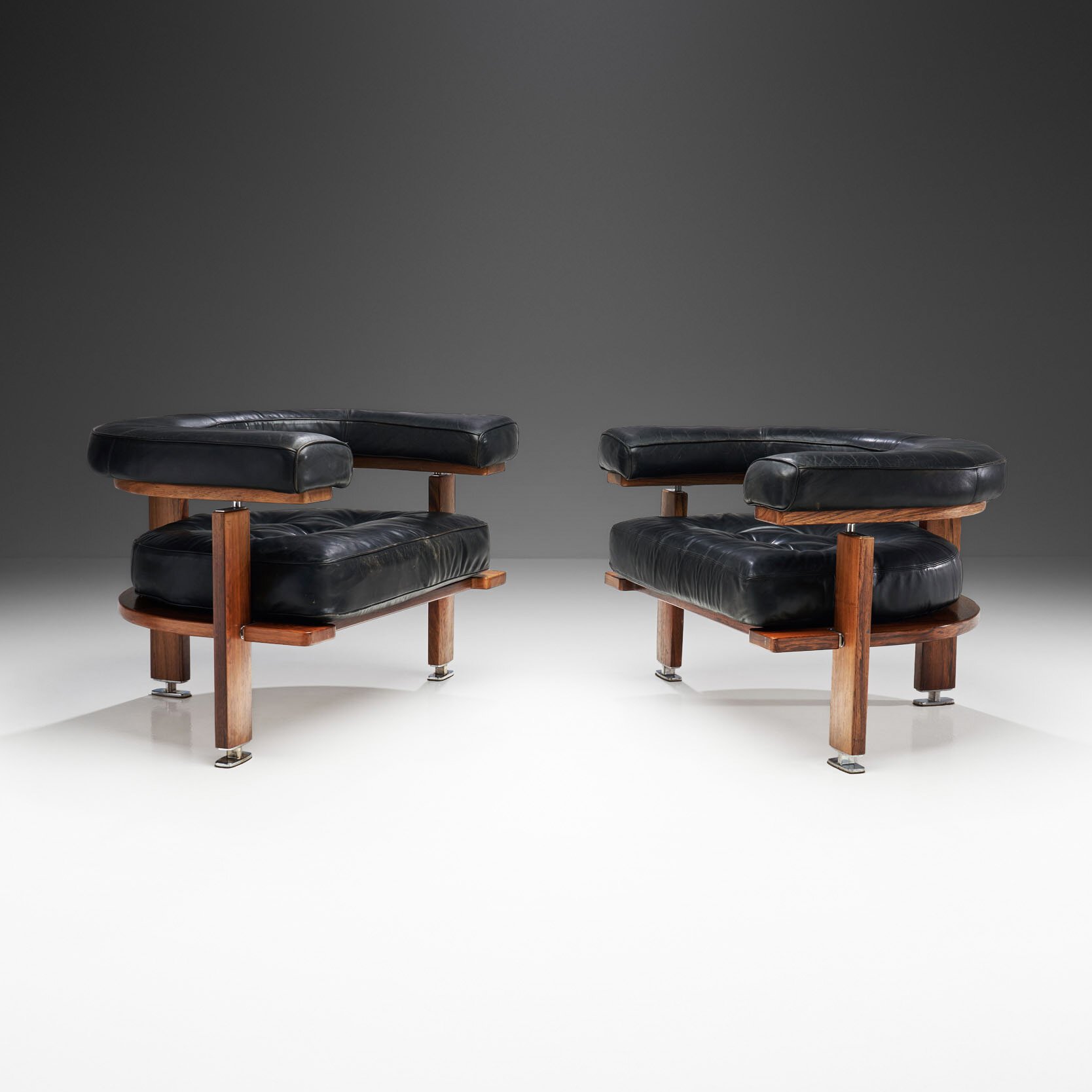
REQUEST PRICE HERE
Price category: 12,500 - 15,000 usd / eur
This pair of “Polar” lounge chairs was designed by the eminent Finnish designer, Esko Pajamies, and produced by Lahden Lepokalusto Oy Finland during the 1960s.
These leather chairs feature a half moon shaped backrest and comfortable, aesthetically pleasing cushions. The sitting cushions are tufted, and along with the upholstered armrests, have a beautiful patina. The strong and sturdy wooden frame provides a beautiful contrast to the black leather, and with the chrome plated steel connections supporting the curved armrests, it gives these chairs a modern look.
The legs have similar chrome plated steel details, which provide the chairs with an almost floating appearance. The open wooden frame further contributes to the spacious feel of the design. The chairs have their original black leather upholstery.
Condition:
In good vintage condition. Wear consistent with age and use. Piping has some minor repairs. Leather has some minor marks. Note: Although from the same source, the items differ a little bit in height. These chairs come with their original leather or have been reupholstered by a previous owner. Each of our items can be re-upholstered by our in-house atelier in a fabric of choice. Please reach out for more information.
Dimensions:
29.53 in W x 40.56 in D x 25.99 in H; seat height 16.34 in
75 cm W x 103 cm D x 66 cm H; seat height 41.5 cm
Literature:
Arkkitehti-lehti magazine, 1965.
About the designer:
Esko Lauri Alvari Pajamies (born August 20, 1931 Helsinki - September 26, 1990, Eloúnta, Greece) was a Finnish designer, especially known for his upholstered livingroom and public furniture.
Pajamies graduated as an interior architect in 1954, and established his own design studio in 1961. In the 1960s, Pajamies designed the “Bonanza” couch, which combined leather and solid oak, starting the line of his characteristic mixture of materials. The “Koivutaru” armchair made of bent birch at the end of the 1970s. Pajamies’ workshop also designed furniture for the Helsinki-Vantaa Airport's passenger terminal.
The Finnish designer and architect was awarded the State Art Prize in 1979. Besides being active as a designer, Pajamies was an avid Jazz Trumpeter. ~H.
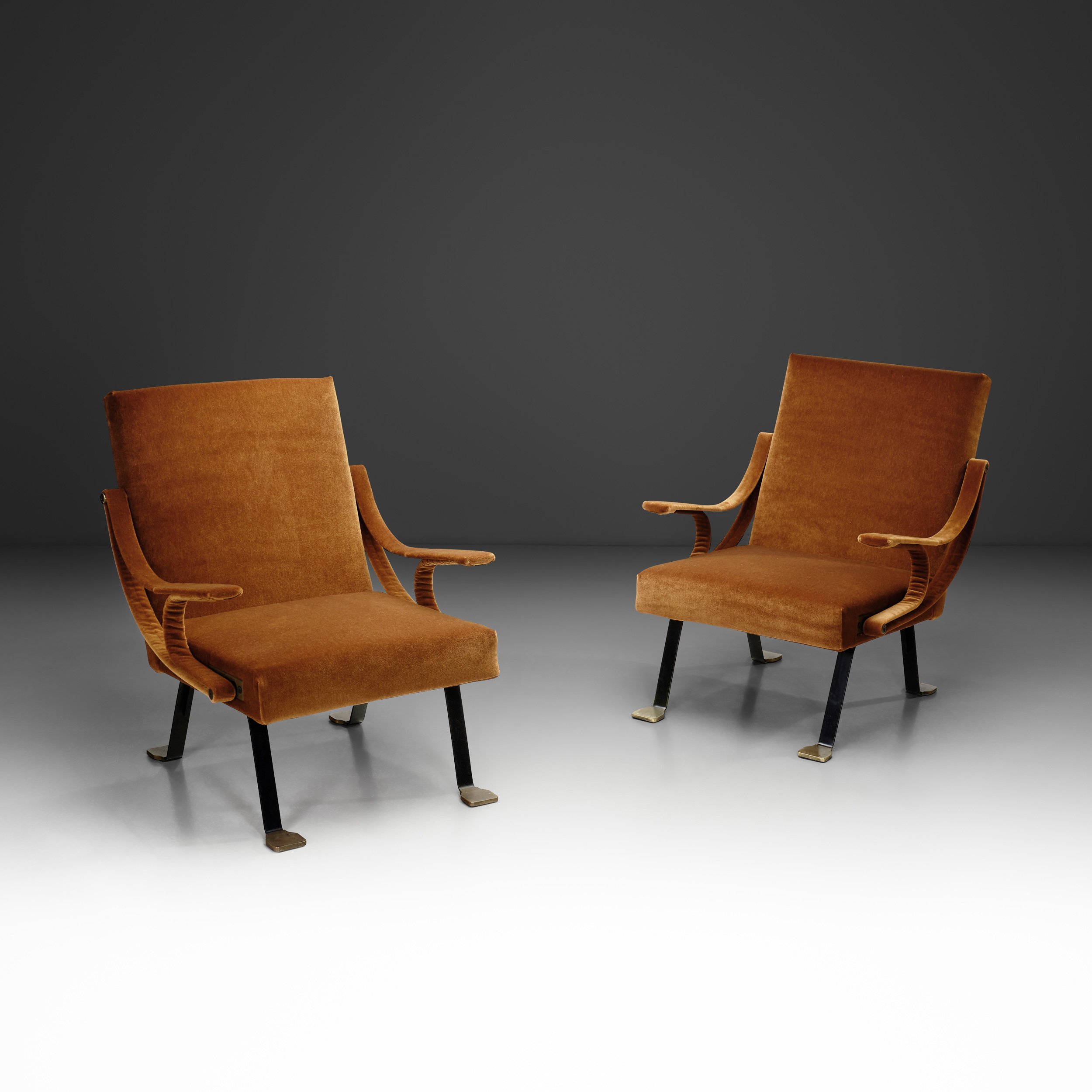
REQUEST PRICE HERE
Price category: 30,000 - 40,000 usd / eur
The postwar boom years of the 1950s through to the 1960s were one of the periods of greatest influence of Italian designers. Design in the 60s paved a way to a more aesthetical approach to products as opposed to its utilitarian predecessors, resulting in exceptional pieces like these armchairs.
In the 1960s, together with Gavina, Ignazio Gardella created these innovative "Digamma" armchairs. This model is versatile and functional with a strong personality, characteristic of Italian modern design. There are several features that show different style elements starting with the fully upholstered, sculptural body and tapered metal legs. With the outward pointing armrests and the dynamic lines of the seating, the chairs combine modern forms and ideals to obtain a timeless, impressive piece of furniture. Furthermore, the burnt orange mohair fabric adds a rich and luxurious look and feel, with the deep, warm hue of the upholstery creating a sense of opulence, making it an ideal choice for an eye-catching interior. The mohair’s tone enhances the sculptural qualities of the form, contrasting the crisp, linear frame with a plush, inviting surface. On the decoration front, the chairs aren’t in need of much thanks to the brilliance of the design itself, therefore the sole decorative element is the subtle rouching of the armrests on each chair.
The design was created in the golden days of Italian mid-century modernism, when Italian design giants like Gio Ponti and Paolo Buffa worked as well. With an outstanding design, quality materials and Italian design elements, this pair is sure to provide comfort and style in any interior.
Condition:
In good vintage condition. Wear consistent with age and use. The chairs have recently been reconditioned. The back of the chairs can be adjusted in three ways. Chairs may have some marks, scratches, and discolouration. The chairs have recently been reupholstered in a premium fabric. Each of our items can be re-upholstered by our in-house atelier in a fabric of choice. Please reach out for more information.
Dimensions:
28.14 in W x 33.46 in D x 33.46 in H; Seat height 16.53 in; Seat depth 21.45 in; Arm height 21.45 in
71.5 cm W x 85 cm D x 85 cm H; Seat height 42 cm; Seat depth 54.5 cm; Arm height 54.5 cm
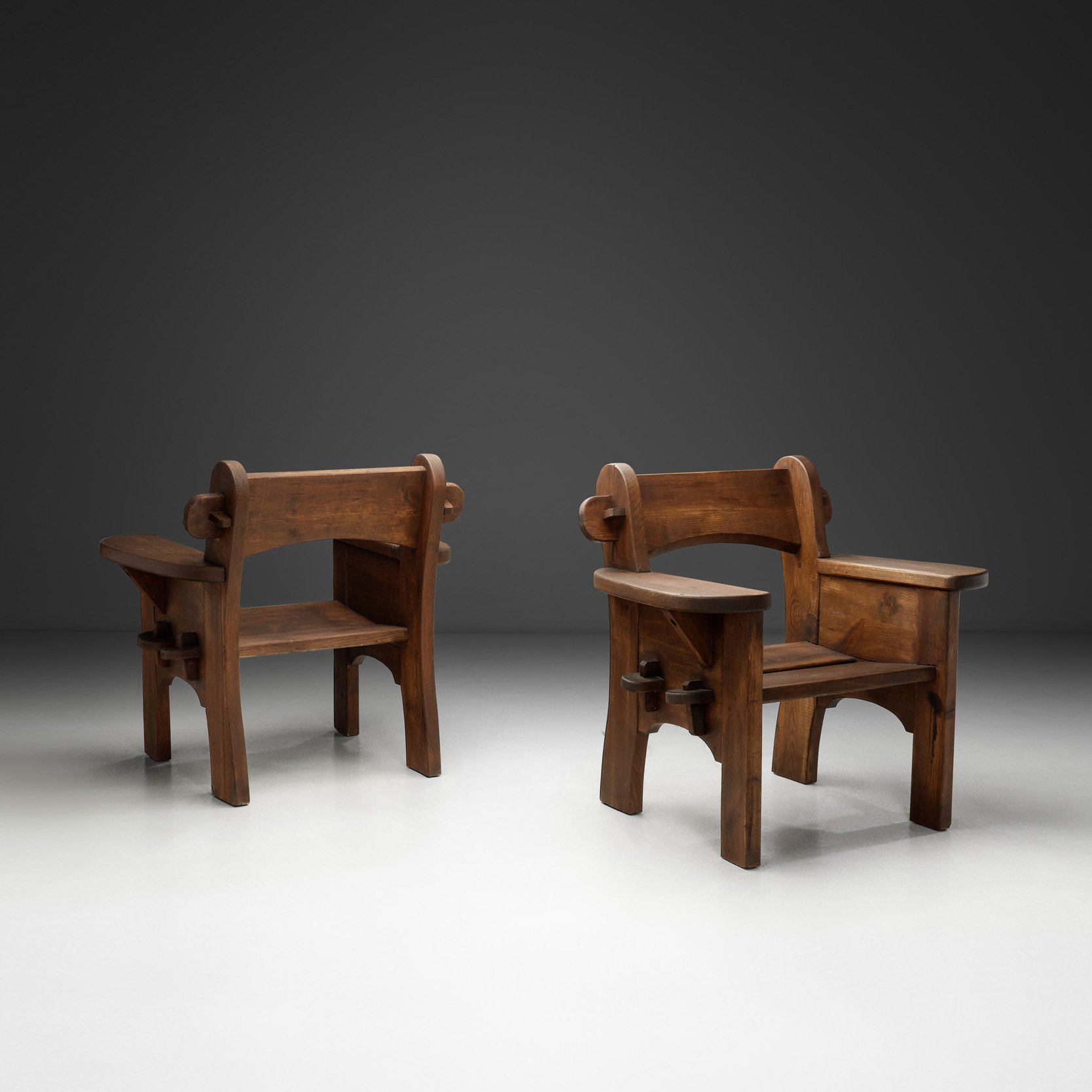
REQUEST PRICE HERE
Price category: 12,500 - 15,000 usd / eur
These "Berga" chairs by David Rosén for Nordiska Kompaniet reflect the refined elegance and functional clarity that defined Scandinavian modernism. As a prominent figure in Swedish furniture design, Rosén worked extensively with Nordiska Kompaniet, one of the country’s most influential department stores and producers, creating furniture pieces that embodied the ideals of quality craftsmanship, restrained form, and comfort.
This pair of chairs exude a lovely charm and robust aesthetic that is characteristic of the era. In 20th century design, the use of wood held a special significance; it was not merely a material choice, but a philosophy that emphasised the natural and organic over the ornate and extravagant. Moreover, in a rather distinctive way, softness and tradition merge in these armchairs. While it is elemental thanks to the solid stained pine and interesting construction, the roundness and elegantly sculpted form still provide a sense of gentleness. Pine was a popular choice of wood in Swedish furniture design during the early-to-mid 20th century. Axel Einar Hjorth was another prominent figure who extensively worked with pine, he was also the head of Nordiska Kompaniet during the time of Rosén’s tenure. Hjorth greatly contributed to the burgeoning Swedish design culture, in which these influences are seen in this pair of chairs.
The Swedish company Nordiska Kompaniet manufactured this pair of chairs with utmost care for its quality and design. The company was among the most renowned Swedish lighting manufacturers during the mid-century era, working with some of the most well-known Scandinavian designers - and this "Berga" model is a prime example of the great success these collaborations resulted in.
Condition:
In good vintage condition. Wear consistent with age and use. The chairs have recently been reconditioned. Due to the nature of the material, the items may have some marks, scratches, and discolouration.
Dimensions:
34.25 in W x 25.20 in D x 32.48 in H; Seat height 15.16 in; Seat depth 17.71 in; Arm height 23.22 in
87 cm W x 64 cm D x 82.5 cm H; Seat height 38.5 cm; Seat depth 45 cm; Arm height 59 cm
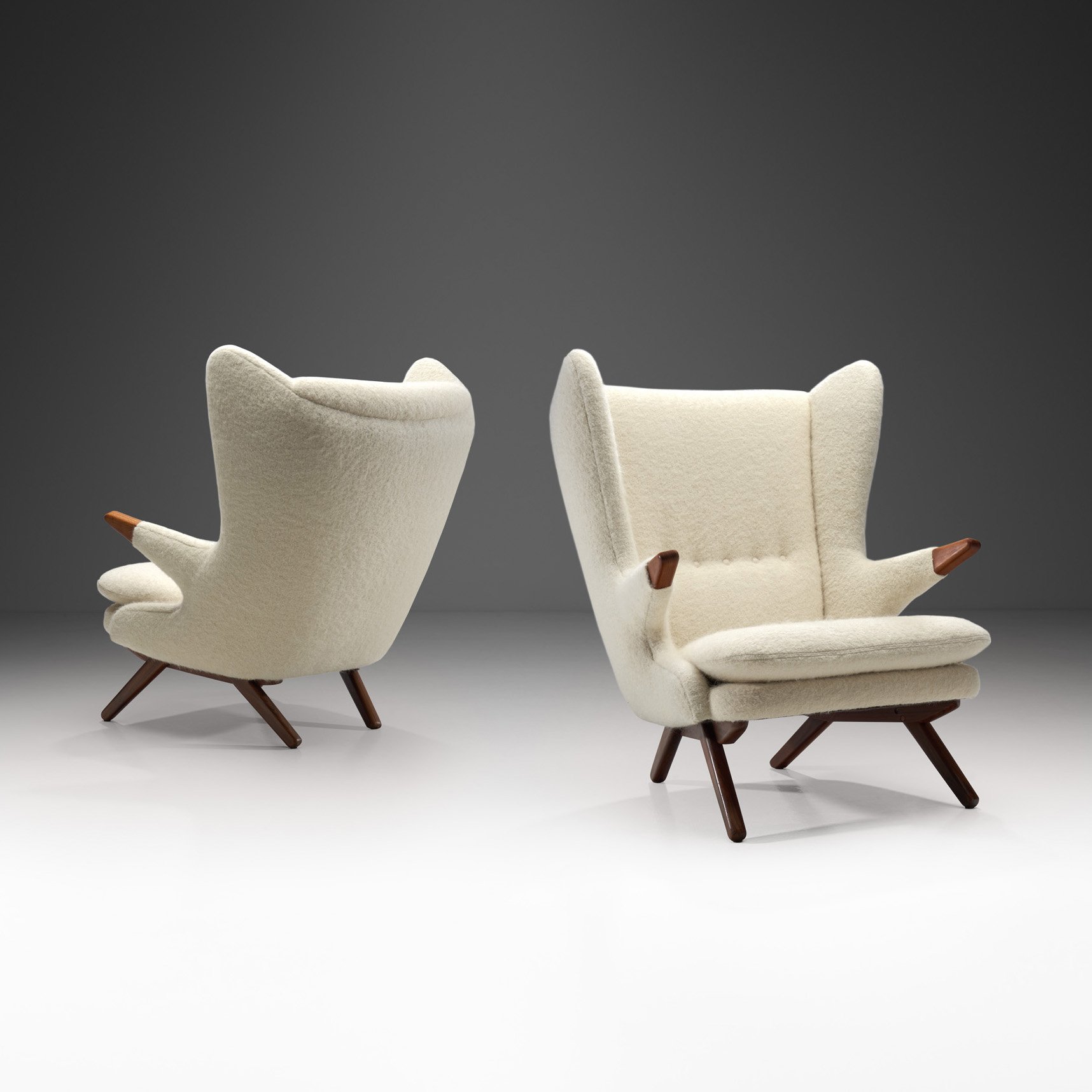
REQUEST PRICE HERE
Price category: 15,000 - 20,000 usd / eur
This pair is the most recognizable model of Danish designer and manufacturer, Svend Skipper, and a great example of the mid-century era design. Skipper only created commissioned pieces, meaning none of his designs were mass-produced.
“Model 91” features a masterfully sculpted teak base and legs. The teak tips “poke out” at the end of the upholstered armrests, which is a very characteristic design element of this model. The high wing-back offers back support, while enveloping the sitter. It also features tufted buttons arranged in a single, horizontal line, adding to the visual interest of the piece. The loose cushion on the seat provides great sitting comfort while also adding to the welcoming look. These details create a sculptural silhouette that made this model popular already in its time.
The design was created in 1956 and this particular piece was manufactured by Skipper Møbelfabrik in the 1960s. For its resemblance to Hans J. Wegner’s “Papa Bear” chair, this model is often referred to by that name, however, “Model 91” was only made upon order. Skipper’s craftsmanship and quality can be observed in every single detail, from the exposed teak arms, to the distinctive shape and level of comfort.
Condition:
In good vintage condition. Wear consistent with age and use. The chairs have been reupholstered recently in premium light wool. Each of our items can be re-upholstered by our in-house atelier in a fabric of choice. Please reach out for more information.
Dimensions:
31.29 in W x 34.05 in D x 38.58 in H; Seat height 15.74 in
79.5 cm W x 86.5 cm D x 98 cm H; Seat height 40 cm
Literature:
Mobilia Volume 6 #73 August 1961, edited by Paul Henningsen & Gunnar Bratvold. Published by [Snekkersten: Mobilia, 1961]
About the designer:
Svend Skipper was a Danish furniture designer and manufacturer. Skipper Møbelfabrik was founded in 1955 by the namesake and has since produced seating furniture as a Danish craft for almost 6 decades. The manufacturer still exists, and “Model 91” has been relaunched in 2011 as a response to its growing popularity and rarity.

REQUEST PRICE HERE
Price category: 30,000 - 40,000 usd / eur
The 1960s and 1970s saw Italian interior design become world renowned and revered. This set of four “Africa” chairs were born from the creative genius of design-duo Afra and Tobia Scarpa in the mid-1970s. They are a perfect combination of simplicity, functionality, and aesthetic.
This set was part of the Artona line by the Scarpa’s and was also the first line ever produced by Maxalto. The company was originally set up in 1975 as an exclusive branch of B&B Italia to focus solely on the production of artisanal furniture that was primarily crafted from wood. As we find ourselves in a design era that embraces the nostalgia of the mid-20th century, this set of four serves as both an homage to the past and a testament to the timeless allure of Afra and Tobia Scarpa’s work. In these chairs, the pattern and grain of the walnut backrests is striking, showing the traces of history in every line and mark. Sensitive touches enliven the design, visible in the careful craftsmanship and quality of woodworking with impeccable joinery that masterfully utilises nothing but the wood itself. The colour of the leather seats matches the walnut body beautifully, further enhancing the visual appeal. Another impressing element is the centrally placed back leg that continues upwards to form the backrests, highlighting the Scarpas’ architectural expertise. Through its eccentric geometries and expressive forms these chairs are perfect for any interior.
Tobia Scarpa once said “I make things as I know how, and I try to be simple, without arrogance”, a sentiment that is apparent in these chairs. The emphasis on quality craftsmanship and the use of noble materials like walnut has undeniably left a lasting imprint and solidified the “Africa” model’s legacy in the Italian design landscape.
Condition:
In good vintage condition. Wear consistent with age and use.
Dimensions:
22.04 in W x 18.50 in D x 31.10 in H; Seat height 17.32 in; Seat depth 16.14 in
56 cm W x 47 cm D x 79 cm H; Seat height 44 cm; Seat depth 41 cm

REQUEST PRICE HERE
Price category: 40,000 - 50,000 usd / eur
Dining room chair “S34” has the playful and majestic characteristics typical of Pierre Chapo's emblematic creations. Asymmetrical, yet perfectly balanced, this model belongs with the designer’s famous “Sfax” table.
This model is one of those designs where the aesthetic is elevated, and the individual features enhanced when the same models are put together. Said aesthetic is based on the cross-legged base that corresponds to the design of the backrest, which is slightly offset from the middle. Made from Chapo's favourite wood, elm, these chairs have a rustic style with architectural precision. This comes as no surprise, as Pierre Chapo trained as an architect in Paris and this knowledge becomes evident in his elaborate structural solutions. The slightly more rounded edges show that these chairs are an older, authentic version of the “S34” model. The cross-legged bases match the backs that are slightly placed out of the middle, enhancing the masterful asymmetry that not only distinguishes the design, but also adds a sense of playfulness. The overall look is very sleek, and combined with details like the visible joinery and the solid wooden structure, this set is perfectly imperfect, which is a conscious, Chapo-esque ideal.
Chapo's work originated by means of special commissions that would later be adapted to universal needs. Chapo was inspired by Frank Lloyd Wright's balanced lines, Corbusier's research on proportions and the Bauhaus. The three principles that motivated Pierre Chapo were material, form, and function. Despite his love for the imperfect, he measured his furniture by means of the golden ratio and used elm wood as his preferred material. These “S34” chairs are beautiful examples of his ideals in a material form.
Condition:
In good vintage condition. Wear consistent with age and use. Small scratches on the wood.
Dimensions:
15.74 in W x 21.25 in D x 29.13 in H; Seat height 16.73 in
40 cm W x 54 cm D x 74 cm H; Seat height 42.5 cm
About the designer:
Pierre Chapo, born in Paris in July 1927, was initially interested in becoming a professional painter. However, after a chance meeting with a shipbuilder who introduced him to wood and wood crafts, Chapo changed his focus and decided to study architectural studies at the prestigious École Nationale Supérieure des Beaux-Arts in Paris.
After graduation, Chapo and his wife, the sculptor, and painter Nicole Lormier, started to travel extensively through Scandinavia and Central America. Among the many places the couple visited was the home and studio of Frank Lloyd Wright in Taliesin West. A visit that had a lasting influence on Chapo’s future work and designs. Read more about Pierre Chapo. ~H.
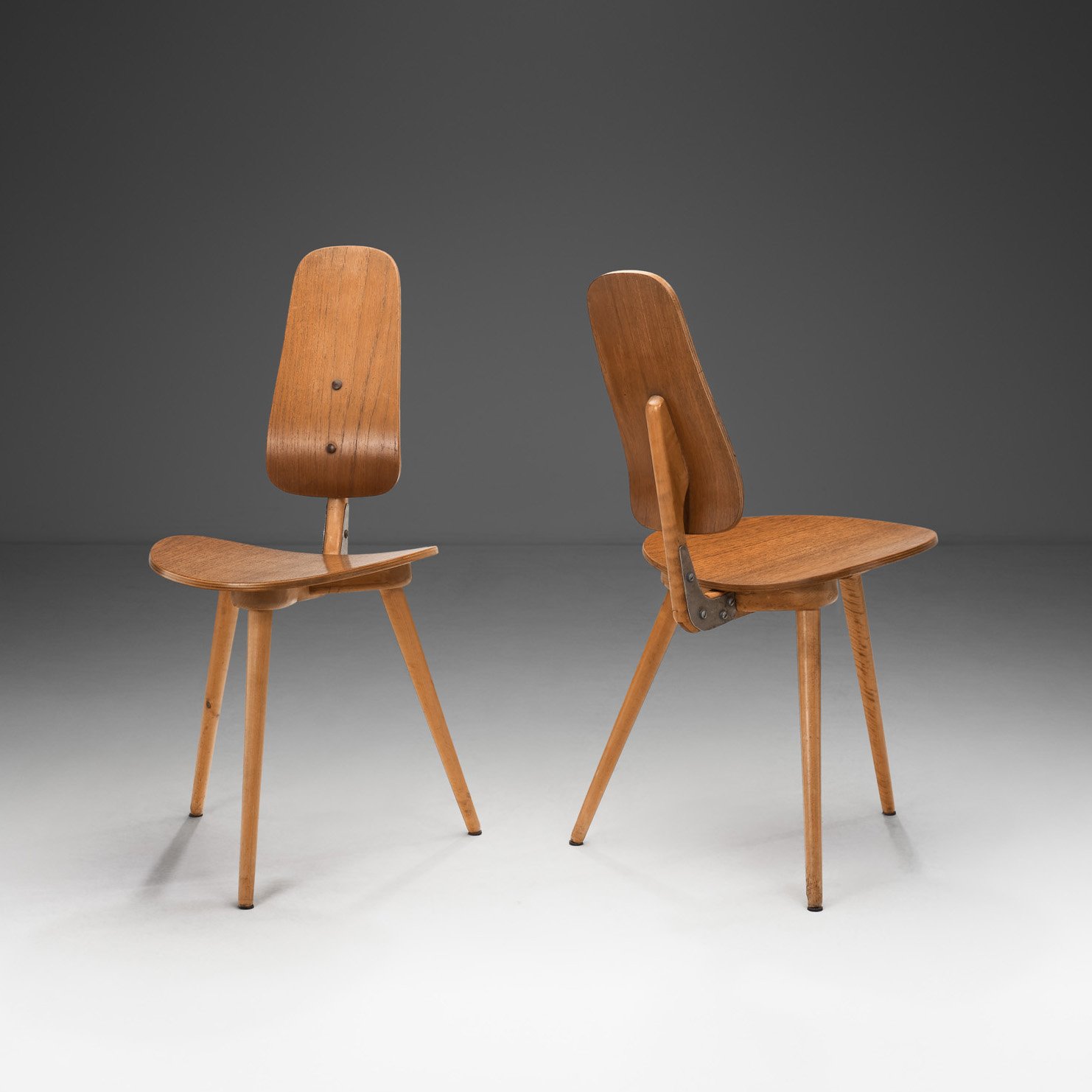
REQUEST PRICE HERE
Price category: 7,500 - 10,00 usd / eur
Designer Bengt Ruda was the first qualified designer to be employed at IKEA. Before being recruited in 1957, he had designed furniture for the high-end department store Nordiska Kompaniet (NK), working among other things on the self-assembly Triva series.
The “GRILL” chairs are distinctive for their three-legged design, crafted from laminated teak and birch. These materials lend the chairs a natural and warm appearance. The splayed birch legs also provide stability and a touch of Scandinavian simplicity to the design of the chairs. Moreover, these chairs boast a sleek and contemporary look that seamlessly blend functionality with style.
“GRILL” is a good example of how, from the early days, IKEA focused on smart product development. In 1958, “GRILL” won the jury award at the Society of Crafts and Design’s major design exhibition – the forerunner of Excellent Swedish Design. One of the adjectives used by the panel to describe the little chair was “energetic”.
Condition:
In good vintage condition. Wear consistent with age and use. Minor marks and scratches on the wood.
Dimensions:
15.35 in W x 22.05 in D x 33.07 in H
39 cm W x 56 cm D x 84 cm H
REQUEST PRICE HERE
Price category: 50,000+ usd / eur
Swedish architect and furniture maker Axel Einar Hjorth worked as the lead designer for Sweden’s Nordiska Kompaniet department store from 1926 to 1938. While combining the simple, honest forms of the traditional nordic “allmoge” furniture common in Swedish rural culture, with the international 20th century Modernist movement, Hjorth designed the “Sportstugemöbler” series, (“sports cabin furnishings”) a collection of wooden furniture designed for country homes.
The “Lovö” chair was initially launched by Nordiska Kompaniet in 1932. The series was a response to a new, growing demand for furnishings for leisure houses, thus Hjorth used local pine to create a model that unites the robust and straightforward Nordic style with skilful handcrafting. The result is a modest, yet visually interesting presence with a strong and tall outline. These chairs are crafted from local pine wood, while the backrests feature iron rivets. The juxtaposition between the pine and iron provides a rustic, sturdy and resilient feel, elevating the timeless look of the model. The chairs combine simple and honest forms of the handcrafted style of traditional Nordic “allmoge” furniture, and the international 20th century Modernist movement. The seats feature loose, removable cushions, upholstered in a textured fabric. The cushions further increase the chairs’ special character, increasing both comfort and charm. The design is completed by four square, straight legs.
The “Sportstugemöbler” series had a lasting influence on Hjorth’s contemporaries, inspiring other big names within Nordic design, such as Carl Malmsten. From an international perspective, this series is the forerunner of later pioneering designs, so it comes as no surprise that these “Lovö” chairs became part of modernist design history.
Condition:
In good vintage condition. Wear consistent with age and use. The chairs have recently been reconditioned. The chairs show marks and dents Due to the age and nature of the materials, the chairs may have additional scratches or discolouration. The pillows were costum made by our in-house atelier in a premium fabric. In addition, the chairs can be purchased including their original striped cushions. Each of our items can be reupholstered by our in-house atelier in a fabric of choice. Please reach out for more information.
Dimensions:
18.5 in W x 20.86 in D x 37.4 in H; Seat height 17.71 in; Seat depth 16.54 in
47 cm W x 53 cm D x 95 cm H; Seat height 45 cm; Seat depth 42 cm