
HIDDEN GEM COLLECTION
An ode to the odd ones and the misfits hiding in plain sight
REQUEST PRICE HERE
Price category: 9,000 - 12,500 usd / eur
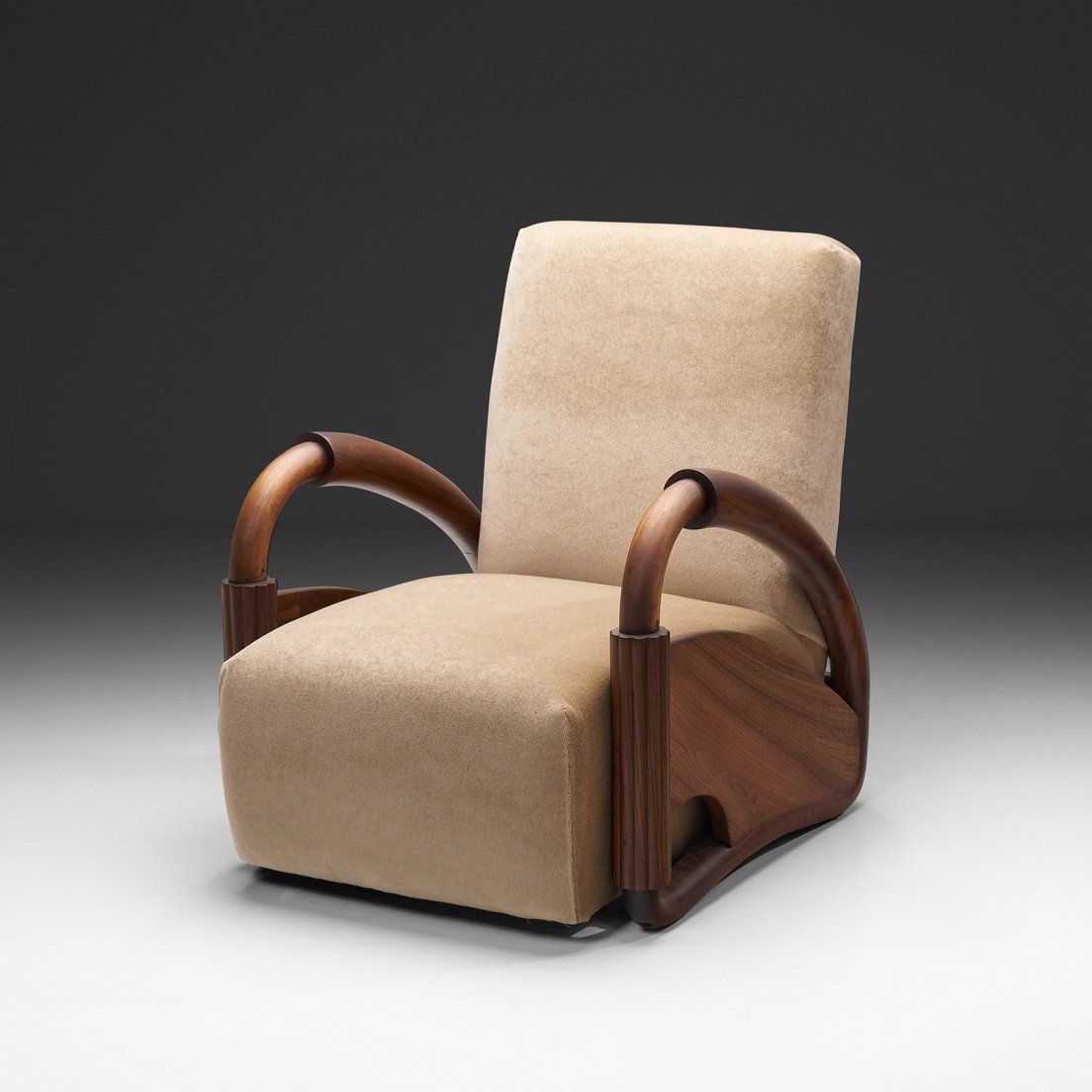
The Art Deco movement, which emerged in the early 20th century, is known for its bold geometric shapes, luxurious materials, and an emphasis on streamlined forms. Art Deco came as a reaction against the flowing organic lines of Art Nouveau, thus opting for symmetry, order, and elegance. Influenced by modernity and industrialisation, furniture from this period often features rich fabrics, polished finishes, and an overall sense of opulence, designed to elevate everyday spaces.
This armchair is in made the manner of André Arbus - one of the most influential Art Deco designers in the first half of the twentieth century. Crafted with meticulous attention to detail, the geometrically inspired frame is made from rich, dark wood that exudes opulence. The armrests are beautifully constructed in a streamline moderne manner, highlighting the design prowess of the maker. Since the arms are hollow, the upholstery is visible from the sides as well, further complementing the gentle curvature. The wood’s beautiful grain and colour variation stands out thanks to the upholstery’s textured fabric and elegant colour. The tightly upholstered seat and back - while adding plenty of comfort and cosiness to the design - don’t take the attention away from the wooden structure.
Art Deco is a modern art style that attempts to infuse functional objects, such as this chair, with artistic touches. The movement is different from the fine arts as the art object has practical purpose or use beyond providing an interesting look. With this ideal in mind, this armchair model provides not only visual pleasure, but also great sitting comfort and functionality.
Condition:
In good vintage condition. Wear consistent with age and use. The chair has recently been reconditioned. Due to the nature and age of the materials, the item may have some marks, scratches, and discolouration. The chair has recently been reupholstered in a premium fabric. Each of our items can be reupholstered by our in-house atelier in a fabric of choice. Please reach out for more information.
Dimensions:
25.20 in W x 37.40 in D x 32.68 in H; Seat height 14.17 in; Seat depth 23.62 in; Arm height 23.23 in
64 cm W x 95 cm D x 83 cm H; Seat height 36 cm; Seat depth 60 cm; Arm height 59 cm
REQUEST PRICE HERE
Price category: 20,000 - 30,000 usd / eur
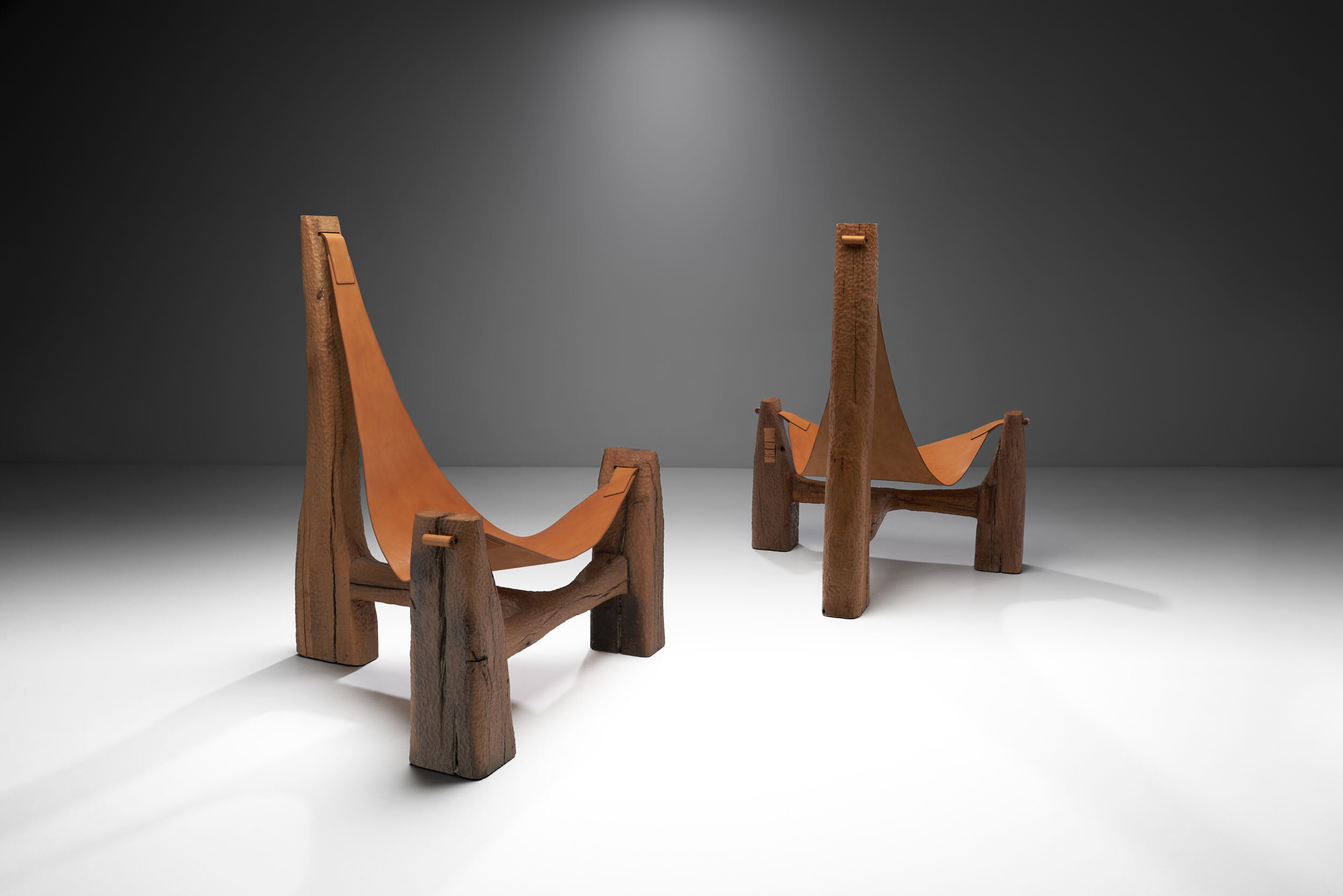
The Czech designer, Pavel Novak’s corpus of work is finally starting to surface, and as these chairs show, we are lucky to witness it. Described as a "bedroom genius" whose life and work would have deserved a completely different fate, Novak often worked with a gouge, that originally never had any other vocation than to furnish his farm.
The chairs are made of hand gouged oak, which is in itself a time-consuming and rare woodcarving technique. While most manuals offer help with fixing gouges in wood, Novak used the technique to create these rustic looking bodies that can be considered to be functional sculptures. Thanks to the unique, hand-carved texture, each lounge chair is one of a kind, with a unique pattern. The leather seat is suspended between the three legs, one of which is elongated to serve as a backrest. The chairs’ joinery technique is seamless and shows the outstanding craftsmanship and vision of Novak. The leather straps are inset into the legs in a rough, yet sophisticated way.
Rough yet sophisticated defines the overall aesthetic of these chairs, which is reflected in the pairing of the materials as well. The patinated cognac leather’s even surface contrasts beautifully with the gouged, coarse look of the oak. With its straightforward design, this pair is a seminal work of Pavel Novak. ~H.
Condition:
In good vintage condition. Wear consistent with age and use. Some cracks and marks on the wood. These chairs come with their original leather or have been reupholstered by a previous owner. Each of our items can be re-upholstered by our in-house atelier in a fabric of choice. Please reach out for more information.
Dimensions:
40.94 in W x 30.7 in D x 48.81 in H; Seat height 20.07 in
104 cm W x 78 cm D x 124 cm H; Seat height 51 cm

REQUEST PRICE HERE
Price category: 12,500 - 15,000 usd / eur
Art Deco (or streamline moderne, as it’s often referred to), was originally named Art Décoratifs. The design style received its “Art Deco” name after the Exposition Internationale des Arts Décoratifs et Industriels Modernes, hosted in Paris in 1925. The Art Deco period peaked in popularity around the mid 20th century, then spread across Europe and the Unites States up to the start of World War II.
Incorporating Art Deco furniture pieces into interiors is a brilliant way of gracefully achieving the essence of luxury and glamour. This design style is one-of-a-kind; it incorporates geometric shapes often resembling sleek futuristic forms, and these lounge chairs are a perfect example of this. The lounge chairs’ symmetry and distinctive look is characteristic of a style that celebrates modernity and industry. The designer of this set beautifully couples soft upholstery with the sharp lines and angular shape of the iron body, which will no doubt add a sense of boldness to a space.
As a testament to the enduring allure of Art Deco furniture, these lounge chairs showcase the marriage of form and function, exquisite materials, and masterful design.
Condition:
In good vintage condition. Wear consistent with age and use. The frames have been later repainted in black powder coating. Each of our items can be re-upholstered by our in-house atelier in a fabric of choice. Please reach out for more information.
Dimensions:
39.37 in W x 23.62 in D x 27.56 in H; Seat height 17.72 in; Arm height 27.56 in
100 cm W x 60 cm D x 70 cm H; Seat height 45 cm; Arm height 70 cm
REQUEST PRICE HERE
Price category: 12,500 - 15,000 usd / eur
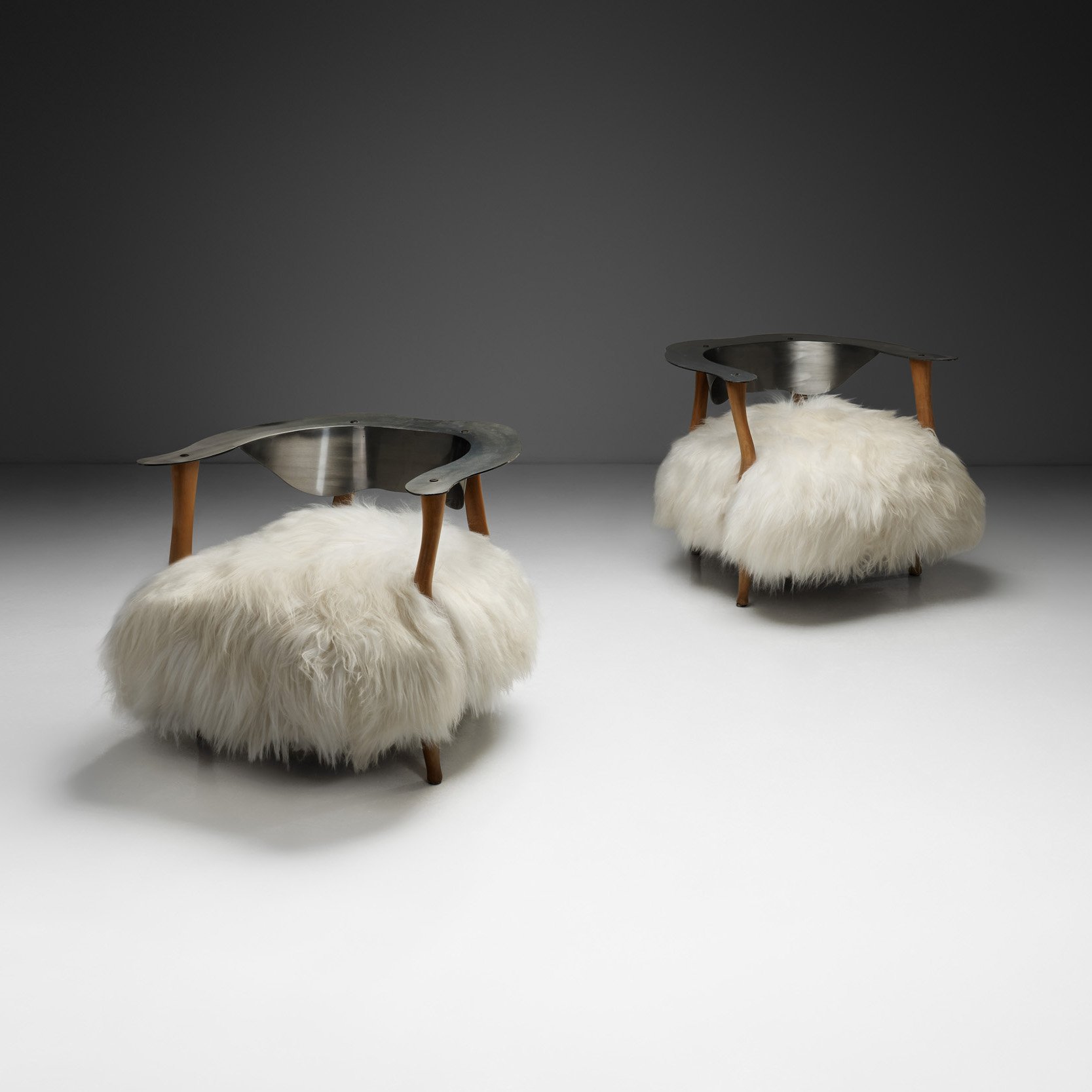
These “Fantasy” armchairs, designed by Kurt Beier for Koinor epitomise the avant-garde and experimental nature of postmodern design. Created during a period marked by a break from traditional creative conventions, these chairs combine unconventional materials and bold forms that challenge the boundaries of furniture design. Postmodernism embraced humour, irony, and a playful approach to design, making this pair not only functional but also statement pieces that serve to inject energy and individuality into any interior.
The chairs’ striking visual contrast is created through the juxtaposition of the industrial feel of the metal structure and the luxurious, soft fur upholstery. The smooth backrest is made of steel, strong and durable, ensuring the pairs' longevity. The metal’s cool, smooth silver surface stands out beautifully against the warmth and cosiness of the sheepskin upholstery, creating a compelling dialogue between the distinct materials and highlighting the tactile dimension of the pair. The designer did not forget to ensure comfort when envisioning the silhouette of the chairs - the curved metal wraps around the seat in an almost cocoon-like manner, providing both support and an intriguing visual element. The upholstery’s fluffy texture, on the other hand, contributes an organic softness that contrasts sharply with the mechanical, rigid nature of the metal. The wooden legs add a natural, grounding element to the chairs, balancing the two materials.
With a sense for incredible craftsmanship and endless passion for innovation, Beier's work captures the essence of the 1980s design ethos, where function and form merge with playfulness. Their bold combination of materials, contrasting textures, and sculptural form make this pair of armchairs exceptional pieces that stand as both art and furniture, perfect for modern interiors that value individuality and creative expression.
Condition:
In good vintage condition. Wear consistent with age and use. The chairs have been reupholstered recently in a premium fabric. Each of our items can be reupholstered by our in-house atelier in a fabric of choice. Please reach out for more information.
Dimensions:
30.5 in W x 33.46 in D x 26.37 in H; Seat height 16.92 in; Seat depth 27.55 in; Arm height 26.37 in
77.5 cm W x 85 cm D x 67 cm H; Seat height 43 cm; Seat depth 70 cm; Arm height 67 cm
REQUEST PRICE HERE
Price category: 7,500 - 10,000 usd / eur
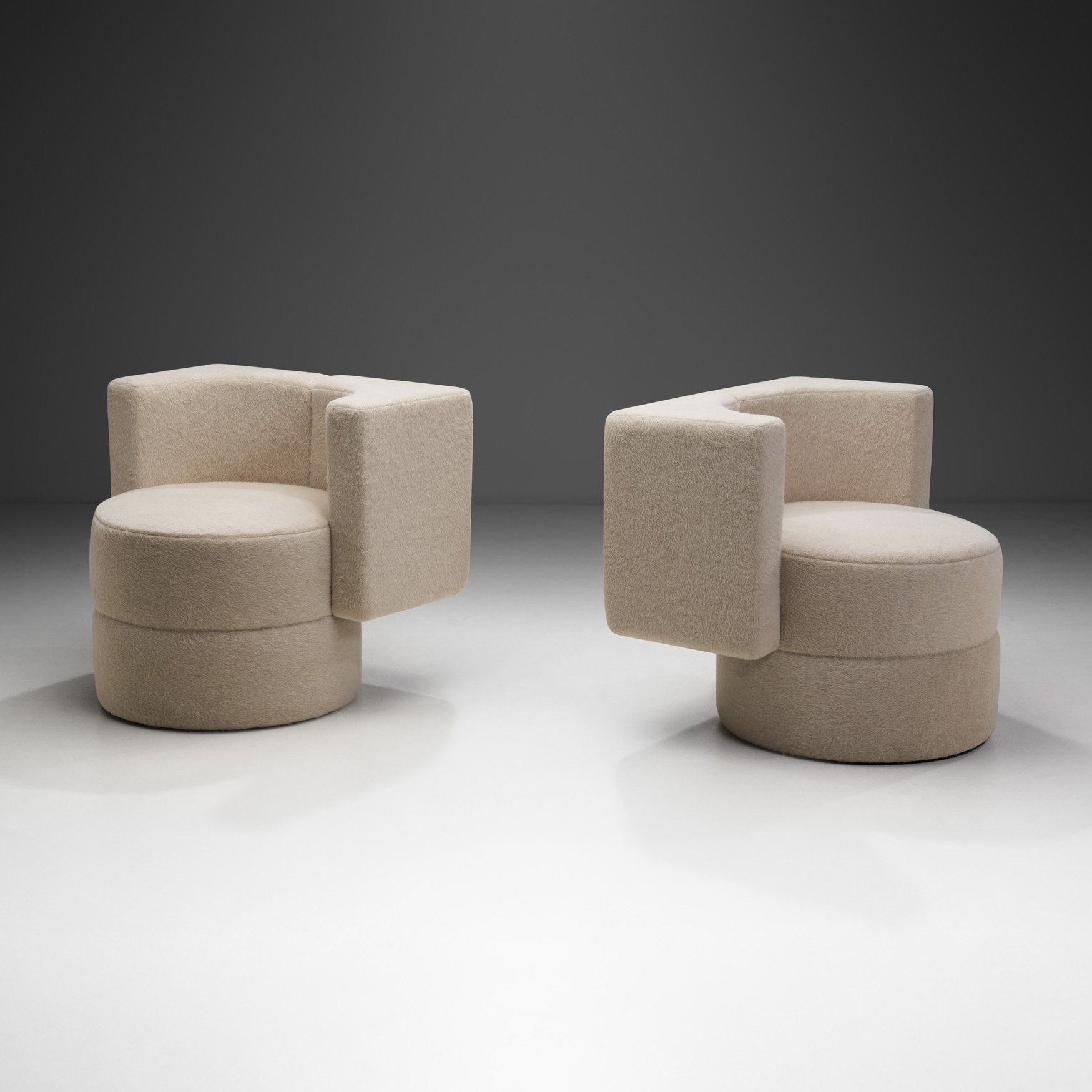
Amidst the tumultuous political landscape of 1970s Czechoslovakia, designers demonstrated remarkable resilience. Despite the constraints imposed by the era, they managed to create innovative and functional pieces that embodied the principles of modernism. These club chairs, initially housed in the iconic RTVS program building - completed in 1975 - stand as clear visual icons to this creative spirit. The building's modernist style, innovative use of materials and structure likely influenced contemporary furniture designs, including these chairs. The chairs' design language, with its emphasis on clean lines, functional spaces, and modern aesthetics, echoes the architectural style of the building.
This pair of club chairs from the 1970s are a captivating embodiment of geometric modernist design. Each chair features a cylindrical base with a circular seat, creating a robust foundation. The backrest and armrests - designed as a single, unified piece - form a semi-enclosed structure that envelops the sitter. This design juxtaposes sharp lines and right angles with the soft, rounded seat and premium fabric, creating a visually intriguing and inviting appearance. These chairs are upholstered in a light, plush fabric, adding comfort and sophistication to the bold, rigid form. The chairs' minimalist aesthetic, with its clean lines and lack of excessive decoration, reflects the modernist principles prevalent in Czechoslovakian design. The designers of the era, such as Jindřich Halabala, Miroslav Navrátil, and Karel Kozelka, were renowned for their ability to blend modernism with traditional craftsmanship, often using materials like wood, metal, and textiles to create elegant and versatile pieces easily recognisable within today’s design landscape.
The unique fusion of modernist minimalism and traditional craftsmanship in these club chairs not only gives them their distinctive geometric forms, but also makes them a symbol of an era. They embody the innovative spirit of Czech designers during a transformative period in Central European design history. The RTVS, once the tallest building in the former Czechoslovakia, now stands unused and preserved. The design of these chairs is embedded with the RTVS building and Czech history, broadly fused with a timeless aesthetic - a testament to the era's design legacy, serving as a tangible link to the past.
Condition:
In good vintage condition. Wear consistent with age and use. The chairs have been reupholstered recently in a premium alpaca blend fabric. Each of our items can be re-upholstered by our in-house atelier in a fabric of choice. Please reach out for more information.
Dimensions:
29.33 in W x 27.76 in D x 25.20 in H; Seat height 16.34 in; Seat depth 21.65 in
74.5 cm W x 70.5 cm D x 64 cm H; Seat height 41.5 cm; Seat depth 55 cm
REQUEST PRICE HERE
Price category: 12,500 - 15,000 usd / eur
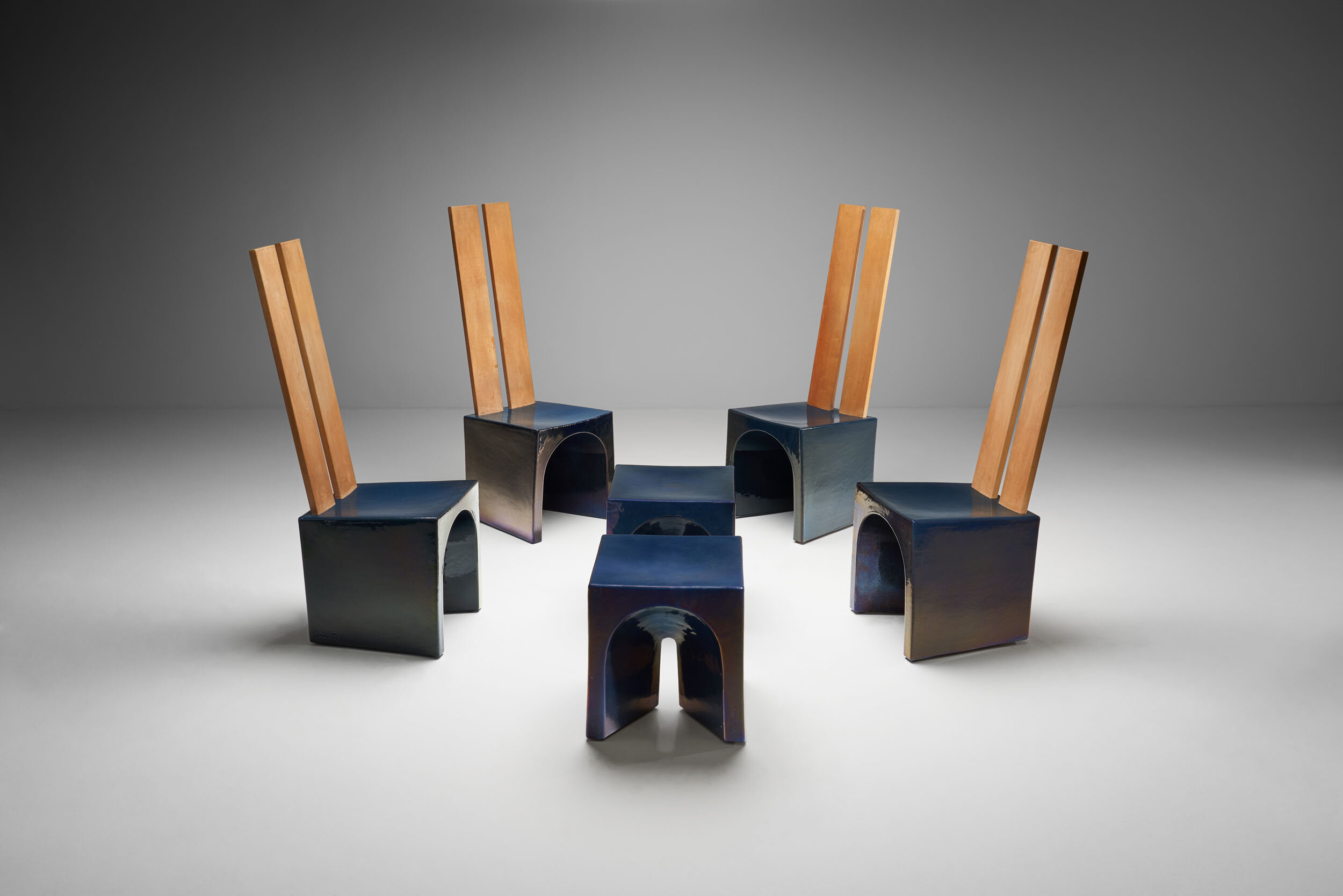
This set of four elemental chairs and two tables is a beautiful example of the collaboration between Dutch designer Tom Bruinsma and Mobach Ceramics. These fully glazed ceramic pieces appear in a variety of colours depending on the angle and light. The wooden backs add an organic and modern touch to the chairs. Dutch designer, Tom Bruinsma is primarily known for his ceramic designs featuring sharp edges and angles.
As all Mobach ceramics, the lower body of each chair is handmade in small batches. The glazing and the firing processes ensure that each ceramic piece is unique. All ceramics bear the Mobach stamp.
Condition:
In good vintage condition. Wear consistent with age and use.
Dimensions:
14.96 in W x 15.75 in D x 45.28 in H; Seat Height 14.96 in
38 cm W x 40 cm D x 115 cm H; Seat Height: 38 cm
About the manufacturer:
The Mobach Ceramics factory was established in Utrecht in 1895 by Klaas Mobach (1855-1928). Since the establishment, five generations of Mobachs have been working with a team of staff in an historic building on Kanaalweg, Utrecht. Through the century, the method hardly changed. All ceramics are thrown on the wheel or shaped by hand from coils or sheets of clay. The ceramic pieces, such as the bodies of this set, owe their distinctive look to the exclusive glazes, which are composed according to the company’s own recipe. Due to the high firing temperature, Mobach ceramics are suitable for both indoor and outdoor use. ~H.
REQUEST PRICE HERE
Price category: 2,500 - 5,000 usd / eur
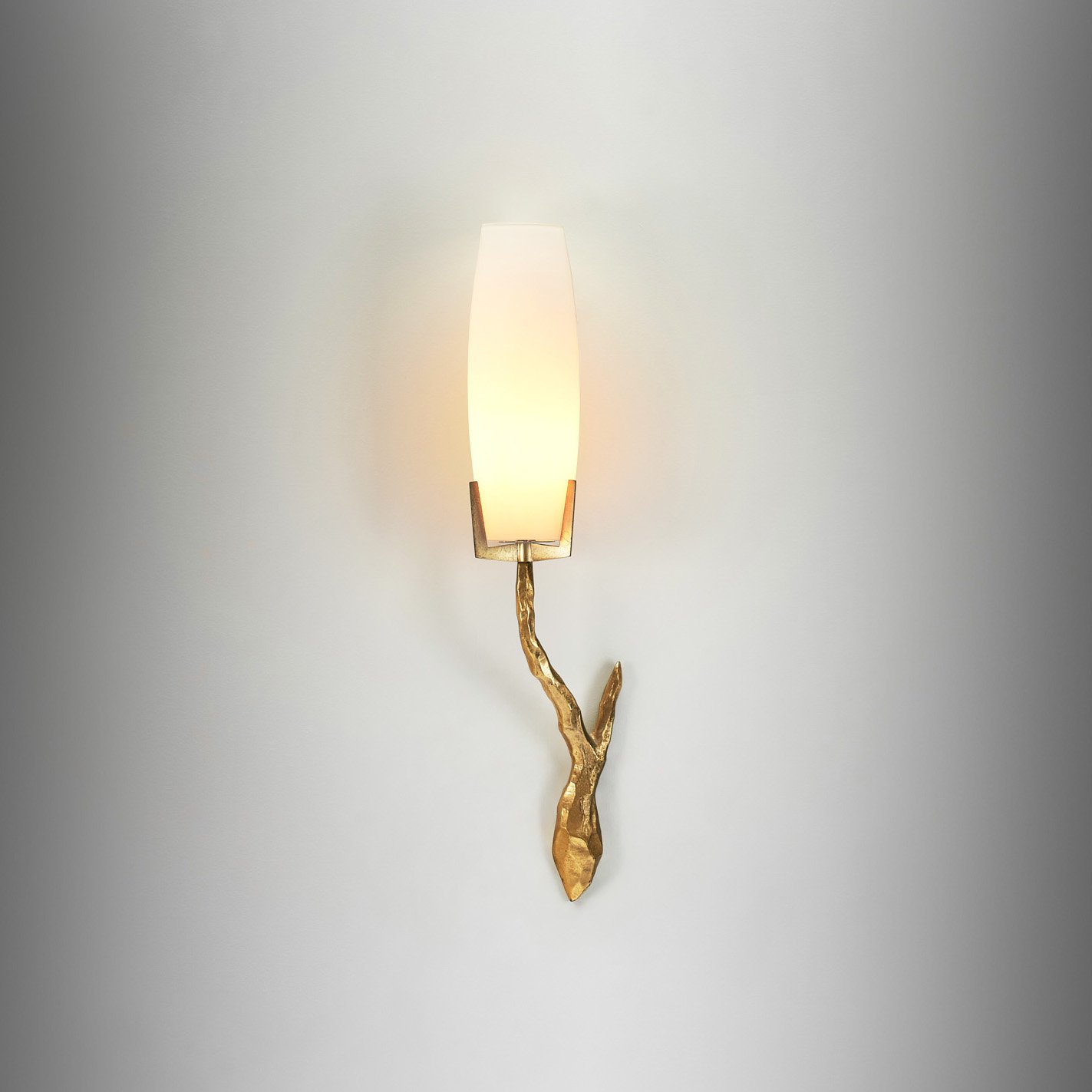
Maison Arlus, a French lighting design company, was founded in the early 20th century by Robert and Jean Arlus. The company quickly gained recognition for its innovative and stylish lighting fixtures, which were characterised by their use of high-quality materials and focus on unique design.
This beautiful wall lamp was made in the manner of Félix Agostini, a French sculptor and designer who was active in the mid-20th century. His manner of lighting design was abstract and stylised, often incorporating animals or mythological icons. The form of this wall lamp assumes a more minimalist look at first glance, yet is coupled with subtle decorative elements that adds to the uniqueness of the piece. The shape of the shade and pairing of materials creates the overall aesthetic impression, introducing modernism to the classic style of a one-armed wall lamp. The gilt bronze arm that holds the glass shade is reminiscent of a deer’s antler, which further enhances the visual interest of the piece. When lit, the lamp creates an exceptionally atmospheric light, giving the bronze a warm colour. Wall lamps such as this are a timeless example of how simplicity, combined with thoughtful craftsmanship, can result in lighting fixtures that transcend their utilitarian purpose, becoming works of art in their own right. Today, we consider the mid-century era a golden age for lighting design. During these decades, some of the most significant luminaries were created, and remain highly sought-after today.
Over the years, Maison Arlus collaborated with a number of notable designers, including Jacques Biny, Pierre Guariche, and Michel Buffet, and continued to produce a wide range of lighting fixtures that were both functional and aesthetically pleasing.
Condition:
In good vintage condition. Wear consistent with age and use.
Dimensions:
3.94 in W x 3.54 in D x 18.50 in H
10 cm W x 9 cm D x 47 cm H

REQUEST PRICE HERE
Price category: 1,000 - 2,500 usd / eur
Swedish Modern lighting was directly influenced by ASEA, the historic company that had a decisive influence on how the Swedish electrotechnical industry has developed. Based on the classic pairing of brass and glass, these models have plenty to offer visually.
These wall sconces are special for a couple of reasons besides the obvious visual uniqueness, starting with their material: acid treated glass. Essentially, acid-etching is a specialized glass fabrication process involving the application of hydrofluoric acid to annealed glass sheets or sections to give its surface a frosted look. The result is less opaque than milk glass, letting through more light. As these “coquille” or shell wall sconces show, enhancing glass with acid-etching is ideal to highlight the glass’s surface. The shell shape is further supported by the scalloped edge and lines throughout the shades that also creates an appealing effect when the lamps are switched on since the corrugated surface of the glass offers a pleasantly diffused light. The sconces are open on the sides and tops, therefore the provided light is functional as well. The bodies are mounted on brass bases that provide elegance and a beautiful contrast both in terms of colour and material. ASEA, the jewel of Swedish industry was broadly defined as "the generation and application of electric power". The company manufactured such diverse items as steam turbines for power plants and high-speed electric locomotives for passenger railroads, and of course, these wall lamps.
Adding illumination to a living space with this pair of beautiful wall lamps will not only improve the ambience, it will also bring a piece of design history to the space. Apart from the aesthetics, the quality of these lamps is also true to its Swedish heritage.
Condition:
In good vintage condition. Wear consistent with age and use. Some small marks on the glass. The brass has beautiful patina.
Dimensions:
10.23 in W x 5.7 in D x 8.85 in H
26 cm W x 14.5 cm D x 22.5 cm H
REQUEST PRICE HERE
Price category: 2,500 - 5,000 usd / eur
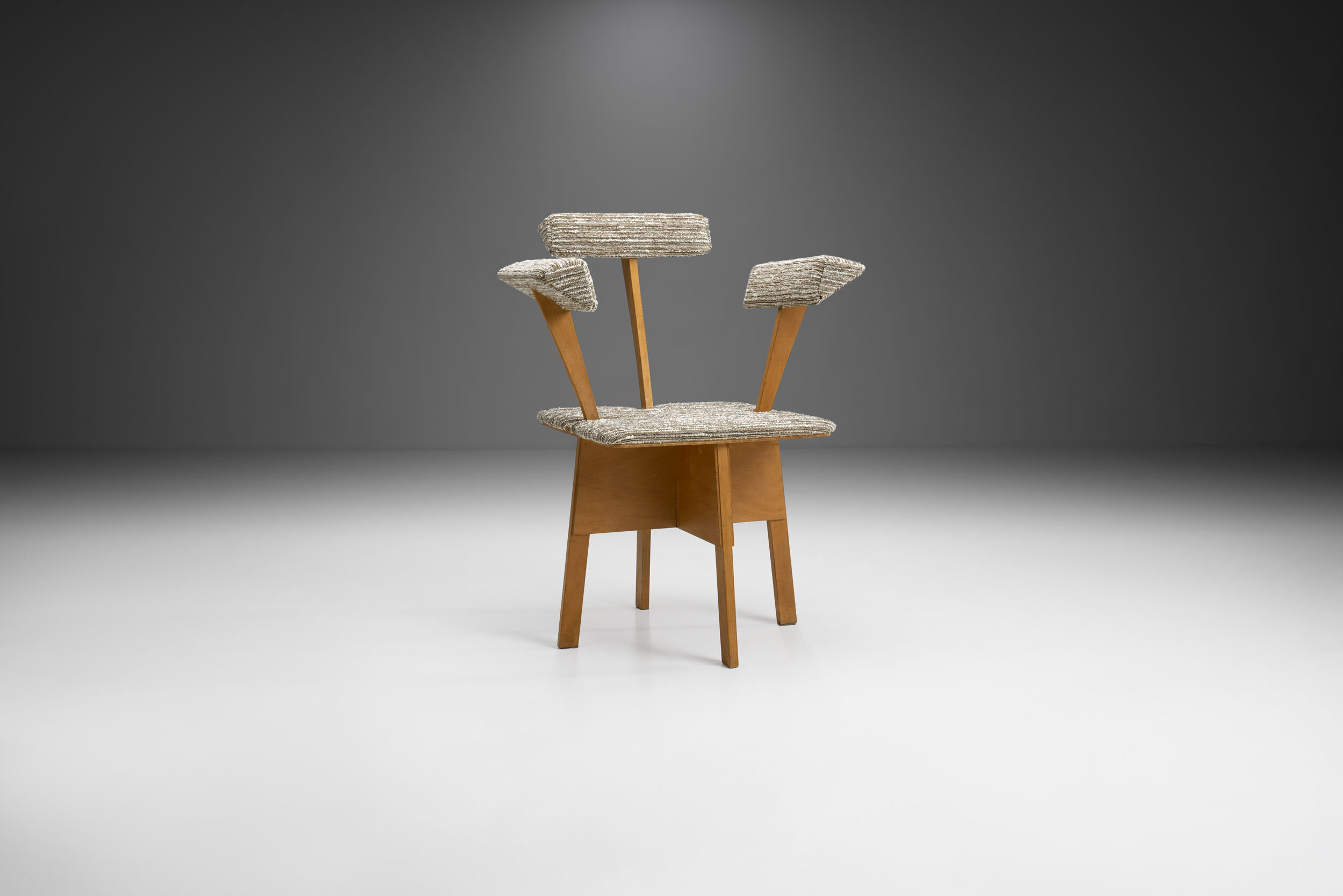
The uniqueness of this mid-century Dutch chair is beyond question. With a peculiar shape and history, every aspect of this chair is one-of-a-kind. Seriously minimal and highly functional, this chair is out of the ordinary.
Dutch mid-century furniture is defined by characteristics of simplicity and functionality in the context of industrial production, and a preoccupation with geometry. Dutch furniture makers aspired to affect lives with good functional design, which, in this case was taken quite literally. Visually this chair does not quite fit into any traditional chair category, which is explained by its historical purpose. In the 1940s, this model was known as a UKG (ultra-short wave) chair, as it was used in facilities where high frequency electrotherapeutic treatments were available. Accordingly, this chair contains a piece of history in its shape and materials alike. The chair is completely metal-free and features removable armrests. The slim arms and back appear to be emerging from the seat, ending in the upholstered back- and armrests. The fabric is by by the world famous French atelier, Toyine Sellers, who created this fabric that can be considered art in itself.
While this chair was not created to strictly conform to the principles of the era, it is interesting to see how it nevertheless reflects many of the characteristics of mid-century design. The plywood is light with geometrical lines without any ornamentation. Compressed plywood is in fact typical of the Dutch modernist aesthetic. Dutch mid-century furniture designers were not concerned with organic forms and the natural world in the way that Scandinavian designers were, rather, they presented true Modernism, ultimately traceable back to the legacy of the Bauhaus.
Condition:
In good vintage condition. Wear consistent with age and use. The chair has been reupholstered recently in premium bouclé fabric by Toyine Sellers. Each of our items can be re-upholstered by our in-house atelier in a fabric of choice. Please reach out for more information.
Dimensions:
28.74 in W x 26.37 in D x 37 in H; Seat height 19.68 in
73 cm W x 67 cm D x 94 cm H; Seat height 50 cm
REQUEST PRICE HERE
Price category: 7,500 - 10,000 usd / eur
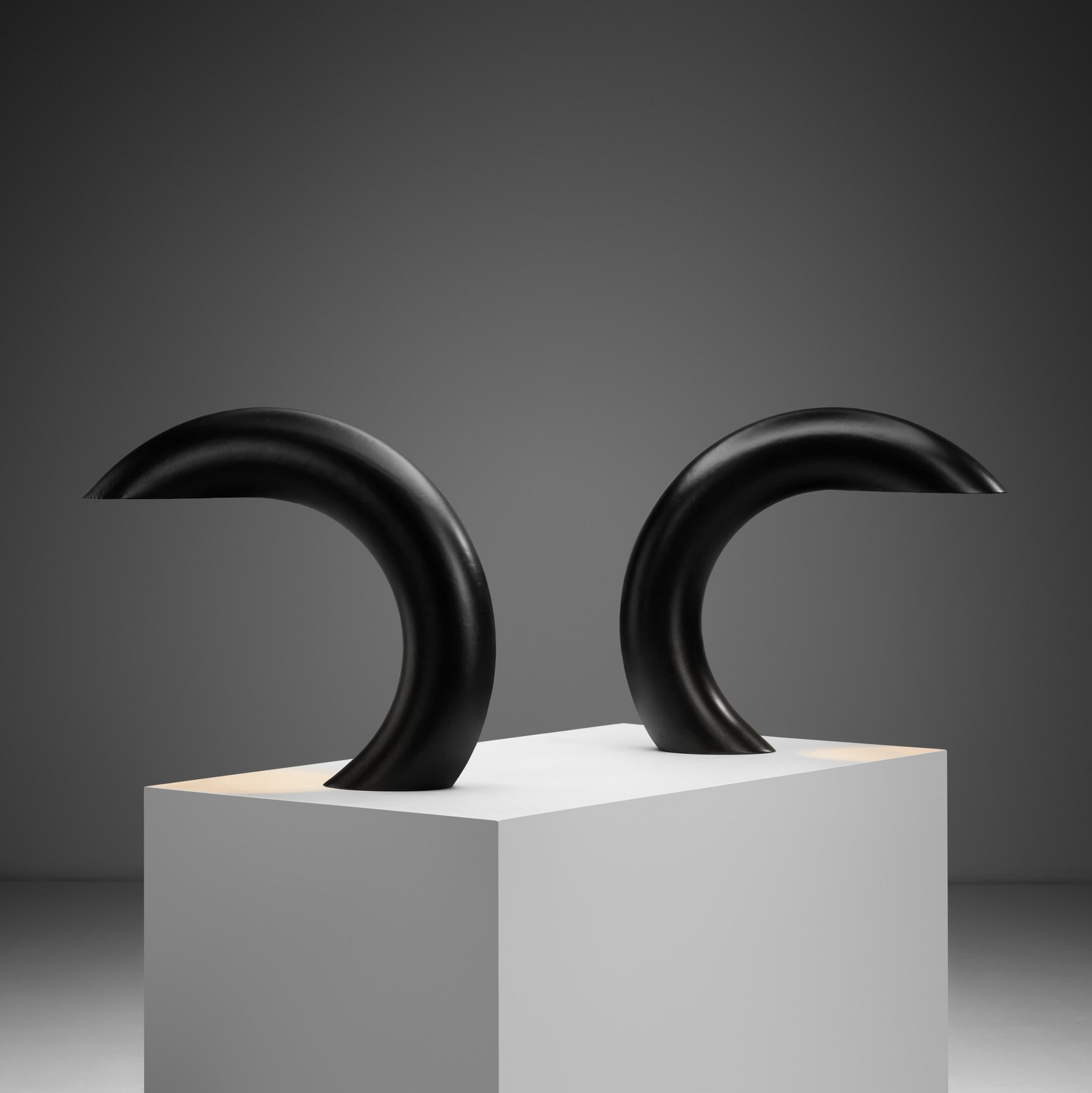
This pair of sculptural table lamps was designed in Italy by a little-known company named Alfredo Bianchi. As design pieces, they represent an organic mix of aesthetics and functionality.
The lamps feature a dramatic, sculpted form that blurs the line between functional lighting and art. The pair captures the spirit of 1970s Italian design, where experimentation with form, material, and silhouette was central to the creative process. The lamps’ shape is both commanding and refined, with a strong visual presence that will make them a focal point in any interior. The geometrical form is created from a single circular tube that is skillfully made of cast aluminium and finished with a black lacquer. On the end of the cylindrical tube is the cleverly integrated light source casting a soft ambient glow that highlights the form without overwhelming it. Whether viewed from the front or the side, the design offers dynamic perspectives. The black colour of the lamp balances the unique shape, by allowing the silhouette to shine without overpowering it or visually disturbing the organic flow of the curves.
These lamps are a testament to Alfredo Bianchi’s ability to merge function with sculptural integrity. Adding illumination to a living space with these table lamps will not only improve the ambience, it will also bring a piece of design history to the space. Apart from the aesthetics, the quality of this model is also true to its Italian heritage.
Condition:
In good vintage condition. Wear consistent with age and use. The lamps have been recently rewired.
Dimensions:
17.71 in W x 4.33 in D x 16.53 in H
45 cm W x 11 cm D x 42 cm H

REQUEST PRICE HERE
Price category: 5,000 - 7,500 usd / eur
In Italy, the evolution of lighting design developed side by side with the post-war recovery after WWII. Designer lamps became more accessible, and the aesthetic and materials more experimental. This table lamp’s design shows this interesting and unique era’s marks in its clever solutions and use of materials.
The modern look of this lamp is achieved through the simple yet smart use of mediums. A continuous sheet of chromed metal was shaped to explore light diffusion, resulting in a piece that feels both contemporary and timeless. It carries an almost industrial quality, yet retains the refined edge of Italian mid-century design, encapsulating a harmonious interplay of light and shadow that casts a gentle, ambient glow. Composed of a base and a curved body that, from the side, resembles a capital ‘G’, the lamp’s form is both sculptural and functional. The sheen of the metal softens the light, producing a warm glow rather than a harsh beam. This choice of material also makes the lamp lightweight while maintaining its durability. Simplicity meets sophistication in this design, where craftsmanship and finish take center stage. The piece exudes a sense of artistic whimsy and individuality, embodying the best of its era. Italian lighting fixtures make striking focal points in any modern home and this table lamp is no exception.
Each component of this table lamp was designed with functionality and elegance in mind, culminating in a piece that transcends simple utility. It is a striking blend of form and function, a luminary that offers not just light, but also a touch of modern charm that can enhance the decor and warmth of an interior.
Condition:
In good vintage condition. Wear consistent with age and use. The item has recently been reconditioned. Minor marks and scratches. Due to the nature and age of the material, item may have additional discolouration.
Dimensions:
10.63 in W x 8.66 in D x 12.59 in H
27 cm W x 22 cm D x 32 cm H
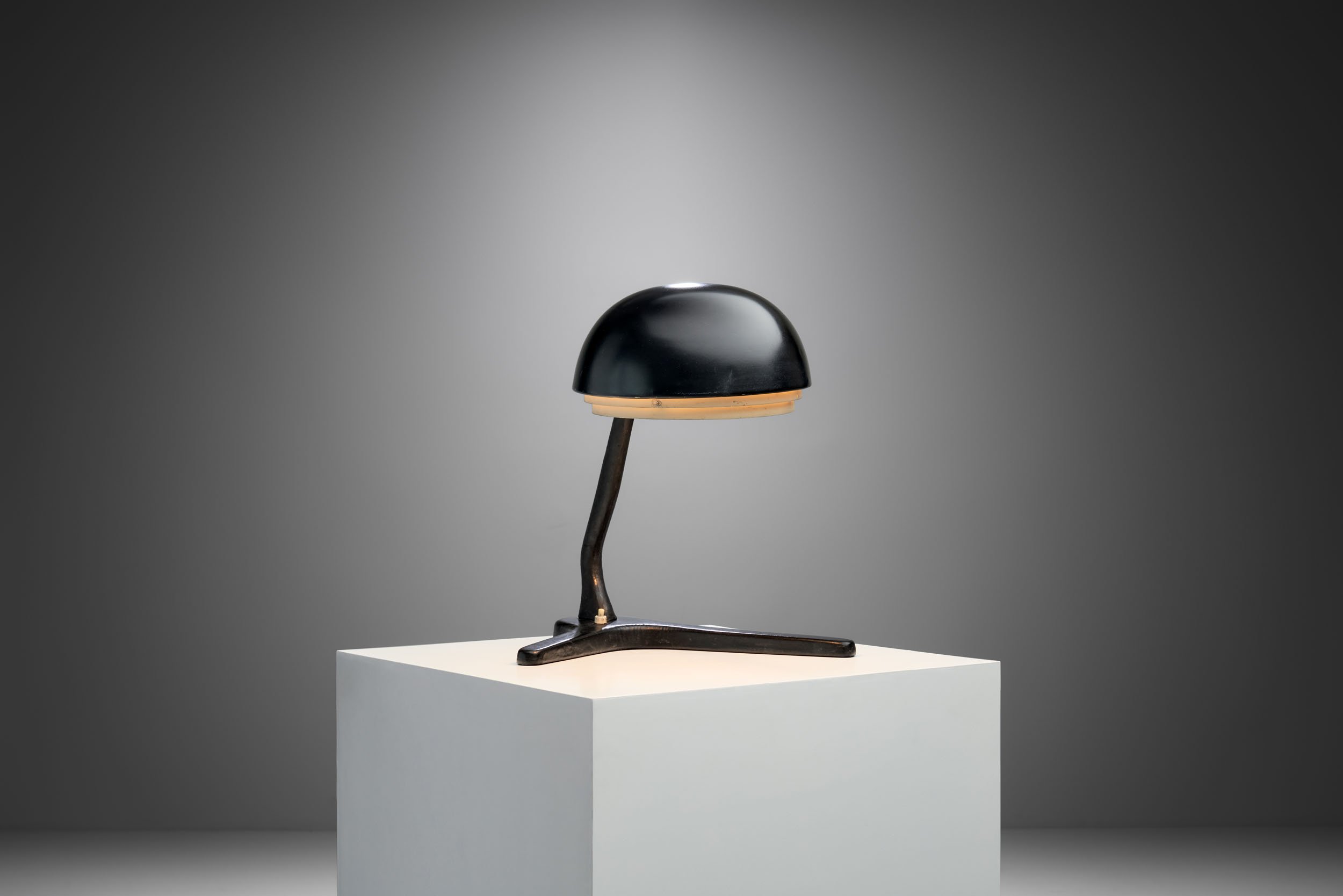
REQUEST PRICE HERE
Price category: 15,000 - 20,000 usd / eur
Finland and Helsinki were extremely important in the Mid-Century Modern design history, and one of its most famous designers was Alvar Aalto. In contrast with the functionalism of the International, Aalto brought a refreshing breath of humanism to modern design.
There is a saying that “Functionalism is a Finnish thing”, and it is hard to argue with that when looking at this table lamp. Functionality is without a doubt one of the most important aspects of Finnish design, however, there is also a demand for the highest quality, both in design and materials. Alvar Aalto is the Finnish icon of functionalism, and through this “A704” model it is easy to see why. The design is first and foremost functional, combining practicality and aesthetics. The body consists of a metal frame that is uniquely covered in black leather, and a painted metal shade. The shape resembles a figure leaning forward, which is reinforced by the “two-toed” base and the sizeable shade, which is perforated towards the neck. The shade has two additional white layers that are especially appealing when the lamp is turned on. When lit, the textural interest of the lamp’s structure becomes even more apparent. In the inside of the shade, the manufacturer’s mark can be found with the model’s name.
In contrast with the functionalism of the international scene, Alvar Aalto brought a refreshing breath of humanism to modern design. Aalto's free-form designs, in harmony with human needs and nature, anticipated the organic modernism of the 1950s and 1960s. This model can be a design statement in any space while also serving its functional purpose.
Condition:
In good vintage condition. Wear consistent with age and use. Some minor scratches and marks on the metal and leather. The lamp has its original leather cover.
Dimensions:
13.58 in W x 15.74 in D x 14.96 in H
34.5 cm W x 40 cm D x 38 cm H
Literature:
Eva B Ottillinger, Alvar Aalto, Furniture: The Kossdorff Collection, Vienna, 2002, p. 53, fig. 50.
Thomas Kellein, ed. Alvar & Aino Aalto, Design Collection Bischofberger, exh. cat., Kunsthalle Bielefeld, Zurich, 2005, page 190.
Charlotte and Peter Fiell, eds., 1000 Lights, Vol. 1: 1879 to 1959, Cologne, 2005, p. 492.
About the Designer:
Hugo Alvar Henrik Aalto, (1898, Kuortane, Fin., Russian Empire - 1976, Helsinki, Fin.) was a Finnish architect, city planner, and furniture designer. Aalto achieved an international reputation as a furniture designer and architect. Through his more than 200 buildings and projects, ranging from factories to churches, (a number of them built outside Finland), Aalto remains the most renowned Finnish architect and designer.
Alvar Aalto’s architectural studies at the Technical Institute of Helsinki were disrupted by the Finnish War of Independence, in which he also participated. Ultimately, he graduated in 1921 and began working in Jyväskylä, in central Finland. In 1927 Aalto moved his studio to Turku, and in 1933 to Helsinki, where he collaborated with his wife, Aino Marsio until 1949.
The first experiments with furniture date from the early 1930s, when he took charge of the interior of the Paimio Sanatorium. At the time, Aalto’s furniture was known for its use of laminated wood and original, structural forms. In 1935 the Artek Company was established by Aalto and Maire Gullichsen, the wife of the industrialist and art collector Harry Gullichsen, to manufacture and market his furniture. His distinctive style is a blend of modernist refinement and indigenous materials, which eventually earned him world-wide recognition.
Throughout his long career, Alvar Aalto received several prizes and honours. He was a member of the Academy of Finland (Suomen Aketemia) and was its president from 1963 to 1968 as well as a member of the Congrès Internationaux d’Architecture Moderne from 1928 to 1956. In 1957 he received the Royal Gold Medal for Architecture from the Royal Institute of British Architects and the Gold Medal from the American Institute of Architects (1963).
Today, the Alvar Aalto Museum keeps the legacy of the designer alive. It was designed by Aalto himself, and is located in the Finnish town of Jyväskylä. ~H.
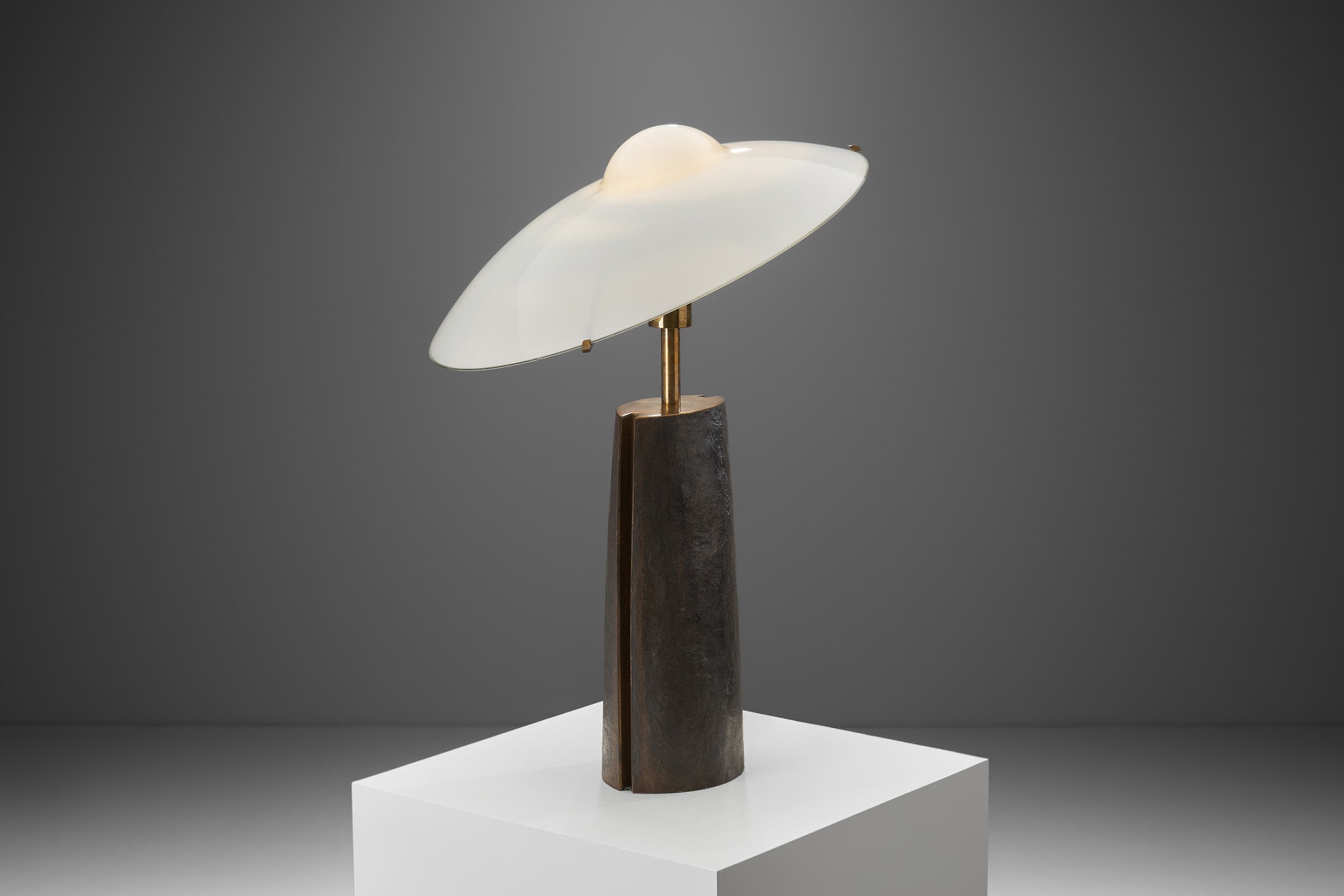
REQUEST PRICE HERE
Price category: 7,500 - 10,000 usd / eur
‘Kallisto’ is part of the first Tobias Grau lighting collection that combines sculptural and delicate forms with classical materials and a pioneering use of halogen technology. The collection brought the company much acclaim and established key hallmarks of Tobias Grau design: dynamic shapes, smooth surfaces, and cutting-edge technology.
Tobias Grau lamps follow not only visual requirements, but also possess an outstanding technical quality. This large ‘Kallisto’ table lamp could easily be mistaken for a sculpture, where the materials are combined in different and unusual ways. This model is a draft from 1990, therefore, production was highly limited - making it a rare collectible. The design has a certain extravagance and comes across as incredibly aesthetic and is an eye-catcher in any room. The diffuser is made of opal Murano glass, standing on a brass stand with a highly structured surface completed by the elaborate brass frame around the lightbulb. The technical aspect of the design is most apparent in this structure, utilising an adjustable system that allows the diffuser to be turned and rotated. Whether a chic hat or an alien ship comes to mind, the diffuser is undeniably unique. It then says a lot that the base doesn’t fall short either aesthetically or technically; its surface adds more textural interest to the design and contrasts cleverly to the smooth Murano glass. Further, the beautifully patinated brass lights up against the other materials.
Tobias Grau states that the best product brings human-oriented innovations into a simple, intuitive and artful form. This ‘Kallisto’ table lamp visualises this sentiment in a material form that offers outstanding quality and craftsmanship.
Condition:
In good vintage condition. Wear consistent with age and use. The brass has a beautiful patina.
Dimensions:
15.35 in W x 19.29 in D x 27.95 in H
39 cm W x 49 cm D x 71 cm H
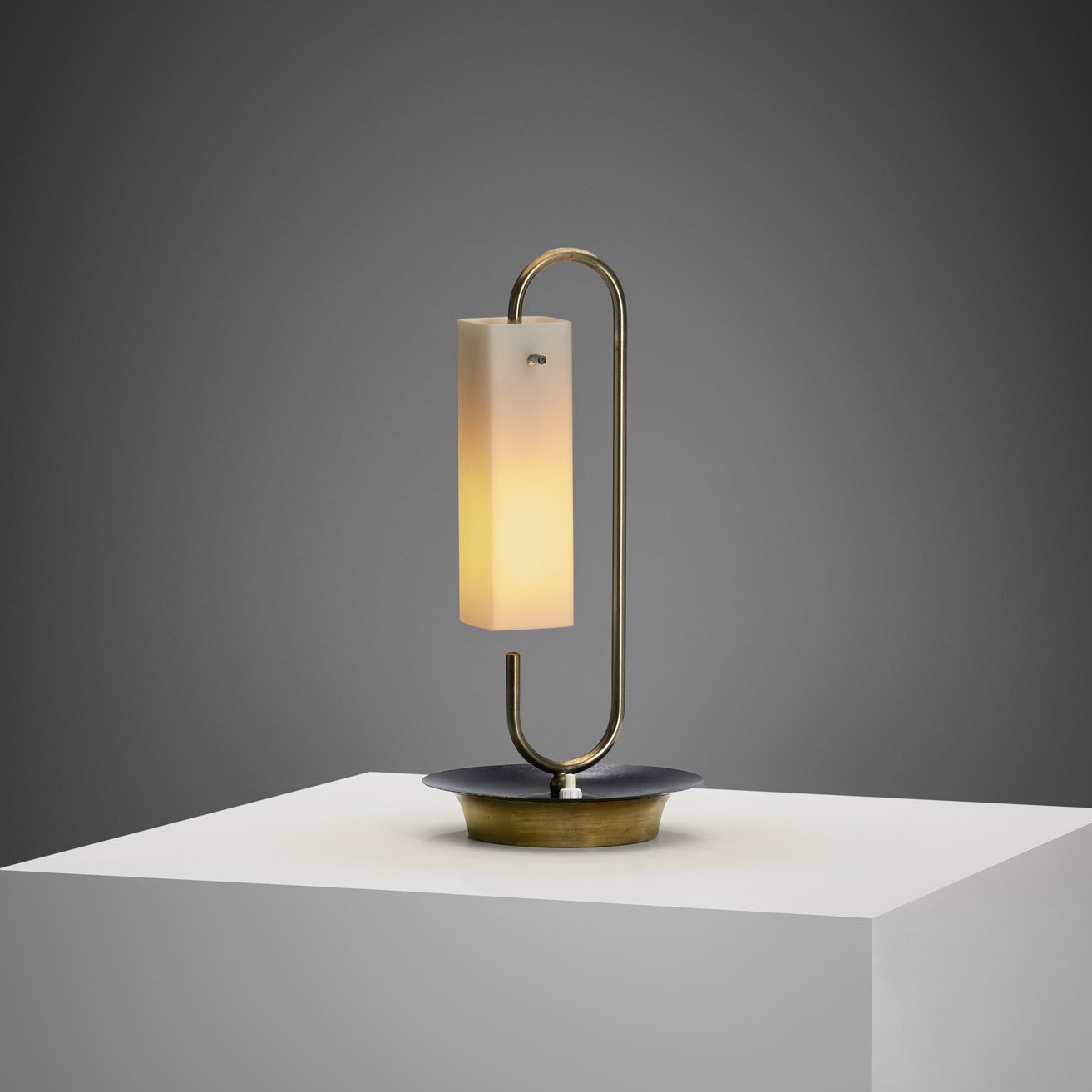
REQUEST PRICE HERE
Price category: 2,500 - 5,000 usd / eur
The 20th century emerged as a golden era where linear forms seamlessly intertwined with function, giving rise to timeless pieces that continue to captivate contemporary sensibilities. Featuring a minimalist and functional design, with distinctive details and high-quality materials, this table lamp is a unique addition to any space.
Based on the classic pairing of brass and opal glass this model can bring understated modernism to any interior. The shape of this lamp is achieved through the geometry of its elements, from the rectangular shade to the rounded stem and circular base. The design displays clean and symmetrical lines creating a visually neat, and modern look. The lamp is thoughtfully constructed from high-quality brass with a beautiful patina which provides a durable foundation. The shade is held from above by a brass stem and appears to be floating from below. The circular base is reminiscent of a candle chamber stick, used as a small pan designed to catch dripping wax. This element echoes traditional forms of lighting which originally used candles as a source of light. The opal glass softens the glow of the light emitted, creating a warm and inviting ambience.
Each component of this table lamp was designed with functionality and elegance in mind, culminating in a piece that transcends simple utility. It is a striking blend of form and function, a luminary that offers not just light, but also a touch of modern charm that can enhance the decor and warmth of an interior.
Condition:
In good vintage condition. Wear consistent with age and use.
Dimensions:
6.29 in ⌀ x 13.38 in H
16 cm ⌀ x 34 cm H
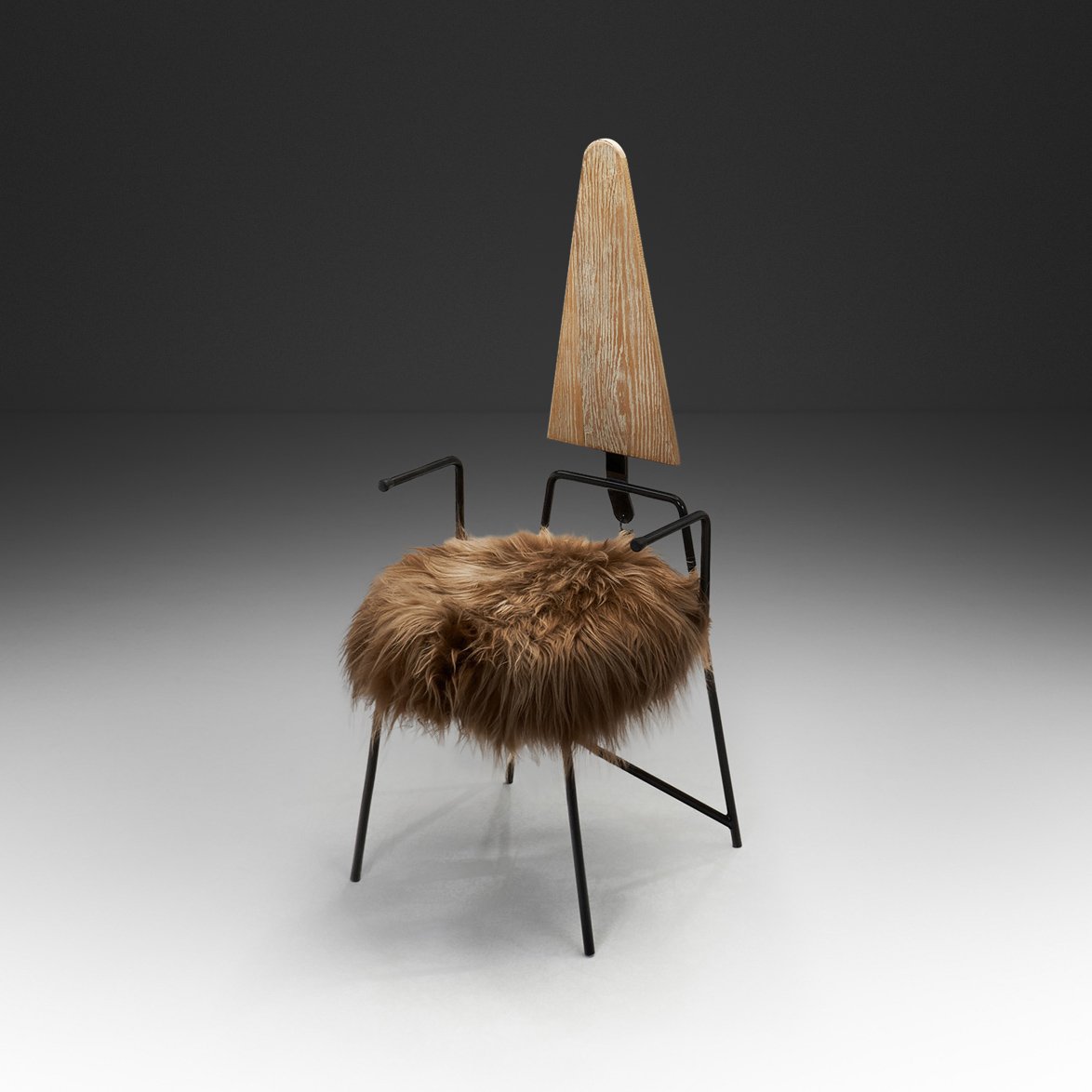
REQUEST PRICE HERE
Price category: 1,000 - 2,500 usd / eur
Rach Finazzi, an Italian designer active from the late 20th century, is recognised for a distinctive approach to furniture-making that merges geometric structures with unique materials. Finazzi’s work often explores unconventional forms and material contrasts, from glass to metal and wood, resulting in pieces that command attention both as functional furniture and as sculptural statements.
This geometric dining chair is a quintessential example of Finazzi’s design ethos, the chair is characterised by a striking interplay between an angular metal framework, natural wood, and plush sheepskin. The chair rests on slender, black metal legs that intersect to create a dynamic, sculptural base, flowing into the arms. The composition feels both visually light and structurally stable. Adding to the design, the backrest is crafted from solid wood in a dramatically tapered, triangular form. The back introduces an architectural element that draws the eye upward, establishing a visual dialogue between the angular metal structure and the natural wood grain. To fully drive in the textural juxtaposition, the seat is upholstered in longhair sheepskin, adding a warm, inviting texture that contrasts beautifully with the cool, industrial feel of the metal frame and the earthy wooden backrest.
More than just seating, this dining chair functions as a sculptural piece that showcases Finazzi’s ability to harmonise disparate materials and forms. The combination of materials creates a compelling visual and tactile experience, showcasing the skill and creativity of Italian craftsmanship. Whether arranged around a dining table with other pieces or displayed as a standalone accent piece, the chair encapsulates a bold design language, merging functionality with a strong artistic presence.
Condition:
In good vintage condition. Wear consistent with age and use. The item has recently been reconditioned. Due to the nature and age of the materials, the item may have marks, scratches, and discolouration. The seat has been reupholstered recently in a premium sheepskin. Each of our items can be reupholstered by our in-house atelier in a fabric of choice. Please reach out for more information.
Dimensions:
19.29 in W x 22.04 in D x 44.68 in H; Seat height 19.68 in; Seat depth 20.47 in; Arm height 24.40 in
49 cm W x 56 cm D x 113.5 cm H; Seat height 50 cm; Seat depth 52 cm; Arm height 62 cm
REQUEST PRICE HERE
Price category: 7,500 - 10,00 usd / eur
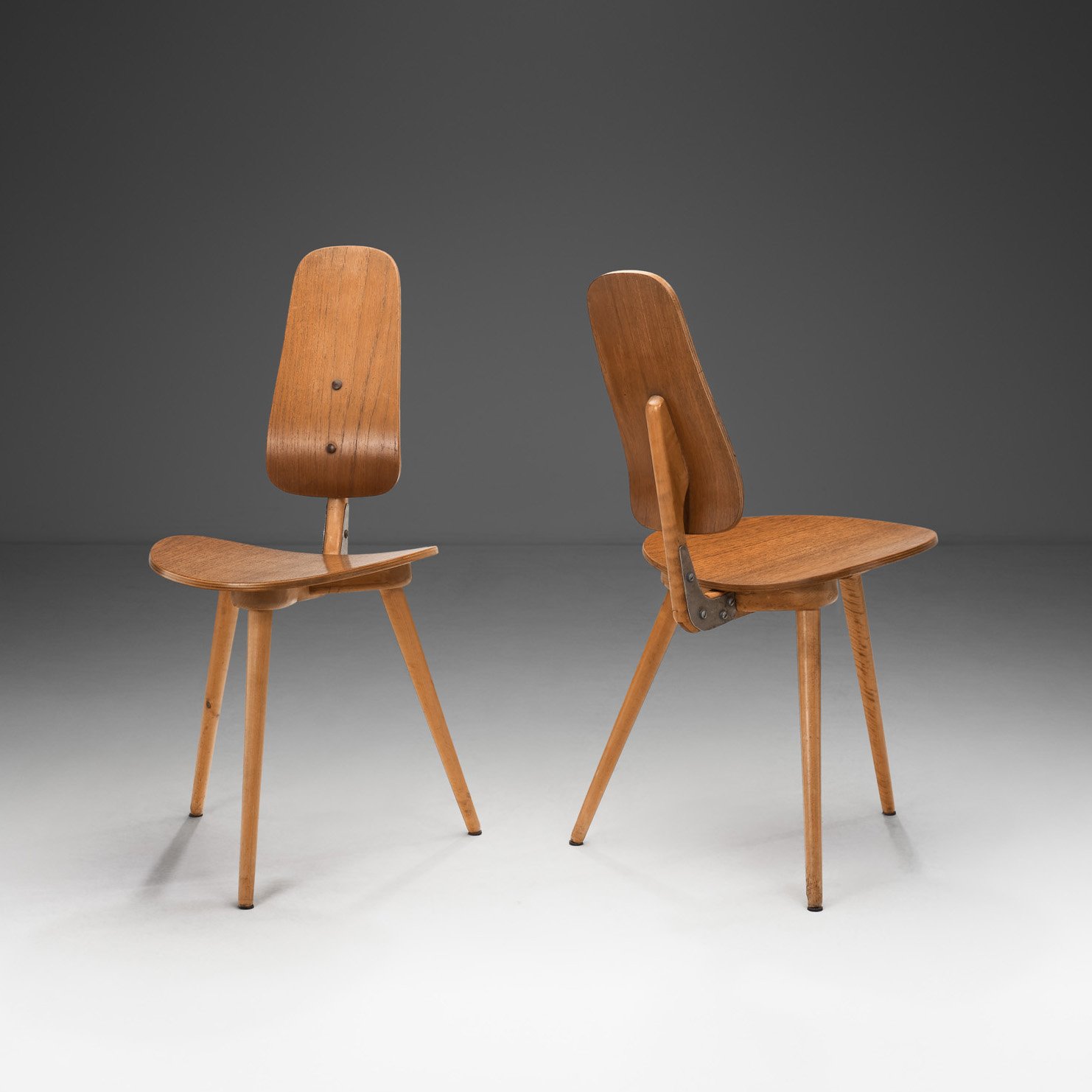
Designer Bengt Ruda was the first qualified designer to be employed at IKEA. Before being recruited in 1957, he had designed furniture for the high-end department store Nordiska Kompaniet (NK), working among other things on the self-assembly Triva series.
The “GRILL” chairs are distinctive for their three-legged design, crafted from laminated teak and birch. These materials lend the chairs a natural and warm appearance. The splayed birch legs also provide stability and a touch of Scandinavian simplicity to the design of the chairs. Moreover, these chairs boast a sleek and contemporary look that seamlessly blend functionality with style.
“GRILL” is a good example of how, from the early days, IKEA focused on smart product development. In 1958, “GRILL” won the jury award at the Society of Crafts and Design’s major design exhibition – the forerunner of Excellent Swedish Design. One of the adjectives used by the panel to describe the little chair was “energetic”.
Condition:
In good vintage condition. Wear consistent with age and use. Minor marks and scratches on the wood.
Dimensions:
15.35 in W x 22.05 in D x 33.07 in H
39 cm W x 56 cm D x 84 cm H
REQUEST PRICE HERE
Price category: 5,000 - 7,500 usd / eur
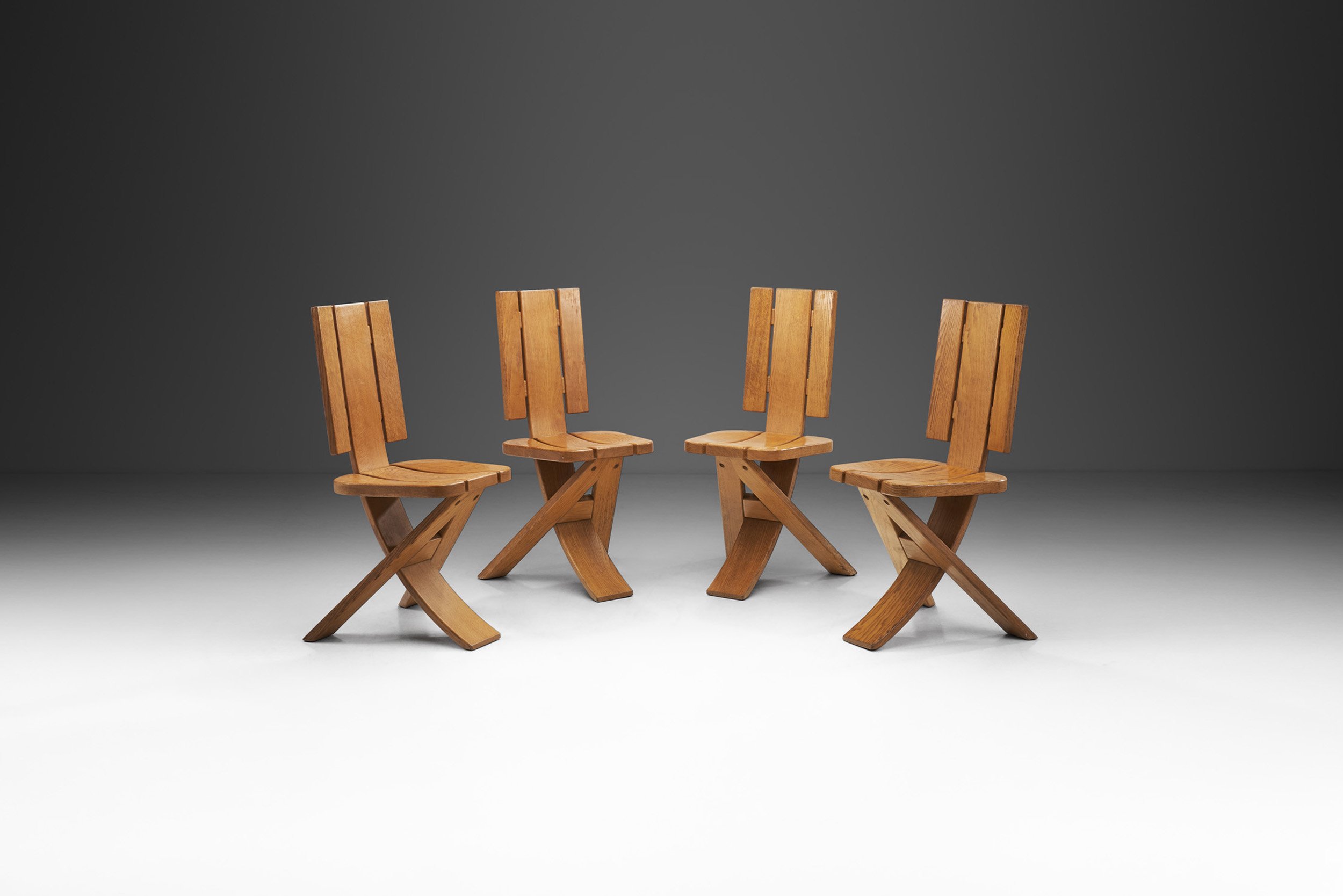
This set of four French chairs is in the Arts & Crafts style, preserving and emphasizing the natural qualities of the material used to make it. Curves are slight and infrequent, instead, there is a clear emphasis on the structure itself.
The striking, sculptural design is both figuratively and literally based on the tripod structure comprising the base of this chair model. Each one accommodates a curved wooden slat ending in the backrest. Much like when the "Morris chair" was released with its ultra-simple lines, at a time when Rococo Revival and other ultra-fancy Victorian styles were all the rage, these chairs also redefine the general style of the 1970s. They are a stark contrast that comes into focus when looking at overall groovy and free-flowing looks of the era. The design of this set has a strong architectural approach instead, and while it is very sturdy on first sight, the outstanding execution of the legs and the natural appeal of oak make it the embodiment of a creative, elegant design. The use of the sizeable pieces of oak wood with a beautiful grain, and the visible joints and bolts give each chair a natural, elemental feeling. While each wooden part is interesting, the main visual element is the centrally placed front leg that continues upwards in a curved shape, where it forms the middle part of the backrest. The other front legs are in the shape of the letter “A”. The backrest feature a carved detail, originally designed to ease the handling of the chairs. The lower structures are true balancing acts, executed with architectural precision and knowledge.
This striking set was produced by the French manufacturer, Ebénisterie Seltz. The small, family run wood workshop in the Alsace region was selected by Pierre Chapo to produce some of his designs in the 1970s and 1980s. Mostly working with solid oak and elm wood, their way of working was based on great respect for the material and the use of elegant, simple and functional shapes.
Condition:
In good vintage condition. Wear consistent with age and use. Some small scratches and marks on the wood.
Dimensions:
15.74 in W x 18.7 in D x 35.43 in H; Seat height 17.51 in
40 cm W x 47.5 cm D x 90 cm H; Seat height 44.5 cm
REQUEST PRICE HERE
Price category: 2,500 - 5,000 usd / eur
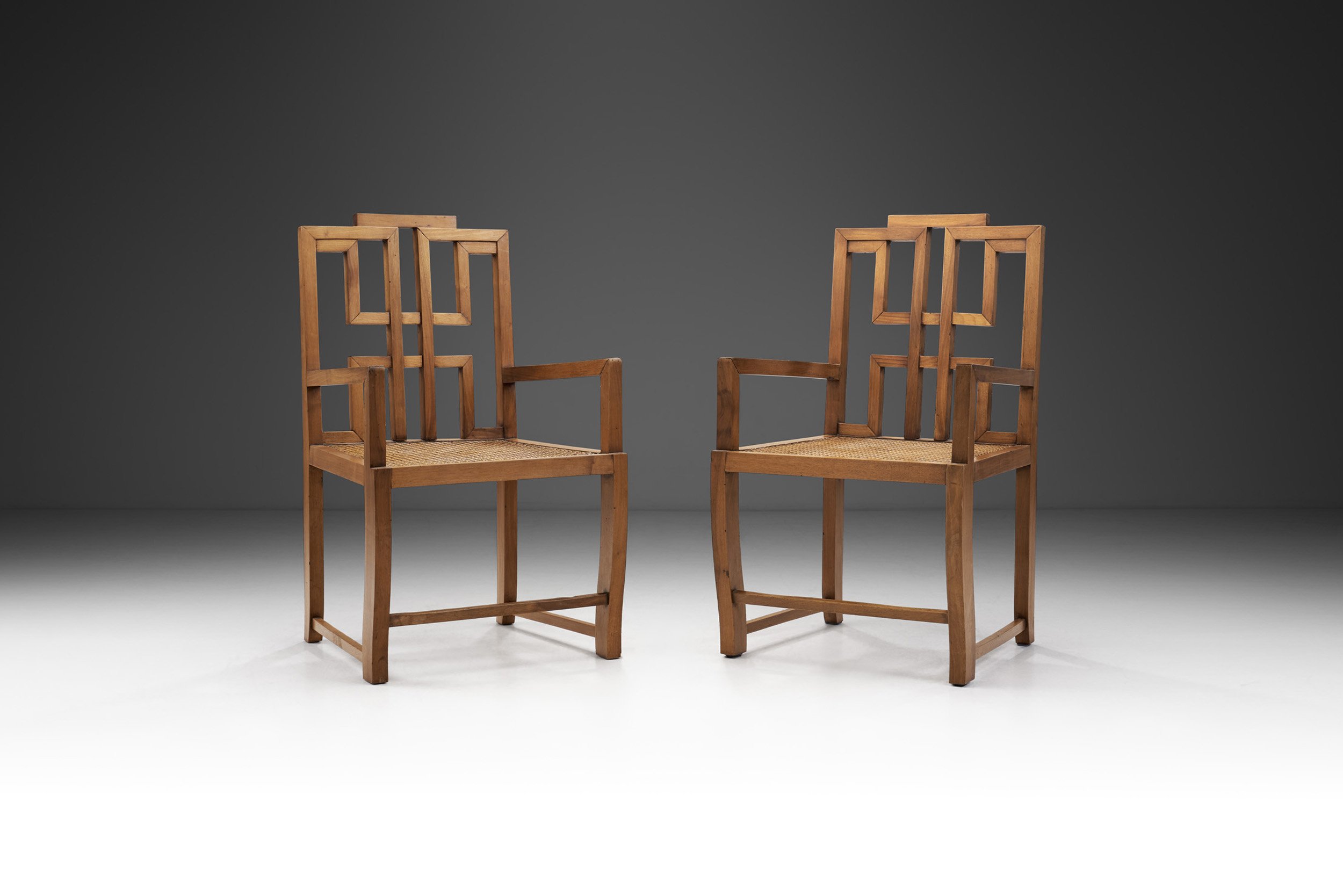
The influence of Chinese design on the West has been subtle, almost by osmosis, but we can see references in much of western art and design. Much of Europe has long had a magpie tradition of taking from the different cultures it has come into contact with in its past, furniture being no exception.
Similar to European Chinoiseries, Britain formulated an Anglo-Chinese style that copied Chinese models yet adhered to British fashions affecting furniture design. The resulting aesthetic is quite unique and has evolved much in the past decades as demonstrated by these armchairs. These solid, exotic wood chairs have an essentially modern, streamlined structure with interesting angles and flawless woodworking. The traces of the Anglo-Chinese style manifest in the backs, with an elaborate motif resembling historic Asian patterns. The design of these armchairs emphasizes the uniqueness and originality of handmade objects and features stylized, organic forms. The sense of balance between horizontal and vertical lines, between the elaborate backs and the straight and curved lines of the rest of the structures is outstanding. The chairs’ construction leaves plenty of open space, emphasizing the airy feel and every single line of the design. This airiness is further emphasized by the caned seats that are carefully crafted and light, pairing very well with the solid wood frames. Finally, the legs have stretchers between them, giving them a “grounded” look.
From the octagonal mesh cane webbing to the gently bent front legs, there are plenty these chairs offer even beyond their beautifully crafted frames and Asian-inspired backs. The natural quality of the wood, with its imperfections and individuality, adds an elemental feel that enhances the strong presence of these armchairs.
Condition:
In good vintage condition. Wear consistent with age and use. Original cane panels. The wood has some marks and scratches.
Dimensions:
21.06 in W x 20.86 in D x 35.62 in H; Seat height 16.92 in; Arm height 24.21 in
53.5 cm W x 53 cm D x 90.5 cm H; Seat height 43 cm; Arm height 61.5 cm

REQUEST PRICE HERE
Price category: 9,000 - 12,500 usd / eur
This “Fantasy” sofa, designed by Kurt Beier, epitomises the avant-garde and experimental nature of postmodern design. Created during a period marked by a break from traditional creative conventions, this piece combines unconventional materials and bold forms that challenge the boundaries of furniture design. Postmodernism embraced a playful approach to design, making this sofa not only functional but also a statement piece that serves to inject energy and individuality into any interior.
The sofa's striking visual contrast is created through the juxtaposition of the industrial feel of the metal structure and the luxurious, soft longhair upholstery. The smooth backrest is made of steel, strong and durable, ensuring longevity. The metal’s cool, smooth silver surface stands out beautifully against the warmth and cosiness of the upholstery, creating a compelling dialogue between the distinct materials and highlighting the tactile dimension of the sofa. The designer did not forget to ensure comfort when envisioning the silhouette of the piece - the curved metal wraps around the seat in an almost cocoon-like manner, providing both support and an intriguing visual element. The upholstery’s fluffy texture, on the other hand, contributes an organic softness that contrasts sharply with the mechanical, rigid nature of the metal. The wooden legs become the mediating element, adding a natural, grounding element to the sofa, balancing the two mediums.
With a sense for incredible craftsmanship and endless passion for innovation, Beier's work captures the essence of the 1980s design ethos, where function and form merge with playfulness. Thus, the sofa becomes a character inside a room rather than seating alone. Its bold combination of materials, contrasting textures, and sculptural form make this piece perfect for modern interiors that value individuality and creative expression.
Condition:
In good vintage condition. Wear consistent with age and use. The sofa has recently been reconditioned. The metal frame has a beautiful patina. Due to the nature and age of the materials, the item may have marks, scratches, and discolouration. The seat has recently been reupholstered in premium longhair. Each of our items can be reupholstered by our in-house atelier in a fabric of choice. Please reach out for more information.
Dimensions:
72,04 in W x 36,22 in D x 26,18 in H; Seat height 16,92 in; Seat depth 24,01 in; Arm height 26,18 in
183 cm W x 92 cm D x 66.5 cm H; Seat height 43 cm; Seat depth 61 cm; Arm height 66.5 cm
REQUEST PRICE HERE
Price category: 7,500 - 10,000 usd / eur
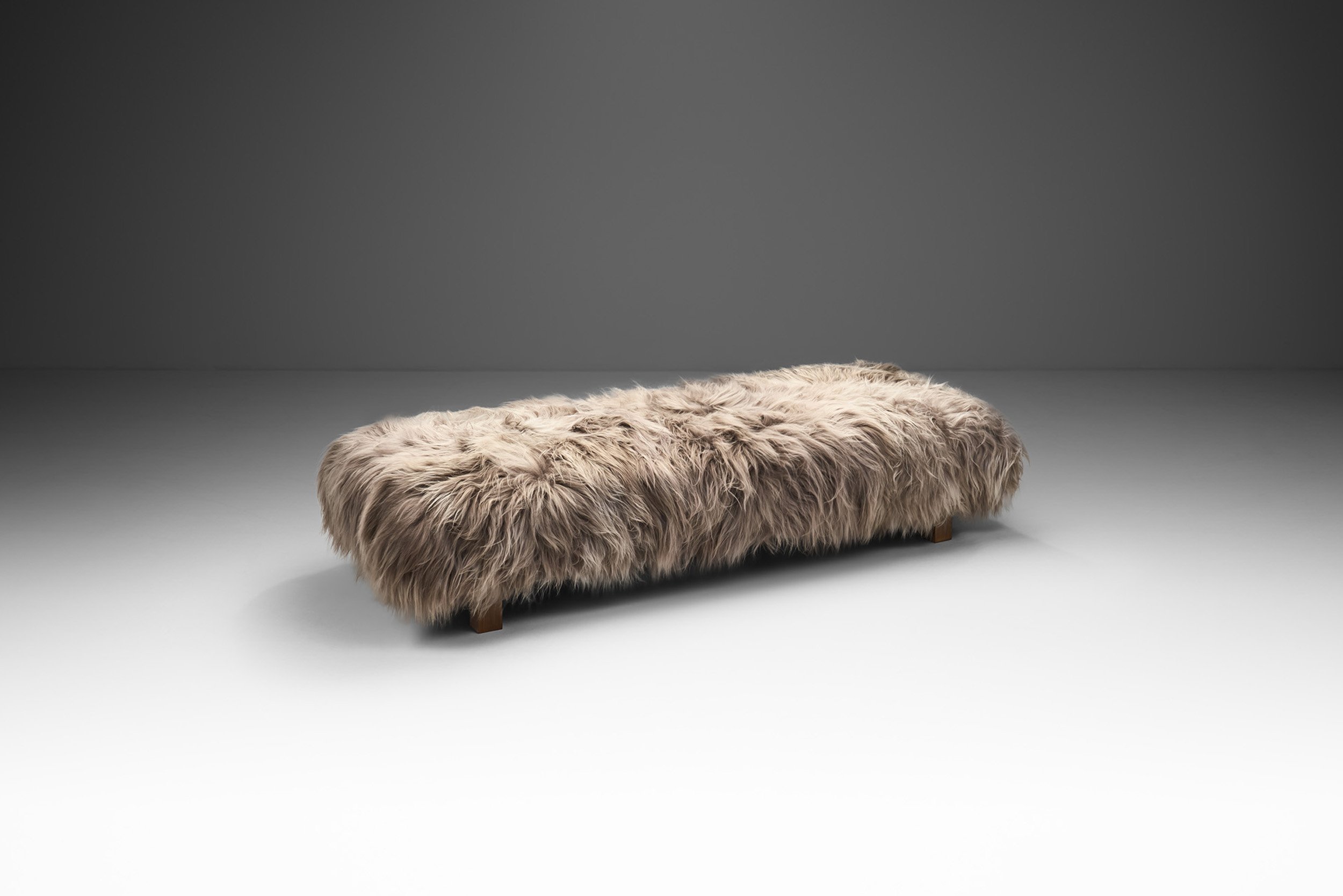
A desire for functionalism went hand in hand with understatement, refinement, and elegance. The Danish mid-century furniture designer was concerned with graceful proportions and restrained, harmonious ornament while reinstating the ideals of fine craftsmanship. He desired sleekness. He revered the maxim “form follows function.”
This spectacular daybed is essentially a simple, refined design standing on solid wood legs. What makes it stand out is its opulent upholstery. Yak hide provides warmth, and wherever they are placed, they provide an attractive Nordic look. Renowned for its decadent thickness and length, this material has been the accessory of choice for modernist architects and designers throughout the 1950s. Today they are perfect for creating the mid-century look in any space. This daybed - unlike sofa beds - can be easily placed and used as a bench in large entryways, next to windows, or at the foot of a bed thanks to its functionality. Thanks to its visual qualities, mainly the yak hair’s lush texture and colour, this infinitely cosy daybed can also function as a kind of sculpture to break the mostly straight lines of any minimalistic space.
Characterized by functionality, simplicity and clean lines, Danish design is all about harmony. Here, the pairing of the materials creates this balance as the understated wooden structure complements and supports the extravagant yak hide. Danish design also left much room for individuality thanks to which this daybed is one of a kind with its stylish edge.
Condition:
In good vintage condition. Wear consistent with age and use. The legs are a later replacement. This daybed has been reupholstered recently in premium yak hide. Each of our items can be re-upholstered by our in-house atelier in a fabric of choice. Please reach out for more information.
Dimensions:
74.8 in W x 29.13 in D x 17.32 in H
190 cm W x 74 cm D x 44 cm H
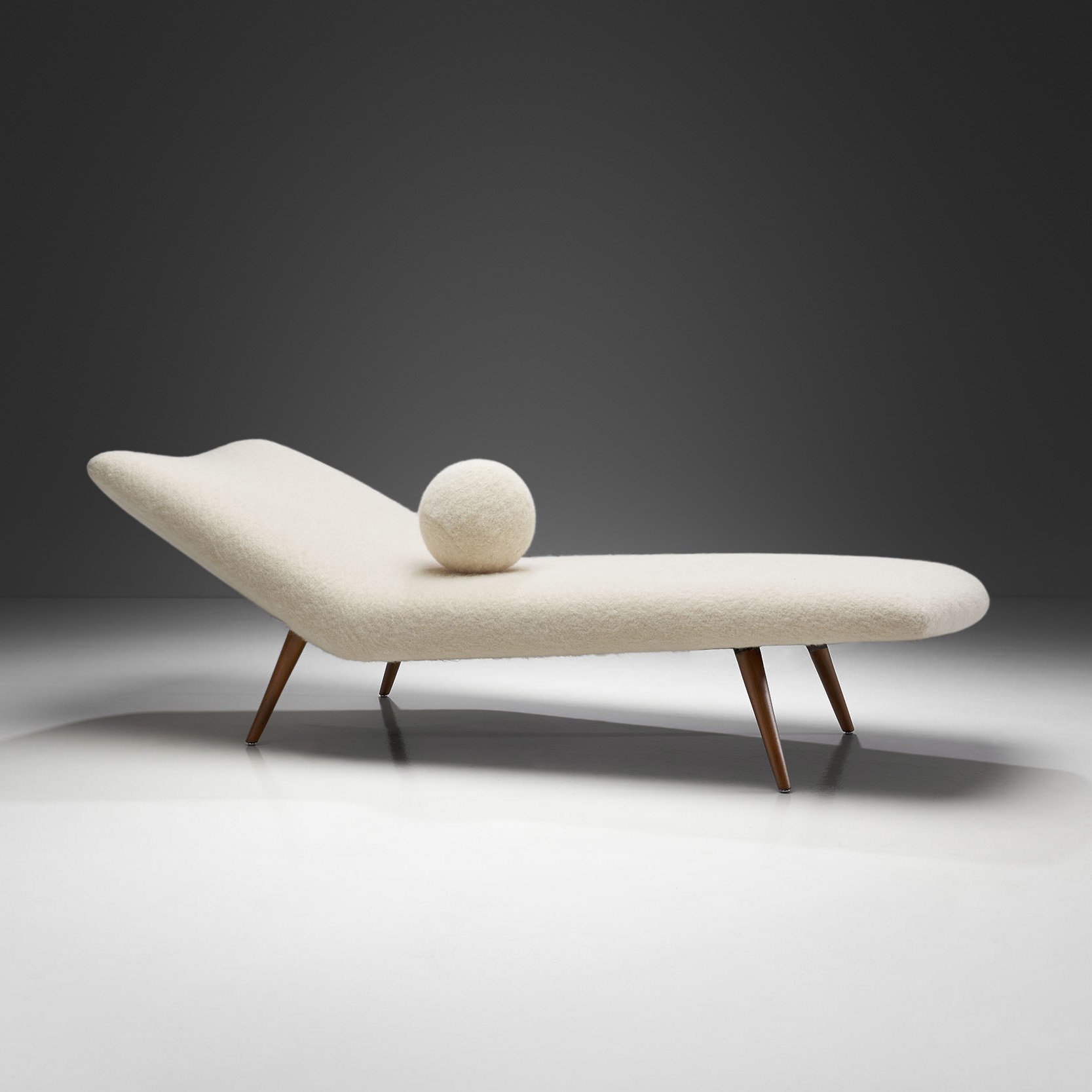
REQUEST PRICE HERE
Price category: 15,000 - 20,000 usd / eur
This eye-catching daybed was designed by Theo Ruth in 1947 and manufactured in a limited series. The keywords around this model are quality, comfort and understated elegance.
The slender, slightly conical wooden legs are made from patinated beech. The legs balance out the body well, creating a light look. The elegant shape is formed by the raised back and the round, soft edges. This daybed is an exceptional piece of Dutch design that was exclusively produced by Eugen Schmidt Soloform (later Eugen Schmidt GmbH in Darmstadt) and Artifort. While many daybeds have been “inspired” by Ruth’s present design, this original model remains very limited in numbers.
This daybed has been reupholstered in a premium alpaca-wool blend fabric, which guarantees outstanding comfort and softness. The light colour of the upholstery brings out the beautiful shade and grain of the beech legs.
Condition:
In good vintage condition. Wear consistent with age and use. Item has recently been reupholstered in a premium alpaca wool blend fabric.
Dimensions:
32.67 in W x 77.16 in D x 24.80 in H; Seat height 14.56 in
83 cm W x 196 cm D x 63 cm H; Seat height 37 cm
About the Designer:
Dutch designer Theo Ruth was born in 1915 in Maastricht. He trained as a furniture designer and interior designer at the Middelbare Kunstnijverheidsschool in Maastricht (which later became the Maastricht Academy of Arts). In 1936, he joined Artifort in Maastricht, where he specialized in designing living room furniture. Just three years later, in 1939, he became head of design and development, a position he maintained until his death in 1971.
Ruth was Artifort’s first permanent designer, and had a major impact on its design legacy. His most famous pieces include the 1952 Congo Chair and the 1953 Penguin Chair, both of which were constructed from two interlocking pieces that fit together without locks or screws (the latter’s original version featured a black back and a white cushion to mimic its namesake). Theo Ruth’s designs are famous around the world as highlights of Dutch design. ~H.

REQUEST PRICE HERE
Price category: 12,500 - 15,000 usd / eur
By the middle of the 20th century, design and handicrafts from Sweden had caught the eye of the outside world. Since the 1910s, the modern movement had worked for a modern and functional form. Functionalism had a major public breakthrough during the Stockholm Exhibition in 1930, however, as this peculiar sofa shows, the objective, square and stripped-down functionalist style was short-lived.
The term ‘Swedish Modern’ was quickly established as a reinterpretation of modernity during the 1940s, and the early and square functionalism was replaced by the new Swedish Modern style’s freer and more artistic ideal. These qualities perfectly describe this amazing sofa, standing on four club-shaped legs. This two-seater sofa has a lot of character with a welcoming presence that exudes high quality craftsmanship and design. The rounded edges and curves create flowing lines, which is further enhanced by the upholstery’s rich texture and softness. The many tufted buttons on the backrest are arranged symmetrically and adds even more character to the body. The splayed legs’ shape is in accordance with the rounded edges of the body, and together with the armrests -where the wood is exposed - showcases the wood’s beauty. With a careful combination of organic shapes, master craftsmanship, and luxurious materials, both Swedish modernity, crafts history and tradition were combined in this sofa.
Swedish Modern made the Swedish form widely known. This second generation of 'functionalists' affirmed craftsmanship, tradition and history. The new style thus signalled both status, unassuming and sensitive awareness right up to the 1960s. The country had a second international breakthrough at the end of the 1930s - under the term Swedish Modern, and a third one that is happening right now, and looking at this sofa, is unlikely to end anytime soon.
Condition:
In good vintage condition. Wear consistent with age and use. The sofa has been reupholstered recently in premium sheepskin.
Dimensions:
86.6 in W x 34.3 in D x 33.5 in H; Seat height 21.7 in
124 cm W x 83 cm D x 87 cm H; Seat height 40 cm
REQUEST PRICE HERE
Price category: 5,000 - 7,500 usd / eur
“Breathing'“ by Dutch sculptor Ineke van Zuuren is an exploration of organic abstraction. Van Zuuren transforms a dense block of wood into a form that feels remarkably fluid and alive. Rather than depicting the human figure directly, van Zuuren suggests its presence through graceful curves, balanced proportions, and an elegant sense of movement.
The rich, dark tones of the sculpture are complemented by the wood’s striking natural grain, which becomes an integral part of the composition. Smoothly sculpted convex and concave surfaces catch the light beautifully, emphasising the subtle transitions in the form while highlighting the warmth and tactile quality of the material. The result is a work that feels both monumental and intimate, celebrating the expressive possibilities of solid wood. This sculpture is undoubtedly as captivating from afar as it is up close. This work invites viewers to engage with the interplay of tradition and innovation, celebrating the enduring appeal of solid wood as a medium for artistic expression.
This piece is also a rare representation of Dutch Post-Modernist design, an interesting phase of cultural, social impacts with artists and designers trying to figure out their way towards leaving their marks.
Condition:
In good vintage condition. Wear consistent with age and use. Due to the nature and age of the material, the sculpture may have marks, scratches, and discolouration.
Dimensions:
23.62 in W x 13.38 in D x 33.46 in H
60 cm W x 34 cm D x 85 cm H