
Mid-Century Dutch Plywood Chair, The Netherlands 1940s






Mid-Century Dutch Plywood Chair, The Netherlands 1940s
REQUEST PRICE HERE
Price category: 2,500 - 5,000 usd / eur
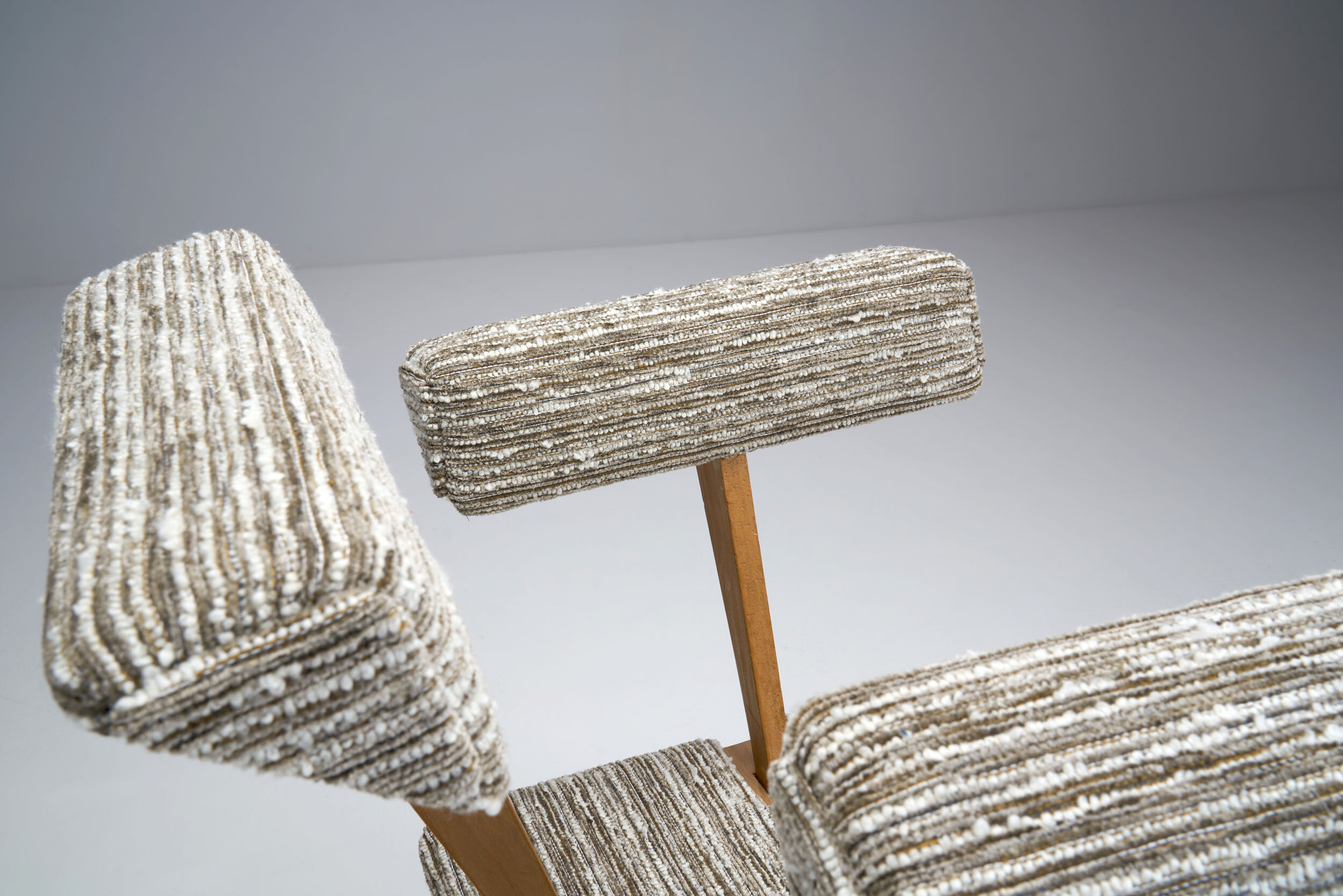
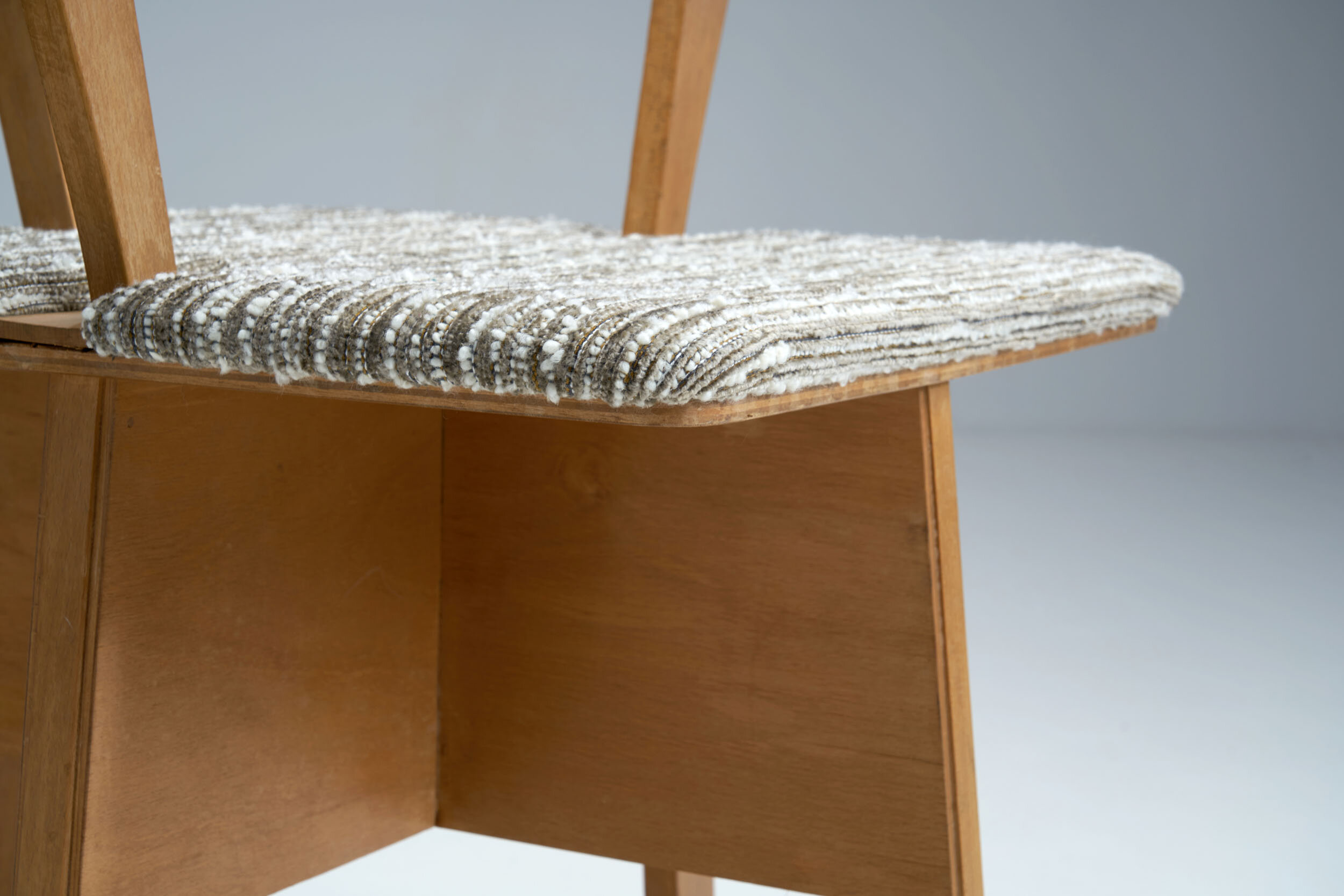
The uniqueness of this mid-century Dutch chair is beyond question. With a peculiar shape and history, every aspect of this chair is one-of-a-kind. Seriously minimal and highly functional, this chair is out of the ordinary.
Dutch mid-century furniture is defined by characteristics of simplicity and functionality in the context of industrial production, and a preoccupation with geometry. Dutch furniture makers aspired to affect lives with good functional design, which, in this case was taken quite literally. Visually this chair does not quite fit into any traditional chair category, which is explained by its historical purpose. In the 1940s, this model was known as a UKG (ultra-short wave) chair, as it was used in facilities where high frequency electrotherapeutic treatments were available. Accordingly, this chair contains a piece of history in its shape and materials alike. The chair is completely metal-free and features removable armrests. The slim arms and back appear to be emerging from the seat, ending in the upholstered back- and armrests. The fabric is by by the world famous French atelier, Toyine Sellers, who created this fabric that can be considered art in itself.
While this chair was not created to strictly conform to the principles of the era, it is interesting to see how it nevertheless reflects many of the characteristics of mid-century design. The plywood is light with geometrical lines without any ornamentation. Compressed plywood is in fact typical of the Dutch modernist aesthetic. Dutch mid-century furniture designers were not concerned with organic forms and the natural world in the way that Scandinavian designers were, rather, they presented true Modernism, ultimately traceable back to the legacy of the Bauhaus.
Condition:
In good vintage condition. Wear consistent with age and use. The chair has been reupholstered recently in premium bouclé fabric by Toyine Sellers. Each of our items can be re-upholstered by our in-house atelier in a fabric of choice. Please reach out for more information.
Dimensions:
28.74 in W x 26.37 in D x 37 in H; Seat height 19.68 in
73 cm W x 67 cm D x 94 cm H; Seat height 50 cm
REQUEST PRICE HERE
Price category: 30,000 - 40,000 usd / eur
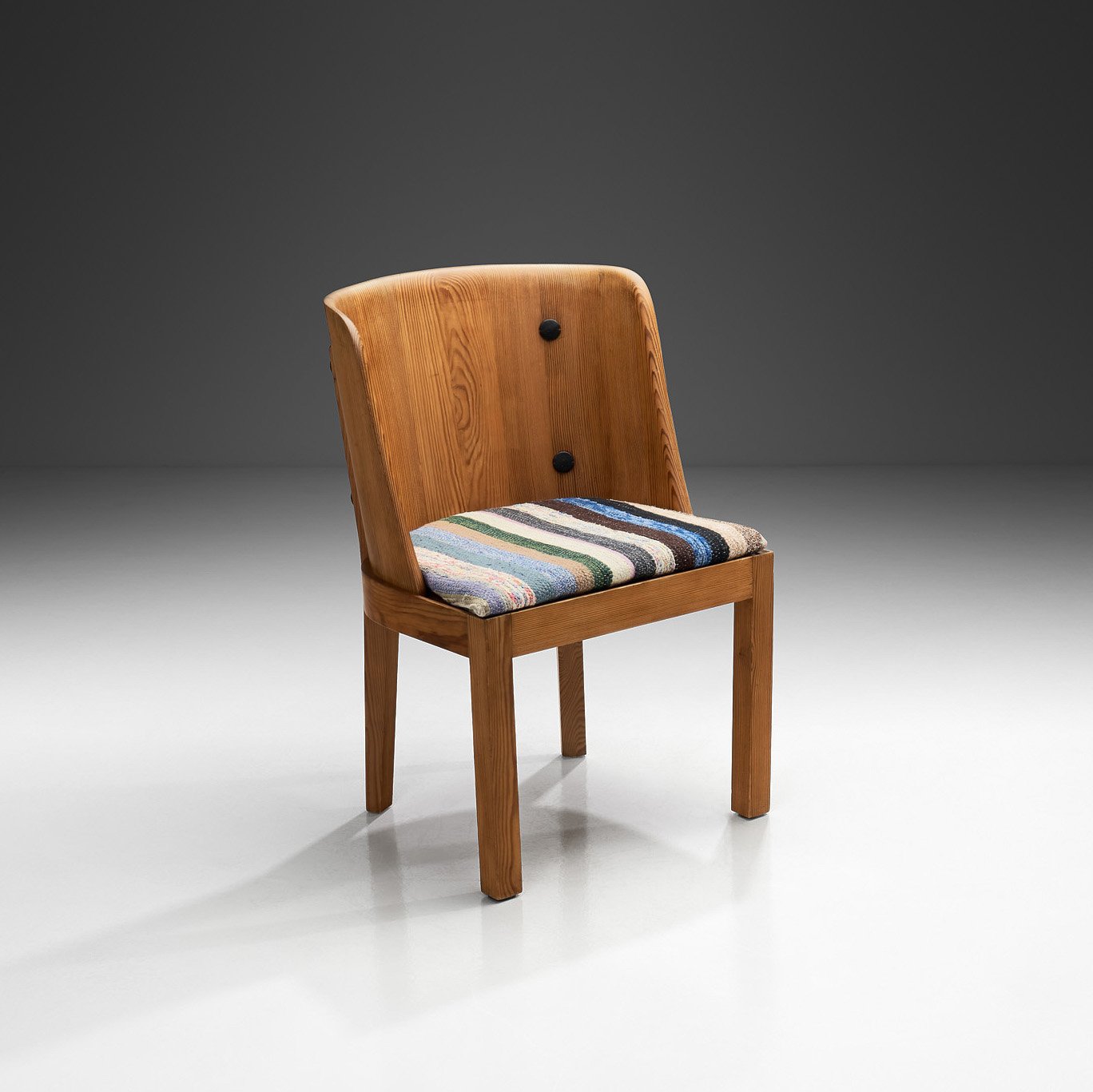
Swedish architect and furniture maker Axel Einar Hjorth worked as the lead designer for Sweden’s Nordiska Kompaniet department store from 1926 to 1938. During this time, Hjorth designed the “Sportstugemöbler” series, (which translates to “sports cabin furnishings”) a collection of wooden furniture designed for country homes. The various models in the sportstugemöbler series took their names from locations in the Stockholm archipelago – including Blidö, Lovö, and Utö.
The “Lovö” model, designed within the series of chalet furnishings, was initially launched by Nordiska Kompaniet in 1932. The series was a response to a new and growing demand for furnishings for leisure houses where the style was more informal. This chair is crafted from local pine wood, while the backrest features iron rivets. The juxtaposition between the pine and iron provides a rustic, sturdy and resilient feel, elevating the timeless look of the model. The chair combines a simple and honest form of the handcrafted style of traditional Nordic “allmoge” furniture, and the international 20th century Modernist movement. The result is a modest yet visually interesting design with a strong silhouette. The pine body is composed of a low, curved back that is slightly tilted in order to increase the sitter’s comfort - highlighting the functional nature of the chair. The seat features a loose, removable cushion, upholstered in a textural, striped fabric. Not only is the design of this model unique, but the colourful, cushion further increases the special character, ensuring remarkable charm. The design is completed by four square, straight legs, offering sturdiness.
The “Sportstugemöbler” series had a lasting influence on Hjorth’s contemporaries, inspiring other big names within Nordic design, such as Carl Malmsten. From an international perspective, this series is the forerunner of later pioneering designs, so it comes as no surprise that these “Lovö” chairs became part of modernist design history.
Condition:
In good vintage condition. Wear consistent with age and use. This chair comes with its original upholstery or has been reupholstered by a previous owner. Each of our items can be re-upholstered by our in-house atelier in a fabric of choice. Please reach out for more information.
Dimensions:
20.86 in W x 20.07 in D x 31.49 in H; Seat height 18.50 in; Seat depth 16.92 in
53 cm W x 51 cm D x 80 cm H; Seat height 47 cm; Seat depth 43 cm
About the designer:
Axel Einar Hjorth was born in a small Swedish village named Krokek, just outside Norrköping, on March 7, 1888. At the age of 20, he moved to Stockholm to study architecture and design at the Högre Konstindustriella Skolan.
Although he never graduated, in the 1920s Hjorth started working as a furniture designer for various manufacturers, such as H. Joop & Co., Myrestedt & Stern, Jonssons, and Nordiska Kompaniet. Hjorth’s designs from this period had neoclassical features combined with Swedish Grace. This romantic national style of Sweden was elegant and refined, yet simple. The anniversary exhibition of 1923 in Gothenburg marked the breakthrough of Swedish decorative arts, and made Axel Einar Hjorth a well-respected artist. From October 1926, Hjorth became the chief designer and architect of Nordiska Kompaniet department store in Stockholm. In the 1930s, Hjorth designed a furniture collection out of pine meant for serial production known as Sportstugemöbler (furniture for holiday houses).
Hjorth’s designs, from the luxury of neoclassicism to the severity of functionalism, are sharply distinctive in style, materials, and character. Unlike many of his contemporaries, Hjorth did not conform to the socially oriented ideas produced by Svensk Form (the Swedish Society of Crafts and Design). He played a significant role in the development of Swedish society as a whole, and particularly in Swedish industrial art.
Today Hjorth is often viewed as a precursor to the modern designs popularised by Charlotte Perriand, Jean Royére, Pierre Chapo, or Josef Frank. Recently, there has been a revival of appreciation for his work, showing his genius in a new light.
REQUEST PRICE HERE
Price category: 5,000 - 7,500 usd / eur
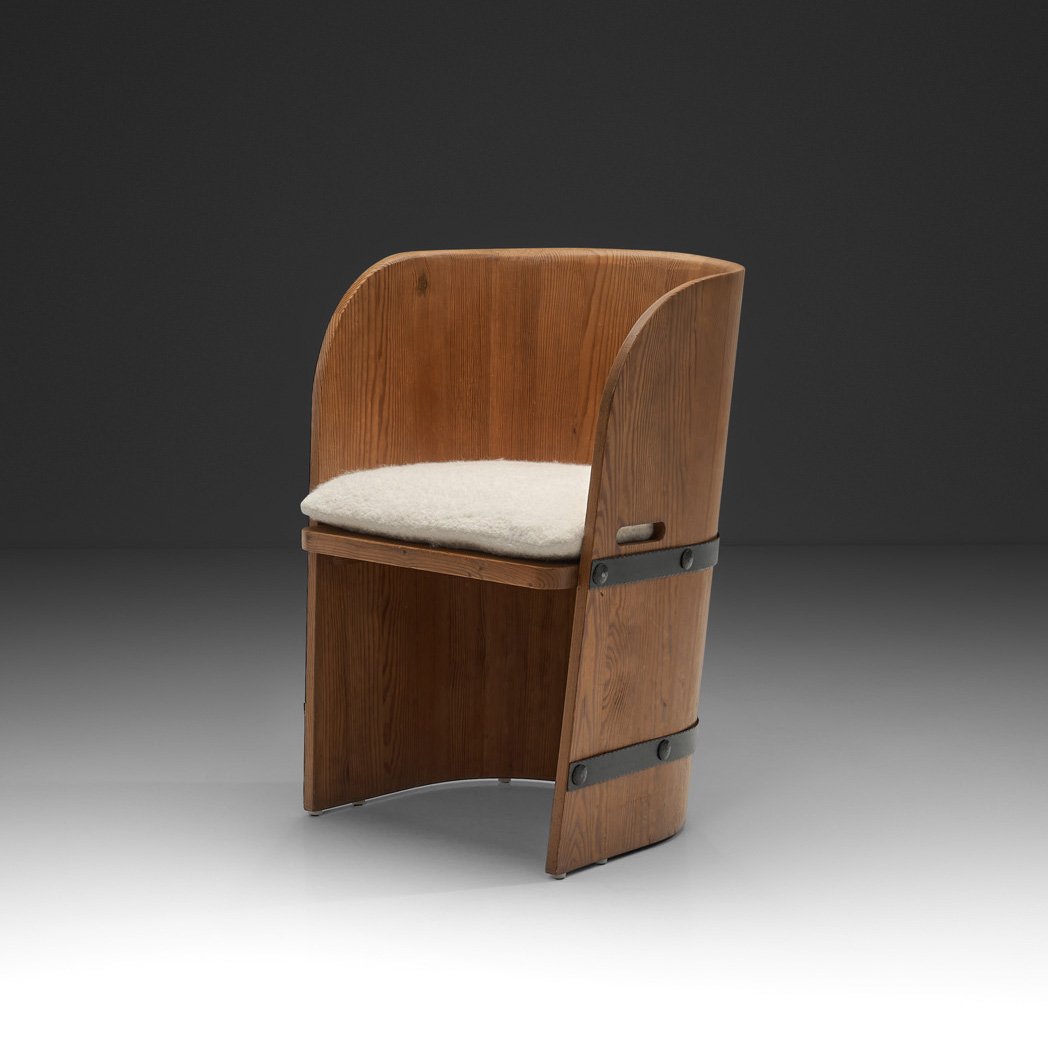
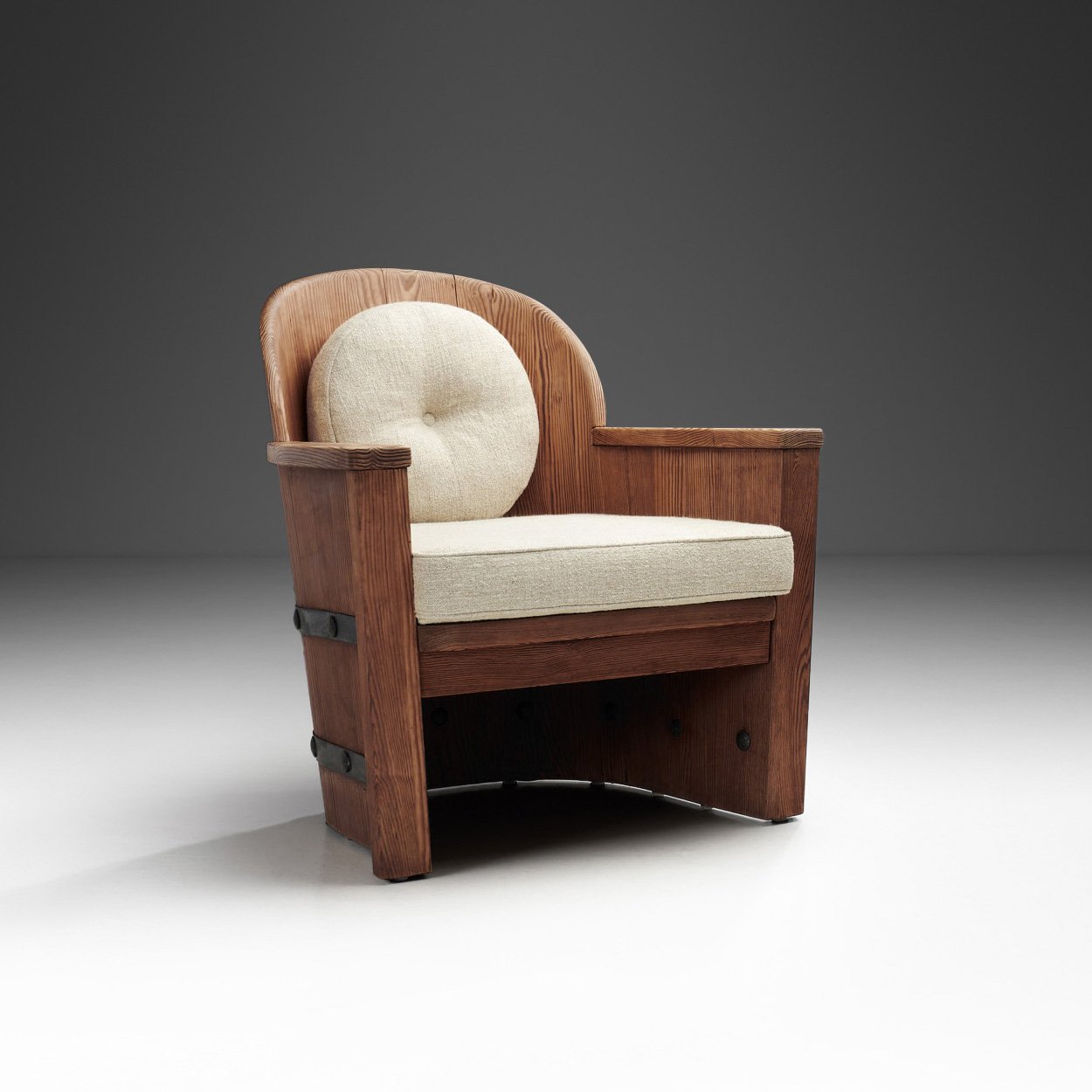
This beautiful barrel armchair is an example of Swedish mid-century design as well as outstanding craftsmanship with a quality that honours the materials and their users. The period from roughly the 1940s through the 1960s was a high point for Scandinavian furniture makers, and this chair shows why.
Åby Möbelfabrik factory was located in Tjureda parish, in Sweden’s Växjö municipality. The company primarily manufactured pine furniture. The chair’s shape and construction show the signs of the master craftsmanship of Åby Möbelfabrik as the robust, barrel-like body has a rounded construction, with the back flowing into the arms to achieve an enveloping, comforting experience for the user. The wood’s grain and pattern is very appealing throughout the design of this chair, which adds an organic touch to the design. This piece displays a beautiful contrast between the light wood frame’s colour and the elegant off-white fabric of the cushions. The upholstery is just as much a decorative element as the wooden structure with the two materials pairing exceptionally well.
Barrel chairs are generally considered among the best accent chair types as their unique shapes immediately draw the eye. Simply styled and elegant had always been mid-century designers’ speciality, and there is no better example than this pair of unique barrel chairs.
Condition:
In good vintage condition. Wear consistent with age and use. The item has recently been reconditioned. Due to age, the item has some dents, scratches, and discolouration. The cushion has recently been reupholstered in a premium fabric. Each of our items can be reupholstered by our in-house atelier in a fabric of choice. Please reach out for more information.
Dimensions:
21.26 in W x 18.70 in D x 30.32 in H; Seat height 18.90 in; Seat depth 17.32 in
54 cm W x 47.5 cm D x 77 cm H; Seat height 48 cm; Seat depth 44 cm
REQUEST PRICE HERE
Price category: 5,000 - 7,500 usd / eur
This chair is a striking example of mid-century Scandinavian design, blending natural materials with industrial elements. The chair features a robust frame constructed from solid pine, which is known for its durability and warm, organic tones. The wood's natural grain is accentuated through a light finish, showcasing the Scandinavian aesthetics' emphasis on simplicity and connection to nature. The combination of pine and iron not only reflects the practical and resourceful design ethos of the 1940s but also demonstrates a harmonious blend of organic and industrial materials, characteristic of Swedish furniture design during this period.
The chair’s shape and construction show the signs of a master cabinetmaker. The beautiful light upholstery, the wooden frame, and the traditional craft of woodworking translate the primordial beauty of nature into this modern piece. The design aims to maximize comfort while putting an emphasis on elegance and function. This is most visible in the round, welcoming body, enhanced by the light fabric of the chair's cushions. The pine slats form a curved backrest, providing ergonomic support and comfort, while the iron components add structural integrity. The armrests feature a beautiful and unique wood grain, further enhancing the natural beauty of the material.
This armchair by Åby Möbelfabrik encapsulates the timeless appeal of Scandinavian design, where form meets function in a way that feels both natural and modern. Its enduring materials and clean lines make it a versatile piece that could easily complement various interiors, from rustic to contemporary. The armchair stands as a testament to the craftsmanship and innovative design principles that defined Swedish furniture making in the mid-20th century.
Condition:
In good vintage condition. Wear consistent with age and use. The chair has been reupholstered recently in a premium fabric. Each of our items can be re-upholstered by our in-house atelier in a fabric of choice. Please reach out for more information.
Dimensions:
28.34 in W x 29.13 in D x 30.31 in H; Seat height 16.53 in
72 cm W x 74 cm D x 77 cm H; Seat height 42 cm
REQUEST PRICE HERE
Price category: 2,500 - 5,000 usd / eur
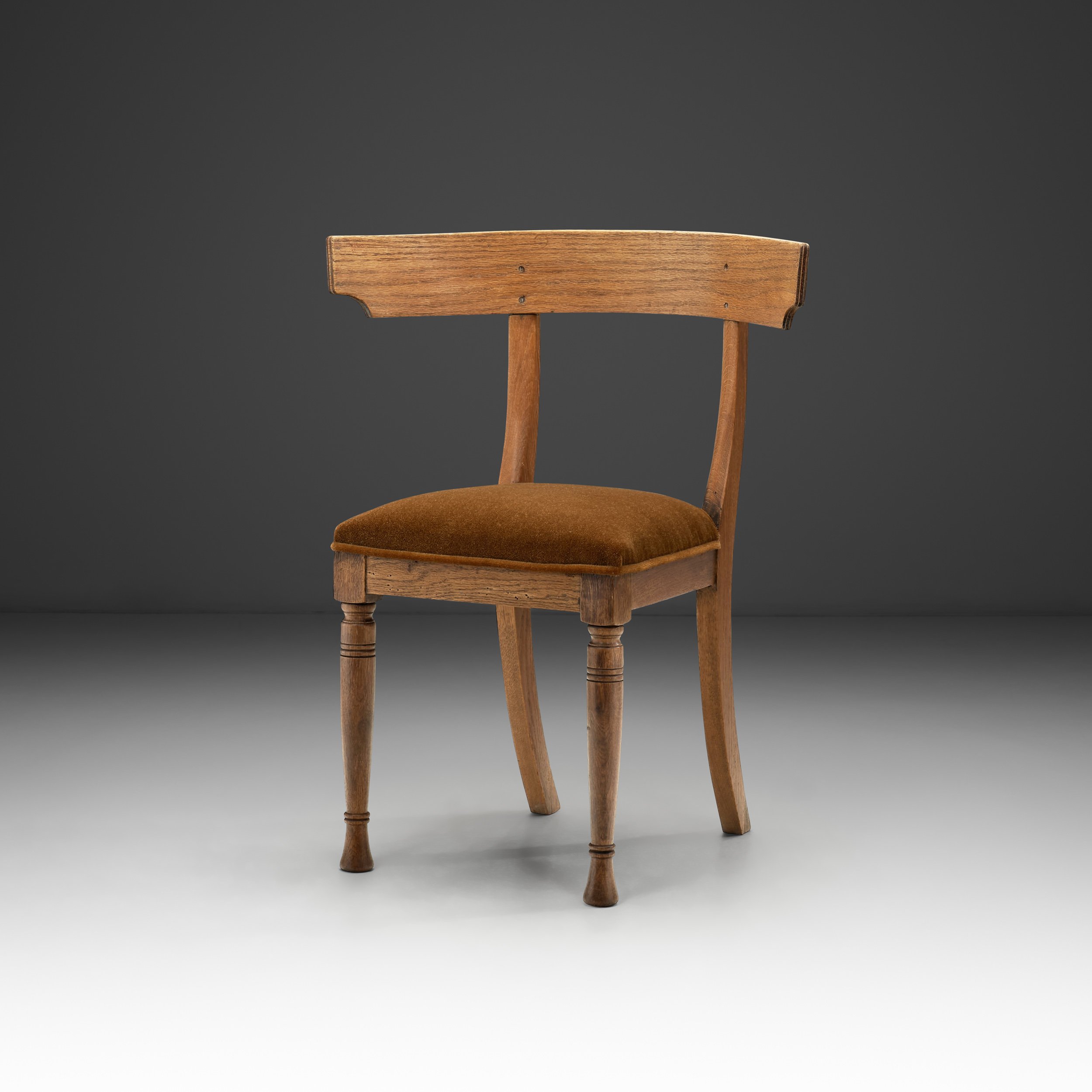
While the Klismos chair model originated in ancient Greece, the style made its way throughout the globe, being revived in several design movements and eras. This particular Klismos-inspired chair is a beautiful reflection of the Nordic interpretation of the ancient Greek form.
This chair model boasts a functional, well-thought-out structure, crafted from quality materials. The openness of the piece is highlighted by the frame, which is quite distinctive; the wide backrest shows an interesting curvature that is characteristic of the Klismos style. The back legs also retain the design’s distinctive stance - splayed and curved. The upholstered seat, designed for comfort, is finished in a warm, earthy fabric that complements the natural wood tones, emphasizing the organic and utilitarian principles of the early 20th-century era. Chairs from this period also often appeared as accent pieces, however, thanks to their blend of neoclassical influences and Scandinavian restraint, they became versatile enough with their timeless appeal to stand out. This chair’s simple yet refined structure allows it to integrate into various interior styles, from vintage-inspired rooms to more contemporary settings, where it adds a touch of old-world charm.
The Danish design idiom was centred on warm woods, quality fabrics, and gentle yet robust support for the spine - qualities that engender contentment and well-being, a defining characteristic of Danish culture. These aspects are evident in this chair, allowing the piece to be extremely modest and confident at the same time.
Condition:
In good vintage condition. Wear consistent with age and use. The chair has been reconditioned. Due to the nature and age of the wood, the frame may have some marks, scratches, and discolouration. The seat has recently been reupholstered in a premium fabric. Each of our items can be reupholstered by our in-house atelier in a fabric of choice. Please reach out for more information.
Dimensions:
28.54 in W x 19.29 in D x 32.87 in H; Seat height 19.68 in; Seat depth 16.33 in
72.5 cm W x 49 cm D x 83.5 cm H; Seat height 50 cm; Seat depth 41.5 cm

REQUEST PRICE HERE
Price category: 2,500 - 5,000 usd / eur
In 1920, the term "Nieuwe Haagse School" was first mentioned by the architect C.J. Blaauw. And not in a positive way. Blaauw thought nothing of the latest developments in modern architecture. "Typical of The Hague" - that was how the designer spoke of the style. The movement blossomed between 1925 and 1940 and brought uniformity to the cityscape. The Hague School style is closely related to the Amsterdam School and the Bauhaus movement, but has more-so been influenced by Art Deco, and it drew a great deal of inspiration from Berlage's rationalism, the Arts and Crafts movement, and De Stijl.
Standing as evidence of the reason many Dutch architects succeeded at the craft of furniture design; the precision of the structure is evident at first glance, showing great geometric order. Driven by function, the maker’s focus was evidently on practicality, structural stability, and a design in favour of these principles. The construction of this chair is traditional and robust - it features a solid yet graceful frame, crafted from a warm, rich wood, which highlights the natural grain of the material. The arms and backrests showcase a sense of airiness. This neat detail accentuates the high level of woodworking and creates an effortless look. The arms’ angles are aligned with the seats and backs’ angles, resulting in a harmonious look while also being ergonomic, with solid support for the spine. The sitting comfort is pleasant, further aided by the stability the sturdy wooden legs provide. The frame is complemented by the elegant rope seat woven tightly in the wood, with the material of the seat giving the piece a warm and cosy feel all while staying very functional. The chair’s simplicity and honest elegance makes it an exceptional piece of furniture.
Haagse School furniture wasn’t flashy but instead focused on being well-made and to fit a warm, comfortable and welcoming home. As this chair exemplifies, blending functionality, good quality natural materials and organic colours with excellent craftsmanship is the key to the success of this design period.
Condition:
In good vintage condition. Wear consistent with age and use. Item may have some marks, scratches, and discolouration.
Dimensions:
22.04 in W x 21.85 in D x 33.66 in H; Seat height 17.12 in; Seat depth 19.48 in; Arm height 26.57 in
56 cm W x 55.5 cm D x 85.5 cm H; Seat height 43.5 cm; Seat depth 49.5 cm; Arm height 67.5 cm
REQUEST PRICE HERE
Price category: 2,500 - 5,000 usd / eur
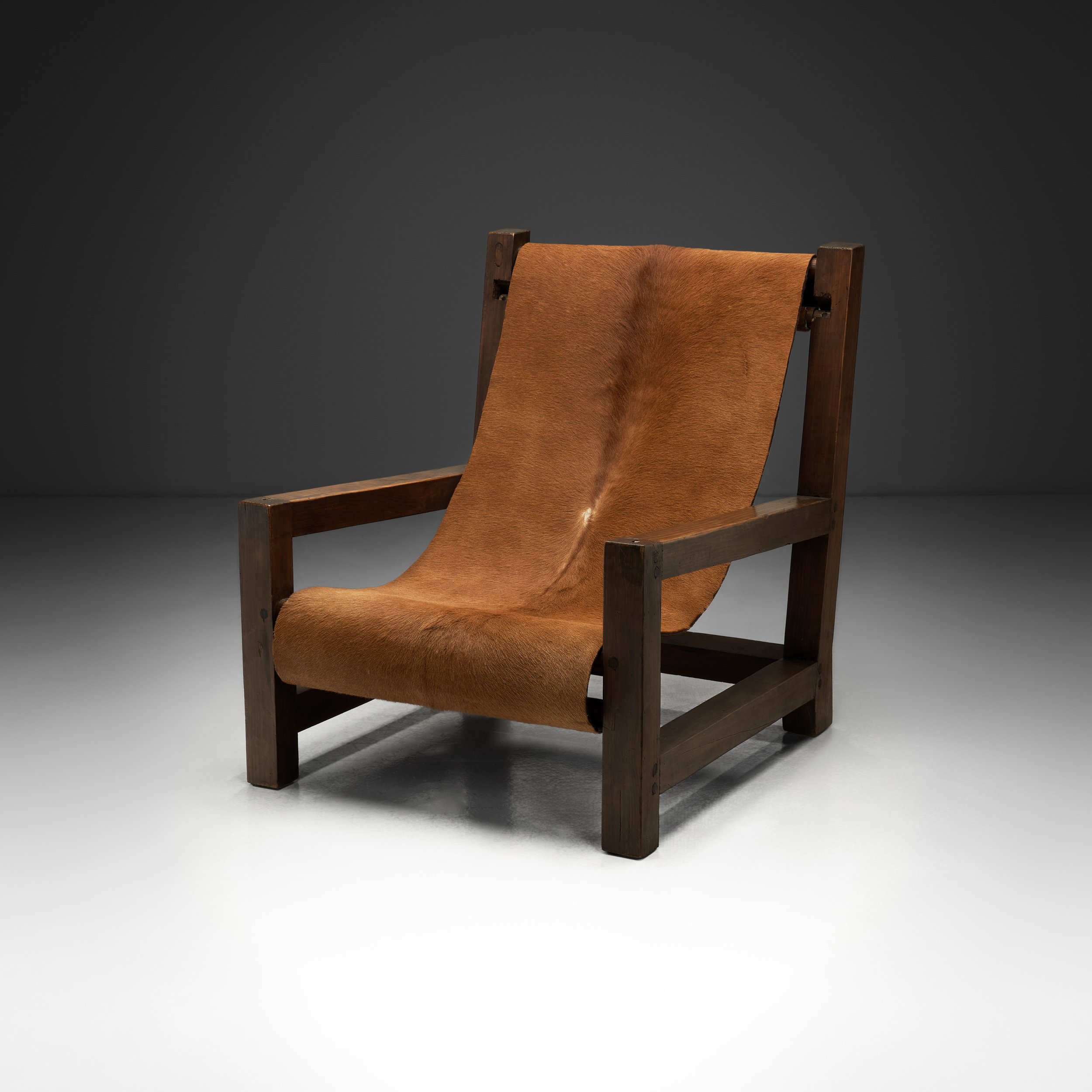
The 1950s saw brilliant designers working to create furniture of the highest quality that explored modern shapes and forms. These designers experimented with new materials and construction methods. This armchair is an example of how successful these experiments were.
This armchair features a simplistic structure and a completely arresting silhouette. The lines are crisp and elegant, aiding the stability, comfort and ergonomic design. The invisible, smooth joinery, the raised seat and the precise pine structure are especially expressive of the mastery of the cabinetmaker. The main visual element however, remains to be the upholstery which slopes down and doubles as the seat and backrest. The brown cowhide is very textural, which stands out against the smoothness of the wood. The use of cowhide is usually reserved for occasional chairs or accent chairs as they raise the aesthetic level significantly. Mid-century modern design, with a golden age during the 1950s, prioritised clean lines, simplicity, and a connection with nature. This chair exemplifies these principles, as the linearity of the wood and the use of cowhide evoke a sense of harmony and balance. The armchair, while exuding elegance, remains remarkably functional.
This piece preserves the value and beauty of master craftsmanship and exquisite materials, and would make a lovely addition to any interior.
Condition:
In good vintage condition. Wear consistent with age and use. The chair comes with its original upholstery or has been reupholstered by a previous owner. Each of our items can be reupholstered by our in-house atelier in a fabric of choice. Please reach out for more information.
Dimensions:
26.97 in W x 32.48 in D x 16.14 in H; Seat height 12.20 in; Seat depth 17.72 in; Arm height 18.11 in
68.5 cm W x 82.5 cm D x 41 cm H; Seat height 31 cm; Seat depth 45 cm; Arm height 46 cm
REQUEST PRICE HERE
Price category: 5,000 - 7,500 usd / eur
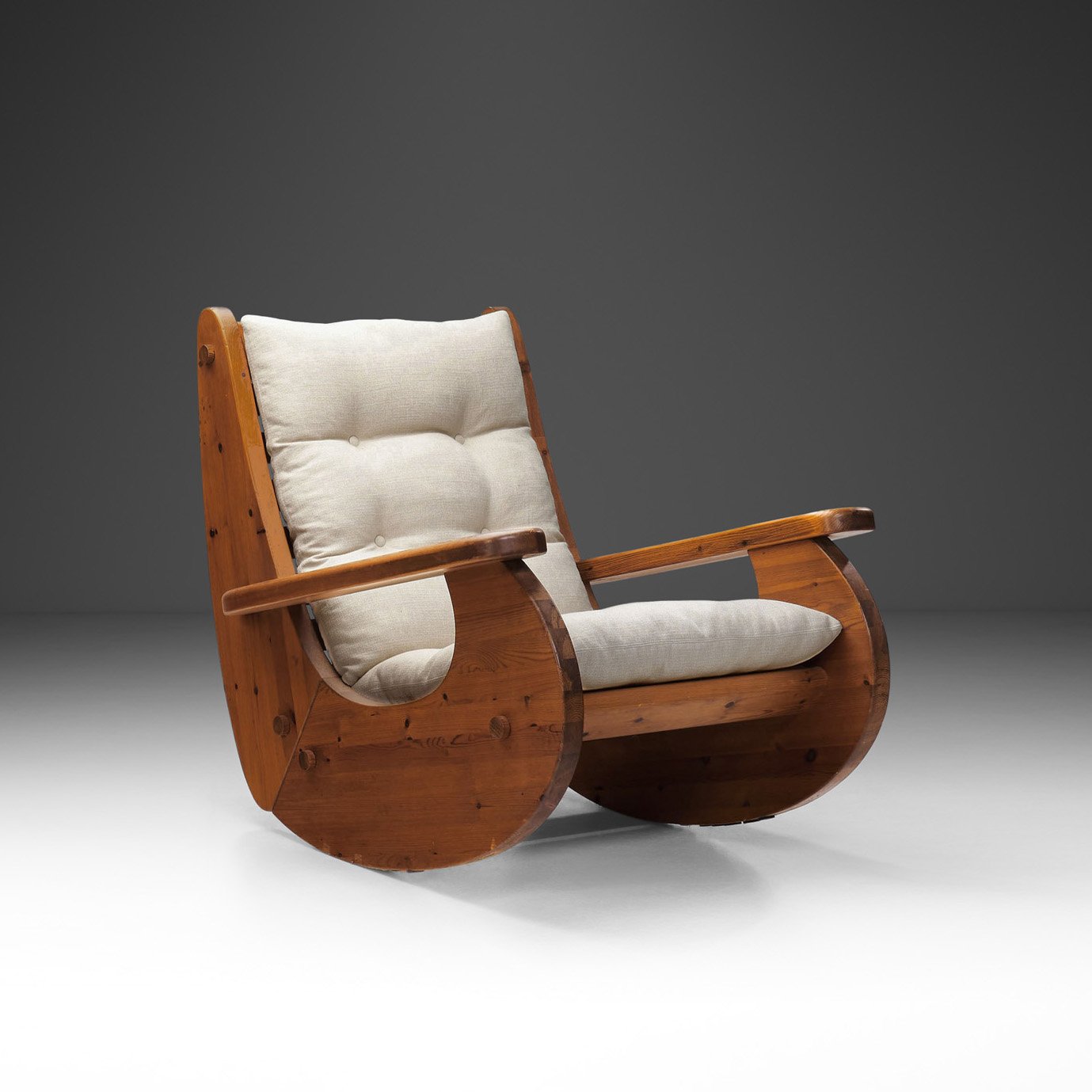
This rocking chair, born from the era's penchant for Brutalist design, manages to strike an intriguing balance between the rugged and the refined. The 1970s marked a distinctive period in design, and the Brutalist movement, characterised by its raw, unapologetic use of materials, left an indelible mark on furniture.
This piece embodies the spirit of Brutalism, boasting a robust pine wood construction that conveys a sense of strength and durability. Yet, in a departure from the harsh edges often associated with Brutalist design, the chair surprises with soft, flowing lines that gently cradle the sitter. The use of pine wood brings its own set of advantages: renowned for its resilience, pine became a canvas for many 20th century designers to showcase the marriage of strength and grace. The natural grain of the wood, visible through a subtle finish, adds depth to the chair, embracing the imperfections that come with time, like a visual memoir of shared moments. The essence of this rocking chair lies not just in the design, but also in the experience it offers. Rocking chairs, with their rhythmic motion, invite contemplation and relaxation. They transform a simple seat into a haven, a place to unwind and reflect. The designer clearly understood the timeless allure of a rocking chair, choosing to augment the utilitarian aspect of seating with an inherent connection to human comfort. The upholstered seat and back cushion provide great comfort, and also a gentle contrast to the starkness of the wood. This cushion, rather than diminishing the Brutalist appearance, accentuates it. Softness meets strength, and the result is a tactile experience that harmonises the senses. The light, textural upholstery, carefully selected for its texture and neutrality, introduces a touch of luxury without compromising the chair's integrity.
This rocking chair stands as a visual illustration of the era's exploration of contradictions. It is both bold and welcoming, robust and refined. This design, pairing of materials, and sheer quality makes it a special accent piece.
Condition:
In good vintage condition. Wear consistent with age and use. The chair has been reupholstered recently in premium linen fabric. Normal patina, including some scratches and marks.
Dimensions:
31.29 in W x 36.81 in D x 35.62 in H; Seat height 16.92 in; Arm height 22.04 in
79.5 cm W x 93.5 cm D x 90.5 cm H; Seat height 43 cm; Arm height 56 cm
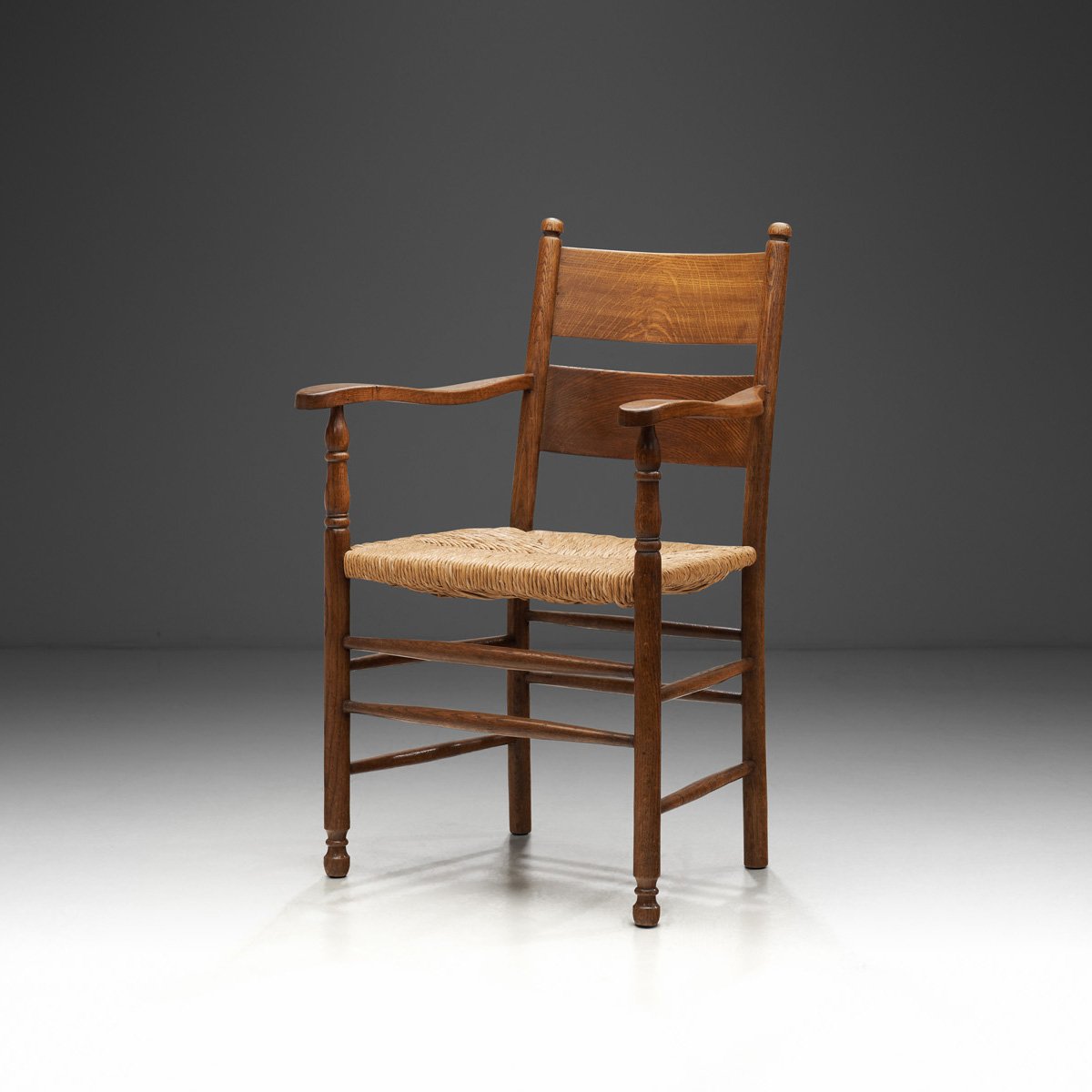
REQUEST PRICE HERE
Price category: 2,500 - 5,000 usd / eur
This rustic armchair embodies the aesthetic, practicality and functional design that was valued in European homes of the early 20th century. Displaying artisanal techniques such as weaving and beautifully carved details, pieces such as this chair showcase the expert craftsmanship of 20th century woodworkers and furniture designers.
This armchair showcases a timeless blend of simplicity and craftsmanship. Constructed from solid oak, the chair features a sturdy frame with a warm, natural finish that highlights the wood's grain and durability. Oak was the favoured material in this period for its resilience and beautiful grain pattern, thus increasing the visual depth of the chair. The seat is made of tightly woven rush, which adds beautiful texture and a traditional look, while still maintaining comfort through its natural flexibility. By being entirely constructed from natural materials, this piece maintains its classic charm typical of early 20th century furniture, while adding versatility through its unpretentious, organic character. The armrests feature a subtle curve, providing ergonomic support, highlighting the chair's understated elegance. Two wooden stretchers are positioned between each pair of legs, creating symmetry within the design. These additions go beyond their aesthetic purpose - not only do they complete the design but they also reinforce the structure, lending it additional stability.
This armchair showcases the inherent beauty of natural materials, as well as the simple honesty of 20th century design. Its balanced proportions and natural materials make it an indisputably valuable piece, equally suited for a cozy kitchen or a modern rustic interior.
Condition:
In good vintage condition. Wear consistent with age and use.
Dimensions:
23.22 in W x 23.62 in D x 37 in H; Seat height 15.94 in; Seat depth 16.53 in; Arm height 27.95 in
59 cm W x 60 cm D x 94 cm H; Seat height 40.5 cm; Seat depth 42 cm; Arm height 71 cm
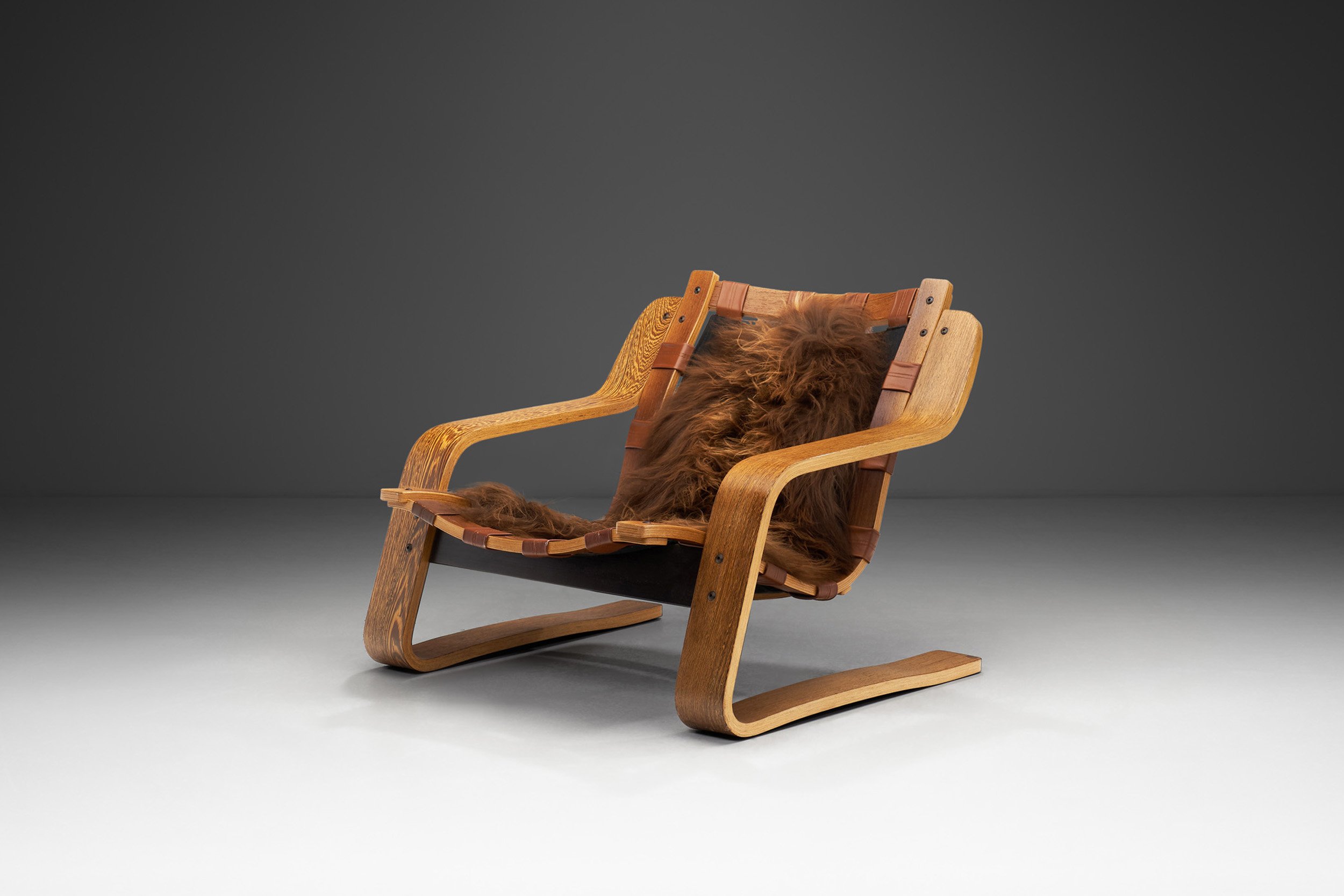
REQUEST PRICE HERE
Price category: 2,500 - 5,000 usd / eur
The 1970s witnessed the emergence of eccentric furniture pieces that seamlessly blended the avant-garde with practicality. Crafted in the Netherlands, this distinctive lounge chair bears the mark of Dutch ingenuity and artistry, reflecting an era where experimentation in design was the norm. What set this chair apart was not just its striking appearance but the innovative use of Zebrano plywood.
The so-called “Zebrano” wood -derived from tropical trees in America, Asia, and Africa, yielding striped hardwood used in cabinetwork - is known for its distinctive dark stripes reminiscent of a zebra's markings, hence the name. In this chair, the zebrano plywood structure takes centre stage, recalling designers Ingmar Relling from Norway because of the wood, and the bentwood designs of Alvar Aalto. Showcasing the wood's natural beauty and unique patterns, the chair's use of Zebrano plywood not only enhances its aesthetic appeal but also speaks volumes of the craftsmanship inherent in Dutch design of the era. Plywood, a versatile material, played a pivotal role in the creation of this extraordinary lounge chair. Unlike solid wood, plywood is composed of layers of wood veneer bonded together, making it sturdy and flexible. This flexibility allows for the creation of sculptural, bent wood shapes, which is also the main visual hallmark of this chair's design. The cantilevered structure, with visible screws holding the distinct pieces together, showcases the prowess of Dutch craftsmanship and design. The ingenuity of the Dutch designer is evident in the chair's cantilever design. The back and seat are supported only by the front legs, creating an elegant curve that defies not just traditional expectations but, seemingly, also gravity. The use of plywood allows for this daring structure, showcasing the designer's willingness to push the boundaries of conventional furniture shapes and forms. What truly sets this lounge chair apart is without a doubt is its plywood frame, however the seat also deserves attention: carefully stretched between the sides of the back frame via faux leather straps, the canvas seat assures great ergonomic comfort. Additionally, the brown sheepskin throw is a small, but important visual addition that softens the overall impression. This cosy addition not only enhances the chair's visual appeal but also contributes to its visual and practical comfort. The deliberate visibility of screws adds an industrial touch, embracing the raw aesthetic that contrasts nicely with the organic zebrano wood and fabric.
In essence, this Dutch-made cantilever lounge chair from the 1970s is in many ways a testament to the era's spirit of exploration and innovation. It showcases the marriage of unconventional materials like Zebrano plywood with groundbreaking design, leaving an indelible mark on the landscape of furniture craftsmanship. The chair also exemplifies the era's commitment to pushing boundaries, making it a rare and individual example of Dutch design brilliance.
Condition:
In good vintage condition. Wear consistent with age and use. The chair’s brown sheepskin throw is newly produced. Each of our items can be re-upholstered by our in-house atelier in a fabric of choice. Please reach out for more information.
Dimensions:
31.88 in W x 34.44 in D x 26.57 in H; Seat height 11.22 in; Arm height 16.92 in
81 cm W x 87.5 cm D x 67.5 cm H); Seat height 28.5 cm; Arm height 43 cm

REQUEST PRICE HERE
Price category: 2,500 - 5,000 usd / eur
Carl Malmsten is one of Sweden's most famous furniture designers. Many of his furniture are considered modern design classics. His present 'Stugan' (Cottage or Cabin in Swedish) armchair was designed by Malmsten for OH Sjögrens Stoppmöbler in Tranås, Sweden. This cosy model demonstrates Carl Malmsten’s fine sense of proportion, line tension and balance between the surfaces, and how skilfully he carried in the heritage of traditional allmoge (folk art) design.
This Stugan chair is – design-wise- in the vein of Swedish modernism, with simplicity and functionality, while also showcasing the subtle details and quality Malmsten is known and appreciated for. Even though Swedish design is generally democratic and meant for the masses, pieces were not stripped of all beauty in order to make them as easy to use as possible. The importance of this balance can be identified in the design and execution of this armchair as well: The wooden spindles comprising the back are the most apparent visual feature of the chairs, while the more subtle details, such as the upholstered seat and back cushions, make this model interesting. The design of this chair shows great balance of lines and utilization of the natural beauty of the pinewood. The solid pine structure is a frame for the cushions, both in a literal and figurative way. The light patterned bouclé fabric is beautifully framed by the chair’s frame, highlighting the captivating texture of both materials. The back and removable seat cushion are quite rotund; therefore, the sitting comfort is great. During his career, Malmsten collaborated with several architects, such as Ragnar Östberg, Ivar Tengbom, and Ferdinand Boberg. He designed furniture for Stockholm's concert hall and Ulriksdal castle. He participated in the now iconic hosing exhibition at Liljevalchs gallery in 1917, where the term "Beautiful everyday goods" was coined. Still, the producer of most of his upholstered pieces was O.H. Sjögren in Tranås, Sweden.
This “Cottage” armchair is an elegant and comfortable evidence of the mastery and artistry of the Swedish cabinetmakers who defined mid-20th century modern seating. O. H. Sjögren was one of these renowned workshops, materializing a great deal of Carl Malmsten’s most brilliant upholstered designs. This chair is of the highest quality, both in terms of materials and craftsmanship. Its name is mirrored in its construction and cosy aesthetic quality, offering the same level of comfort and sense of wellbeing and comfort as the Swedish cottages that also inspired Axel Einar Hjorth’s collectible pinewood pieces.
Condition:
In good vintage condition. Wear consistent with age and use. The chair has been reupholstered recently in premium patterned bouclé fabric.
Dimensions:
6.18 in W x 32.28 in D x 31.49 in H; Seat height 15.74 in; Arm height 23.22 in
66.5 cm W x 82 cm D x 80 cm H; Seat height 40 cm; Arm height 59 cm
About the designer:
Carl Malmsten (December 7, 1888 – August 13, 1972) was a Swedish furniture designer, architect, and educator. Malmsten was born in Stockholm, Sweden. Malmsten's career took off when he won a competition in 1916 to design furniture for the Stockholm City Hall and shortly after in 1917, he exhibited alongside well-known Swedish architects such as Gunnar Asplund and Uno Åhrén.
In the 1920s he was invited to furnish a room for the crown prince, Gustaf VI Adolf, and his wife Louise in Ulriksdal Palace. He was honoured with an inaugural Prince Eugen Medal for design in 1945. Already as a young designer in the early 20th century, Carl Malmsten advocated an artisanal furniture design based on local ingredients and traditions, available to a wide audience at a reasonable price.
Nature was Carl Malmsten's foremost teacher and source of inspiration. He conveyed his love of craftsmanship as a teacher in his own schools, at Olofskolan in Stockholm, Capellagården on Öland and the Carl Malmsten school on Lidingö, today a branch of Linköping University and one of the country's leading design colleges. As a debater, Malmsten stormed against functionalism, but in retrospect it can be seen that his ideas often coincided with the rational and frugal style ideals of function.
Malmsten has had a lasting influence on Swedish furniture design through the two schools he founded—the Carl Malmsten Furniture Studies (Carl Malmstensskolan), which has been a part of Linköping University since 2000, is situated on the island of Lidingö on the outskirts of Stockholm. Carl Malmsten spoke about the importance of tradition, craftsmanship and the nation. His furniture was in many ways a product of the thoughts and ideals of the time, they have a timeless quality that makes them just as relevant and loved today. ~H.
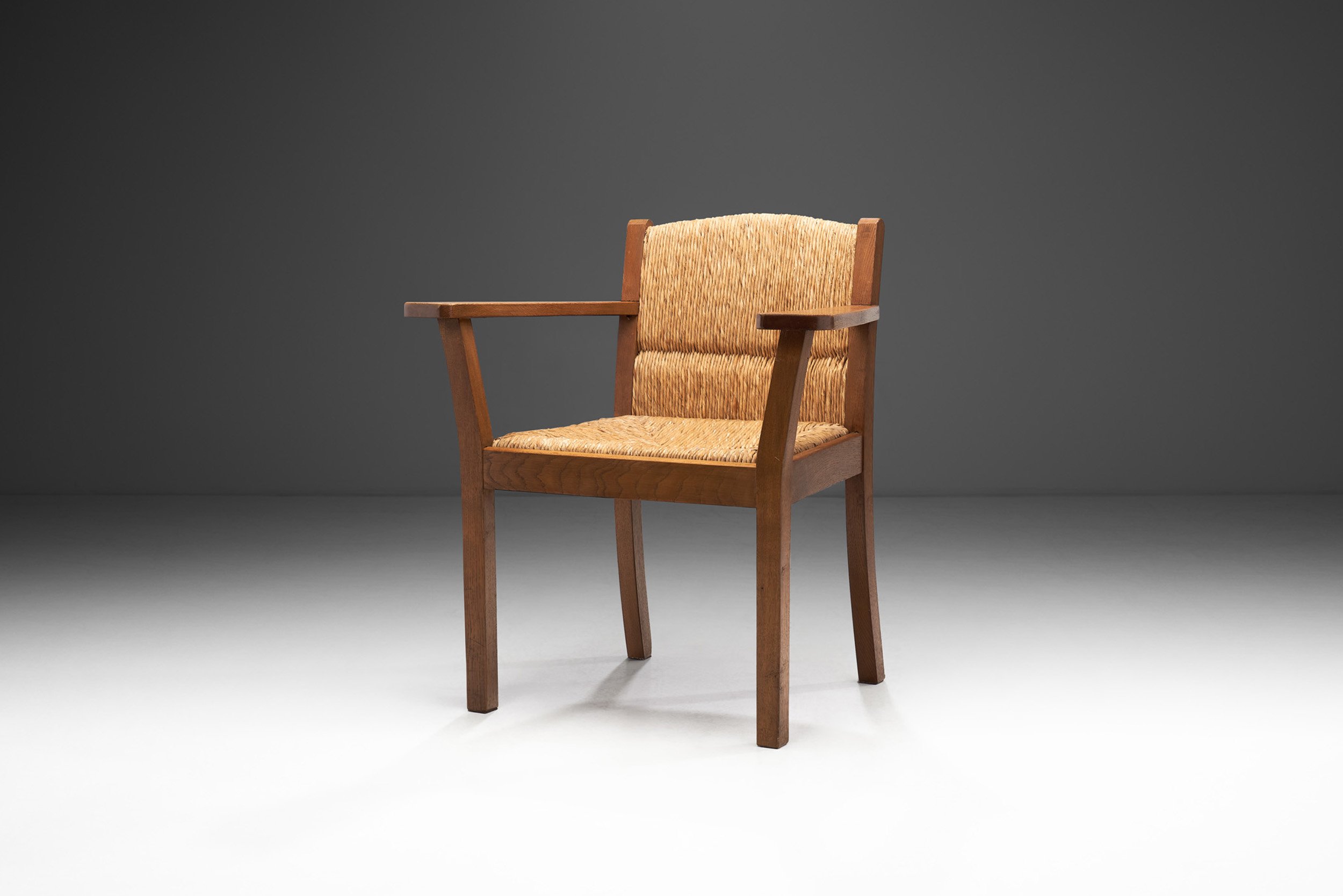
REQUEST PRICE HERE
Price category: 2,500 - 5,000 usd / eur
This beautiful 'Worpsweder' armchair was designed in the 1920s by German artist, Willi Ohler and was manufactured by Erich Schultz in Germany. The so-called “Worpsweder” either denote chairs made at the Worpsweder Kunsthütten (Worpsweder arts huts) in Germany, or a specific style of German chairs with solid wood frames, broad armrests, often from tall wood, with woven seats and backs.
The “Worpsweather” style’s design language and materiality is embodied in this pair: the structures are made up of solid oak elements. The seats and backs are woven braided from rush. This chair carries with it the same beloved modernist characteristics applied to American, Scandinavian, and Italian mid-century design – simple, functional – and shows the generally less known early 20th century rustic side of German design. The woven rush seat and back define the armchair’s aesthetic. The straight wooden lines of the minimalist wooden frame serve as the perfect canvas to showcase the appealing and artistic rush weaving. The structure has an airy impression despite being sturdy that is further enhanced by the absence of stretchers between the legs. With the additional organic charm provided by the woven rush seats, this chair is an ideal accent piece. The expert rush weaving pairs beautifully with the solid wood body, and gives this Worpsweder chair its rustic and organic charm.
Worpswede in Lower Saxony is famous nationwide for its long tradition as an artists' colony. Nowadays, about 130 artists and craftsmen and women live there permanently. The artists who created the so called "Worpsweder Kuentlerkolonie" were looking for the simple and original in art and life. One of the most famous members of this colony was Paula Modersohn-Becker. The traditional reed and rush woven chairs of this region were greatly appreciated by the artists of the colony, and some of them were still produced around 1900-1920. They have become collectors’ pieces thanks to the craftsmanship that went into each chair’s creation.
Condition:
In very good vintage condition. Wear consistent with age and use. Some marks and scratches on the wood and rush panels.
Dimensions:
30.51 in W x 25 in D x 32.87 in H; Seat height 18.5 in; Arm height 27.17 in
77.5 cm W x 63.5 cm D x 83.5 cm H; Seat height 47 cm; Arm height 69 cm
REQUEST PRICE HERE
Price category: 2,500 - 5,000 usd / eur
Bas van Pelt was one of the key figures in early Dutch modernist design, active during the 1930s and 1940s through his firm “My Home.” His work is recognised for its clarity of construction, careful proportions, and thoughtful integration of natural materials. Van Pelt focused on creating furniture that balanced function and craftsmanship, often incorporating elements such as wicker, rattan, and solid wood to introduce both durability and texture.
This high-back chair by Bas van Pelt combines of strong verticality and refined material contrast. The solid wooden frame establishes a clear architectural outline, with the elongated tall back defining the silhouette. The back is composed by ladder-like horizontal slats that introduce a sense of rhythm while maintaining the openness of the design. The seat is crafted from woven wicker, a material valued for its strength and breathability, which adds a tactile, organic quality to the otherwise linear construction. This contrast between the smoothness of the frame and the texture of the woven surface is central to the chair’s character. The armrests are gently shaped, introducing a subtle curvature that softens the overall form. Below, the legs are connected by stretchers that reinforce the structure and ensure stability. The craftsmanship is evident in the precision of the joinery which contribute to the overall sense of durability and refinement.
This armchair shows why Bas van Pelt is widely regarded as a Dutch design icon. From the handcrafted frame to the beautiful woven element, the chair remains of hifh quality and ideally suited for everyday use.
Condition:
In good vintage condition. Wear consistent with age and use. The chair has recently been reconditioned. Some chips and dents are present. Due to the nature and age of the materials, the item may have some marks, scratches, and discolouration.
Dimensions:
25.20 in W x 28.35 in D x 40.95 in H; Seat height 13.39 in; Seat depth 20.08 in; Arm height 23.82 in
64 cm W x 72 cm D x 104 cm H; Seat height 34 cm; Seat depth 51 cm; Arm height 60.5 cm