

PAN AMSTERDAM
14 - 21 November 2021
We are delighted to announce our participation in PAN Amsterdam 2021, Amsterdam’s leading fair in art, antiques and design. The fair will take place from 14 to 21 November at RAI Amsterdam. You’ll find us at booth ‘Walls and Cabinet’ - F.
At PAN Amsterdam 2021, we’ll present an overview selection of the gallery.
HIGHLIGHTS

This “Rokato” lounge chair is an immediately recognizable design by the Dutch designers, Gebroeders Jonkers (Jonkers Brothers). In the middle of the last century, rattan played an important role in Dutch Design. The cradle was located in Noordwolde in Friesland, where the factory, Gebr. Jonkers, specialized in wickerwork. This model is uniquely both designed and manufactured by the company.
Gebroeders Jonkers are known for their stunning rattan designs and this low chair shows why. The shell seat is formed by one, elaborately woven rattan piece. The organic material and symmetrical pattern of the seat are combined with, and contrasted by the wooden base with a structural look. The base consists of crossed bars that hold the seat. The geometrical and clean lines of this chair make it a beautiful example of Dutch mid-century modern design, that was, among others, inspired by its Scandinavian contemporaries.
Adding to the softness are the seat and back cushions that have been reupholstered recently in a premium fabric. Characterized by the expressiveness of the material, the clear and honest construction, with a clear distinction between seat and frame, this Rokato chair is a unique design piece, and a visual reminder of the design prowess of the Dutch brothers, Jacob and Johan Jonkers.
SOLD
Condition:
In good vintage condition. The chair has been reupholstered recently in a premium fabric.
Dimensions:
27.55 in W x 33.85 in D x 25.59 in H; Seat height 12.20 in
70 cm W x 86 cm D x 65 cm H; Seat height 31 cm
About the designer:
Rattan furniture enjoys the renewed attention of stylists and interior designers. Rattan is being embraced again in the 21st century. The most beautiful Dutch rattan furniture from the fifties to the seventies were created by Jacob and Johan Jonkers, better known as the brothers Jonkers in Noordwolde. The brothers had furniture factories that collaborated with nationally and internationally recognized designers.
In the middle of the last century, rattan played an important role in Dutch Design. The cradle is located in Noordwolde in Friesland, where two factories, Rohé and Gebr. Jonkers, specialized in wickerwork. The rattan came from Indonesia and replaced the originally used willow, which is much less tough and pliable. The airy and sleek rattan furniture fit perfectly in the functionalist style of the “Goed Wonen” (lit. good living) period. Both furniture producers worked with both Danish and Dutch designers, including one of the most famous Dutch designers, Dirk van Sliedregt. In the 1970s, Gebr. Jonkers found themselves in a tough situation, as the crisis hit and furniture trade also collapsed. The supply of rattan was also discontinued because of the protective measures that Indonesia took at the time to protect its own industry. Gebr. Jonkers had to stop their production in the 1980s, soon followed by Rohé, closing its doors in 1997.
The rattan industry’s history in the Netherlands is intertwined with that of the manufactory of Gebr. Jonkers in Noordwolde. Their woven chairs and elaborate supporting structures made them famous in- an outside of the Netherlands. ~H.
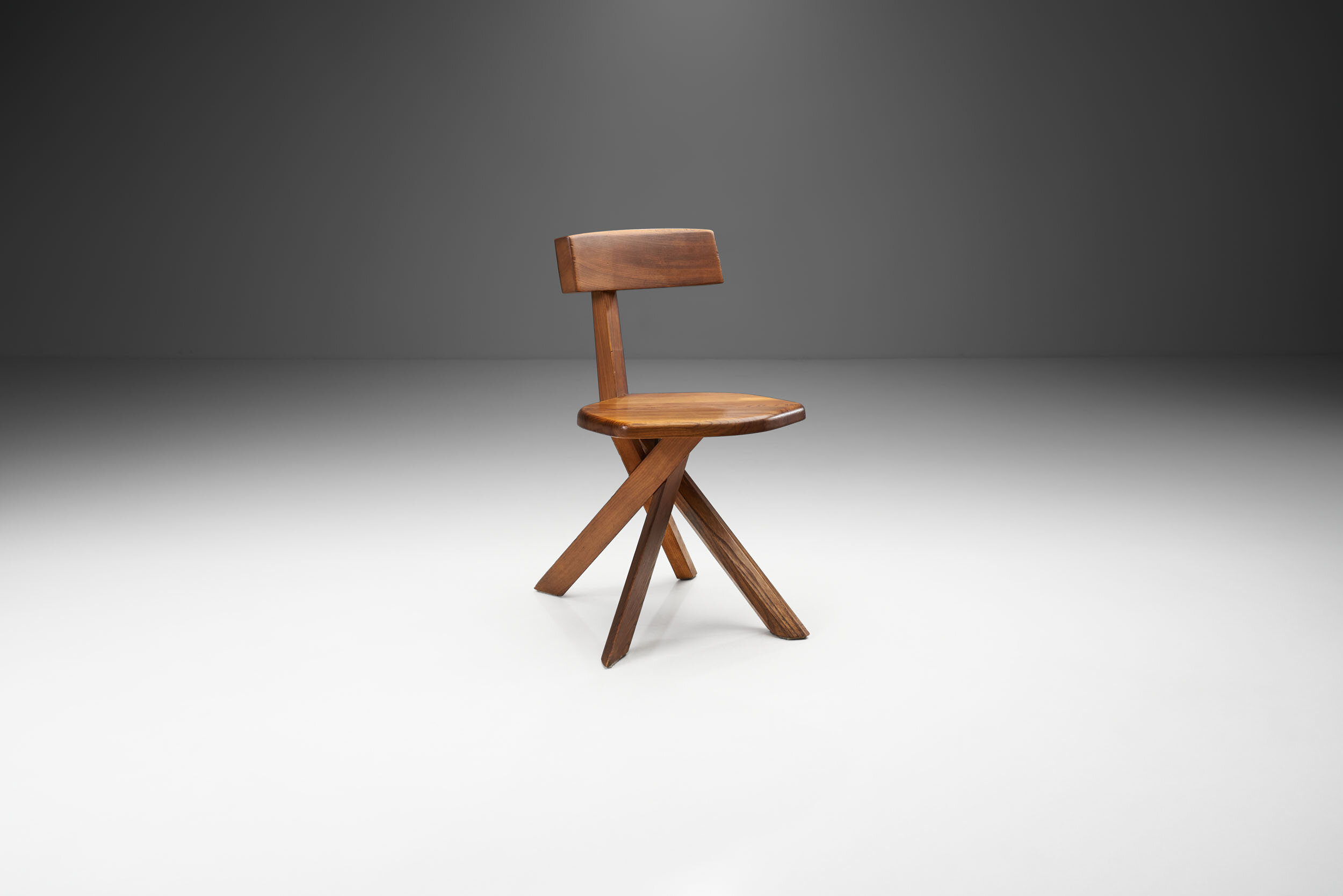
Dining room chair “S34” has the playful and majestic characteristics typical of Pierre Chapo's emblematic creations. Asymmetrical, yet perfectly balanced, this model belongs with the designer’s famous “Sfax” table.
The cross-legged base corresponds to the design of the backrest, which is slightly offset from the middle. Made from Chapo's favourite wood, elm, this chair has a rustic style with architectural precision, which comes as no surprise, as Pierre Chapo trained as an architect in Paris. The slightly more rounded edges show that this chair is an older, authentic version of the “S34” model. The cross-legged base matches the back that is slightly placed out of the middle, enhancing the masterful asymmetry that defines the design. The overall look is very sleek, and combined with details like the visible joinery and the solid wooden structure, this chair’s perfectly imperfect, which is a conscious, Chapo-esque ideal.
Chapo's work originated by means of special commissions that could later be adapted to universal needs. Chapo was inspired by Frank Lloyd Wright's balanced lines, Corbusier's research on proportions and Bauhaus. The three principles that motivated Pierre Chapo were material, form, and function. He measured his furniture by means of golden ratio and used elm wood as his preferred material. This chair is a beautiful example of his ideals in a material form.
SOLD
Condition:
In good vintage condition. Wear consistent with age and use. Small scratches and marks on the wood.
Dimensions:
15.74 in W x 21.65 in D x 29.33 in H; Seat height 16.14 in
40 cm W x 55 cm D x 74.5 cm H; Seat height 41 cm
About the designer:
Pierre Chapo, born in Paris in July 1927, was initially interested in becoming a professional painter. However, after a chance meeting with a shipbuilder who introduced him to wood and wood crafts, Chapo changed his focus and decided to study architectural studies at the prestigious École Nationale Supérieure des Beaux-Arts in Paris.
After graduation, Chapo and his wife, the sculptor and painter Nicole Lormier, started to travel extensively through Scandinavia and Central America. Among the many places the couple visited was the home and studio of Frank Lloyd Wright in Taliesin West. A visit that had a lasting influence on Chapo’s future work and designs. Read more about Pierre Chapo. ~H.
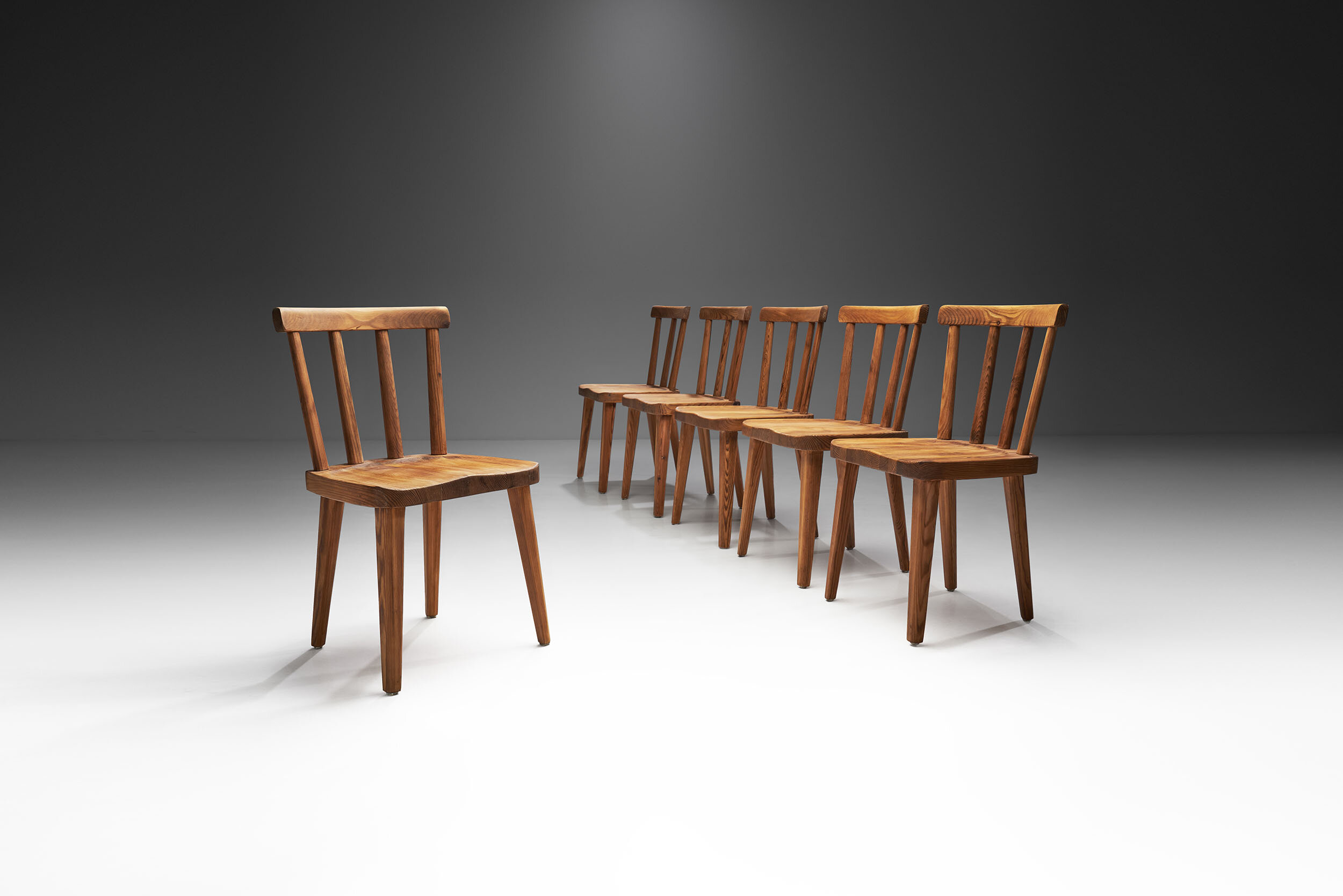
Swedish architect and furniture designer Axel Einar Hjorth served as the lead designer for Sweden’s Nordiska Kompaniet department store from 1926 to 1938. During this time, Hjorth designed the “Sportstugemöbler” series, (which translates to “sports cabin furnishings”) a collection of wooden furniture designed for country homes. The various models in the sportstugemöbler series took their names from the Stockholm archipelago – including Blidö, Lovö, and famously, Utö.
These Utö chairs were designed in 1932 as part of the collection. Unlike the department store's interiors for floors and villas in the cities, the Utö designs had a simple character with robust and simple basic shapes in solid pine. Accordingly, the design of these chairs focuses on simple lines and the material itself. Made of pine wood, these chairs are strong, reflecting Hjorth’s principles, according to which he mixed the ideals of the modernist movement with provincial Swedish traditions, producing a unique and primitive modernism. As a result, the design of this set of six has a completely unique and headstrong primitive modernism. Each chair demonstrates a conscious construction aesthetic, where the joinery and fittings related to traditional craftsmanship are emphasized. Dominated by rounded, straight lines, the chairs have spindle backrests and ergonomically carved seats. The design eludes harmony and stability, fitting the government’s summer cabin concept perfectly.
Hjorth's aesthetic alludes to both the traditional simplicity of the common people and the radical aesthetics of international modernism. The ‘sports cottage furniture’ that these dining chairs are part of, also had an influence on the designer’s contemporaries and inspired Carl Malmsten among others. In an international perspective, Hjorth's sportstugemöbler series is the forerunner of later pioneering designers such as Charlotte Perriand. It is no surprise that these Utö chairs became part of Swedish and international modernist design history. In their time, the pieces of the Utö collection may have appeared as pioneering and radical, but today they are viewed as status symbols in interiors of international character.
SOLD
Condition:
In good vintage condition. Wear consistent with age and use. Minor scratches and marks on the wood.
Dimensions:
18.11 in W x 16.92 in D x 31.49 in H; Seat height 16.92 in
46 cm W x 43 cm D x 80 cm H; Seat height 43 cm
Literature:
Christian Bjork, Thomas Ekstrom and Eric Ericson, 'Axel Einar Hjorth: Mobelarkitekt', Stockholm, 2009, p.130
About the designer:
Axel Einar Hjorth was born in a small Swedish village named Krokek, just outside Norrköping, on March 7, 1888. At the age of 20, he moved to Stockholm to study architecture and design at the Högre Konstindustriella Skolan.
Although he never graduated, in the 1920s Hjorth started working as a furniture designer for various manufacturers, such as H. Joop & Co., Myrestedt & Stern, Jonssons, and Nordiska Kompaniet. Hjorth’s designs from this period had neoclassical features combined with Swedish Grace. This romantic national style of Sweden was elegant and refined, yet simple. The anniversary exhibition of 1923 in Gothenburg marked the breakthrough of Swedish decorative arts, and made Axel Einar Hjorth a well-respected artist. From October 1926, Hjorth became the chief designer and architect of Nordiska Kompaniet department store in Stockholm. In the 1930s, Hjorth designed a furniture collection out of pine meant for serial production known as Sportstugemöbler (furniture for holiday houses).
Hjorth’s designs, from the luxury of neoclassicism to the severity of functionalism, are sharply distinctive in style, materials, and character. Unlike many of his contemporaries, Hjorth did not conform to the socially oriented ideas produced by Svensk Form (the Swedish Society of Crafts and Design). He played a significant role in the development of Swedish society as a whole, and particularly in Swedish industrial art
Today Hjorth is often viewed as a precursor to the modern designs popularized by Charlotte Perriand, Jean Royére, Pierre Chapo, or Josef Frank. Recently, there has been a revival of appreciation for his work, showing his genius in a new light. ~H.
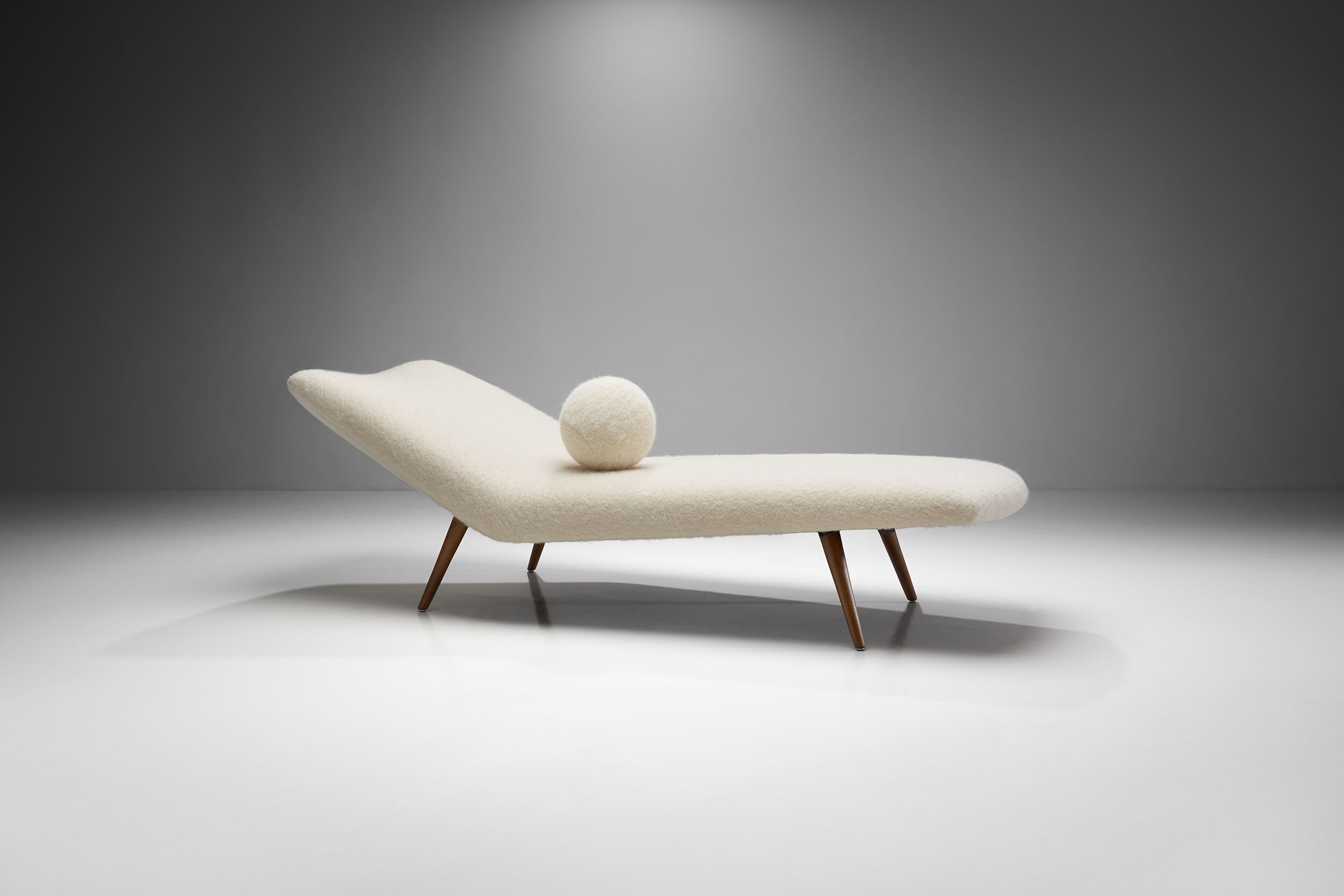
This eye-catching daybed was designed by Theo Ruth in 1947 and manufactured in a limited series. The keywords around this model are quality, comfort and understated elegance.
The slender, slightly conical wooden legs are made from patinated beech. The legs balance out the body well, creating a light look. The elegant shape is formed by the raised back and the round, soft edges. This daybed is an exceptional piece of Dutch design that was exclusively produced by Eugen Schmidt Soloform (later Eugen Schmidt GmbH in Darmstadt) and Artifort. While many daybeds have been “inspired” by Ruth’s present design, this original model remains very limited in numbers.
This daybed has been reupholstered in a premium alpaca-wool blend fabric, which guarantees outstanding comfort and softness. The light colour of the upholstery brings out the beautiful shade and grain of the beech legs.
SOLD
Condition:
In very good vintage condition. Wear consistent with age and use. Decorative pillow included. The item has recently been reupholstered in a premium alpaca wool blend fabric. Each of our items can be re-upholstered by our in-house atelier in a fabric of choice. Please reach out for more information.
Dimensions:
32.67 in W x 77.16 in D x 24.80 in H; Seat height 14.56 in
83 cm W x 196 cm D x 63 cm H; Seat height 37 cm
About the Designer:
Dutch designer Theo Ruth was born in 1915 in Maastricht. He trained as a furniture designer and interior designer at the Middelbare Kunstnijverheidsschool in Maastricht (which later became the Maastricht Academy of Arts). In 1936, he joined Artifort in Maastricht, where he specialized in designing living room furniture. Just three years later, in 1939, he became head of design and development, a position he maintained until his death in 1971.
Ruth was Artifort’s first permanent designer, and had a major impact on its design legacy. His most famous pieces include the 1952 Congo Chair and the 1953 Penguin Chair, both of which were constructed from two interlocking pieces that fit together without locks or screws (the latter’s original version featured a black back and a white cushion to mimic its namesake). Theo Ruth’s designs are famous around the world as highlights of Dutch design. ~H.

This “Reversivel” (Reversible) chair is without a doubt a Brazilian design icon. It is considered to be one of the most emblematic armchairs of Brazilian Modern Design. Martin Eisler designed this sculptural armchair in 1955.
The uniqueness of this armchair lies in several qualities, including the form itself, which is architectural and geometric. The use of the tubular metal is characteristic of the two designers, which is perhaps most evident in this model. At the same time, - despite structure and material - Eisler also paid careful attention to the user experience. The vanguard value of the design is clearly visible in the big moving seat rest in an iron frame structure that combines visual lightness and stability, complemented by the little brass feet that are minimally touching the ground.
This chair can be adjusted by lifting the curved seat and placing it in the desired position and angle on its conforming base. The “Reversivel” bears witness to the soft, sensuality of Brazilian mid-century design, a combination of tradition and creativity, folk craft and visionary innovation. The reupholstered body in a premium bouclé fabric further heightens the unique, masterful design of the frame. The one of a kind upholstery’s fabric is by the world famous French atelier, Toyine Sellers.
SOLD
Condition:
In good vintage condition. Wear consistent with age and use. The chair has been reupholstered recently in premium bouclé fabric by the world famous Toyine Sellers. We suspect the feet have been replaced in the past. Each of our items can be re-upholstered by our in-house atelier in a fabric of choice. Please reach out for more information.
Dimensions:
43.70 in W x 20.31 in D x 26.37 in H; Seat height 14.65 in
111 cm W x 77 cm D x 67 cm H; Seat height 37 cm
Literature:
Catalogue of the exhibition 'Modernity of Brazilian design from 1950 to 1980', from September 6 to October 31, 2018, Galerie Chastel-Maréchal, Paris, our armchair reproduced pp. 28-31.
Model Moderno Brasileiro, Marcelo Vasconcellos et al., Ed. Olhares, Sao Paulo, 2017, pp. 228-229.
Desenho de utopia - mobiliario moderno brasileiro, Ruy Teixeira & Jayme Vargas, ed. Olhares, Sao Paulo, 2016, p. 87.
Movel Brasileiro moderno, Marcelo Vasconcellos & al., Ed. Aeroplano / FGV Projetos, Sao Paulo, 2012, p. 207.
Revista GIZ, São Paulo, 2016, p. 348/349.
Interni Magazine, Milano, 2017, p. 68.
About the designer:
Born in 1913 in Vienna, Austria, Martin Eisler received his architecture degree in 1936. However, as in the life of so many Brazilian designers, it was the looming thundercloud of the second world war that made him move just after his studies where finished. First to Czechoslovakia (where his parents lived) and later, in 1938, to Argentina. Here Eisler began to exercise his profession as an architect and interior designer and opened up his interior design firm, later named Interieur Forma. In the early 1950’s he decided to move to Brazil.
Born in Brescia in 1927, Carlo Hauner studied technical drawing and drawing at the Brera Academy in Milan, Italy. In 1948 he successfully participated in the Venice Biennale after which he moved to Brazil, where he dedicated himself to the design of textile, ceramics, furniture and architecture. In only a very short time he founded a furniture production company and purchased a factory from Lino Bo Bardi and her husband Pietro Bardi, renaming it to Móveis Artesanal.
In 1953 Hauner met Martin Eisler and the rest is history. The two connected and opened Galeria Artesanal on a busy street in São Paulo. Móvies Artesanal later changed into Forma and together with Oca, it became one of the biggest names in Brazilian furniture production.
Hauner and Eisler’s designs are characterized by the use of Brazilian woods, thin tubular frames and range from furniture, to ceramics and textiles. Forma prospered during the 60’s and 70’s. Although Hauner and Eisler designed and produced many pieces, the depth and quality of their work that is reaching the waterfront is still only the tip of the iceberg. We are sure many more interesting pieces will find the spotlight during the coming years. ~H.
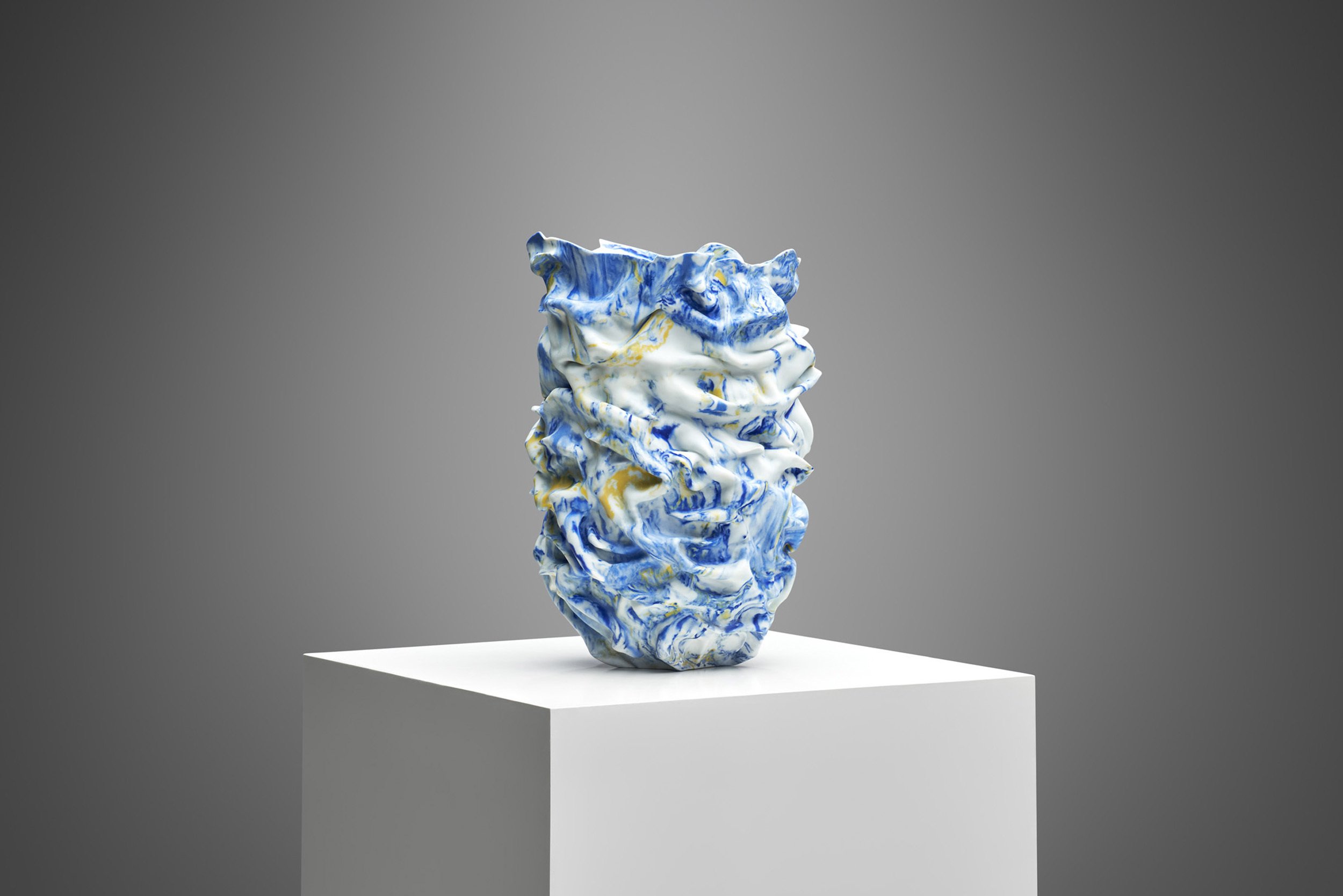
This richly pigmented vase, with its unruly form and angles, seems as if it is ready to burst out of its static form any second. The form relays an ecstatic expression of feeling, and this vase successfully gives a physical form to it.
The name of this vase derives from a Chinese idiom, that literally translates to: “verdant hills and limpid water” which in a figurative way depicts an enchanting scenery. Looking at this vase, the idiom takes form. An equal importance was given to line, colour, and form, resulting in a visually striking but harmonious piece. On closer observation, the vase has several pigments and a beautiful pattern that gives a geological element to the piece. The yellow pigment is especially characteristic, and highlights the tumultuous “waves” of the pattern. The painterly way in which Babs Haenen adorns her vessels demonstrates the way in which abstract painting inspires her; landscape motifs, such as rippling water, are recurring themes.
Without a question, this “Shan Ming Shui Xin” vase is a standout ceramic piece, carrying the unique characteristic of Babs Haenen’s art.
SOLD
About the designer:
The world-renowned ceramist, Babs Haenen, was born in Amsterdam in 1948. In 1979, she graduated with Geert Lap, Barbara Nanning and Paulus van Leeuwen at the Gerrit Rietveld Academy in Amsterdam. During her career, she has taught extensively, won a number of prestigious awards and has undertaken several high-profile public commissions in The Netherlands.
Haenen creates expressive and impressionistic ceramics inspired by abstract paintings and landscapes of the 15th and 16th centuries. She creates colourful and organic porcelain vessels with dynamic lines and forms. Her work consists of different coloured slabs of clay using a technique known as slab building.
The artist works with coloured porcelain creating a lot of shapes, patterns, and colours. Her work is in the permanent collections in several museums in countries around the world such as in the Netherlands, the United States, and Japan. ~H.
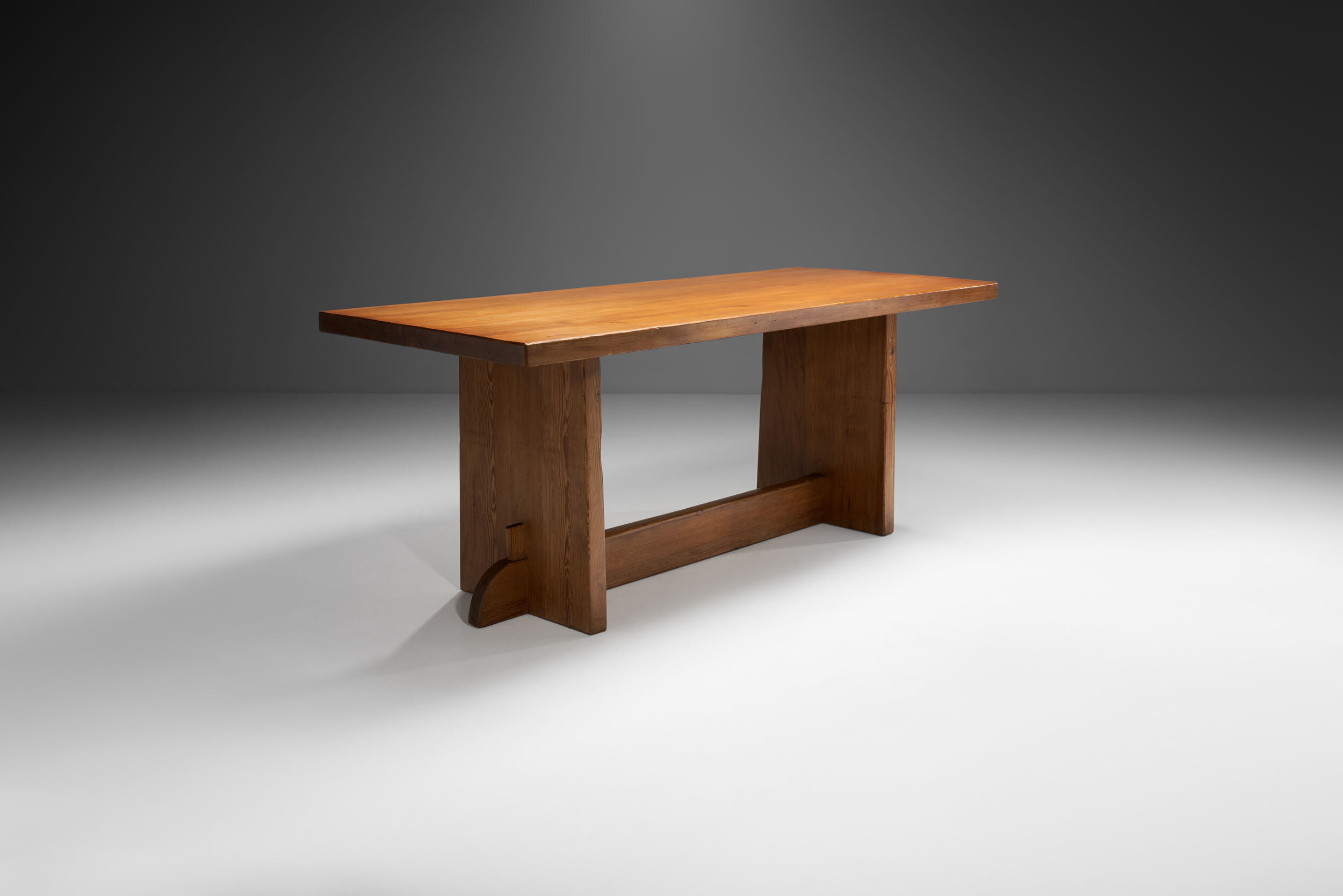
The models in the famous “Lovö” series are regarded by many as Swedish Modernist, Axel Einar Hjorth’s masterpieces. This pine table from the series designed ca 1932 is well-known for its modern reduced design and Hjorth’s characteristic way of playing with classical themes, creating “primitive modernism”.
This pine Lovö table has a central stretcher, joining the two trestle ends with mortice and tenon joints. These joinery techniques are another typical feature of Hjorth that contribute to the innate aesthetic of his models. The rounded ends bring variety to the straight lines that define the table’s top and legs, marking the design ethos of playfulness with styles, which was later adopted by a younger generation of architects and designers and absorbed into aspects of Modernism in Sweden. At the time of this table’s design year, a new focus on health and leisure led to the official instalment of paid holiday leave by the Swedish government, which made it possible for more and more people to acquire a summerhouse. The Lovö series – named after one of the islands of the Stockholm archipelago - unified these modern ideas of leisure with the aesthetics of traditional provincial life. With his highly original strand of Primitive modernism, Hjorth was able to combine a farmhouse simplicity with a functional, modernist idiom.
Creating designs for a variety of Swedish furniture manufacturers, including the Stockholm department store Nordiska Kompaniet, Hjorth contributed to the burgeoning Swedish design culture and the international recognition it began to receive in the 1920s.
SOLD
Condition:
In good vintage condition. Wear consistent with age and use. Some stains and marks on the wood.
Dimensions:
70.86 in W x 29.33 in D x 28.34 in H
180 cm W x 74.5 cm D x 72 cm H
About the Designer:
Axel Einar Hjorth was born March 7, 1888 in Krokek outside Norrköping. From 1908, he studied in Stockholm at the Högre Konstindustriella Skolan (University of Arts, Crafts and Design later to be "Konstfack"). His career in furniture design started around 1920, when Hjorth started working at Nordiska Kompaniet under the architect and designer Carl Bergsten.
Hjorth worked as the head of the assembly section of Jubileumsutställningen (the Jubilee Exhibition) in Gothenburg in 1923. The English critic P. Morton Shand has characterized this exhibition as the beginning of the breakthrough of Swedish decorative arts. "The Gothenburg Exhibition of 1923 revealed [...] that [Sweden was] almost the only one that really counted as far as design and craftsmanship were concerned."
For more than 10 years, from October 1927, Axel Einar Hjorth acted as the chief designer/architect at Nordiska Kompaniet. During the years between the wars, Nordiska Kompaniet was one of the most important furniture producers in Sweden and above all, the most exclusive one. Nordiska Kompaniet and Axel Einar Hjorth took part in most of the important national as well as international exhibitions of that time.
The position as chief architect at Nordiska Kompaniet also meant that he received quite a few commissions to create interiors, although the company had a separate department for this purpose. Among the most striking commissions performed by Axel Einar Hjorth were the railway trains of the Shah of Persia and Nordiska Kompaniet's Paris shop. Axel Einar Hjorth left Nordiska Kompaniet in order to start his own business in February 1938.
Hjorth’s work that often times mixed Art Deco and Modernist influences, remains highly relevant even sixty years after his death. ~H.
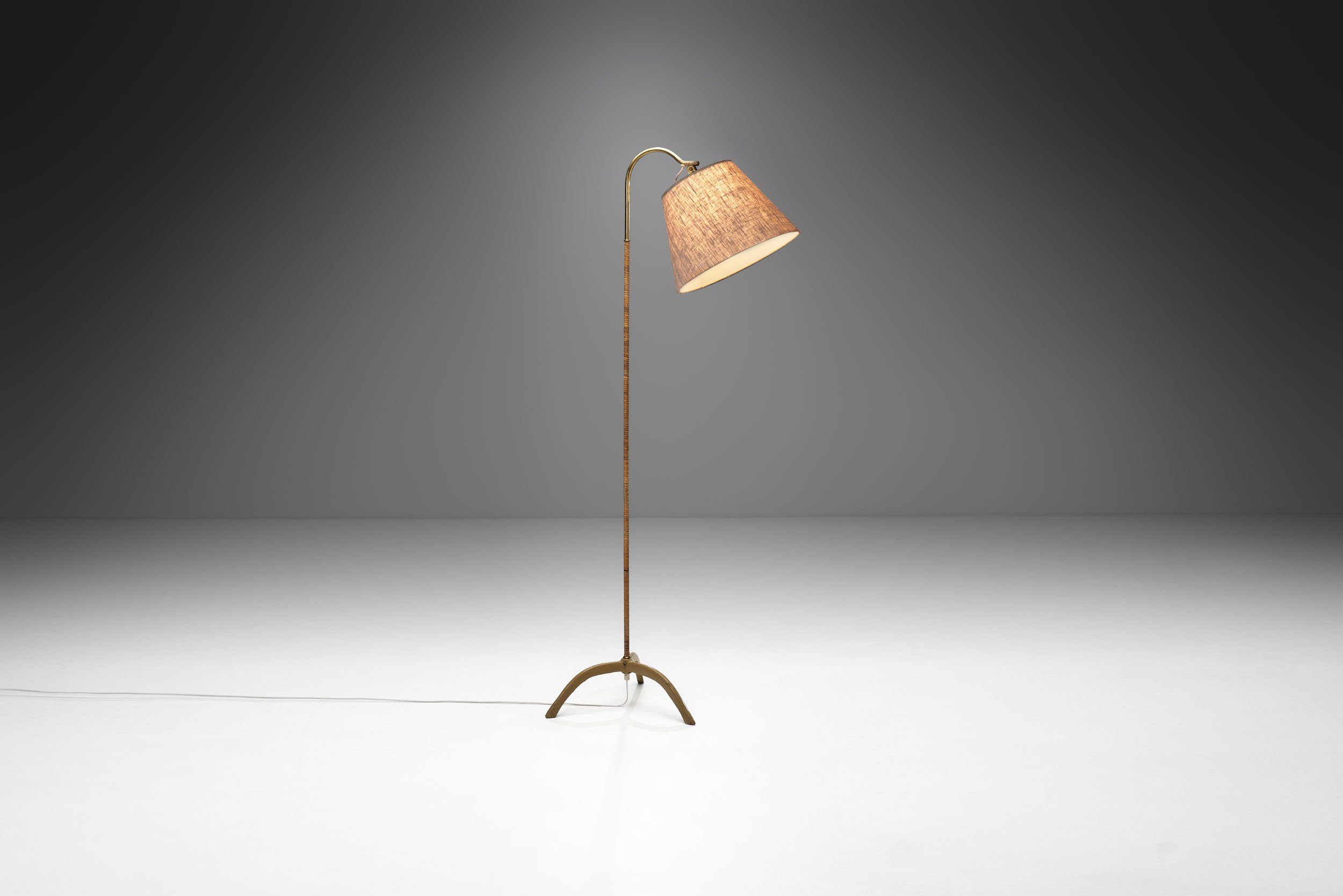
This rare model from the “man who illuminated Finland”, is a beautiful, classic example of the Finnish’s designer’s aesthetic and craftsmanship. Natural materials are combined with metals and premium fabric to create a look that is modern, stylish, and above all, Finnish at its core.
Paavo Tynell’s present mid-century model “9609” floor lamp features brass and cane with an organic shape that is inspired by nature. Tynell was hugely influenced by forms found in nature and often incorporated them in his lighting designs, either as decoration, materials, or in his models’ shapes. Here the latter two categories apply, as the main materials are brass, cane, and the shade’s light fabric. The model rests on a painted, cast iron triform base, from which the brass stand emerges. The pole has rattan winding, which is the most characteristic Tynell detail of the design, and serves as a ‘handle’ that prevents finger stains on the brass. Towards the top, the brass becomes visible as it curves gently to hold the shade. The lamp has a light fabric shade that is supported by the thin, slanted brass pole. On the top, the lamp has a hinge to adjust the shade to a desired angle. When lit up, the shade provides a warm, cosy light, revealing the fabric’s intricate texture. The lamp is marked by the manufacturer’s sign.
A master craftsman himself, Tynell’s elegant brass designs were derivative of a traditional aesthetic with a modern sensibility. He was one of the founders and chief designer of Taito Oy - the first industrial producer of lighting fixtures in Finland. With the innovation of electricity, Taito Oy and Tynell expanded the thinking and manufacturing of modern lighting solutions in Europe and abroad.
SOLD
Condition:
In good vintage condition. Wear consistent with age and use. Some marks on the brass.
Dimensions:
25.59 in W x 17.32 in D x 61.02 in H
65 cm W x 44 cm D x 155 cm H
About the Designer:
Paavo Tynell (1890-1973) was an industrial designer, known as the great pioneer of Finnish lighting design and fondly dubbed as “the man who illuminated Finland”. Tynell was one of the founders and chief designers of Taito Oy – the first industrial producer of lighting fixtures in Finland.
With the innovation of electricity in the beginning of the 20th century, Taito Oy and Tynell expanded the thinking and manufacturing of modern lighting solutions in Europe and abroad. Paavo Tynell rose to prominence in the 1930s and 1940s, during which period he collaborated with some of the most renowned Finnish architects, including Alvar Aalto. Working to incorporate artificial lighting into modern environments, Tynell’s company, Taito Oy produced fixtures for all of Alvar Aalto’s major projects including the Paimio Sanatorium and the Viipuri Library.
Tynell was especially appraised through his involvement with the Finland House, a design atelier in New York that showcased the work of Finnish designers and craftspeople. His elegant brass designs became an instant success in North America, and he began creating lighting designs for the prestigious American company Lightolier.
A master craftsman himself, Tynell’s designs were derivative of a traditional aesthetic with a modern sensibility, mixed with an extensive use of perforated and polished brass as material. Marked by delicacy and softness, his most famous forms in lightning echo the structures of nature; he adroitly created sculptural shapes reminiscent of the branches of trees, swirling snowflakes and seashells. ~H.
This early Danish mid-century lounge chair with the pair of matching ottomans is a great example of the unification of comfort and delicate design elements.
With its rounded edges, cosy, premium upholstery and soft colour, this chair and ottomans are ideal to blend a stroke of modernity to any space, with a nod to comfort and simple artistry. From the frame to the upholstery, this lounge chair and ottomans guarantee quality and longevity. Although these virtues are important, design never fell short either for Danish cabinetmakers. In the case of this lounge chair, the carved oak legs and round edges stand out even under the fabric. The voluptuous shape is a result of the upholstered, winged backrest that embraces the sitter, complimented by the soft seat and armrests. Furthermore, the round front legs and slim, slightly tapered back legs are visually interesting details.
We have added two newly produced matching, upholstered ottomans to provide additional comfort and visual interest. The three pieces of this set are all upholstered in a premium alpaca and wool blend bouclé fabric. Thanks to this combination of materials, the set is extremely soft and comfortable.
.
SOLD
Condition:
In great vintage condition. Wear consistent with age and use. The set has been recently (re)upholstered in a premium alpaca and wool blend bouclé fabric. Front legs most likely unoriginal. The ottomans are a later addition.
Dimensions:
Chair: 33.46 in W x 32.28 in D x 36.22 in H; Seat height 12.99 in
Ottoman 1: 25.19 in W x 23.22 in D x 16.14 in H
Ottoman 2: 16.53 in W x 14.17 in D x 11.41 in H
Chair: 85 cm W x 82 cm D x 92 cm H; Seat height 33 cm
Ottoman 1: 64 cm W x 59 cm D x 41 cm H
Ottoman 2: 42 cm W x 36 cm D x 29 cm H
About the designer:
The practical and comfortable designs of Danish cabinetmakers defined mid-20th century modern seating. The Danish Cabinetmakers focused on minimalist design executed by expertly skilled craftsmen.
Works from the Danish Cabinet-Makers' Guild is a concept of its own in collectible design. The Cabinet-Makers' Guild began annual exhibitions in 1927 in Copenhagen. The group formed an exhibit showing each year in October the quality furniture made to drawings by gifted architects. The exhibition took place each year, without interruption, for forty years. A number of successful Danish Design collaborations were formed during this time between cabinetmakers and architects.
Danish Modernism has influenced Scandinavian furniture to a great degree, defined by minimalism, simplicity, and functionality. The muted colours and gentle designs make Danish mid-century furniture an ideal addition to contemporary living spaces. Additionally, master cabinetmakers were highly aware of body proportions, prioritizing comfort just as much as the visual qualities.
The works of master cabinetmakers – such as this chair – are of the highest quality, both in terms of materials and craftsmanship. Cabinetmakers take the art of working with wood one step further, and focus on the finer details of what can be created with the material. Therefore, it comes as no surprise that numerous master cabinetmakers are part of the renowned Danish Culture Canon (Danish: Kulturkanonen). The canon contains no more than 108 works of cultural excellence, based on works with a useful function and that are still recognizable today. This small armchair is the perfect illustration of Danish design, and the work of a true cabinetmaker. ~H.