
Swedish Modern Armchairs with Structural Legs, Sweden 1960s


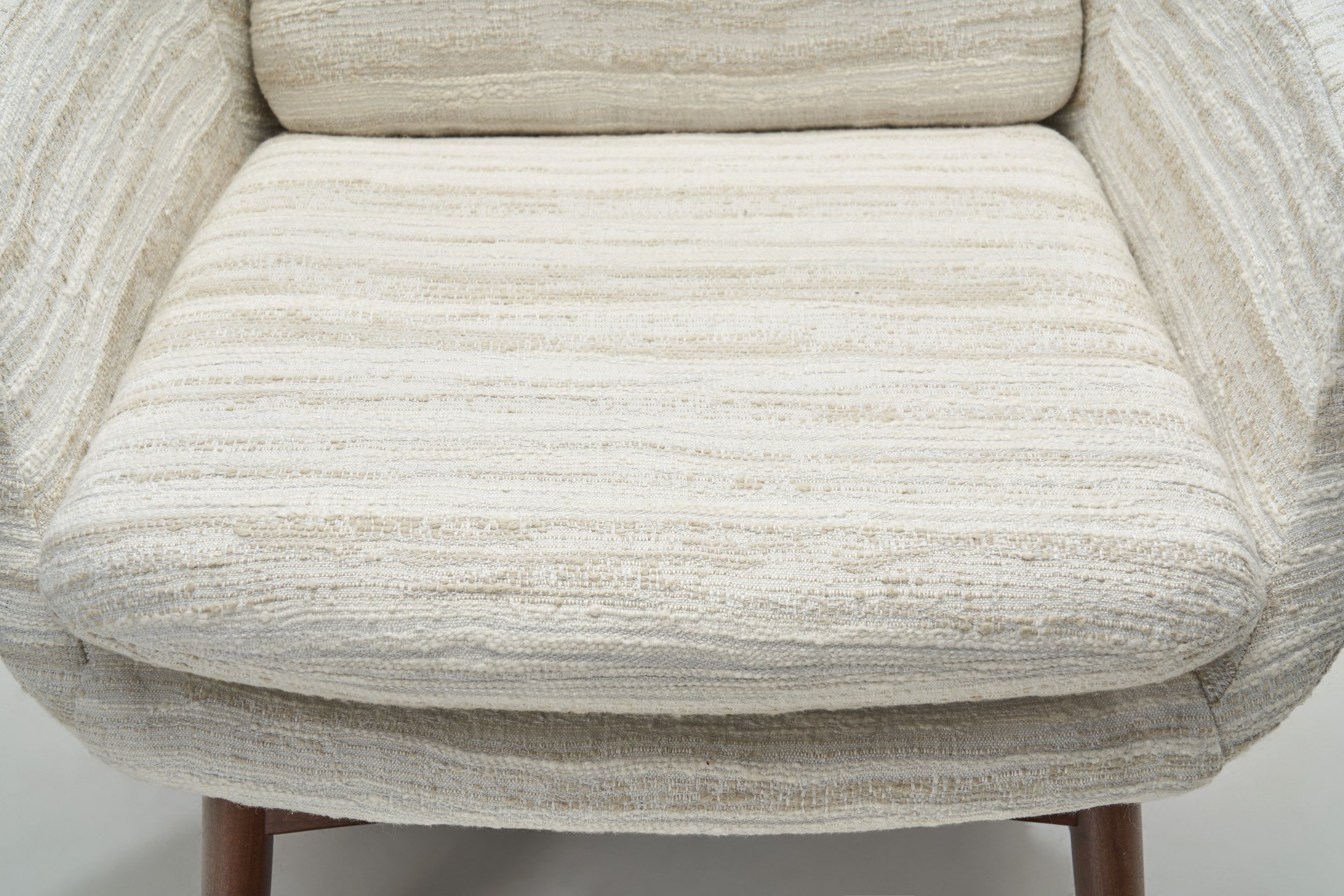


Swedish Modern Armchairs with Structural Legs, Sweden 1960s
REQUEST PRICE HERE
Price category: 9,000 - 12,500 usd / eur
The 1960s saw brilliant Scandinavian designers working to create furniture of the highest quality that explored truly modern shapes and forms. These designers experimented with new materials and construction methods but, crucially, they all had a formal training, either as architects or as furniture makers. This pair of sculptural armchairs show how successful these experiments were.
The form of the body of this model is a standout feature, it combines straight and flowing lines masterfully, while staying in the line of Swedish Modernism. While the edges are crisp, the rest of the body has a gentle curvature that maintains the overall cosy look. As this pair shows, the modern version of Swedish design isn’t always only about efficiency and space-saving solutions, though it is still both practical and aesthetically pleasing. These armchairs showcase a mix of the traditional style of almost rustic simplicity alongside the sleek design of a forward-thinking designer who, like many of the most known Scandinavian designers, emerged in the middle of the 20th century. Accordingly, there is an undeniable designer edge to the bodies that is complemented by the legs’ structure that has a well-crafted, structural look. The tapered legs support the bodies impeccably, the solid wood structures with the stretchers provide stability and support to the design. The duality of practicality and beauty is especially visible in this pair’s design, while the colour scheme and the materials reinforce the Swedish mid-century aesthetic and quality.
Scandinavian style has a long, well-established history, traditionally marked by simplicity, bright whites, natural wood tones, minimal folk style ornamentation, and colour washed furnishings and trims. And while these characteristics do define the style in general, the details are just as captivating, which is beautifully demonstrated by this pair of armchairs. “Svensk” design defines these chairs both in terms of looks and quality, uniting great design with the knowledge of Swedish craftsmen.
Condition:
In good vintage condition. Wear consistent with age and use. The armchairs have been reupholstered recently in premium fabric. Each of our items can be re-upholstered by our in-house atelier in a fabric of choice. Please reach out for more information.
Dimensions:
29.33 in W x 31.88 in D x 29.52 in H; Seat height 15.74 in
74.5 cm W x 81 cm D x 75 cm H; Seat height 40 cm

REQUEST PRICE HERE
Price category: 7,500 - 10,000 usd / eur
These “Grand Pedro” armchairs show the curviness that defined the design of the 1950s. Hiort af Ornäs developed this model for his own furniture company, Puunveisto Oy.
The “Grand Pedro” model has a soft, sculptural shape paired with an ergonomic construction, which is very representative of the designer’s beliefs. Hiort af Ornäs was very firm about two things regarding his chair designs: the sitting comfort and that the model must look good from every single angle. “Pedro” fulfills these principles, for as even from the bottom, it showcases the elongated, tapered back legs that are visually captivating. The bodies have a welcoming look, with outward curving armrests and slightly bent backrests. In service of utmost comfort are the seat cushions that ensure sitting comfort, and the upholstery that is extremely soft. The light colour and texture of the fabric complements the lacquered wood legs beautifully, highlighting their sculptural lines.
The craftsmanship and quality provided by Hiort af Ornäs is very visible in the “Pedro” collection that includes a sofa besides these chairs. The seating designs of the architect/designer have been gradually more and more recognized world-wide, which resulted in the recent exhibition titled “Forgotten Ornäs”.
Condition:
In good vintage condition. Wear consistent with age and use. The chairs have been reupholstered recently in a premium wool-mohair blend fabric. Each of our items can be re-upholstered by our in-house atelier in a fabric of choice. Please reach out for more information.
Dimensions:
27.95 in W x 28.15 in D x 32.28 in H; Seat height 16.14 in; Arm height 22.64 in
71 cm W x 71.5 cm D x 82 cm H; Seat height 41 cm; Arm height 57.5 cm
About the designer:
Carl-Gustaf Vilhelm (nicknamed “Nalle”) Hiort of Ornäs was born on 27 February 1911 and lived most of his life in Tapiola/Espoo in Finland and in his later life moved to Spain. He is remembered as a Finnish interior architect and designer known to be uncompromising.
Before the Finnish wars (1939-1944), Hiort af Ornäs spent his time in Pori, working at Björneborgs Mekaniska Verkstad. He studied at the Helsinki University of Technology to become an architect but never graduated. He did, however, become known as an interior designer, and eventually even more known as a furniture designer.
In 1945, Hiort af Ornäs founded the furniture company Puunveisto Oy, for which he developed versatile techniques for shaping plywood. He started the furniture manufacturing shop on Lauttasaari in Helsinki (Veneentekijäntie 14) together with his brother. The wood shop, showroom and office were all located in the same building in Helsinki. Rolf Mesterton was the man in charge of producing the furniture, but there were several other carpenters at work in the woodshop. Hiort af Ornäs’s furniture was exhibited and sold by the shop Nupponen who also distributed Olavi Hänninen’s designs, while Puunveisto’s furniture were also sold by Gösta Westerbergs Möbler in Stockholm, Sweden but, in spite of a good selection of chairs, tables and shelves, did not do too well. Since production costs were high, Hiort af Ornäs faced economic troubles. The company was later sold to Nupponen after which Hiort af Ornäs’s interest in the company waned.
Hiort af Ornäs spent his retirement in Spain, and designed several buildings for Fuengirola’s Los Pacos neighbourhood, which has a large Finnish population. His house that he drew and built in Tapiola, Espoo, Finland, ‘Villa Hiort’, still stands and houses some of the designer’s original drawings. It is a beautiful example of 1950s Modernism and the talent of Hiort af Ornäs that brought him recognition that lasts to this day. ~H.