
Mid-Century Brutalist Solid Oak Chair, France 1960s (sold)



Mid-Century Brutalist Solid Oak Chair, France 1960s (sold)
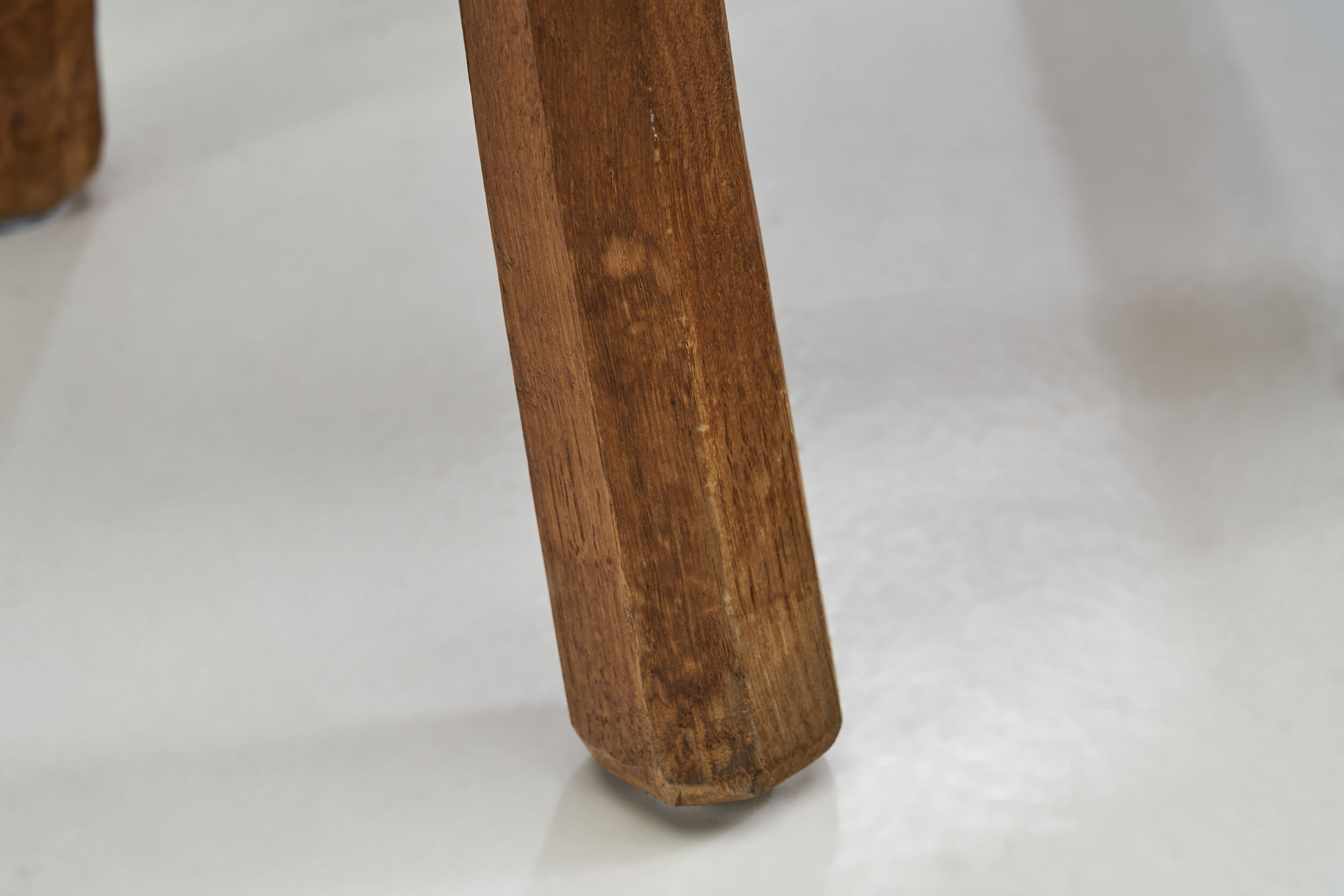
With a robust organic form and an earth-toned palette, this chair is the embodiment of Brutalism. In furniture and décor, the Brutalist movement was somber, giving importance to eerie organic and rugged shapes in dark, earthy tones. The defining characteristics of Brutalist furniture design can be observed in this chair: jagged shape, asymmetrical organic design, and an earthly palette.
Using simple but well-though out lines, this chair was designed to be minimalistic, yet aesthetically distinct. The chair gives and airy feel, while the sturdy frame provides a firm and reliable base, with the overall design focusing on the natural beauty of the wood. The Brutalist style of design - the term derives from the French word brut, meaning “raw” – is characterized by a deliberate plainness and crudity. It emerged in the mid-20th century and gained popularity in the late 1950s and 1960s. It originated post–World War II, when the design of low-cost housing and government buildings was composed of mainly raw, unrefined materials. As a descendant of the modernist movement of the late 19th and the first half of the 20th century, Brutalism favours simple and bare, yet well-thought-out, stark design. The architects and builders sought to project a sense of strength through their fortress-like designs, while also celebrating the imperfect appeal of handmade items. While Brutalism started out as an architectural style, it quickly influenced furniture design in Europe and the Americas.
This chair has a startling rawness, but with its warm-toned and slightly asymmetrical body it is a greatly-balanced piece. Sensitive touches enliven the brutalist design, visible in the careful craftsmanship. Through its eccentric geometries and expressive forms, - brutalist furniture design’s best qualities - this chair is the perfect piece for any interior. In the 21st century, unlike in architecture, brutalist furniture design has been making a comeback, making 20th century pieces like this chair a rare and valuable piece of the movement.
SOLD
Condition:
In good vintage condition. Wear consistent with age and use. Beautiful patina with marks on the wood.
Dimensions:
11.41 in W x 17.12 in D x 32.08 in H; Seat height 16.92 in
29 cm W x 43.5 cm D x 81.5 cm H; Seat height 43 cm
REQUEST PRICE HERE
Price category: 7,500 - 10,000 usd / eur
This beautiful Danish lounge chair is an early example of Scandinavian mid-century modern design as well as outstanding craftsmanship with a quality that honours the materials and users. The period from roughly the 1940s through the 1960s was a high point for Danish furniture makers, and this chair shows why.
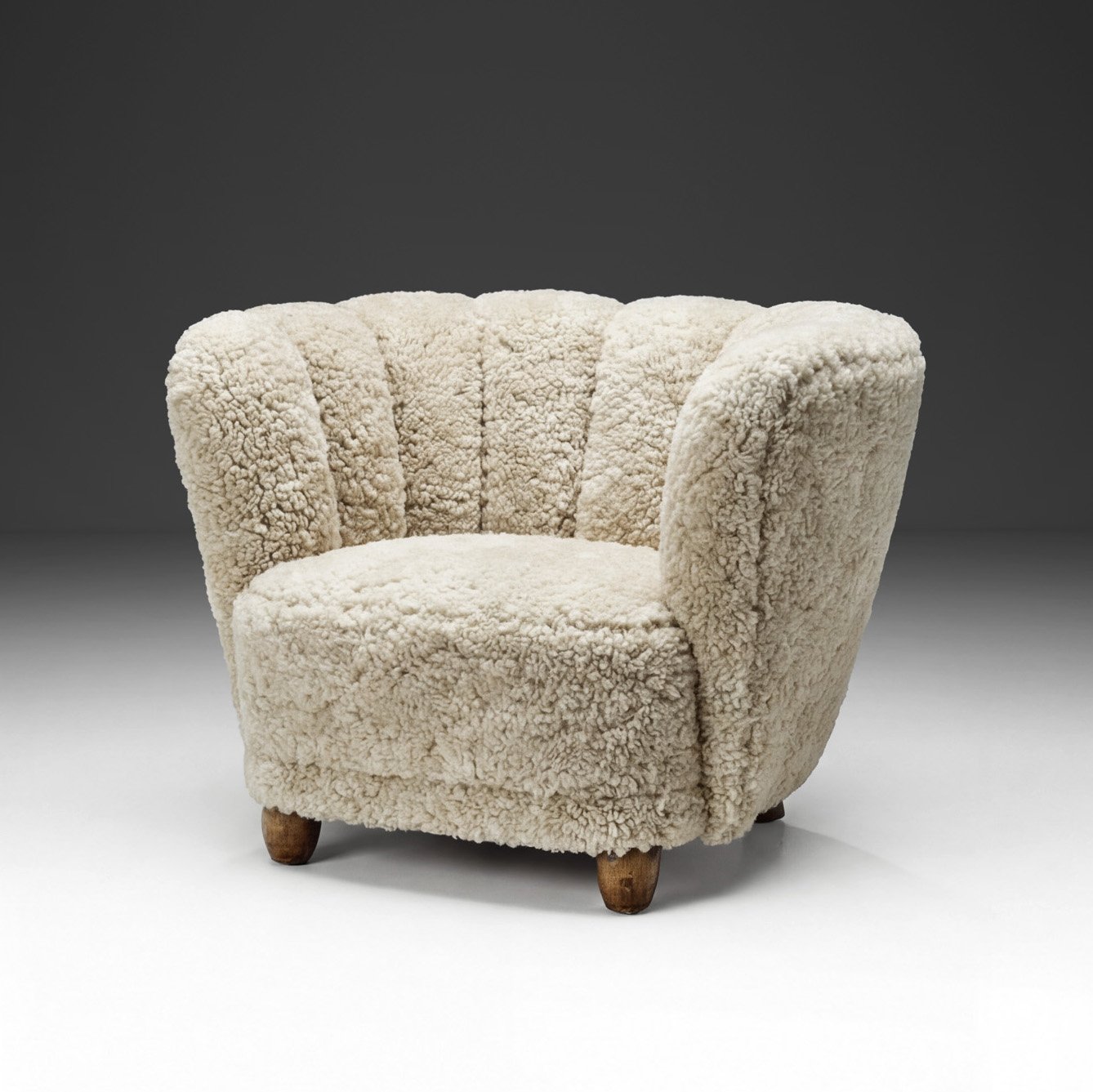
Designed in the early phase of what we know today as mid-century modern, this lounge chair is a Danish delicacy with a unique look. With its classic shape paired with modern design elements, it combines the best design characteristics of the 1940s. The large, enveloping backrest dictates the shape of this chair, as it forms most of the structure, including the armrests. The curvature creates an inviting and open look, enhanced by the soft sheepskin upholstery. The inside of the upholstered back is sectioned which creates a shell-like look. The thick, bun feet-like front legs are a pleasant touch. The warm brown colour of the stained wood nicely contrasts to the off-white sheepskin, not to mention the thick wooden feet make a long-lasting, rock solid foundation for any chair. The chair’s back legs differ, they are straight, which is an eccentric detail that adds visual interest. Master cabinetmakers were highly aware of body proportions, prioritising comfort just as much as the visual qualities, therefore this lounge chair provides support for the back and great sitting comfort.
Perfectly suited for a vintage or contemporary interior, this chair represents a marriage of artistry and comfort. Its upholstery captures attention, adding warmth and vibrancy to any space, while the wooden feet are grounding, together making this piece into an ideal statement piece.
Condition:
In good vintage condition. Wear consistent with age and use. The wood has some scratches and marks. Due to the nature and age of the materials, the chair may have additional discolouration. The chair has recently been reupholstered in premium sheepskin. Each of our items can be re-upholstered by our in-house atelier in a fabric of choice. Please reach out for more information.
Dimensions:
34.25 in W x 33.46 in D x 27.55 in H; Seat height 14.56 in
87 cm W x 85 cm D x 70 cm H; Seat height 37 cm
REQUEST PRICE HERE
Price category: 2,500 - 5,000 usd / eur
Danish armchairs reflect a strand of mid-20th century design that is expressive while also maintaining the minimal decor of the period. While much Scandinavian furniture from this period is associated with restraint and lightness, artists such as Henning often introduced a more sculptural character, combining solid oak construction with carved or shaped elements. His “razorblade” backrests became a defining feature, giving otherwise simple chairs a distinctive identity.
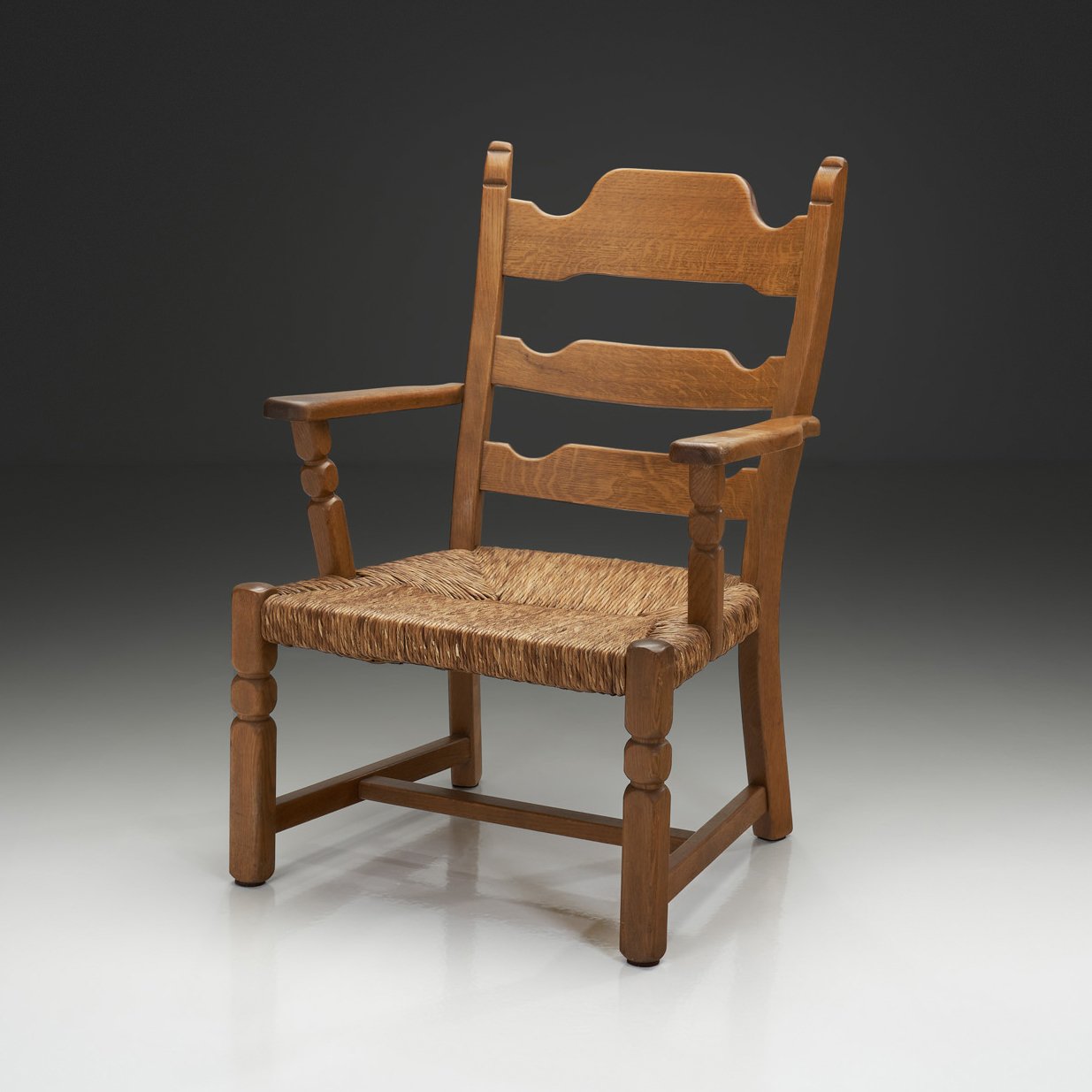
This armchair, in the manner of Kjærnulf’s work, follows that direction through its solid oak frame and clearly defined silhouette. The structure is built with thick elements, with the legs and arm supports featuring turned details. The backrest is composed of three horizontal slats with gently curving edges, creating a layered effect that adds depth without complicating the form. The woven seat introduces a counterpoint to the rigid wooden frame. Made from natural fibres, it has an organic texture that contrasts with the smoother surfaces of the oak. This material choice offers breathability while remaining durable over time. The combination of solid wood and woven seating reflects traditional craftsmanship, where each material is valued, and comes together to create enduring pieces.
What makes the chair stand out is the way it balances weight and detail within Danish design. It feels solid and deliberate, able to anchor a space, while still being functional for everyday use.
Condition:
In good vintage condition. Wear consistent with age and use. The item has recently been reconditioned. Minor dents and scratches are present. Due to the nature of the materials, the item may have some marks and discolouration.
Dimensions:
25.19 in W x 26.37 in D x 36.61 in H; Seat height 14.96 in; Seat depth 20.47 in; Arm height 24.80 in
64 cm W x 67 cm D x 93 cm H; Seat height 38 cm; Seat depth 52 cm; Arm height 63 cm
REQUEST PRICE HERE
Price category: 7,500 - 10,000 usd / eur
This stunning armchair, designed by the renowned French duo Guillerme et Chambron, showcases an exquisite blend of elegant aesthetics and rustic design elements. Crafted in the mid-20th century by Votre Maison, the model reminds us how form and elegance blend together in the duo's exceptional distinctive craftsmanship style.
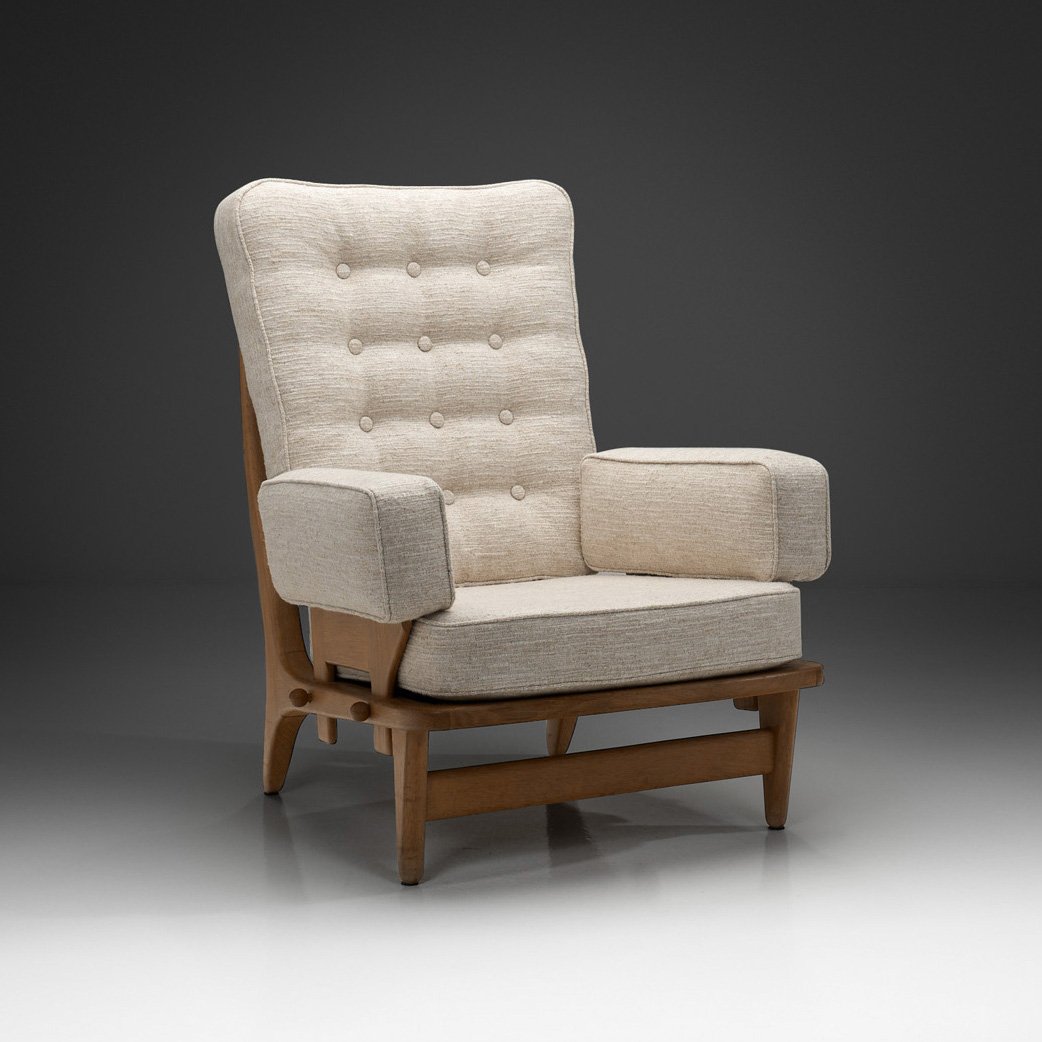
The solid oak wood frame provides a sturdy yet elegant structure, showcasing the beautiful material. The sculptural form allows for a dynamic visual movement between the different accents of this model. The back is composed of seven oak spindles, standing detached from the arms. The armrests are carved with great precision to serve a double purpose: an aesthetic role, and a functional one thanks to the cushioning. The frame is striking through its composition, yet the look is enhanced even further thanks to the upholstered cushions, which immediately draw the eye with their playful geometry. Like most of their designs, this chair model displays a beautiful contrast between the wooden frame and the elegant light fabric. The material is not only visually appealing but also selected for its comfort and durability, ensuring that the chair is as practical as it is beautiful. This model also shows how Guillerme et Chambron pieces possess an unusual flare.
Guillerme et Chambron’s work not only represents the fusion of function and form, but also exemplifies the mid-century modern and brutalist aesthetic - which they played a pivotal role in shaping. Their emphasis on quality craftsmanship and the use of noble materials like oak has undeniably left a lasting imprint in the world of furniture making, solidifying their legacy in the French design landscape during the mid-century era.
Condition:
In good vintage condition. Wear consistent with age and use. The item has been reconditioned. Due to the nature of the materials, the item may have some marks, scratches, and discolouration. The chair has recently been reupholstered in a premium fabric. Each of our items can be reupholstered by our in-house atelier in a fabric of choice. Please reach out for more information.
Dimensions:
29.92 in W x 35.03 in D x 37.79 in H; Seat height 15.35 in; Seat depth 20.86 in; Arm height 22.24 in
76 cm W x 89 cm D x 96 cm H; Seat height 39 cm; Seat depth 53 cm; Arm height 56.5 cm
REQUEST PRICE HERE
Price category: 7,500 - 10,000 usd / eur
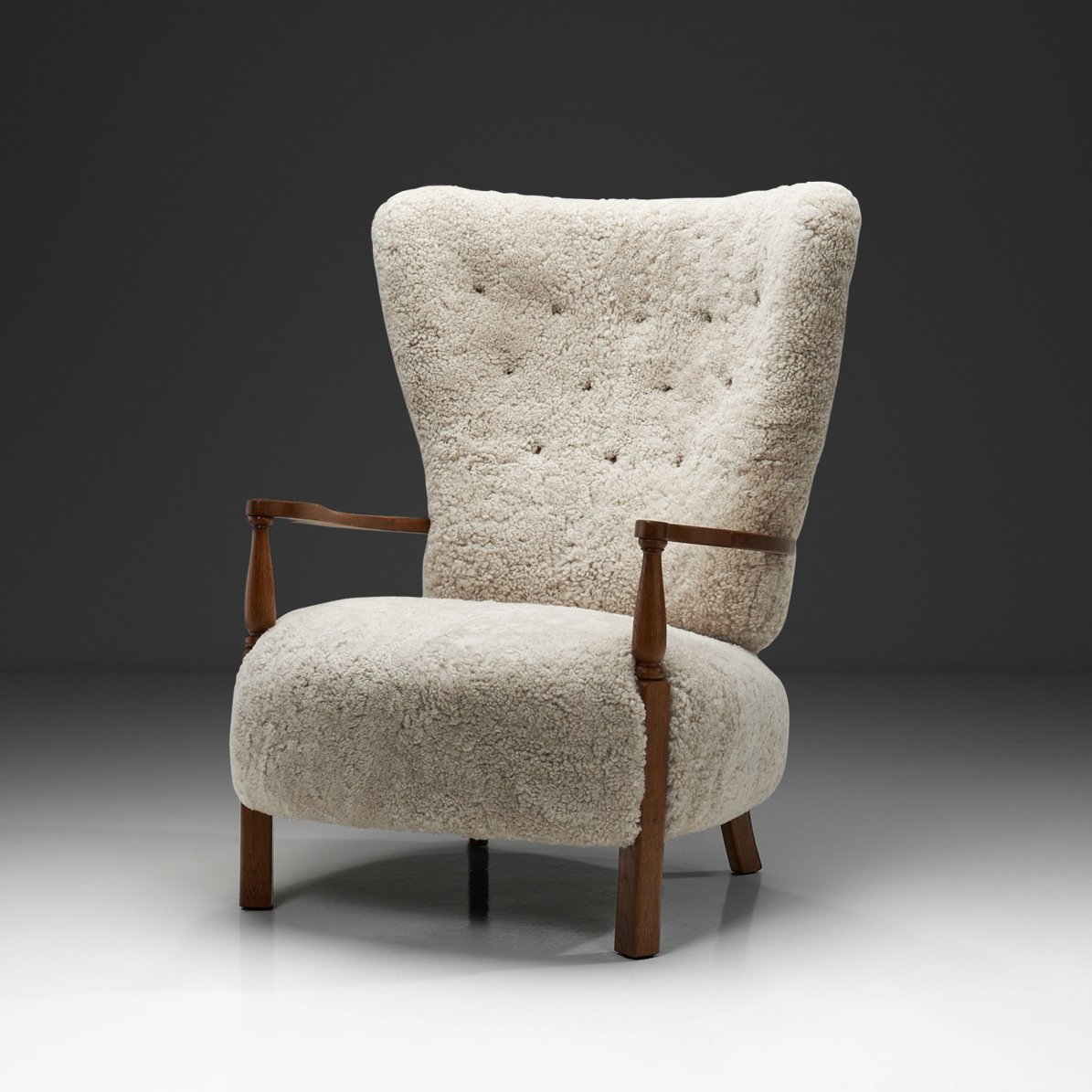
Danish Modernism can be visually described by this beautiful wing-back chair: sleek, organic and timeless. These attributes are met with high quality materials and the famous craftsmanship of the country’s cabinetmakers. This chair is a testament to the quality and craftsmanship of Villy Sørensen.
From the welcoming winged body and the solid wood frame to the cosy sheepskin upholstery, this chair expresses a quality of hygge and a feeling of contentment. The distinctive shape is a result of the two “ears” that encompass the sitter. One of the most notable chair styles that embodies Scandinavian modern design is the wing-back chair. The history of this type of chair can be traced back to the 17th century when they were originally designed to provide protection from drafts in grandiose, often chilly, European homes. With high backs and "wings" on each side to shield the sitter from cold air, these chairs were originally a symbol of prestige and comfort. To balance the sculptural, upholstered body is the beautiful solid wood frame that is left exposed on the sides as it also functions as a decorative element with its geometric angles and curves. The arms and tapered legs are formed from the same piece of wood resulting in a sleek impression. The wood’s colour and smooth surface contrast brilliantly with the sheepskin’s light colour and texture. Thanks to the properties of the sheepskin, this chair provides great, soft comfort as well.
Villy Sørensen had a unique design idiom, which is clearly visible in this model: function, durability, timeless design, and perhaps above all, comfort. This traditional yet playful chair combines all of these attributes, which makes it ideal to be the stylish focal point of any space.
Condition:
In good vintage condition. Wear consistent with age and use. Due to the nature of the wood, the item may have some marks, scratches, and discolouration. The chair has recently been reconditioned and has recently been reupholstered in premium sheepskin. Each of our items can be reupholstered by our in-house atelier in a fabric of choice. Please reach out for more information.
Dimensions:
29.92 in W x 32.28 in D x 38.98 in H; Seat height 14.96 in; Seat depth 22.83 in
76 cm W x 82 cm D x 99 cm H; Seat height 38 cm; Seat depth 58 cm
REQUEST PRICE HERE
Price category: 7,500 - 10,000 usd / eur
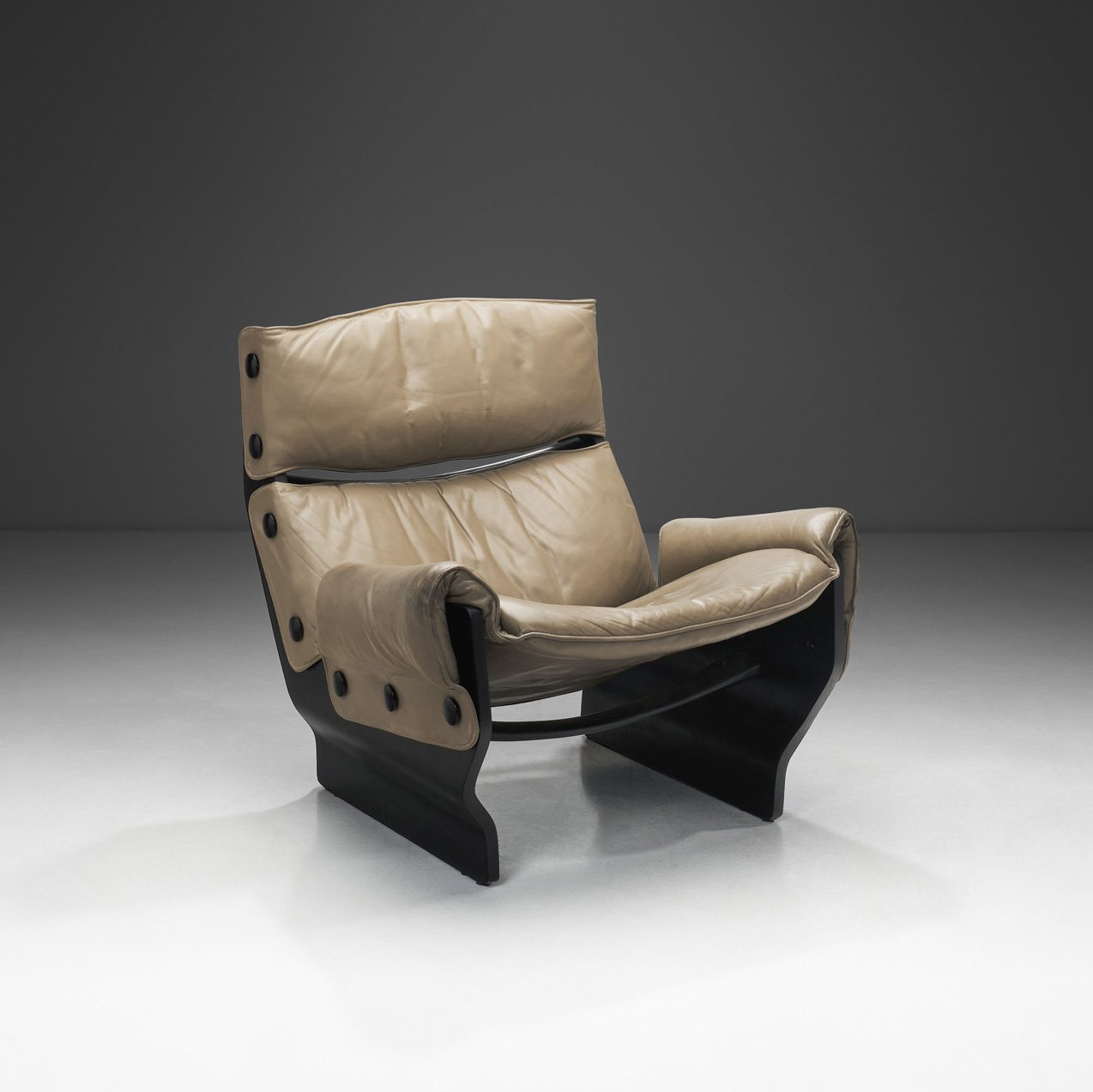
This “Canada” or model P110 chair was designed by Osvaldo Borsani in 1965 and manufactured by the Borsani brothers’ company, Tecno. The chair is enriched with mechanical components that give it versatility in terms of composition, shape and arrangement.
The Borsani brothers’ company, founded in 1953, had strong ideals, mainly a philosophy of quality. Just like the company’s name in Italy, this “Canada” lounge chair is unmistakable. The wooden structure serves as the base for the upholstered sections that are divided into three parts. Immediately standing out are the oversized buttons, seven on both sides, that secure the cushions in place, while also increasing the visual quality of the chair. The extraordinary heritage of craftsmanship in the treatment of materials, in the attention to detail, in the interpretation of the shape defines this chair. Thanks to the innovative language of the design, this model can fit perfectly into any interior while still standing out visually.
The “Canada” lounge chair shows the rigor of form, the quality of materials and workmanship, and the attention to the opportunities of technology that Tecno is known for. The chair is upholstered in leather, which contrasts beautifully to the peculiar body.
Condition:
In good vintage condition. Wear consistent with age and use. Minor scratches on the back. The chair comes with its original upholstery or has been reupholstered by a previous owner. Each of our items can be reupholstered by our in-house atelier in a fabric of choice. Please reach out for more information.
Dimensions:
32.28 in W x 33.46 in D x 33.07 in H; Seat height 15.74 in; Seat depth 22.04 in; Arm height 21.06 in
82 cm W x 85 cm D x 84 cm H; Seat height 40 cm; Seat depth 56 cm; Arm height 53.5 cm
REQUEST PRICE HERE
Price category: 2,500 - 5,000 usd / eur
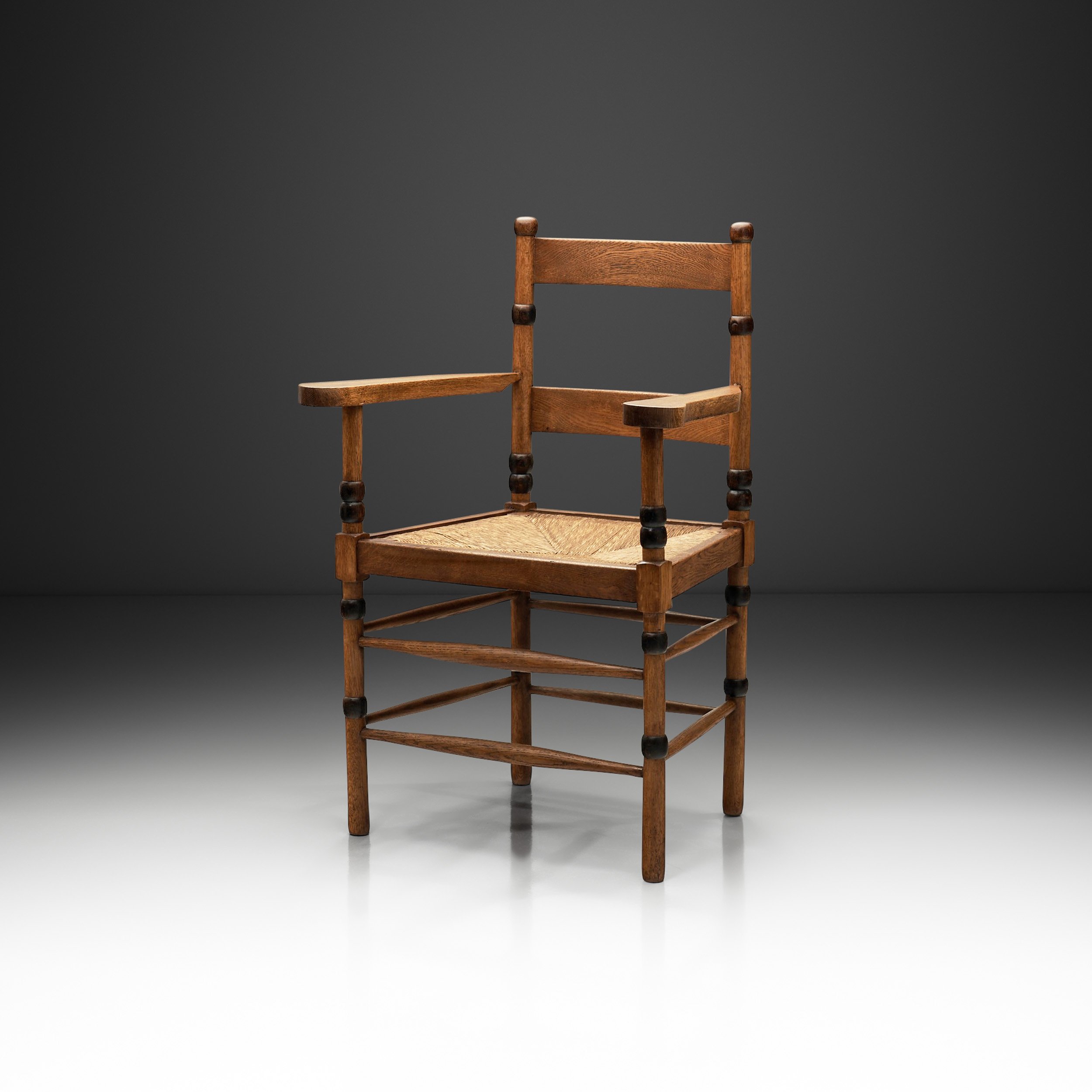
The Amsterdamse School movement arose in response to the influence of Art Nouveau and Jugendstil in the late 19th and early 20th centuries. This movement, which took root in Amsterdam, sought to create a uniquely Dutch style that embraced traditional craftsmanship and celebrated the spirit of the current times. The Amsterdamse School extended its influence across various artistic disciplines, including architecture, decorative arts, and furniture design.
The styles’ main characteristics are reflected in the design of this chair beautifully: expressive, art deco-reminiscent, and functional. Amsterdamse School furniture is renowned for its sculptural qualities. Designers like Jac Levee sought to integrate form and functionality seamlessly, resulting in furniture pieces that were not only visually striking but also practical. The craftsmanship of Amsterdamse School furniture is exemplified by its intricate woodwork and joinery. Pieces often showcased decorative detailing through carvings, inlays, and geometric patterns. These elements add a touch of individuality and artistry to a piece, setting them apart from the mass-produced furniture of the time. In this chair, the backrest’s clean, symmetrical lines reflect the simple, yet sophisticated aesthetics of the era. The use of black round accents not only adds an element of visual interest to the design, but also serve to reinforce the structure and enhance the overall strength. To further add to the charm of the piece, the woven seat, made from durable natural fibres, highlights the attention to both function and form, by creating visual and textural interest. The beautifully symmetrical pattern showcases the timeless artistry of artisanal furniture.
Whether placed in a farmhouse or used to add an organic element to a modern interior, this chair provides both history and utility. More than just functional seating, this chair represents a moment in design history where furniture was built to last, to be used daily, and to shape the atmosphere of a room.
Condition:
In good vintage condition. Wear consistent with age and use. The chair has recently been reconditioned. Minor scratches and discolouration. Due to the nature of the wood, the item may have some additional marks.
Dimensions:
25.59 in W x 20.86 in D x 37.40 in H; Seat height 18.50 in; Seat depth 16.92 in; Arm height 28.14 in
65 cm W x 53 cm D x 95 cm H; Seat height 47 cm; Seat depth 43 cm; Arm height 71.5 cm
REQUEST PRICE HERE
Price category: 12,500 - 15,000 usd / eur
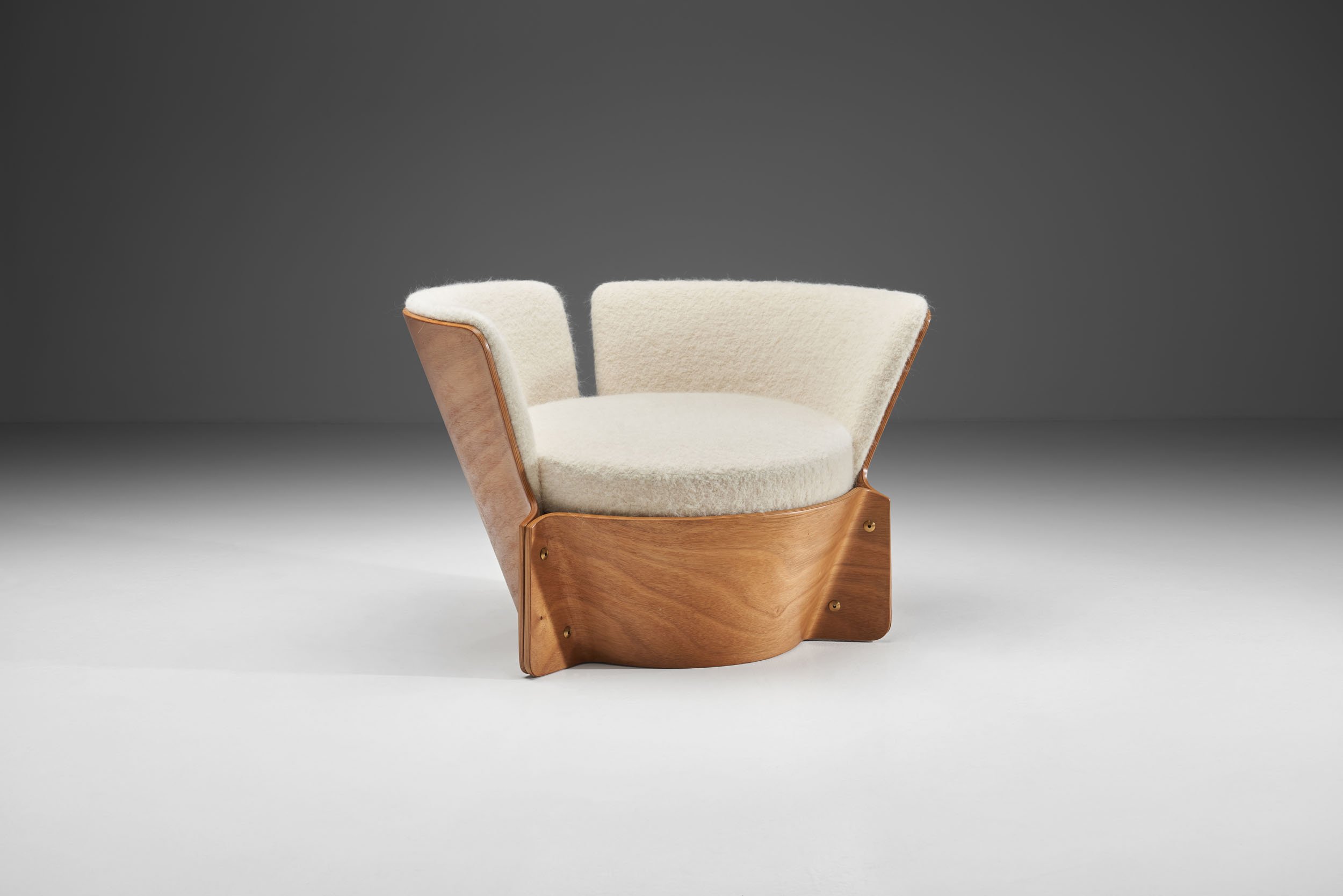
This rare "Roset" chair is a striking creation by the Danish designer duo Ole Gjerløv-Knudsen and Torben Lind, manufactured by Mogens Kold in Denmark in the early 1970s. Introduced in 1972, the “Roset” model stands out for its sculptural form and innovative construction, embodying the spirit of Danish modernism with a playful and organic twist.
The chair’s design is both functional and deeply expressive. Its unusual shape evokes the comfort of a nest, welcoming the sitter into a softly embracing form. The chair’s broad circular seat and gently curved split backrest encourage a relaxed lounging posture, creating an intimate and cocoon-like experience for the user. The feet, resembling fins, not only provide visual dynamism but also ensure stability, giving the piece a grounded yet airy presence. The body is constructed from three laminated plywood panels, precisely joined with visible brass screws that lend a subtle industrial touch while highlighting the craftsmanship and attention to structural detail. The model is upholstered in a premium wool and alpaca blend fabric, chosen for its softness, warmth, and luxurious texture. The light, tactile quality of the upholstery enhances the chair's inviting character and complements the warm natural tones and grain of the plywood shell.
The “Roset” model remains a rare piece that offers both sculptural impact and everyday warmth. It is an ideal statement chair capturing the balance between innovation, comfort, function, and aesthetics, that defines the best of Danish design from the period.
Condition:
Wear due to age and use. Some scratches and marks. Recently reupholstered in premium alpaca - wool blend fabric.
Dimensions:
35.63 in W x 31.50 in D x 23.43 in H; Seat Height 14.17 in
90.5 cm W x 80 cm D x 59.5 cm H; Seat Height 36 cm
About the designer:
Ole Gjerløv-Knudsen (1930-2009) was a Danish furniture architect. He studied at the School of Crafts, graduating in 1952 and then at the Academy of Fine Arts in Copenhagen until 1955. Gjerløv-Knudsen designed furniture series for both carpentry and industrial production in collaboration with fellow Danish furniture designer Torben Lind (1928-2016) from 1962.
Lind’s works showed a commitment to using the finest materials and extraordinary precision to create one-of-a-kind designs. Together, they became well-known for their light furniture in beech and plywood. The duo worked together at PP Møbler, creating furniture that became a trademark of Danish design.
During their long collaboration, Gjerløv-Knudsen and Lind designed numerous successful chair designs representing Danish mid-century modern, with special attention to outstanding comfort and ensuring long-lasting value by using quality materials. Many of their designs were produced by France & Son and Mogens Kold Møbelfabrik. The latter produced some of the most coveted furniture of the mid- 20th century. ~H.

REQUEST PRICE HERE
Price category: 20,000 - 30,000 usd / eur
This “Clam” chair has a beloved design thanks to which it is considered by many as one of the most attractive chairs of Nordic Design. At the same time, this chair is arguably also the most mysterious piece on the Danish furniture market.
The model has a rather perplexing history, and has been attributed to several designers before, the latest being the Danish architect Phillip Arctander. However, recent research revealed that the “Clam” is the model that in fact started the story of Madsen & Schubell. Arnold Madsen designed this model in 1944 in his small basement workshop in Gothersgade, Copenhagen.
This chair has a characteristic organic shape with soft curves, perched on club-shaped beech legs. The name comes from the shape of the seat and back that together form the silhouette of an open clam. The round armrests compliment the overall round feel of the chair. The seat is slightly raised towards the front, while the back is tilted to provide great sitting comfort. The seat and back are covered in light sheepskin, adding to the soft and cosy feel of this “Clam”. Interestingly, Hans Schubell invented the special connecting piece of this chair, formed from only one piece of wood. The rest of the seat and backrest were glued to this single piece.
In 1944, the chair was already exhibited in conjunction with the presentation of the newly opened furniture store NY FORM A/S in Copenhagen, which sold the leading design of the day. In 1945, the Clam went into serial production as the first model of the new furniture company Madsen & Schubell and many well-known stores soon included Madsen & Schubell in their product range. Illums Bolighus was one of them, as were the Messen department store and the Copenhagen furniture store Nordisk Staal-og-Møbel Central. In 1953, Madsen & Schubell sold the licence of the chair to the Norwegian company Vik and Blindheim.
Condition:
In good vintage condition. Wear consistent with age and use. The chair has been reupholstered recently in light sheepskin. Each of our items can be re-upholstered by our in-house atelier in a fabric of choice. Please reach out for more information.
Dimensions:
26.38 in W x 33.27 in D x 32.28 in H; Seat height 14.96 in; Arm height 22.64 in
67 cm W x 84.5 cm D x 82 cm H; Seat height 38 cm; Arm height 57.5 cm
About the designer:
Henry Hans Schubell was born on February 23. 1906 in Elsinore, Denmark. After completing school, he became an apprentice cabinetmaker in Elsinore. After 5 years he finished his apprenticeship, and was awarded a medal for his work. When he turned 20, he moved to Copenhagen, where he worked for various cabinetmakers. In 1929, at the age of 23, he was employed as a foreman at the cabinetmakers Winter & Winding, where he supervised the production of furniture until 1945.
In 1944, the firm received a request from an upholsterer named Arnold Madsen, who had an idea for a chair. Madsen was having difficulties finding a cabinetmaker with the required skills to do the woodwork based on Madsen’s little plaster model. Henry Schubell succeeded in producing the wooden frame, making it possible for the chair to be put into production. Arnold Madsen was so impressed by his work that he suggested forming a partnership where Henry Schubell would design the furniture and produce the wooden frames, which Arnold Madsen would then upholster and market. The workshop was realized in the inner city of Copenhagen, and their joint venture was named “Madsen & Schubell”.
The cooperation between Henry Schubell and Arnold Madsen was so successful that they purchased a factory building on the outskirts of Copenhagen. Over the next 20 years, the company produced several successful models, most of which were designed by Henry Schubell. Some of these chairs were licensed to the Norwegian company Vik & Blindheim and to the Dutch company Bovenkamp.
The cooperation between the two ended in 1963, and by mutual agreement, Arnold Madsen established his new upholstery firm under the name “Madsen og Schubell”, in cooperation with his son, Ib Madsen. In the 1970s, Ib took over the company which still ran under the name Madsen & Schubell causing some confusion about the attribution of Madsen & Schubell models. ~H.
REQUEST PRICE HERE
Price category: 5,000 - 7,500 usd / eur
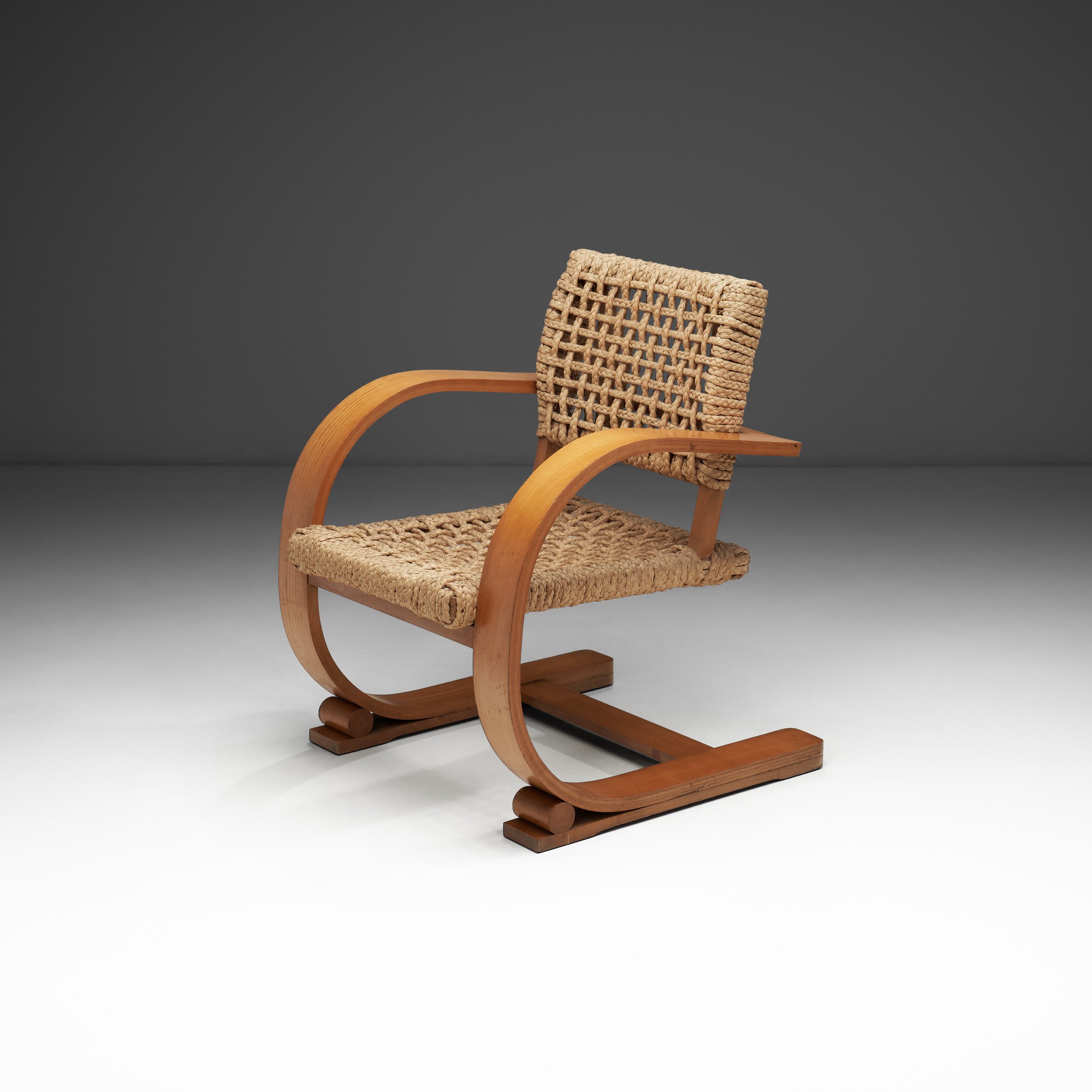
This armchair is a compelling embodiment of the French design duo Adrien Audoux and Frida Minet. Their design philosophy was centered around a commitment to accessible furnishing made out of natural materials that suit the rhythms of modern life. Active in mid-20th century France, they played a crucial role in shaping post-war design. Drawing inspiration from modernist movements, they steered the view of design towards a more functional, refined, and streamlined aesthetic.
This chair showcases excellent craftsmanship, care, and precision, visible in the smallest details of the design. The woven seat and backrest, composed of finely braided natural fibres, offer both support and comfort, gently adapting to the shape of the body for a relaxed resting experience. Unlike most chairs, this unique design does not utilise the typical four legs - instead, the structure flows seamlessly into a wide curve that comprises the frame and is the visual highlight of the chair’s form. The armrests appear to be curving down and back in two smooth lines, partially creating a supporting base. The structure of the base is further enforced by a stretcher between the two pieces of bentwood, enhancing stability. Another interesting design detail are the cylinder supports at the front where the arms and base meet, which act as a reinforcement while still maintaining harmony with the rest of the piece. This clever element helps to create a scooped base that supports the entire seat. The bent wood creates a fluid connection, giving the seat a sense of suspension - a light, almost floating presence - with the open surface of the seating and back further enhancing the airy characteristic of the armchair. Though the back rail is a separate piece between the two large curved elements it visually continues the line of the arms, creating the sense of a frame that gracefully encloses the seat.
The impressive silhouette of the armchair is defined by the choice of solid bentwood and woven rope as materials, and techniques that require expert skill, all poured into the final result to create this graceful form. The timeless appeal of this piece complements a wide range of interior styles, capable of transforming any environment with its organic appearance in both form and medium.
Condition:
In good vintage condition. Wear consistent with age and use.
Dimensions:
25 in W x 27.55 in D x 31.88 in H; Seat height 16.14 in
63.5 cm W x 70 cm D x 81 cm H; Seat height 41 cm
REQUEST PRICE HERE
Price category: 5,000 - 7,500 usd / eur
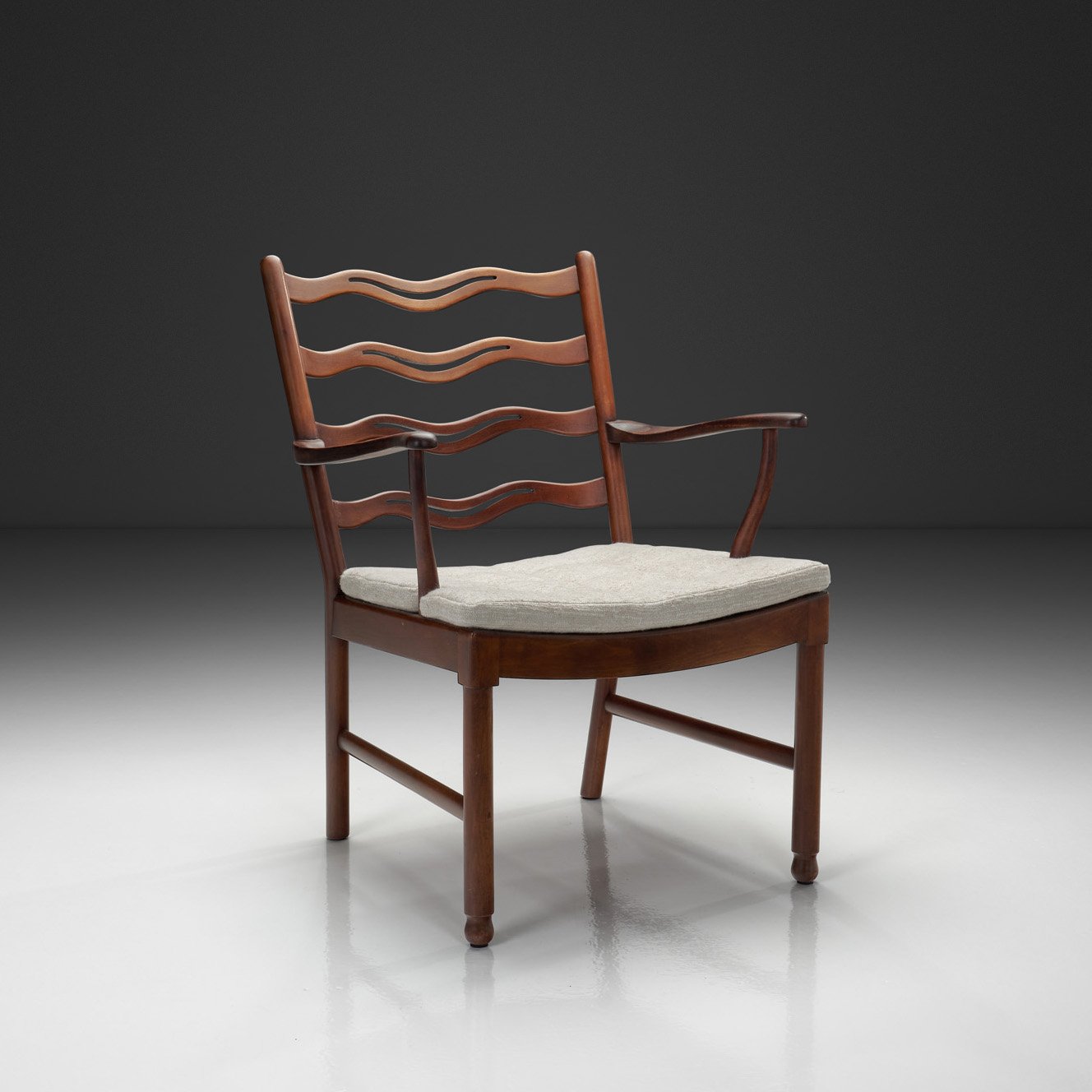
Ole Wanscher was one of the leading figures of 20th century Danish design. Trained as an architect and later a professor at the Royal Danish Academy of Fine Arts, Wanscher’s work is characterised by restraint, clarity, and a deep respect for craftsmanship. Makers like him believed that good furniture should feel appropriate in its proportions, neither excessive nor incomplete, and that belief is evident throughout his designs.
Model “1755” exemplifies this disciplined yet elegant approach. The chair’s back is composed of three gently undulating horizontal slats that introduce movement without disrupting the overall symmetry of the frame. These shaped rails provide ergonomic support while creating a subtle decorative rhythm across the backrest. The uprights are slightly tapered, lending lightness to the silhouette and preventing the form from feeling heavy. The arms extend from the back, curving forward in a subtle arc that supports the sitter while maintaining visual continuity with the backrest. Transitions and joinery are seamless and organic, demonstrating careful attention to structural flow. The legs are slender and proportioned with precision, connected by thin stretchers that reinforce stability without drawing attention away from the main lines. Every element feels considered, from the thickness of the rails to the spacing between slats, resulting in a chair that is visually calm yet structurally assured. The upholstered seat introduces a measured softness that balances the architectural clarity of the wooden frame. Its tailored form provides comfort while maintaining the light, refined character of the design.
Suitable for use at a dining table, desk, or as an occasional armchair, model “1755” reflects Wanscher’s enduring commitment to proportion, craftsmanship, and the thoughtful reinterpretation of historical furniture making within a modern context.
Condition:
In good vintage condition. Wear consistent with age and use. The chair has recently been reconditioned. Due to the nature and age of the wood, the chair may have some marks, scratches, and discolouration. The seat cushion was newly produced and upholstered in a premium fabric. Each of our items can be reupholstered by our in-house atelier in a fabric of choice. Please reach out for more information.
Dimensions:
24.60 in W x 26.37 in D x 33.85 in H; Seat height 17.12 in; Seat depth 19.68 in; Arm height 25.19 in
62.5 cm W x 67 cm D x 86 cm H; Seat height 43.5 cm; Seat depth 50 cm; Arm height 64 cm

REQUEST PRICE HERE
Price category: 5,000 - 7,500 usd / eur
Ergonomic in its structure, this mid-century armchair showcases the best characteristics of post-war Italian design. These postwar boom years of the 1950s through the 1960s were a greatly influential - and experimental - period for Italian creatives. Striking in its balanced proportions and clean architectural lines, this armchair was born of careful decision making, where every curve, joint and surface was conceptualised with comfort and sculptural grace in mind.
The elegant lines of the chair create a pleasing visual balance, a result of the gently rounded back and pointed wingback crown. The silhouette, with its open construction, is comprised of an enveloping back that flows down in a curve towards the generous seat, forming a cocoon for the sitter. Creating a welcoming impression, the sheltering arms hug the person even further, adding a further layer of relaxation. The arms, slightly overturning at the ends, unfold the form of the design and emphasise its openness and welcoming spirit even further. The dark, splayed legs ensure stability, and their minimal shape allow the chair’s body to shine as the focal point. Acting as complementary elements, the tapered legs on the bottom are in harmony with the sharp peaks at the top of the backrest. Meanwhile, along the midsection, the elegant overspill of the armrests traces the sides, opening up the structure and introducing another intriguing dimension that deepens the visual presence of the piece. The armchair is full of unique design elements, but rather than working against each other, they instead unify the design through their shared aesthetic characteristics. In their own unique way, these small details are striving for the same sophisticated style. Recently upholstered in premium fabric, the chair flourishes in a beautiful, neutral colour that complements any interior.
The subtle colour of the chair, combined with its elegant form, provides a beautiful visual cohesiveness. This armchair is not just a functional sitting element, but also brings its own refined character into the atmosphere of the room, making it simultaneously both charming and practical.
Condition:
in good vintage condition. Wear consistent with age and use. The chair has been reupholstered recently in a premium fabric. Each of our items can be re-upholstered by our in-house atelier in a fabric of choice. Please reach out for more information.
Dimensions:
33.07 in W x 31.49 in D x 40.55 in H; Seat height 15.15 in; Seat depth 18.70 in; Arm height 21.45 in
84 cm W x 80 cm D x 103 cm H; Seat height 38.5 cm; Seat depth 47.5 cm; Arm height 54.5 cm
REQUEST PRICE HERE
Price category: 5,000 - 7,500 usd / eur
Art Deco seating developed around a balance between modern construction and a more decorative approach to form. While earlier movements prioritised either ornament or strict function, Art Deco combined the two through geometry, symmetry, and the use of rich materials. Upholstered armchairs from this period often feature materials such as velvet, wood, and metal, used alongside bold shapes to create contrast while maintaining cohesion.
This armchair reflects that approach through its clear form and combination of upholstery with wooden detailing. The chair has thick armrests and a plush seat that allows for a stable and comfortable sitting position. The upholstery is fitted across the frame, with the material itself contributing to both comfort and appearance. A defining feature is the vertical wooden detailing integrated into the sides of the chair. This element introduces a contrasting material while also breaking up the otherwise smooth upholstered surfaces. The vertical flute reinforce a sense of rhythm and geometry that aligns with Art Deco’s signature characteristics. At the same time, they provide a visual transition between the soft fabric and the short feet that anchor the piece. Chromatically, the burnt orange of the textile and the warm tone of the wood come together to create a cosy, comforting look.
This chair combines a functional form with careful detailing, highlighting the artistry and timeless craftsmanship of an era that valued glamour and luxury as well as usability. It will work perfectly as an accent piece in a home, offering a clear, structured presence within an interior.
Condition:
In good vintage condition. Wear consistent with age and use. The item has recently been reconditioned. Due to the nature of the material, the item may have some marks, scratches, and discolouration. The item has recently been reupholstered in a premium fabric. Each of our items can be reupholstered by our in-house atelier in a fabric of choice. Please reach out for more information.
Dimensions:
33.85 in W x 35.82 in D x 29.72 in H; Seat height 19.48 in; Seat depth 23.22 in; Arm height 24.60 in
86 cm W x 91 cm D x 75.5 cm H; Seat height 49.5 cm; Seat depth 59 cm; Arm height 62.5 cm