
Mogens Lassen Stool in Solid Teak Mounted on Three Tapering Legs, Denmark 1942 (sold)




Mogens Lassen Stool in Solid Teak Mounted on Three Tapering Legs, Denmark 1942 (sold)
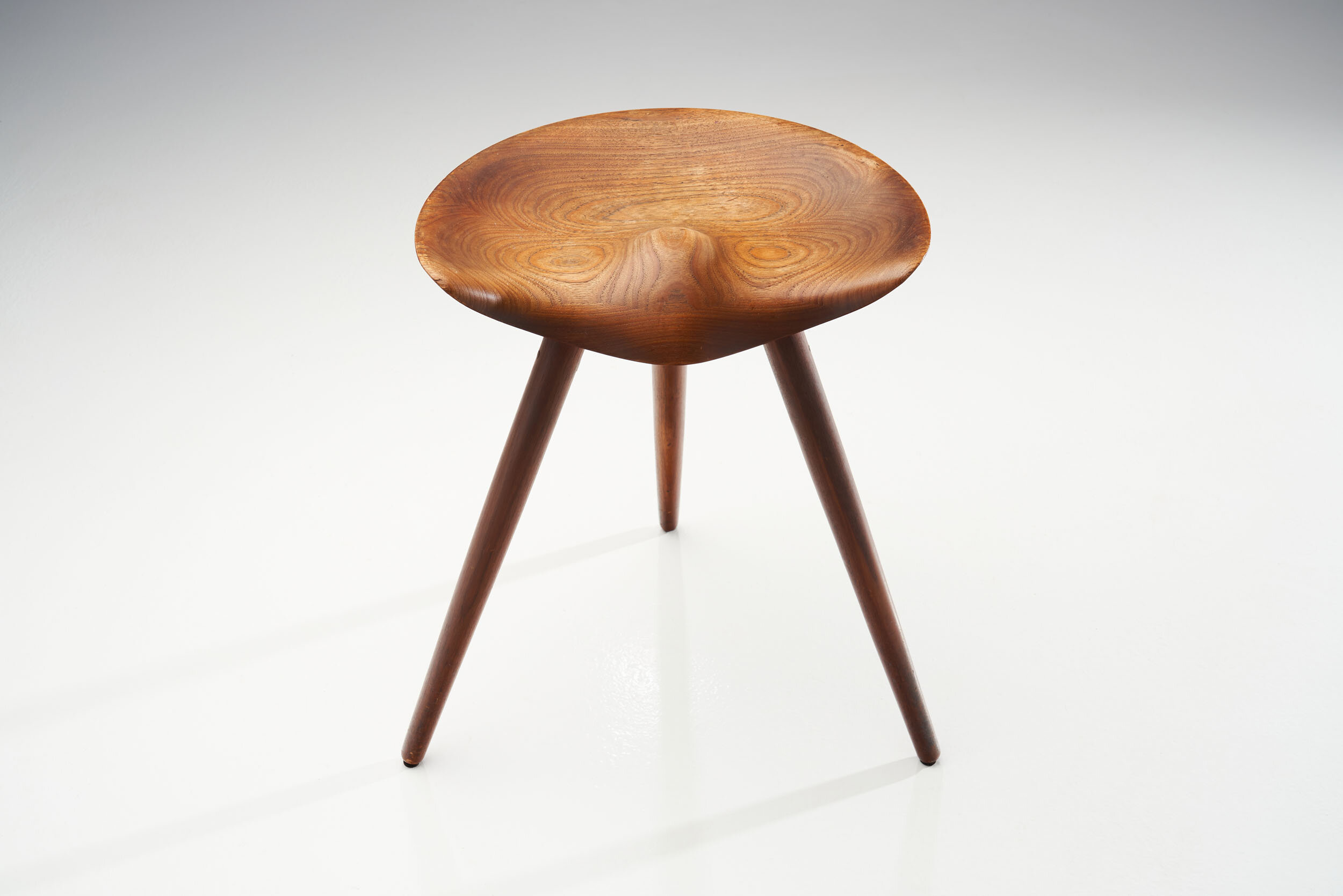
This stool was designed in 1942, and at the time the design was simply called “Taburet” (Stool in Danish), for as this model is well-known as “the stool” of Mogens Lassen. The three-legged design was inspired by a traditional cobbler’s stool, which is reflected in the seat’s ergonomic design. The legs are tapered, providing a firm base for the seat.
This mid-century piece has the main characteristics Danish design is famous for. From the sculptural shape to the functional design and the high quality of the material, this stool is the work of a master craftsman.
The stool was originally produced by Danish Snedkermester (cabinet maker) K. Thomsen, but it is now back in production by ‘by Lassen Denmark’ under the name ML42 stool. However, the new edition stools are not manufactured in the original wooden materials of teak and mahogany; therefore, the value is not the same. This stool is from the original manufacturer, marked with K. Thomsen’s label, and is made of solid teak, making it a real treasure.
SOLD
Condition:
In good vintage condition. Beautiful patina on the seat. Wear consistent with age and use. The seat has minor chips. The top of one of the legs has a small, another has a minor crack.
Dimensions:
17.72 in W x 12.21 in D x 20.08 in H; seat height 20.08 in
45 cm W x 31 cm D x 51 cm H; seat height 51 cm
Exhibition:
Model presented at The Copenhagen Cabinetmakers' Guild Exhibition at Designmuseum Danmark, 1942.
Literature:
Grete Jalk - 40 Years of Danish Furniture Design, vol. 2, p. 185.
Arkitekten Mogens Lassen, Lisbet Balslev Jørgensen, ill. p. 39.
Per H. Hansen, Klaus Petersen - 300 danske designmøbler, Lindhardt og Ringhof, 5 Nov 2015. Section 16.
About the designer:
Architect and designer Mogens Lassen (1901-1987) is among the most influential Danish architects and is internationally acknowledged as a pioneer of Danish Functionalism. His architectural designs are regarded as iconic, nevertheless, along with his brother, Flemming Lassen, he also left his mark in history as a furniture designer.
Mogens Lassen trained as a mason before starting his studies at the Royal Danish Academy of Fine Arts in 1923. Following his graduation, he underwent further architectural training in Copenhagen and started his own design studio in 1935. While he was primarily occupied with architectural design, Lassen was also a keen furniture designer. His exceptional craftsmanship and pursuit for simplicity resulted in steel-based pieces that influenced the modernist movement in the 1930s. His later designs focused on wooden pieces and quickly became part of classical Danish Modern, particularly his three-legged stool (1942) and Egyptian folding table (1940). Apart from furniture, Lassen also designed accessories, the most famous being the Kubus line, with the Kubus candlestick, that has become an icon of Danish design. In 1971, Mogens Lassen was awarded the C.F. The Hansen Medal.
The grandchildren and grand-grandchildren of Lassen established the design company By Lassen in 2008 to honour the work of Mogens Lassen and his brother Flemming Lassen. ~H.
REQUEST PRICE HERE
Price category: 5,000 - 7,500 usd / eur
Belgian Brutalist furniture design in the 20th century mirrored the country's complex cultural and political tapestry. Nestled between the influences of neighbouring European design powerhouses, Belgian designers carved a distinctive niche that blended functionality with an uncompromising commitment to artistic expression.
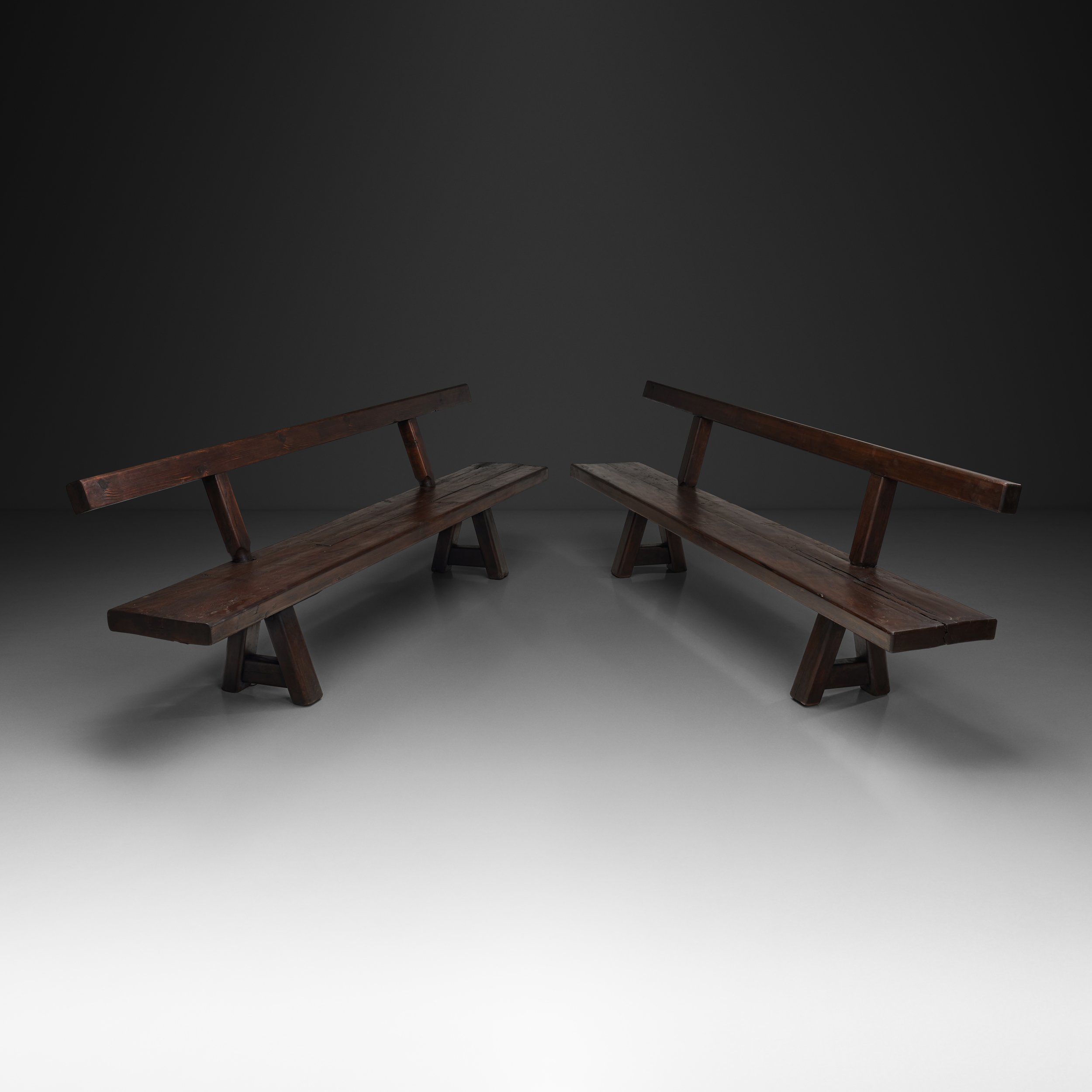
The Brutalist movement, though often associated with architecture, influenced furniture makers who explored volume, geometry, and materials to create designs that were both functional and sculptural. Emerging during the mid-twentieth century, the movement favoured solid timber, bold proportions, and exposed joinery, allowing the inherent qualities of the mediums to shape the final design. These benches are distinguished by their commanding simplicity. Broad solid oak planks form both the seats and backrests, their dimensions conveying a sense of strength. The design is defined by the long horizontal lines, the impeccable joinery, and the natural, raw beauty of the oak. The backrests appear to hover above the seats on diagonal supports. The natural splits, knots, and variations in the grain have been preserved on the surface through the passage of time, reinforcing the individuality of each bench and highlighting the character of the oak. The dark tone further enriches the look, lending depth to the broad surfaces while accentuating the tactile quality of the material. These benches can be incorporated into any space thanks to their classic look, not to mention the functionality.
Whether placed opposite one another, alongside a dining table, or within an entrance hall, the pair possesses a sculptural presence that extends beyond their practical function. Their restrained vocabulary reflects the essence of Belgian Brutalist design without excess or embellishment.
Condition:
In good vintage condition. Wear consistent with age and use. The benches have recently been reconditioned. Some cracks are present. Due to the age and nature of the wood, the items may have marks, scratches, and discolouration.
Dimensions:
Bench 1
98.22 in W x 17.71 in D x 31.10 in H; Seat Height 16.14 in; Seat Depth 14.17 in
249.5 cm W x 45 cm D x 79 cm H; Seat Height 41 cm; Seat Depth 36 cm
Bench 2
98.42 in W x 18.89 in D x 30.51 in H; Seat Height 15.94 in; Seat Depth 14.56 in
250 cm W x 48 cm D x 77.5 cm H; Seat Height 40.5 cm; Seat Depth 37 cm
REQUEST PRICE HERE
Price category: 5,000 - 7,500 usd / eur
This pair of barstools showcase the Danish principles of interior design: careful proportions, high-quality materials, and an emphasis on functionality. The result was seating models that felt refined enough for domestic settings while retaining the simplicity and durability required for everyday use.
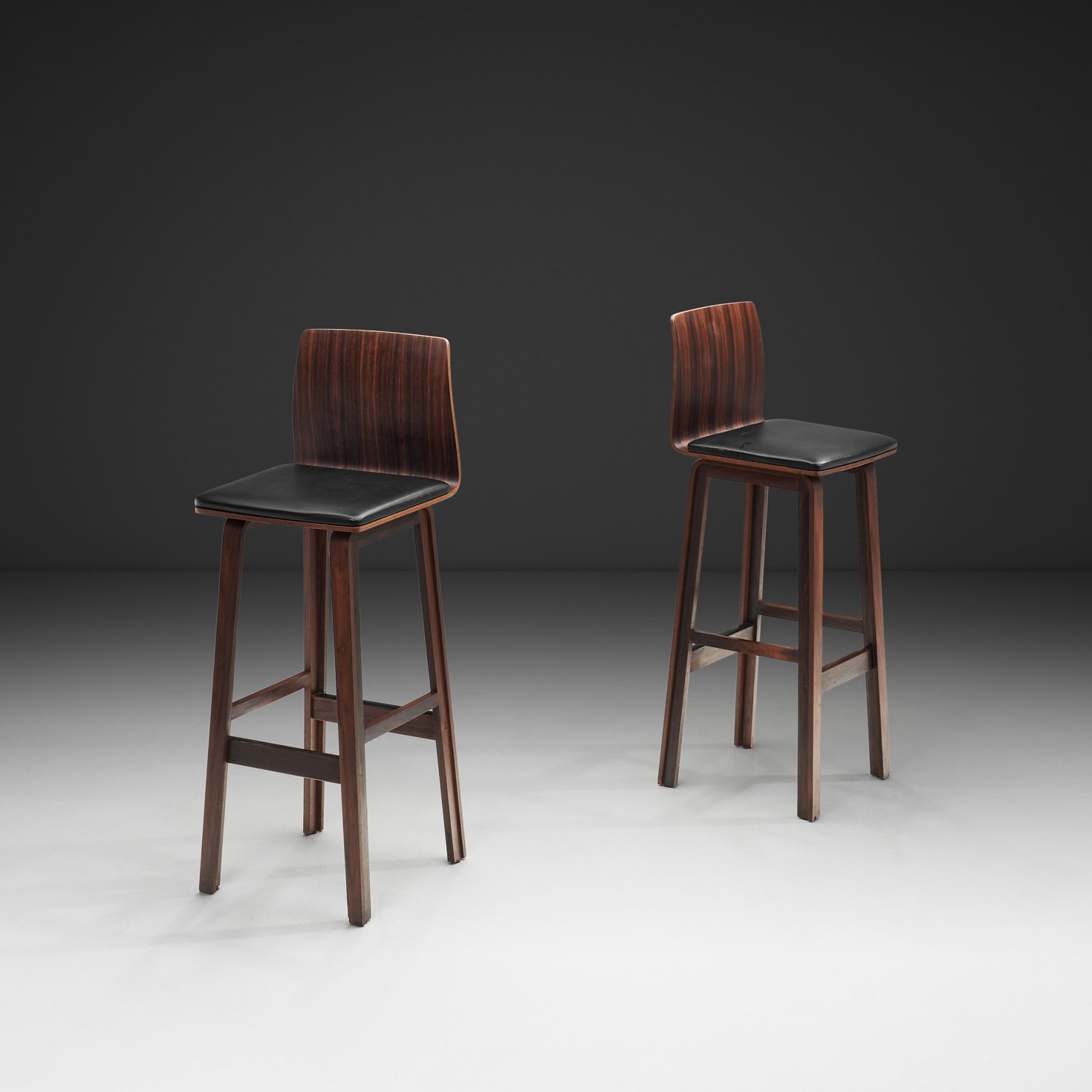
Designers in the post-war period focused on simple, well-made pieces of home-grown and exotic woods alike. Made from richly grained wood, these stools embody the perfect balance of detail and minimalist design. A striking contrast between materials defines the character of this pair. The warm-toned wooden frames and veneered backrests are paired with black leather seats, creating a composition that feels both elegant and inviting. The bent base provides visual softness and ergonomic support, while the slim legs and stretchers maintain an elegant, lightweight profile. Particularly appealing is the way the grain of the wood flows across the backs, introducing movement and depth to an otherwise restrained silhouette. The leather seats add another layer of texture, their dark surfaces grounding the composition and emphasizing the richness of the wood. Defined by clean, smooth lines, and excellent joinery, each of these stools was evidently created by skilled craftsmen.
Placed at a kitchen counter, bar, or high dining table, the pair brings a distinctly Scandinavian sense of ease to an interior. More than simply elevated seating, they reflect the Danish talent for creating furniture that is practical, comfortable, and quietly sophisticated, sure to appeal to generations.
Condition:
In good vintage condition. Wear consistent with age and use. The stools have recently been reconditioned. Due to the nature and age of the materials, some marks and scratches are present. The seats come with their original leather or have been reupholstered by a previous owner, and show some signs of use and minor scratches. Each of our items can be reupholstered by our in-house atelier in a fabric of choice. Please reach out for more information.
Dimensions:
14.37 in W x 13.58 in D x 39.57 in H; Seat Height 29.92 in; Seat Depth 12.20 in
36.5 cm W x 34.5 cm D x 100.5 cm H; Seat Height 76 cm; Seat Depth 31 cm
REQUEST PRICE HERE
Price category: 2,500 - 5,000 usd / eur
Brutalist furniture emerged as a reaction against refinement and ornament, favouring instead expressive raw materials. Designers and artisans embraced rough textures, asymmetry, and forms that appeared almost primitive in their honesty. While many Brutalist pieces relied on heavy geometric volumes, others explored a more organic language, drawing inspiration from nature and hand-carved objects. Chairs such as this example blur the boundary between furniture and sculpture, where utility merges with artistic expression.
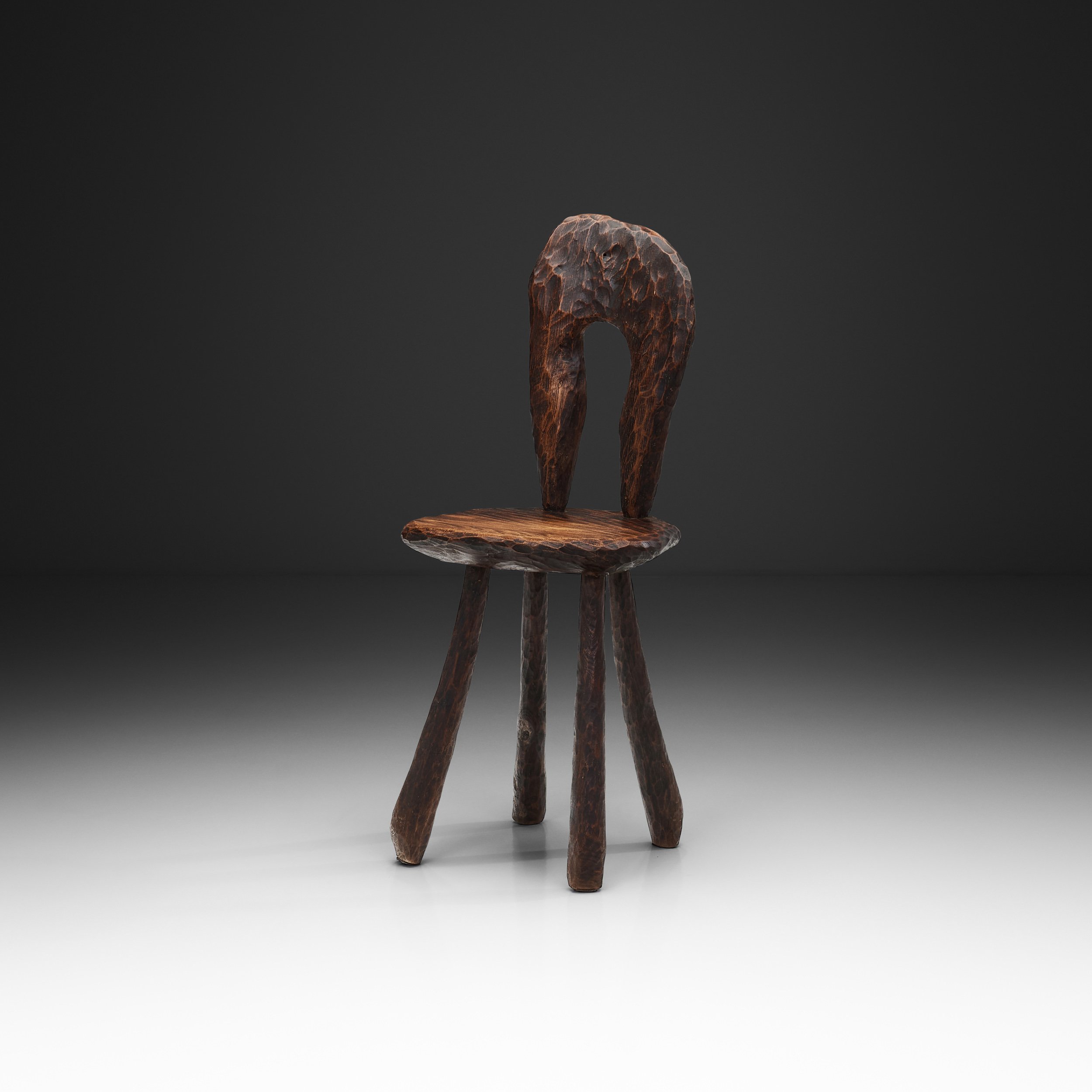
This side chair stands out through its highly sculptural presence and deeply textured surface. Hand-carved from solid wood, the chair preserves a raw and tactile character throughout its form. The seat is formed as a hand carved, rough disc, supported by four irregular legs that taper organically towards the floor. Above, the backrest rises in a dramatic arched form, creating a silhouette that immediately draws the eye. The uneven contours, visible tool marks, and richly textured surface give the piece a sense of organic flow and individuality, ensuring that no two pieces are entirely the same. Rather than concealing the making process, the chair celebrates it, allowing every carved ridge to become part of its visual identity. The dark patinated wood further enhances this effect, creating depth across the surface and accentuating the sculptural quality of the design. Despite its unconventional appearance, the chair balances visual drama with functionality.
More than a seating piece, this chair functions as a work of art. Its expressive form allows it to stand alone as a statement object while still serving its practical purpose. The combination of raw craftsmanship, organic shaping, and Brutalist sensibility offers the chair a powerful presence.
Condition:
In good vintage condition. Wear consistent with age and use. The chair has recently been reconditioned. Minor marks, scratches, and discoloration.
Dimensions:
13.78 in W x 13 in D x 33.07 in H; Seat height 17.72 in; Seat depth 12.60 in
35 cm W x 33 cm D x 84 cm H; Seat height 45 cm; Seat depth 32 cm
REQUEST PRICE HERE
Price category: 2,500 - 5,000 usd / eur
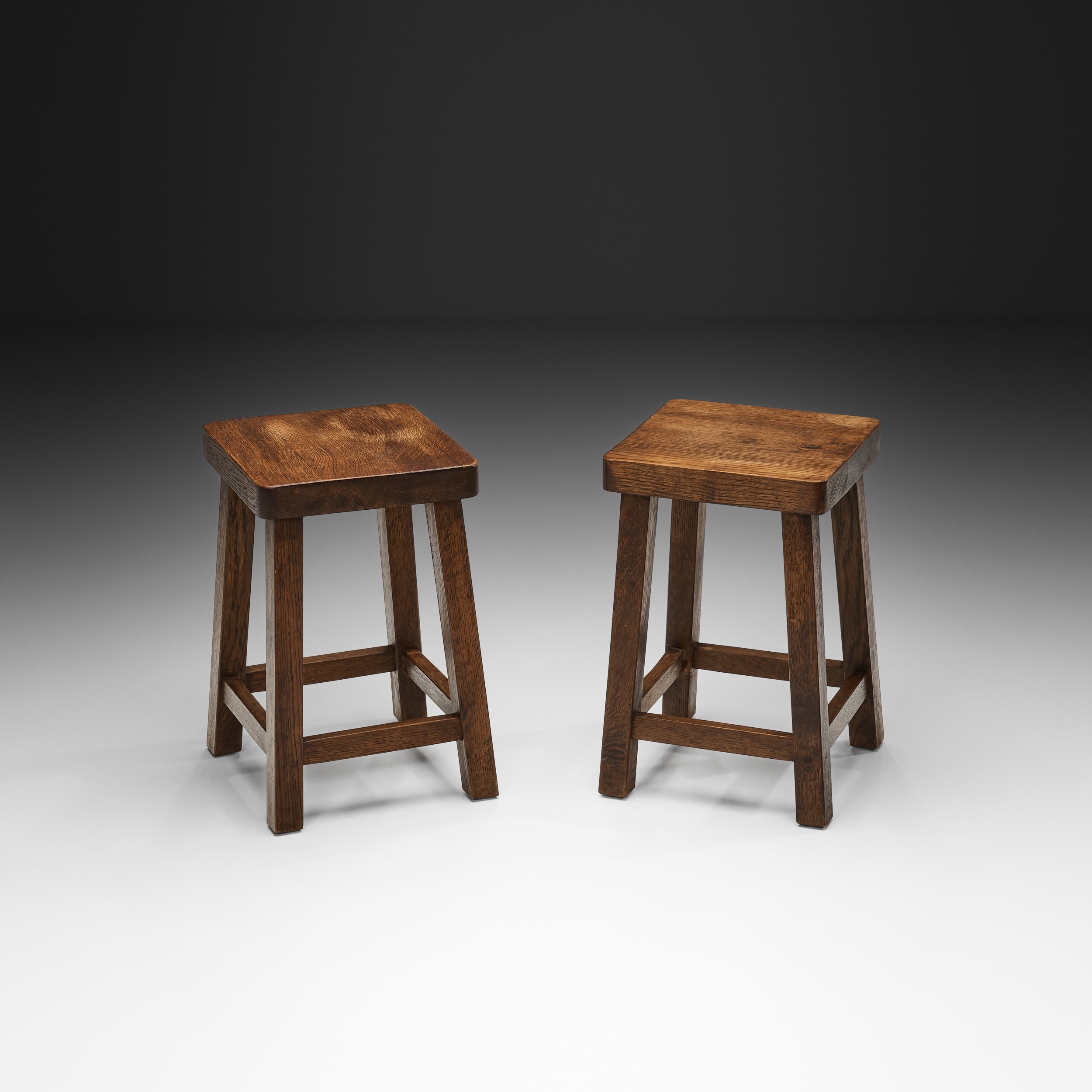
Throughout the mid-20th century, European cabinetmakers continued to draw on traditional woodworking techniques while embracing the cleaner silhouettes associated with modern design. Smaller utility pieces from this period, such as this pair of stools, serve a variety of functions while maintaining the same attention to proportion and material quality found in larger furnishings. Their simplicity allowed the beauty of the wood and the skill of the maker to take centre stage.
Reduced to only the necessary elements, this pair showcases the quality of the timber, the precision of the joinery, and the maker's understanding of proportion. Crafted from solid wood, each stool is defined by a compact square seat supported by four gently splaying legs. The construction is straightforward, yet the clear lines and strong craftsmanship prove their quality. Beneath the seats, stretchers connect the legs on all sides, reinforcing the structure while creating a pleasing geometry. These elements not only contribute to the stability of the stools but also add depth and visual interest to the otherwise minimal silhouette. The slightly softened edges of the seats balance the angular construction, preventing the design from feeling austere. The understated appearance of the stools allows the material itself to become the focal point, showcasing the character and natural variation of the wood.
Versatile and enduring, these stools function equally well as occasional seating, side tables, or decorative accents within an interior. Their uncomplicated form allows them to integrate effortlessly into a wide variety of settings, from rustic and traditional spaces to more contemporary environments.
Condition:
In good vintage condition. Wear consistent with age and use. The stools have recently been reconditioned. Some minor chips are present. Due to the nature and age of the material, the items may have some marks, scratches, and discolouration.
Dimensions:
12 in W x 11.61 in D x 18.89 in H
30.5 cm W x 29.5 cm D x 48 cm H
REQUEST PRICE HERE
Price category: 2,500 - 5,000 usd / eur
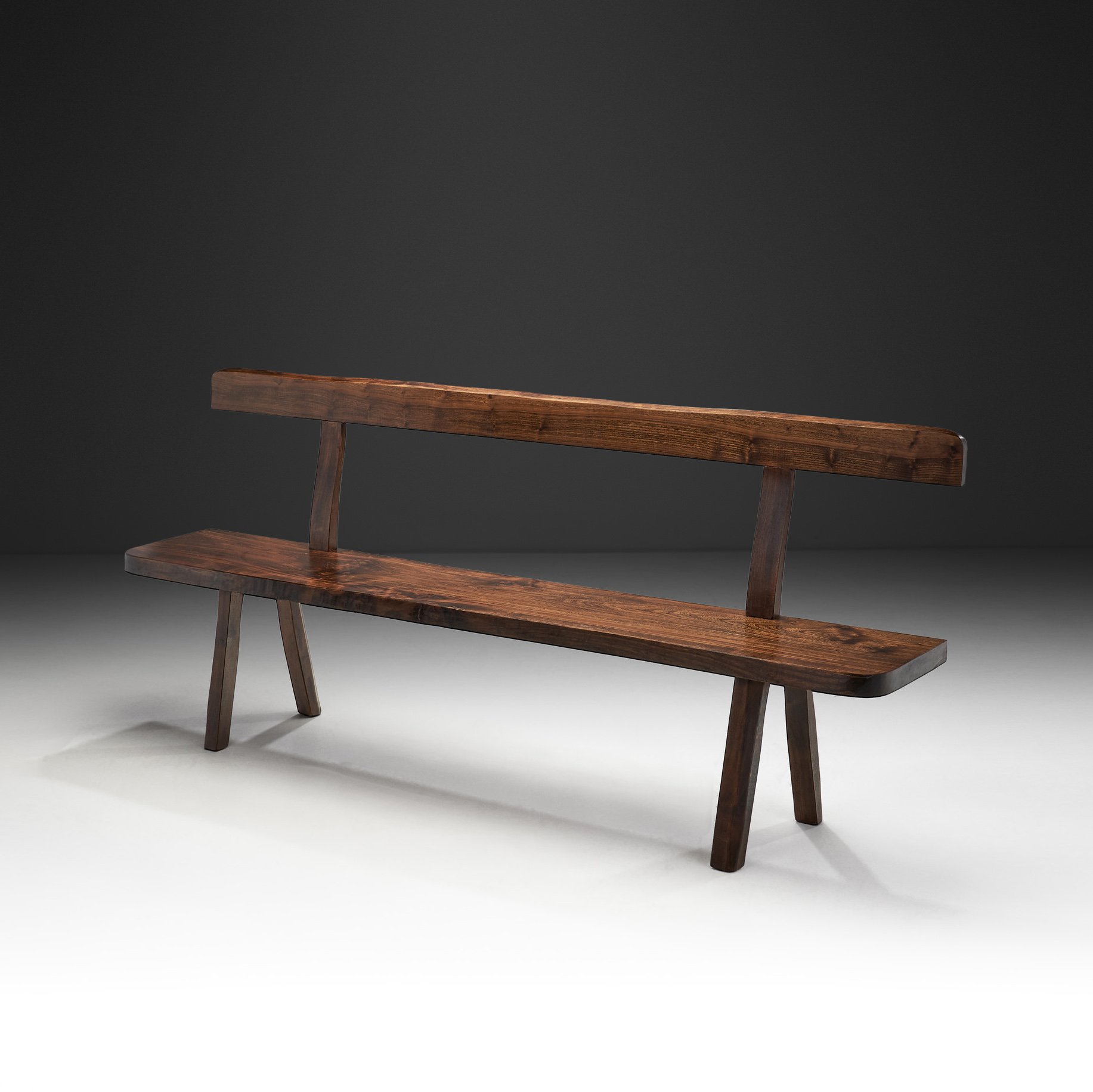
The 1950s in France was a very versatile decade, the era’s design projects had a wide range both aesthetically and material wise. The modernist solid wood models were mostly created by hand, including this bench, showing the organic and modern approach to design.
This bench has an almost brutalist look that allows the distinctive back and the stained elm wood to guide the design. The design is defined by the long horizontal lines, the impeccable joinery, and the natural, raw beauty of the material. It can be incorporated into any space thanks to its classic look, not to mention its functionality; benches in general can be placed in any space, including the living room, bedroom, hallway or even outside. The design has a startling rawness and has a preference for the material to set the tone of the overall aesthetic, which is somber, giving importance to the craftsmanship that formed it into its eerie organic shape. French furniture manufacturers are still regarded as some of the best of the mid-century era and are especially known for impeccable joinery and woodwork (think Guillerme et Chambron or Pierre Chapo for example).
The designer generation active during the mid-20th century created some of the most iconic wooden furniture designs of the whole century. This Aranjou edition table is a beautiful example of how successfully they managed to merge traditional craftsmanship and materials with an essentially modern approach to design.
Condition:
In good vintage condition. Wear consistent with age and use. Some small marks on the wood.
Dimensions:
78.74 in W x 16.53 in D x 33.85 in H; Seat height 17.32 in
200 cm W x 42 cm D x 86 cm H; Seat height 44 cm
REQUEST PRICE HERE
Price category: 1,000 - 2,500 usd / eur
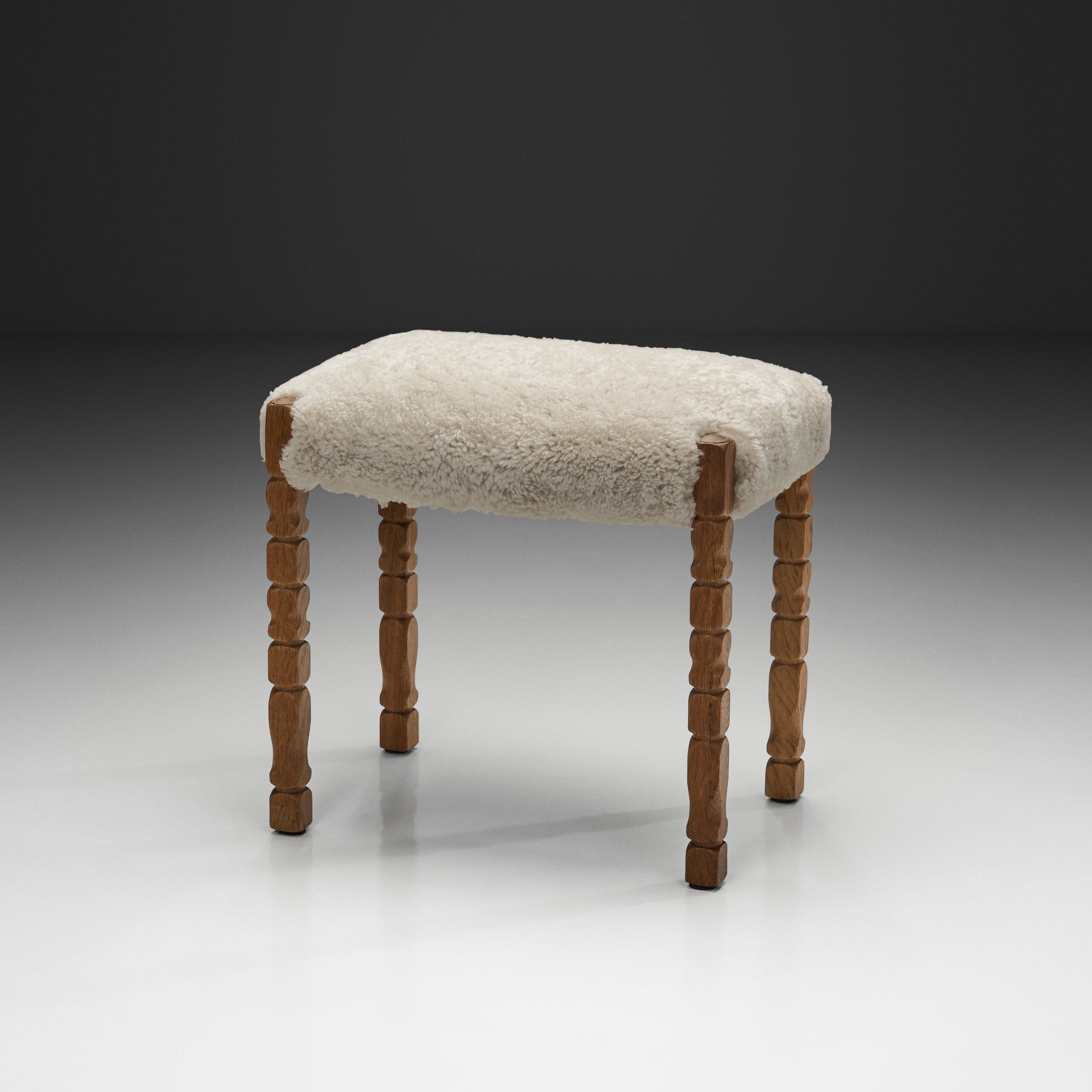
Danish furniture from the 1970s saw an interest in craftsmanship and natural materials, moving away from strict industrial modernism toward pieces with a more tactile and handmade character. This oak stool reflects the cabinetmakers’ interest in highlighting the texture of wood through carving, turning, and exposed grain, while materials such as sheepskin and wool were introduced to soften otherwise simple constructions.
Rather than concealing elements of the construction process, pieces from this period embraced it, allowing hand-worked details to become part of the final expression. This stool showcases the contrast between its heavily carved legs and soft sheepskin seat. The frame is constructed through essential elements: four turned legs supporting a thick upholstered top. Each leg is individually worked with rounded carvings that create a rhythmic appearance, giving the otherwise compact stool a strong sculptural quality. The oak retains a warm natural tone that highlights the carving and the variation in the grain. Above, the padded seat is upholstered in cream sheepskin, introducing a different texture to the composition. The wool surface softens the geometry of the wooden structure and gives the piece a tactile warmth. Thanks to the upholstery, the stool gains a fuller and more relaxed silhouette despite its minimal construction.
The balance between rough carved wood and soft sheepskin gives the piece its timeless appeal. This piece functions as extra seating, a footstool, or as a small accent, while still carrying the material richness and presence of Scandinavian furniture of the period.
Condition:
In good vintage condition. Wear consistent with age and use. The stool has recently been reconditioned. Due to the age and nature of the wood, the item may have some marks, scratches, and discolouration. The piece has recently been reupholstered in premium sheepskin. Each of our items can be reupholstered by our in-house atelier in a fabric of choice. Please reach out for more information.
Dimensions:
19.69 in W x 13.78 in D x 18.51 in H
50 cm W x 35 cm D x 47 cm H

REQUEST PRICE HERE
Price category: 9,000 - 12,500 usd / eur
The postwar boom years of the 1950s through to the 1960s were one of the periods of the greatest influence of Italian designers. Design in the 50s paved a way to a more aesthetic approach to products as opposed to more utilitarian predecessors, resulting in exceptional pieces like this piece.
This bench features elegant and measured proportions, balanced compositions, and refined décor elements including the choice of materials. The outline is quite sculptural, with characteristic curved shapes. The details set the piece apart from most benches and sofas, and transforms it into a statement piece which can break the monotony of any space. The seats are upholstered in a high-quality fabric that exudes both comfort and luxury, with a soft textural feel that invites relaxation. The stained dark colour stands out beautifully against the upholstery and emphasizes the slim shape of the backrest. With a clear preoccupation with geometry, this model’s outstanding architectural frame speaks of the mastery of the designer and of the producer. All the decorative elements are in service of the piece’s functionality. Moreover, the smooth, tapered legs typical of the period, contribute to both a sense of lightness and sturdiness. The Italian craftsmanship that went into creating this piece is nothing short of exceptional. Each part of the bench was carefully crafted, the joinery is also exemplary of the skill of the artisans who meticulously shaped the wood frames to fit seamlessly together.
Though many mid-century Italian designers may not have the same name recognition as some of their Scandinavian counterparts, they were integral to developing a modern aesthetic in Europe. The appreciation for their contribution is still growing today, making outstanding Italian pieces like this modular bench highly sought after.
Condition:
In good vintage condition. Wear consistent with age and use. This bench comes with its original upholstery or has been reupholstered by a previous owner. Each of our items can be reupholstered by our in-house atelier in a fabric of choice. Please reach out for more information.
Dimensions:
72.44 in W x 56.29 in D x 37.79 in H; Seat height 21.06 in; Seat depth 16.93 in
184 cm W x 143 cm D x 96 cm H; Seat height 53.5 cm; Seat depth 43 cm
REQUEST PRICE HERE
Price category: 7,500 - 10,000 usd / eur
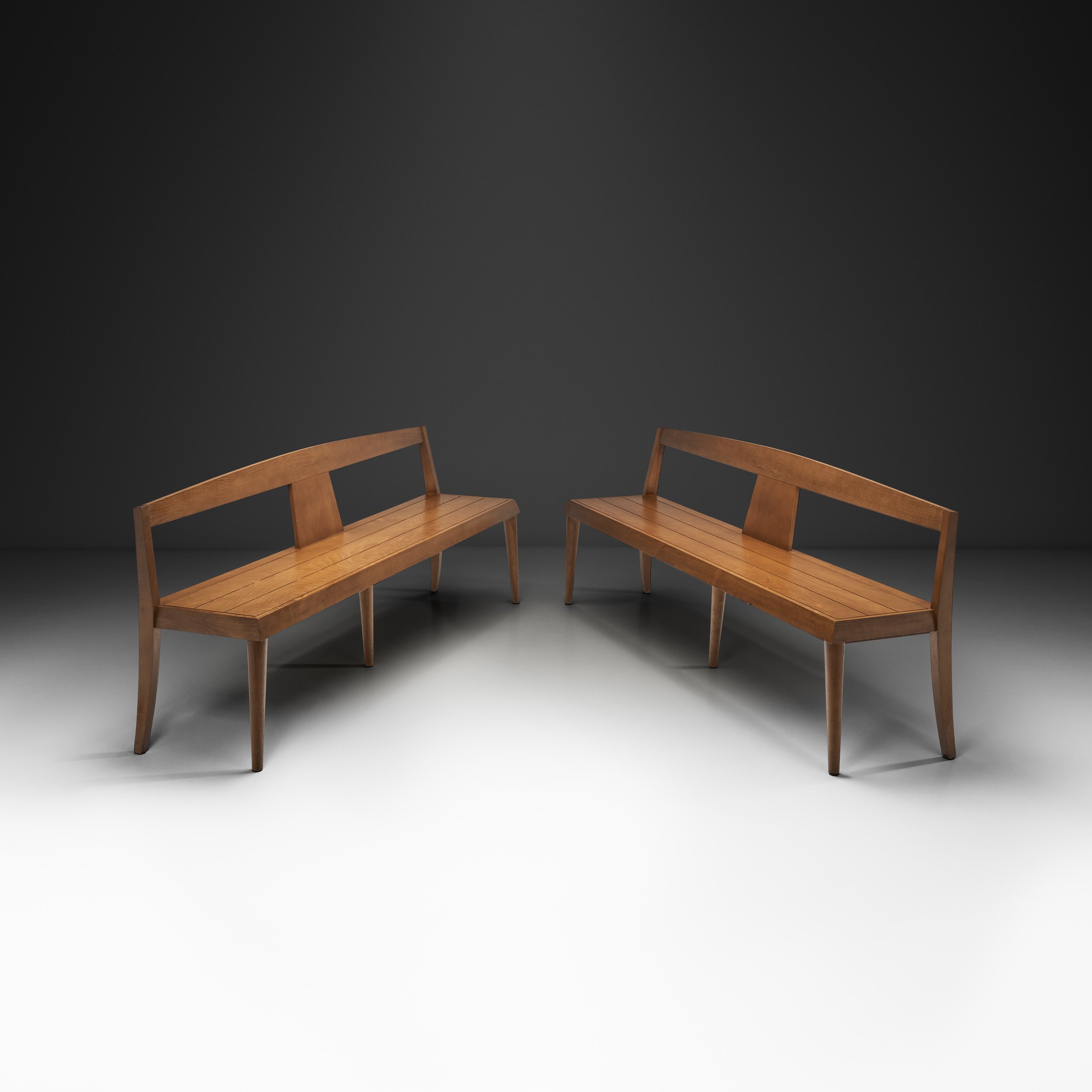
Mid century modern design in Europe was driven by a desire to balance comfort, clarity, and everyday use. Emerging after the Second World War, it favoured honest materials, soft sculptural forms, and furniture that felt functional yet welcoming. Designers moved away from heavy ornamentation and instead focused on proportion, tactility, and a focus on how pieces work within a space.
In recent years, benches have become a popular choice in home décor. Of course, a bench’s primary purpose is to provide a convenient and comfortable place to sit. However, a pair, such as this beautiful wooden model, can also be used as an interior decorative element. With a clear preoccupation with geometry, this model’s outstanding architectural frame speaks of the mastery of the designer and of the producer. The wooden frame is outstanding, both in visual and technical terms. Each bench features a softly curved backrest that offers both comfort and rhythm, accentuated by a middle slat for subtle texture and visual warmth. The form of the backs gives the pieces a sculptural quality, inviting the sitter into a posture that feels both natural and upright. The light colour and the slender lines that make up the benches create an airy feeling, while also retaining an overall impression of strength and durability. The neat finish also further emphasises the beautiful grain pattern and warm tones of the wood giving the piece a rich, inviting appearance.
With the major rise in popularity that mid-century modern experienced, it’s easy to see touches of the style in contemporary homes. The natural and unfading beauty of wood, and the understated, but ingeniously stylish design is timeless of the era. With an outstanding balance of straight and curved lines, quality materials, and unmistakably modern design elements, this pair of benches is sure to provide a stylish touch to any interior.
Condition:
In good vintage condition. Wear consistent with age and use. The benches have recently been reconditioned. The finish differs slightly in each bench. Visible scratches and dents are present. Due to the nature and age of the wood, the items also have some marks and slight discolouration.
Dimensions:
72.83 in W × 18.11 in D × 30.51 in H
185 cm W x 46 cm D x 77.5 cm H
REQUEST PRICE HERE
Price category: 9,000 - 12,500 usd / eur
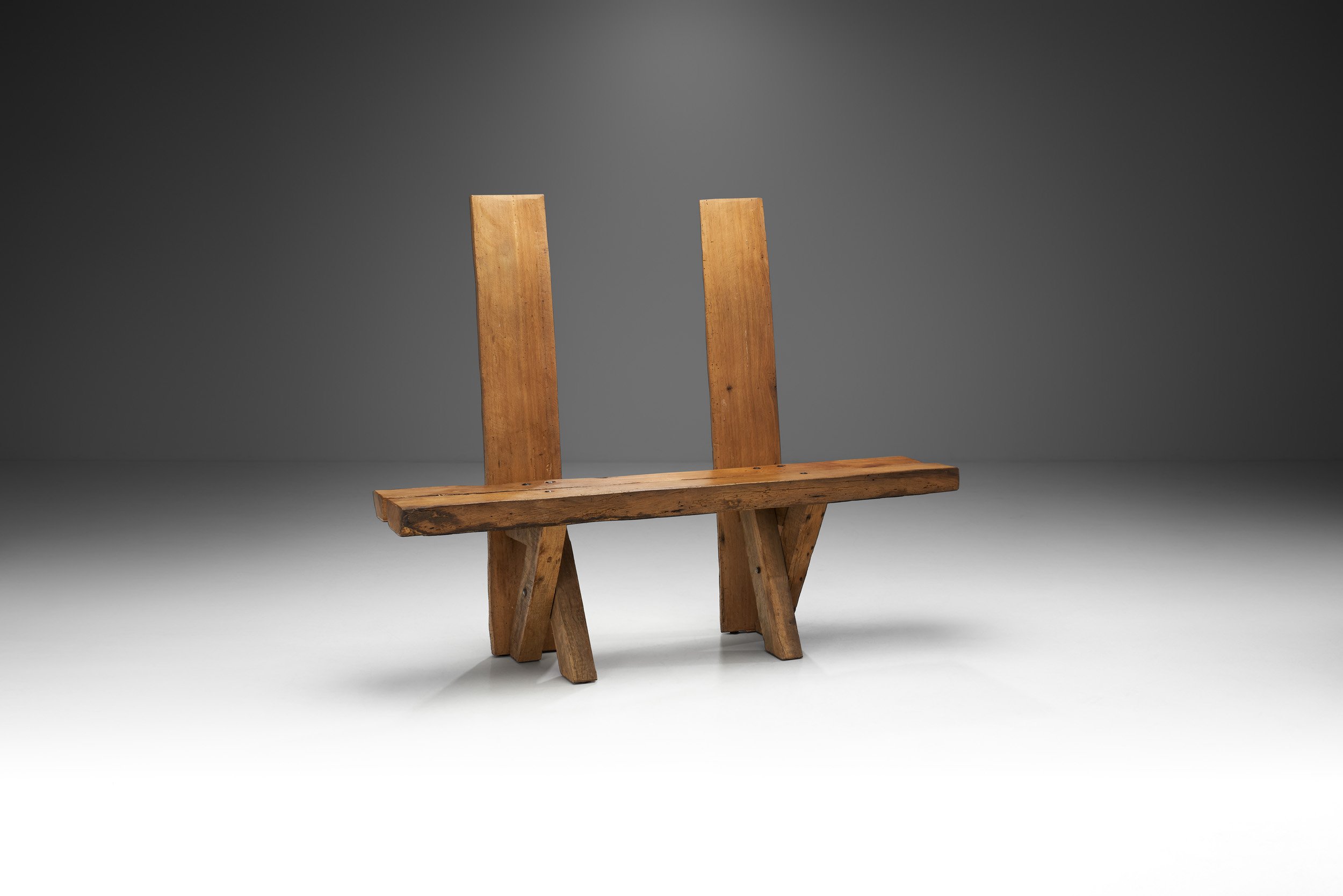
The term brutalism — which derives from the French word brut, meaning “raw” — was originally coined to describe an architectural style that emerged in the 1950s featuring monumental buildings, usually made of unornamented concrete, whose design was meant to project an air of strength and solidity. Similarly, in furniture design Brutalism inspired designers to create models with the same look of strength and style.
This rare Jean & Sébastien Touret oak bench is a beautiful example of this design movement, with a clear emphasis on the material’s natural qualities. This bench was created for a religious community of Loir et Cher -a department in the Centre-Val de Loire region of France - from oak of the property.
The duo’s design has a strong architectural approach, and while it is very sturdy on first sight, the outstanding execution of the legs and the natural appeal of oak make this bench the embodiment of creative, elegant design. Much like in architecture, brutalist furniture has organic, unpolished shapes. The seat and back planks of this bench exemplify this characteristic, with uneven edges, letting the natural qualities of the oak shine. The use of the sizeable pieces of oak wood with a beautiful grain, and the visible joints and bolts give this bench a natural, elemental feeling. The body was created employing the “bois arraché technique”, a finishing method by which lacquer is rubbed onto wood.
It might go unnoticed, but nowadays, brutalist furniture is part of any modern interior design project. In the same fashion, glimpses of brutalist interior design are found in top interior design projects. Think about Kelly Wearstler‘s interior design projects, where both on residential and commercial interior design projects, the popular interior designer integrates brutalist furniture. Nevertheless, like Wearstler, most designers prefer brutalist furniture with organic shapes, just like this oak bench.
Condition:
In good vintage condition. Wear consistent with age and use. Some scratches on the wood and old woodworm marks.
Dimensions:
55.11 in W x 18.11 in D x 44.68 in H; Seat height 16.92 in
140 cm W x 46 cm D x 113.5 cm H; Seat height 43 cm
REQUEST PRICE HERE
Price category: 2,500 - 5,000 usd / eur
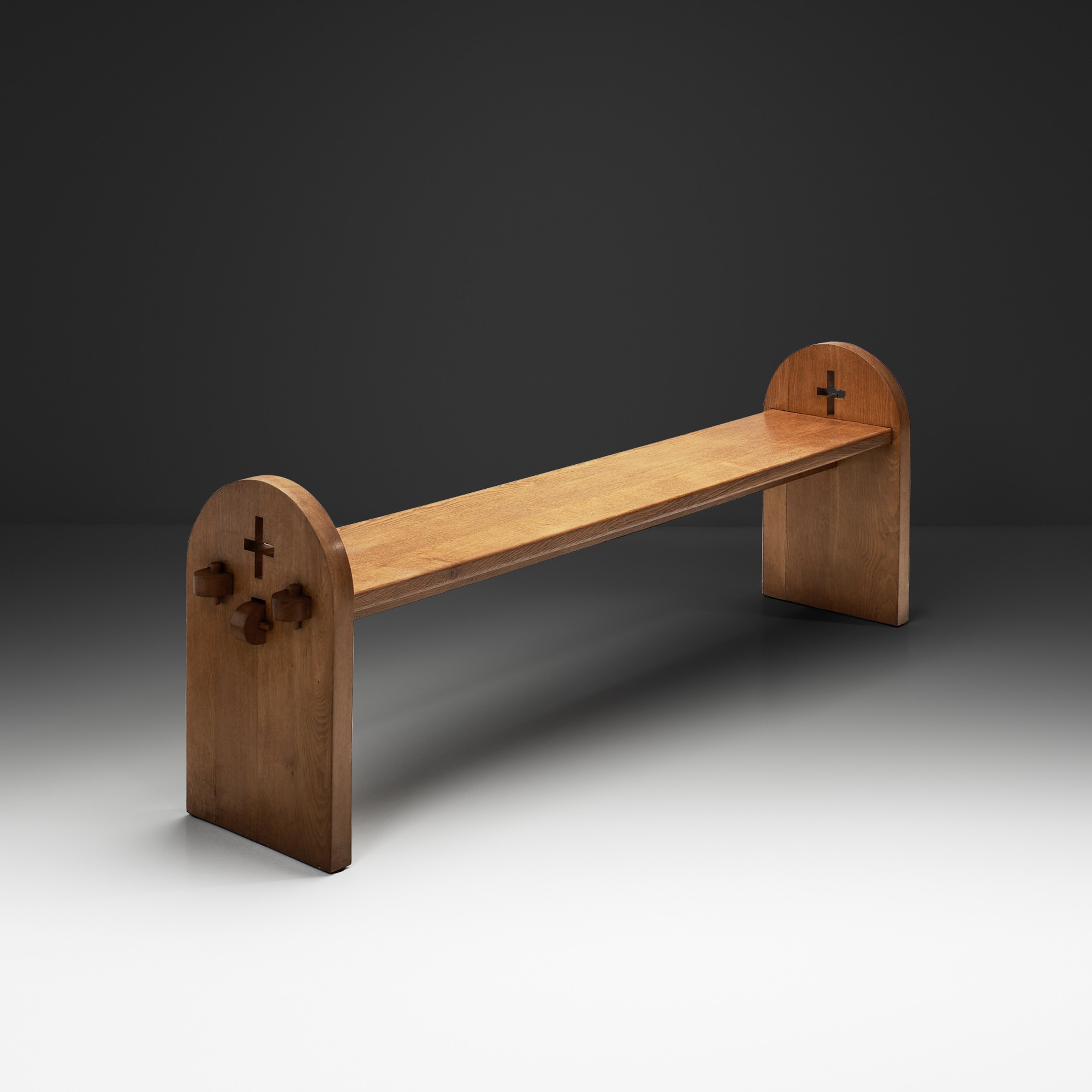
Many major interior design companies have released their own bench models, but it is hard to live up to the wooden pieces created in the mid-20th century. This oak bench is dominated by two elements: its material and the master joinery techniques.
Oak was the preferred material for many craftsmen in the mid-20th century, and in creating this piece, the maker of this bench has expertly showcased its rich and robust character - resulting in a solid, functional, and captivating work of art. This bench combines solid materials with clear lines and elegant curves to arrive at a truly timeless piece of furniture. The oak, with its natural grain and warm tones, becomes a canvas for the subtle sculptural details that adorn the side of this bench, highlighting the beauty of simplicity. The carved out crosses on the sides are the only decorative elements of this design. They are visually appealing details that give plenty of character. The proportions are carefully considered, providing function while maintaining the strong architectural outline that makes the piece so visually striking.
This bench can be incorporated into any space thanks to its classic look, not to mention its functionality. Benches in general can be placed in any space, including the living room, bedroom, hallway or sometimes even outside. Craftsmanship and quality materials are among the few things that will never go out of style, therefore this pine bench could be a perfect to any space.
Condition:
In good vintage condition. Wear consistent with age and use. The bench has recently been reconditioned. Minor marks, scratches, and discolouration.
Dimensions:
78.15 in W x 15.35 in D x 25.59 in H; Seat height 18.50 in; Seat depth 13.38 in
198.5 cm W x 39 cm D x 65 cm H; Seat height 47 cm; Seat depth 34 cm
REQUEST PRICE HERE
Price category: 2,500 - 5,000 usd / eur
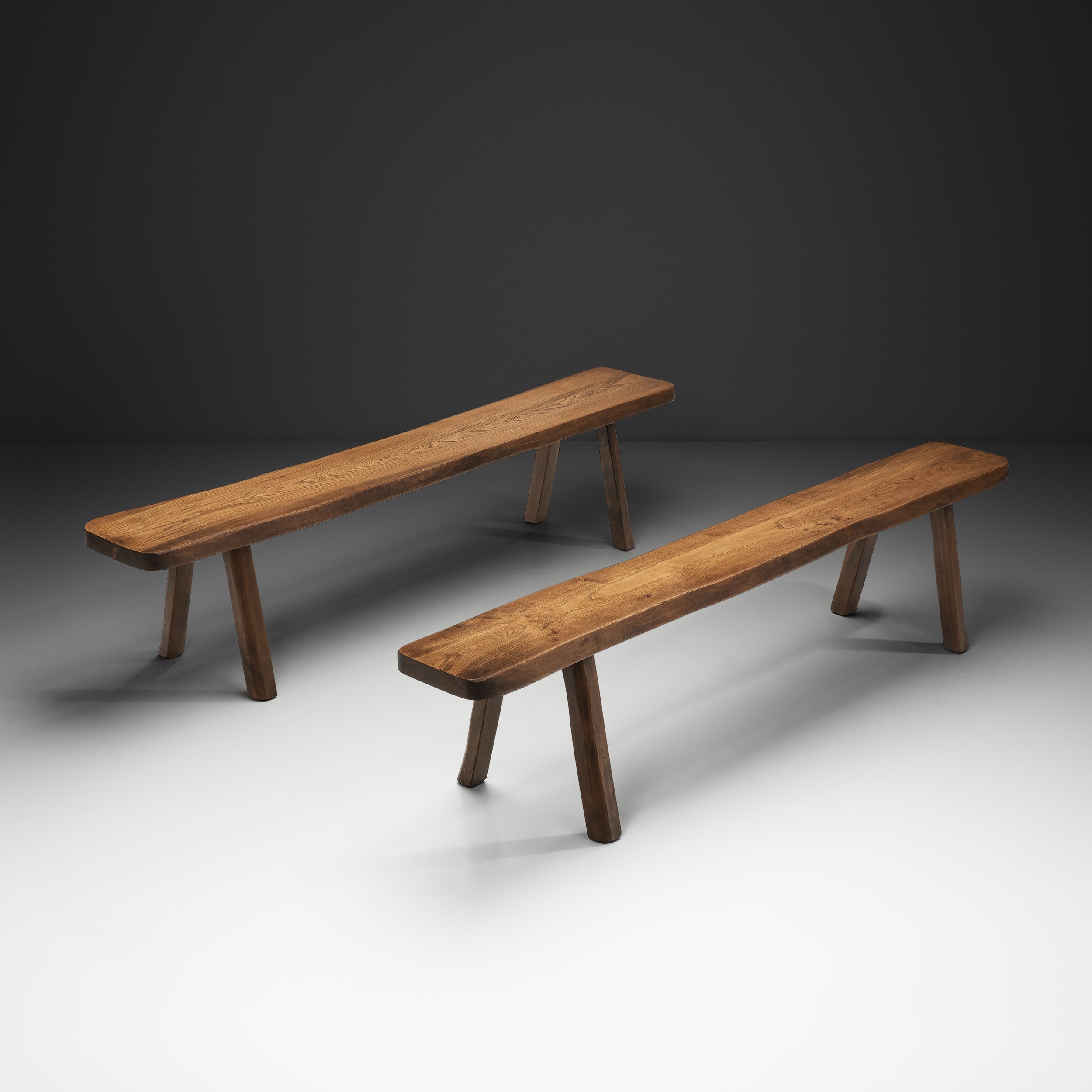
European furniture makers in the mid-20th century increasingly embraced simplified forms that highlighted the natural character of wood rather than concealing it beneath ornament or excessive carving. Influenced by Brutalism, benches like this pair were often reduced to their essential elements: a solid seat supported by sturdy legs. This allowed proportion, craftsmanship, and material quality to define the overall impression of mid-20th century furniture.
This pair of benches features long, uninterrupted wooden tops and angled supports. The seats are cut from thick planks of elm, their surfaces revealing a lively grain pattern that runs continuously across the length of each piece. With its pronounced grain and durability, elm wood was favoured, giving even modest forms a strong appearance. Rather than being perfectly geometric, the edges of the seats retain a slight softness that preserves the natural look of the wood and keeping it from looking overly polished. The legs are positioned at a subtle outward angle, giving the pieces stability and completing the composition. Their relatively narrow proportions create an elongated silhouette that feels practical and understated, allowing the richness of the elm to remain the dominant visual element.
Placed together, the benches create a rhythmic effect, as well as ensuring generous seating space. Their simplicity makes them highly adaptable, from dining areas to unconventional interiors. The design relies entirely on material, proportion, and construction, which gives the pair a quiet confidence characteristic of mid-century European furniture.
Condition:
In good vintage condition. Wear consistent with age and use. The benches have recently been reconditioned. Minor scratches and spots are present. Due to the age and nature of the material, the items may have marks and discolouration.
Dimensions:
78.75 in W x 11.42 in D x 17.92 in H
200 cm W x 29 cm D x 45.5 cm H
REQUEST PRICE HERE
Price category: 12,500 - 15,000 usd / eur
Derived from the French "brut", meaning raw, Brutalism describes the architectural style that emerged in the mid-20th century, featuring minimalist constructions that showcase bare materials and structural elements over decorative design. It originated post–World War II, when low-cost housing and government buildings were composed of mainly raw, unrefined materials. Similarly, in furniture design, Brutalism inspired creators to follow the same look of deliberate simplicity, rawness and strength.
These chairs reflect the deliberate simplicity, rawness and strength sought out by the creators of Brutalist pieces. Without any heavy ornamentation, the focus falls on the natural materials, the authenticity being celebrated, rather than disguised or embellished. This choice of pine not only aligns with the organic principles of Brutalism, but it also contributes to the chairs' overall longevity in both form and function. Each chair is constructed from dark-stained wood, with legs and backrests that appear hand cut rather than machined. The robust, slightly irregular forms emphasise the hand of the maker, lending the chairs a distinctly tactile, grounded character. The proportions are harmonious, with the backs that widen towards the top, and mirroring splayed tripod legs. The beauty of craftsmanship is evident in every detail of this set. The resulting union of form and function exemplifies the marriage of beauty and useful design.
This set of chairs is ideal for a space that embraces authenticity and values materials in their natural form. Their clean look and rustic sensibility make them stand out without the need for embellishment, offering a quiet but impactful addition within an interior.
Condition:
In good vintage condition. Wear consistent with age and use. The chairs have recently been reconditioned. Due to the nature and age of the wood, the chairs have some marks, scratches, dents and discolouration.
Dimensions:
16.73 in W x 15.74 in D x 32.67 in H; Seat height 16.33 in; Seat depth 16.92 in
42.5 cm W x 40 cm D x 83 cm H; Seat height 41.5 cm; Seat depth 43 cm