
Mid-Century Papercord and Dark Stained Wood Stool, Europe ca 1960s (sold)


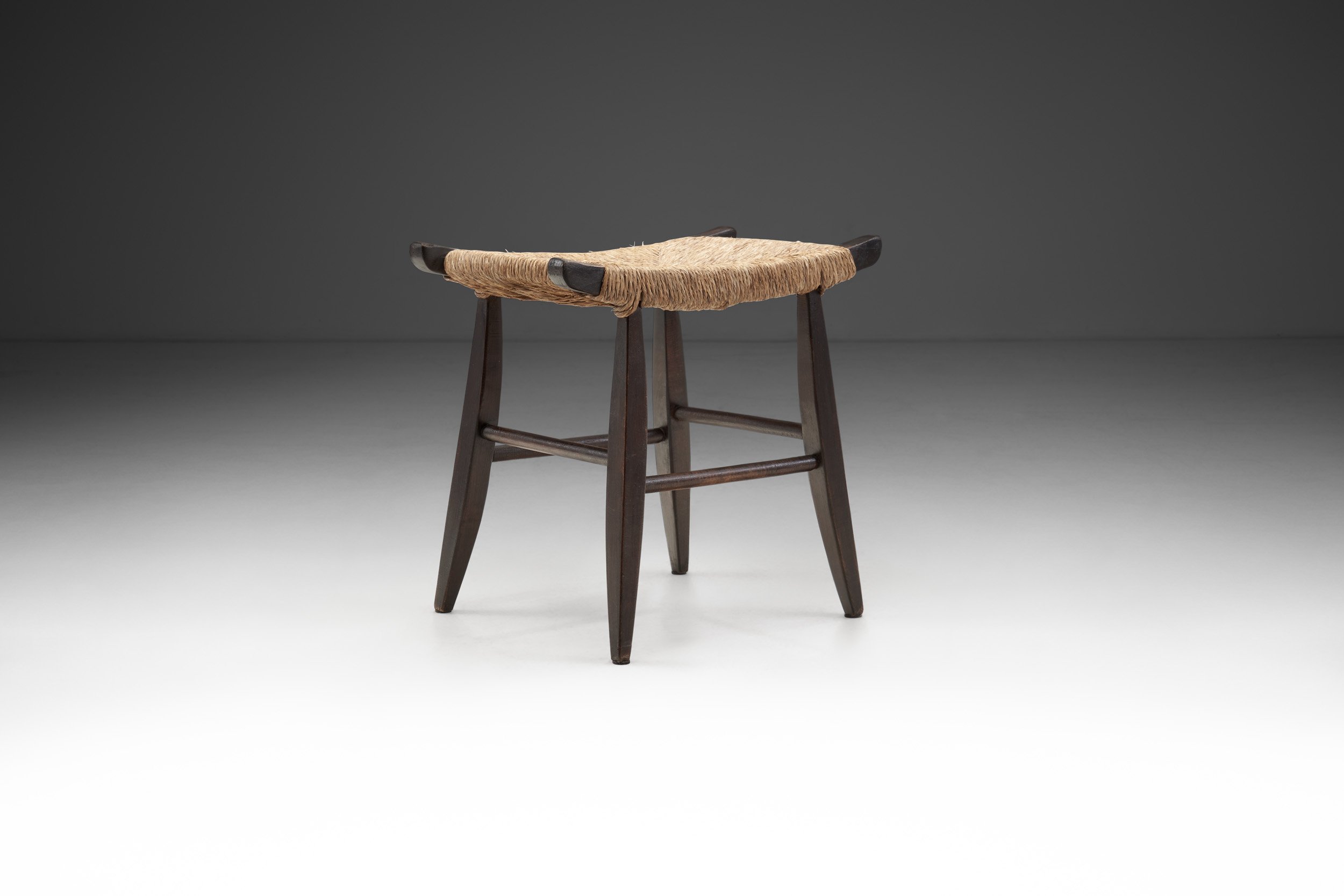


Mid-Century Papercord and Dark Stained Wood Stool, Europe ca 1960s (sold)
From Charlotte Perriand to Axel Einar Hjorth, stools have been staples in European design history. This modernist design is made of solid wood and twisted papercord with an understated, organic look. This style of stool has been beloved for decades and many mid-century designers created their own iteration of it.
With its arresting look, this stool stands as evidence why many European architects succeeded at the craft of furniture design. The precision of the structure and the weaving technique is evident at first glance, showing great geometric order. Driven by function, the designer’s focus was evidently on practicality, structural stability, and a design in favour of these principles. The combination of curved and straight lines and the absence of excess decoration is very typical of the era’s designers, who saw possibilities in the aesthetics of modernist design and materials. Next to the beautiful, dark stained wood, the use of the papercord is the defining material and aesthetical choice. Noteworthy for its organic charm, the material is also beloved for its functional qualities. The seat is made with a traditional hand woven technique, where the twisted strands of fibre are wrapped around each corner of the seat in a continuous loop. Here, the tips however are left unwrapped, highlighting the rising angle. The weaving forms four distinct triangles in the seat pattern, with the points of the triangles meeting in the centre.
The straight lines of the stretchers, arranged at differing heights, counterbalance the curved legs and seat, and the raw surface of the rush. The wood has a beautiful patina that complements the rush’s organicity. This beautiful stool’s simplicity and honest design combined with mid-century modernism enhances the exceptional craftsmanship.
SOLD
Condition:
In good vintage condition. Wear consistent with age and use. Some scratches and marks on the wood.
Dimensions:
19.09 in W x 12.99 in D x 18.11 in H
48.5 cm W x 33 cm D x 46 cm H
REQUEST PRICE HERE
Price category: 5,000 - 7,500 usd / eur
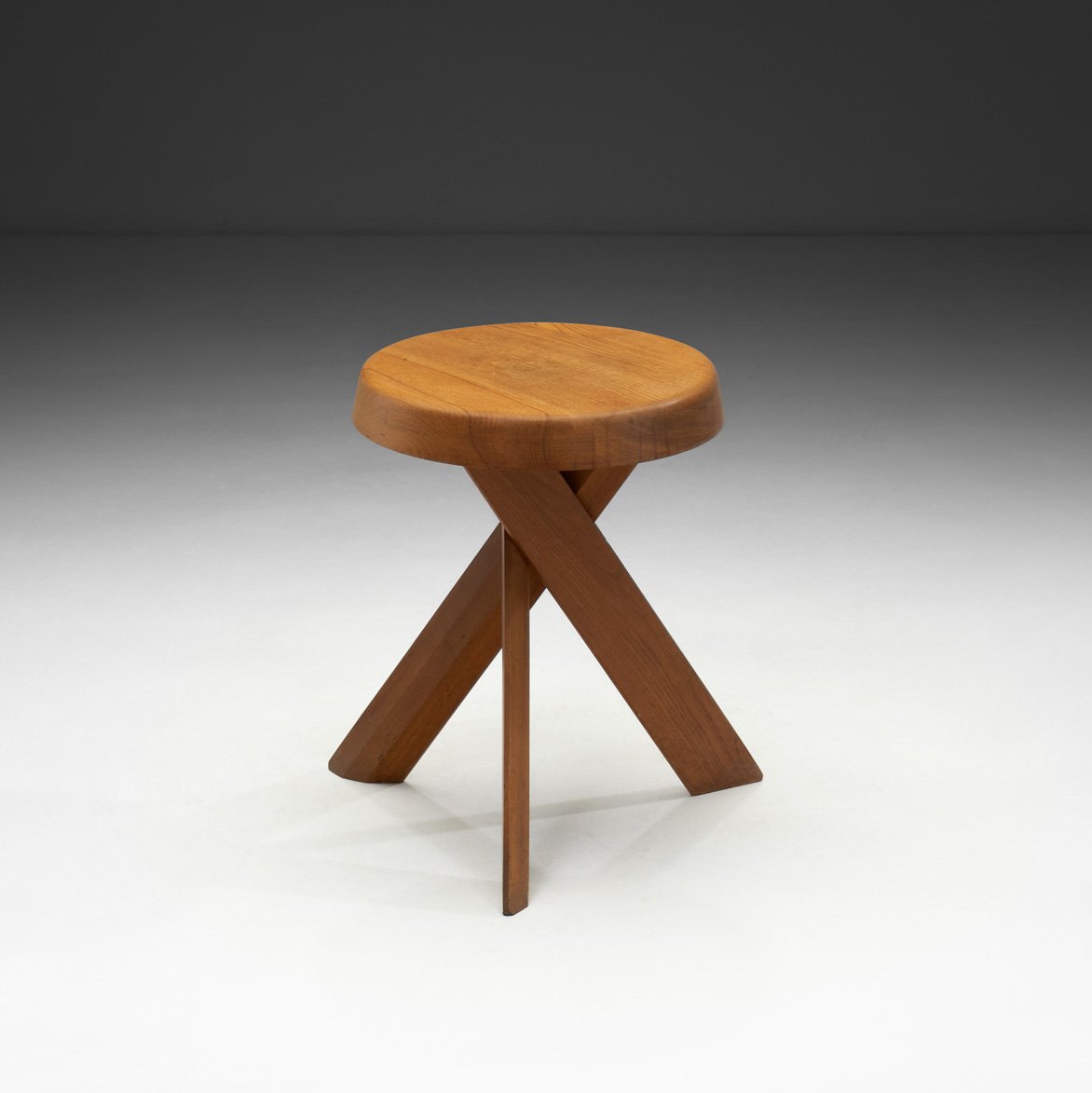
Pierre Chapo was inspired by Frank Lloyd Wright's balanced lines, Corbusier's research on proportions and the Bauhaus. The three principles that motivated him were material, form, and function. Despite his love for the imperfect, he measured his furniture by means of the golden ratio and used elm wood as his preferred material, and this model is a beautiful example of his ideals in a material form.
This “S31 A” stool has the playful and majestic characteristics typical of Pierre Chapo's emblematic creations. Asymmetrical, yet perfectly balanced. Made from elm, this stool has a rustic style with architectural precision. This comes as no surprise, as Pierre Chapo trained as an architect in Paris and this knowledge becomes evident in his elaborate structural solutions. The joinery technique is unique yet simple, enhancing the honest design. Just as with art styles, culture and fashion, each region of the world had their own joinery styles. While each region’s techniques are vastly different from one another, they still followed the same principles, in that they would join the timbers in such a way that they couldn’t be pulled apart. This is also true for this stool, making it a durable and timeless piece. The smooth circular seat shows off the beautiful grain of the elm which not only highlights Chapo’s preference for the material but also his deep respect for it. Furthermore, the rounded shape is a lovely contrast to the sharpness of the legs.
Being functional as well as aesthetically pleasing, this stool is a great addition to set the tone of a space. Its design is archtectural yet simple in its material choice, there is nothing superfluous about it. It strips back the unnecessary, showcasing the essential beauty of the wood and its capabilities.
Condition:
In good vintage condition. Wear consistent with age and use.
Dimensions:
15.94 in W x 15.94 in D x 17.32 in H
40.5 cm W x 40.5 cm D x 44 cm H

REQUEST PRICE HERE
Price category: 12,500 - 15,000 usd / eur
Despite being long misattributed to Axel Einar Hjorth, this “Pall” or “Palle” stool was designed and manufactured by K. J. Pettersson & Söner Storvreta in the second half of the 20th century. The stool is a striking example of Scandinavian design of the 1970s. It represents the Swedish brand's commitment to high-quality and sustainable design that would seamlessly blend into both modern and traditional interiors.
The model embodies principles of the mid-century and Scandinavian modern movements, where functionality, simplicity, and the use of natural materials take precedence. Visually, the piece features a bold and almost sculptural form, with clean lines and smooth surfaces that reflect the organic beauty of the wood. Its silhouette is minimalist yet distinctive, with a gently curved seat to provide ergonomic comfort. In the absence of heavy ornamentation, this stool takes pride in its material’s natural qualities. Pine wood became the bamboo of the north in the sense that it lasts for decades. The stool is constructed from several slats of pine wood, with the grain clearly visible, adding texture and warmth. Thanks to the individual blocks, which are visible from the side, the pattern and grain differs throughout, thus increasing the visual appeal. The base of the stool is open on each side, emphasizing its sculptural look and providing a sense of airiness. This thoughtful craftsmanship not only highlights the beauty of the material but also ensures stability and practicality in use. This sort of northern minimalism allows people to invite peace into their home without creating a space that is uninviting or cold. Similarly, this stool is full of vitality without being chaotic or overworked.
The stool is a testament to the timeless quality of Scandinavian design, which continues to resonate in contemporary interiors. Its unadorned elegance make it a perfect piece for modern homes, offering both style and utility. With its durable construction and inviting form, this piece is more than just a stool—it is a work of art that would bring a sense of natural beauty and practicality to any space.
Condition:
In good vintage condition. Wear consistent with age and use. Item has some small chips and marks. The wood has a nice patina.
Dimensions:
23.42 in W x 23.62 in D x 11.15 in H
59.5 cm W x 36 cm D x 36 cm H
About the designer:
The “Pall” or “Palle” tabouret has long been associated with Hjorth, however, many with knowledge in the field suspected it to be a misattribution both in terms of period and designer. Swedish auction house, Uppsala Auktionskammare finally put an end to the mystery surrounding this stool design in early January 2020, when in their Decorative Sale auction catalogue a model of the previously misattributed Pall stool was for the first time attributed to K.J. Pettersson & Söner.
The Swedish town of Storvreta was known for its many furniture manufacturers and the largest among them was Karl Julius Pettersson and Sons (Gösta, Nils, Karl-Erik and Birger respectively) furniture manufactory. Pettersson & Söner started as a small-scale manufacturing business in 1933 in a building at the address Fullerövägen 9. Production grew rapidly, resulting in a larger factory and furniture shop, now under the company’s name, AB K. J. Pettersson & Söner. In 1948 a separate furniture store / exhibition hall was started on the property next to the furniture factory, which a few years later was moved to more suitable premises. In 1953 the expansion continued with another, even larger factory building which still survives.
The furniture company specialised primarily in sofa beds with patented constructions. In low season the company employed around fifty to sixty people, while in high season, the number grew to around a hundred. As Karl-Erik Pettersson reminisced:
“A good thing was that we didn't have to ask any authority for permission to build during the first 10-12 years. It was just putting the shovel in the ground and building as we wished. And we really built. We expanded the factory and we built it privately. But, as the municipal bureaucracy expanded, more and more people wanted to be involved in deciding what we should do and how we would do it. We continued to specialize in sofa beds, corner beds and countertops. And it went well and time and time again we got our sofas jury-selected at the big furniture fairs.” K. J. Pettersson & Söner worked in Storvreta for 48 years until closing down in 1980.
REQUEST PRICE HERE
Price category: 1,000 - 2,500 usd / eur
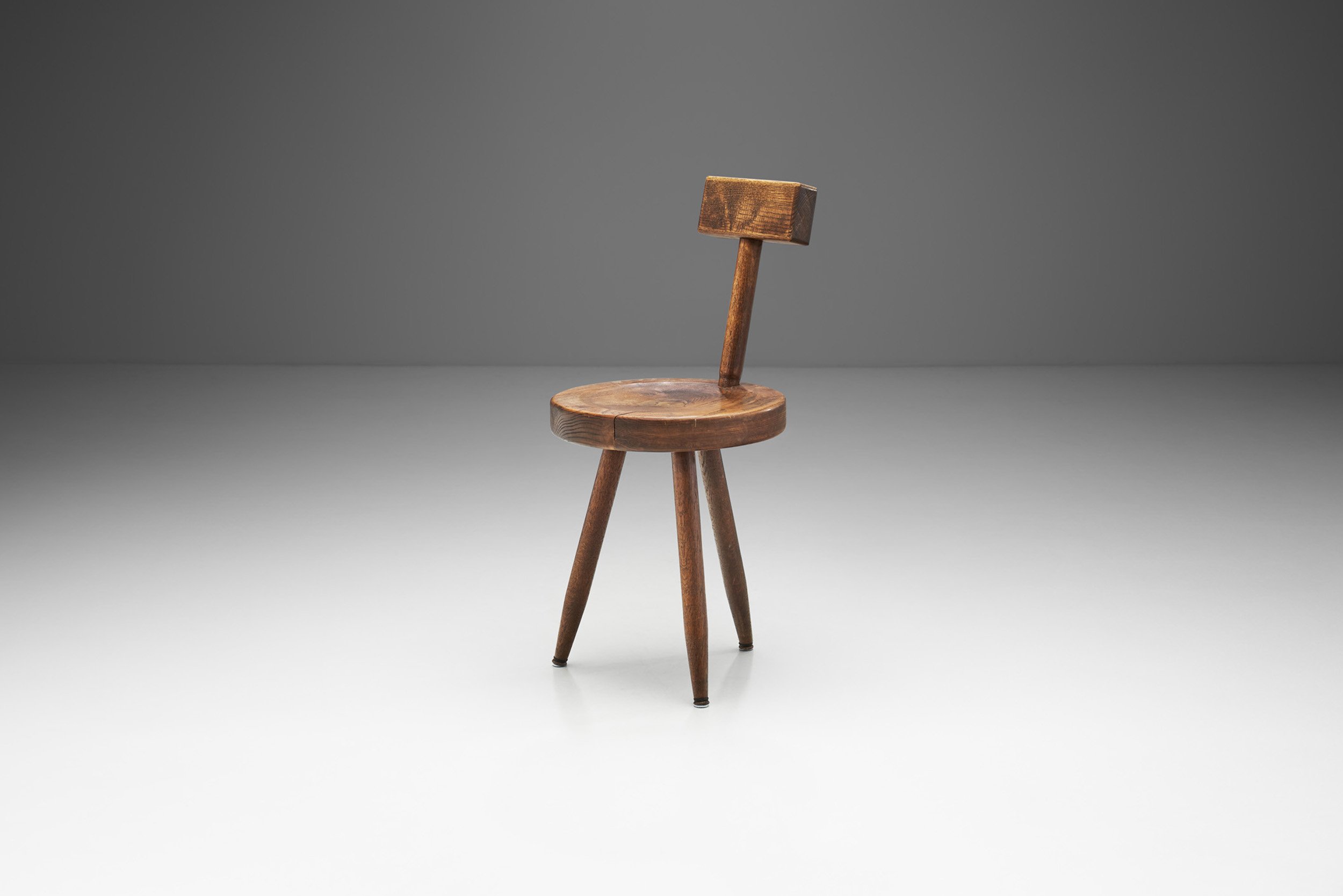
This tripod chair has a simple composition that mixes the aesthetics of rural handicraft with international modernism.
While many postwar French designers were embracing new industrial techniques and mass production, some, like Alexandre Noll, personally selected his materials and handmade each unique piece. Like Noll, this chair’s designer paid little attention to trends, preferring to let the material guide the design, letting the shape of the wood be the main source of inspiration. Thanks to this, the chair has an organic form and a focuses on the solid wood as a material. Even at first glance, this chair has a startling rawness, but with its warm-toned and slightly asymmetrical body, it is a greatly-balanced piece. Sensitive touches enliven the design, visible in the careful craftsmanship, especially in the carved seat and tripod legs.
The aesthetic of this tripod chair is somber, giving importance to eerie organic and rugged shapes. Through its eccentric geometries and expressive forms, this chair is the perfect piece to add visual and elemental interest to any interior.
Condition:
In good vintage condition. Wear consistent with age and use.
Dimensions:
14.76 in W x 17.51 in D x 31.49 in; Seat height 18.3 in
37.5 cm W x 44.5 cm D x 80 cm H; Seat height 46.5 cm
REQUEST PRICE HERE
Price category: 1,000 - 2,500 usd / eur
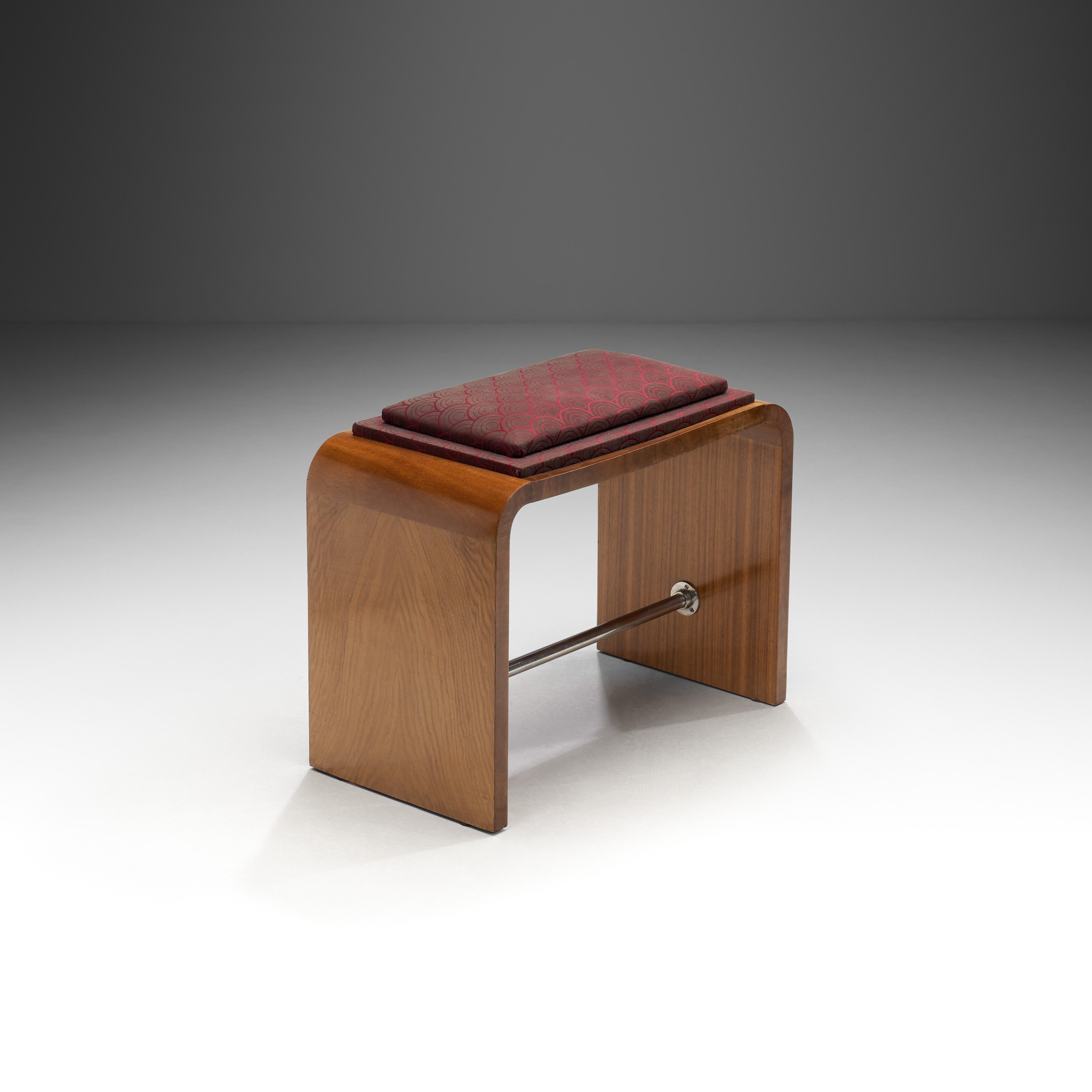
Art Deco furniture is a great way to add drama and sophistication to any room. It’s a style often used to add a modern yet timeless touch to living rooms and bedrooms. Whether you love the glamour of bold colours and patterns, or prefer the elegance of muted tones and sleek lines, Art Deco furniture can bring your vision to life.
In an era marked by unprecedented cultural dynamism and bold artistic expression, the Art Deco movement emerged as a testament to modernity and sophistication. This period witnessed the creation of exquisite furniture pieces that epitomized the union of form and function, with this Art Deco stool standing out as a prime example. This stool has a classic look that relies on the beauty of the materials. The wood's warm tones and distinct grain add a touch of natural beauty to the otherwise modern impression.
Stools, typically overlooked in comparison to larger furniture pieces, played a crucial role in the Art Deco interior. Their compact size and versatility made them ideal for multi-functional spaces, embodying the modern ethos of efficiency and adaptability. Today, stools are experiencing a resurgence in popularity as contemporary design embraces the concept of versatile and space-saving furniture.
Condition:
In good vintage condition. Wear consistent with age and use. This stool comes with its original upholstery or has been reupholstered by a previous owner. Each of our items can be re-upholstered by our in-house atelier in a fabric of choice. Please reach out for more information.
Dimensions:
25.20 in W x 13.58 in D x 20.87 in H
64 cm W x 34.5 cm D x 53 cm H
REQUEST PRICE HERE
Price category: 2,500 - 5,000 usd / eur
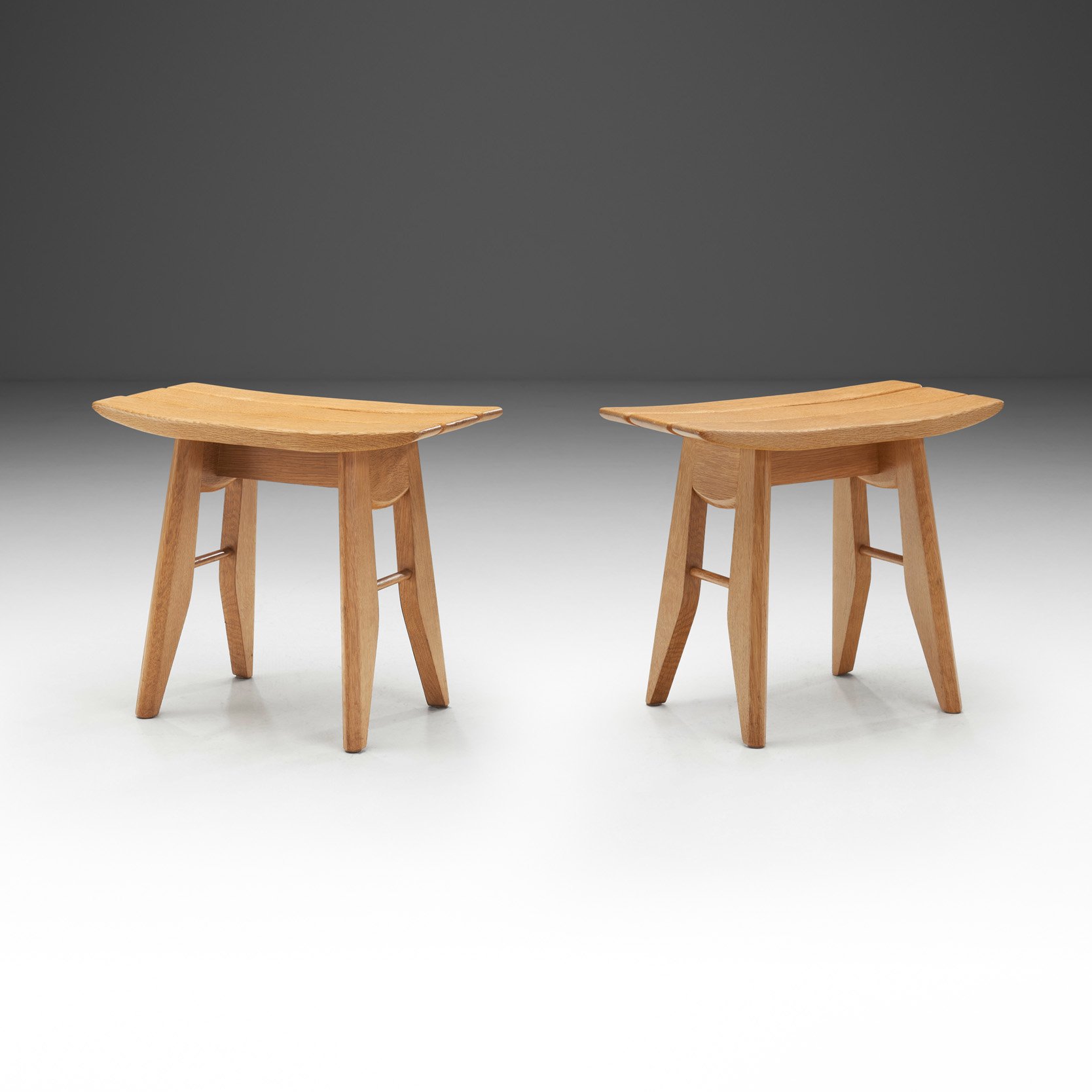
Form and function collide in this 'Thierry' stool model, a piece of accent furniture that is often underestimated. Designers define stools as jewels and statements in a room, and this rare model is perfect to add visual interest to any space.
Designs by Guillerme et Chambron, the iconic French designer duo, are brilliant in their simplicity, as this pair exemplifies. These well-formed stools are dominated by the blonde oak construction that is immediately recognizable as a feature of Guillerme et Chambron's pieces. The seat's form, resembling the Japanese “torii” gate, has an unmistakable shape. The top reaches over the seat, forming small “wings”, that is quite unusual for stools in general. In a perfectly symmetrical arrangement, the legs are connected by two decorative stretchers running parallel to each other. The seats rest on a carved bottom that has rounded design elements on its sides. Executed entirely in solid oak, the structure’s versatile lines stand out. The concave seat breaks the rigour of the design and adds a mid-century flair. The craftsmanship of Robert Guillerme and Jacques Chambron is evident in the joinery technique, as this stool model has no visible tenon or mortise joints.
Being functional as well as aesthetically pleasing, these stools are a great addition to set the tone of a space. Votre Maison didn’t make its mark in the history of French design without reason - as this pair illustrates.
Condition:
In good vintage condition. Wear consistent with age and use. Small marks and scratches on the wood.
Dimensions:
19.7 in W x 12 in D x 17 in H
50 cm W x 30.5 cm D x 43 cm H

REQUEST PRICE HERE
Price category: 1,000 - 2,500 usd / eur
Form and function collide in this stool, a piece of furniture that is often underestimated. Designers define stools as jewels and statements in a space, and taking practicality into account, this rare model is perfect to add visual interest to any space.
The iconic French designer duo’s present stool is brilliant in its simplicity. This well-formed stool is dominated by its blonde oak construction that is immediately recognizable. It is the shape the seat forms with the sides that resembles the Japanese “torii” gate that has an unmistakable shape. The top reaches over the seat, forming small “wings”, that is quite unusual for stools in general. In a perfectly symmetrical arrangement, the legs are connected by two decorative stretchers running parallel. The seat rests on a carved bottom that has rounded design elements on its sides. Executed entirely in solid oak, the structure’s versatile lines really stand out. The concave seat breaks the rigour of the design and adds the mid-century flair. The craftsmanship of Guillerme and Chambron is evident in the joinery technique, as this stool has no visible tenon or mortise joints.
Being functional as well as aesthetically pleasing, this stool is a great addition to set the tone of a space. Votre Maison didn’t make its mark in the history of French design without a reason as this stool illustrates.
Condition:
In good vintage condition. Wear consistent with age and use.
Dimensions:
19.7 in W x 12 in D x 17 in H
50 cm W x 30.5 cm D x 43 cm H
About the Designer:
Robert Guillerme graduated in 1934 from the École Boulle where he excelled in architecture and furniture design. After the Second World War he moved to Lille, in the north of France, where he decorated homes and designed furniture for the well regarded Rogier workshops.
In 1948, Guillerme was joined by his long-time friend, decorator Jacques Chambron in Lille. The following year Guillerme and Chambron met master cabinetmaker Émile Dariosecq, owner of a woodworking shop and the company Votre Maison was born. Together, they defined and imposed a new furniture concept. Thanks to their distinctive creativity, originality, and quality, the Votre Maison quickly became well-known.
The Votre Maison marked the history of French design. Guillerme drew the furniture designs while Chambron played the part of salesman, welcoming and advising clients. The power duo was complemented by Dariosecq, whose workshop took charge of the manufacturing. Together, they defined new furnishings concepts. Well-crafted chair back, polished wood and thick cushions make the reputation of their armchairs and sofas. Votre Maison continued to produce furniture right into the 20th century, with Jacques’s son Hervé Chambron, a designer and graduate of the École Boulle, having taken the over in 1983. ~H.

REQUEST PRICE HERE
Price category: 1,000 - 2,500 usd / eur
Minimalism may be currently in fashion, but there is one iteration of clean design that will never go out of style which is Scandinavian Modernism. It is no small achievement to be able to exercise restraint in décor choices, while still managing to make a space feel cosy.
The Swedish Modern style is so popular because it speaks to both our tidy tendencies and our desire to live in inviting and comfortable settings. Warm wood tones and sepia hues are popular in Scandinavian interior design because they make a room feel sunny and bright without using overwhelmingly bright colours. Pinewood is perhaps the most defining natural material of traditional Swedish cabinetmaking. “Furu” (pine) is a wood that creates healthy and sustainable interiors with modern expressions, which contributes to the wood's strong progress even nowadays. When world-class designers choose to work with pine, it is a sign that it is a type of wood that has an obvious place in modern interiors. This stool has a perfectly understated design that lets the material stand out. While the structure evidently serves functionality at its core, there is a feature that serves a purely aesthetic role. The carved parts connecting the seat and the legs are - in a way - the most Swedish feature of the design, showing that there needs to be balance, not just structural, but also visual.
Pinewood is comfortable and tactile. Wood interiors not only smell good, they also have a calming effect on us humans. That wood contributes to healthier indoor environments is an added bonus. This has been well-known for centuries in Scandinavia, and luckily, the rest of the world has been catching on.
Condition:
In good vintage condition. Wear consistent with age and use.
Dimensions:
18.11 in W x 10.23 in D x 17.32 in H
46 cm W x 26 cm D x 44 cm H
REQUEST PRICE HERE
Price category: 15,000 - 20,000 usd / eur
This beautiful set of six stools are crafted in the manner of French design duo Audoux-Minet. Adrien Audoux and Frida Minet worked together during the mid-20th century. The duo are known for their innovative use of natural, sustainable materials, including rope, wicker, and bamboo. Their work was heavily influenced by the Modernist movement, which sought to create functional and streamlined designs that were accessible to a wider audience.
Like in Scandinavia, there was an early emphasis on wood in most European mid-century design as it connected everyday objects to nature. This set of six is a perfect example of this sentiment, and the visual benefits of an understated, organic design. The high quality wicker makes these pieces outstanding examples of woven furniture. They feature a fairly traditional shape with rounded edges and an airy feel. The straightforward shape highlights the understated beauty of the materials, allowing the beautiful woven pattern and the grain of the wood to stand out. The seats are set on three splayed club feet, stained in a rich colour lending a more dramatic presence to the set. The tripod base is ideal for ensuring the sturdiness needed for a classic piece of furniture, even more so when paired with the T stretcher placed between the legs. Being functional as well as aesthetically pleasing, these stools are a great addition to set the tone of a space. The design is strong but subtle, with expert wickerwork thanks to which it can add depth as well as functionality to a space.
The interplay of a simple structure and refined detailing evokes a sense of harmony, aligning with the era’s focus on blending beauty with utility. The organic design makes this set stand out with an elemental edge. The colour palette further allows them to easily adapt to almost any interior to either complement a space, or to pop as accent pieces.
Condition:
In good vintage condition. Wear consistent with age and use. The stools have recently been reconditioned. Due to the age and nature of the materials, the items have minor scratches and dents, and may have additional marks or discolouration.
Dimensions:
15.35 in W × 13.39 in D × 17.72 in H
39 cm W x 34 cm D x 45 cm H