
Minimalist Dutch Wenge Benches, The Netherlands ca 1970s (sold)


Minimalist Dutch Wenge Benches, The Netherlands ca 1970s (sold)
This understated, stylish pair of benches are versatile in their simplicity. They can be used as tables, or, thanks to their very sturdy constructions, can also easily be used as seating.
These benches are completely veneered in wenge hard wood, which also defines their overall visual impression. The honest use of materials, clear construction and lack of decoration define this pair. Clearly preoccupied with functionalism, the rectangular bodies have confidently straight lines with impeccable joinery. Due to their length, width and height dimensions, these benches can be used in different ways; as benches in the hall or at the foot end of the bed or even as a coffee table. The main characteristics of modernism can be clearly observed in the design: clean, straight lines and a masterfully crafted structure. The large surfaces allow the versatile shades and patterns of the wood to stand out. The open fronts prevent the design from looking heavy and instead create a stylish, modern look. The wenge wood is spectacular and the understated design allows it to truly stand out.
The timeless design and clear design language makes this pair of benches a true classic. These characteristics make them able to fit in a minimalist modern decor just as well as in a more wabi-sabi inspired interior.
SOLD
Condition:
In very good vintage condition. Wear consistent with age and use. Some small marks.
Dimensions:
41 in W x 16 in D x 10 in H
105 cm W x 40 cm D x 25 cm H
REQUEST PRICE HERE
Price category: 5,000 - 7,500 usd / eur
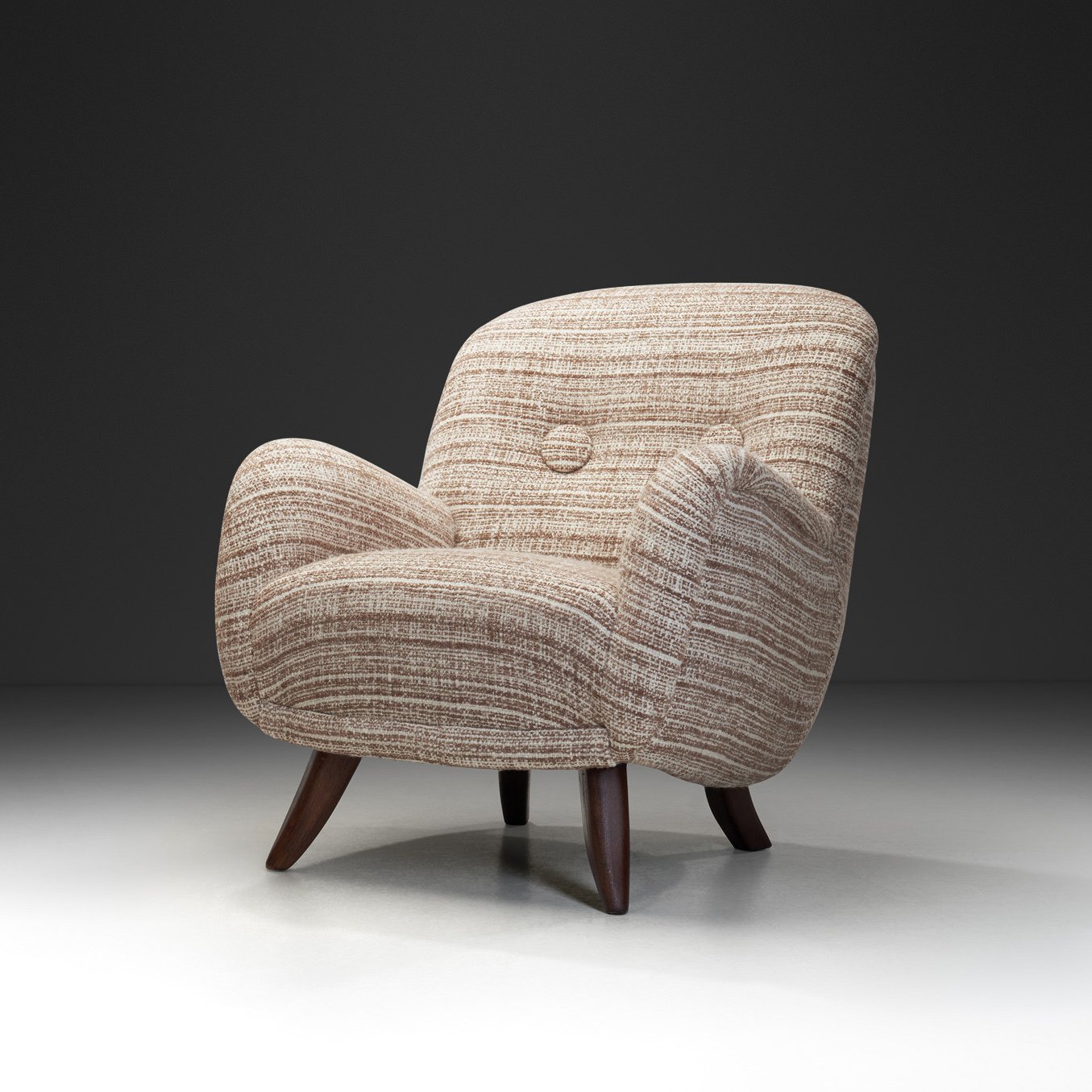
The European perspective on cabinetmaking is exceptional, and wood was an omnipresent material in mid-century modernism. This sumptuous rounded armchair features the immediately recognisable touches of Modernism: excellent materials, craftsmanship, and elegantly curved shapes.
This armchair holds all the characteristics that define Berga Möbler’s style, from the playful softness, to the organic sophistication. The chair is slightly tilted backwards by the tapered front legs. The curved and rounded backrest and armrests are a few elements that define the elegance of the chair. Slightly inclined towards the backrest, the armrests provide an excellent seating experience, making the chair a wonderful choice for any contemporary living space. Not only this, but the back is tufted with two large buttons that give the pieces a pleasant and welcoming appearance. The upholstery's texture adds to the visual appeal. It enhances the tactile experience, making it a delight to sit on. The frame is constructed from high-quality wood, ensuring durability and sturdiness. Furthermore, apart from being structurally integral, the legs add a touch of mid-century modern flair with their outward bend and smooth finish. The design of this chair possesses an elegant homely curviness, an aesthetic balance that is only seemingly easy to achieve, but this armchair exudes it.
Crafted with precision and finished with attention to detail and care for the aesthetic dimension, this armchair stands the test of time thanks to both its visual and material quality.
Condition:
In good vintage condition. Wear consistent with age and use. The chair has recently been reconditioned. Due to the nature and age of the materials, the item may have marks, scratches, and discolouration. The chair has recently been reupholstered in a premium fabric. Each of our items can be re-upholstered by our in-house atelier in a fabric of choice. Please reach out for more information.
Dimensions:
29.52 in W x 34.25 in D x 32.67 in H; Seat height 18.11 in; Seat depth 19.68 in; Arm height 23.62 in
75 cm W x 87 cm D x 83 cm H; Seat height 46cm; Seat depth 50 cm; Arm height 60 cm
REQUEST PRICE HERE
Price category: 2,500 - 5,000 usd / eur
Derived from the French "brut", meaning raw, Brutalism describes the architectural style that emerged in the mid-20th century, featuring minimalist constructions that showcase bare materials and structural elements over decorative design. It originated post–World War II, when low-cost housing and government buildings were composed of mainly raw, unrefined materials. Similarly, in furniture design, Brutalism inspired creators to follow the same look of deliberate simplicity, honesty and strength.
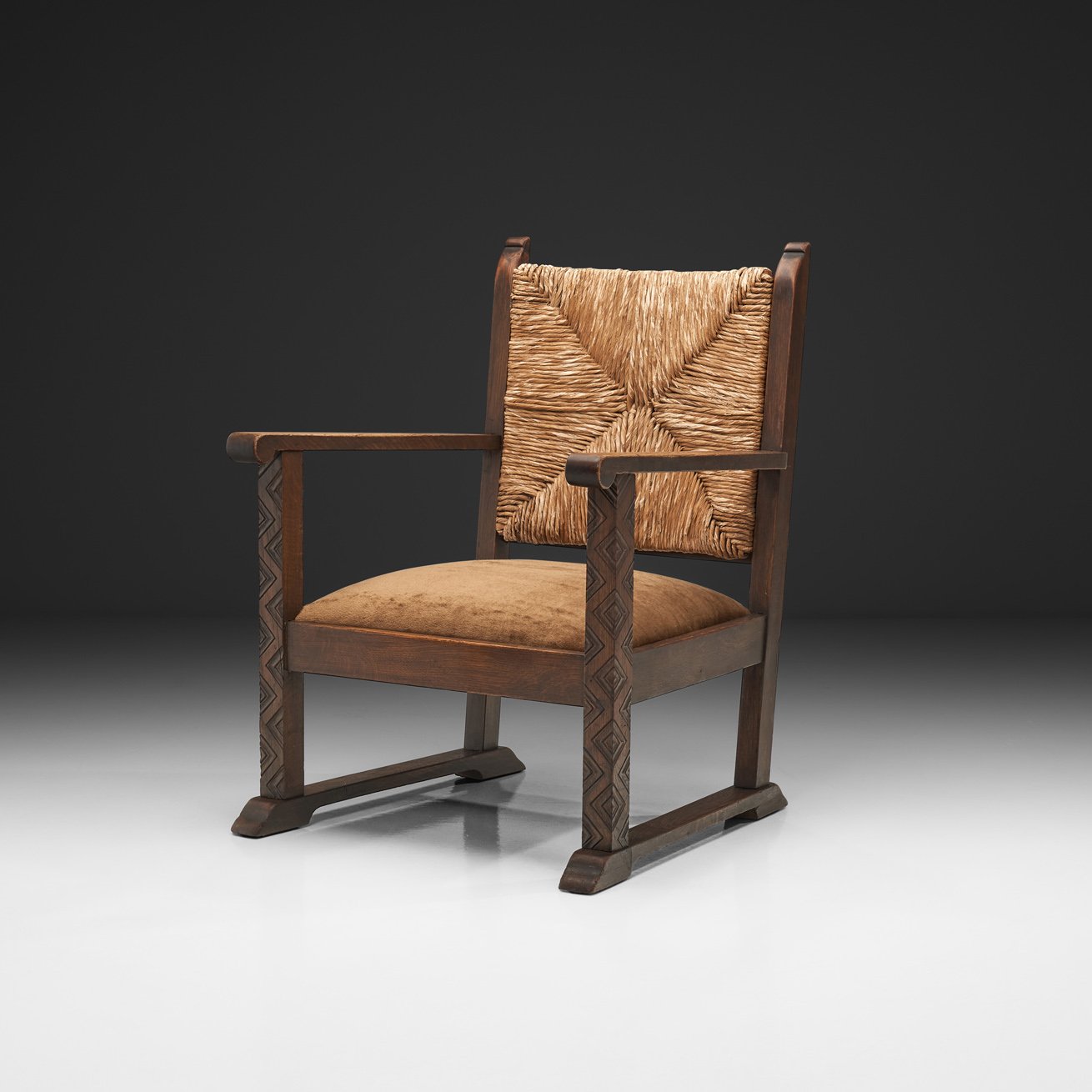
This armchair stands as evidence why many European architects succeeded at the craft of furniture design; the precision of the structure and the rush weaving is evident at first glance, showing great geometric order. Driven by function, the designer’s focus was evidently on practicality, structural stability, and construction in favour of these principles. The straight lines and the absence of excess decoration are very typical of the era’s designers, who saw possibilities in the aesthetics of modernist design and materials. This beautiful chair’s simplicity and honest look combined with brutalist influences enhances the exceptional craftsmanship. The woven back and upholstered seat gives the piece an organic and cosy impression, all while staying very functional. It is perfect to bring natural charm to a minimalist space. The oak has a beautiful patina due to its age, feature that enhances even more its charm.
Its bold, unapologetic aesthetic resonates with those seeking a departure from the sleek minimalism of recent years. This armchair serves as both an homage to the past and a testament to the timeless allure of Brutalism.
Condition:
In good vintage condition. Wear consistent with age and use. The chair has recently been reconditioned. Due to the nature and age of the wood, the item has marks, and scratches. The arms show discolouration. The seat cushion has recently been reupholstered in a premium fabric. Each of our items can be reupholstered by our in-house atelier in a fabric of choice. Please reach out for more information.
Dimensions:
25.19 in W x 27.95 in D x 26.77 in H; Seat height 15.74 in; Seat depth 20.86 in; Arm height 23.62 in
64 cm W x 71 cm D x 68 cm H; Seat height 40 cm; Seat depth 53 cm; Arm height 60 cm
REQUEST PRICE HERE
Price category: 15,000 - 20,000 usd / eur
Swedish architect and furniture designer Axel Einar Hjorth served as the lead designer for Sweden’s Nordiska Kompaniet department store from 1926 to 1938. During this time, Hjorth designed the “Sportstugemöbler” series, (which translates to “sports cabin furnishings”) a collection of wooden furniture designed for country homes. The various models in the sportstugemöbler series took their names from the Stockholm archipelago – including Blidö, Lovö, and famously, Utö.
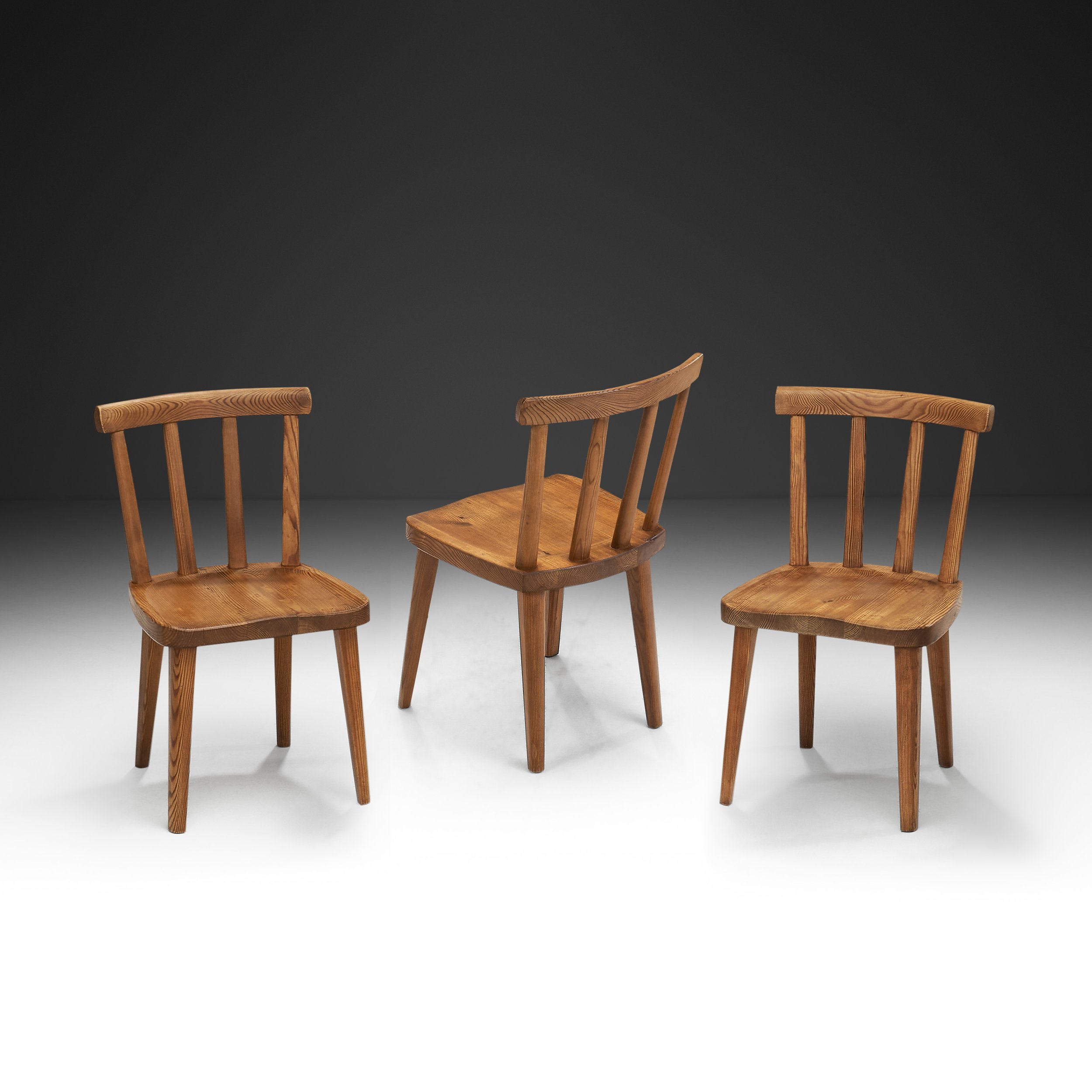
These Utö chairs were designed in 1932 as part of the collection. Unlike the department store's interiors for floors and villas in the cities, the Utö designs had a simple character with robust and basic shapes in solid pine. Accordingly, the design of these chairs focuses on simple lines and the material itself. Made of pine wood, these chairs are strong, reflecting Hjorth’s principles in which he mixed the ideals of the modernist movement with provincial Swedish traditions. As a result, the design of this set is completely timeless. Each chair demonstrates a conscious construction, where the joinery and fittings related to traditional craftsmanship are emphasized. Dominated by rounded, straight lines, the chairs have spindle backrests and ergonomically carved seats. The form alludes harmony and stability, fitting the summer cabin concept perfectly.
In an international perspective, Hjorth's “sportstugemöbler” series was the forerunner of later pioneering designers such as Charlotte Perriand. It is therefore no surprise that these Utö chairs became part of Swedish and international modernist design history. In their time, the Utö collection may have appeared as pioneering and radical, but today they are viewed as status symbols in interiors of international character.
Condition:
In good vintage condition. Wear consistent with age and use. Some marks and stains on the wood. Due to the nature and age of the wood, the items may have scratches and discolouration.
Dimensions:
18.89 in W x 18.3 in D x 31.49 in H; Seat height 16.92 in
48 cm W x 46.5 cm D x 80 cm H; Seat height 43 cm
Literature:
Christian Bjork, Thomas Ekstrom and Eric Ericson, 'Axel Einar Hjorth: Mobelarkitekt', Stockholm, 2009, p.130
About the designer:
Axel Einar Hjorth was born in a small Swedish village named Krokek, just outside Norrköping, on March 7, 1888. At the age of 20, he moved to Stockholm to study architecture and design at the Högre Konstindustriella Skolan.
Although he never graduated, in the 1920s Hjorth started working as a furniture designer for various manufacturers, such as H. Joop & Co., Myrestedt & Stern, Jonssons, and Nordiska Kompaniet. Hjorth’s designs from this period had neoclassical features combined with Swedish Grace. This romantic national style of Sweden was elegant and refined, yet simple. The anniversary exhibition of 1923 in Gothenburg marked the breakthrough of Swedish decorative arts, and made Axel Einar Hjorth a well-respected artist. From October 1926, Hjorth became the chief designer and architect of Nordiska Kompaniet department store in Stockholm. In the 1930s, Hjorth designed a furniture collection out of pine meant for serial production known as Sportstugemöbler (furniture for holiday houses).
Hjorth’s designs, from the luxury of neoclassicism to the severity of functionalism, are sharply distinctive in style, materials, and character. Unlike many of his contemporaries, Hjorth did not conform to the socially oriented ideas produced by Svensk Form (the Swedish Society of Crafts and Design). He played a significant role in the development of Swedish society as a whole, and particularly in Swedish industrial art
Today Hjorth is often viewed as a precursor to the modern designs popularized by Charlotte Perriand, Jean Royére, Pierre Chapo, or Josef Frank. Recently, there has been a revival of appreciation for his work, showing his genius in a new light. ~H.
REQUEST PRICE HERE
Price category: 5,000 - 7,500 usd / eur
The first half of the 20th century saw the rise of brilliant designers working to create furniture of the highest quality that explored truly modern shapes and forms. Danish cabinetmakers sought to combine comfort and elegance to achieve timeless designs that remain iconic examples of style and skill to this day.
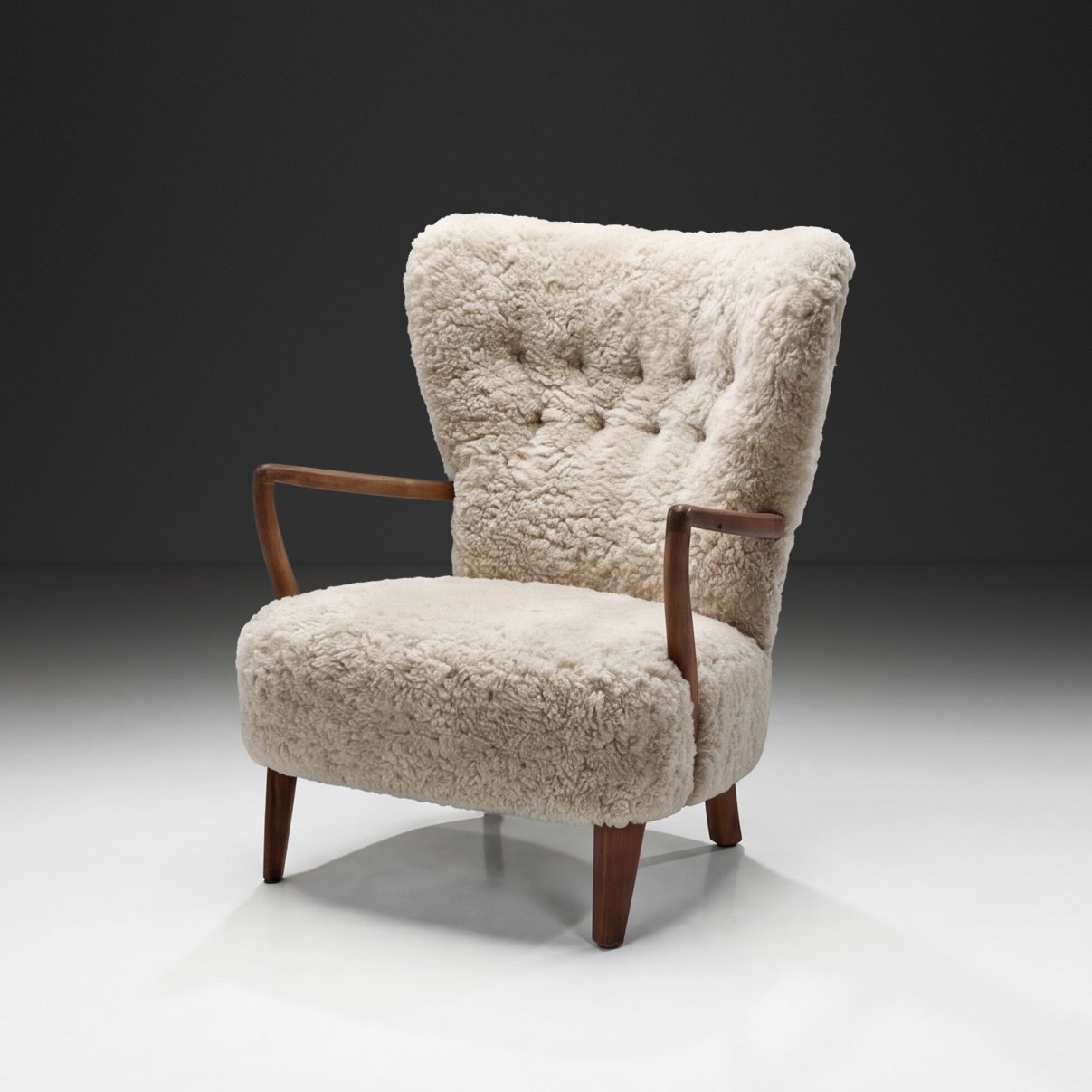
This upholstered armchair proves the success of the cabinetmaker’s pursuit. The craftsmanship is an immediately distinguishable; the chair’s sleek, yet classic look features a high back which is wide at the top but tapers in to draw the eye, highlighting two rows of tufted upholstered buttons. Not only is the body generously padded, but the slightly rounded backrest, as well as the tilted seat increase comfort even further. The chair is upholstered in a soft white sheepskin fabric, providing the piece with a luxurious and textured feel, while contrasting the oak frame. The open and angular armrests complement the rounded plushness of the body, along with the simple tapered legs. The combination of the clean, honest design, high-quality materials, and understated sophistication makes this piece a standout example of Scandinavian furniture.
Danish cabinetmakers were, and are still world-renowned for their unmatched skill. This chair preserves the value and beauty of master craftsmanship, while creating a warm and welcoming look through the use of natural materials.
Condition:
In good vintage condition. Wear consistent with age and use. Due to the nature and age of the wood, the chair may have some marks, scratches, and discolouration. The chair has recently been reconditioned and has recently been reupholstered in premium sheepskin. Each of our items can be reupholstered by our in-house atelier in a fabric of choice. Please reach out for more information.
Dimensions:
28.74 in W x 31.1 in D x 33.07 in H; Seat height 17.32 in; Seat depth 28.74 in; Arm height 24.01 in
73 cm W x 79 cm D x 94 cm H; Seat height 44 cm; Seat depth 73 cm; Arm height 61 cm
REQUEST PRICE HERE
Price category: 5,000 - 7,500 usd / eur
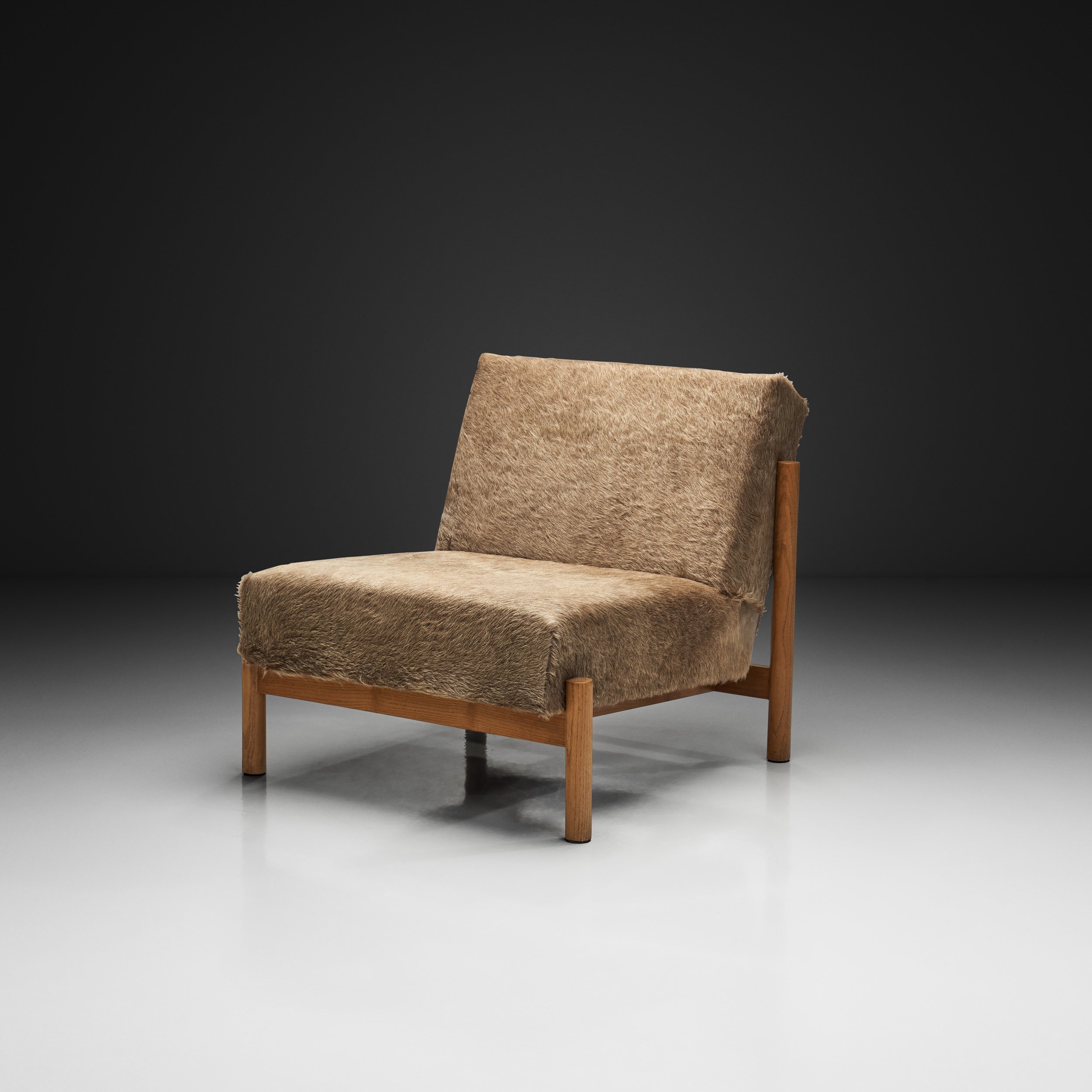
Wim den Boon was a Dutch designer and architect associated with the post-war modernist movement in the Netherlands. After studying interior design at the Academy of Fine Arts in The Hague, he worked alongside artists like Hein Stolle and Pierre Kleykamp to contribute to a number of important post-war interiors, including projects for Schiphol Airport. Den Boon later established himself independently in The Hague, where he designed furniture characterised by restrained compositions, careful spatial treatment, and a preference for unadorned everyday materials.
Influences from De Stijl and Scandinavian modernism remained visible throughout his work, particularly in the balance between strict structure and warmth. This lounge chair reflects that sensibility through its reduced oak construction and tactile ponyskin upholstery. The frame is composed of cylindrical supports and straight horizontal rails, creating a clear geometric outline around the upholstered body. The proportions are low and generous, giving the piece a relaxed, grounded posture. The seat and backrest form a wide lounging space upholstered entirely in champagne-coloured ponyskin. The material introduces a textured surface, giving the otherwise minimal form a sense of movement and depth. Still, the oak remains visible throughout the design, outlining the silhouette and through its slim slats it prevents the chair from appearing overly heavy. The tilt of the backrest softens the strict geometry and contributes to the lounge-like comfort of the piece.
Den Boon was part of the generation of Dutch designers who helped shape post-war modernism in the Netherlands through a restrained and architectural approach to furniture. This chair is proof of his talent. It feels architectural in structure, yet tactile and warm in appearance, reflecting the balance that made Dutch modernist furniture so distinctive during the period.
Condition:
In good vintage condition. Wear consistent with age and use. The lounge chair has recently been reconditioned. Due to the age and nature of the materials, the item may have marks, scratches, and discolouration. The piece has recently been reupholstered in premium ponyskin. Each of our items can be reupholstered by our in-house atelier in a fabric of choice. Please reach out for more information.
Dimensions:
25.79 in W x 34.26 in D x 27.56 in H; Seat height 14.97 in; Seat depth 20.67 in
65.5 cm W x 87 cm D x 70 cm H; Seat height 38 cm; Seat depth 52.5 cm
REQUEST PRICE HERE
Price category: 2,500 - 5,000 usd / eur
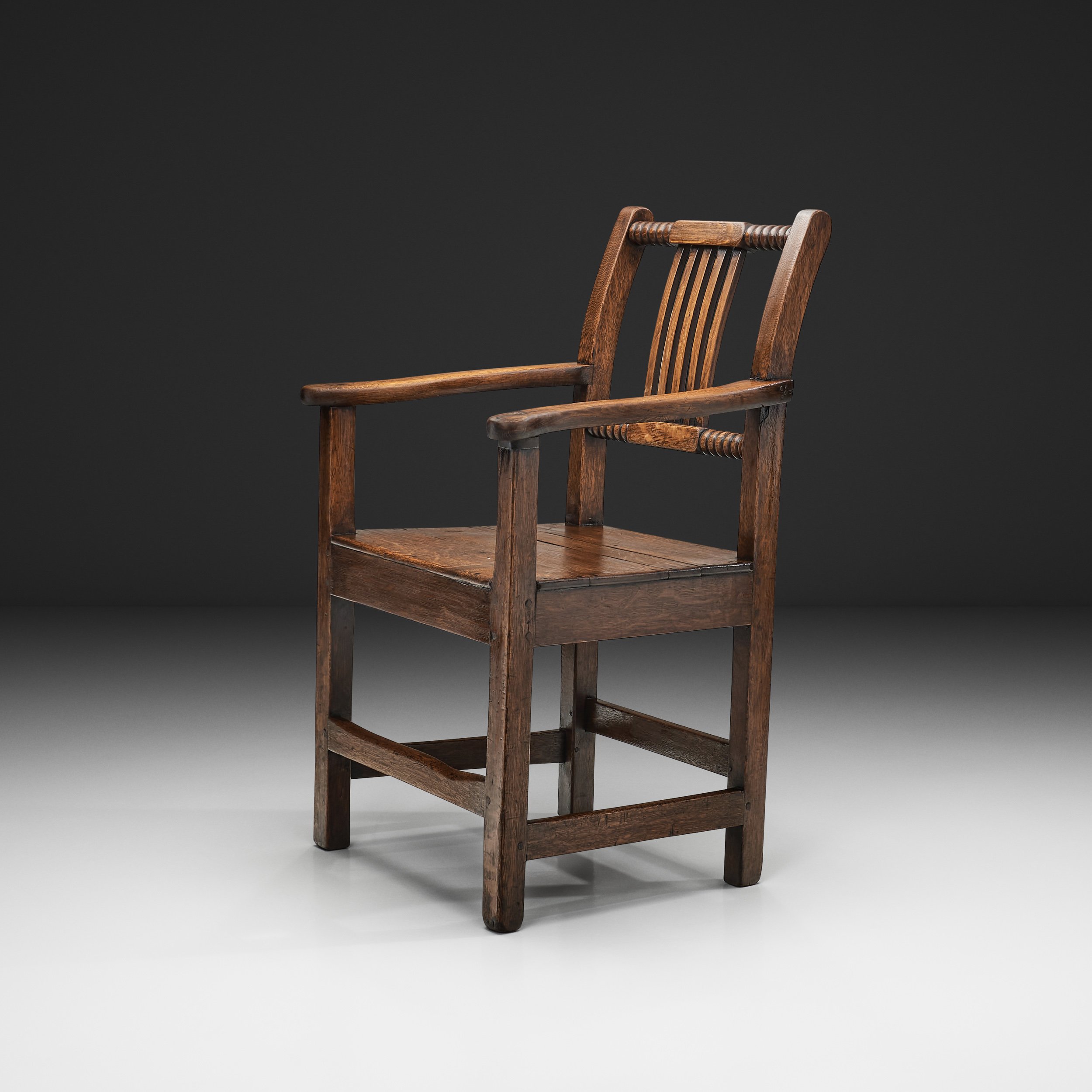
This antique armchair embodies the aesthetic, practicality and functional design that was valued in European homes of the 19th century. Displaying artisanal techniques such as weaving and beautifully carved details, pieces such as this chair showcase the expert craftsmanship of the woodworkers and furniture designers from the period.
Constructed from solid oak, the chair features a sturdy frame with a warm, natural finish that highlights the wood's grain and durability. Oak was the favoured material in this period for its resilience and beautiful grain pattern, thus increasing the visual depth of the chair. By being entirely constructed from natural materials, this piece maintains its classic charm typical of 19th century furniture, while adding versatility through its unpretentious, organic character. The armrests feature a subtle curve, providing ergonomic support, highlighting the chair's understated elegance. The wooden stretchers are positioned between each pair of legs, creating symmetry within the design. These additions go beyond their aesthetic purpose - not only do they complete the design but they also reinforce the structure, lending it additional stability.
With its organic feel and natural elements, this chair stands out with its timeless appeal. The piece’s simple yet refined structure allows them to integrate into various interior styles, from vintage-inspired rooms to more contemporary settings where they add a touch of old-world charm.
Condition:
In good vintage condition. Wear consistent with age and use. The chair has recently been reconditioned. Due to the nature and age of the wood, the item has some marks, scratches, and discolouration.
Dimensions:
23.04 in W x 22.25 in D x 37.01 in H; Seat height 18.31 in; Seat depth 17.72 in; Arm height 27.96 in
58.5 cm W x 56.5 cm D x 94 cm H; Seat height 46.5 cm; Seat depth 45 cm; Arm height 71 cm
REQUEST PRICE HERE
Price category: 5,000 - 7,500 usd / eur
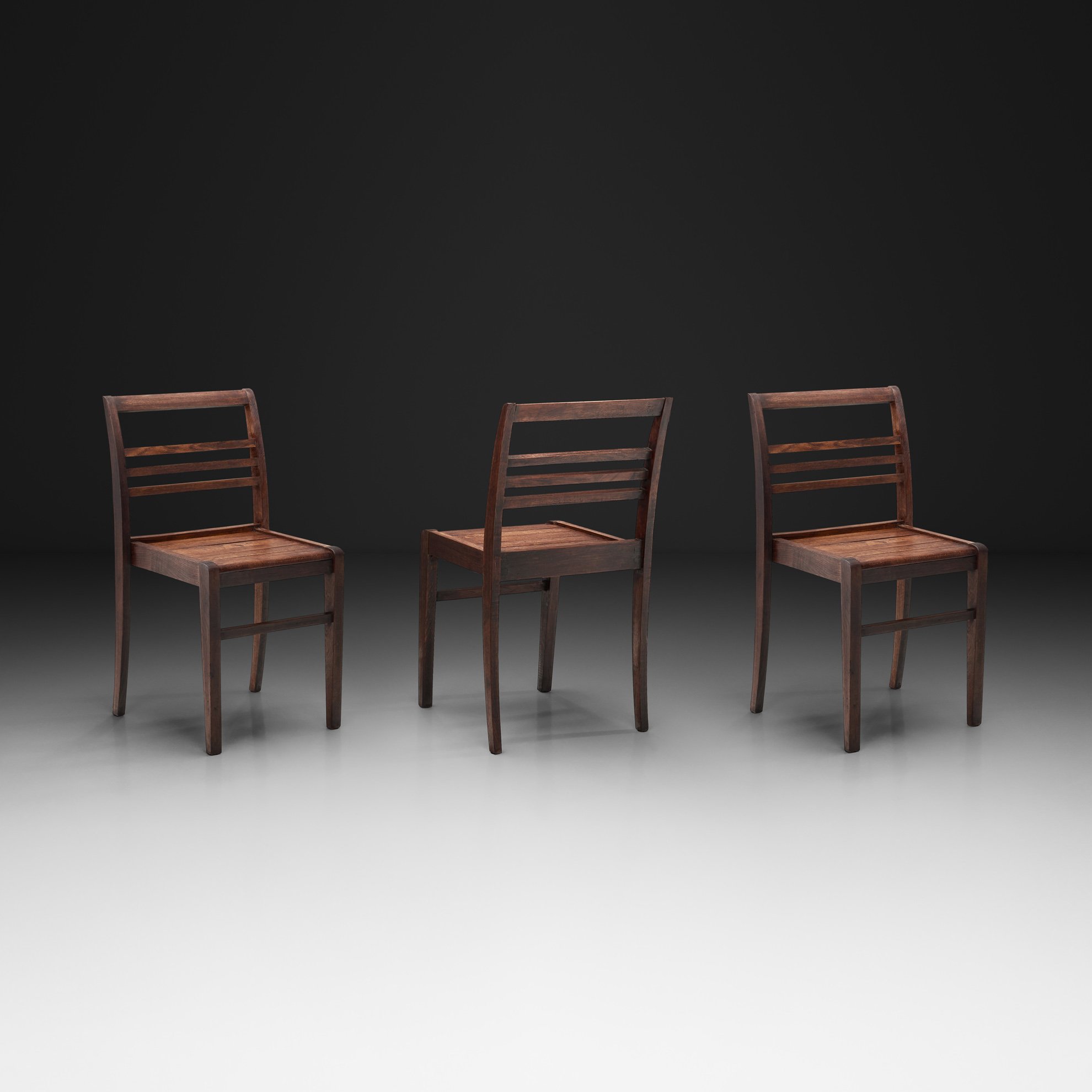
Born in 1890 in France, René Gabriel was one of the leading figures of the modernist movement in Paris. From 1923 to 1950, he presented an innovative body of work, offering new vision on the way people could live in the 20th century. He became widely recognised for developing practical, well-made furniture intended for the reconstruction period following the Second World War. Appointed president of the Société des Artistes Décorateurs (SAD) at the Liberation, he steered French decoration towards more economical productions, with sharp lines, efficient joinery, and a preference for the authenticity of local woods over imported species.
Gabriel distinguished himself through the extreme simplicity and sturdiness of his designs, where a Cartesian aesthetic streamlined production. His work rejected unnecessary ornament in favour of robust construction, honest materials, and economical forms that could be produced efficiently without compromising quality. The design of this set of chairs are ingeniously functional and have a well-thought-out structure, crafted from oak. The chairs are built from a series of straightforward elements that work together with remarkable precision. The horizontal back slats create an open, lightweight appearance while providing comfortable support, and the slightly curved sides soften the otherwise rectilinear composition. The slatted wooden seats continue this emphasis on practicality, allowing the grain of the oak to remain fully visible while introducing subtle texture. The legs are gently tapered and connected by unobtrusive stretchers, giving the chairs excellent stability without adding unnecessary visual weight. Every joint is clearly expressed, making the construction itself part of the design rather than something to be concealed.
Model “103” belongs to René Gabriel’s body of work reflecting his enduring belief that good design should remain elegant through clarity of purpose, thoughtful craftsmanship, and an unwavering focus on function. Wood has never gone out of style, and pieces with an emphasis on a natural look are only gaining popularity today. These oak chairs are equally striking standing alone, or as part of an interior with a medley of styles.
Condition:
In good vintage condition. Wear consistent with age and use. The chairs have recently been reconditioned. Due to the nature and age of the oak, the chairs have some marks, scratches, and discoloration.
Dimensions:
16.93 in W x 16.53 in D x 31.49 in H; Seat Height 17.72 in; Seat Depth 15.55 in
43 cm W x 42 cm D x 80 cm H; Seat height 45 cm; Seat depth 39.5 cm
REQUEST PRICE HERE
Price category: 5,000 - 7,500 usd / eur
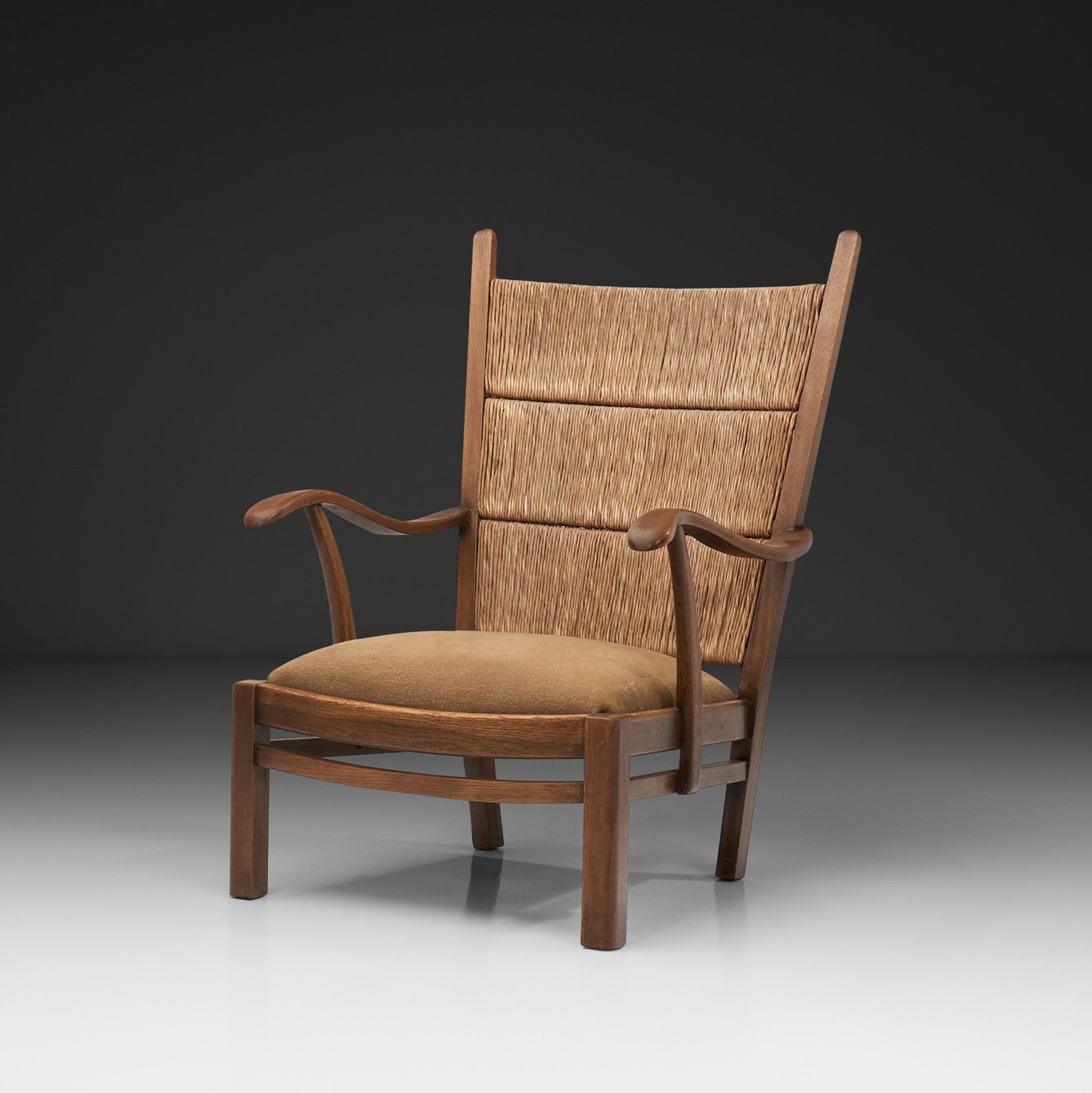
Bas van Pelt (1900–1945) was a Dutch furniture and interior designer whose work combined traditional craftsmanship with the principles of early modernism. While Van Pelt's creative work was primarily dominated by the Hague School, this armchair is the result of his more mature design period, characterised by natural materials, in order to create a friendly and inviting appearance that combines the warmth of solid oak with the distinctive texture of woven rush.
The construction of this model is simple at its core, but thanks to certain details, it is a playful representation of early Dutch modernism. While made of solid oak, this armchair has an open feel to it thanks to the horizontal spaces on the back that divide the three rush panels. The tall, slightly inclined backrest is framed by two straight wooden uprights, creating a strong vertical outline that contrasts with the more fluid shape of the armrests. The curved lines of the arms contrast nicely with the straight lines of the frame and clearly show wonderful craftsmanship. Each armrest extends outward in a gentle wave, giving the chair a particularly individual character. The rush weaving on the back adds textural interest, bringing the appealing roughness of nature to the design. Its closely arranged vertical strands create a warm, sandy surface, beautifully complemented by the oak's rich brown colour and the similar tone of the upholstery. The legs and stretchers are simple in their design, serving a primarily structural role and allowing the rush weaving and the wooden construction to stand out. The legs are connected by a gently curved wooden rail beneath the seat, while the rear supports continue naturally from the backrest. Thanks to the well-chosen proportions and the combination of natural materials, this armchair provides great comfort while maintaining a remarkable appearance.
Bas van Pelt's progressive designs were, in many ways, ahead of his time. The Dordrecht-born designer's furniture models are quite rare, with examples preserved in the collection of the Stedelijk Museum Amsterdam. Furniture pieces like this easy chair stand out through their unique textures and materials, as well as their classic charm. Its generous backrest and comfortable seat make it particularly suitable for a living room, library or reading area, where the craftsmanship can be appreciated from every angle.
Condition:
In good vintage condition. Wear consistent with age and use. The chair has recently been reconditioned. Due to the nature and age of the wood, the item has minor marks, scratches, dents and discolouration. The seat cushion has recently been reupholstered in a premium fabric. Each of our items can be reupholstered by our in-house atelier in a fabric of choice. Please reach out for more information.
Dimensions:
24.8 in W x 29.13 in D x 38.18 in H; Seat height 14.96 in; Seat depth 22.44 in; Arm height 22.83 in
63 cm W x 74 cm D x 97 cm H; Seat height 38 cm; Seat depth 57 cm; Arm height 58 cm
REQUEST PRICE HERE
Price category: 2,500 - 5,000 usd / eur
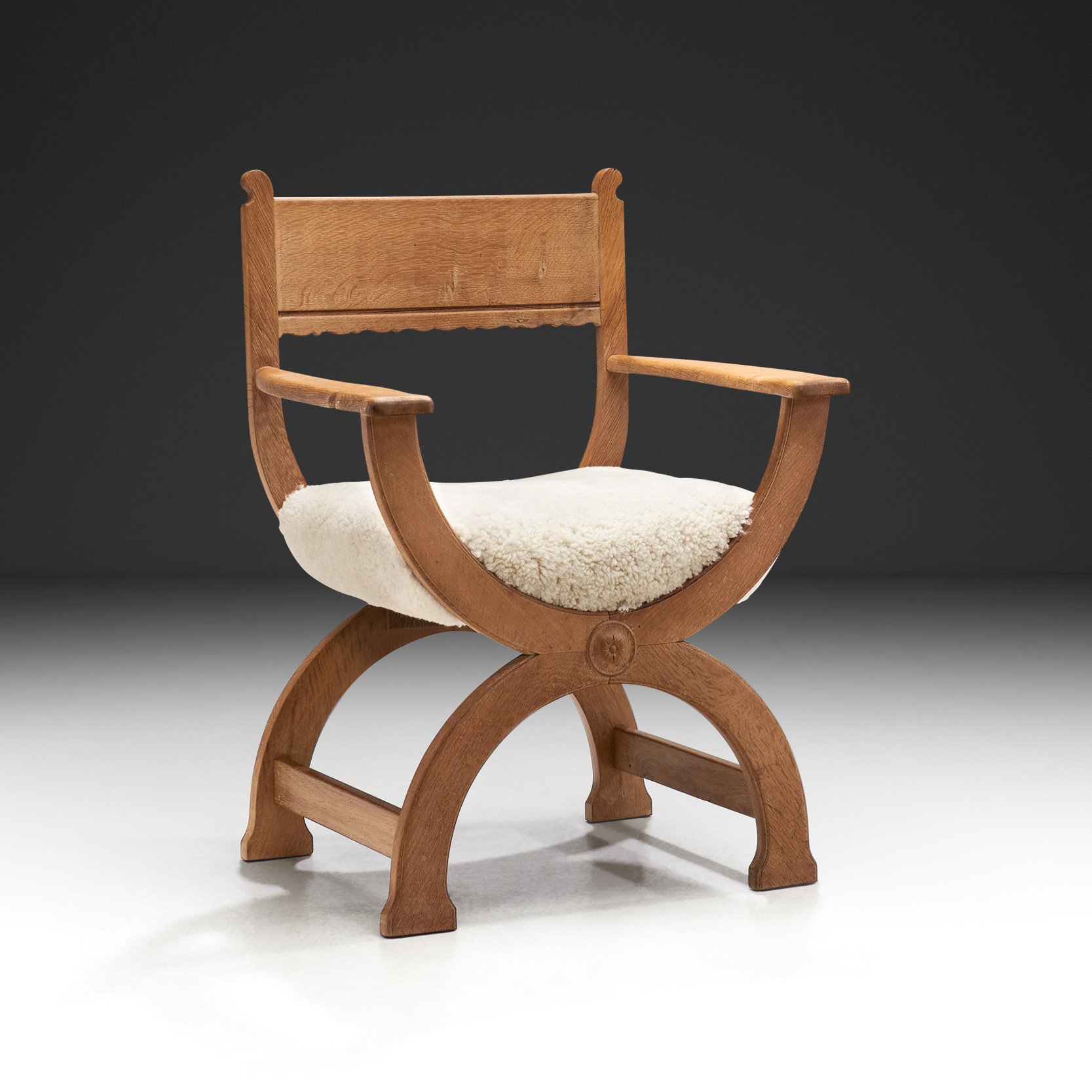
This so-called “kurulstol” or kurul chair, is an iconic model by Danish designer, Henning Kjærnulf. The Kurul chair is an ancient folding chair, originally a folding stool with straight or curved legs. Among the Romans, in addition to being an ordinary utility chair, it was symbolically linked to officials, often within the judiciary.
This armchair combines the traditional kurul structure with a rounded and curved appearance, with an upholstered seat and backrest that gives the historic look a modern edge. The oak frame is carved and sculpted in an unmistakeable way, showing the skills of both the designer and the manufacturer. The body is composed of two slats of wood of equal length in the front and back, fastened together in a saltire formation (resembling the letter X) which are extended up at the top and back to form the armrests and the backs as well. The seat, upholstered in soft sheepskin, is stretched between the front and back slats connecting the two. Kjærnulf removed the folding function of the historic design, giving his model a more stable, organic look. This impression is further enhanced by the solid oak, which is carved with great precision into straight and curving lines. The rich sheepskin melts these carved and straight lines together, contrasting to the oak’s smoothness. While the historic kurul chair was often decorated with intarsia, this model only showcases subtle decor elements, such as the charming sculpted mark in the front with a flower (or the sun) carved into the wood.
While the kurulstol is a Renaissance classic originating from ancient Rome, thanks to Kjaernulf, Scandinavian modernism remains at the core of the design. Kjærnulf’s designs are easy to spot in a crowd thanks to his originality, making his pieces like the razorblade chair and this kurulstol eternally unique. This chair was manufactured by EG Kvalitetsmobel in Denmark during the 1960s.
Condition:
In good vintage condition. Wear consistent with age and use. The chair has recently been reconditioned. Some minor scratches and marks on the wood. The chair’s seat has been reupholstered recently in premium sheepskin. Each of our items can be re-upholstered by our in-house atelier in a fabric of choice. Please reach out for more information.
Dimensions:
24.8 in W x 26.77 in D x 31.29 in H; Seat height 17.32 in; Arm height 26.18 in
65 cm W x 55 cm D x 88 cm H ; Seat height 49 cm; Arm height 63.5 cm
About the designer:
Danish mid-century designer and architect, Henning Kjaernulf, is somewhat of a mystery. A lot more is known about his designs than Kjaernulf himself. His wooden designs, crafted to perfection, speak for themselves. Kjaernulf mainly designed for the Danish manufacturers EG Kvalitetsmøbel, Nyrup Møbelfabrik, and Vejle Stole Møbelfabrik. The latter produced the designer’s well-known teak extending dining table design. The historic archives of the Danish municipality, Stenlille, reveal the history of Nyrup Møbelfabrik, mentioning Kjaernulf’s architectural designs for the company’s factory, referring to him as an architect based in Odense, Denmark.
Kjaernulf’s works reveal quality craftsmanship throughout, featuring clean Danish modern era lines with sculpted edges and shapes. The unique shapes, like his razorblade chair backrests, distinguish the designer from other Danish mid-century designers.
In light of how sought after his dining sets and lounge chairs are, it remains a mystery why so little is known about the designer. The curious background of Kjaernulf if anything, adds more charm to his pieces. ~H.
REQUEST PRICE HERE
Price category: 7,500 - 10,000 usd / eur
The so-called “Kurulstol” or “Kurul” chair, is an iconic model by Danish designer, Henning Kjærnulf. The Kurul chair is an ancient folding chair, originally a folding stool with straight or curved legs. Among the Romans, in addition to being an ordinary utility chair, it was symbolically linked to officials, often within the judiciary.
This pair of chairs combine the traditional kurul structure with a rounded and curved appearance, with an upholstered seat and backrest that gives the historic look a modern edge. The oak frames are carved and sculpted in an unmistakeable way, showing the skills of both the designer and the manufacturer. The bodies are composed of two slats of wood of equal length in the front and back, fastened together in a saltire formation (resembling the letter X) which are extended up at the top and back to form the armrests and the backs as well. The seats are upholstered in soft sheepskin, stretched between the front and back slats connecting the two. Kjærnulf removed the folding function of the historic design, giving his model a more stable, organic look. This impression is further enhanced by the solid oak, which is carved with great precision into straight and curving lines. The rich sheepskin melts these carved and straight lines together, contrasting to the oak’s smoothness. While the historic kurul chair was often decorated with intarsia, this model only showcases subtle decor elements, such as the charming sculpted mark in the front with a flower (or the sun) carved into the wood.
While the kurulstol is a Renaissance classic originating from ancient Rome, thanks to Kjaernulf, Scandinavian modernism remains at the core of the design. Kjærnulf’s designs are easy to spot in a crowd thanks to his originality, making his pieces like the razorblade chair and this kurulstol eternally unique. This chair was manufactured by EG Kvalitetsmobel in Denmark during the 1960s.
Condition:
In good vintage condition. Wear consistent with age and use. Some scratches and marks on the wood. The pair has been reupholstered recently in premium sheepskin. Each of our items can be re-upholstered by our in-house atelier in a fabric of choice. Please reach out for more information.
Dimensions:
24.8 in W x 26.77 in D x 31.29 in H; Seat height 17.32 in; Arm height 26.18 in
65 cm W x 55 cm D x 88 cm H ; Seat height 49 cm; Arm height 63.5 cm