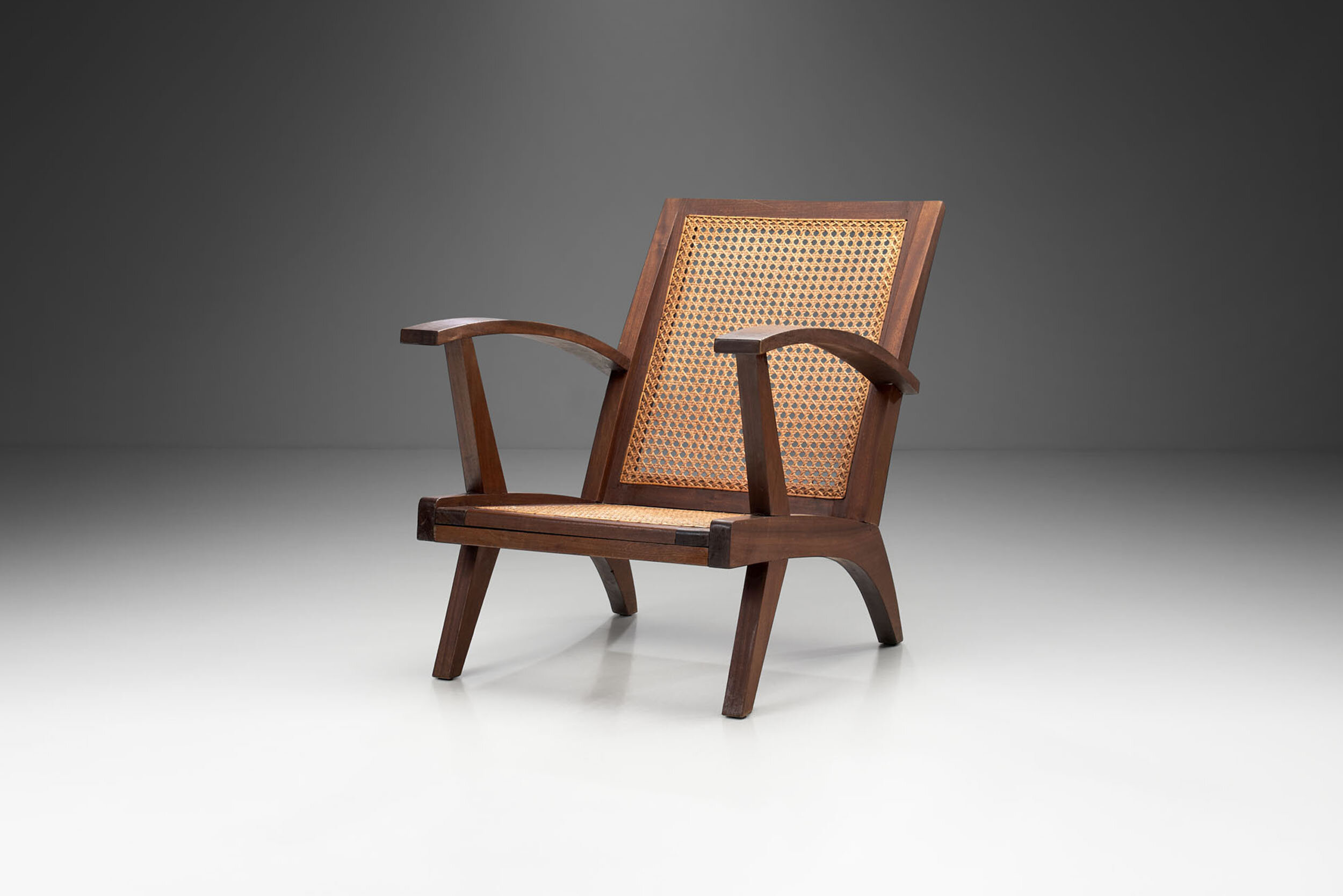
“Rokato” Lounge Chair by Gebroeders Jonkers Noordwolde, The Netherlands 1960s (sold)


“Rokato” Lounge Chair by Gebroeders Jonkers Noordwolde, The Netherlands 1960s (sold)
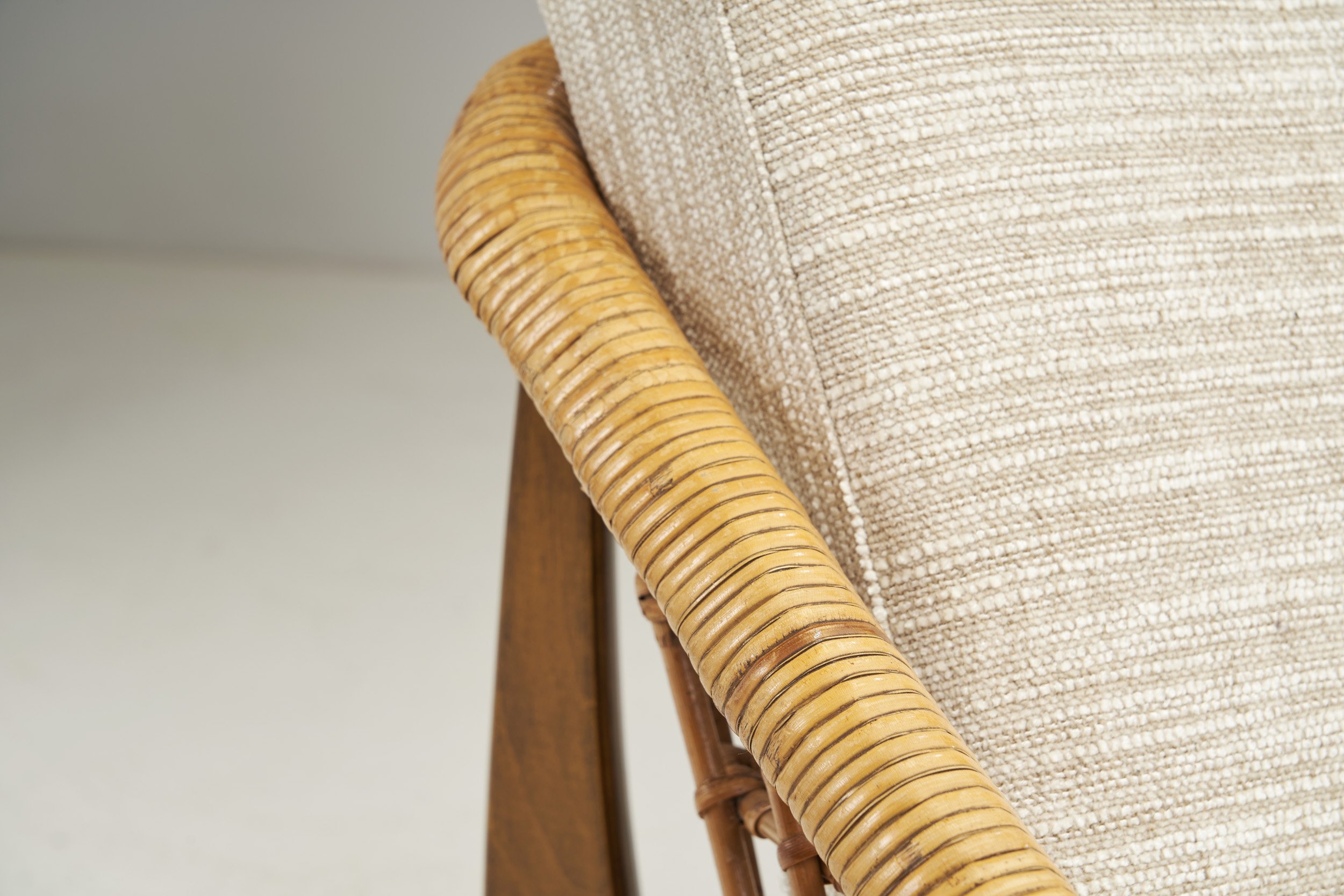
This “Rokato” lounge chair is an immediately recognizable design by the Dutch designers, Gebroeders Jonkers (Jonkers Brothers). In the middle of the last century, rattan played an important role in Dutch Design. The cradle was located in Noordwolde in Friesland, where the factory, Gebr. Jonkers, specialized in wickerwork. This model is uniquely both designed and manufactured by the company.
Gebroeders Jonkers are known for their stunning rattan designs and this low chair shows why. The shell seat is formed by one elaborately woven rattan piece. The organic material and symmetrical pattern of the seat are combined with, and contrasted by the wooden base with a structural look. The base consists of crossed bars that hold the seat. The geometrical and clean lines of this chair make it a beautiful example of Dutch mid-century modern design, that was, among others, inspired by its Scandinavian contemporaries.
Adding to the softness are the seat and back cushions that have been reupholstered recently in a premium fabric. Characterized by the clear and honest construction with a clear distinction between seat and frame, this Rokato chair is a unique design piece, and a visual reminder of the design prowess of the Dutch brothers, Jacob and Johan Jonkers.
SOLD
Condition:
In good vintage condition. Wear consistent with age and use. The chair cushions have been reupholstered recently in a premium fabric. Each of our items can be re-upholstered by our in-house atelier in a fabric of choice. Please reach out for more information.
Dimensions:
26.37 in W x 34.64 in D x 25.98 in H; Seat height 15.35 in
67 cm W x 88 cm D x 66 cm H; Seat height 39 cm
About the designer:
Rattan furniture enjoys the renewed attention of stylists and interior designers. Rattan is being embraced again in the 21st century. The most beautiful Dutch rattan furniture from the fifties to the seventies were created by Jacob and Johan Jonkers, better known as the brothers Jonkers in Noordwolde. The brothers had furniture factories that collaborated with nationally and internationally recognized designers.
In the middle of the last century, rattan played an important role in Dutch Design. The cradle is located in Noordwolde in Friesland, where two factories, Rohé and Gebr. Jonkers, specialized in wickerwork. The rattan came from Indonesia and replaced the originally used willow, which is much less tough and pliable. The airy and sleek rattan furniture fit perfectly in the functionalist style of the “Goed Wonen” (lit. good living) period. Both furniture producers worked with both Danish and Dutch designers, including one of the most famous Dutch designers, Dirk van Sliedregt. In the 1970s, Gebr. Jonkers found themselves in a tough situation, as the crisis hit and furniture trade also collapsed. The supply of rattan was also discontinued because of the protective measures that Indonesia took at the time to protect its own industry. Gebr. Jonkers had to stop their production in the 1980s, soon followed by Rohé, closing its doors in 1997.
The rattan industry’s history in the Netherlands is intertwined with that of the manufactory of Gebr. Jonkers in Noordwolde. Their woven chairs and elaborate supporting structures made them famous in- and outside the Netherlands. ~H.
REQUEST PRICE HERE
Price category: 2,500 - 5,000 usd / eur
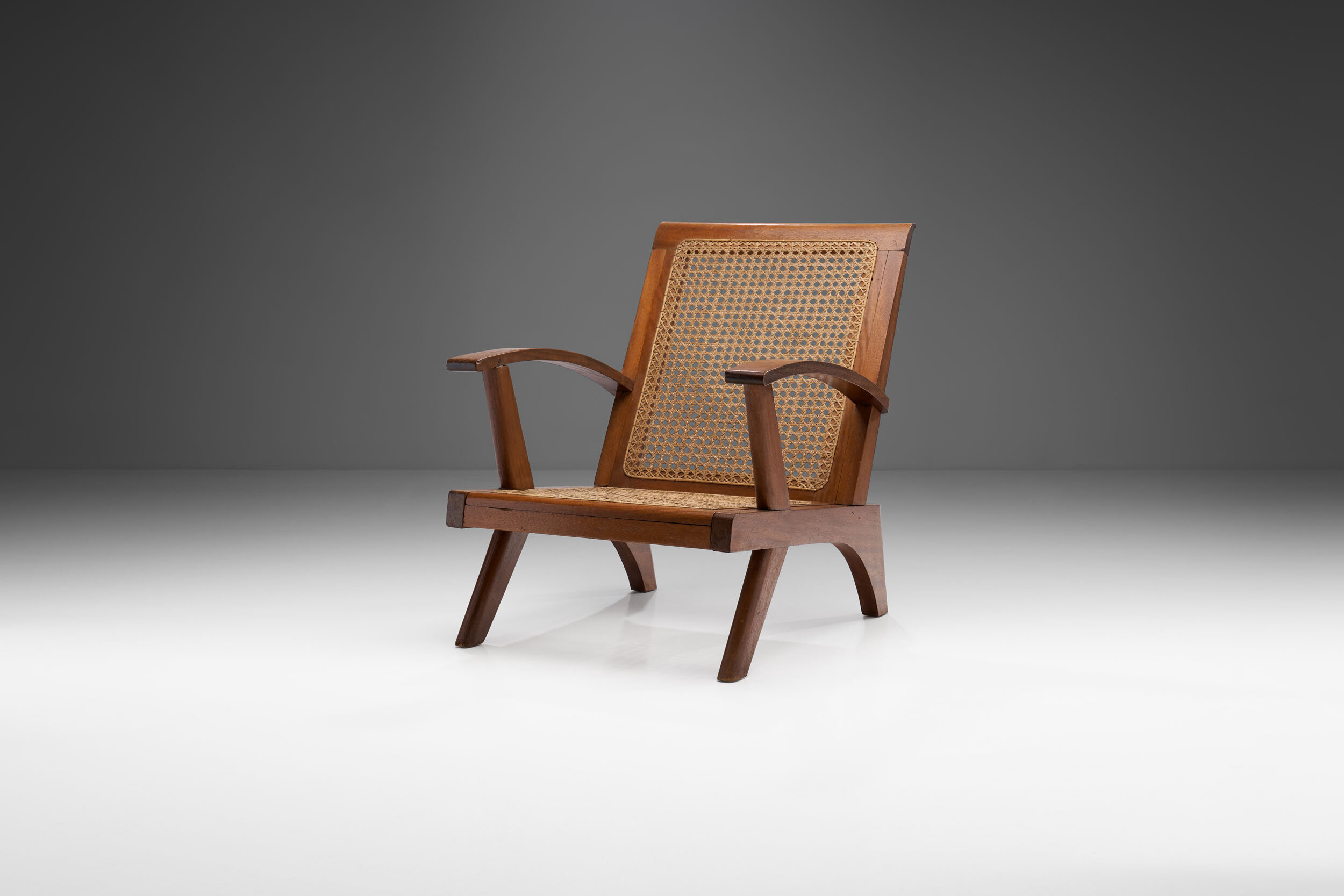
This mid-century French armchair combines a visually stunning structural body with expert caning technique and high-quality materials.
As with the UK and much of Europe, there was something of a design renaissance in France in the 1950s, due to developments in materials and technology after the war. In France, designers were often also architects, whose focus on functionality and quality resulted in sculptural models, such as this armchair. This model is all about the gorgeous teak structure and the cane panels. Pure, sleek forms, free from artifice or decoration characterise the aesthetic; a style that is commonly referred to as reconstructivism. A reconstructivist design builds upon prior, deconstructionist models and techniques, but adapts them to classic themes and structures, with the goal of creating works of genuine emotion and significance. This armchair in particular recalls the chairs of Swiss architect, Pierre Jeanneret’s designs for Chandigarh in India.
The body features octagonal mesh cane webbing, which is an elegant material that enhances quality and complements the teak wood. Cane webbing is strong enough to support the weight of a sitting person and flexible enough to bend around the sharp corners of wooden frames. Production of cane webbing requires a lot of labour, attention and craftsmanship and every production step involves repetitive careful hand selection. The cane panels are original and in great condition, testifying to the outstanding quality of this armchair and the skill of its maker. ~H.
Condition:
In good vintage condition. Wear consistent with age and use. Original cane panels. Some minor scratches and marks on the wood.
Dimensions:
25.59 in W x 32.87 in D x 31.1 in H; Seat height 11.41 in
65 cm W x 83.5 cm D x 79 cm H; Seat height 29 cm
REQUEST PRICE HERE
Price category: 2,500 - 5,000 usd / eur
This is a beautiful Peter Hvidt & Orla Mølgaard-Nielsen designed model “FD 144” easy chair, made in Denmark in 1953. It was produced by France & Daverkosen Denmark.
This solid oak FD-144 Easy Chair by the designer duo, has distinctive, wide and imposing bent armrests. The darker teak wood on the armrests and legs emphasises the elegant lines of this chair. The back is supported with a series of slender spindles that stand out as the main design element of this model.
The chair comes with two loose cushions that have been recently reupholstered in a premium bouclé fabric. Both cushions feature button tufting, giving a classic look. This chair is a Danish mid-century piece to its core, uniting functionality with and understated, yet interesting and elegant design.
Condition:
In good vintage condition. Wear consistent with age and use. Re-upholstered in premium bouclé fabric. Each of our items can be re-upholstered by our in-house atelier in a fabric of choice. Please reach out for more information.
Dimensions:
25.4 in W x 28.55 in D x 33.08 in H; seat height 16.93 in
64.5 cm W x 72.5 cm D x 84 cm H; seat height 43 cm
About the designer:
Hvidt & Mølgaard were the founders of the Copenhagen-based, Danish design and architectural firm which existed from 1944 until 2009. Founded by Peter Hvidt (1916-1986) and Orla Mølgaard-Nielsen (1907-1993), the company was a pioneering force in Danish furniture design and industrialized production in the 1950s, creating furniture that was easy to mass-produce and economic to transport.
Danish architect-designer Orla Mølgaard-Nielsen was born in 1907. His formative years were spent in Copenhagen, studying at the Aalborg Technical School and at the Art and Crafts School of the Design Museum. From 1931 until 1934, he continued his studies in furniture design at the Royal Danish Academy of Fine Arts under the instruction of Kaare Klint. Peter Hvidt was born in Copenhagen in 1916. He studied architecture and cabinetry at the School of Arts and Crafts in Copenhagen. Subsequently, he worked at various design firms before establishing his own studio in 1942. In 1944, Hvidt designed the Portex Chair, which was one of Denmark’s first stacking chairs.
In 1944, the pair co-established Hvidt & Mølgaard Studio, which they ran together until 1975. During this time, the pair created designs for Fritz Hansen, France & Søn, and Søborg Møbelfabrik. In 1950, they designed the AX Chair, which solidified their careers as industrial designers and became an icon of Danish mid-century design. It was the first Danish chair that was crafted with both a seat and back made of curved laminated wood.
From 1970, Hvidt & Mølgaard focused on architectural projects, which spanned office buildings and factories, as well as collective housing projects. They were known for their light, simple, and clear designs, which were carried out with precision. Both Hvidt and Mølgaard-Nielsen retired in 1975, designing over 256 pieces of furniture together over the course of their careers. Their work can be found at New York’s MoMA, the National Gallery in Melbourne, and the Danish Museum of Art & Design in Copenhagen. ~H.
REQUEST PRICE HERE
Price category: 1,000 - 2,500 usd / eur
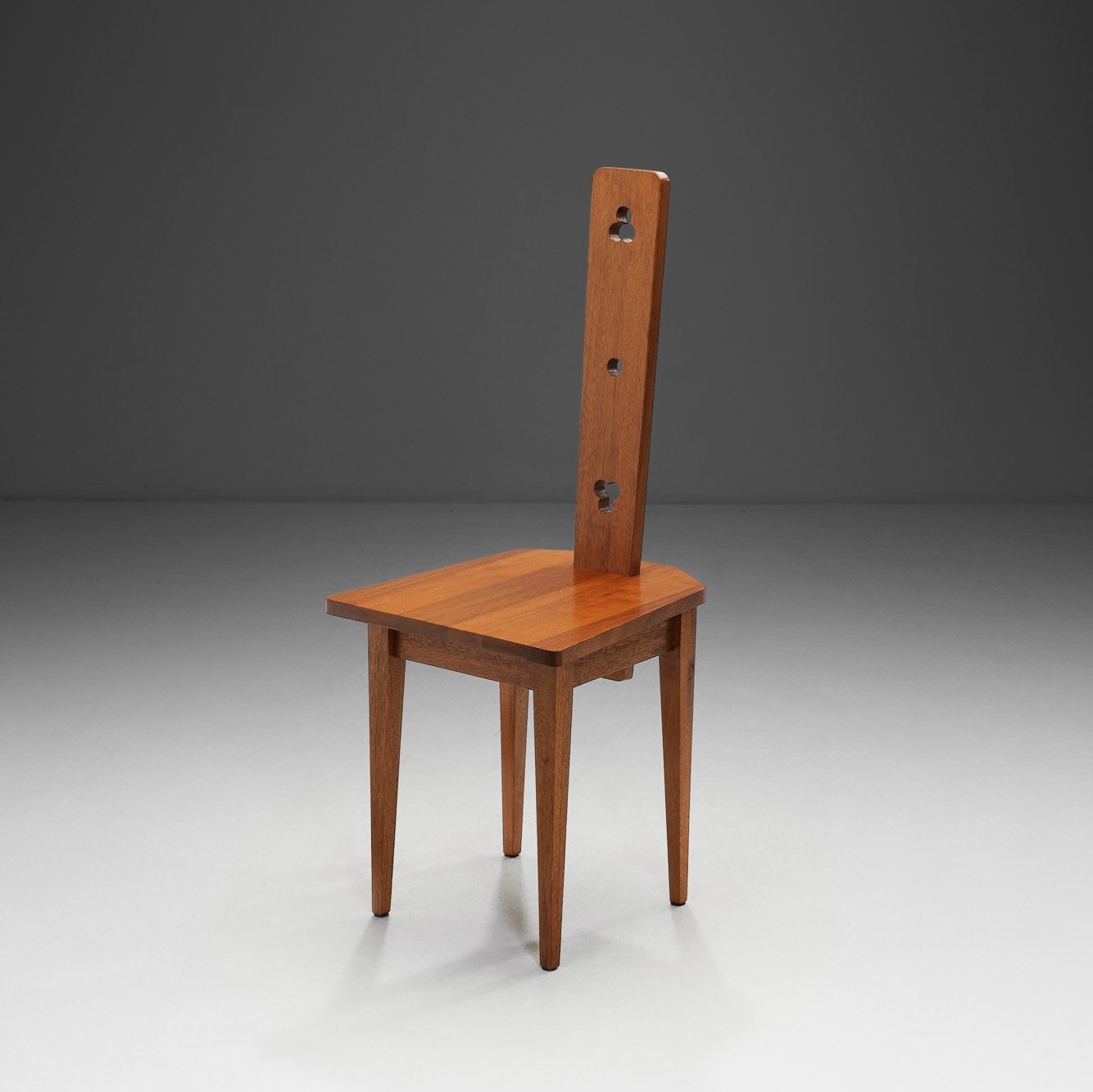
The ‘spinning chair’ is a historic type of seating with numerous modern interpretations across Europe - however, most preserved the main functional characteristics: solid wood, enduring, high quality craftsmanship, a tall, straight back for good posture and freedom of movement.
The art of spinning yarn is thousands of years old, but the spinning wheel as we know it is estimated to have arrived in Europe around the middle of the 13th century, and along with it came the three or four-legged spinning chair. The backs were often hand carved with various motifs or fantasy creatures, making each one unique and individual. During the 20th century, designers were inspired by the uniqueness of these chairs and reinterpreted them with a modern twist. The structure consists of straight and clean lines, with added subtle decorative elements. The simple ornamentation consists of three rounded shapes carved in the backrest, two of these resembling a three-leaf clover - possibly a reminder of the Celtic history of spinning chairs. In addition, the quality of the wood ensures simultaneously its durability and its aesthetic quality, with the construction of the piece showing off the wood grain to its best advantage.
This spinning chair remains ideal for craft spinners, however, it also possesses the visual qualities to be a perfect decorative accent piece for any space. It is a modern twist on the rich spinning history of Europe, and undoubtedly a beautiful addition to any interior.
Condition:
In good vintage condition. Wear consistent with age and use.
Dimensions:
15.74 in W x 17.32 in D x 40.35 in H; Seat height 18.11 in; Sear depth 14.37 in
40 cm W x 44 cm D x 102.5 cm H; Seat height 46 cm; Seat depth 36.5 cm
REQUEST PRICE HERE
Price category: 1,000 - 2,500 usd / eur
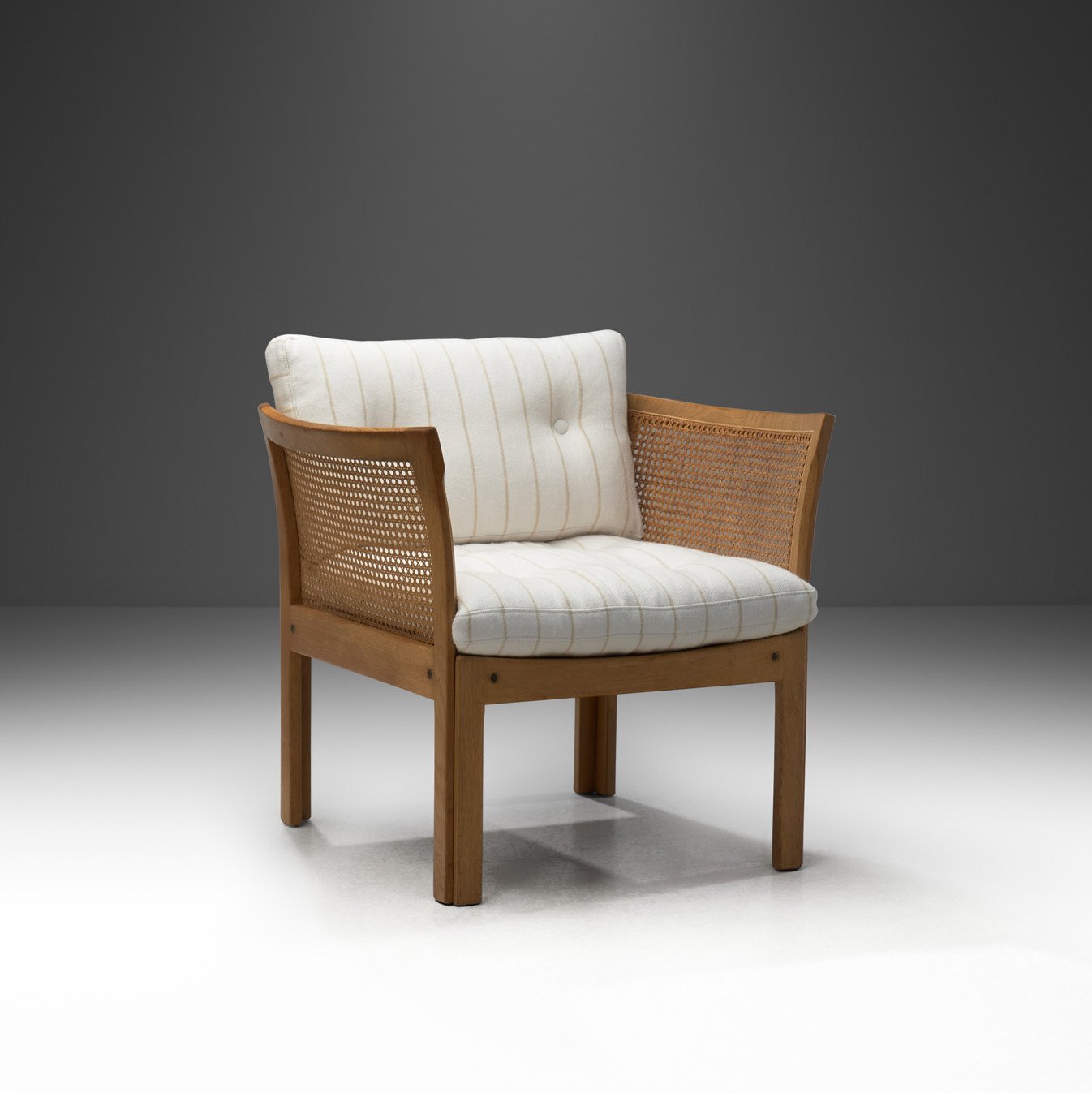
Danish furniture designer Illum Wikkelsø believed that furniture should be built to last, to indulge the body and to please the eye. He belonged to a group of designers who represented the “Golden Age” of Danish modern design during the mid-20th century era.
In a world increasingly filled with decoration, the Danish modern style chose to focus on designs that were simple yet meaningful. This simplicity wasn’t about lacking elements but about carefully choosing each one to have purpose and function, and this chair exemplifies that. Wikkelsø generally worked with clean lines, but also had a strong sense of organic expression and was deeply inspired by nature – especially the Danish landscape. He aimed to capture the beauty he saw in the environment around him in his furniture designs. In the case of this chair, the frame is crafted from oak, an especially durable hardwood that is extremely multi-faceted with a beautiful grain. Oak became an important material in the Danish mid-century period. Furthermore, the precision of the structure and the woven cane is evident at first glance, showing great geometric order. The cane elements of the frame are woven in a tight, visually pleasing pattern. It is clear this model is entirely based on Wikkelsø’s artisanship, which hails from a generation of cabinetmakers, upholsterers and furniture producers established before the 1950s. This heritage shines through this chair with a creative design that doesn’t compromise on quality. Extremely modest and confident at the same time is how this chair can be best described, showing great craftsmanship skill, and making it a lovely addition to any interior.
The Danish modern movement, rooted in the mid-20th century, was not a fleeting trend but a lasting shift in design philosophy. Its principles, grounded in simplicity, functionality, and a deep appreciation for natural elements, have not only withstood the test of time but have become foundational for many contemporary design approaches.
Condition:
In good vintage condition. Wear consistent with age and use. The chair has been reupholstered recently in a premium fabric. Each of our items can be re-upholstered by our in-house atelier in a fabric of choice. Please reach out for more information.
Dimensions:
29.13 in W x 26.38 in D x 29.13 in H; Seat height 17.32 in; Seat depth 18.11 in; Arm height 25.20 in
74 cm W x 67 cm D x 74 cm H; Seat height 44 cm; Seat depth 46 cm; Arm height 64 cm
REQUEST PRICE HERE
Price category: 5,000 - 7,500 usd / eur
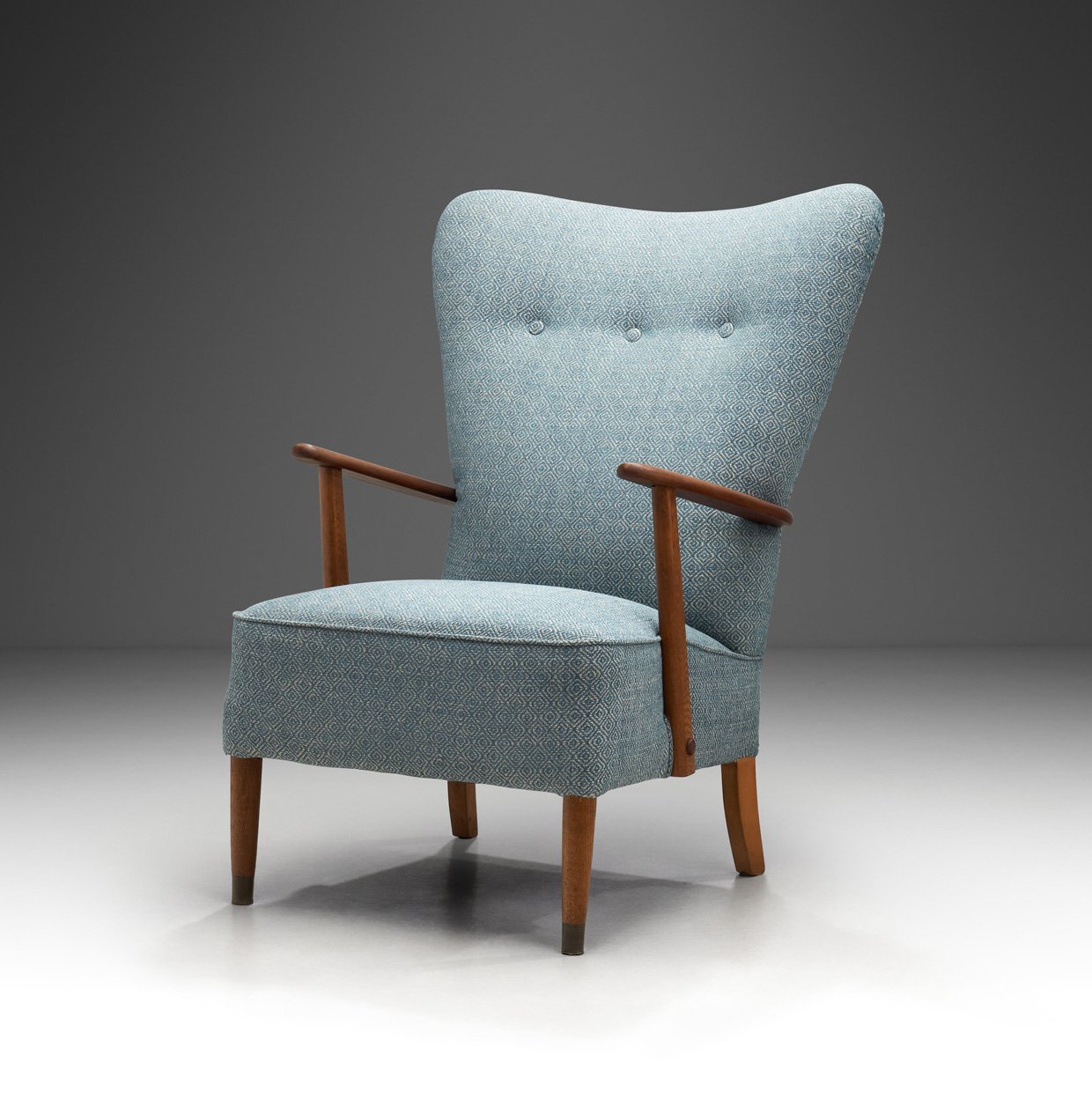
Danish Modern, a recognisable term around the world, stands for the characteristic style of Danish design created during the 20th century. With its golden age around the middle of the century, Danish Modern can be described by its clarity of design, use of high-quality materials and focus on functionality.
As this armchair shows, the craftsmanship skill of Danish master cabinetmakers is an immediately distinguishable characteristic of Scandinavian design. Easy chairs – an umbrella term for typically upholstered, comfortable chairs - like this one are expected to provide a level of comfort that assures relaxation. This is achieved by the large, slightly raised seat and tilted backrest. The back, including the headrest, is slightly rounded, increasing comfort even further. The chair’s high back, while wide at the top, tapers in and draws the eye, also highlighting three elegant tufted buttons. The open, sculptural armrests complement the rounded edges of the upholstered body, along with the simple wooden legs, with the front brass-capped legs standing straight and the back legs slightly bent and tilted to increase stability and comfort. The patterned upholstery dominates the look, and in the absence of additional ornamentation, the unique texture of the material remains the focus of the design.
This armchair is the perfect illustration of how the combination of Danish design, the work of a true cabinetmaker, and luxurious upholstery come together to create exceptional pieces. With its classically beautiful form and charming pattern, this armchair can truly elevate any interior.
Condition:
In good vintage condition. Wear consistent with age and use. The chair has been reupholstered recently in a premium fabric. Each of our items can be re-upholstered by our in-house atelier in a fabric of choice. Please reach out for more information.
Dimensions:
29.53 in W x 33.86 in D x 39.37 in H; Seat height 17.13 in; Seat depth 18.11 in; Arm height 24.41 in
75 cm W x 86 cm D x 100 cm H; Seat height 43.5 cm; Seat depth 46 cm; Arm height 62 cm
REQUEST PRICE HERE
Price category: 5,000 - 7,500 usd / eur
“Danish Modern” is a recognized term around the world, standing for the characteristic style of Danish design created during the mid-20th century. Danish designers were often trained architects themselves, resulting in masterful structures as seen in this armchair. The design is focused on the aesthetics of modernism whilst employing the exquisite technique and material familiarity of the highly skilled craftsmen.
The lovely shell body has effortlessly flowing lines with an open profile. The arms curve outwards highlighting the shape. It is evident from every single angle that the body was designed with the sitter in mind, offering great ergonomic design. This model is built in a permanently reclined position, which is a key feature; the slightly reclined backrest and raised seat provide ultimate comfort both for the eyes and the body. The round edges of the body create a nice balance by contrasting with the solid teak legs’ tapered shape. Furthermore, the colours and texture of the wood and the upholstery complement each other as well to create the coveted mid-century modern look. With a calm, elegant style, armrests with sinuous curves, and tapered wooden legs relieving its formal weight, this lounge chair is a visual treat with an understated look that is harmonious and well-balanced.
Without any excess decoration, the focus is on the round lines of the body and its unequaled upholstery. Danish design allowed aesthetics to flow more naturally, which is clearly visible in the lines of this chair, from its embracing back to its voluptuous seat. With a classic look, storied design and solid quality, this chair is a truly timeless piece.
Condition:
In good vintage condition. Wear consistent with age and use. Some minor scratches and marks on the wood. The chair has been reupholstered recently in a premium alpaca blend fabric. Each of our items can be re-upholstered by our in-house atelier in a fabric of choice. Please reach out for more information.
Dimensions:
31.89 in W x 38.19 in D x 40.55 in H; Seat height 18.5 in; Seat depth 19.49 in; Arm height 22.05 in
81 cm W x 97 cm D x 103 cm H; Seat height 47 cm; Seat depth 49.5 cm; Arm height 56 cm
REQUEST PRICE HERE
Price category: 2,500 - 5,000 usd / eur
This mid-century French armchair combines a visually stunning structural body with expert caning technique and high-quality materials. From all sides, this chair’s angles are visually arresting, revoking the chairs created by the Swiss architect, Pierre Jeanneret for Chandigarh in India.
As with the UK and much of Europe, there was something of a design renaissance in France in the 1950s, due to developments in materials and technology after the war. In France, designers were often also architects, whose focus on functionality and quality resulted in sculptural models, such as this armchair. This model is all about the gorgeous teak structure and the cane panels. Pure, sleek forms, free from artifice or decoration characterise the aesthetic; a style that is commonly referred to as reconstructivism. A reconstructivist design builds upon prior, deconstructionist models and techniques, but adapts them to classic themes and structures, with the goal of creating works of genuine emotion and significance.
The body features octagonal mesh cane webbing, which is an elegant material that enhances quality and complements the teak wood. Cane webbing is strong enough to support the weight of a sitting person and flexible enough to bend around the sharp corners of wooden frames. Production of cane webbing requires a lot of labour, attention and craftsmanship and every production step involves repetitive careful hand selection. The cane panels are original and in great condition, testifying to the outstanding quality of this armchair and the skill of its maker.
Condition:
In good vintage condition. Wear consistent with age and use. Original cane panels. The wood has beautiful patina.
Dimensions:
25.59 in W x 34.64 in D x 31.88 in H; Seat height 11.81 in
65 cm w x 88 cm D x 81 cm H; Seat height 30 cm
REQUEST PRICE HERE
Price category: 2,500 - 5,000 usd / eur
The designs of most of Danish mid-century modern furniture designers and architects aimed at functionality, an equally minimalist and appealing appearance and easy accessibility. This slatback chair with a woven Danish paper cord seat is perhaps one of the best examples of these principles of the Danish modern design.
The beautifully shaped armchair with a Shaker-like design clarity and honesty not only exudes mid-century modern charm but also the organicity of wabi sabi and japandi style pieces. The most attention-grabbing visual element of this chair’s design is the backrest, with six wooden spindles that create an airy look that recalls the traditional slat back chair style. The lightly curved top rail and arms have a sculptural look, mimicked by the armrests that are also supported by a single bent slat in the front. This creates a unified appearance that highlights the diverse shapes and the natural beauty of the teak wood and its versatile grain. Interesting details are to be found everywhere in the design, including the perfectly fitted, woven paper cord seat and the uniquely arranged stretchers connecting the legs. As the lower structure with the legs and stretchers combine straight lines with smooth surfaces and a geometric arrangement, the design gains a sculptural look that is appealing from all angles. The structure displays a beautiful contrast between the smooth teak frame and the organic and textured Danish paper cord seat. One material that is often vastly underrated is Danish cord. Noteworthy for its durability, Danish cord is also beloved for its functional and aesthetic qualities. As the name implies, it is a product of Denmark that became an important material in the Danish Modern period of the 1940s and 1950s. Danish cord is a strong, three-ply paper cord roughly 1/8” in diameter. Renowned designers such as Hans Wegner and Børge Mogensen employed Danish cord in some of their most iconic designs. The woven or basket form of the seat of this armchair has a tight, visually pleasing pattern in great condition.
Extremely modest and confident at the same time is how this chair can be best described. The most renowned Danish designers of the era preferred to work with traditional and natural materials, but also liked to experiment with new techniques; the resulting models - such as this chair - are Danish Modern classics.
Condition:
In good vintage condition. Wear consistent with age and use. Some small marks and scratches on the wood and the paper cord.
Dimensions:
24.8 in W x 24.01 in D x 33.66 in H; Seat height 16.14 in; Arm height 24.01 in
63 cm W x 61 cm D x 85.5 cm H; Seat height 41 cm; Arm height 61 cm
REQUEST PRICE HERE
Price category: 5,000 - 7,500 usd / eur
During the 1950s, Danish designers led the way in furniture design, with Danish mid-century seating pieces to this day being some of the most iconic of their time.
This armchair embodies the characteristics and ethos of its period. Georg Thams designed this chair in line with his minimalistic, yet functional style for Danish manufacturer Vejen Polstermøbelfabrik, showcasing attention to detail through qualities such as the shape and mix of materials used in the construction. Oak and teak wood are amongst the most durable and naturally beautiful choices of material, making this armchair into a long-lasting and classically elegant piece. Originally, wingback chairs were designed to protect occupants from drafts and offer a touch of privacy, and have since become synonymous with comfort and timeless style. The traditional wingback design is reinterpreted in the mid-century fashion of this piece, moving from the classic rounded and closed structure to a more modern silhouette. The curved sides of the chair maintain their winged look, while the teak armrests feature an open construction. The high, curved back of this piece ensures comfort, transforming the chair into a statement piece of decor with additional subtle details such as the five tufted buttons placed horizontally on the backrest. The brown tones of the angled teak arms and tapered oak legs combine with the soft green coloured upholstery to give the piece a natural, earthy feel.
The quality materials of this armchair ensure durability, while the shape intertwines the traditional design with a quintessential Danish mid-century touch. The beauty of this piece is evident through both its form and function, making it a great addition to a modern interior.
Condition:
In good vintage condition. Wear consistent with age and use. This chair has been reupholstered recently in a premium fabric. Each of our items can be re-upholstered by our in-house atelier in a fabric of choice. Please reach out for more information.
Dimensions:
30.31 in W x 37.80 in D x 39.37 in H; Seat height 17.12 in; Seat depth 21.26 in; Arm height 23.42 in
77 cm W x 96 cm D x 100 cm H; Seat height 43.5 cm; Seat depth 54 cm; Arm height 59.5 cm
Literature:
Mobilia no. 2, February 1956, p. 10, in the advertisement.