
"Safari" Chairs in Patinated Cognac Leather, Europe ca 1960s (sold)


"Safari" Chairs in Patinated Cognac Leather, Europe ca 1960s (sold)
Born from both adventure and practicality, the safari chair has transcended its 18th-century origins being lugged around the great outdoors to become a beloved icon of design. Here, the classic pairing of the elegant patinated leather is paired with beautiful solid wood to command attention which is partly why this chair style remains popular in contemporary interior design.
The design of this pair of remarkable chairs sits in a long tradition of safari chairs. From Eileen Gray to Kaare Klint and Elias Svedberg a lot of great designers have made versions of self-assembled furniture, which probably finds it origin in Indian Roorkhee Chairs used by the British military. The design recalls Pierre Chapo’s “S10” chair, with a similar frame that utilizes a simple, elegant construction with an impeccable joinery technique that also serves a decorative role. The mortise and tenon joinery is especially defining, joining the seats and the legs. The chairs have a confident outline with straight lines that allow the gorgeous patinated leather to stand out. Comprising the seats, arm- and backrests, the cognac leather is secured to the frames in various ways including belted straps on the seats, screws in the backs, and weaving on the backs. These differing methods add a lot to the chairs visually, and showcase the outstanding craftsmanship. Through a simple mechanism, the backs can be adjusted in their position for ultimate comfort.
By focusing on “connections” such as the wooden joints and the leather’s diverse attaching techniques to the frames, these chairs have a striking modernist style. Whether in need of a statement piece or a comfortable spot to unwind, high-quality leather safari chairs are a great choice to bring a dash of stylish allure to any space.
SOLD
Condition:
In good vintage condition. Wear consistent with age and use. The cognac leather has some marks and a beautiful patina. Each of our items can be re-upholstered by our in-house atelier in a fabric of choice. Please reach out for more information.
Dimensions:
25 in W x 27.16 in D x 29.92 in H; Seat height 14.56 in; Arm height 22.04 in
63.5 cm W x 69 cm D x 76 cm H; Seat height 37 cm; Arm height 56 cm

REQUEST PRICE HERE
Price category: 5,000 - 7,500 usd / eur
This peculiar mid-century easy chair features multiple distinctive characteristics, from its floating back to the curvaceous armrests. This model is, without a doubt, the work of a master cabinetmaker. The period from roughly the 1940s through the 1960s was a high point for Scandinavian furniture makers, and this chair shows why.
The elegant organic lines of the design create a striking silhouette. Its generous proportions and luxurious upholstery provide great sitting comfort. The chair’s seat and backrest are separated in a style that is typical of Swedish designer, Otto Schulz. This stylish feature highlights the beautiful oaken frame. The armrests are in a peculiar shape, wider in the middle, and along with the generous proportions and upholstery, are perfectly sculpted to accommodate the sitter. Schulz was known for his floating back designs as seen here, preventing the chair from looking heavy. As with most lounge chairs, this chair is also built in a slightly reclined position which provides ultimate comfort. Thanks to the open profile and luxurious, organic style, it is an ideal way to draw attention while complementing any space.
Swedish furniture reflected traditional Scandinavian craftsmanship and mixed it with a modern style. This is reflected in the beautiful sheepskin upholstery, which give this easy chair a soft, modern edge. The sturdy frame and armrests are all carved from solid oak and have acquired a beautiful patina over the decades.
Condition:
In good vintage condition. Wear consistent with age and use. Due to the nature and age of the wood, the chair may have marks, scratches, and discolouration. The chair has been recently reupholstered in premium sheepskin. Each of our items can be reupholstered by our in-house atelier in a fabric of choice. Please reach out for more information.
Dimensions:
27.95 in W x 30.90 in D x 31.29 in H; Seat height 16.92 in
71 cm W x 78,5 cm D x 79,5 cm H; Seat height 43 cm
About the (attributed) designer:
Otto Schulz (1882-1970) was Swedish interior designer, furniture designer, publisher and founder of the furniture company BOET in Gothenburg.
Schulz was born in Germany and moved to Sweden in 1907. He mainly produced opulent upholstered furniture, as well as lavishly inlaid, decorative box furniture style-wise between functionalism and traditionalism. He has some of his own invented techniques patented, including the use of decorative nails as part of the design, called Bopoint. After establishing his own furniture company, BOET, he used it as a showroom to exhibit his designs as well.
In the 1920s he started publishing the eponymous magazine BOET, which was also a platform for his own collection. The magazine was at the time the most influential, appearing in regular editions in Sweden and often included interviews with well-known designers and architects. ~H.
REQUEST PRICE HERE
Price category: 5,000 - 7,500 usd / eur
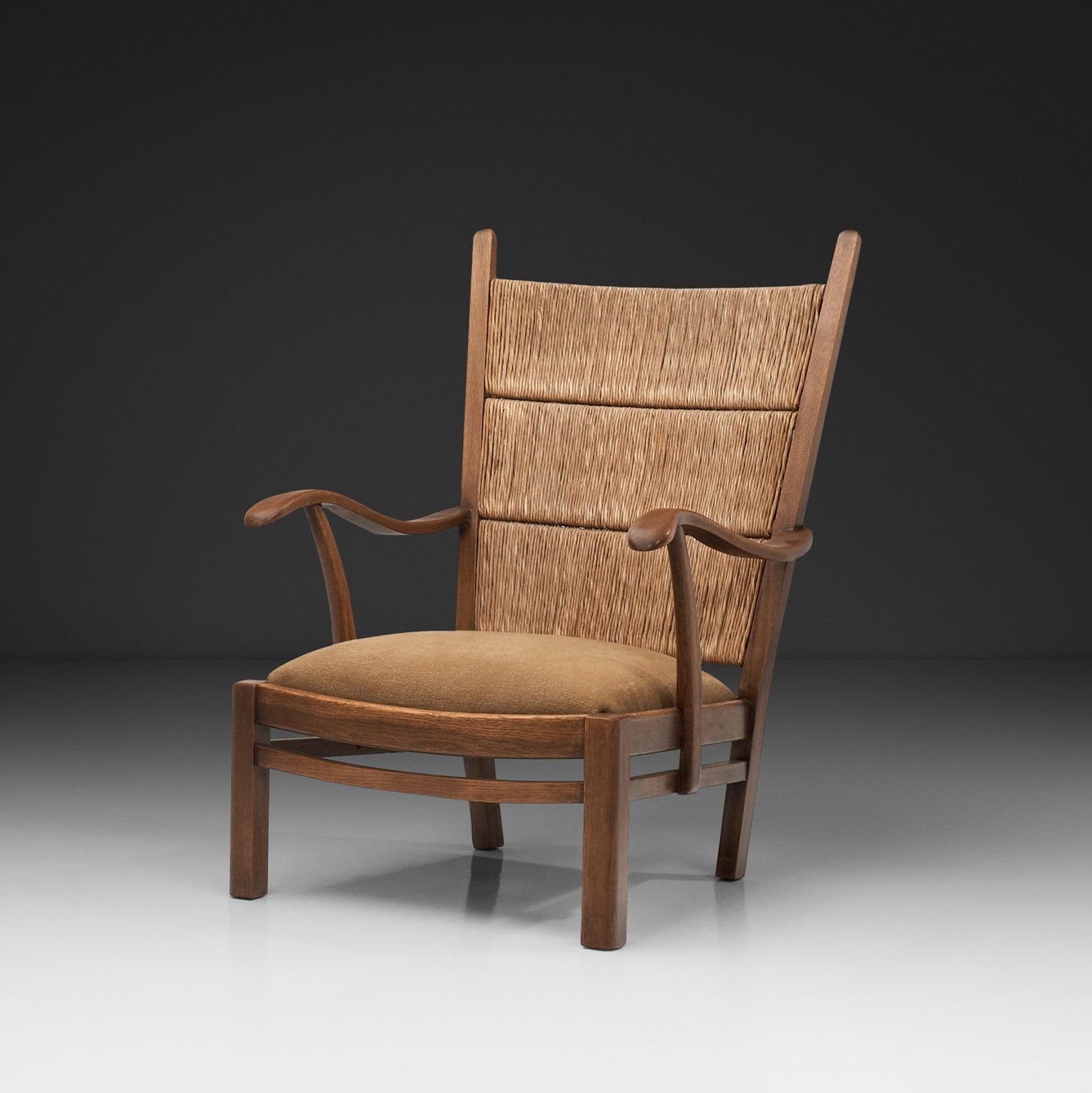
Bas van Pelt (1900–1945) was a Dutch furniture and interior designer whose work combined traditional craftsmanship with the principles of early modernism. While Van Pelt's creative work was primarily dominated by the Hague School, this armchair is the result of his more mature design period, characterised by natural materials, in order to create a friendly and inviting appearance that combines the warmth of solid oak with the distinctive texture of woven rush.
The construction of this model is simple at its core, but thanks to certain details, it is a playful representation of early Dutch modernism. While made of solid oak, this armchair has an open feel to it thanks to the horizontal spaces on the back that divide the three rush panels. The tall, slightly inclined backrest is framed by two straight wooden uprights, creating a strong vertical outline that contrasts with the more fluid shape of the armrests. The curved lines of the arms contrast nicely with the straight lines of the frame and clearly show wonderful craftsmanship. Each armrest extends outward in a gentle wave, giving the chair a particularly individual character. The rush weaving on the back adds textural interest, bringing the appealing roughness of nature to the design. Its closely arranged vertical strands create a warm, sandy surface, beautifully complemented by the oak's rich brown colour and the similar tone of the upholstery. The legs and stretchers are simple in their design, serving a primarily structural role and allowing the rush weaving and the wooden construction to stand out. The legs are connected by a gently curved wooden rail beneath the seat, while the rear supports continue naturally from the backrest. Thanks to the well-chosen proportions and the combination of natural materials, this armchair provides great comfort while maintaining a remarkable appearance.
Bas van Pelt's progressive designs were, in many ways, ahead of his time. The Dordrecht-born designer's furniture models are quite rare, with examples preserved in the collection of the Stedelijk Museum Amsterdam. Furniture pieces like this easy chair stand out through their unique textures and materials, as well as their classic charm. Its generous backrest and comfortable seat make it particularly suitable for a living room, library or reading area, where the craftsmanship can be appreciated from every angle.
Condition:
In good vintage condition. Wear consistent with age and use. The chair has recently been reconditioned. Due to the nature and age of the wood, the item has minor marks, scratches, dents and discolouration. The seat cushion has recently been reupholstered in a premium fabric. Each of our items can be reupholstered by our in-house atelier in a fabric of choice. Please reach out for more information.
Dimensions:
24.8 in W x 29.13 in D x 38.18 in H; Seat height 14.96 in; Seat depth 22.44 in; Arm height 22.83 in
63 cm W x 74 cm D x 97 cm H; Seat height 38 cm; Seat depth 57 cm; Arm height 58 cm
REQUEST PRICE HERE
Price category: 9,000 - 12,500 usd / eur
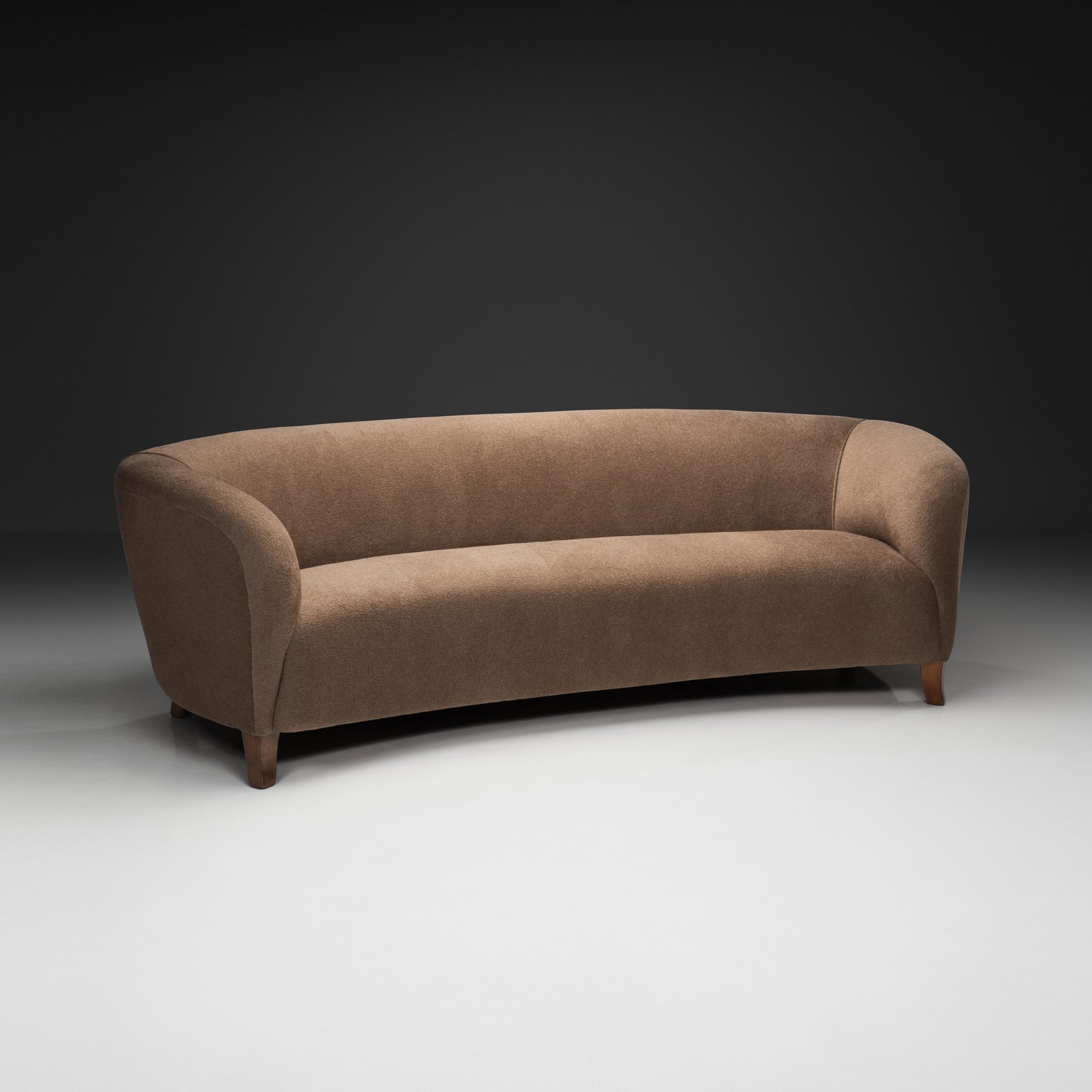
This sofa reflects the quiet confidence of Scandinavian design from circa 1930s, a period when modern ideas were being absorbed into more traditional forms. Swedish furniture of this era often balanced restraint with comfort, favouring clean silhouettes. Rather than chasing novelty, designers focused on proportion, usability, and longevity.
Curved sofas in general are considered statement pieces, for reasons that are eminently present in this three-seater sofa. With its classic shape paired with modern design, the generous size and fully upholstered body, it is outstanding, even when measured to the many beautiful sofas created in Sweden during the first half of the 20th century. The large, curved backrest follows the curve of the voluptuous seat, creating an inviting and open look. This shape is referred to as the ‘banana’ in furniture design, and is perfect to bring people closer together. The armrests are not independent, but rather a continuation of the back. The solid wooden legs provide perfect stability and visual appeal to the upholstered body, while balancing the sizeable body. Wood is the most important material in Swedish mid-century design, and the luxurious upholstery highlights and complements the beautiful colour of the wood.
Free from unnecessary ornamentation, the aesthetic of this three-seater sofa is sleek, elegant and modern. With its curved shape, it is perfect to break the rigour of any space, keeping the elegant appearance, elevated by the warm toned upholstery.
Condition:
In good vintage condition. Wear consistent with age and use. The sofa has recently been reconditioned. Due to the nature and age of the materials, the item has some marks, scratches, and discolouration. The sofa has recently been reupholstered in a premium fabric. Each of our items can be reupholstered by our in-house atelier in a fabric of choice. Please reach out for more information.
Dimensions:
92.51 in W x 33.07 in D x 27.55 in H; Seat height 17.32 in; Seat depth 17.71 in; Arm height 27.55 in
235 cm W x 84 cm D x 70 cm H; Seat height 44 cm; Seat depth 45 cm; Arm height 70 cm
REQUEST PRICE HERE
Price category: 9,000 - 12,500 usd / eur
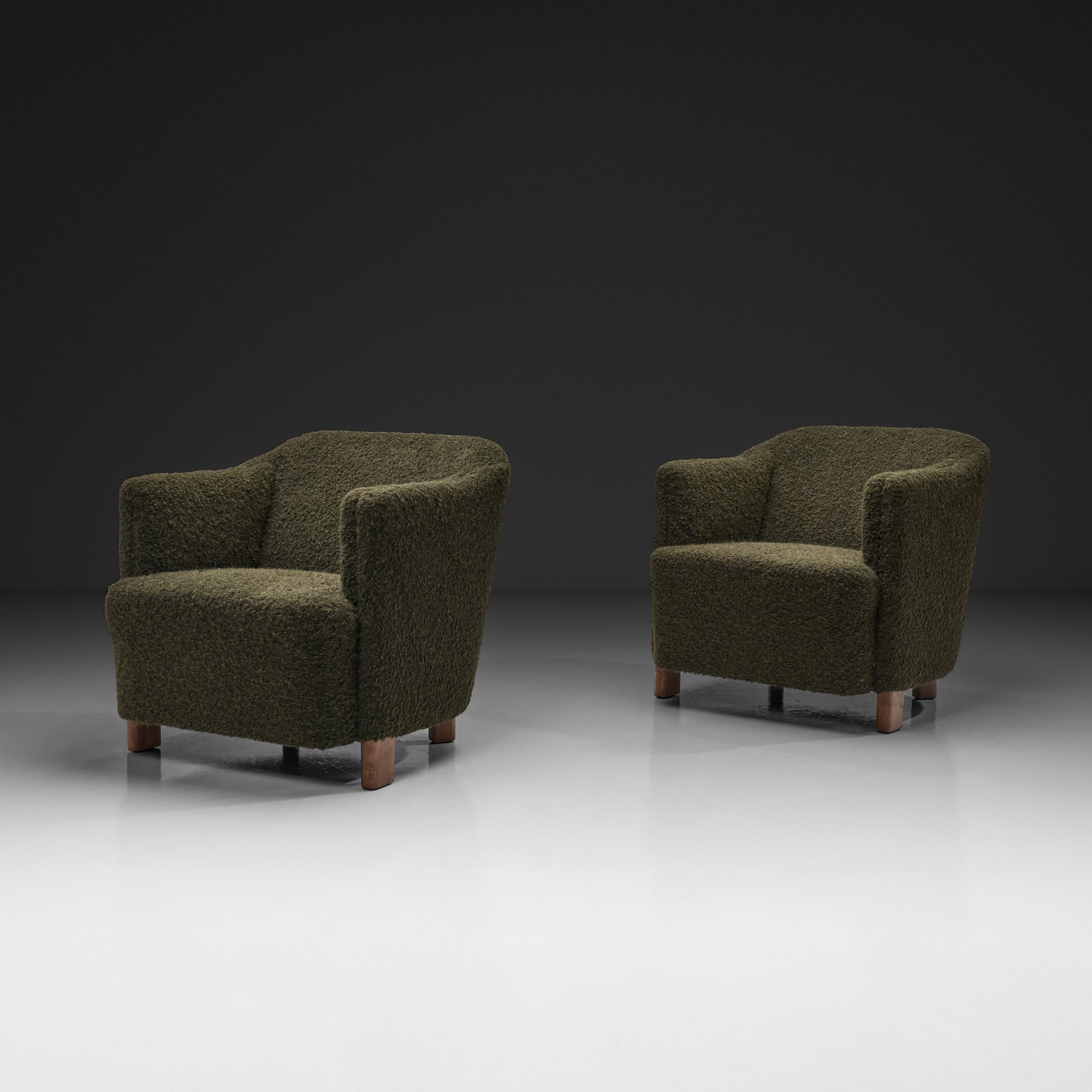
These chairs were created by Asko, the Finnish furniture manufacturing company founded in 1918 by Aukusti Asko Avonius, known for the production of high-quality furniture. By 1930, the company had grown to be the largest furniture chain in Finland and the largest supplier of furniture in the Nordic countries. This pair of Model “217” or “Continent” armchairs belongs to this period of Finnish furniture design, combining the generous comfort of traditional upholstered seating with a more restrained and modern appearance.
These armchairs embody comfort and elegance in equal measure. With their soft curves and rounded bodies, they cradle the sitter in a harmonious and just as stylish embrace. The defining feature of these lounge chairs is their enveloping design, which creates a sense of cosy intimacy and warmth. Each chair has a broad, rounded backrest that curves forward at the sides into the upholstered arms. The soft curves that define their shape not only evoke inviting comfort but also serve a practical purpose, as the curvature follows the natural contours of the human body. The chairs appear open and welcoming thanks to the arms and backs curving outwards, while the deep seats and generous padding emphasise their comfortable character. The soft outline of the design remains clearly defined, enhanced by the dark moss-green upholstery. The fabric has a rich, textured surface that accentuates the gentle curves and gives the chairs a warm, inviting appearance. The seats extend forward between the rounded arms, with their upholstered fronts creating a uniform image. Short wooden legs support the chairs, their warm brown colour contrasting beautifully with the green fabric. In the absence of additional ornamentation, the focus stays on the distinctive shape, supported by functionality and comfort.
As part of Asko's furniture production, the model “217” represents an interesting chapter in the development of modern seating. With their cosy appearance, distinctive bodies and appealing material combination, the armchairs bring warmth and character to an interior while retaining the comfort and practicality for which they were designed.
Condition:
In good vintage condition. Wear consistent with age and use. The chairs have recently been reconditioned. Due to the nature and age of the materials, the wood has minor scratches, dents and discolouration. The chairs have recently been reupholstered in a premium fabric. Each of our items can be reupholstered by our in-house atelier in a fabric of choice. Please reach out for more information.
Dimensions:
27.76 in W x 31.89 in D x 27.95 in H; Seat height 15.75 in; Seat depth 20.67 in; Arm height 24.41 in
70.5 cm W x 81 cm D x 71 cm H; Seat height 40 cm; Seat depth 52.5 cm; Arm height 62 cm
REQUEST PRICE HERE
Price category: 9,000 - 12,500 usd / eur
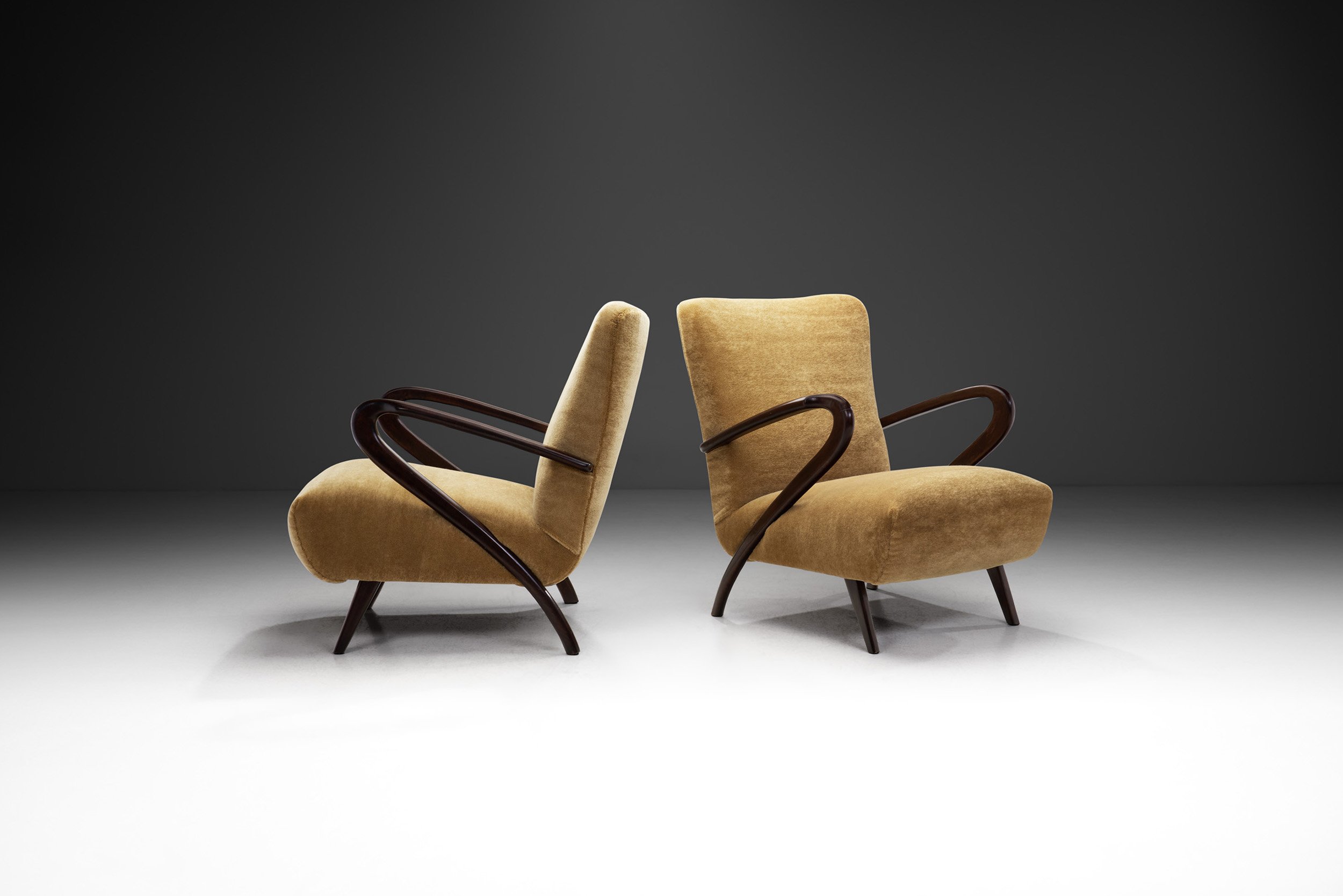
The Italian architect, painter and furniture designer, Guglielmo Ulrich, descended from a noble family with Danish origins. He quickly became a very influential figure in modern Italian design and his models are real delicacies today.
As this pair of 1950s lounge chairs show, Ulrich’s work is elegant and rich in detail. Although his work does not quite conform with the strict norms of simplicity of the time, it fits the prevalent aesthetics of Modernism. In the case of these chairs, the fully upholstered bodies show the general mid-century modern characteristics with an ergonomic and functional design. The seats are slightly raised, and the backs tilted, creating an angle that supports the sitter and the lounging experience. The wooden arms transcending to form the back legs however, truly stand out. The sharp curvature of the armrests and front legs define the look and create an interesting effect, as if the upholstered seats and backs were connected to them without joinery. The carved, dark wood and soft upholstery make them even more pronounced. There are more, subtler features to these chairs, including the wider armrests and the curved backrests, both in service of comfortable lounging. Thanks to the quality of his furnishings, that Ulrich designed and made personally, he became the trusted architects of many upper-class Milanese families. He participates in the furnishing of the most prestigious Italian ships: Cristoforo Colombo, Raffaello, etc.
“A nobleman of yesteryear, with sudden jokes and twists, such as a pipe with an egg in his mouth and a very concrete sense of doing” is how he was often described. This pair of chairs is much like this description with a playful, elegant design completed by quality materials and craftsmanship.
Condition:
In good vintage condition. Wear consistent with age and use. The chair has been reupholstered recently in a premium fabric. Each of our items can be re-upholstered by our in-house atelier in a fabric of choice. Please reach out for more information.
Dimensions:
24.4 in W x 31.69 in D x 31.49 in H; Seat height 14.17 in; Arm height 23.42 in
62 cm W x 80.5 cm D x 80 cm H; Seat height 36 cm; Arm height 59.5 cm
About the designer:
Guglielmo Ulrich (born 1904, Milan–died 1977) was an Italian architect, furniture designer, and painter. He was born to a notable family of Danish origin. In 1924, Ulrich enrolled in the Scuola Speciale di Architettura at the Accademia di Belle Arti di Brera. He finished his studies at Politecnico di Milano in 1927 and soon became a very influential figure in modern Italian design.
In 1930, along with Scaglia and Wild, Guglielmo Ulrich founded and became head designer of home furnishing company Arca (Arredamento casa, or Home Furnishing), a company engaged in the creation of high-quality furnishing accessories characterized by craftsmanship and the use of premium materials. In the 1950s, he participated in several editions of the Triennale di Milano and concentrated on designing buildings, offices, and retail shops throughout Italy.
Most of Ulrich’s furniture designs from this era, and especially his chairs and chaise lounges, resemble simplified and streamlined design versions of late 19th century pieces and do not necessarily conform to modern designs prevalent in Northern Europe and the U.S. in the 1950s. In the 1960s, Ulrich focused his work toward industrial design and was able to create original and impactful objects. His talent was rewarded on many occasions. In 1961, he won the Fiera di Trieste award for his Trieste chair, produced by furniture maker Saffa.
REQUEST PRICE HERE
Price category: 7,500 - 10,000 usd / eur
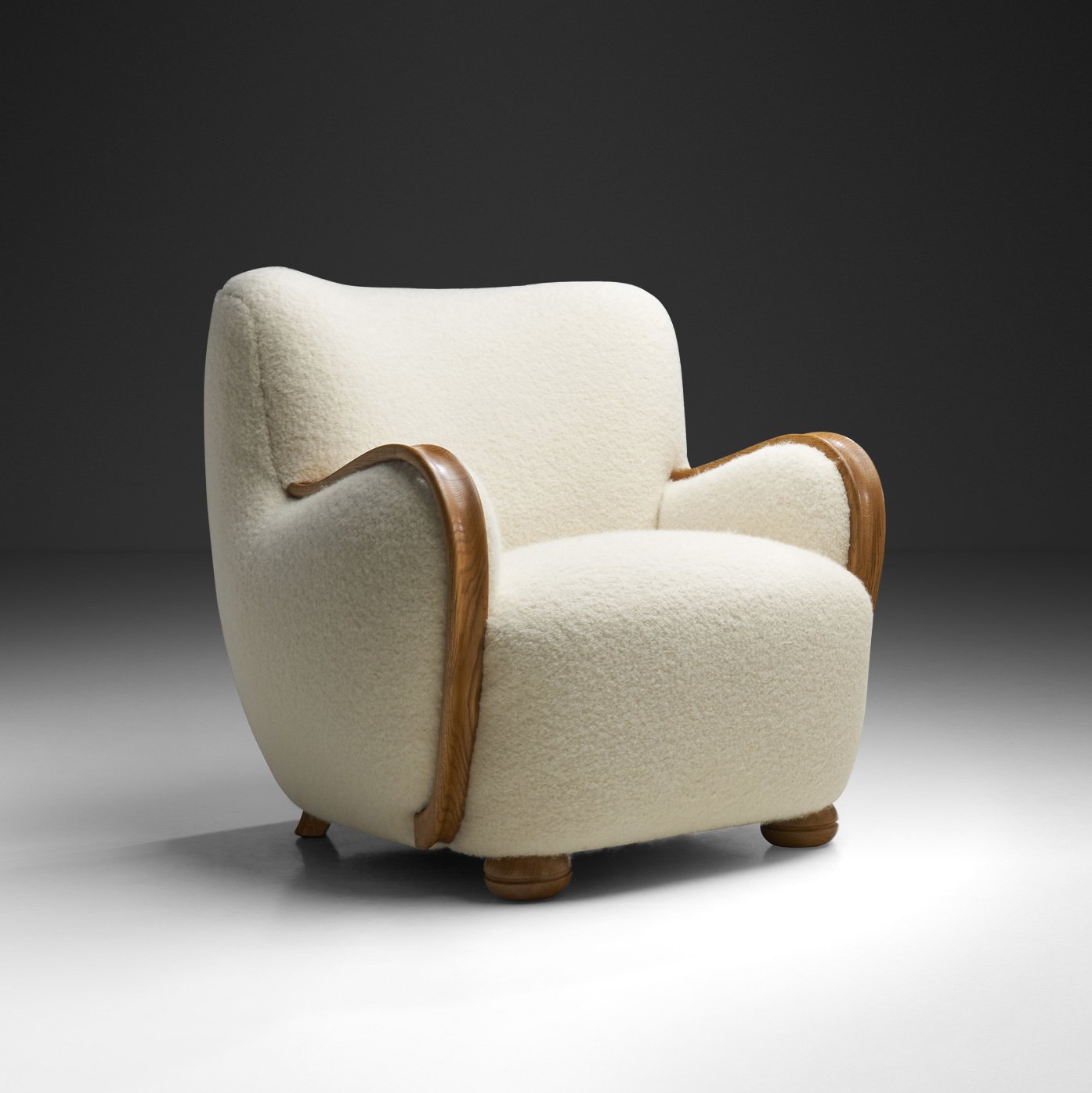
Simplicity, functionality, and elegance - these are the basic aspects of Danish design and accordingly, of this sophisticated easy chair as well. As a representation of early modernist seating, there is a profound focus on comfort and cosiness, that invokes a pleasant homelike feeling.
The subtle decorative qualities stemming from the early 20th century art movements and the simple lines deriving from the inter-war art movements gives the chair its elegance. Even though Scandinavian design is generally democratic and meant for the masses, pieces were not stripped of all beauty in order to make them as easy to use as possible. The importance of this balance can be identified in the design and execution of these armchairs as well. This balance is achieved through the clever use of the materials and rounded edges of the upholstered body. The exposed wood outlining the armrests’ shape is the standout design element. Quality craftsmanship was evidently of optimum importance for the cabinetmaker who created this piece, especially visible in the sculpted armrests. The pairing of the bun feet in the front and the short, tapered legs in the back is a quirky Scandinavian detail that adds more visual interest to this model.
This armchair further illustrates how modernist design can be warm and cosy despite its reputation of often cold simplicity. The elegant light wool upholstery highlights the beautiful wood lines of the armrests and the legs. With a classic look, storied design and solid quality, this chair is truly soulful and timeless.
Condition:
In good vintage condition. Wear consistent with age and use. Due to the nature and age of the materials, the item may have some marks, scratches, and discolouration. The chair has been reupholstered recently in a premium fabric. Each of our items can be reupholstered by our in-house atelier in a fabric of choice. Please reach out for more information.
Dimensions:
32.48 in W x 37.4 in D x 32.48 in H; Seat height 16.73 in
82.5 cm W x 95 cm D x 82.5 cm H; Seat height 42.5 cm
REQUEST PRICE HERE
Price category: 9,000 - 12,500 usd / eur
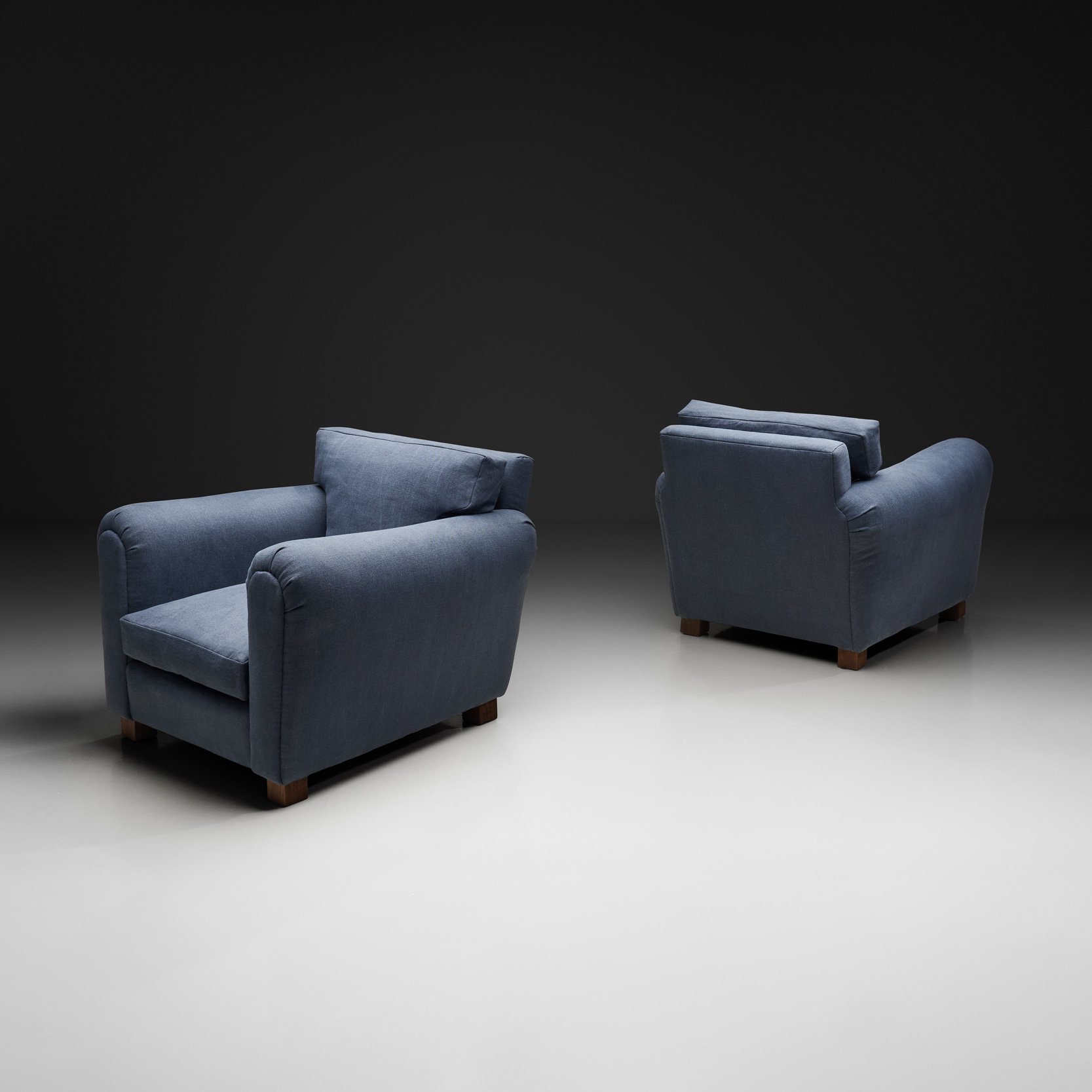
Club chairs, often recognised by their deep seats, sleek lines and wide armrests, originated in French gentlemen’s clubs in the early 20th century. They were created for cosiness and relaxation, typically featuring full-body upholstery and sturdy frames that allowed for comfortable seating over extended periods of time. Attributed to Jean Saint-Georges, this pair reflects the rich history of the club chair while introducing the simpler forms associated with mid-century modernism.
These chairs each feature a strikingly voluptuous body, combining both comfort and bold aesthetics. The chairs' plushness and generously rounded arms provide an inviting and enveloping seating experience. Each armchair has a broad, deep seat framed by substantial upholstered sides that curve gently around the front. The armrests are particularly distinctive, with their softly rolled upper edges continuing towards the backrests in a smooth, uninterrupted line. The backs are wide, with separate upholstered cushions providing additional support and comfort. The low, wide seats emphasise a relaxed posture, making the chairs perfect for lounging and unwinding. The upholstery is a beautiful muted blue fabric with a soft, textured surface that accentuates the gentle curves and generous proportions of the chairs. Its uniform colour allows the shape of the bodies to remain the focus of the design. The seats are fitted with thick, rectangular cushions, while subtle piping along the edges defines the different upholstered sections. Short wooden feet remain mostly concealed beneath the chairs, subtly lifting their substantial bodies from the floor.
The curves and material choice make this a striking pair that can bring warmth and character to a variety of interiors, from a comfortable living room to a more formal lounge or library. The chairs' main decorative element is the design itself, combining traditional club chair comfort and European mid-century design, equally captivating and practical.
Condition:
In good vintage condition. Wear consistent with age and use. The chairs have recently been reconditioned. Due to the nature and age of the materials, the items have minor scratches, dents and discolouration. The chairs have recently been reupholstered in a premium fabric. Each of our items can be reupholstered by our in-house atelier in a fabric of choice. Please reach out for more information.
Dimensions:
34.64 in W x 37.99 in D x 28.54 in H; Seat height 15.74 in; Seat depth 22.83 in; Arm height 23.81 in
88 cm W x 96.5 cm D x 72.5 cm H; Seat height 40 cm; Seat depth 58 cm; Arm height 60.5 cm
REQUEST PRICE HERE
Price category: 5,000 - 7,500 usd / eur
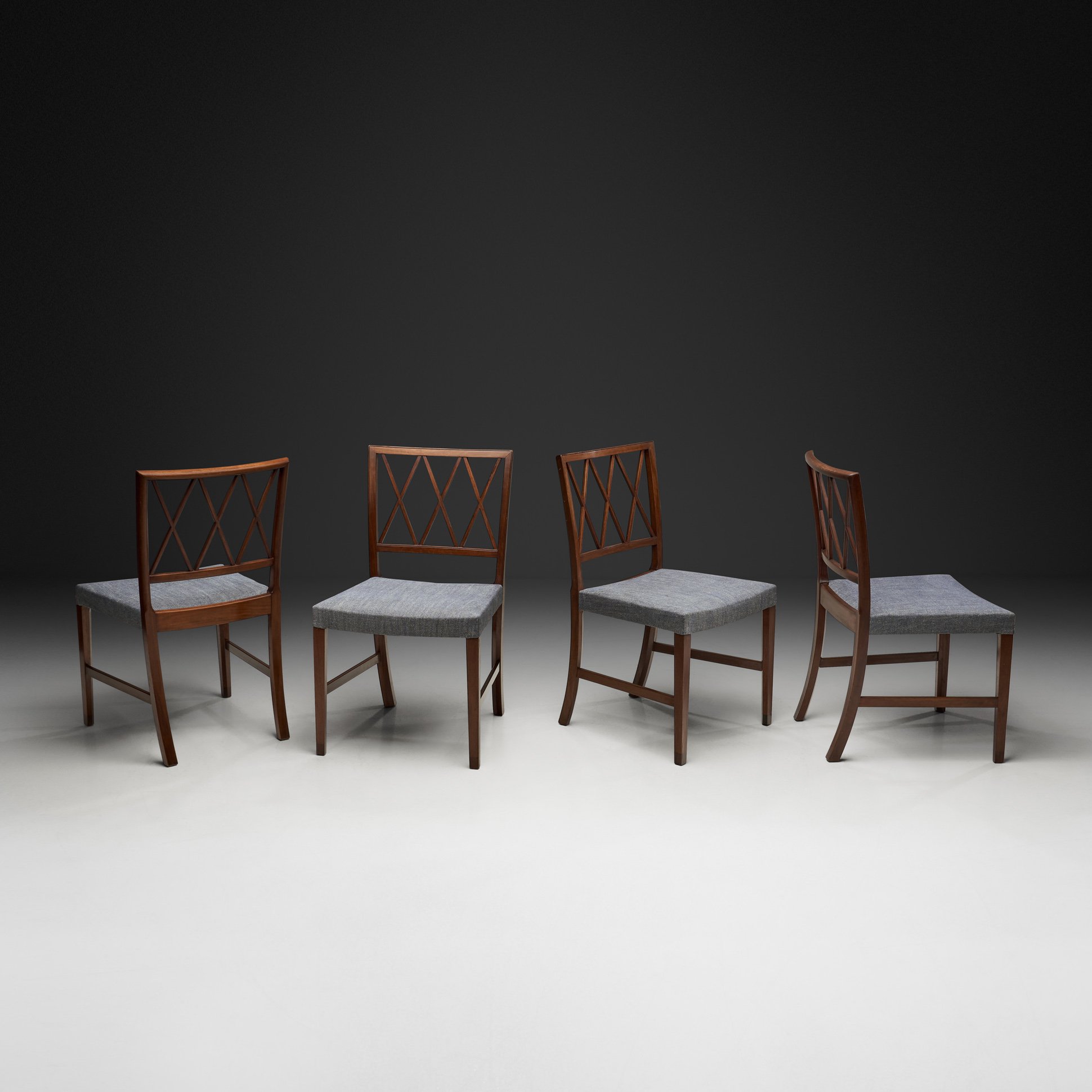
Ole Wanscher was a leading figure in Danish and Scandinavian design, as was A.J. Iversen. He acquired his skills at the esteemed Det Kongelige Danske Kunstakademi - Billedkunst Skolerne in Copenhagen. Drawing inspiration from human anatomy, Wanscher’s developments influenced the concept of Scandinavian modernism as we know it today, and his contribution to the field is widely acknowledged.
The post-war era, especially the period spanning from 1940 to 1960 resembled the golden age of Danish furniture. This set of dining chairs retains the cherished Danish modernist traits, such as simplicity and functionality, while also reflecting an ongoing precise focus on quality materials and artistry care. The allure of these dining chairs lies in the detailed backrests with the criss-cross design. The structure creates an airy and rhythmic look, further complemented by the legs’ thin figure and slight inward bend aligning perfectly with the flow of the backrest. The upholstered seats are covered in a light, blue fabric that complements the wood’s tone while providing a soft counterpoint to the structure beneath. Every detail, from the gentle sweep of the backrest to the textural contrast between materials, reflects a commitment to harmony and restraint.
The set seamlessly blends traditional precision with modern innovation, where each chair not only serves a functional purpose but also stands as a timeless work of art. With its meticulous attention to detail and premium quality wood, this set is beautiful and harmonious, and would make a charming addition to a variety of interior decor styles.
Condition:
In good vintage condition. Wear consistent with age and use. The chairs have recently been reconditioned. Due to the age and nature of the materials, the items have some scratches, dents, and discolouration. The seat of the chairs have recently been reupholstered in a premium fabric. Each of our items can be reupholstered by our in-house atelier in a fabric of choice. Please reach out for more information.
Dimensions:
19.48 in W x 20.86 in D x 33.85 in H; Seat height 18.11 in
49.5 cm W x 53 cm D x 86 cm H; Seat height 46 cm
REQUEST PRICE HERE
Price category: 2,500 - 5,000 usd / eur
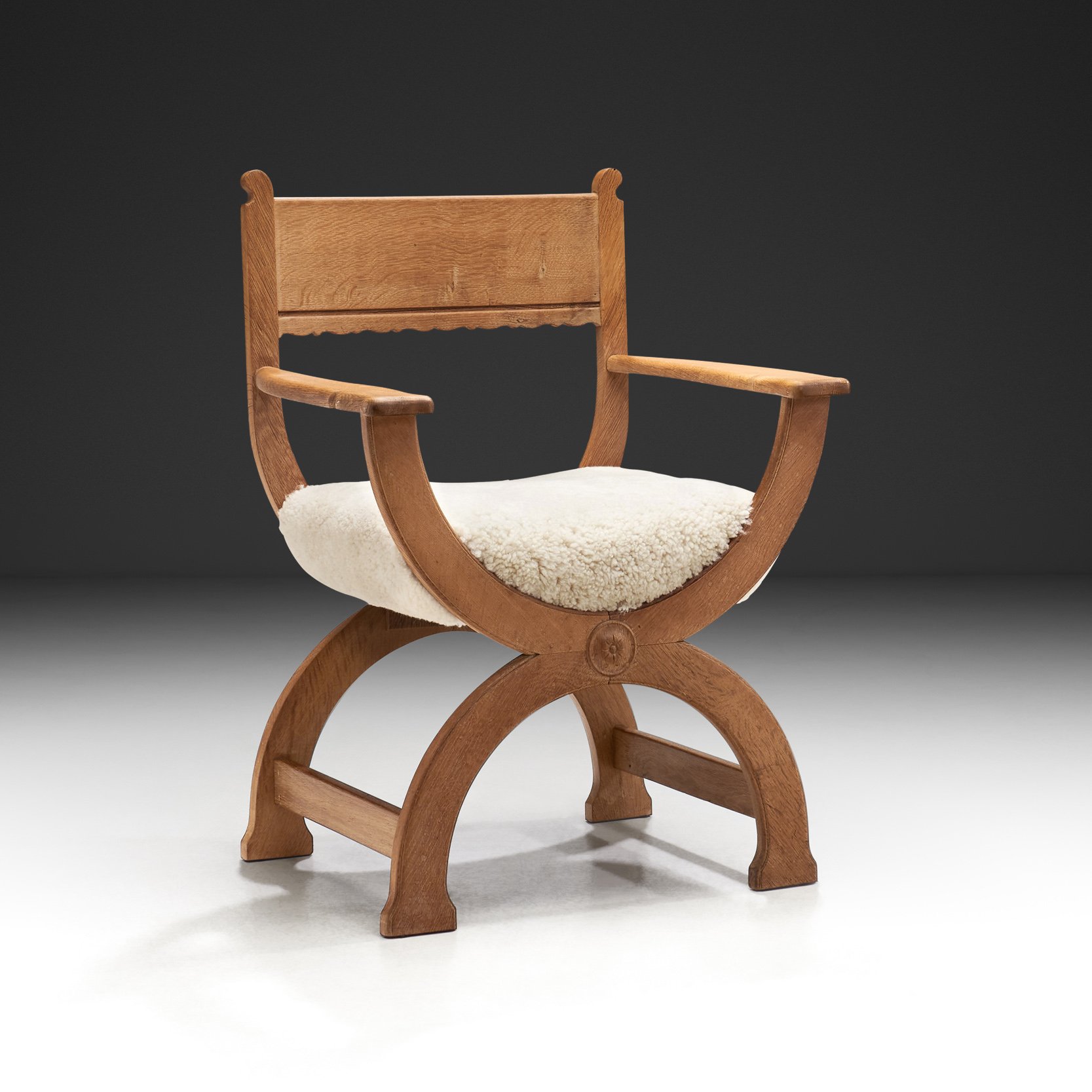
This so-called “kurulstol” or kurul chair, is an iconic model by Danish designer, Henning Kjærnulf. The Kurul chair is an ancient folding chair, originally a folding stool with straight or curved legs. Among the Romans, in addition to being an ordinary utility chair, it was symbolically linked to officials, often within the judiciary.
This armchair combines the traditional kurul structure with a rounded and curved appearance, with an upholstered seat and backrest that gives the historic look a modern edge. The oak frame is carved and sculpted in an unmistakeable way, showing the skills of both the designer and the manufacturer. The body is composed of two slats of wood of equal length in the front and back, fastened together in a saltire formation (resembling the letter X) which are extended up at the top and back to form the armrests and the backs as well. The seat, upholstered in soft sheepskin, is stretched between the front and back slats connecting the two. Kjærnulf removed the folding function of the historic design, giving his model a more stable, organic look. This impression is further enhanced by the solid oak, which is carved with great precision into straight and curving lines. The rich sheepskin melts these carved and straight lines together, contrasting to the oak’s smoothness. While the historic kurul chair was often decorated with intarsia, this model only showcases subtle decor elements, such as the charming sculpted mark in the front with a flower (or the sun) carved into the wood.
While the kurulstol is a Renaissance classic originating from ancient Rome, thanks to Kjaernulf, Scandinavian modernism remains at the core of the design. Kjærnulf’s designs are easy to spot in a crowd thanks to his originality, making his pieces like the razorblade chair and this kurulstol eternally unique. This chair was manufactured by EG Kvalitetsmobel in Denmark during the 1960s.
Condition:
In good vintage condition. Wear consistent with age and use. The chair has recently been reconditioned. Some minor scratches and marks on the wood. The chair’s seat has been reupholstered recently in premium sheepskin. Each of our items can be re-upholstered by our in-house atelier in a fabric of choice. Please reach out for more information.
Dimensions:
25.59 in W x 21.65 in D x 34.65 in H; Seat height 19.29 in; Arm height 25 in
65 cm W x 55 cm D x 88 cm H ; Seat height 49 cm; Arm height 63.5 cm
About the designer:
Danish mid-century designer and architect, Henning Kjaernulf, is somewhat of a mystery. A lot more is known about his designs than Kjaernulf himself. His wooden designs, crafted to perfection, speak for themselves. Kjaernulf mainly designed for the Danish manufacturers EG Kvalitetsmøbel, Nyrup Møbelfabrik, and Vejle Stole Møbelfabrik. The latter produced the designer’s well-known teak extending dining table design. The historic archives of the Danish municipality, Stenlille, reveal the history of Nyrup Møbelfabrik, mentioning Kjaernulf’s architectural designs for the company’s factory, referring to him as an architect based in Odense, Denmark.
Kjaernulf’s works reveal quality craftsmanship throughout, featuring clean Danish modern era lines with sculpted edges and shapes. The unique shapes, like his razorblade chair backrests, distinguish the designer from other Danish mid-century designers.
In light of how sought after his dining sets and lounge chairs are, it remains a mystery why so little is known about the designer. The curious background of Kjaernulf if anything, adds more charm to his pieces. ~H.

REQUEST PRICE HERE
Price category: 2,500 - 5,000 usd / eur
This remarkable armchair was designed by German artist, Willi Ohler. The so-called “Worpsweder” either denote chairs made at the Worpsweder Kunsthütten (Worpsweder arts huts) in Germany, or a specific style of German chairs with solid wood frames, broad armrests, often from tall wood, with woven seats and backs. This piece features all of those characteristics.
Crafted during a time when movements like Modernism were reshaping design worldwide, this early 20th-century armchair reflect a transitional style rooted in both simplicity and elegance. This era emphasises clean lines, unique shapes, and high-quality craftsmanship to achieve timeless pieces like this one. The honey-toned wood highlights the warm patina that has developed over decades. The softly sculpted armrests framing the chair bring both elegance and ergonomic comfort to the overall form. Woven wicker is the main highlight of the piece. The material is used to construct the seat and tall backrest. The beautifully symmetrical pattern showcases the timeless artistry of artisanal furniture. The rectangular, slim legs create a sleek structure while not abandoning sturdiness. This chair preserves the value and beauty of master craftsmanship and exquisite materials.
Worpswede in Lower Saxony is famous nationwide for its long tradition as an artists' colony. Nowadays, about 130 artists and craftsmen and women live there permanently. The artists who created the so called "Worpsweder Kuentlerkolonie" were looking for the simple and original in art and life. The traditional reed and rush woven chairs of this region were greatly appreciated by the artists of the colony, and some of them were still produced around 1900-1920. They have become collectors’ pieces thanks to the craftsmanship that went into each chair’s creation.
Condition:
In good vintage condition. Wear consistent with age and use. The chair has recently been reconditioned. Due to the nature and age of the materials the item has minor scratches and discolouration.
Dimensions:
34.64 in W x 33.07 in D x 46.45 in H; Seat height 16.53 in; Seat depth 19.68 in; Arm height 24.80 in
88 cm W x 84 cm D x 118 cm H; Seat height 42 cm; Seat depth 50 cm; Arm height 63 cm
REQUEST PRICE HERE
Price category: 2,500 - 5,000 usd / eur
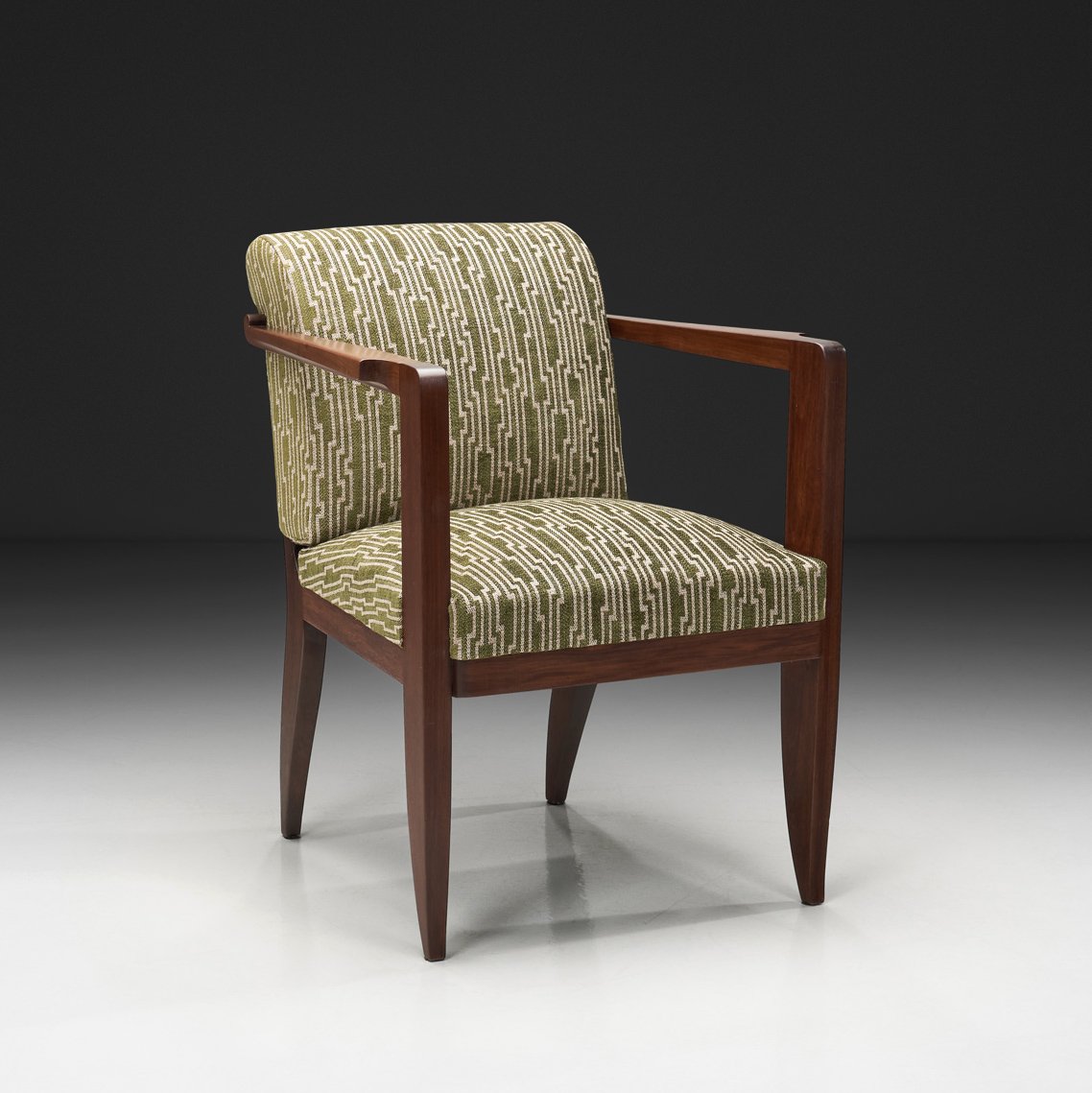
Christian Krass (1868–1957) was a French cabinetmaker and furniture designer based in Lyon, he became an important figure in the city’s decorative arts during the first half of the 20th century. His work included seating, tables, desks and cabinets, often combining carefully worked woods with the geometric forms and refined materials associated with Art Deco. This armchair, which dates back to circa 1930s, applies Krass’s skill to a compact and elegant seating design.
The armchair is defined by its exposed wooden frame, which combines straight lines with subtle curves. Four tapered legs support the upholstered seat, with the front legs continuing upward to meet the armrests and creating a clear structural outline. The armrests have a particularly interesting shape, extending horizontally into a carved element before turning downward. Their broad wooden surfaces and warm reddish-brown tone contrast with the patterned upholstery while keeping the construction clearly visible. The backrest is generously upholstered and slightly curved, with rounded upper corners that soften the otherwise geometric frame. Its shape follows naturally into the broad seat below, creating comfortable proportions within a relatively compact structure. The green and cream upholstery introduces a small repeating geometric pattern that complements the straight lines of the wood while adding texture and visual depth. The clean junctions between the legs, seat rails, arms, and back show the quality of the woodworking, with each element contributing equally to the overall composition.
The chair captures the more restrained side of French Art Deco, where decorative effect could be achieved through proportion, material and carefully controlled lines. Its scale makes it particularly suitable as a desk chair, side chair or additional seating in a living room or bedroom. It represents an interesting example of French furniture design from the 1930s.
Condition:
In good vintage condition. Wear consistent with age and use. The chair has recently been reconditioned. The armrests have minor marks and scratches. Due to the nature and age of the materials, the item may have some discolouration. The chair has recently been reupholstered in a premium fabric. Each of our items can be reupholstered by our in-house atelier in a fabric of choice. Please reach out for more information.
Dimensions:
23.42 in W x 25.98 in D x 30.70 in H; Seat height 18.70 in; Seat depth 17.12 in; Arm height 26.77 in
59.5 cm W x 66 cm D x 78 cm H; Seat height 47.5 cm; Seat depth 43.5 cm; Arm height 68 cm
REQUEST PRICE HERE
Price category: 9,000 - 12,500 usd / eur
The 20th century saw the rise of brilliant designers, like Steen Østergaard, working to create furniture of the highest quality that explored truly modern shapes and forms. Østergaard sought to combine comfort and elegance to achieve timeless designs that remain iconic examples of style and skill to this day.
Immediately, these chairs captivate with their cosy and stylish silhouette. The shell bodies cradle the occupant, providing a sense of intimacy and comfort that transcends mere functionality. The mid-century modern aesthetic is elegantly expressed through clean lines and organic curves, creating a harmonious balance between form and function. The designer managed to create pieces that seamlessly integrate into contemporary living spaces while preserving the warmth and character of natural materials, ideals deeply rooted in the Danish tradition. The wooden frames of these chairs showcase the skillful artistry of Steen Østergaard. The tripod legs, with beautiful joinery, not only add a touch of sophistication but also exemplify the meticulous attention to detail and aesthetic balance. The upholstery of the pair further enhances the allure. Meticulously chosen fabrics not only contribute to the overall aesthetic appeal but also emphasise the commitment to creating pieces that age gracefully.
Danish modern chairs have not only stood the test of time but continue to inspire contemporary designers and homeowners worldwide. Their enduring popularity is a testament to the genius of Danish modern design, based on both form and function, resulting in pieces that are as comfortable as they are stylish.
Condition:
In good vintage condition. Wear consistent with age and use. The chairs have recently been reconditioned. Due to the age and nature of the materials, the chairs have minor scratches, dents, and discolouration. The chairs have recently been reupholstered in a premium fabric. Each of our items can be reupholstered by our in-house atelier in a fabric of choice. Please reach out for more information.
Dimensions:
27.2 in W x 22.8 in D x 25.8 in H; Seat height 14.4 in
69 cm W x 58 cm D x 65.5 cm H; Seat height 36.5 cm