
Hans-Agne Jakobsson Brass Table Mirror for Hans-Agne Jakobsson AB Markaryd, Sweden 1960s (sold)

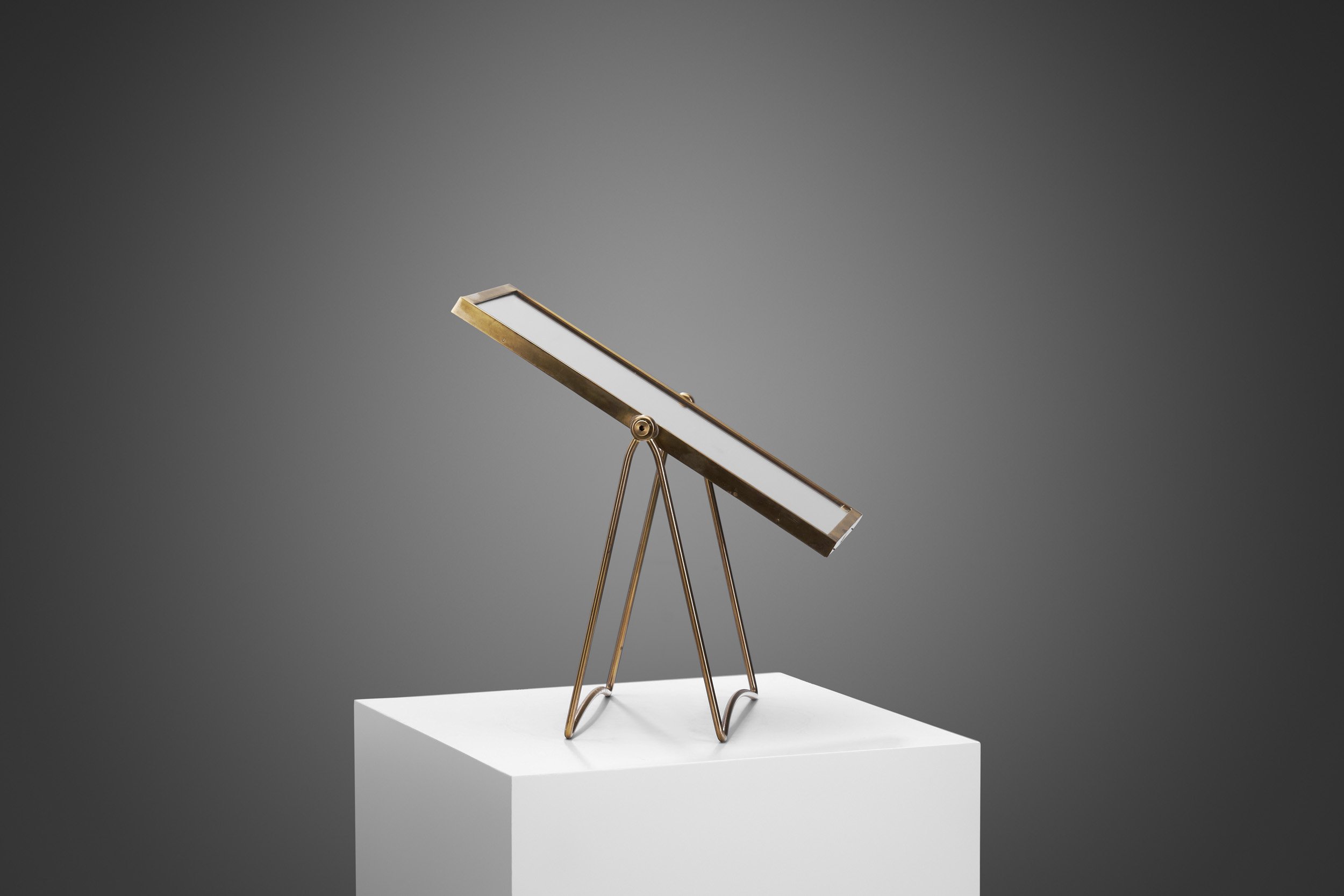


Hans-Agne Jakobsson Brass Table Mirror for Hans-Agne Jakobsson AB Markaryd, Sweden 1960s (sold)
Mirrors are versatile pieces of interior décor with several functions and advantages; they create depth, increase light coverage, and add a statement to any space. Fusing function and form, table mirrors offer useful reflection while also providing an eye-catching focal point in any room. This rare and beautiful mirror by Swedish master of light, Hans-Agne Jakobsson, has a stylish, defined look that is sure to stand out in any space.
Vanity or table mirrors such as this model are freestanding jewels on any table, functional focal points that can easily add personality to any interior. This large model’s creator, Hans-Agne Jakobsson is mostly associated with his decorative lighting designs, however, he also excelled in other fields of design as this piece demonstrates. With a rectangular frame and curved base, this sculptural mirror has a stalwart stance that commands attention not solely for its size. The ratio of curved and straight lines is measured precisely, resulting in a balanced design. The patinated brass further enhances the versatile lines of the frame and base connected by joints on the sides that allow the mirror to be adjusted in its position. As such, this model is a great utilitarian piece for a vanity table with an impressive size. Like almost all Hans-Agne Jakobsson models, this mirror was also produced by his own company that he established in 1951: Hans Agne Jakobsson AB in Markaryd, Sweden.
Accent mirrors can be great in small spaces as they can make a room look bigger. This extremely rare Hans-Agne Jakobsson modern mirror has a strong and stylish presence that can both dominate and complement its interior. The design and material provide simple elegance that is a perfect way to bring some understated Swedish modernism to any space.
SOLD
Condition:
In good vintage condition. Wear consistent with age and use. Some marks on the patinated brass frame.
Dimensions:
12.2 in W x 6.1 in D x 20.66 in H
31 cm W x 15.5 cm D x 52.5 cm H
About the Designer:
Born in 1919 in Gotland, Sweden, Hans Agne Jakobsson is one of the most well-known Swedish lighting designers. He did his carpenter apprenticeship before studying architecture in Gothenburg.
First working as an industrial designer for General Motors, he later founded his own company after being an assistant to the designers Carl Malmsten and Werner West. In 1950, due to Christmas, he added a model of hanging lamps in small strips of pine in one of his stores to soften the lively lighting of the shop window. The people who were passing by were immediately seduced by this hanging lamp, which started it all. He established his own company in 1951: Hans Agne Jakobsson AB and began producing this model in his factories and achieved success abroad as well. In 50 years, he designed more than 2000 lamps with unique designs.
He used materials and experimented with multiple techniques, for example using fabrics with fringes, blown glass of colour and smoked glass. His great diversity resulted in a wide range of timeless lighting models. These pieces continue to seduce design lovers, as they adapt themselves to any interior, without blending into the background.
Today, Jakobsson’s works can be found in private homes as well as public institutions throughout Sweden. The designer passed away in 2009 in Sweden, leaving behind a great legacy. ~H.


REQUEST PRICE HERE
Price category: 1,000 - 2,500 usd / eur
Josef Frank designed Vänskapsknuten (the Knot of Friendship) as a symbol of friendship and peace at a time when Europe was filled with turmoil. The very first sketch of the candelabra dates back to 1938, just a year before the outbreak of the Second World War, but it is as relevant now as it was then.
The Austrian designer and architect may be best known for his vivid textiles for Swedish firm Svenskt Tenn, but his artistic touch reached far beyond textiles and created iconic objects such as this candle holder. The elaborate brass structure intertwines at multiple points, but the brass rods only meet in the middle where a small sphere connects them. Each of the three brass cup have so-called chambersticks, small pans to catch dripping wax. The looping calligraphic design gives this piece a weightless grace that is stunning even without the symbolism behind it. The body’s busy look is completed and balanced by the long candles. The design changes from angle to angle and shows Frank’s sensitive touch. The Knot of Friendship has become an iconic object not only in Svenskt Tenn’s range, but also of Sweden. The production traditionally required a process of thorough methodology and great craftsmanship. Josef Frank was the most prestigious designer in the Stockholm design company Svenskt Tenn (Swedish Pewter), recruited by the founder of the company, Estrid Ericson herself.
Since 2018, after a careful assessment of Josef Frank’s original drawing, the candelabra regained its original form from 1938 under the hands of Svenskt Tenn. However, the production of this well-known and widely-loved candle holder now takes place at Humstorp Metal in Västergötland. This piece however, is from the original production from the post-war era.
Condition:
In good vintage condition. Wear consistent with age and use. The brass has a beautiful patina with some marks. Due to the nature and age of the material, the item may have some scratches and discolouration.
Dimensions:
8.85 in W x 7.48 in D x 6.29 in H
22.5 cm W x 19 cm D x 16 cm H
About the designer:
Josef Frank (July 15, 1885 – January 8, 1967) was an Austrian-born architect, artist, and designer who adopted Swedish citizenship in the latter half of his life. Together with Oskar Strnad, he created the Vienna School of Architecture, and its concept of Modern houses, housing, and interiors.
Josef Frank was one of early Vienna modernism’s foremost figures, but already in the beginning of the 1920s he started to question modernism’s growing pragmatism. He had little appreciation for the French architect Le Corbusier’s belief that a house should be “a machine for living in”. He was against puritanical principles and on the contrary, feared that standardized interiors would make people all too uniform. Josef Frank represented a freer, more artistic style ideal, and he developed his own type of modernism where values like comfort, hominess, and a wealth of colour were at its core. He resisted limitations and models for his furniture and textiles came from across all boundaries both in time and space.
Josef Frank began working at Svenskt Tenn in 1934 and just a few years later, the Frank-Ericson duo made their international breakthrough. Svenskt Tenn’s exhibition room at the World Expositions in Paris in 1937 and New York in 1939 was completely contrary to the ideal of the time with its bold contrasts in materials, colours, and prints. The duo received a great deal of attention and became, somewhat paradoxically, the model for the expression “Swedish Modern”. Although he was already 50 years old when he left Vienna for Sweden, Frank is considered one of Sweden’s most important designers.