
Woven Cord Chair with Steam Bent Arms by Erich Dieckmann (Attr.), Germany circa 1930s (sold)





Woven Cord Chair with Steam Bent Arms by Erich Dieckmann (Attr.), Germany circa 1930s (sold)
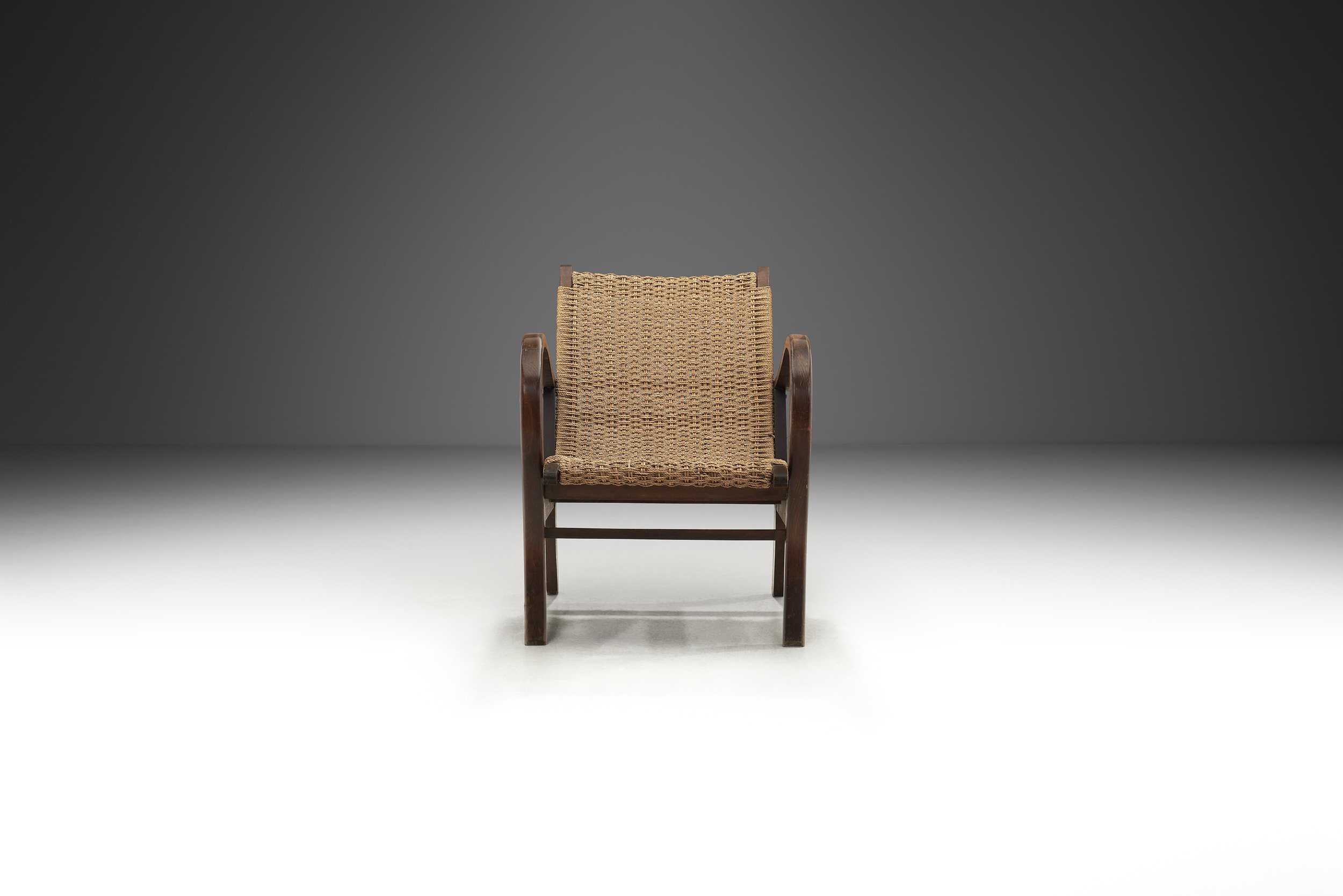
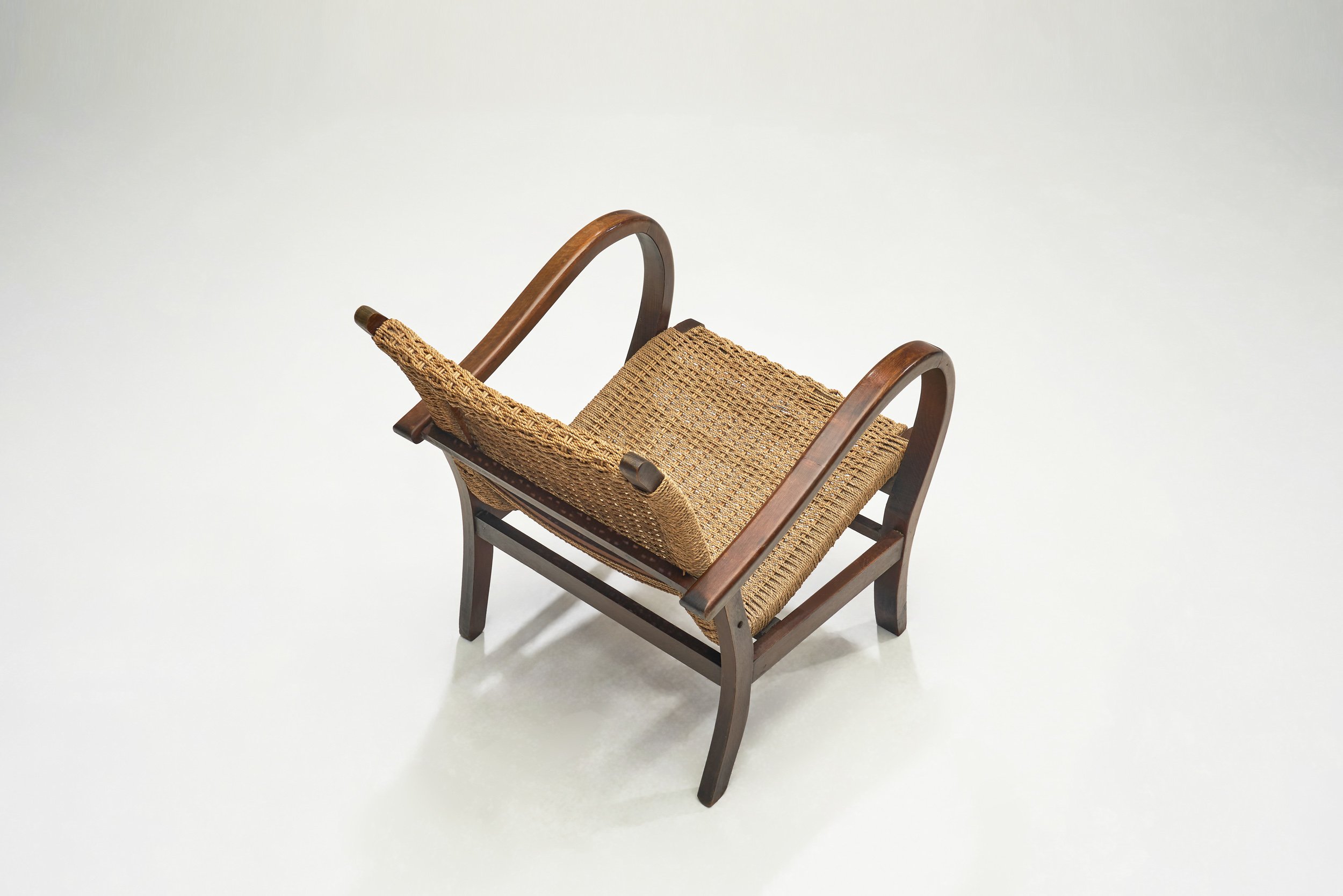
Erich Dieckmann was one of the pre-eminent furniture designers of the Bauhaus and, like Marcel Breuer, was experimenting with steel tubing, standardization, and geometric forms in the 1920s and 1930s. The design of this chair is the result of one of these experiments.
This rare armchair, recalling the Bauhaus, is made of wood and cord. Dieckmann’s furniture models were often characterized by quality hardwoods, cane matting and geometric frames that link the armrests and legs, creating a unique runner construction. This model is therefore a typical Dieckmann model, with a curved stained wood frame that perfectly shows the designer's unique avant-garde yet minimalist style and workmanship. This wooden structure was a technical innovation in its time, as it was created by steam bending the wood. During the process, the wood is exposed to steam to make it pliable. Heat and moisture from steam can soften wood fibres enough so they can be bent and stretched, and when cooled down they will hold their new shape. This is most apparent in the armrests‘ curvature that flows down to form the front legs. This continuous piece is the main focus of the design. The dark frame is complemented by the elegant cord seat and back woven tightly around the wood.
This chair is defined by its materials: steam bent wood and woven cord. Both techniques require expert skill, which Erich Dieckmann and the manufacturer evidently both possessed. Erich Dieckmann was one of the most important furniture designers of the Bauhaus movement, leaving behind an iconic body of Bauhaus-inspired seating.
SOLD
Condition:
In good vintage condition. Wear consistent with age and use. Some minor scratches on the legs.
Dimensions:
22.83 in W x 27.16 in D x 28.74 in H; Seat height 15.35 in
58 cm W x 69 cm D x 73 cm H; Seat height 39 cm
About the Designer:
Erich Dieckmann was one of the pre-eminent furniture designers of the Bauhaus and, like Marcel Breuer, was experimenting with steel tubing, standardization, and geometric forms in the 1920s and 1930s.
Dieckmann was born in present-day Poland in 1896. He studied architecture from 1918 to 1920 at the Technical University of Gdańsk in Poland and served a carpentry apprenticeship at the Bauhaus in Weimar from 1921 to 1925. When the Bauhaus moved to Dessau in 1925, he remained in Weimar and became the head of the carpentry workshop at the State University of Applied Sciences until 1930.
Throughout the 1930s, he designed furniture as well as worked for various carpentry workshops and consulted for interior and craft design companies. Dieckmann’s furniture is often characterized by quality hardwoods, cane matting and geometric frames that link the armrests and legs, creating a unique runner construction. Designing affordable, enduring pieces that could be mass-produced was also one of his key efforts. Dieckmann passed away in Berlin in 1944, leaving behind an iconic body of Bauhaus-inspired seating.


REQUEST PRICE HERE
Price category: 2,500 - 5,000 usd / eur
This organic armchair attributed to Dutch designer Bas Van Pelt is an elegant model with an exceptionally high level of craftsmanship. The construction of this rare 1940s design is simple at its core, but thanks to the details, it is a unique representation of early Dutch modernism.
While Bas Van Pelt's creative work was primarily influenced by the 1920s straight lines dominated by The Hague School, this armchair is the result of his more mature design era, which was dominated by natural materials and more curvature. While made of solid wood, this armchair has an open feel to it thanks to the three horizontal slats that compose and divide the back. The curved lines of the armrests are beautifully crafted and follow the raised seat’s angle. The curves nicely contrast with the straight lines of the frame, keeping it from appearing too strict. Apart from the expert woodwork, the paper cord seat stands out as well. The so-called “planflet” (flat-weave) pattern requires considerable expertise, as the warp is wrapped around the frame, and then the weave follows a checkerboard pattern. The seat adds textural interest and also serves a decorative role, not to mention how durable paper cord is. The tapered legs blend seamlessly into the back and arms, and are connected by double stretchers on all sides except the back where the back’s slats dominate. Thanks to the well-chosen proportions and the expert weaving technique on the seat, this armchair provides great comfort.
Bas van Pelt’s progressive designs were, in many ways, ahead of his era. The Dordrecht-born designer’s furniture models are quite rare, a few are preserved in the Stedelijk Museum Amsterdam for modern art, contemporary art, and design.
Condition:
In good vintage condition. Wear consistent with age and use. Some minor marks and scratches on the wood.
Dimensions:
25.59 in W x 28.74 in D x 40.16 in H; Seat height 13.39 in; Seat depth 20.28 in; Arm height 24.21 in
65 cm W x 73 cm D x 102 cm H; Seat height 34 cm; Seat depth 51.5 cm; Arm height 61.5 cm