
A Pair of Pine and Iron Armchairs for Åby Möbelfabrik, Sweden 1940s (sold)




A Pair of Pine and Iron Armchairs for Åby Möbelfabrik, Sweden 1940s (sold)
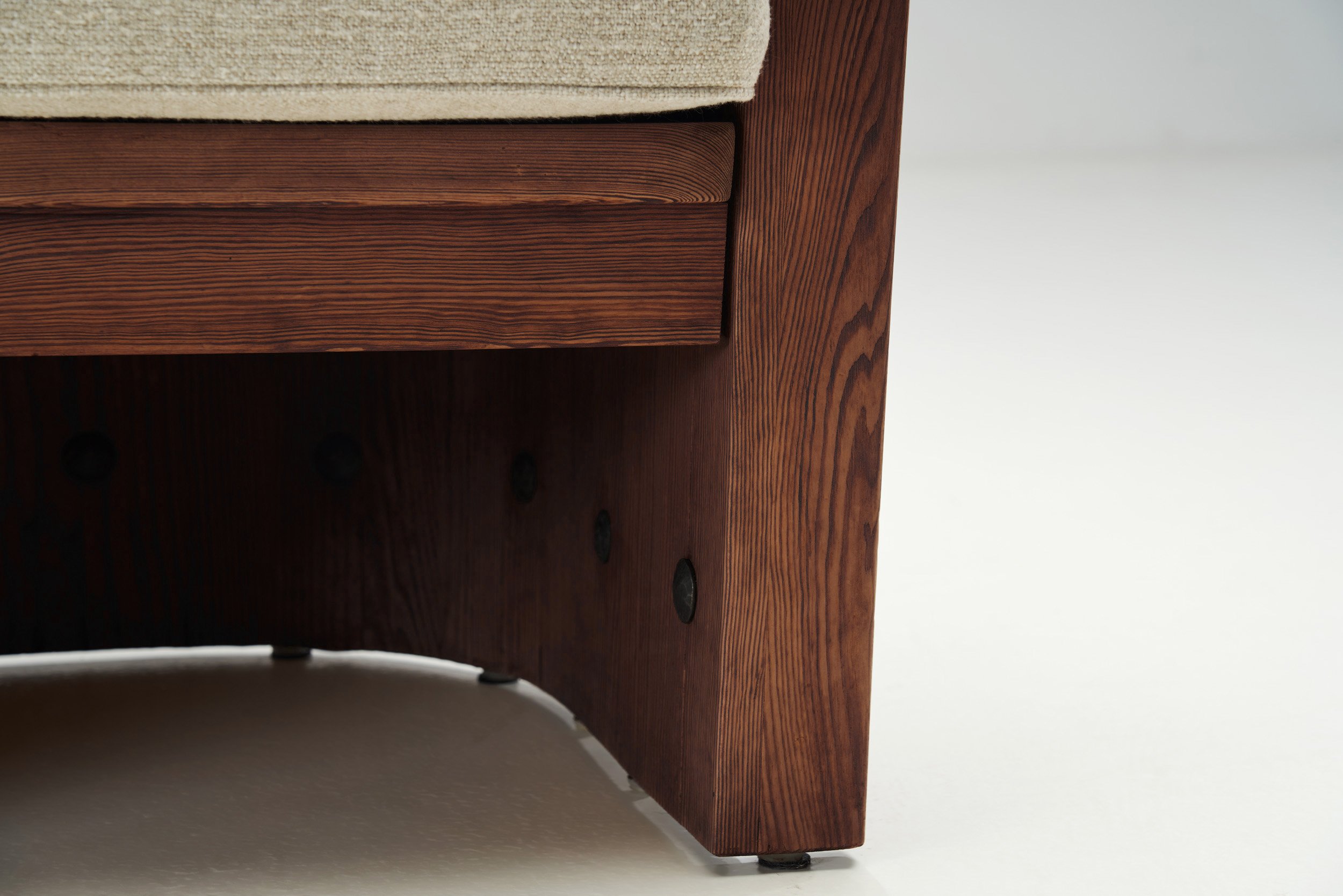
This pair is a striking example of mid-century Scandinavian design, blending natural materials with industrial elements. The chairs feature a robust frame constructed from solid pine, which is known for its durability and warm, organic tones. The wood's natural grain is accentuated through a light finish, showcasing the Scandinavian aesthetics' emphasis on simplicity and connection to nature. The combination of pine and iron not only reflects the practical and resourceful design ethos of the 1940s but also demonstrates a harmonious blend of organic and industrial materials, characteristic of Swedish furniture design during this period.
The chairs’ shape and construction show the signs of a master cabinetmaker. The beautiful light upholstery, the wooden frame, and the traditional craft of woodworking translate the primordial beauty of nature into these modern pieces. The design aims to maximize comfort while putting an emphasis on elegance and function. This is most visible in the round, welcoming bodies, enhanced by the light fabric of the chairs’ cushions. The pine slats form curved backrests, providing ergonomic support and comfort, while the iron components add structural integrity. The armrests feature beautiful and unique wood grain, further enhancing the natural beauty of the material.
This pair of armchairs by Åby Möbelfabrik encapsulate the timeless appeal of Scandinavian design, where form meets function in a way that feels both natural and modern. The enduring materials and clean lines make them a versatile pair that could easily complement various interiors, from rustic to contemporary. The armchairs stand as a testament to the craftsmanship and innovative design principles that defined Swedish furniture making in the mid-20th century.
SOLD
Condition:
In good vintage condition. Wear consistent with age and use. The cushions have been reupholstered recently in a premium fabric. Each of our items can be re-upholstered by our in-house atelier in a fabric of choice. Please reach out for more information.
Dimensions:
28.34 in W x 29.13 in D x 30.31 in H; Seat height 16.53 in
72 cm W x 74 cm D x 77 cm H; Seat height 42 cm
REQUEST PRICE HERE
Price category: 15,000 - 20,000 usd / eur
Swedish architect and furniture designer Axel Einar Hjorth served as the lead designer for Sweden’s Nordiska Kompaniet department store from 1926 to 1938. During this time, Hjorth designed the “Sportstugemöbler” series, (which translates to “sports cabin furnishings”) a collection of wooden furniture designed for country homes. The various models in the sportstugemöbler series took their names from the Stockholm archipelago – including Blidö, Lovö, and famously, Utö.
These Utö chairs were designed in 1932 as part of the collection. Unlike the department store's interiors for floors and villas in the cities, the Utö designs had a simple character with robust and basic shapes in solid pine. Accordingly, the design of these chairs focuses on simple lines and the material itself. Made of pine wood, these chairs are strong, reflecting Hjorth’s principles in which he mixed the ideals of the modernist movement with provincial Swedish traditions. As a result, the design of this set is completely timeless. Each chair demonstrates a conscious construction, where the joinery and fittings related to traditional craftsmanship are emphasized. Dominated by rounded, straight lines, the chairs have spindle backrests and ergonomically carved seats. The form alludes harmony and stability, fitting the summer cabin concept perfectly.
In an international perspective, Hjorth's “sportstugemöbler” series was the forerunner of later pioneering designers such as Charlotte Perriand. It is therefore no surprise that these Utö chairs became part of Swedish and international modernist design history. In their time, the Utö collection may have appeared as pioneering and radical, but today they are viewed as status symbols in interiors of international character.
Condition:
In good vintage condition. Wear consistent with age and use. Some marks and stains on the wood. Due to the nature and age of the wood, the items may have scratches and discolouration.
Dimensions:
18.89 in W x 18.3 in D x 31.49 in H; Seat height 16.92 in
48 cm W x 46.5 cm D x 80 cm H; Seat height 43 cm
Literature:
Christian Bjork, Thomas Ekstrom and Eric Ericson, 'Axel Einar Hjorth: Mobelarkitekt', Stockholm, 2009, p.130
About the designer:
Axel Einar Hjorth was born in a small Swedish village named Krokek, just outside Norrköping, on March 7, 1888. At the age of 20, he moved to Stockholm to study architecture and design at the Högre Konstindustriella Skolan.
Although he never graduated, in the 1920s Hjorth started working as a furniture designer for various manufacturers, such as H. Joop & Co., Myrestedt & Stern, Jonssons, and Nordiska Kompaniet. Hjorth’s designs from this period had neoclassical features combined with Swedish Grace. This romantic national style of Sweden was elegant and refined, yet simple. The anniversary exhibition of 1923 in Gothenburg marked the breakthrough of Swedish decorative arts, and made Axel Einar Hjorth a well-respected artist. From October 1926, Hjorth became the chief designer and architect of Nordiska Kompaniet department store in Stockholm. In the 1930s, Hjorth designed a furniture collection out of pine meant for serial production known as Sportstugemöbler (furniture for holiday houses).
Hjorth’s designs, from the luxury of neoclassicism to the severity of functionalism, are sharply distinctive in style, materials, and character. Unlike many of his contemporaries, Hjorth did not conform to the socially oriented ideas produced by Svensk Form (the Swedish Society of Crafts and Design). He played a significant role in the development of Swedish society as a whole, and particularly in Swedish industrial art
Today Hjorth is often viewed as a precursor to the modern designs popularized by Charlotte Perriand, Jean Royére, Pierre Chapo, or Josef Frank. Recently, there has been a revival of appreciation for his work, showing his genius in a new light. ~H.