
Upholstered European Cabinetmaker Wingback Armchairs with Stained Wood Feet, Europe first half of the 20th century (sold)
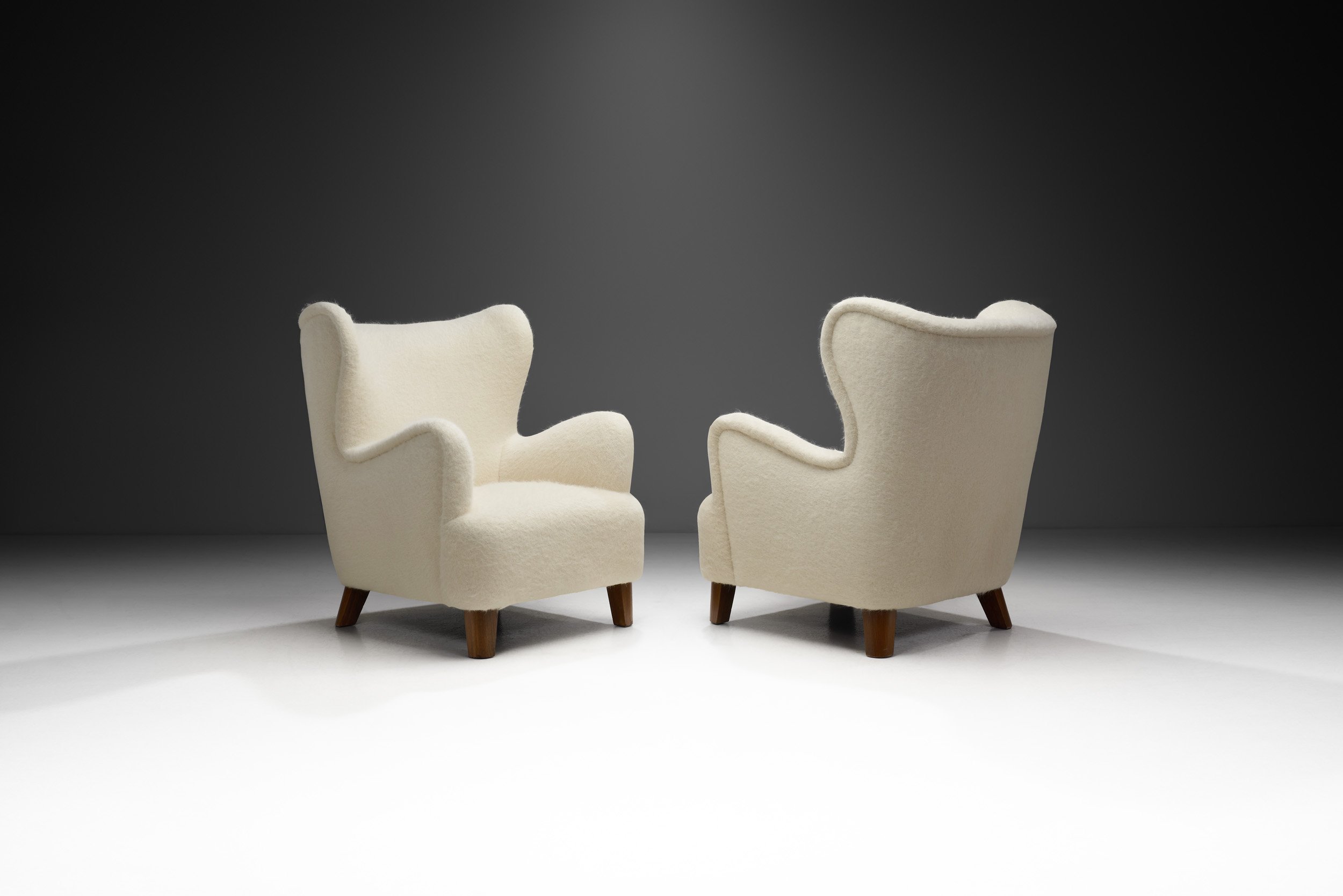


Upholstered European Cabinetmaker Wingback Armchairs with Stained Wood Feet, Europe first half of the 20th century (sold)
This elegant pair of winged back chairs is a great representation of the quality and craftsmanship of European master cabinetmakers of the 20th century and the immediately recognizable characteristics of the era’s design. With the organically curved silhouette, the design is warm and cosy, dressed in a luxurious wool blend fabric.
The welcoming, rounded shape of the voluminous arm- and backrests is a signature characteristic of Modernism that dates back to the early 20th century as a design movement. It was inspired by classical predecessing furniture styles and shapes such as the fireside chair in this case. Comfort and style were evidently prioritized with large, curved proportions that serve both the aesthetic and functional roles. While early 20th century designs often still made use of heavier ornamentation, this pair is much more pared down thanks to the upholstery that unites the separate parts of the chairs to create a flowing impression. With the rolled edges, the outline becomes even more pronounced, especially the top. The frames have distinct, sharply-curved so-called wings in the top that give the impression that the chairs are ready to embrace the sitter. Made of stained wood, the front legs stand straight while the back ones are slightly splayed for extra support. It is this detail of the construction that shows the careful consideration of structural stability and therefore functionality. Additionally, the wood provides great contrast both in colour and material to the bodies.
The light wool blend fabric allows the design to flow more naturally, accentuating the embracing backs and arms. This pair of armchairs is an elegant and comfortable evidence of the mastery and artistry of 20th century cabinetmakers, who largely defined 20th century European seating as a whole.
SOLD
Condition:
In good vintage condition. Wear consistent with age and use. The chairs have been reupholstered recently in a premium wool blend fabric. Each of our items can be re-upholstered by our in-house atelier in a fabric of choice. Please reach out for more information.
Dimensions:
29.13 in W x 35.04 in D x 38.19 in H; Seat height 17.72 in; Arm height 24.8 in
74 cm W x 89 cm D x 97 cm H; Seat height 45 cm; Arm height 63 cm
REQUEST PRICE HERE
Price category: 12,500 - 15,000 usd / eur
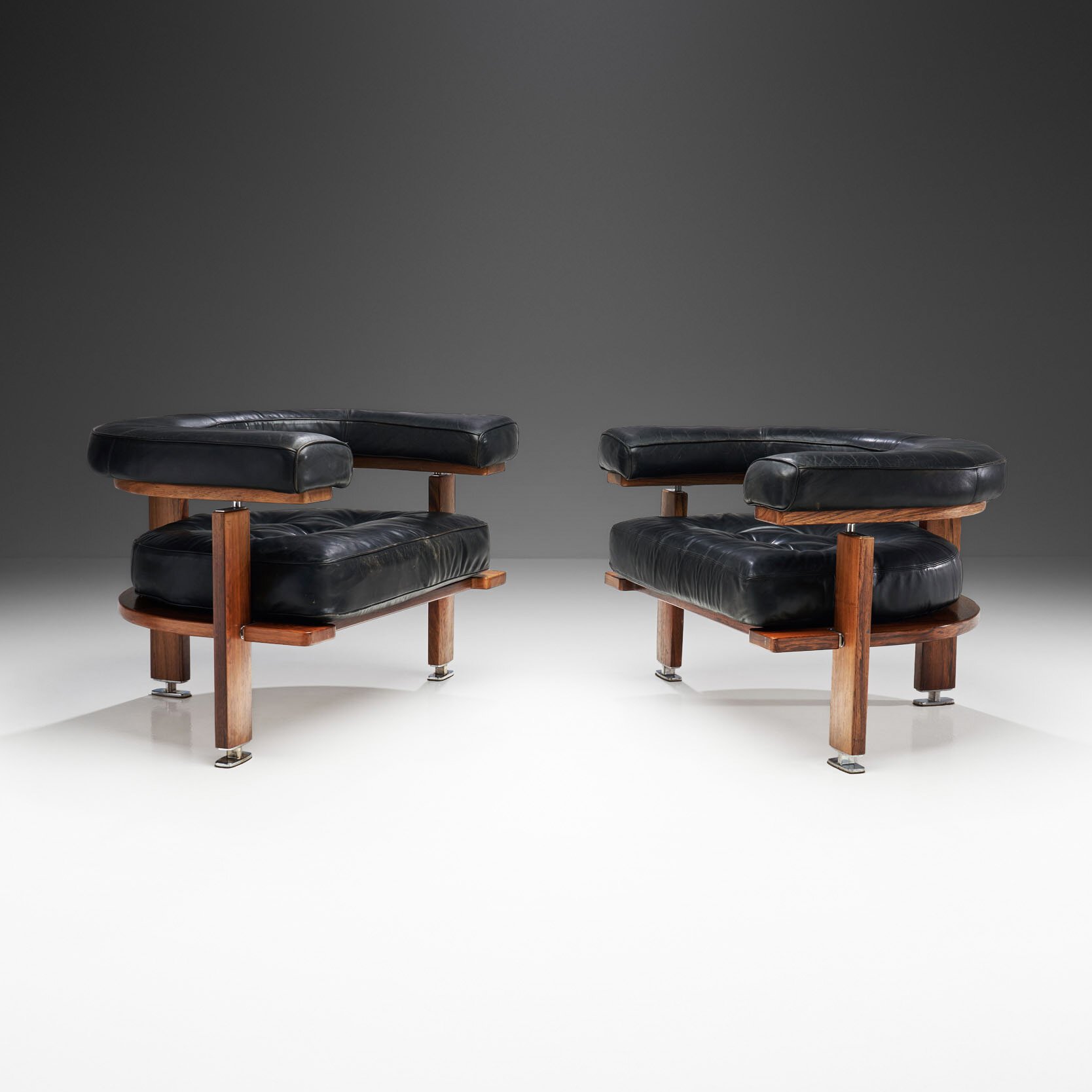
This pair of “Polar” lounge chairs was designed by the eminent Finnish designer, Esko Pajamies, and produced by Lahden Lepokalusto Oy Finland during the 1960s.
These leather chairs feature a half moon shaped backrest and comfortable, aesthetically pleasing cushions. The sitting cushions are tufted, and along with the upholstered armrests, have a beautiful patina. The strong and sturdy wooden frame provides a beautiful contrast to the black leather, and with the chrome plated steel connections supporting the curved armrests, it gives these chairs a modern look.
The legs have similar chrome plated steel details, which provide the chairs with an almost floating appearance. The open wooden frame further contributes to the spacious feel of the design. The chairs have their original black leather upholstery.
Condition:
In good vintage condition. Wear consistent with age and use. Piping has some minor repairs. Leather has some minor marks. Note: Although from the same source, the items differ a little bit in height. These chairs come with their original leather or have been reupholstered by a previous owner. Each of our items can be re-upholstered by our in-house atelier in a fabric of choice. Please reach out for more information.
Dimensions:
29.53 in W x 40.56 in D x 25.99 in H; seat height 16.34 in
75 cm W x 103 cm D x 66 cm H; seat height 41.5 cm
Literature:
Arkkitehti-lehti magazine, 1965.
About the designer:
Esko Lauri Alvari Pajamies (born August 20, 1931 Helsinki - September 26, 1990, Eloúnta, Greece) was a Finnish designer, especially known for his upholstered livingroom and public furniture.
Pajamies graduated as an interior architect in 1954, and established his own design studio in 1961. In the 1960s, Pajamies designed the “Bonanza” couch, which combined leather and solid oak, starting the line of his characteristic mixture of materials. The “Koivutaru” armchair made of bent birch at the end of the 1970s. Pajamies’ workshop also designed furniture for the Helsinki-Vantaa Airport's passenger terminal.
The Finnish designer and architect was awarded the State Art Prize in 1979. Besides being active as a designer, Pajamies was an avid Jazz Trumpeter. ~H.

REQUEST PRICE HERE
Price category: 9,000 - 12,500 usd / eur
This pair of armchairs is what we consider a timeless Danish Modern classic. The “ND83” was designed in 1952 by Nanna and Jørgen Ditzel for the exhibition 'Today’s Furniture, Home Equipment' in the Forum Hall Copenhagen in 1952.
Chairs are often considered especially revealing of a designer's skill because of the strict limits placed on their design by the demands of the human body. With this model, the Ditzels arrive at a clearly-structured solution in which a high degree of coherence is maintained while the chair appears visually light and open. The structure of the chairs is made entirely of solid oak. Each sculpted leg is made of a single piece of timber that ascend gently, giving stability to the curved backs. Rounded oak dowels plug the holes in which the fastenings for the back can be found -these help to create the elegant simplicity and honesty of the frame. The large curved backs extend up to the front, forming the armrests for a cosy and elegant profile similar to that of a tub chair. The elegance is further enhanced by the premium bouclé upholstery which complements the oak gracefully.
Cabinetmaker Søren Willadsen handcrafted these chairs, while them company Selig Co., imported them to the U.S. market from Denmark in 1952. The “ND83” model is still made to order today, however chairs – like these - from the original production show Ditzel and Willadsen’s true genius. The original marking on the wood is retained.
Condition:
In good vintage condition. Wear consistent with age and use. The chairs have been recently reupholstered in a premium bouclé fabric. Each of our items can be reupholstered by our in-house atelier in a fabric of choice. Please reach out for more information.
Dimensions:
30.9 in W x 25.98 in D x 26.96 in H; Seat height 14.76 cm
78.5 cm W x 66 cm D x 68.5 cm H; Seat height 37.5 cm
Literature:
Hanne Horsfeld Danske Designere, 'Nanna Ditzel', p.86
Oda Noritsugu, Danish Chairs, p.164
Per H. Hansen, Klaus Petersen, Den Store Danske Møbelguide, p.77

REQUEST PRICE HERE
Price category: 12,500 - 15,000 usd / eur
This rare pair of “Pele” lounge chairs by Finnish designer Esko Pajamies is, without a doubt, his most stunning chair design. It is seldom we see a chair model and immediately recognise it, but Pajamies managed to design such a piece. His unconventional design was strongly characterised by durability and functionality as well as insightful technical solutions.
In Finland, the 1970s saw the use of new materials like plastic, synthetics, and fibreglass being combined with advances in manufacturing technologies, allowing designers to expand their range of colours and forms in mass production. However, this lounge chair model still gives preference to natural materials, primarily to its solid oak structure. The wooden frame provides a firm base with rounded edges. Undeniably, the most eye-catching and distinctive element of this design is the way in which the seat and the back legs of the armchairs are formed by one elongated piece of wood. The ergonomic design with the bent backrest, wide armrests, and upholstered cushions make this pair of lounge chairs exceptionally comfortable. It therefore comes as no surprise, that this model first gained popularity as a TV chair for homes. Later it became a popular choice for fireplace rooms as well as public spaces, similarly to several other designs of Pajamies.
This model was manufactured by the Finnish furniture company, Lahden Lepokalusto Oy in the 1970s. The Lahti-based company has been furnishing public spaces for almost 70 years, and gained worldwide recognition through the iconic furniture designs of Professor Yrjö Kukkapuro and later, Esko Pajamies.
Condition:
In good vintage condition. Wear consistent with age and use. The cushions have recently been reupholstered in a premium fabric. Each of our items can be reupholstered by our in-house atelier in a fabric of choice. Please reach out for more information.
Dimensions:
92 cm W x 94 cm D x 88 cm H
REQUEST PRICE HERE
Price category: 12,500 - 15,000 usd / eur
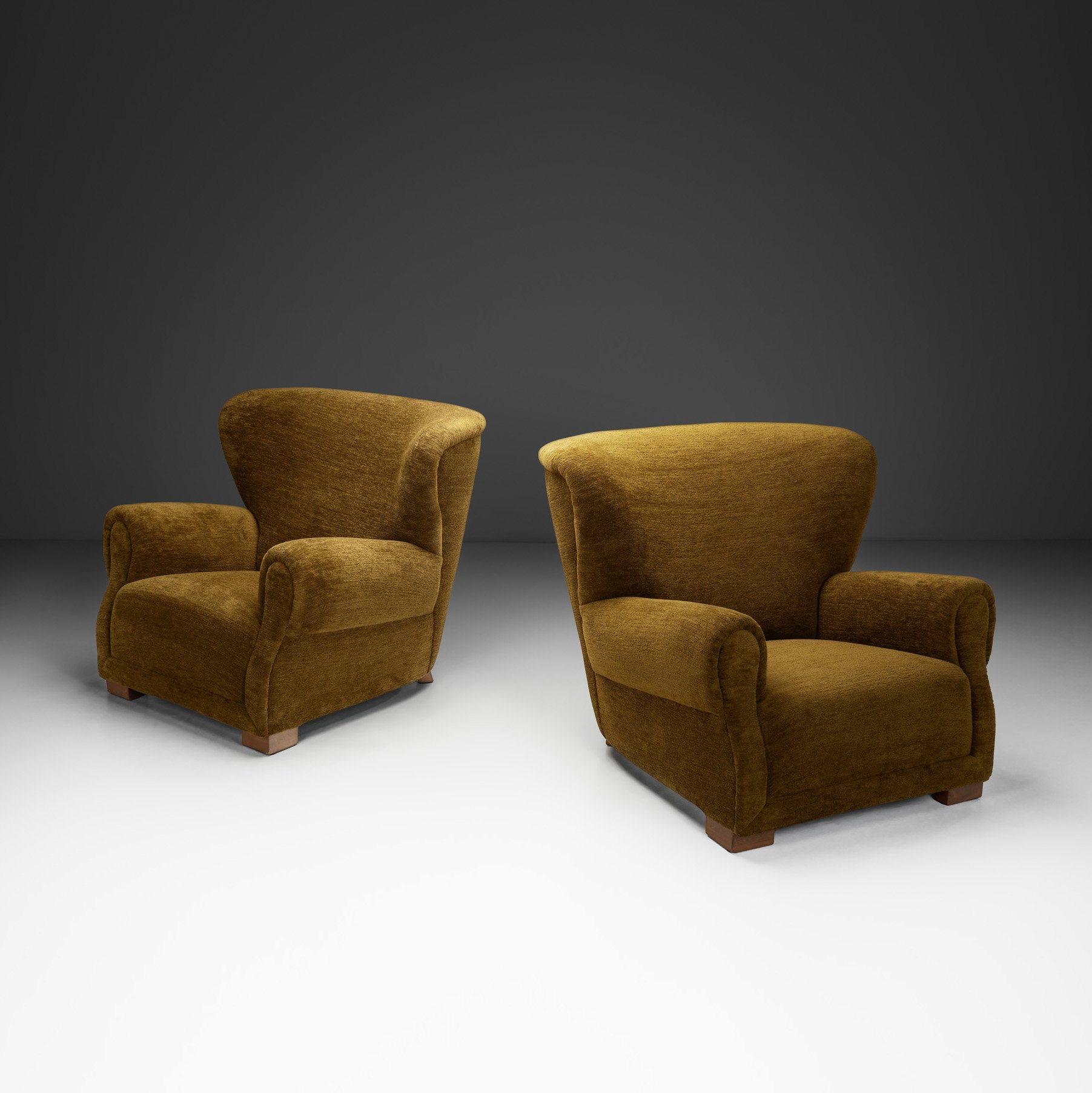
“Danish Modern” is a recognised term around the world, standing for the style of Danish design created during the 20th century. As these armchairs show, furniture created in this period is characterised by clarity of design, and extremely high-quality craftsmanship and choice of materials.
Danish and Scandinavian modern's timeless appeal has made it a go-to for designers and homeowners alike, as furniture in this style can be understated but still stand out in almost any space. This is true for this pair of armchairs as well. Adopting the trend of abandoning ornamentation to benefit the form, the designer of this pair maintained the beauty and warmth inherent to traditional Danish cabinetmaking. From as early as the 1920s, cabinetmakers and architects frequently collaborated to produce exceptional pieces like these chairs. The backs have a welcoming, enveloping shape that embraces the sitter. The fully upholstered bodies are covered in textural, soft fabric that enhances the curves and contrasts nicely with the stained wood legs. The legs are straight and square in the front and slightly bent and splayed in the back to provide structural stability. Unlike models from outside Scandinavia, Danish designers’ products weren’t flashy but made to be last generations while remaining timeless addition to a space, while completing a warm, comfortable and welcoming home. As this pair of armchairs exemplify, blending high functionality, good quality natural materials and organic colours with simple lines, elegance and excellent craftsmanship is the key to the success of Danish Modernism.
The design of this pair promotes relaxation and contentment, inviting one to sit back and enjoy a moment of peace. The understated elegance and warm tones create an alluring atmosphere, making them perfect for the purpose of evoking a hyggelig (cosy) environment in any home.
Condition:
In good vintage condition. Wear consistent with age and use. The chairs have recently been reconditioned. Minor marks and scratches on the legs. The chairs have recently been reupholstered in a premium fabric. Each of our items can be reupholstered by our in-house atelier in a fabric of choice. Please reach out for more information.
Dimensions:
37.79 in W x 41.53 in D x 32.87 in H; Seat height 14.76 in; Seat depth 22.24 in; Arm height 21.45 in
96 cm W x 105.5 cm D x 83.5 cm H; Seat height 37.5 cm; Seat depth 56.5 cm; Arm height 54.5 cm
REQUEST PRICE HERE
Price category: 12,500 - 15,000 usd / eur
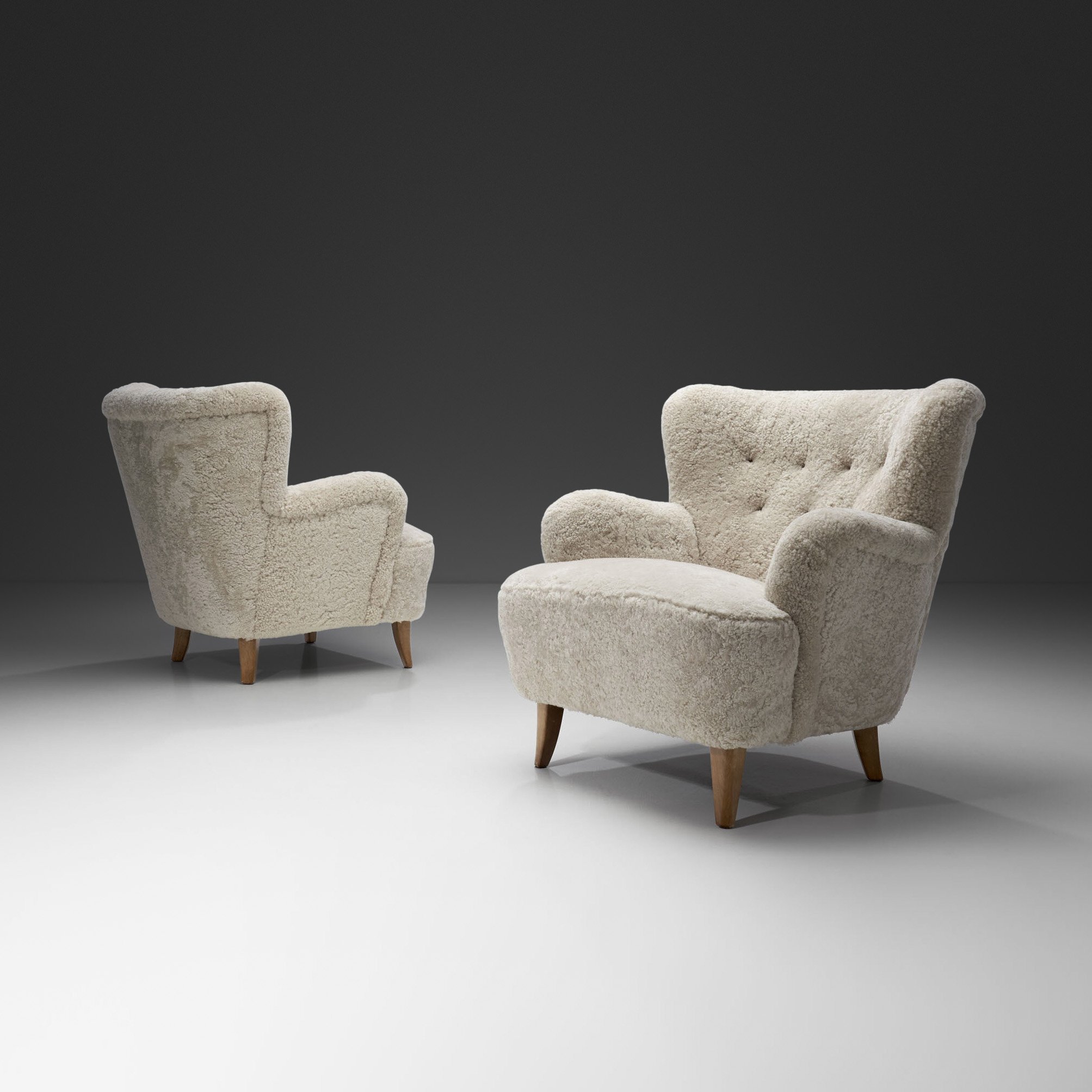
The “Laila” model by the Finnish designer, Ilmari Lappalainen, originates from 1948, with the earliest original drawings kept in the Lahti City Museum in their Lappalainen Collection.
This pair of “nr. 238” armchairs are from the Finnish designer’s most famous series called “Laila”. The design became sought after by collectors even in its production time, which is quite rare in the case of Nordic mid-century modern furniture. Lappalainen was a renowned designer, famous for his designs’ comfort. Some of his designs even received medical approval because they had such a good seating, that it prevented back problems. These armchairs have a cosy modern style, modelled on the Swedish and Danish furniture of the time, including the round edges and generous seat cushions and back with five tufted buttons. The bodies have the classic Nordic look, which explains the contemporary popularity of these armchairs both among the public and museums. The modern aesthetic is further elevated by the soft sheepskin upholstery that complements the shape and the wooden, tapered legs as well.
Wood is omnipresent in the Nordics, and Finnish woodworking is world-famous for its traditions. These chairs were created for Asko, the Finnish furniture manufacturing company founded in 1918 by Aukusti Asko Avonius, known for the production of high-quality furniture. By 1930, the company had developed into the largest furniture chain in Finland and the largest supplier of furniture in the Scandinavian countries. Favourites of this time included Ilmari Lappalainen’s present Laila armchairs.
Condition:
In good vintage condition. Wear consistent with age and use. The chairs have been reupholstered recently in premium sheepskin. Each of our items can be reupholstered by our in-house atelier in a fabric of choice. Please reach out for more information.
Dimensions:
32.87 in W x 32.87 in D x 32.48 in H; Seat height 17.51 in
83.5 cm W x 83.5 cm D x 82.5 cm H; Seat height 44.5 cm
Literature:
Riitta Miestamo "The Form and Substance of Finnish Furniture", Askon Säätiö, Esan Kirjapaino oy, Lahti 1981.p 65.
About the Designer:
Ilmari Lappalainen (1918 - 2006) was a great Finnish designer whose most active working years were from the end of the 1940s until the end of the 1970s.
Lappalainen first graduated as a teacher of woodworking in 1939, followed by a degree in interior design in 1947. By the end of the school of interior design, he was already working as an intern in Asko and after graduating he got a permanent design position at the company. Lappalainen worked as a teacher and as an interior designer for Asko's department stores, public spaces and hotels.
Lappalainen's most popular products / series are the Laila sofa set, the Seija rocking chair, the lazy castle Rex and the Pulkka armchair. Interestingly, the chairs from the Columna series were sold as health chairs for a long time, because they had such a good ergonomic design, that it prevented back problems. The chairs eventually received medical approval as well. ~H.
REQUEST PRICE HERE
Price category: 12,500 - 15,000 usd / eur
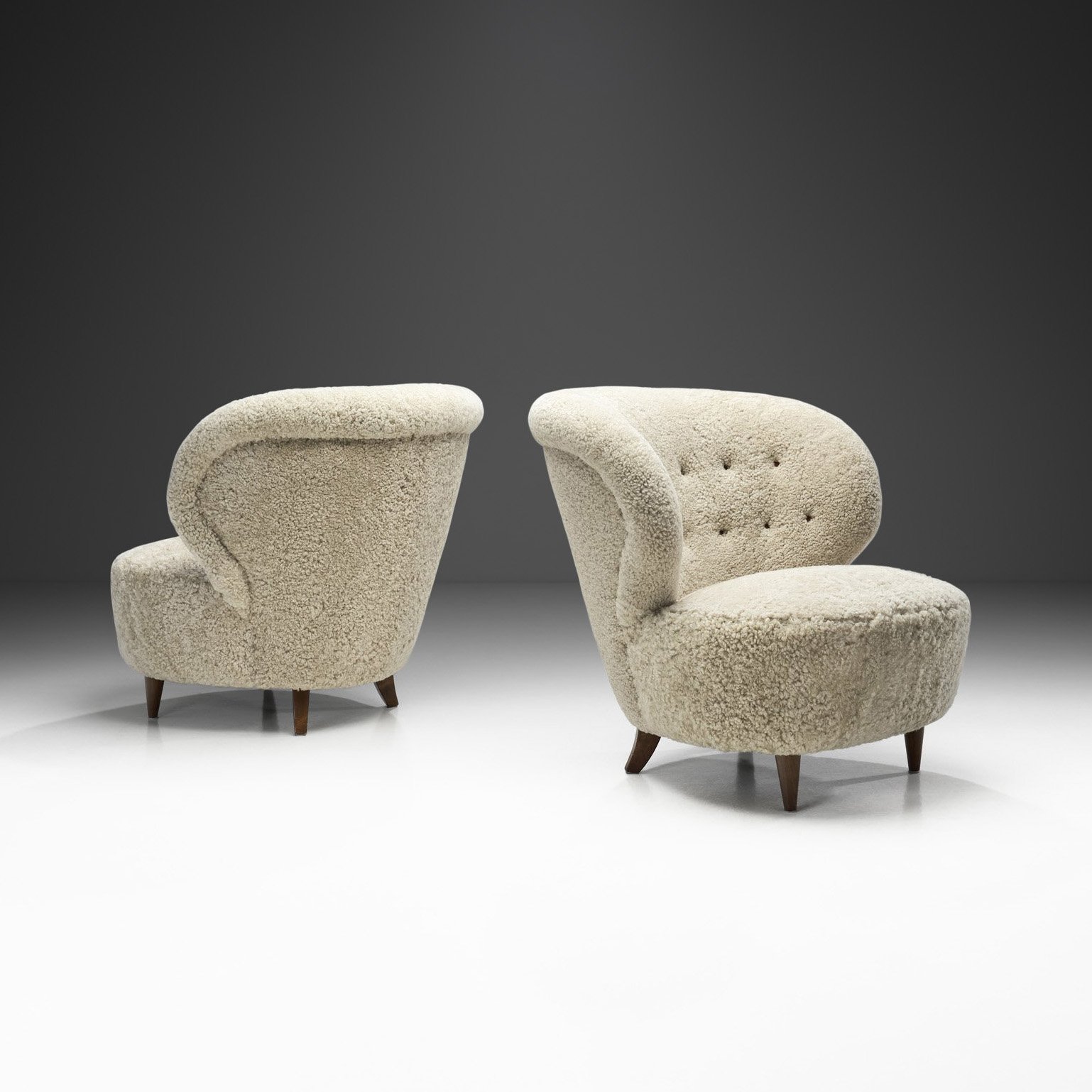
“Danish Modern” is a recognized term around the world, standing for the characteristic style of Danish design created during the 20th century. As these lounge chairs show, furniture created in this period are characterized by clarity in design, and extremely high-quality craftsmanship and choice of materials.
This pair of lounge chairs exudes quality and personality from all angles. Their classic shape is formed by the generous seat and embracing back. The large, curved backrests feature tufted buttons and follow the curve of the voluptuous seats, creating an inviting and open look which is a signature characteristic of Danish Modernism. The tufting stitches are festooned with thirteen, symmetrically arranged buttons on each chair, that sink into the soft upholstery. The tapered, lacquered wood legs prevent the chairs from looking heavy by slightly lifting them off the ground, while their warm brown colour nicely contrasts the soft, light colour of the bodies. The back legs are splayed to provide structural support to the chairs.
Thanks to the sheepskin, the chairs give a natural, textured look, making them ideal to blend a stroke of modernity to any space, with a nod to organic, simple artistry. Sheepskin is the ultimate material for comfort, warm in the winter and cool in the summer. The artisanal production quality is evident throughout this pair and takes the Danish idea of “furniture that last for generations” seriously.
Condition:
In good vintage condition. Wear consistent with age and use. The chairs have been reupholstered recently in premium sheepskin.
Dimensions:
32.28 in W x 33.46 in D x 31.1 in H; Seat height 17.32 in
82 cm W x 85 cm D x 79 cm H; Seat height 44 cm
About the Designer:
The practical and comfortable designs of Danish cabinetmakers defined mid-20th century modern seating. The Danish Cabinetmakers focused on minimalist design executed by expertly skilled craftsmen.
Works from the Danish Cabinet-Makers' Guild is a concept of its own in collectible design. The Cabinet-Makers' Guild began annual exhibitions in 1927 in Copenhagen. The group formed an exhibit showing each year in October the quality furniture made to drawings by gifted architects. The exhibition took place each year, without interruption, for forty years. A number of successful Danish Design collaborations were formed during this time between cabinetmakers and architects.
Danish Modernism has influenced Scandinavian furniture to a great degree, defined by minimalism, simplicity, and functionality. The muted colours and gentle designs make Danish mid-century furniture an ideal addition to contemporary living spaces. Additionally, master cabinetmakers were highly aware of body proportions, prioritizing comfort just as much as the visual qualities.
The works of master cabinetmakers – such as this chair – are of the highest quality, both in terms of materials and craftsmanship. Cabinetmakers take the art of working with wood one step further, and focus on the finer details of what can be created with the material. Therefore, it comes as no surprise that numerous master cabinetmakers are part of the renowned Danish Culture Canon (Danish: Kulturkanonen). The canon contains no more than 108 works of cultural excellence, based on works with a useful function and that are still recognizable today. This small armchair is the perfect illustration of Danish design, and the work of a true cabinetmaker. ~H.

REQUEST PRICE HERE
Price category: 12,500 - 15,000 usd / eur
The “Laila” model by the Finnish designer Ilmari Lappalainen originates from 1948, with the earliest original drawings kept in the Lahti City Museum in their Lappalainen Collection.
This pair of “nr. 238” armchairs are from the Finnish designer’s most famous series called “Laila”. The design became sought after by collectors even in its production time, which is quite rare in the case of Nordic mid-century modern furniture. Lappalainen was a renowned designer, famous for his designs’ comfort. Some of his designs even received medical approval because they had such a good seating that it prevented back problems. These armchairs have a cosy modern style, modelled on the Swedish and Danish furniture of the time, including the round edges and generous seat cushion and back with tufted buttons. The bodies have the classic Nordic look, which explains the contemporary popularity of these armchairs both among the public and museums. The modern aesthetic is further elevated by the textured, premium upholstery that complements the shape and the wooden, tapered legs as well. Sheepskin is the ultimate material for comfort, warm in the winter and cool in the summer. It elevates the sheer size and shape of the chair, especially its back.
Wood is omnipresent in the Nordics, and Finnish woodworking is world-famous for its traditions. These chairs were created for Asko, the Finnish furniture manufacturing company founded in 1918 by Aukusti Asko Avonius, known for the production of high-quality furniture. By 1930 the company had developed into the largest furniture chain in Finland and the largest supplier of furniture in the Scandinavian countries. After the war, the damage it caused and the new homes of Karelian migrants concentrated production on essential furniture, which the Finnish Ministry of Public Affairs ordered to sell at an affordable price. Favourites of this time included Ilmari Lappalainen’s Laila series.
Condition:
In good condition. Wear consistent with age and use. The chairs have been reupholstered recently in a premium sheepskin.
Dimensions:
32.67 in W x 34.64 in D x 34.44 in H; Seat height 17.71 in
83 cm W x 88 cm D x 87.5 cm H; Seat height 45 cm
Literature:
Riitta Miestamo "The Form and Substance of Finnish Furniture", Askon Säätiö, Esan Kirjapaino oy, Lahti 1981.p 65.
About the Designer:
Ilmari Lappalainen (1918 - 2006) was a great Finnish designer whose most active working years were from the end of the 1940s until the end of the 1970s.
Lappalainen first graduated as a teacher of woodworking in 1939, followed by a degree in interior design in 1947. By the end of the school of interior design, he was already working as an intern in Asko and after graduating he got a permanent design position at the company. Lappalainen worked as a teacher and as an interior designer for Asko's department stores, public spaces and hotels.
Lappalainen's most popular products / series are the Laila sofa set, the Seija rocking chair, the lazy castle Rex and the Pulkka armchair. Interestingly, the chairs from the Columna series were sold as health chairs for a long time, because they had such a good ergonomic design, that it prevented back problems. The chairs eventually received medical approval as well. ~H.

REQUEST PRICE HERE
Price category: 7,500 - 10,000 usd / eur
Swedish designer, Arne Norell’s conceptual designs, gained recognition for their use of traditional materials and forms like fabrics and wood combined with simple and vanguard lines. This pair of “Pilot” chairs was designed by Arne Norell in 1967 and each of them was handmade in Aneby, Sweden in the same factory that Norell established himself a decade earlier. This model is a modern classic with all the characteristics of a genuine Swedish modern chair.
The design of these remarkable chairs carries a certain “design weight” that is the result of their understated elegance, premium materials, and the outstanding craftsmanship. Norell was known for his versatile use of wood and leather in his furniture designs that are characterized by comfort and ease and were to a great extent inspired by Danish design. These “Pilot” easy chairs are no exception with a design idiom centred on the curved wooden legs, stylish upholstery, and the subtly curved bodies offering gentle yet robust support for the spine - qualities that engender contentment and well-being. The tightly fitted velour fabric and wood complement each other in numerous ways, enhancing each other’s individual qualities, such as the wood legs’ distinctive curves and the fabric’s rich texture and colour. The result is an infinitely elegant and comfortable look that is unlikely to ever lose its appeal, and only get more stylish with time. This pair of "Pilot" easy chairs encapsulates the essence of Norell’s innovative approach to furniture design. The laminated beech legs allow the shape to be bent and result in the distinctive look this chair model is famous for. Norell began his journey as a furniture designer in the 1950s, becoming renowned for his ability to seamlessly blend comfort and aesthetics through innovative experimentations. During the 1960s, Swedish furniture design witnessed a transformative period marked by a departure from ornate and heavy styles to more streamlined, minimalist forms. Arne Norell played a pivotal role in shaping this evolution, embracing a modernist ethos while staying true to the principles of craftsmanship and quality materials. His designs, including these "Pilot" models, are celebrated for their timeless appeal and functional elegance and style. These chairs epitomize Norell's design philosophy, featuring clean lines, organic shapes, and a commitment to ergonomic excellence. These chairs were produced and are marked by Möbel AB Arne Norell (today known as Norell Möbel AB) in Aneby, Sweden. The workshop was founded in 1954 by Arne Norell, and ever since its establishment, it has been a family business carrying on Norell’s design legacy. In fact, the same factory that Arne Norell built in the 1950s is still where the company exists today in Sweden.
The perks of incorporating these "Pilot" easy chairs into interior design are manifold; their ergonomic design and lush upholstery make them inviting and comfortable, creating an ideal setting for relaxation. Furthermore, thanks to their mid-century modern aesthetic, these chairs can seamlessly adapt to various interior styles, from modern to contemporary, making them versatile additions to any space. The timeless aesthetic of these "Pilot" chairs ensures that they remain relevant and stylish across different design trends. Beyond their aesthetic appeal, easy chairs like the "Pilot" serve as focal points in a room, elevating the overall design scheme. Whether placed in a cosy reading nook or as part of a larger seating arrangement, these chairs effortlessly enhance the visual appeal of the space.
Condition:
In good vintage condition. Wear consistent with age and use. The chairs have been reupholstered recently in a premium velour fabric. Each of our items can be reupholstered by our in-house atelier in a fabric of choice. Please reach out for more information.
Dimensions:
32.28 in W x 29.92 in D x 29.52 in H; Seat height 16.53 in; Arm height 21.25 in
76.5 cm W x 79 cm D x 79.5 cm H; Seat height 45 cm; Arm height 55 cm
About the designer:
Arne Norell started his own workshop in 1954 in the town of Solna, Sweden. Thereafter, he moved to Småland and established his company Möbel AB Arne Norell, today known as Norell Möbel AB (Norell Furniture). He was known for his versatile use of wood, leather, fabric, and metal in furniture characterized by comfort and ease. Norell’s success made him a household name within the interior design-world of Europe. Several models were also produced in other parts of the world under a licence.
He was to a great extent inspired by Danish design. Two examples of this influence are the lounge chair Ari and the safari chair Sirocco. Ari was awarded the British Furniture Manufacturer’s greatest award “showpiece of the year” in 1973. Many of the models he designed came into production after his death in 1971. His designs are still handcrafted by the same company today, Norell Möbel AB.

REQUEST PRICE HERE
Price category: 12,500 - 15,000 usd / eur
This pair of rare oak easy chairs showcases the homely curviness that defined the design of the 1950s in the Nordic countries. Hiort af Ornäs developed the model for his own furniture company, ‘Hiort Tuote Valmistaja Puunveisto Helsinki’, or ‘Hiort Product Manufacturer Puunveisto (woodcarver) Helsinki’.
This chair model’s body has a soft, sculptural shape paired with an ergonomic and firm construction. Hiort af Ornäs was very firm about two things regarding his chair designs: the sitting comfort and that the model must look good from every single angle. Much like the “Pedro” model, these easy chairs easily fulfil these principles, as even from the bottom, they showcase the expertly carved oak structure. The removable seat cushions, framed by the open bodies ensure the sitting comfort. The seats, back- and armrests are all formed from a single piece that has an organic, outward curving look that is highly inviting and stylish. Especially on the armrests, the curves highlight the texture of the velvet upholstery and vice versa. The fabric is most appealing on rounded, curving forms, therefore it is a perfect match for this pair of easy chairs. The legs on the other side have a more straightforward design, creating an interesting contrast with the upholstered bodies. They are gently splayed and bent to support the seats and display the oak’s beautiful, darker shade. The craftsmanship and quality that is to be expected from original Hiort af Ornäs chairs is very apparent.
The seating designs of the architect/designer have been gradually more and more recognized world-wide, which resulted in a recent exhibition titled “Forgotten Ornäs”. Form follows function is a principle of design associated with early and mid-20th century architecture and furniture design, stating that the shape of a building or object should primarily relate to its intended function or purpose. This was evidently an important principle for the designer, seen in the design of both the structure and aesthetic elements.
Condition:
In good vintage condition. Wear consistent with age and use. The chairs have been reupholstered recently in premium velvet. Each of our items can be re-upholstered by our in-house atelier in a fabric of choice. Please reach out for more information.
Dimensions:
34.05 in W x 31.49 in D x 30.31 in H; Seat height 18.11 in
86.5 cm W x 80 cm D x 77 cm H; Seat height 46 cm
About the designer:
Carl-Gustaf Vilhelm (nicknamed “Nalle”) Hiort of Ornäs was born on 27 February 1911 and lived most of his life in Tapiola/Espoo in Finland and in his later life moved to Spain. He is remembered as a Finnish interior architect and designer known to be uncompromising.
Before the Finnish wars (1939-1944), Hiort af Ornäs spent his time in Pori, working at Björneborgs Mekaniska Verkstad. He studied at the Helsinki University of Technology to become an architect but never graduated. He did, however, become known as an interior designer, and eventually even more known as a furniture designer.
In 1945, Hiort af Ornäs founded the furniture company Puunveisto Oy, for which he developed versatile techniques for shaping plywood. He started the furniture manufacturing shop on Lauttasaari in Helsinki (Veneentekijäntie 14) together with his brother. The wood shop, showroom, and office were all located in the same building in Helsinki. Rolf Mesterton was the man in charge of producing the furniture, but there were several other carpenters at work in the woodshop. Hiort af Ornäs’s furniture was exhibited and sold by the shop Nupponen who also distributed Olavi Hänninen’s designs, while Puunveisto’s furniture were also sold by Gösta Westerbergs Möbler in Stockholm, Sweden but, in spite of a good selection of chairs, tables and shelves, did not do too well. Since production costs were high, Hiort af Ornäs faced economic troubles. The company was later sold to Nupponen after which Hiort af Ornäs’s interest in the company waned.
Hiort af Ornäs spent his retirement in Spain, and designed several buildings for Fuengirola’s Los Pacos neighbourhood, which has a large Finnish population. His house that he drew and built in Tapiola, Espoo, Finland, ‘Villa Hiort’, still stands and houses some of the designer’s original drawings. It is a beautiful example of 1950s Modernism and the talent of Hiort af Ornäs that brought him recognition that lasts to this day. ~H.

REQUEST PRICE HERE
Price category: 9,000 - 12,500 usd / eur
Rich in Danish design heritage, this chair model captures the spirit of the mid-20th century, combining natural materials with the sleek, functional style that defined the era. The "Yin" chair is a rare and sought-after collectible that embodies both the beauty and practicality of Scandinavian design.
Danish Modern is known for its emphasis on simplicity, natural materials, and an intrinsic connection to nature. Richard Nissen, influenced by this design movement, often combined traditional craftsmanship with innovative forms, resulting in timeless pieces that still resonate in modern interiors. These chairs embody the principles of functional beauty and understated craftsmanship. The fluid lines of the "Yin" chair, along with its harmonious proportions, create an inviting yet sophisticated presence in any space, evoking a sense of balance and serenity that is key to its design philosophy. The chairs feature a sculptural frame made from rich, honey-toned beech wood, which is known for its durability and smooth grain. The seats are woven from natural wicker, which adds texture and an organic touch to the design. With its gently curved lines and refined proportions, the "Yin" chair exemplifies a harmonious balance between form and function, offering both comfort and aesthetic appeal. The design is a visual interpretation of balance, the careful craftsmanship and attention to detail make this pair a timeless focal point in any interior, ideal for both modern and classic settings.
This Yin Chair is a wonderful example of Richard Nissen's commitment to creating functional yet sculptural furniture pieces. It remains a coveted collectible today, admired for its timeless design and connection to one of the most celebrated movements in modern furniture history.
Condition:
In good vintage condition. Wear consistent with age and use. Some marks and scratches on the wood.
Dimensions:
25.01 in W x 21.66 in D x 34.65 in H; Seat height 16.34 in
63.5 cm W x 55 cm D x 88 cm H; Seat height 41.5 cm
REQUEST PRICE HERE
Price category: 15,000 - 20,000 usd / eur
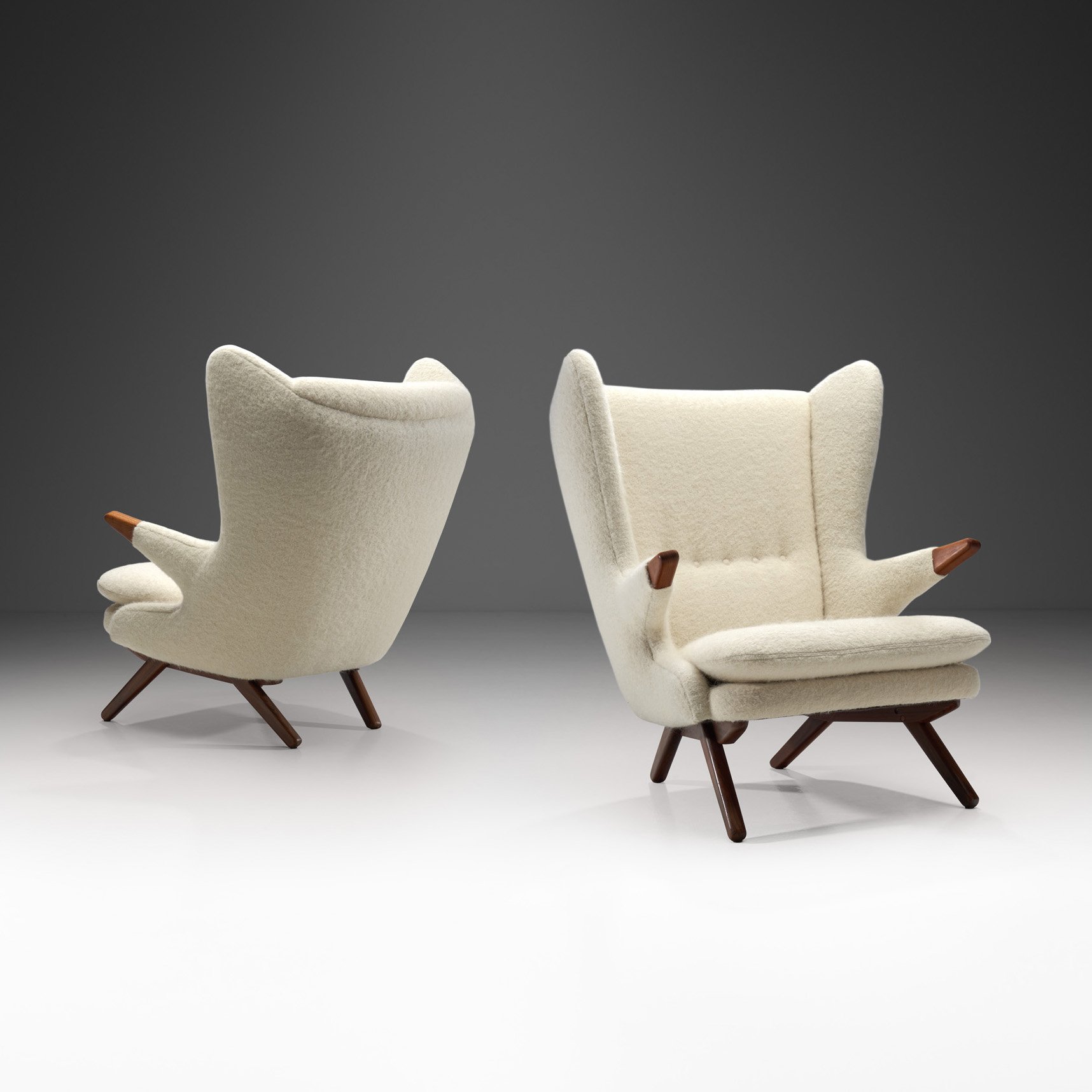
This pair is the most recognizable model of Danish designer and manufacturer, Svend Skipper, and a great example of the mid-century era design. Skipper only created commissioned pieces, meaning none of his designs were mass-produced.
“Model 91” features a masterfully sculpted teak base and legs. The teak tips “poke out” at the end of the upholstered armrests, which is a very characteristic design element of this model. The high wing-back offers back support, while enveloping the sitter. It also features tufted buttons arranged in a single, horizontal line, adding to the visual interest of the piece. The loose cushion on the seat provides great sitting comfort while also adding to the welcoming look. These details create a sculptural silhouette that made this model popular already in its time.
The design was created in 1956 and this particular piece was manufactured by Skipper Møbelfabrik in the 1960s. For its resemblance to Hans J. Wegner’s “Papa Bear” chair, this model is often referred to by that name, however, “Model 91” was only made upon order. Skipper’s craftsmanship and quality can be observed in every single detail, from the exposed teak arms, to the distinctive shape and level of comfort.
Condition:
In good vintage condition. Wear consistent with age and use. The chairs have been reupholstered recently in premium light wool. Each of our items can be re-upholstered by our in-house atelier in a fabric of choice. Please reach out for more information.
Dimensions:
31.29 in W x 34.05 in D x 38.58 in H; Seat height 15.74 in
79.5 cm W x 86.5 cm D x 98 cm H; Seat height 40 cm
Literature:
Mobilia Volume 6 #73 August 1961, edited by Paul Henningsen & Gunnar Bratvold. Published by [Snekkersten: Mobilia, 1961]
About the designer:
Svend Skipper was a Danish furniture designer and manufacturer. Skipper Møbelfabrik was founded in 1955 by the namesake and has since produced seating furniture as a Danish craft for almost 6 decades. The manufacturer still exists, and “Model 91” has been relaunched in 2011 as a response to its growing popularity and rarity.
REQUEST PRICE HERE
Price category: 12,500 - 15,000 usd / eur
The “Laila” model by the Finnish designer, Ilmari Lappalainen, originates from 1948, with the earliest original drawings kept in the Lahti City Museum in their Lappalainen Collection.
This pair of armchairs are from the Finnish designer’s most famous series called “Laila”. The design became sought after by collectors even in its production time, which is quite rare in the case of Nordic mid-century modern furniture. Lappalainen was a renowned designer, famous for his designs’ comfort. Some of his designs even received medical approval because they had such a good seating, that it prevented back problems. These armchairs have a cosy modern style, modelled on the Swedish and Danish furniture of the time, including the round edges and generous seat cushions and back with five tufted buttons. The bodies have the classic Nordic look, which explains the contemporary popularity of these armchairs both among the public and museums. The modern aesthetic is further elevated by the soft sheepskin upholstery that complements the shape and the wooden, tapered legs as well.
Wood is omnipresent in the Nordics, and Finnish woodworking is world-famous for its traditions. These chairs were created for Asko, the Finnish furniture manufacturing company founded in 1918 by Aukusti Asko Avonius, known for the production of high-quality furniture. By 1930, the company had developed into the largest furniture chain in Finland and the largest supplier of furniture in the Scandinavian countries. Favourites of this time included Ilmari Lappalainen’s present Laila armchairs.
Condition:
In good condition. Wear consistent with age and use. Due to the nature and age of the material, the chairs may have some marks, scratches, and discolouration. The chairs have been reupholstered recently in premium sheepskin. Each of our items can be reupholstered by our in-house atelier in a fabric of choice. Please reach out for more information.
Dimensions:
32.67 in W x 34.64 in D x 34.44 in H; Seat height 17.71 in
83 cm W x 88 cm D x 87.5 cm H; Seat height 45 cm