Woven Rush Amsterdamse School Chair by Jac. Levee, The Netherlands 1930s (sold)


Woven Rush Amsterdamse School Chair by Jac. Levee, The Netherlands 1930s (sold)
The Amsterdamse School movement arose in response to the predominant influence of Art Nouveau and Jugendstil in the late 19th and early 20th centuries. This movement, which took root in Amsterdam, sought to create a uniquely Dutch style that embraced traditional craftsmanship and celebrated the spirit of the current times. The Amsterdamse School extended its influence across various artistic disciplines, including architecture, decorative arts, and furniture design.
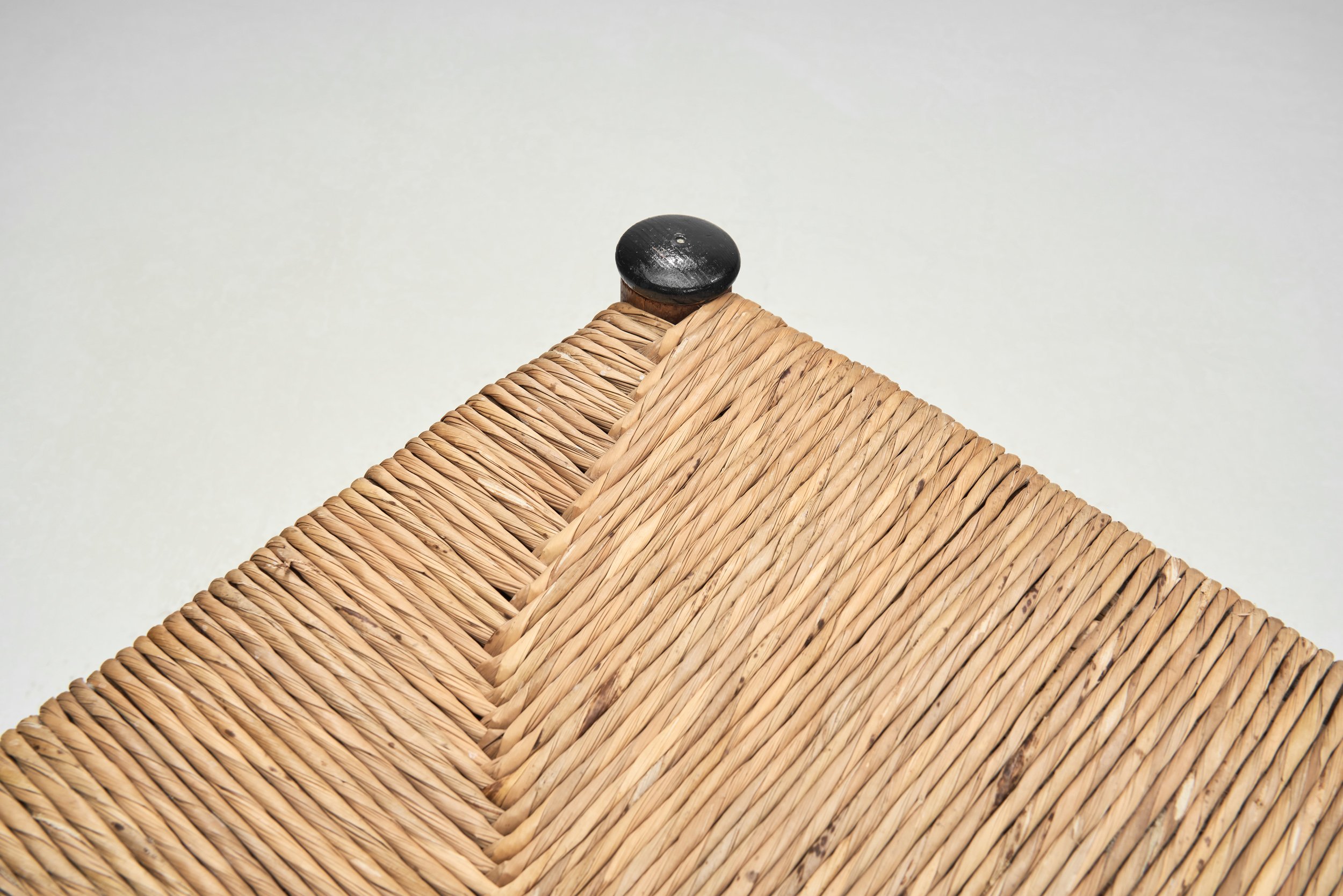
The styles’ main characteristics are reflected in the design of this chair beautifully: expressive, art deco-reminiscent, and functional. Amsterdamse School furniture is renowned for its expressive and sculptural qualities. Designers like Jac. Levee sought to integrate form and functionality seamlessly, resulting in furniture pieces that were not only visually striking but also practical. The craftsmanship of Amsterdamse School furniture is exemplified by its intricate woodwork and joinery. Pieces often showcased decorative detailing through carvings, inlays, and geometric patterns. These elements add a touch of individuality and artistry to a piece, setting them apart from the mass-produced furniture of the time. Subtle, intricate detailing can be observed in this chair as well, from the material contrast to the black elements on the frame. The seat is made of tightly woven rush, which adds beautiful texture and a traditional look, while still maintaining comfort through its natural flexibility. By being entirely constructed from natural materials, this piece showcases the classic charm typical of early 20th century furniture, while adding versatility through its unpretentious, organic character. The wooden stretchers are positioned between each pair of legs, creating symmetry within the design. These additions go beyond their aesthetic purpose - not only do they complete the design but they also reinforce the structure, lending it additional stability.
Despite the passing of decades, the Amsterdamse School furniture style continues to captivate enthusiasts and collectors worldwide. The enduring appeal lies in its unique combination of artistic innovation, craftsmanship, and a commitment to cultural identity. The pieces from this era are not merely functional items but also works of art that convey the spirit of a transformative period in Dutch history.
SOLD
Condition:
In good vintage condition. Wear consistent with age and use.
Dimensions:
16.53 in W x 16.92 in D x 26.77 in H; Seat height 16.14 in; Seat depth 16.14 in
42 cm W x 43 cm D x 68 cm H ; Seat height 41 cm ; Seat depth 41 cm
REQUEST PRICE HERE
Price category: 7,500 - 10,000 usd / eur
Axel Einar Hjorth’s designs are sharply distinctive in style, materials, and character. Unlike many of his contemporaries, Hjorth did not conform to the socially oriented ideas produced by Svensk Form (the Swedish Society of Crafts and Design). He often incorporated playful ornamentation from different historical periods by which he was inspired, such as the French Art Déco, using mixed exotic woods, bright colours, and textiles, as this pair or “Radio” chairs showcase.
Designed in the first half of the 20th century, these armchairs possess a refined and slender appearance with distinctive details. The sleek wooden frames offer a beautiful contrast to the neat upholstery of the seats, creating a visually captivating aesthetic. Together, they make for a harmonious balance between contemporary elegance and traditional style. Even though Swedish design is generally democratic and meant for the masses, pieces were not stripped of all beauty for the sake of functionality. The importance of this balance can be identified in the design and execution of these chairs as well. The craftsmanship displayed in this model is a testament to the high standards of Swedish design in the early 20th century, reflecting both the technical skill and artistic vision of both Hjorth and Nordiska Kompaniet. This pair not only serves as a timeless work of art, but also showcases the elegance and innovation of the era.
The Swedish company Nordiska Kompaniet manufactured this pair with utmost care for its quality and design. Axel Einar Hjorth worked as the lead designer for the department store from 1926 to 1938. The company was among the most renowned Swedish manufacturers during the mid-century era, and this "Radio" model is a prime example of the great success of their works.
Condition:
In good vintage condition. Wear consistent with age and use. The chairs have recently been reconditioned. Due to the age and nature of the wood, the items may have some marks, scratches, and discolouration. The chairs come with their original upholstery or have been reupholstered by a previous owner. We recommend reupholstery due to some signs of wear. Each of our items can be reupholstered by our in-house atelier in a fabric of choice. Please reach out for more information.
Dimensions:
19.29 in W x 19.29 in D x 37.20 in H; Seat height 17.12 in; Seat depth 15.55 in
49 cm W x 49 cm D x 94.5 cm H; Seat height 43.5 cm; Seat depth 39.5 cm
REQUEST PRICE HERE
Price category: 15,000 - 20,000 usd / eur
This beautiful set of six stools are crafted in the manner of French design duo Audoux-Minet. Adrien Audoux and Frida Minet worked together during the mid-20th century. The duo are known for their innovative use of natural, sustainable materials, including rope, wicker, and bamboo. Their work was heavily influenced by the Modernist movement, which sought to create functional and streamlined designs that were accessible to a wider audience.
Like in Scandinavia, there was an early emphasis on wood in most European mid-century design as it connected everyday objects to nature. This set of six is a perfect example of this sentiment, and the visual benefits of an understated, organic design. The high quality wicker makes these pieces outstanding examples of woven furniture. They feature a fairly traditional shape with rounded edges and an airy feel. The straightforward shape highlights the understated beauty of the materials, allowing the beautiful woven pattern and the grain of the wood to stand out. The seats are set on three splayed club feet, stained in a rich colour lending a more dramatic presence to the set. The tripod base is ideal for ensuring the sturdiness needed for a classic piece of furniture, even more so when paired with the T stretcher placed between the legs. Being functional as well as aesthetically pleasing, these stools are a great addition to set the tone of a space. The design is strong but subtle, with expert wickerwork thanks to which it can add depth as well as functionality to a space.
The interplay of a simple structure and refined detailing evokes a sense of harmony, aligning with the era’s focus on blending beauty with utility. The organic design makes this set stand out with an elemental edge. The colour palette further allows them to easily adapt to almost any interior to either complement a space, or to pop as accent pieces.
Condition:
In good vintage condition. Wear consistent with age and use. The stools have recently been reconditioned. Due to the age and nature of the materials, the items have minor scratches and dents, and may have additional marks or discolouration.
Dimensions:
15.35 in W × 13.39 in D × 17.72 in H
39 cm W x 34 cm D x 45 cm H
REQUEST PRICE HERE
Price category: 2,500 - 5,000 usd / eur
While Kay Fisker is considered a leading exponent of Danish Functionalism, his designs show why he was also a great influence on the Danish housing culture. This model was famously brought to Denmark from China by Fisker and there manufactured by Robert Wengler.
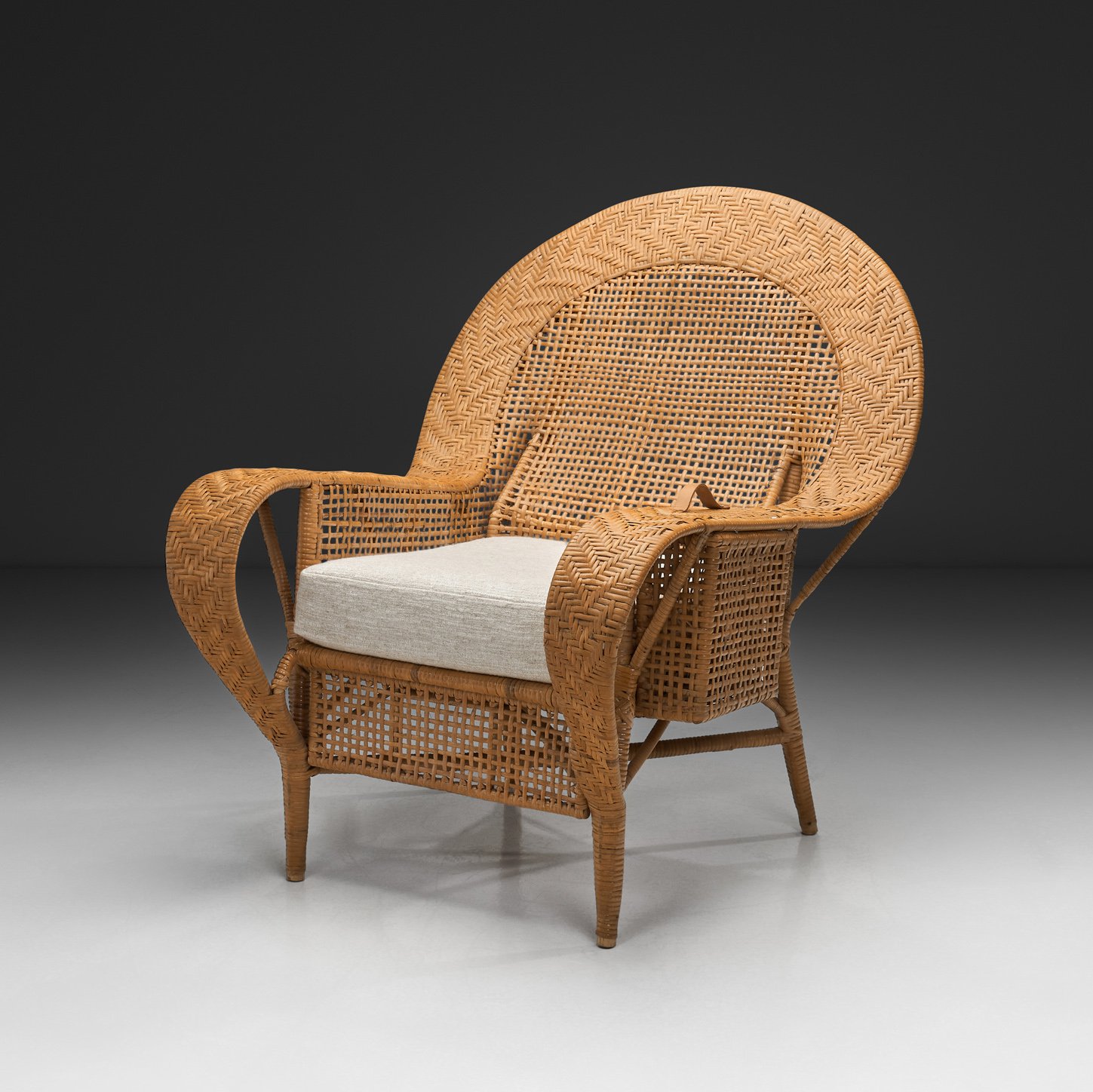
Having trained architects and designers such as Finn Juhl, Kay Fisker designed his furniture pieces with the greatest architectural precision and quality. This “Canton” is a one-of-a-kind design, with an immediately recognisable frame and wickerwork. The masterfully woven cane gives this chair an airy look, complimented by the loose, upholstered seat cushion that adds comfort and cosiness to complement the frame. From every angle, this chair is visually arresting; from the front to the sides and back, the curves and geometric lines provide plenty of visual interest. This chair has a distinct designer edge, with clear signs of a skilled architect. The straight lines are mainly in service of the structural stability, while the lower panel in the front are the creation of an equally skilled designer. The back is especially creative, as it flows down to form the armrests and then further down to the legs, creating balance between the curved and straight lines. Fisker, like many of his Danish contemporaries was highly skilled both as an architect and as a furniture designer, and the “Canton” is perhaps the best evidence of that.
The manufacturer, Robert Wengler was a German craftsman who specialised in wicker furniture, and was appointed as a wicker maker to the Danish Crown in 1914. He was a pioneer in working with rattan in the early 20th century and became the most skillful wicker-maker in Denmark.
Condition:
In good vintage condition. Wear consistent with age and use. The armchair has recently been reconditioned. Due to the age and nature of the metal, the armchair may have minor marks and discolouration. The chair has recently been reupholstered in premium fabric. Each of our items can be reupholstered by our in-house atelier in a fabric of choice. Please reach out for more information
Dimensions:
34.25 in W x 37.40 in D x 39.17 in H; Seat height 19.68 in; Seat depth 21.65 in; Arm Height 23.42 in
87 cm W x 95 cm D x 99.5 cm H; Seat height 50 cm; Seat depth 55 cm; Arm Height 59.5 cm
REQUEST PRICE HERE
Price category: 5,000 - 7,500 usd / eur
Wim den Boon was a Dutch designer and architect associated with the post-war modernist movement in the Netherlands. After studying interior design at the Academy of Fine Arts in The Hague, he worked alongside artists like Hein Stolle and Pierre Kleykamp to contribute to a number of important post-war interiors, including projects for Schiphol Airport. Den Boon later established himself independently in The Hague, where he designed furniture characterised by restrained compositions, careful spatial treatment, and a preference for unadorned everyday materials.
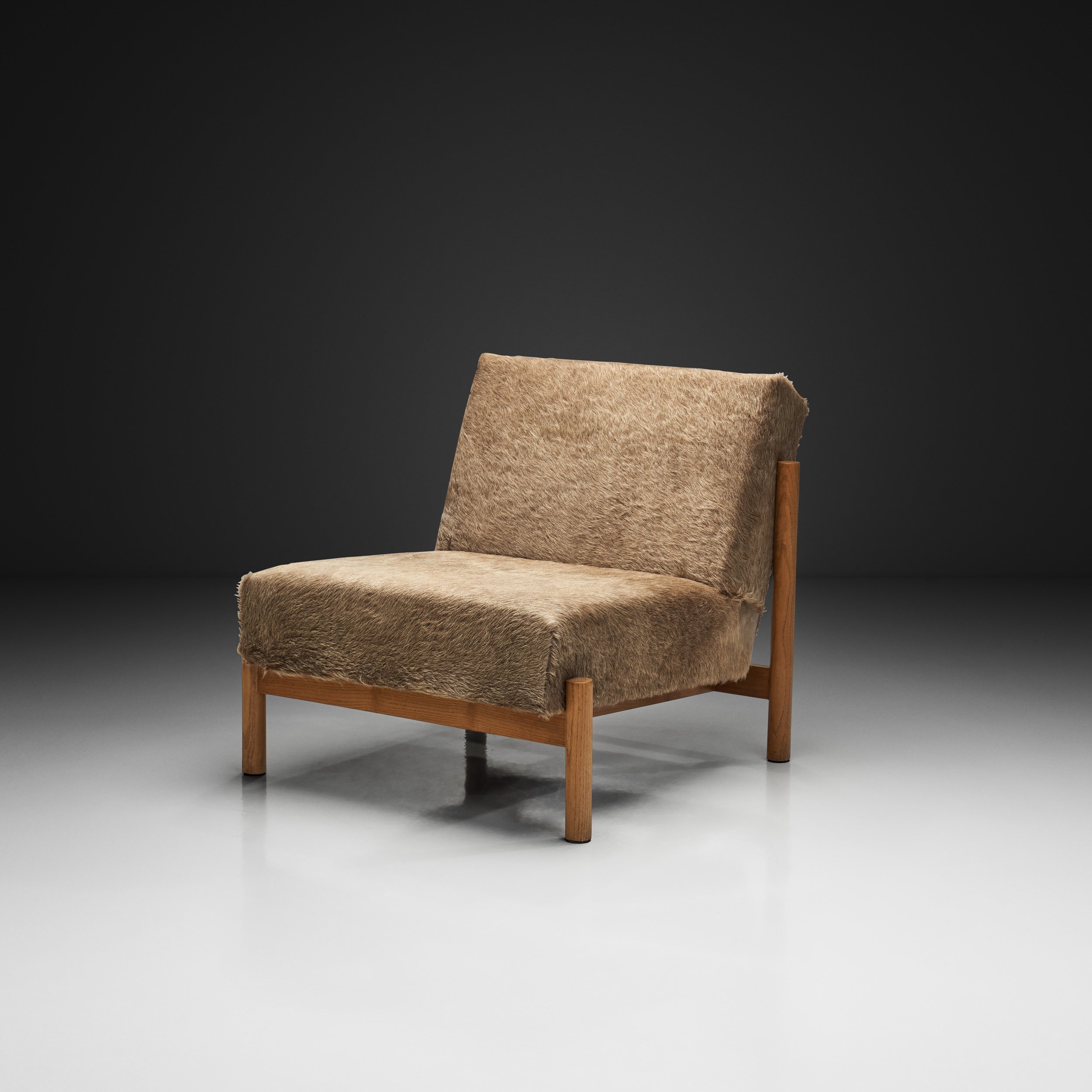
Influences from De Stijl and Scandinavian modernism remained visible throughout his work, particularly in the balance between strict structure and warmth. This lounge chair reflects that sensibility through its reduced oak construction and tactile ponyskin upholstery. The frame is composed of cylindrical supports and straight horizontal rails, creating a clear geometric outline around the upholstered body. The proportions are low and generous, giving the piece a relaxed, grounded posture. The seat and backrest form a wide lounging space upholstered entirely in champagne-coloured ponyskin. The material introduces a textured surface, giving the otherwise minimal form a sense of movement and depth. Still, the oak remains visible throughout the design, outlining the silhouette and through its slim slats it prevents the chair from appearing overly heavy. The tilt of the backrest softens the strict geometry and contributes to the lounge-like comfort of the piece.
Den Boon was part of the generation of Dutch designers who helped shape post-war modernism in the Netherlands through a restrained and architectural approach to furniture. This chair is proof of his talent. It feels architectural in structure, yet tactile and warm in appearance, reflecting the balance that made Dutch modernist furniture so distinctive during the period.
Condition:
In good vintage condition. Wear consistent with age and use. The lounge chair has recently been reconditioned. Due to the age and nature of the materials, the item may have marks, scratches, and discolouration. The piece has recently been reupholstered in premium ponyskin. Each of our items can be reupholstered by our in-house atelier in a fabric of choice. Please reach out for more information.
Dimensions:
25.79 in W x 34.26 in D x 27.56 in H; Seat height 14.97 in; Seat depth 20.67 in
65.5 cm W x 87 cm D x 70 cm H; Seat height 38 cm; Seat depth 52.5 cm
REQUEST PRICE HERE
Price category: 2,500 - 5,000 usd / eur
The Amsterdamse School movement arose in response to the influence of Art Nouveau and Jugendstil in the late 19th and early 20th centuries. This movement, which took root in Amsterdam, sought to create a uniquely Dutch style that embraced traditional craftsmanship and celebrated the spirit of the current times. The Amsterdamse School extended its influence across various artistic disciplines, including architecture, decorative arts, and furniture design.
The styles’ main characteristics are reflected in the design of this chair beautifully: expressive, art deco-reminiscent, and functional. Amsterdamse School furniture is renowned for its sculptural qualities. Designers like Jac Levee sought to integrate form and functionality seamlessly, resulting in furniture pieces that were not only visually striking but also practical. The craftsmanship of Amsterdamse School furniture is exemplified by its intricate woodwork and joinery. Pieces often showcased decorative detailing through carvings, inlays, and geometric patterns. These elements add a touch of individuality and artistry to a piece, setting them apart from the mass-produced furniture of the time. In this chair, the backrest’s clean, symmetrical lines reflect the simple, yet sophisticated aesthetics of the era. The use of black round accents not only adds an element of visual interest to the design, but also serve to reinforce the structure and enhance the overall strength. To further add to the charm of the piece, the woven seat, made from durable natural fibres, highlights the attention to both function and form, by creating visual and textural interest. The beautifully symmetrical pattern showcases the timeless artistry of artisanal furniture.
Whether placed in a farmhouse or used to add an organic element to a modern interior, this chair provides both history and utility. More than just functional seating, this chair represents a moment in design history where furniture was built to last, to be used daily, and to shape the atmosphere of a room.
Condition:
In good vintage condition. Wear consistent with age and use. The chair has recently been reconditioned. Minor scratches and discolouration. Due to the nature of the wood, the item may have some additional marks.
Dimensions:
25.59 in W x 20.86 in D x 37.40 in H; Seat height 18.50 in; Seat depth 16.92 in; Arm height 28.14 in
65 cm W x 53 cm D x 95 cm H; Seat height 47 cm; Seat depth 43 cm; Arm height 71.5 cm
REQUEST PRICE HERE
Price category: 7,500 - 10,000 usd / eur
This pair of armchairs is designed in the manner of Charles Dudouyt, one of the most distinctive figures in French decorative arts of the interwar period. Dudouyt’s work is often celebrated for its rustic charm, and masterful handling of wood, bridging tradition with the evolving aesthetics of Art Deco and modern design.
Impressive in its simplicity, this pair carries with it the beloved modernist characteristics of simplicity and functionality yet shows the rustic side of European design of the era. The chairs feature sturdy wooden frames with a rich, dark finish that accentuates the natural grain and depth of the wood. The meticulous craftsmanship of the wood’s joinery further enhances the chairs' allure; impeccably constructed with no visible screws, the seamless connections speak volumes about the artisan's dedication to precision and quality. The absence of visible hardware not only contributes to the chairs' aesthetic purity but also underscores the skilled craftsmanship that went into their creation. The grounded stance gives the chairs a quiet strength, while the broad seats invite relaxed, informal lounging. Upholstered in a textured beige fabric, the cushions pair a tactile, inviting surface with the clean lines of the wood and wicker base, achieving a compelling balance between warmth and restraint. The combination of materials and finishes results in visually appealing pieces while adding warmth and comfort to the overall design. The dualism within these chairs is amazing: they can fulfill their functional purpose in an interior while also achieving their aesthetic role.
The essence of early 20th century French design is beautifully captured by this pair of armchairs. Functional yet sculptural, rustic yet refined, they stand as enduring testaments of the striking balance only master woodworkers are able to create.
Condition:
In good vintage condition. Wear consistent with age and use. The chairs have recently been reconditioned. Due to the nature and age of the materials, the items may have some marks, scratches, and discolourlation. The cushions have recently been reupholstered in a premium fabric. Each of our items can be re-upholstered by our in-house atelier in a fabric of choice. Please reach out for more information.
Dimensions:
24.02 in W × 23.62 in D × 38.58 in H; Seat height 16.34 in; Seat depth 21.26 in; Arm height 22.83 in
61 cm W x 60 cm D x 98 cm H; Seat height 41.5 cm; Seat depth 54 cm; Arm height 58 cm
REQUEST PRICE HERE
Price category: 2,500 - 5,000 usd / eur
This dining chair, designed by the Amsterdam-based company N.V. Jac Levee, is a beautiful piece of furniture design that embodies the essence of the Amsterdam School style. This movement, which emerged in the Netherlands during the early twentieth century, sought to unite expressive craftsmanship with modern design, resulting in furniture that was both functional and visually distinctive. Its influence extended from architecture to interiors and furnishings, where rich materials and carefully considered decorative details became defining characteristics.
Crafted from high-quality wood, the frame of the chair exudes a sense of strength and durability, while the wicker seating offers a comfortable and tactile sitting experience. The eight stretchers that make up the lower part of the frame provide a sense of balance and stability to the overall structure, while also creating a pleasing geometric rhythm when viewed from different angles. One of the most striking features of this chair is the use of black circular accents positioned along the legs and back. These details not only introduce a subtle graphic contrast against the warm tone of the wood but also reinforce the construction and highlight the chair's architectural character. The restrained ladder-back design further complements the overall composition, balancing the solidity of the frame with an open and elegant silhouette.
Over time, the chair has acquired a beautiful patina that adds to its charm and character. The tone of the wood and the gently aged wicker speak to decades of history, enhancing the authenticity of the piece without diminishing its functionality. More than simply a dining chair, it reflects the enduring quality of Dutch craftsmanship, combining honest materials, thoughtful construction, and understated decorative refinement.
Condition:
In good vintage condition. Wear consistent with age and use. The chair has recently been reconditioned. Some marks, scratches and discolouration are present.
Dimensions:
19.29 in W x 15.74 in D x 34.84 in H; Seat height 18.11 in; Seat depth 15.15 in
49 cm W x 40 cm D x 88.5 cm H; Seat height 46 cm; Seat depth 38.5 cm