
Pair of Matte Opal Glass Ceiling Lamps, The Netherlands 1960s (sold)

Pair of Matte Opal Glass Ceiling Lamps, The Netherlands 1960s (sold)
Dutch lighting design of the 1960s was marked by an exploration of modern materials and a fascination with light as a spatial element. Manufacturers such as Raak and Philips were at the forefront of this movement, producing fixtures that combined technological precision with sculptural restraint. Interestingly, Raak was founded in 1954 by Carel O. Lockhorn, a previous employee of Philips Lighting in Eindhoven.
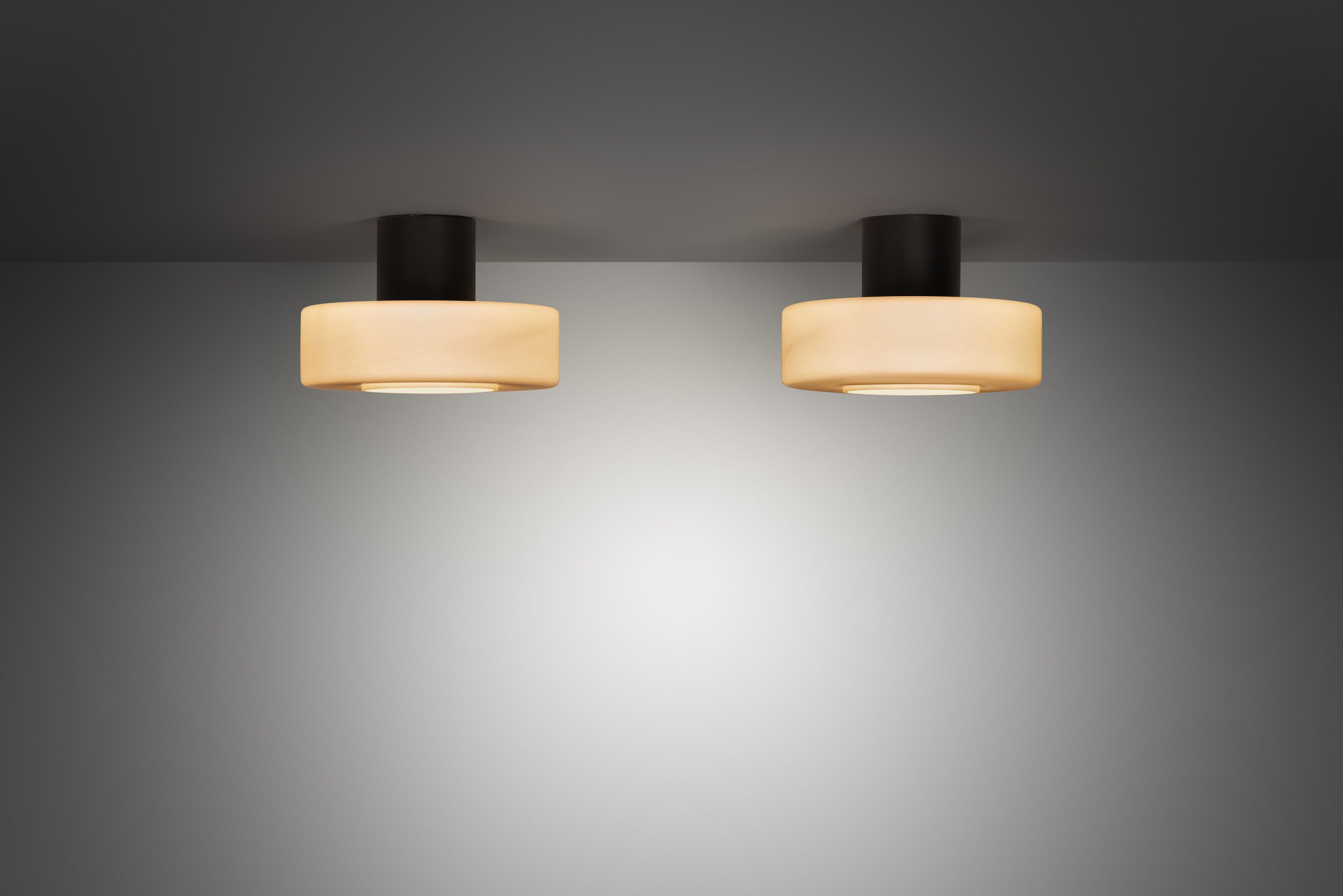
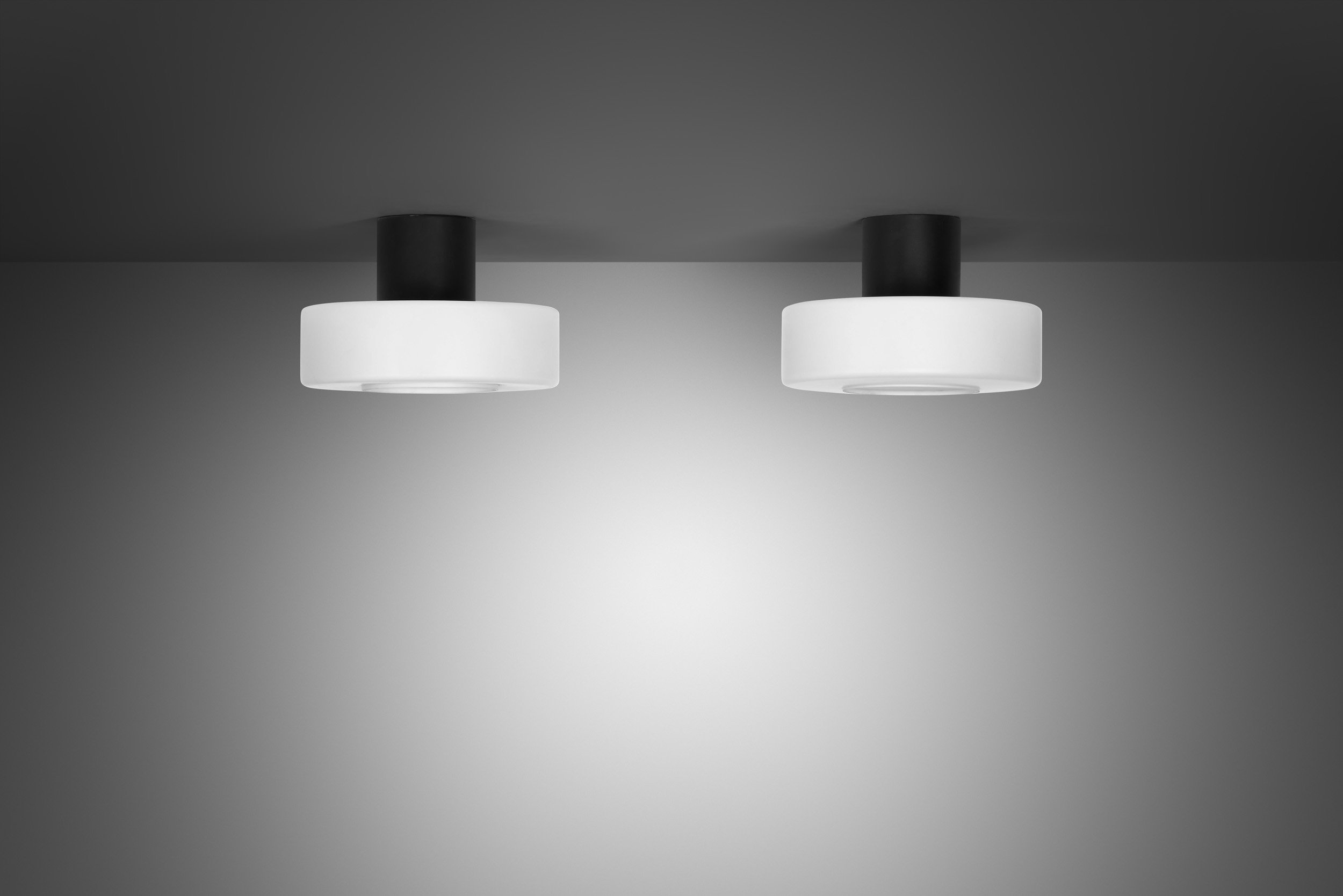
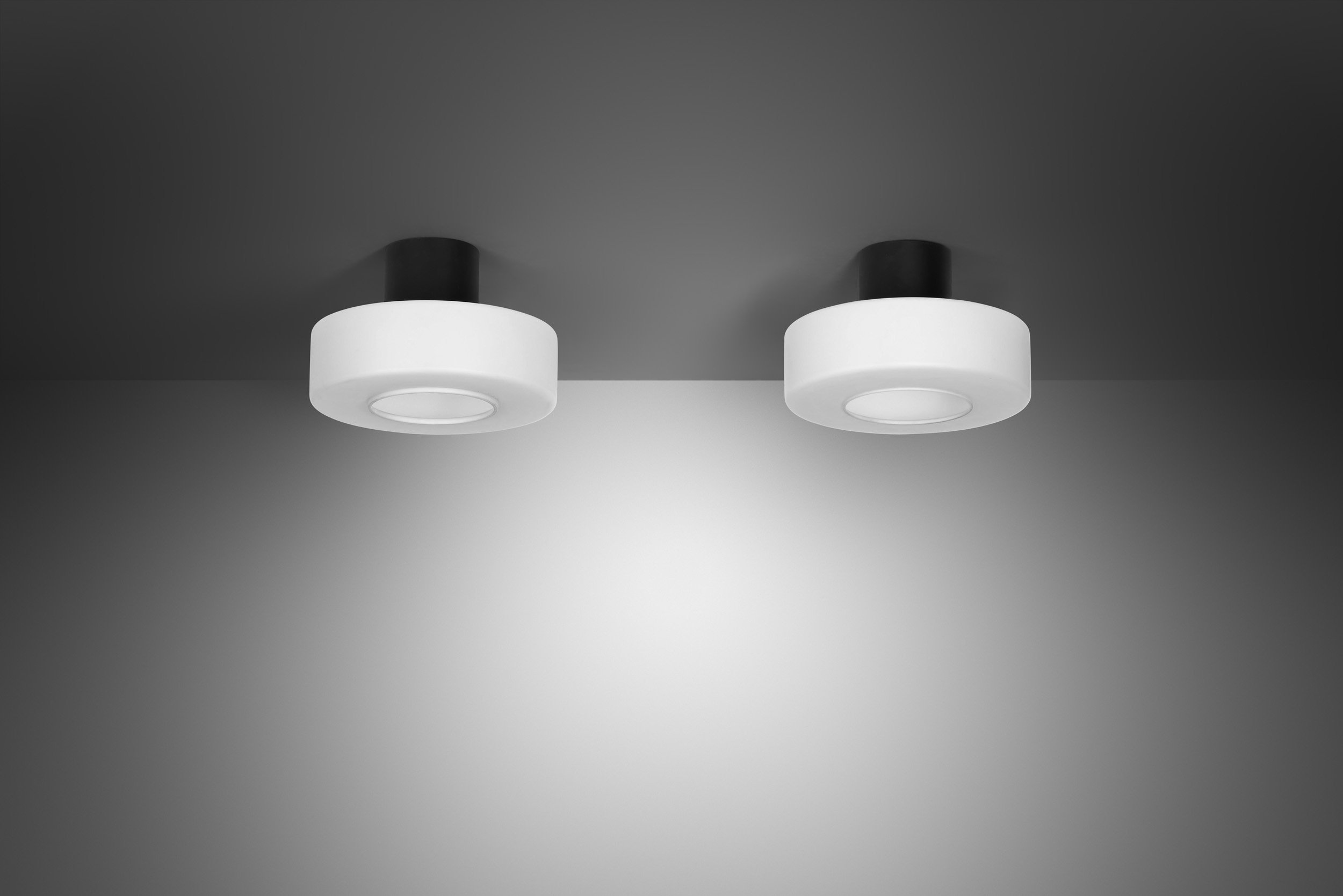
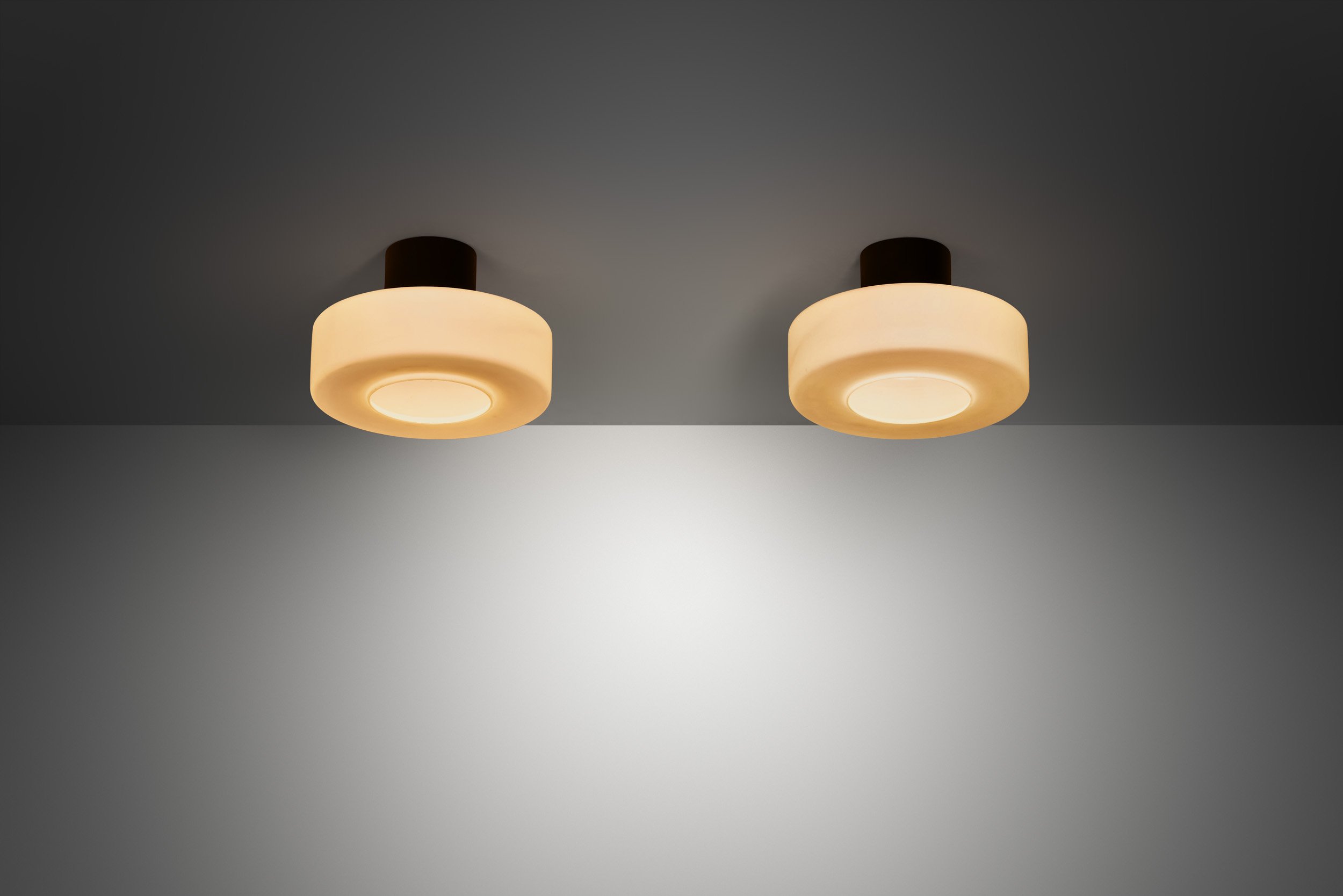
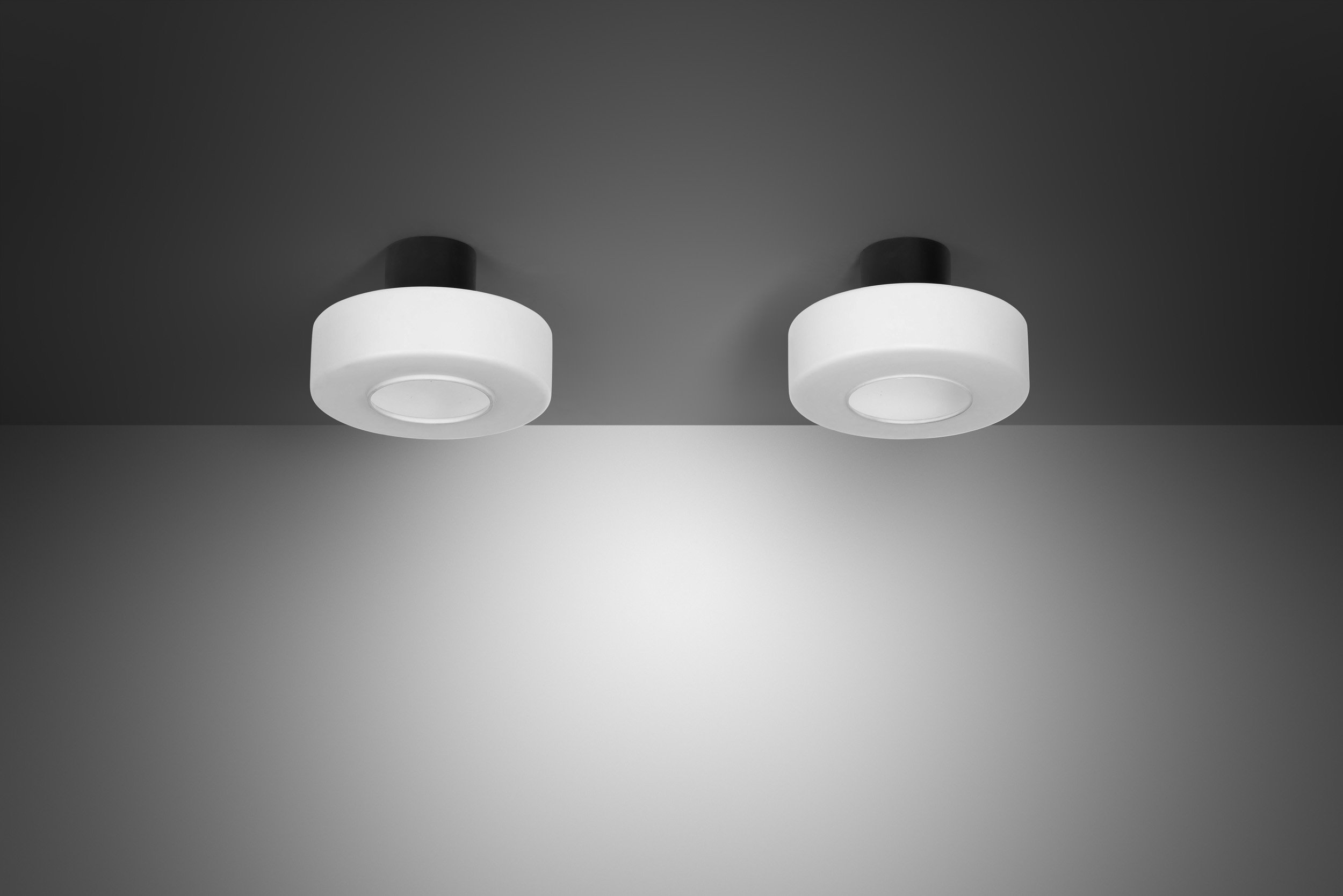
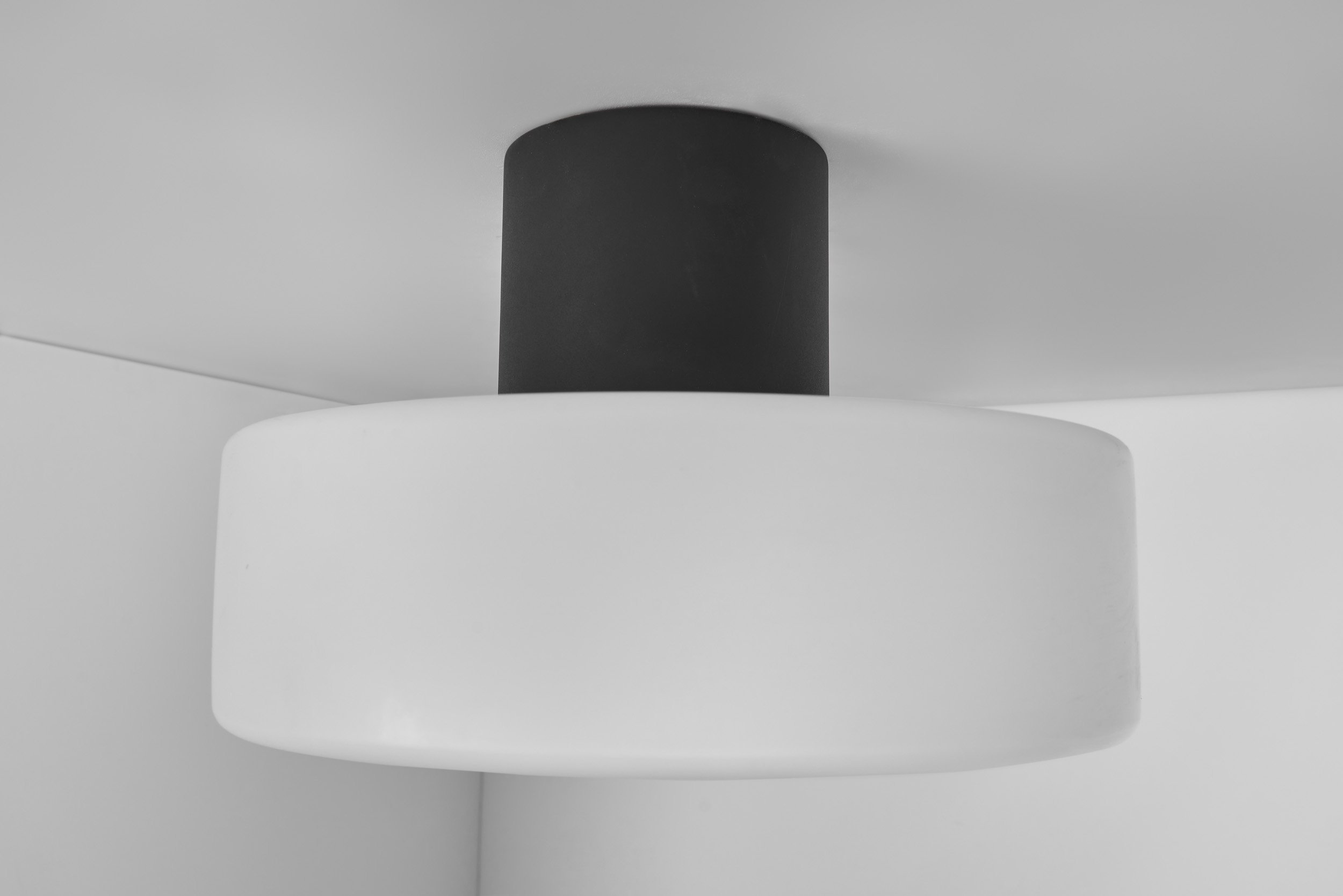
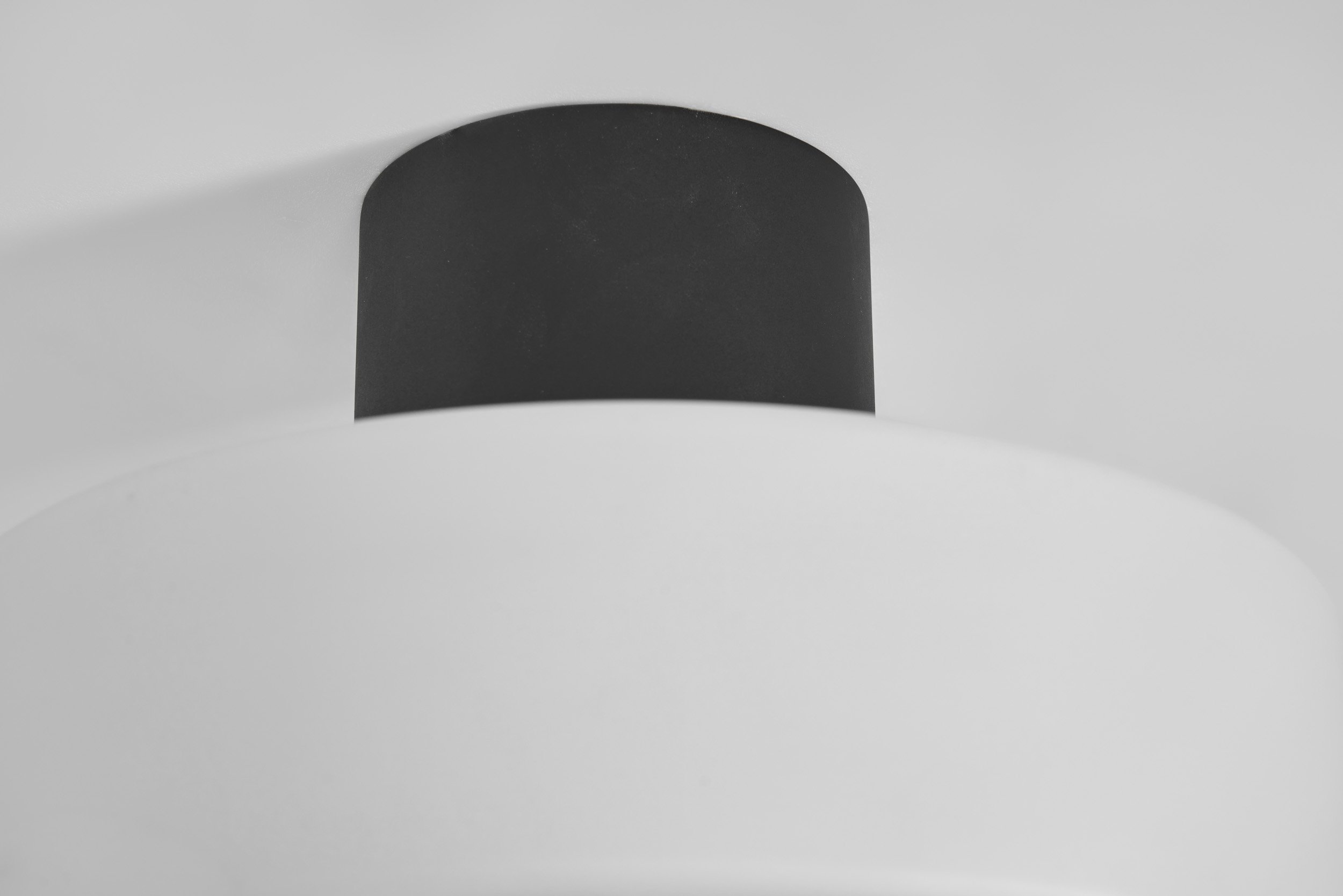
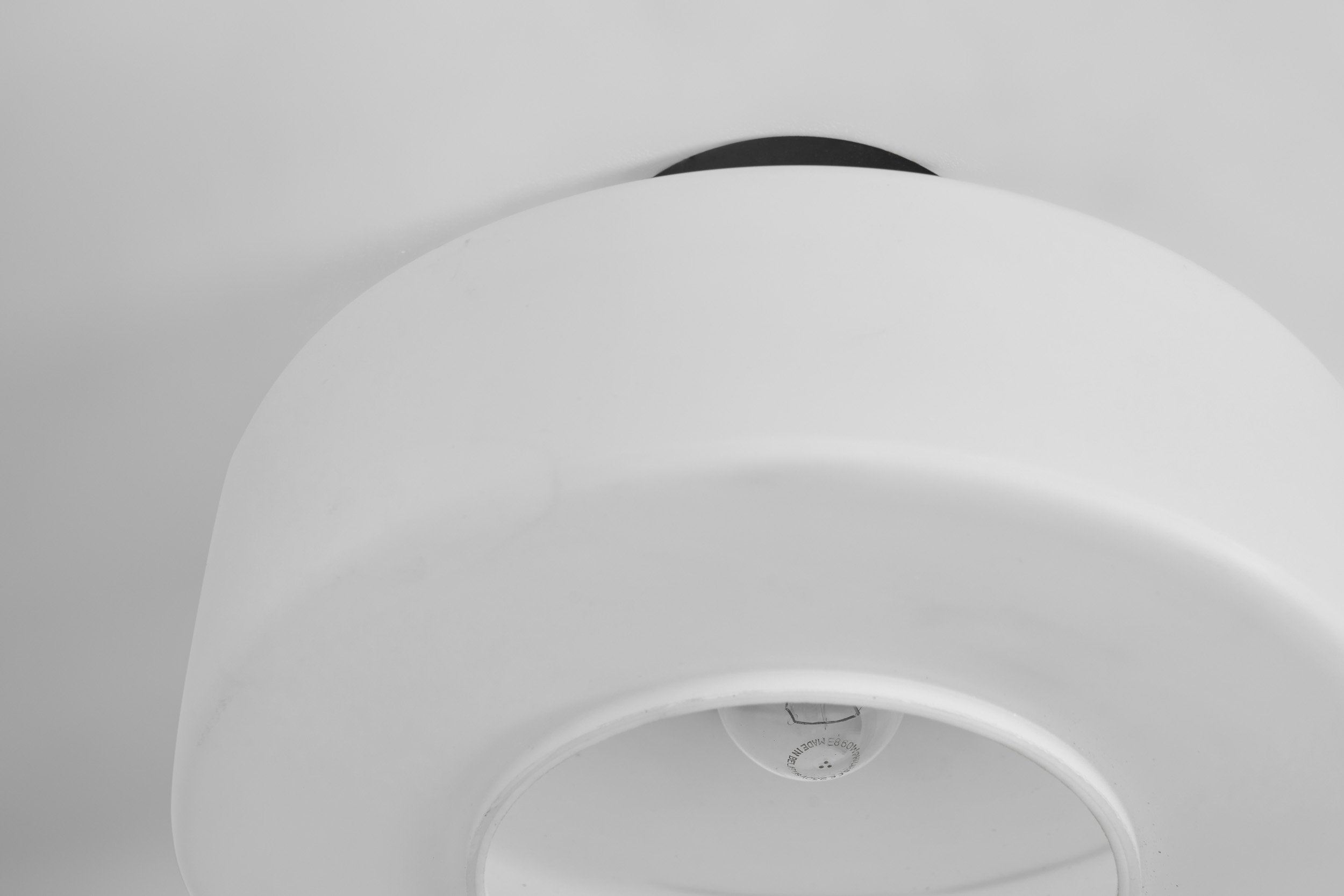
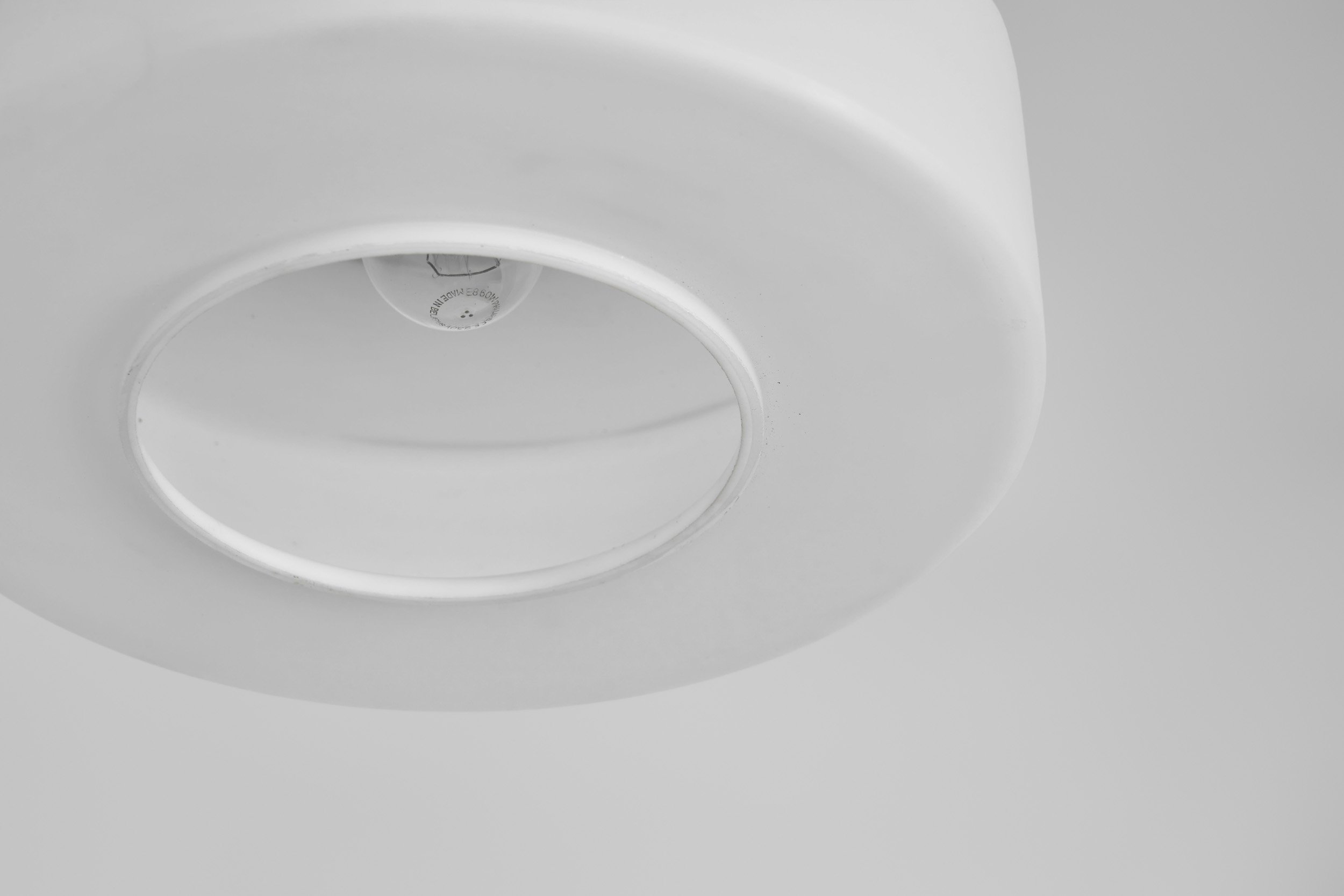
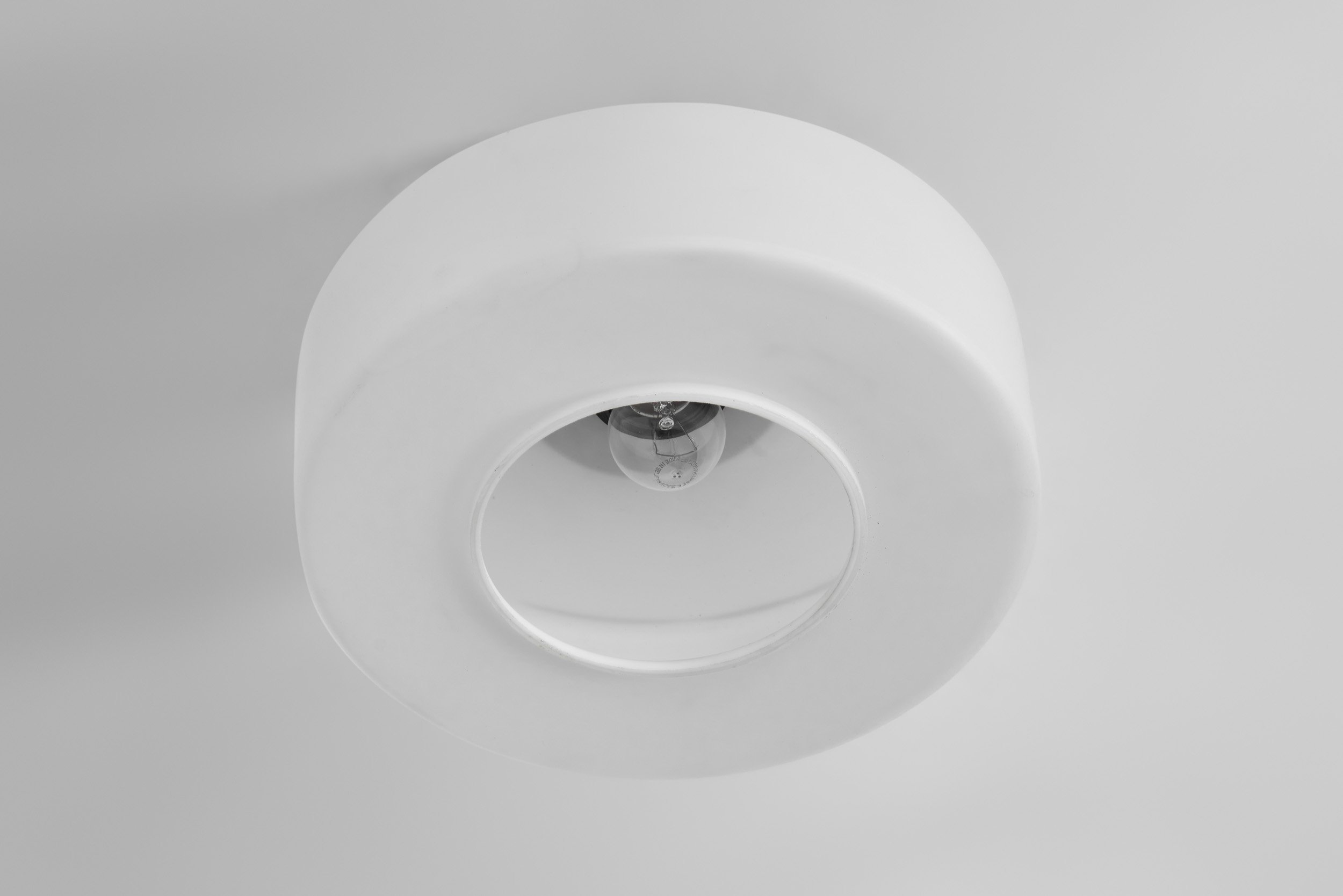
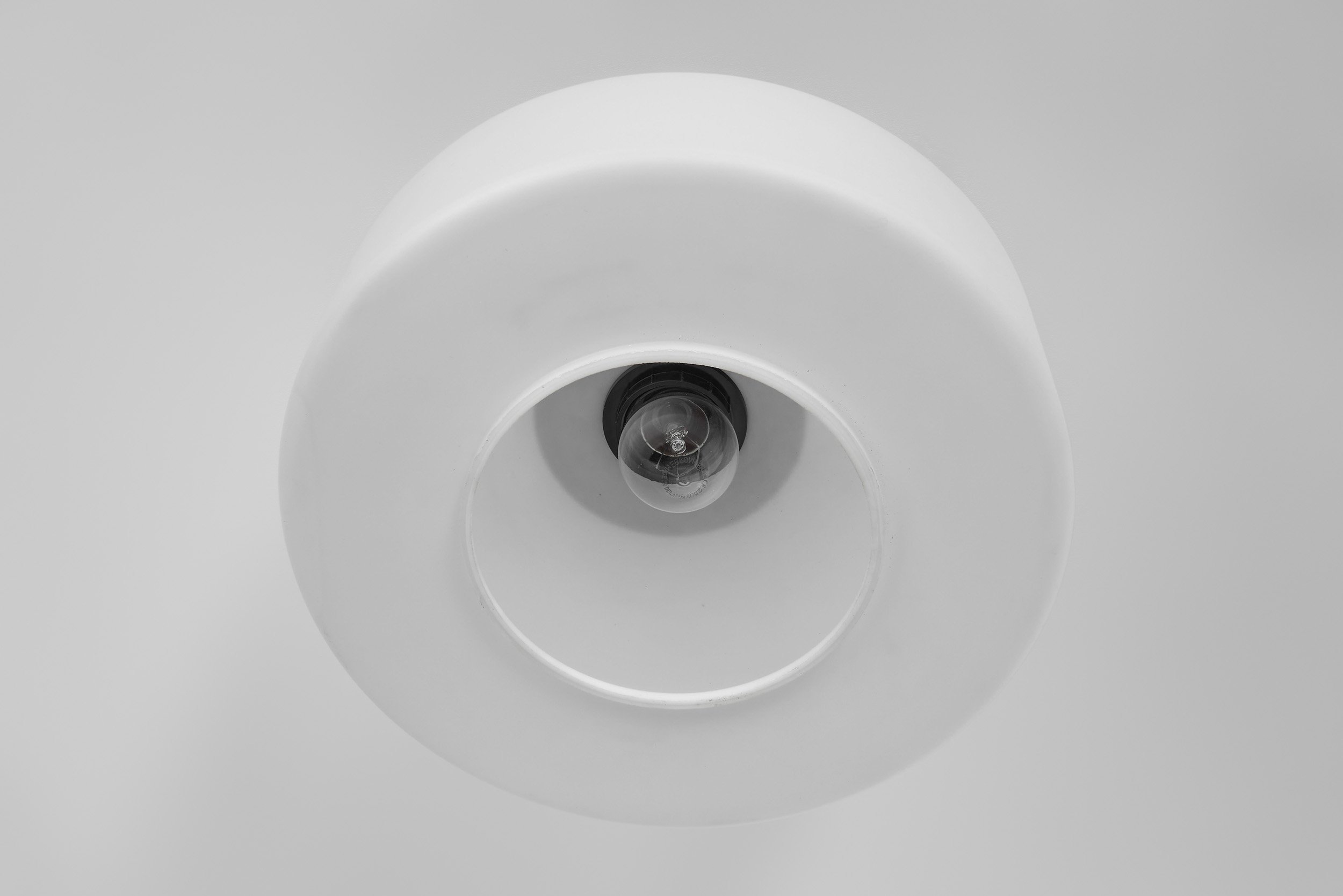
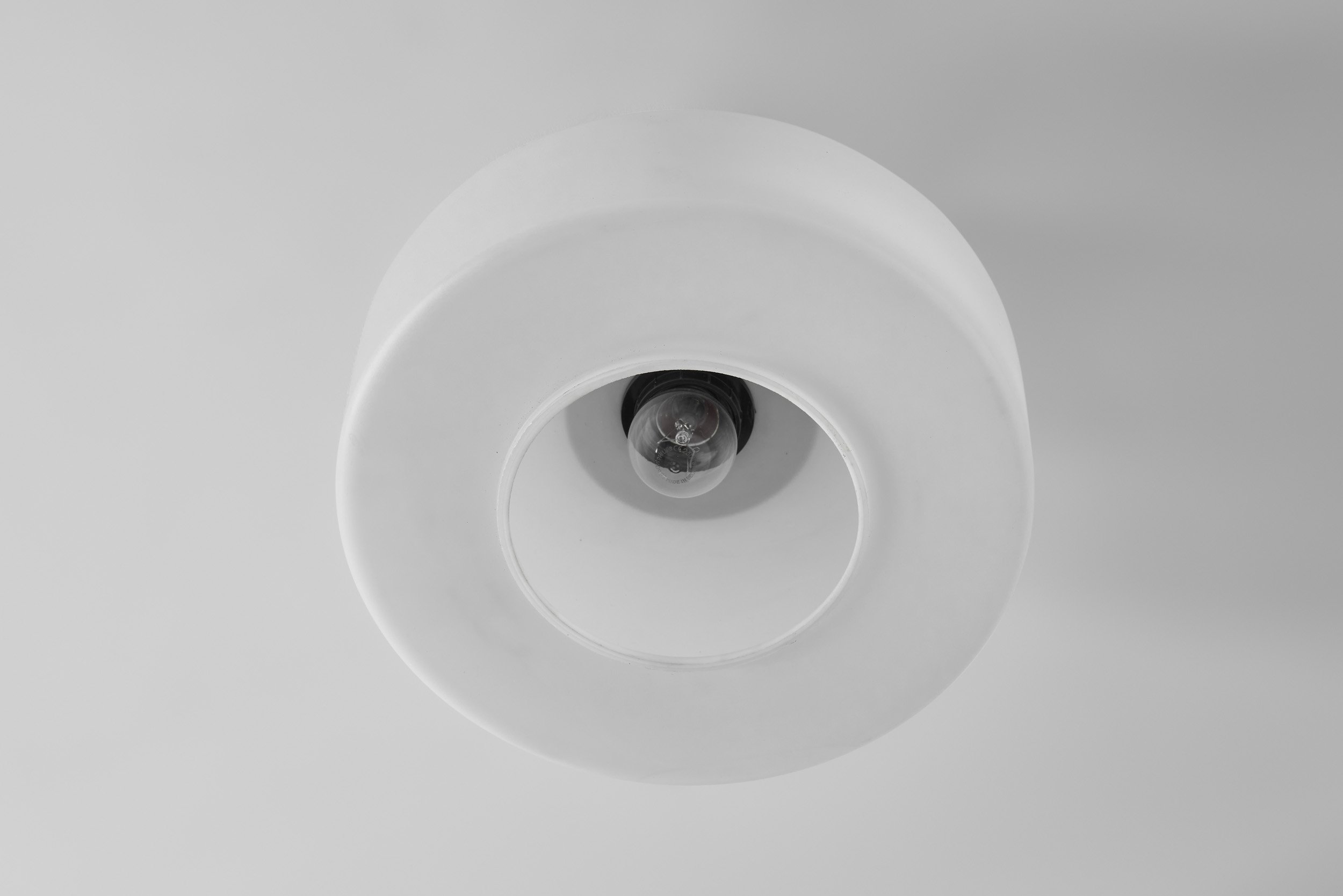
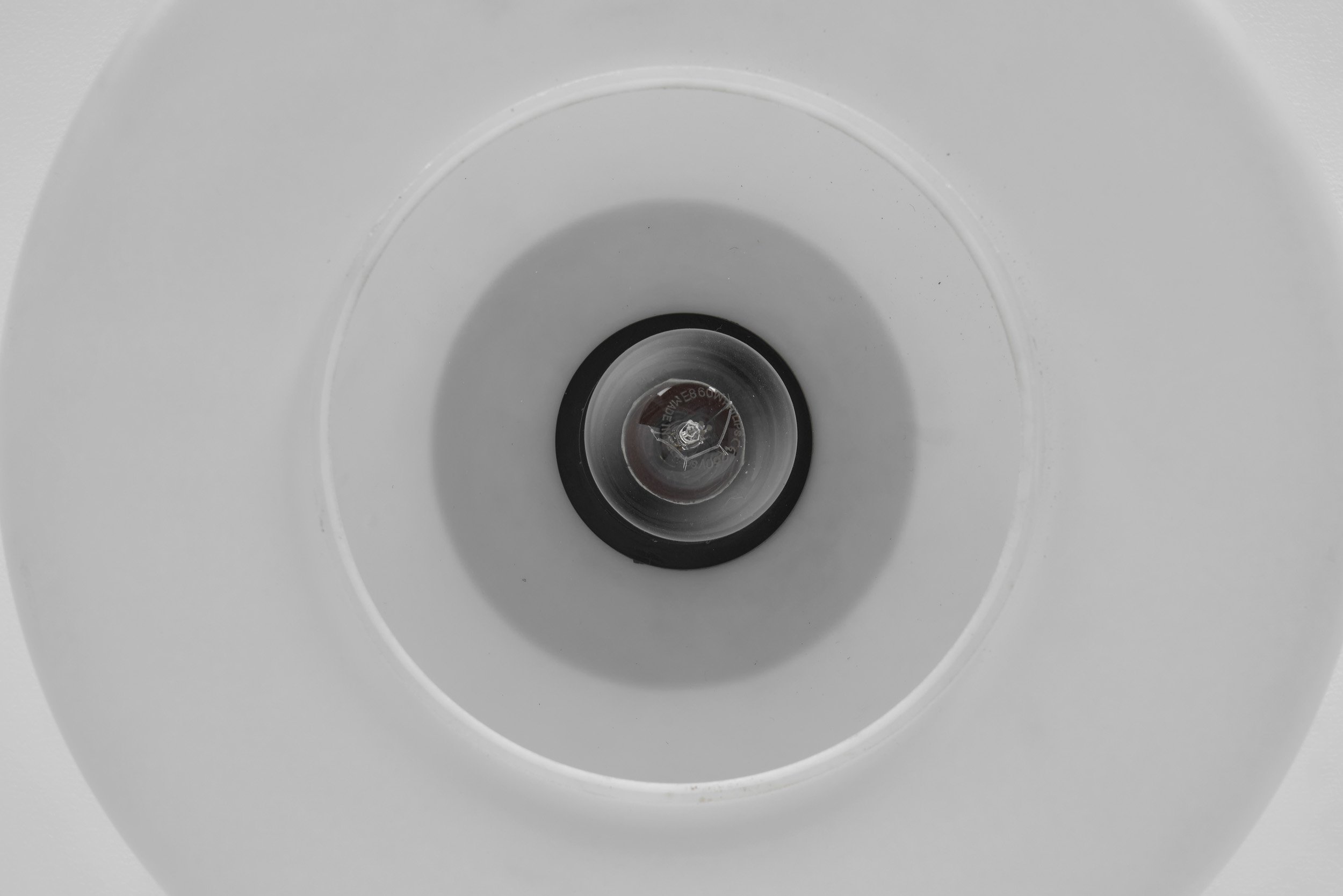
This pair of ceiling lamps reflect a modernist approach through the simple yet striking form. The fixtures consists of a broad circular opaline glass shade with a central opening that creates both direct and ambient illumination. The matte look softens the light, producing an even, atmospheric glow that enhances the surrounding space. The lamps’ smooth cylindrical profile is balanced by a contrasting black metal mount, grounding the design visually while allowing the glass to stand out. The proportions are carefully judged, with the wide ring offering both visual presence and subtlety, making it suitable for a range of interior settings. This pair captures the enduring appeal of Dutch modern lighting. The minimal construction also speaks to the era’s industrial design ethos: clarity of lines, quality of material, and an avoidance of unnecessary embellishment.
This model stands as a reminder of how 1960s designers favoured geometry and a focus on ambient light, turning utilitarian objects into refined expressions of postwar modernism. For collectors and connoisseurs alike, this pair of lamps stand as both a nod to history and a beacon of timeless style for contemporary interiors.
SOLD
Condition:
In good vintage condition. Wear consistent with age and use. The lamps have recently been rewired and reconditioned. Due to the nature and age of the materials, item may have some marks, scratches, and discolouration. Minor imperfections may also be present on the glass due to manufacturing inconsistencies.
Dimensions:
11.02 in ø x 7.48 in H
28 cm ø x 19 cm H
REQUEST PRICE HERE
Price category: 5,000 - 7,500 usd / eur
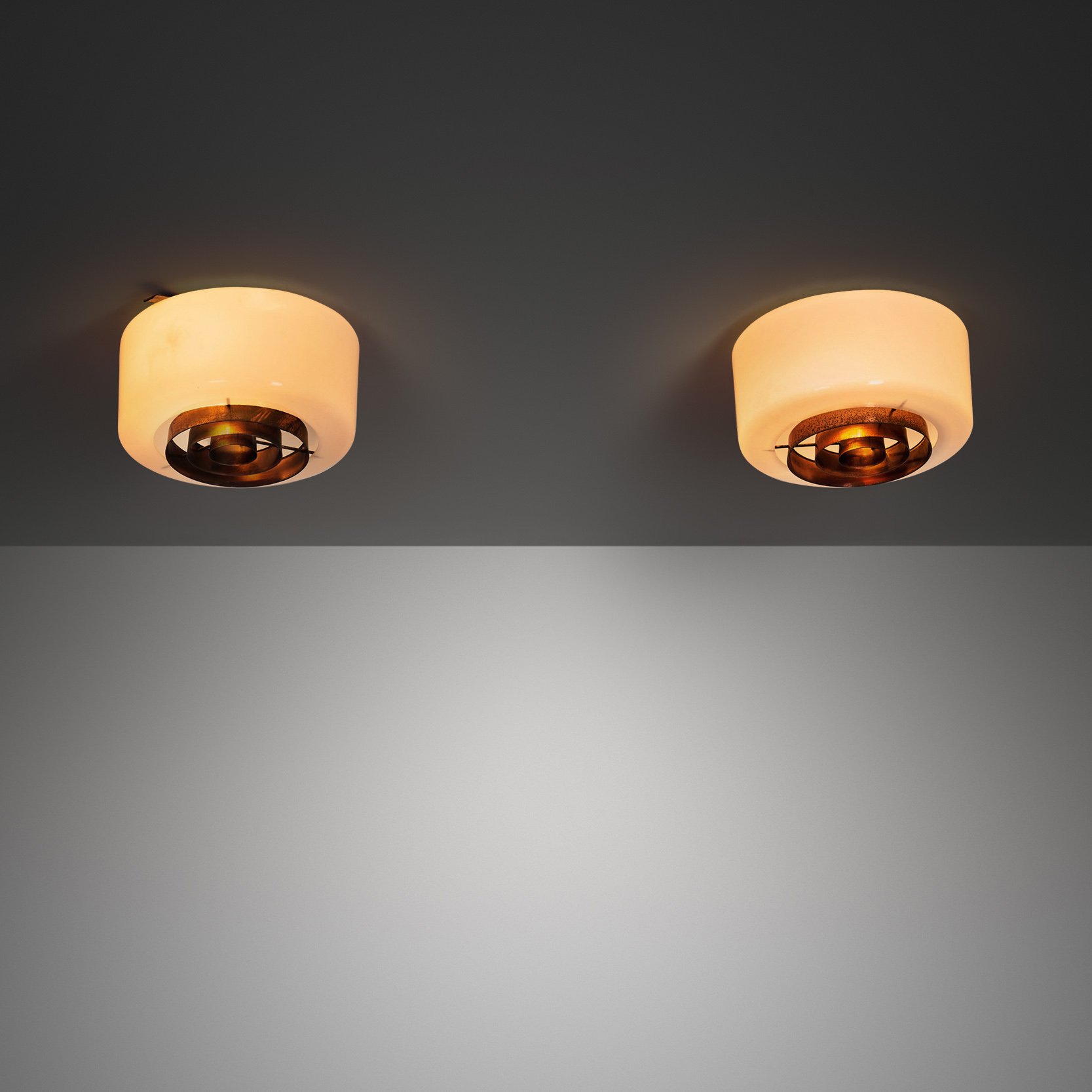
Finnish mid-century design is characterised by simple, elegant forms that Paavo Tynell was a master of. Like Finnish culture, he embraced timeless beauty, sustainability and a deep connection to the natural world. One of his favourite materials to work with was glass, as this set of three ceiling lamps showcases.
This pair embodies the sleek and simple aesthetic that characterised modern Finnish design. Still, even in the absence of ornamentation or elaborate shapes and forms, there was always an emphasis on interesting materials. Milk glass, appropriately named for its opaque or transparent ivory white tone, was first created in Venice in the 16th century, known as Lattimo. At that time, it was widely used for decorative purposes and continued to be popular during the 20th century when the material was used to decorate households as home accents. These lamps have an eye-catching shape thanks to the brass ring detail. Still, the edges are just as soft as the light these lamps emit. These pieces are flush mounted without any exposed parts but the glass shades. Tynell was a master of working with milk glass, and his lamps of this material are some of his most sought-after designs.
The mid-century period was a time of great innovation in Finnish design, as artists like Tynell pushed the boundaries of what was possible with new materials and manufacturing techniques. At the same time, there was a strong emphasis on simplicity and functionality, with designers who sought to create objects that were both beautiful and practical. Tynell's model "A2-7" lamps embody these qualities perfectly, with clean lines, and a unique, but functional design.
Condition:
In good vintage condition. Wear consistent with age and use. The ceiling lamps have recently been rewired and reconditioned. There are minor dents and scratches in the copper. Due to the age and nature of the materials, the lamps may have marks, and discolouration. Additional imperfections on the glass may be present due to manufacturing inconsistencies and age. These lamps are compatible with E27 standard fittings. All lighting can be converted for US usage.
Dimensions:
9.64 in ø x 5.12 in H
24.5 cm ø x 13 cm H
REQUEST PRICE HERE
Price category: 5,000 - 7,500 usd / eur
Itsu, short for Itä-Suomen Sähkö (eng. Eastern Finland Electricity), was a small, lesser-known manufacturer that produced characteristic models in small quantities. Itsu stands as a beacon of innovation in mid-century modern design. This lamp represents an era in which Finland saw the birth of many of its most iconic lighting models.
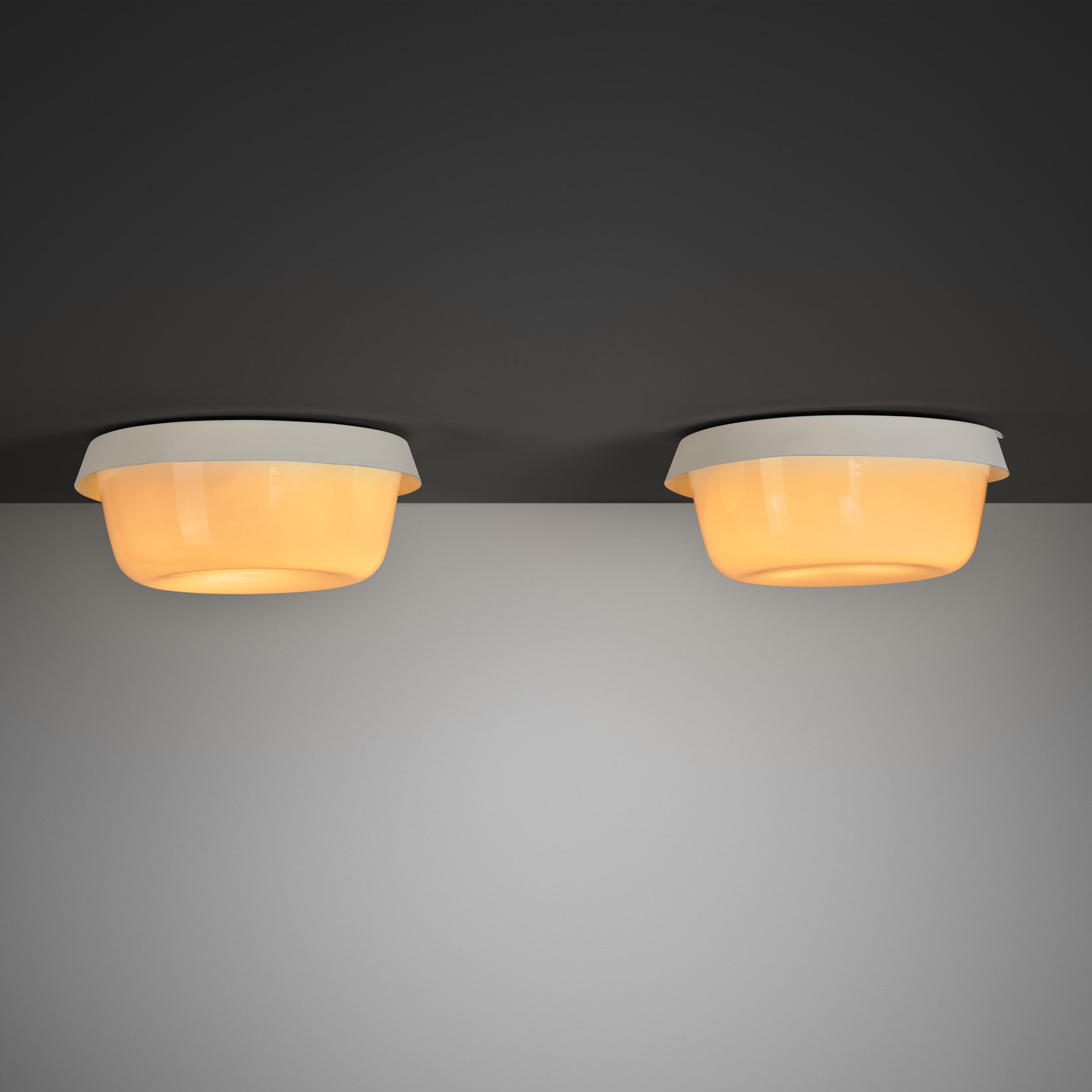
The form of this pair is built around an opal glass diffuser that has a slightly conical and rounded profile that gives it subtle depth without becoming visually heavy. With its sleek and simple aesthetic, and in the absence of heavy ornamentation, the emphasis falls on materials. The use of opal glass is central to the design. The diffuser softens the glow and disperses it, creating a more ambient and balanced illumination. The relatively small diameter and shallow projection also means they can be used in tighter spaces without disrupting the proportions of the room.
The 20th century was a time of great innovation in Finnish design, as makers pushed the boundaries of what was possible with new materials and manufacturing techniques. At the same time, there was a strong emphasis on simplicity and functionality, as this pair demonstrates. As designers sought to create objects that were both beautiful and practical, they left an unforgettable mark in the history of light and ambiance.
Condition:
In good vintage condition. Wear consistent with age and use. The lamps have recently been rewired and reconditioned. Due to the nature and age of the materials, the items may have marks, scratches, and discolouration. These lamps are compatible with an E26 / E27 (standard) fitting.
Dimensions:
15.75 in ø x 6.69 in H
40 cm ø x 17 cm H
REQUEST PRICE HERE
Price category: 5,000 - 7,500 usd / eur
It is simply impossible to talk about 20th century lighting without mentioning Finland. By the 1950s, Finland had established itself as a force for innovation. The best qualities of Finnish light fixtures are their atmospheric glow and disciplined, functionalist design that is not short of subtle decorative elements, as this ceiling lamp exemplifies.
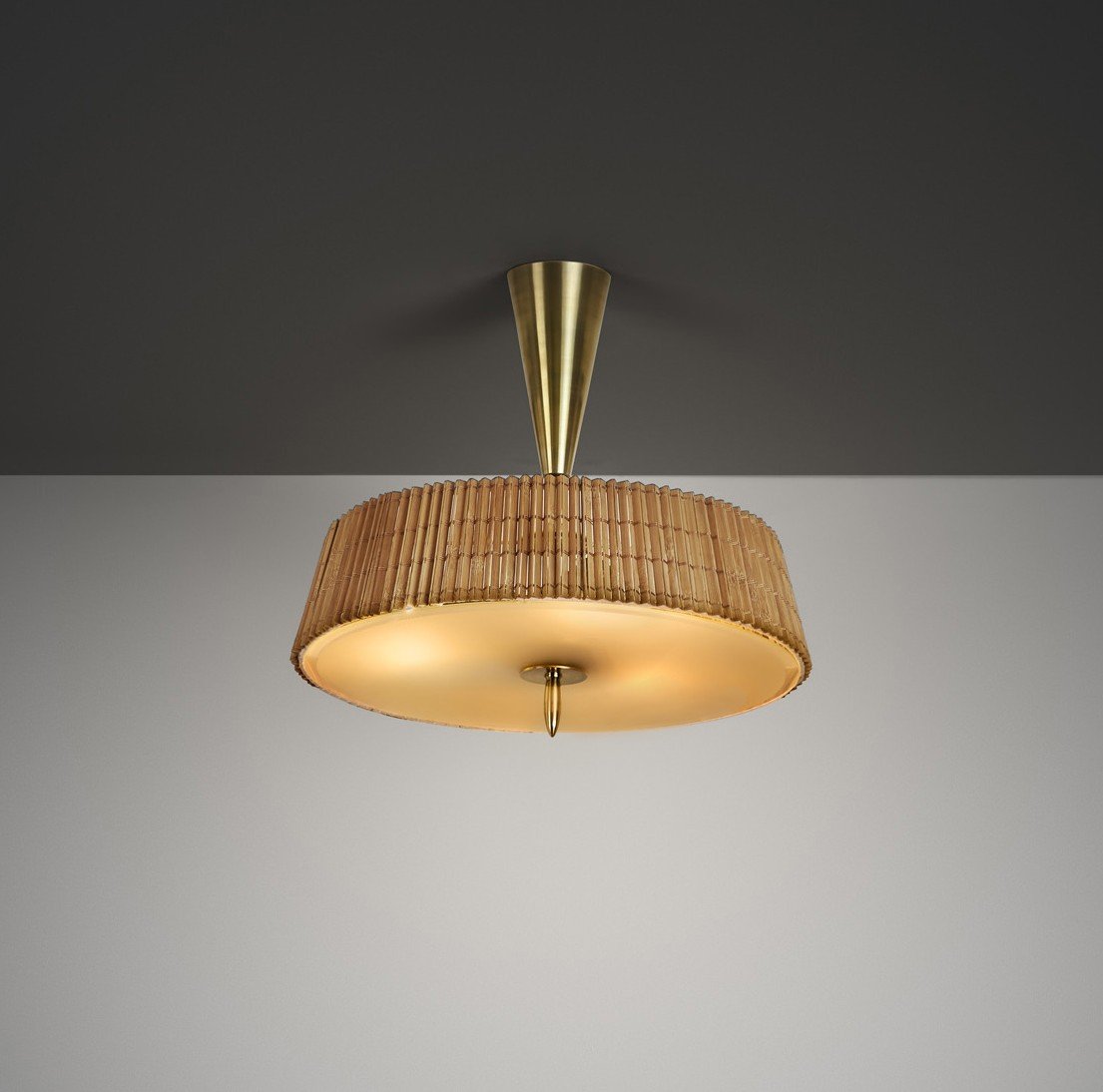
Designers working in Finland during the mid-20th century aimed to create lighting that felt modern without becoming cold or overly industrial. Clean silhouettes were combined with warm materials such as brass, wood, and woven elements in order to soften architectural interiors. Rather than relying on excess, emphasis was placed on structure, balance, and the way light interacted with surfaces. The goal was to produce fixtures that served both as functional light sources and as design statements within a room. This ceiling lamp model is made of delicate wooden slats which allow the light to shine through, while giving the fixture a subtle sense of organic texture and symmetry. The material introduces depth and visual warmth, softly diffusing the glow while contrasting with the texture of the smooth brass. The model remains elegant and refined, with a central brass element beneath the shade further offering visual interest to the composition. When turned on, the lamp produces an even and inviting light that works well above a dining table, in a living room, or in a more intimate sitting area. Its proportions make it suitable for a range of interiors, while the combination of brass and organic material ensures versatility.
In the mid-20th century, Idman Oy played a pivotal role in shaping the Finnish design landscape. The company collaborated with renowned designers and artists, resulting in a portfolio of iconic pieces that continue to be cherished today. This model - with its blend of materials, impeccable craftsmanship, and timeless design - remains a testament to the company's dedication to creating objects of enduring beauty.
Condition:
In good vintage condition. Wear consistent with age and use. The lamp has recently been rewired and reconditioned. Due to the nature and age of the materials, the lamp has some marks, scratches, and discolouration. This lamp is compatible with an E26 / E27 standard fitting. All lighting can be converted for US usage.
Dimensions:
16.34 in ø × 13.39 in H
41.5 cm ø x 34 cm H
REQUEST PRICE HERE
Price category: 2,500 - 5,000 usd / eur
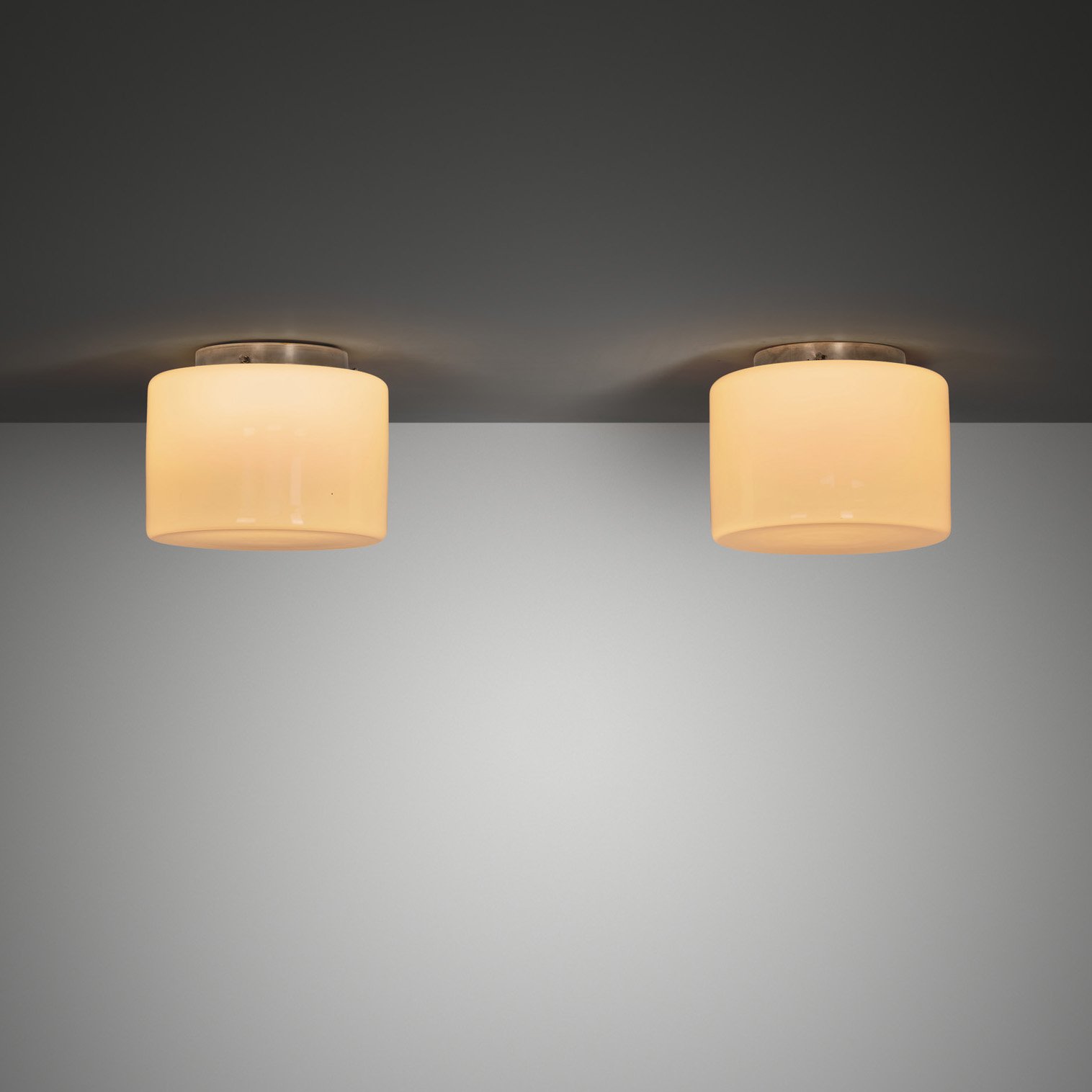
The most famous Finnish industrial designer, Paavo Tynell, came to be known as the “man who illuminated Finland” thanks to his notable lighting designs. A master craftsman himself, Tynell’s models were of a traditional aesthetic with a modern sensibility, mixed with an extensive use of glass and brass as materials.
In the 20th century, he designed a number of iconic lamps that are still sought after today, including these model “2028” milk glass ceiling lamps. This pair embodies the sleek and simple aesthetic that characterised early modern Finnish design. Still, even in the absence of ornamentation or elaborate shapes and forms, there was always an emphasis on interesting materials. Milk glass, appropriately named for its opaque or transparent pure ivory white tone, was first created in Venice in the 16th century, it was known as Lattimo. At that time, the material was widely used for decorative purposes and continued to be popular during the 20th century when it was used as home accents to decorate households. Milk glass was an extremely popular material for lighting fixtures in the 1950s, due in part to its ability to soften and diffuse light, as this pair demonstrates. To complement the glass, nickel-plated brass mounts attach the shades to the ceiling, offering the lamps a cool tone even when unlit. This model has a gentle, round shape that is just as soft as the light it diffuses. Tynell was a master of working with this material combination, and his milk glass ceiling lamps are some of his most sought-after designs to this day.
The 20th century was a time of great innovation in Finnish design, as designers like Tynell pushed the boundaries of what was possible with new materials and manufacturing techniques. At the same time, there was a strong emphasis on simplicity and functionality, as many sought to create objects that were both beautiful and practical, they left an unforgettable mark in the history of light and ambiance.
Condition:
In good vintage condition. Wear consistent with age and use. The lamps have been reconditioned. Due to the nature and age of the materials, items may have marks, scratches, and discolouration. Additionally, minor imperfections may be present on the glass due to manufacturing inconsistencies. All lighting can be converted for US usage.
Dimensions:
11.81 in Ø x 8.66 in H
30 cm Ø x 22 cm H
REQUEST PRICE HERE
Price category: 2,500 - 5,000 usd / eur
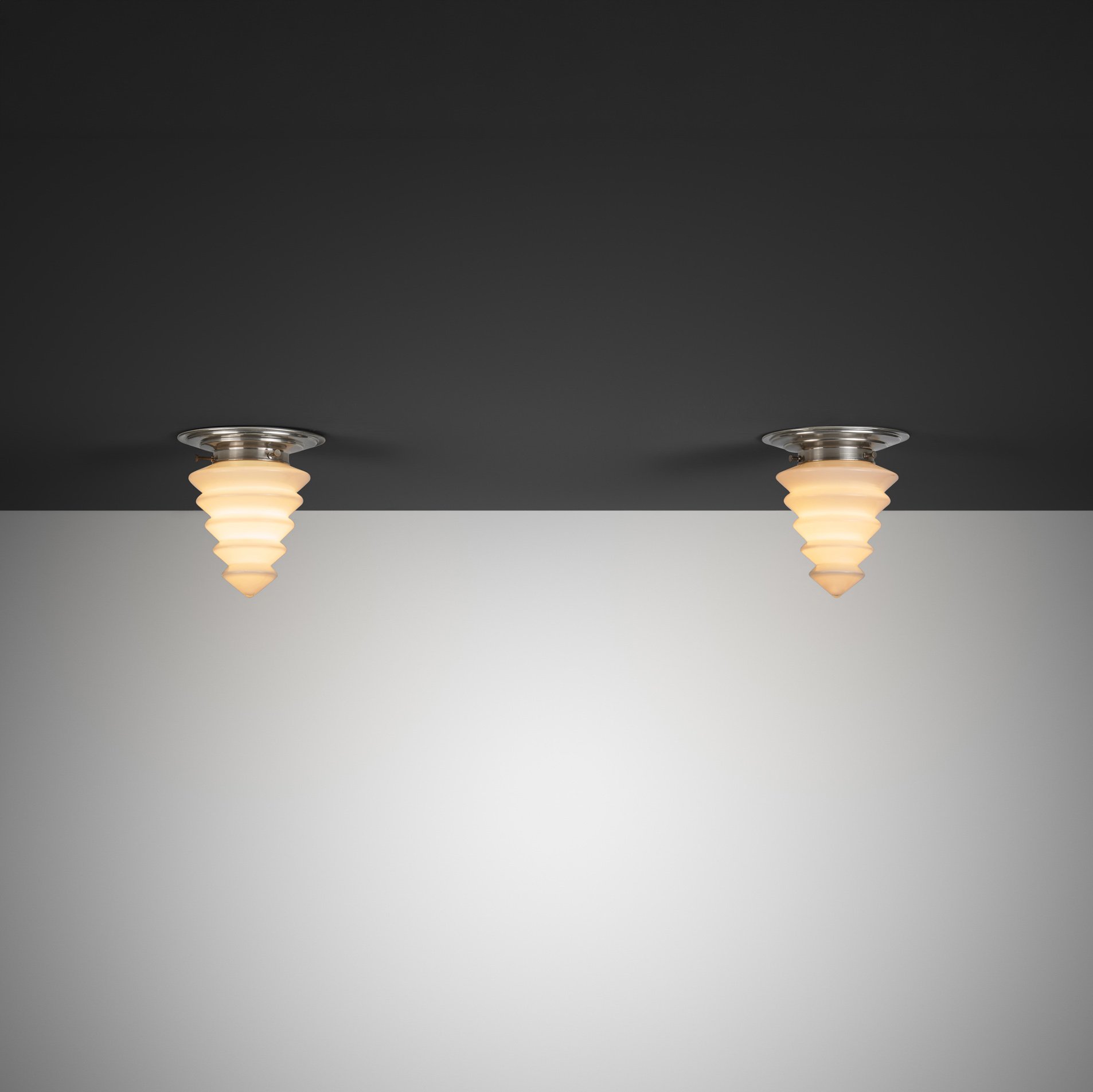
Lighting is a huge part of 20th century design, ranging from the warm, low light of a candle to the bright overhead glow of a ceiling light. This GISO ceiling lamp pair is a unique piece of functionalist design with the unmistakeable touches of Art Deco.
What sets this ceiling lamp model apart is its so-called stepped design, reminiscent of a wedding cake or Christmas tree. The term "stepped design" refers to the distinct arrangement of layers or steps that gradually rise, creating a tiered effect. In the context of this model, these steps in the glass shade and the metal canopy produce a visually striking aesthetic. The layered glass creates a subtle play of light and shadow, adding depth and dimension to the ambient illumination it provides. Furthermore, the stepped design on lamps serves a dual purpose: firstly, it adds a touch of architectural interest, turning a functional object into a sculptural element in the room. The gradual rise of layers not only contributes to the lamp's visual appeal but also imparts a sense of balance and proportion. Secondly, the stepped arrangement serves to diffuse and distribute light more effectively. This pair captures the enduring appeal of Dutch modern lighting. The minimal construction also speaks to the era’s industrial design ethos: clarity of lines, quality of material, and an avoidance of unnecessary embellishment.
This model stands as a reminder of how 1960s designers favoured geometry and a focus on ambient light, turning utilitarian objects into refined expressions of postwar modernism. For collectors and connoisseurs alike, this pair of lamps stand as both a nod to history and a beacon of timeless style for contemporary interiors
Condition:
In good vintage condition. Wear consistent with age and use. The lamps have recently been rewired and reconditioned. Due to the nature and age of the materials, the lamps may have minor marks, scratches, and discolouration. All lighting can be converted for US usage.
Dimensions:
6.29 in ø x 7.48 in H
16 cm ø x 19 cm H
REQUEST PRICE HERE
Price category: 2,500 - 5,000 usd / eur
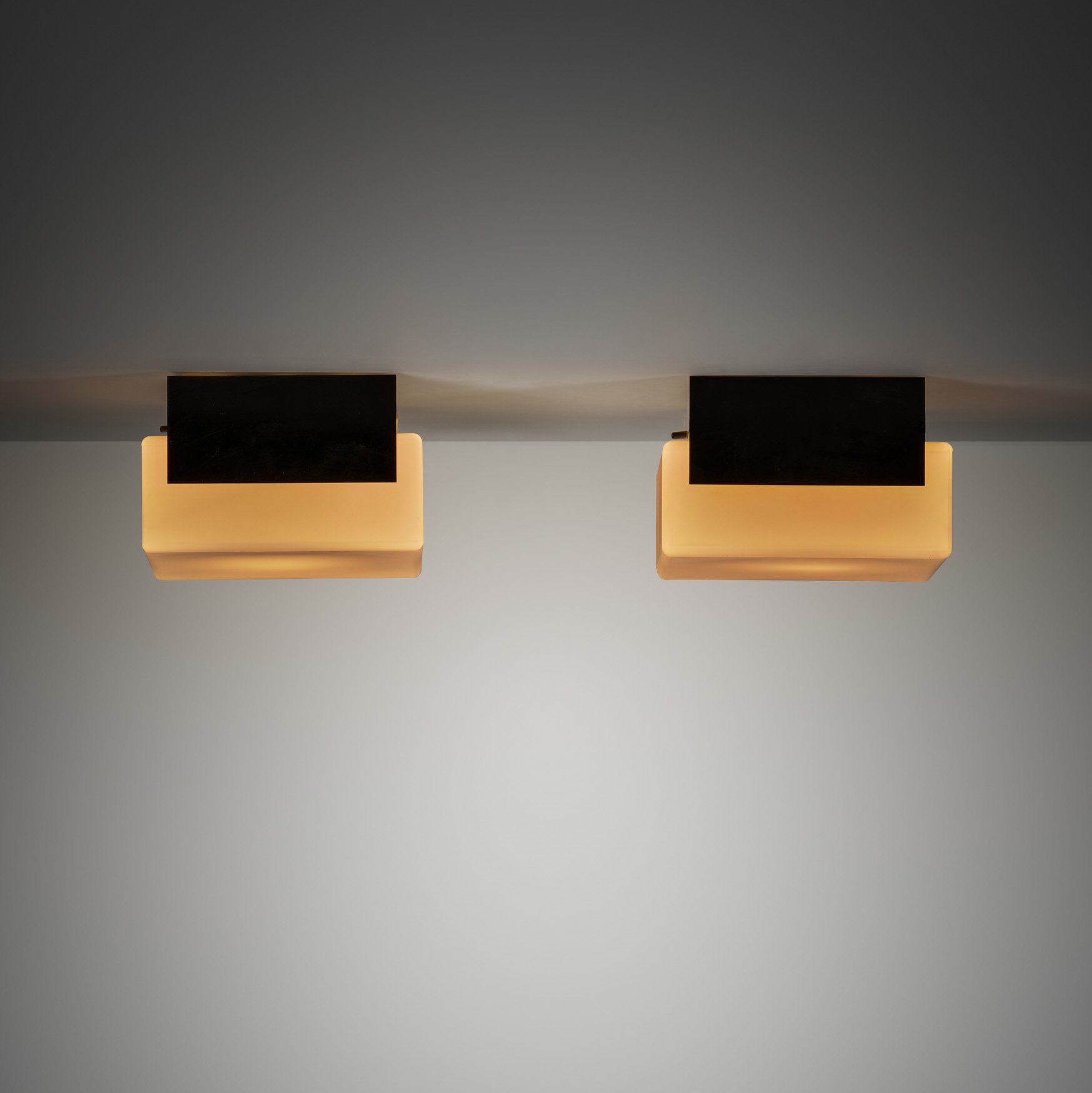
It is easy to dismiss the 1970s as "the decade that taste forgot" yet to overlook its contributions in architecture, furniture design and interior decorating is also a shortcoming. It was the period of transition from Mid-century modernism into Post-modernism, a bridge that these ceiling lamps visually exemplify.
During the 1970s, European lighting design in particular embraced industrial and geometric influences, using materials such as metal and glass to create minimalist yet visually engaging fixtures. These lights exemplify the movement's emphasis on modern materials and streamlined forms. The lights feature square milk glass shades, which provide soft, ambient illumination. This type of glass ensures the light is diffused gently, creating a warm, inviting atmosphere, while the sleek look of the black metal adds a touch of chromatic and textural contrast. The square, boxy shape of the lamps speak to the geometric influence of mid-century modern design, and highlights the uniqueness of the pair. The combination of milk glass and metal ensures that these lights not only serve as striking visual accents, but they maintain their functionality and appeal over time through the durability and timelessness of the materials. Thanks to the compact flush mount design, these lamps can integrate into a variety of interior settings.
These ceiling lights continue to embody the qualities of mid-century modernism that has made it one of the most sought after design movements to this day. The clean lines and understated look further ensure that the pair maintains its relevance and beauty for decades to come.
Condition:
In good vintage condition. Wear consistent with age and use.
Dimensions:
9.64 in W x 9.84 in D x 6.29 in H
24.5 cm W x 25 cm D x 16 cm H
REQUEST PRICE HERE
Price category: 2,500 - 5,000 usd / eur
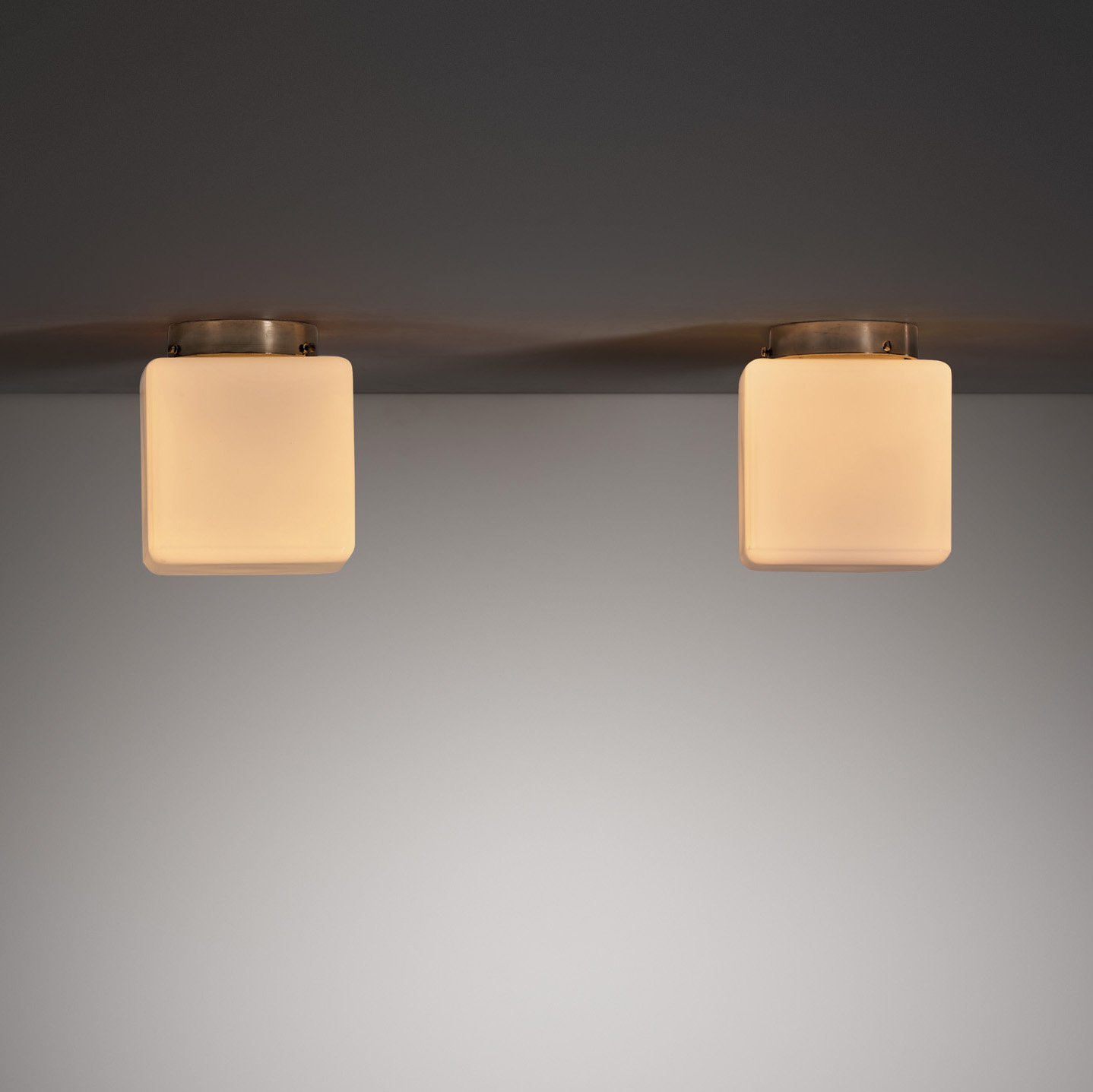
The most famous Finnish industrial designer, Paavo Tynell came to be known as the “man who illuminated Finland” thanks to his notable lighting designs. A master craftsman himself, Tynell’s designs were born from a traditional aesthetic with a modern sensibility, mixed with an extensive use of glass and brass as material.
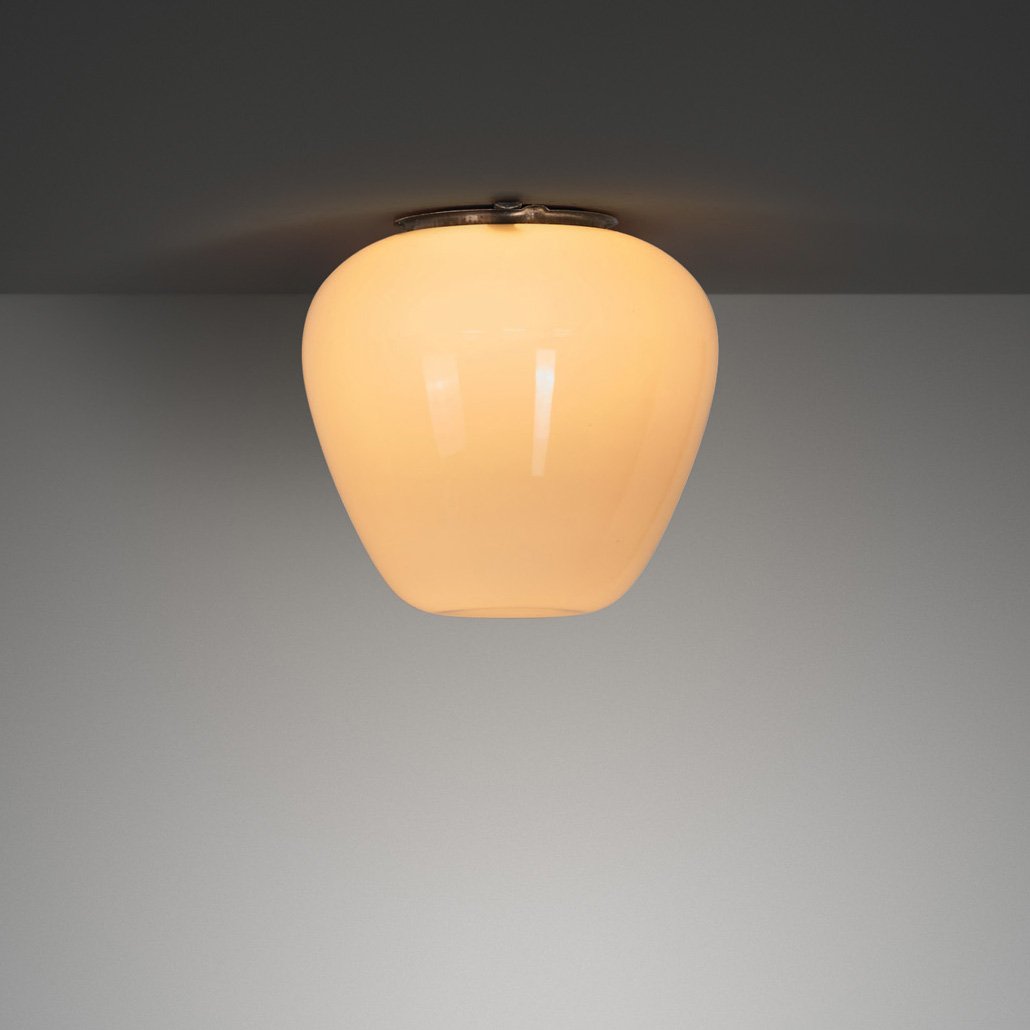
In the early to mid-20th century, he designed a number of iconic lamps that are still sought after today, including this pair of model “2025 A” milk glass ceiling lamps. This pair embodies the sleek and simple aesthetic that characterised early modern Finnish design. Still, even in the absence of ornamentation or elaborate shapes and forms, there was always an emphasis on interesting materials. Milk glass, appropriately named for its opaque or transparent pure ivory white tone, was first created in Venice in the 16th century, known as Lattimo. At that time, it was widely used for decorative purposes and continued to be popular during the 20th century when the material was used to decorate households as home accents. To complement the glass material, the shades feature a bold geometric shape, which is the main visual point of interest. Nickel-plated brass ceiling caps connect the shades to the ceiling, offering the lamps a cool sheen even when unlit. The circular caps balance out the angular shape of the shades. Milk glass was a popular material for lighting fixtures in the mid-20th century, due in part to its ability to soften and diffuse light, as this model demonstrates. Tynell was a master of working with this material, and his milk glass lamps are some of his most sought-after designs.
The 20th century was a time of great innovation in Finnish design, as creatives like Tynell pushed the boundaries of what was possible with new materials and manufacturing techniques. During this time, there was a strong emphasis on simplicity and functionality, leading to more designers creating pieces like this model. Both beautiful and practical, model “2025 A” left an unforgettable mark in the history of light and ambiance.
Condition:
In good vintage condition. Wear consistent with age and use. The lamps have recently been rewired and reconditioned. Imperfections on the glass may be present due to age and manufacturing inconsistencies. Additionally, due to the nature and age of the metal elements, some marks, scratches, and discolouration may be present.
This lamp is compatible with an E26 / E27 (standard) fitting. All lighting can be converted for US usage.
Dimensions:
5.90 in W x 5.90 in D x 7.28 in H
15 cm W x 15 cm D x 18.5 cm H
REQUEST PRICE HERE
Price category: 2,500 - 5,000 usd / eur
Gunnel Nyman (19 September 1909 – 7 October 1948) was a Finnish glass and metal artist, and one of the leading figures of modern Finnish glass design. During the post-war era she transitioned to glassware and collaborated or worked on commission with various glassworks including Riihimäki, Karhula-Iittala and Nuutajärvi. She was also an advocate of early mass-produced glassware, with her work featuring organic lines and focusing on the characteristics of glass itself.
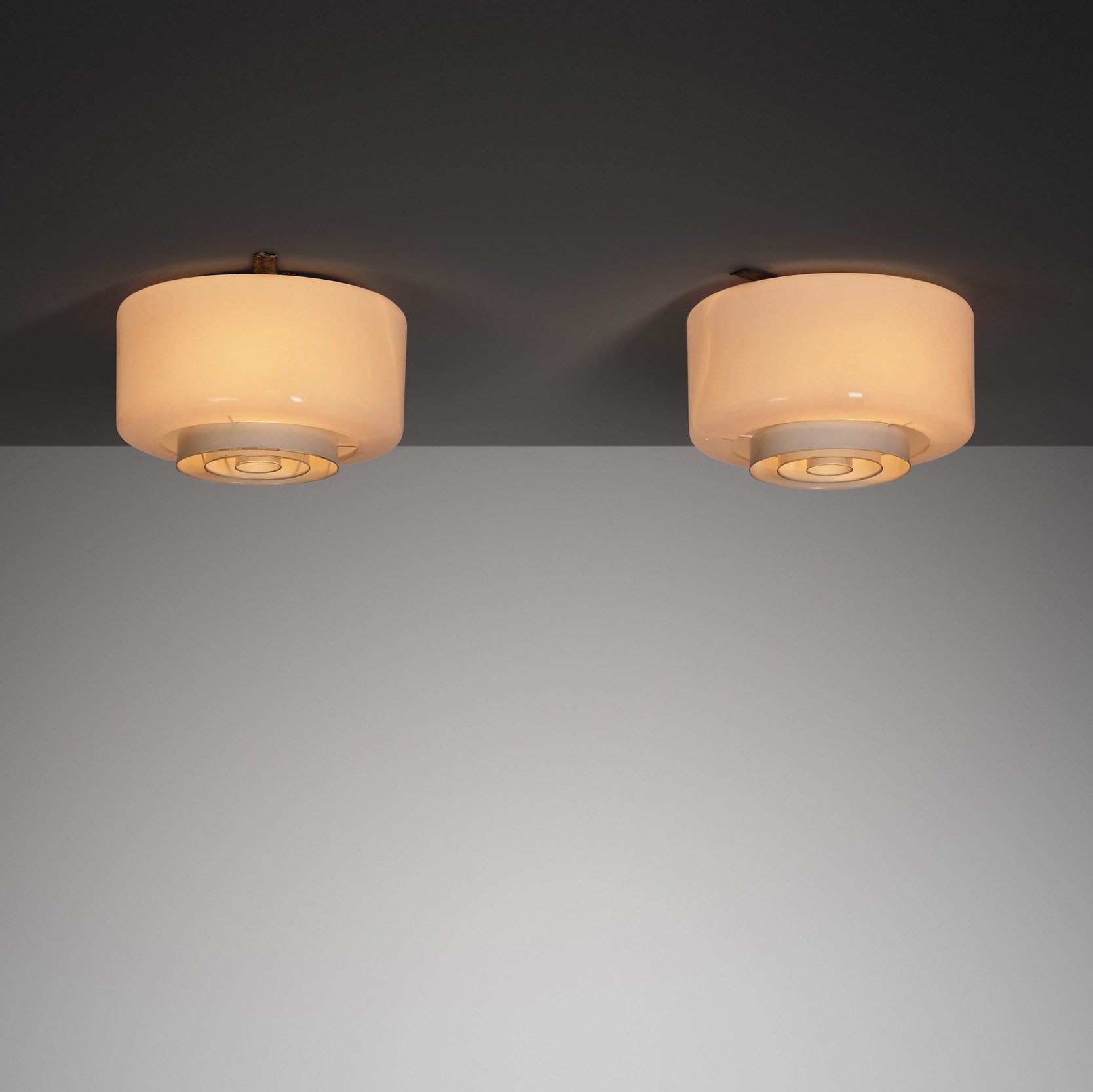
This ceiling lamp embodies the sleek and simple aesthetic that characterised Finnish design in the 1950s. Even in the absence of ornamentation, there was always an emphasis on interesting materials. Milk glass, appropriately named for its opaque or transparent ivory white tone, was first created in Venice in the 16th century, and was known as Lattimo. At that time, it was widely used for decorative purposes and continued to be popular during the 20th century, when the material was used for home accents to decorate households. This lamp has an eye-catching rounded cone shape, with a blunted end and soft edges. Thanks to the concealed ceiling holder, the piece is flush mounted, staying close to the ceiling and allowing the glass shade to remain the focal point of the design. Nyman was a master of working with milk glass, and her lamps of this material are some of her most sought-after designs. She considered material an essential factor in design. Form, proportion and decoration were only there to enhance the properties inherent in the material. The Finnish design blueprint that was set during the first few decades of the 1900s is based on characteristics that can be traced in this lamp model: functionality, an understated, unornamented design created from high quality materials - and most importantly, by a skilled craftsperson.
Although Gunnel Nyman’s career was cut short by an untimely death, she had enough time to give a new direction to Finnish glass design. At the Milan Triennial in 1951, Nyman was awarded the gold medal for glass posthumously.
Condition:
In good vintage condition. Wear consistent with age and use. The lamp has recently been reconditioned and rewired. Minor marks, scratches and imperfections on the glass may be present due to manufacturing inconsistencies and the age of the item. This lamp is compatible with an E(27) fitting. Due to the age of the lamp we recommend using LED bulbs.
Dimensions:
11.82 in ⌀ x 10.83 in H
30 cm ⌀ x 27.5 cm H
REQUEST PRICE HERE
Price category: 5,000 - 7,500 usd / eur
Finnish mid-century design is characterised by simple, elegant forms - which Paavo Tynell was a master of. Reflective of Finnish culture, he embraced timeless beauty, sustainability and a deep connection to the natural world. Tynell is one of Finland’s best known and most collected mid-century designers. He was a pioneer of European lighting design and a founder of the first lighting manufacturing company in Finland, Taito Oy.
Functionality and a pared down style are key principles for the Finnish icon. In the 1960s, he designed a number of iconic lamps that are still sought after today, including this opal glass ceiling lamp with the model number “A2-7”. With its sleek and simple aesthetic, and in the absence of heavy ornamentation, the emphasis falls on materials. Opal glass, appropriately named for its opaque or white tone, was first created by glass blowing houses in Venice in the 16th century. At that time, it was widely used for decorative purposes but continued to be popular during the 20th century. Milk glass was an extremely popular material for lighting fixtures in the mid-20th century, due in part to its ability to soften and diffuse light, as this pair demonstrates. To complement the model, three metal rings come together to create a distinctive element placed at the opening of the shade. Through its white colour, this detail provides an interesting visual point without overwhelming the design.
The 1960s was a decade of great innovation in Finnish design, as designers like Tynell pushed the boundaries of what was possible with new materials and manufacturing techniques. Tynell was a master of working with opal glass, and his lamps of this material are some of his most sought-after designs.
Condition:
In good vintage condition. Wear consistent with age and use. The lights have recently been rewired and reconditioned. Due to the nature and age of the materials, the items may have marks, scratches, and discolouration. Imperfections on the outer glass may be present due to the age of the material and manufacturing inconsistencies. The lamps are compatible with an E26 / E27 (standard) fittings. All lighting can be converted for US usage.
Dimensions:
9.64 in ⌀ x 5.31 in H
24.5 cm ⌀ x 13.5 cm H
About the designer:
Paavo Tynell (1890-1973) was an industrial designer, known as the great pioneer of Finnish lighting design and fondly dubbed as “the man who illuminated Finland”.
Tynell was one of the founders and chief designers of Taito Oy – the first industrial producer of lighting fixtures in Finland. With the innovation of electricity in the beginning of the 20th century, Taito Oy and Tynell expanded the thinking and manufacturing of modern lighting solutions in Europe and abroad.
Paavo Tynell rose to prominence in the 1930s and 40s where he collaborated with some of the most renowned Finnish architects, Alvar Aalto being the most notable one. Working to incorporate artificial lighting into modern environments, Tynell’s company Taito Oy produced fixtures for all of Alvar Aalto’s major projects including the Paimio Sanatorium and the Viipuri Library.
Tynell was especially appraised through his involvement with the Finland House, a design atelier in New York that showcased the work of Finnish designers and craftspeople. His elegant brass designs became an instant success in North America, and he began creating lighting designs for the prestigious American company Lightolier.
A master craftsman himself, Tynell’s designs were derivative of a traditional aesthetic with a modern sensibility, mixed with an extensive use of perforated and polished brass as material. Marked by delicacy and softness, his most famous forms in lightning echo the structures of nature; he adroitly created sculptural shapes reminiscent of the branches of trees, swirling snowflakes and seashells.
REQUEST PRICE HERE
Price category: 2,500 - 5,000 usd / eur
Sähköliikkeiden Oy was a Finnish lighting manufacturer founded in the mid-1940s, and produced practical domestic lighting during a period when design in Finland was becoming increasingly focused on clarity and function rather than ornament. Their work sits alongside the broader mid-century Scandinavian approach, where lighting was treated as part of everyday architecture rather than exclusively decoration.
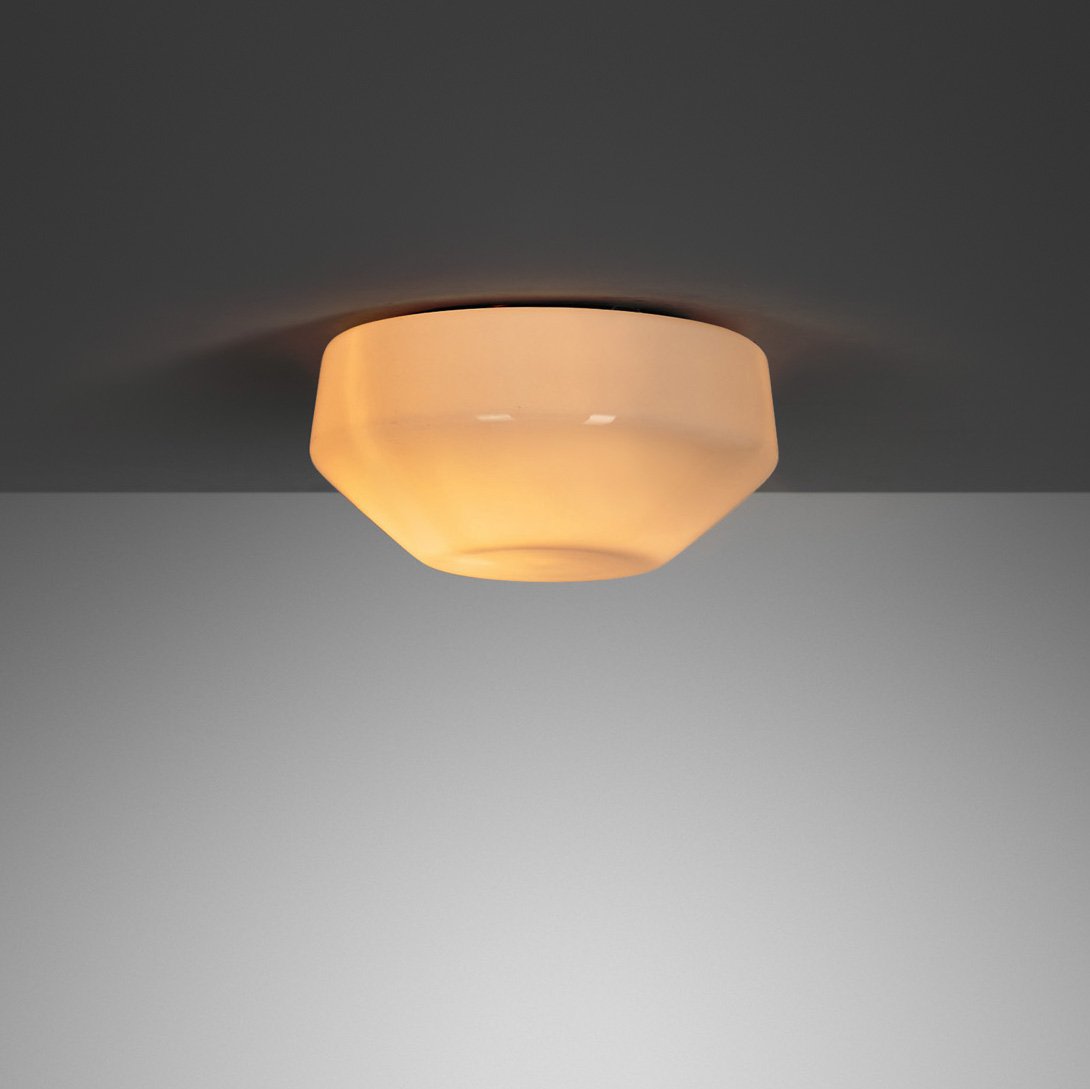
This model “1010” ceiling lamp follows that logic thanks to its compact, flush-mounted structure that sits close to the ceiling. The form is built around an opal glass diffuser that has a slightly conical and rounded profile that gives it subtle depth without becoming visually heavy. The glass conceals the bulb while spreading light evenly across the surrounding area. The mounting system remains discreet, allowing the focus to stay on the glass form itself rather than on visible hardware or detailing. The use of opal glass is central to the piece. The diffuser softens the glow and disperses it, creating a more ambient and balanced illumination. The relatively small diameter and shallow projection also mean it can be used in tighter spaces without disrupting the proportions of the room.
Visually, the "1010" is defined by its simplicity and sleek look. The rounded geometry of the glass gives it a calm, almost architectural presence, while the lack of ornament keeps it from feeling dated or overwhelming. The connection to mid-century Finnish design is clear in its restraint and practicality, making it a great versatile choice.
Condition:
In good vintage condition. Wear consistent with age and use. The lamp has recently been rewired and reconditioned. Minor marks. Due to the nature and age of the materials, the item may have scratches, and discolouration. Additionally, the glass may have imperfections due to manufacturing inconsistencies. This lamp is compatible with an E26 / E27 (standard) fitting. All lighting can be converted for US usage.
Dimensions:
9.84 in Ø x 5.32 in H
25 cm Ø x 13.5 cm H

REQUEST PRICE HERE
Price category: 9,000 - 12,500 usd / eur
By the 1950s, Finland’s international reputation for great design was established, thanks in no small part to the work of Paavo Tynell. He was the most famous Finnish industrial designer and came to be known as “the man who illuminated Finland”, thanks to his notable lighting models. As a master craftsman, his designs were inspired by a traditional aesthetic with a modern sensibility.
Tynell’s ceiling lamp series that this piece belongs to merge together simple shapes and sculptural elements. From the 1930s through the 1950s, he designed a number of iconic lamps that are still sought after today, including these “80112” milk glass ceiling lamps. The pieces embody the sleek and simple aesthetic that characterised Finnish lighting design of the mid-century period. Still, even in the absence of ornamentation, there was a deep emphasis on great materials. Milk glass, appropriately named for its opaque or transparent pure ivory white tone, was first created in Venice in the 16th century, known as Lattimo. At that time, it was widely used for decorative purposes and continued to be popular during the 20th century, when the material was used for constructing home accents. This lamp model has an eye-catching blunted cone shape with a strong presence sticking out - quite literally. Still, the edges are soft, creating an organic shape. Thanks to the concealed aluminium ceiling holders, these lamps are flush mounted without any exposed parts but the glass shades. Tynell was a master of working with milk glass, and these models are some of his most sought-after designs.
The mid-century period was a time of great innovation in Finnish design, as creatives like Tynell and manufacturers like Idman pushed the boundaries of what was possible with new materials and manufacturing techniques. The best qualities of the era’s light fixtures are their atmospheric glow and disciplined, functionalist design. This lamp set embodies these qualities perfectly.
Condition:
In good vintage condition. Wear consistent with age and use. The lamps have recently been rewired and reconditioned. Minor marks, scratches and imperfections on the glass may be present due to manufacturing inconsistencies and the age of the lamps.
Dimensions:
11.61 in ø x 11.81 in H
29.5 cm ø x 30 cm H
REQUEST PRICE HERE
Price category: 2,500 - 5,000 usd / eur
By the 1950s, Finland had established itself as a force of innovation in design. During this era, the country saw the birth of many of its most iconic lighting models; it was a period of consistency in excellence and sophisticated design. Itsu, short for Itä-Suomen Sähkö (eng. Eastern Finland Electricity), was one of the lesser known gems of Finland’s lighting manufacturers. Founded in 1945, after World War II, Itsu produced characteristic models in small quantities, that endure to this day through their masterful design and great quality.
This ceiling light exemplifies that restrained approach through its striking inverted conical shade made from finely pleated fabric. The tightly gathered pleats radiate from the central brass fitting, creating a crisp geometric pattern that gives the large shade a light, even and ethereal appearance. The brass finial anchors the centre of the fixture, while the shade itself covers the ceiling mount, and thus remaining the visual focus. When illuminated, the pleated fabric softens and diffuses the light evenly across its broad surface, producing a warm ambient glow. This quality even further emphasizes the rhythm of the folds. The generous diameter makes the lamp an effective central ceiling fixture, yet its clean silhouette prevents it from overwhelming a space. The combination of fabric and brass, together with the disciplined geometry of the pleated form, demonstrates how simple materials can achieve a refined and highly architectural result.
This ceiling lamp is the perfect way to add a touch of elegance to any space without being overwhelming. Its emphasis on creating comfortable, atmospheric light, as well as its unique character illustrate the qualities for which Finnish mid-century lighting is appreciated.
Condition:
In good vintage condition. Wear consistent with age and use. The lamp has recently been rewired and reconditioned. Due to the nature and age of the materials, the items may have minor marks, scratches, and discolouration. The shade is a later replacement which was custom made by our in-house atelier. All lighting can be converted for US usage.
Dimensions:
27.55 in ø x 11.02 in H
70 cm ø x 28 cm H