
Pair of Opal Glass Seashell Wall Lamps by Glashütte Limburg, Germany 1970s (sold)


Pair of Opal Glass Seashell Wall Lamps by Glashütte Limburg, Germany 1970s (sold)
These Glashütte Limburg wall lamps are a playful example of the rebellion against the sleek minimalism of the mid-century modern style. Early 1970s design accelerated the emergence of bold personal expression with an explosion of new shapes and textures to saturate households.
As difficult as it may be to imagine, this model’s main feature is its material, not its shape. It is made of high-quality, hand-blown luminaire glass, in which a wafer-thin layer of opal glass is enclosed between two crystal glass layers, thus it distributes the light uniformly and pleasantly in the room. The main role of the whimsical seashell design is to highlight the beauty of the three-ply opal glass. In their catalogue, Glashütte Limburg stated that “sand is one of the most precious raw materials in the manufacture of glass – and perhaps this is why we feel a special bond to the seashell.” The satin-matte surface of the hand-blown glass glows beautifully when the light is turned on, creating an ambient mood while also highlighting the sculpted seashell form. Additionally to its aesthetic perks, opal glass has many great qualities. It stands out for its elegance, resistance, and practicality which is why it has steadily been around since the 16th century. As a flush mount, the lamp is close to the wall, connecting to it by a metal backplate that is enamelled white.
Glashütte Limburg is a true manufacturer, where impeccable craftsmanship remained in the focus throughout the past decades. While the designer of this model is unknown, many lamps of the company were designed by the Designabteilung Glashütte Limburg (design department) or Atelier Glashütte Limburg.
SOLD
Condition:
In good vintage condition. Wear consistent with age and use.
Dimensions:
8.26 in W x 3.93 in D x 8.26 in H
21 cm W x 10 cm D x 21 cm H
About the designer:
Three months after the end of the Second World War in August 1945, graduate engineer Dr Walter Heinrich submitted his first plans for setting up a glass-works to the American military authorities in Limburg an der Lahn in Germany. Approval for building the factory was issued rapidly because the country urgently needed all types of glass. As a result, the ground was broken for Glashütte Limburg as early as 28 September 1945.
Initially, the company was called Glasshüttenwerke Limburg GmbH and employed 80 people. The production range covered drinking vessels, mugs and many other types of catering glasses. Production capacities were increased, and Glashütte Limburgbecame Europe’s largest lighting glass specialist within just a few years, employing almost 1000 people.
In 1962, the company succeeded in winning BEGA Gantenbrink-Leuchten OHG, founded in 1945 – which was at that time already one of the largest companies in the German lighting industry – as its ideal partner. The very first lighting catalogue of Glashütte Limburg appeared in 1963.
The Glashütte Limburg company received the state prize for “Gute Form 1982” (good design 1982) and the “Corporate Design Award 1985”. Glashütte Limburg received 160 iF Design Awards in total.


REQUEST PRICE HERE
Price category: 2,500 - 5,000 usd / eur
Paavo Tynell was one of Finland’s most important lighting designers and came to be known as the “man who illuminated Finland”, thanks to his notable lighting models. As a master craftsman, Tynell’s designs combined a traditional aesthetic with a modern sensibility and an extensive use of glass and brass. His work with Idman followed the company’s acquisition of the majority of shares in Taito Oy in 1953, after which Tynell continued designing on a freelance basis.
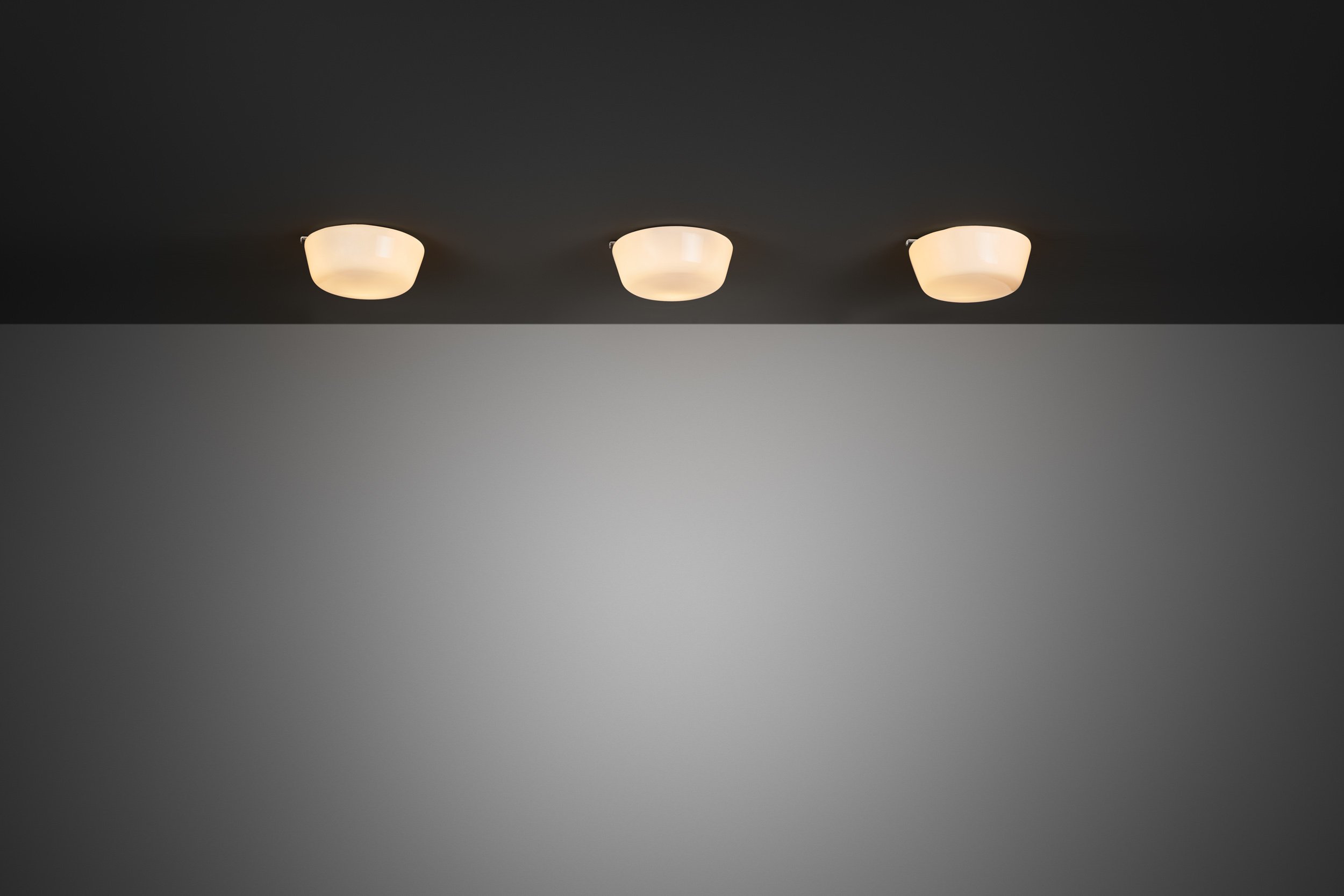
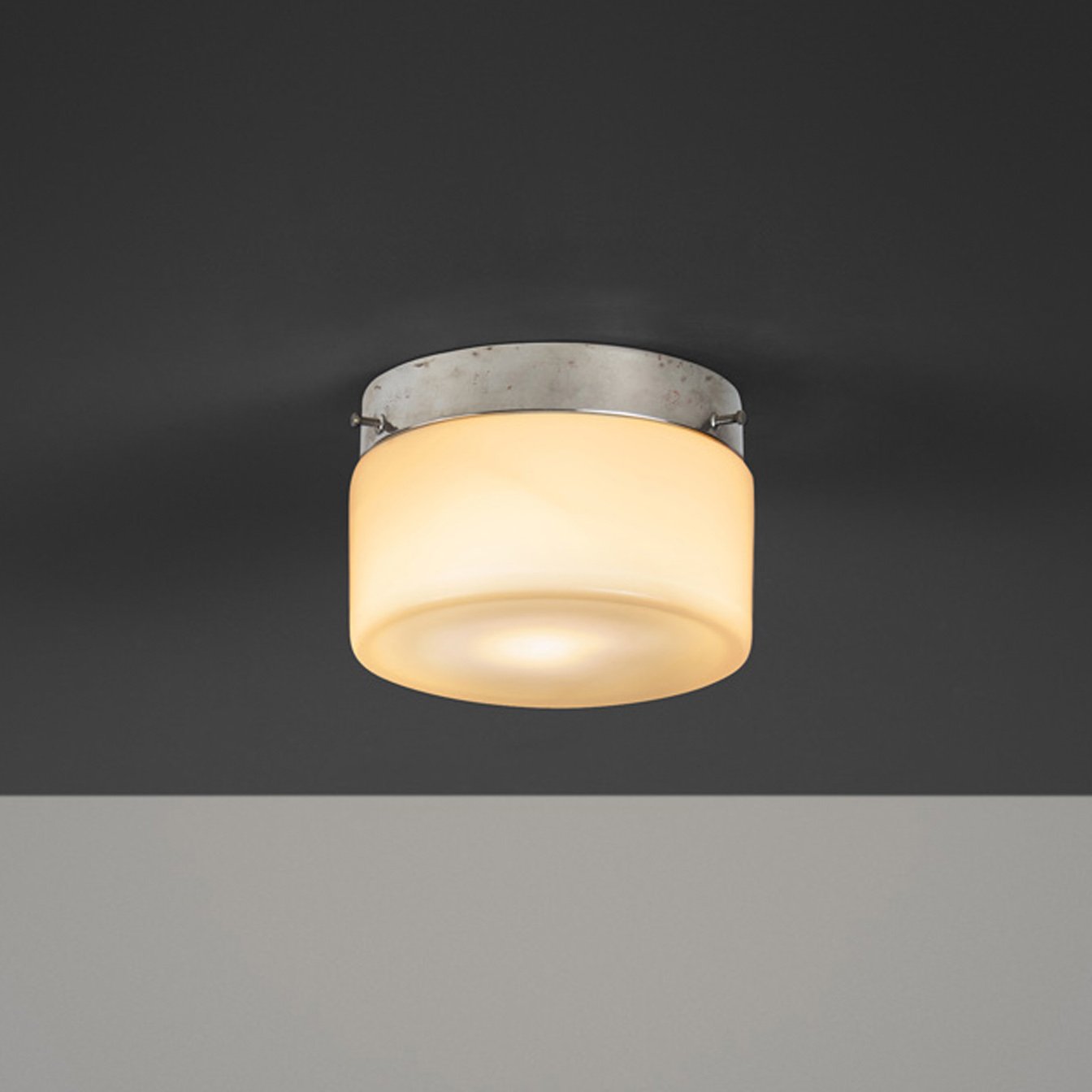
This pair of model “80113” ceiling lamps embodies the sleek and simple aesthetic that characterised Finnish lighting design of the mid-century period. Tynell’s designs merge together simple shapes and carefully considered materials. Each lamp has an eye-catching, shallow milk glass shade with a broad upper section and a softly curved lower profile. The opaque ivory-white glass conceals the light source while allowing the illumination to spread evenly across the entire shade. The edges are just as soft as the light the lamps emit, giving the glass an organic shape despite the simplicity of the design. Thanks to the concealed ceiling holders, the lamps are flush mounted without any prominent exposed parts other than the glass shades. This keeps the construction visually clean and leaves the attention on the material and the quality of the illumination. When lit, the milk glass produces a warm, atmospheric glow and emphasises the smooth curvature of the shades. Used as a pair, the repetition of the same compact form creates an effective rhythm across a ceiling while distributing light over a larger area.
The best qualities of Finnish mid-century light fixtures are their atmospheric glow and disciplined, functional design, and this pair embodies these qualities particularly well. Their construction makes them suitable for hallways, bedrooms or rooms with lower ceilings, while the simple glass forms integrate naturally into the surrounding architecture. Combining Tynell’s sensitivity to light with Idman’s Finnish manufacture, the model “80113” lamps offer an elegant example of his more restrained ceiling designs.
Condition:
In good vintage condition. Wear consistent with age and use. The lamps have recently been reconditioned. There are minor dents and scratches in the metal. Due to the age and nature of the materials, the lamp may have marks, and discolouration. Additional imperfections on the glass may be present due to manufacturing inconsistencies and age. All lighting can be converted for US usage.
Dimensions:
9.84 in ø x 4.72 in H
25 cm ø x 12 cm H