
Pair of “Lata Greven” Armchairs by Carl Malmsten for O.H. Sjögren, Sweden 1950s (sold)
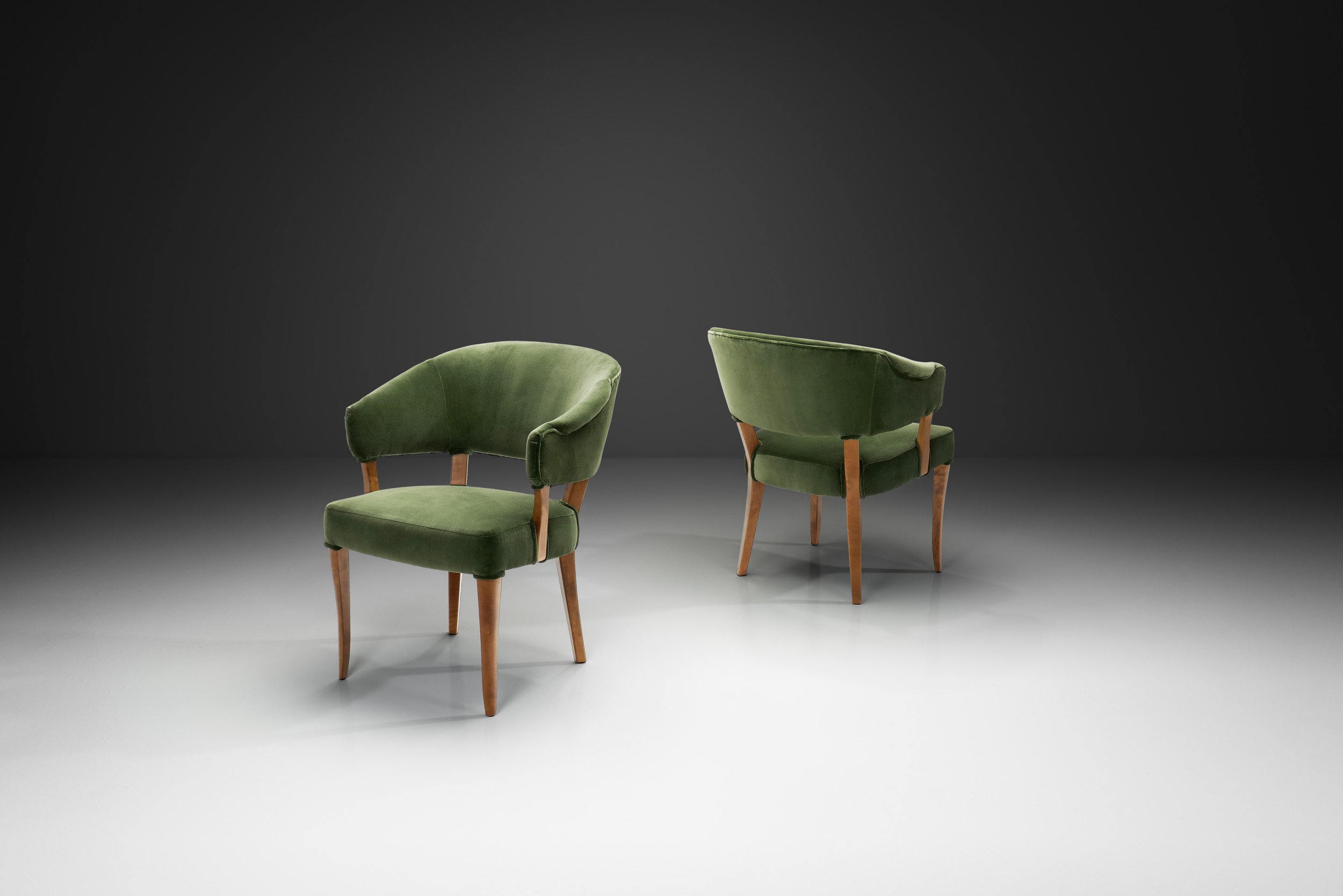
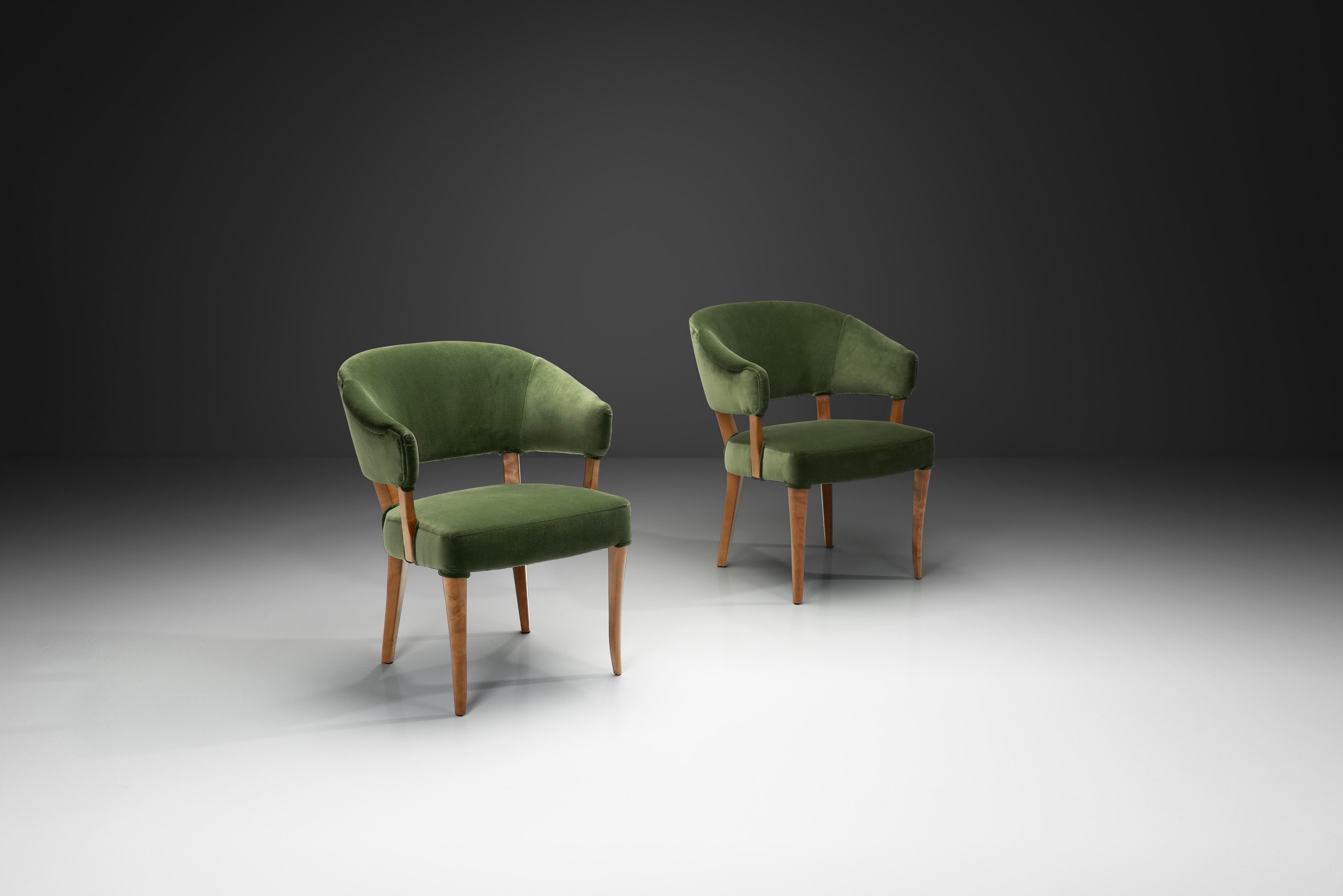
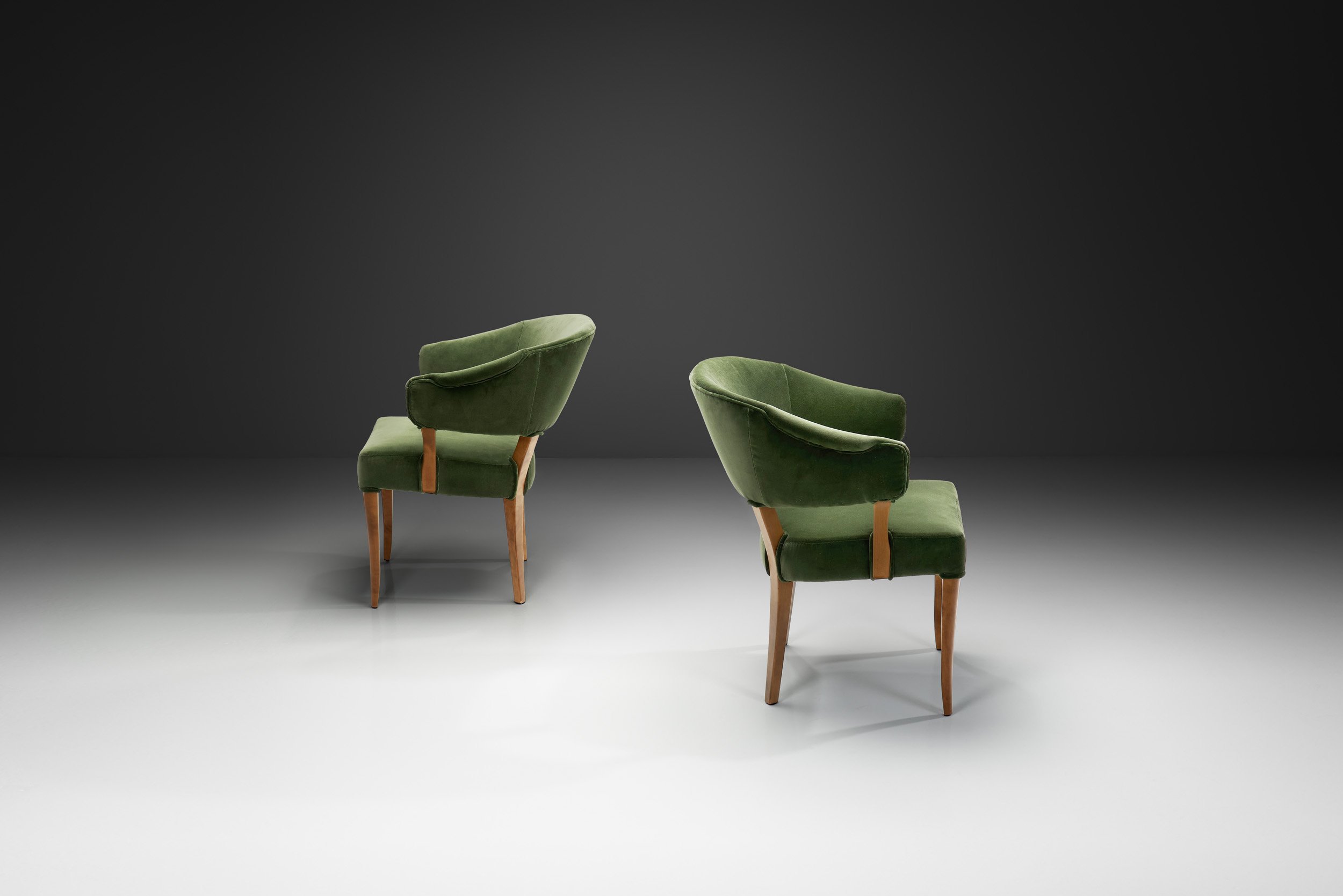
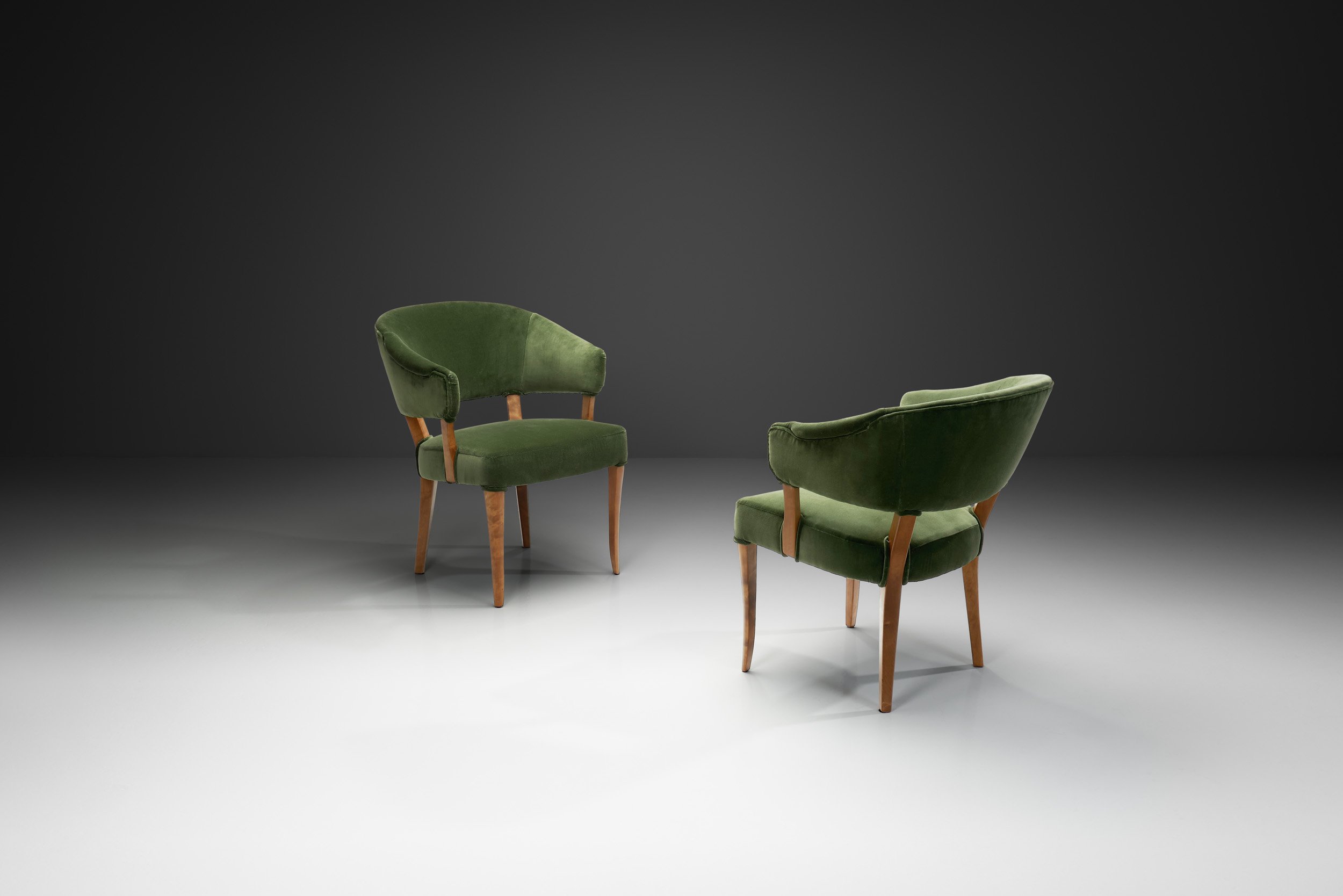
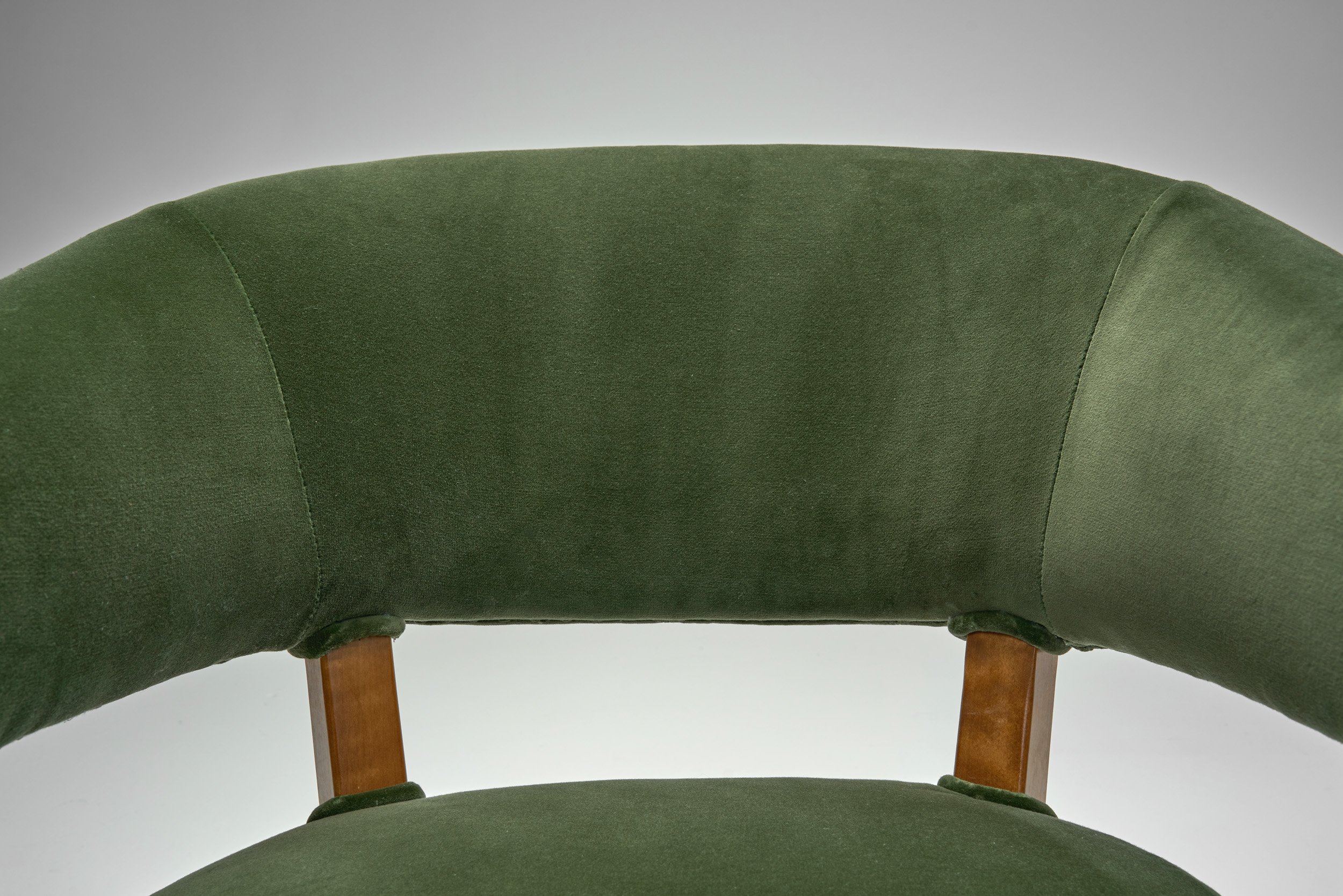
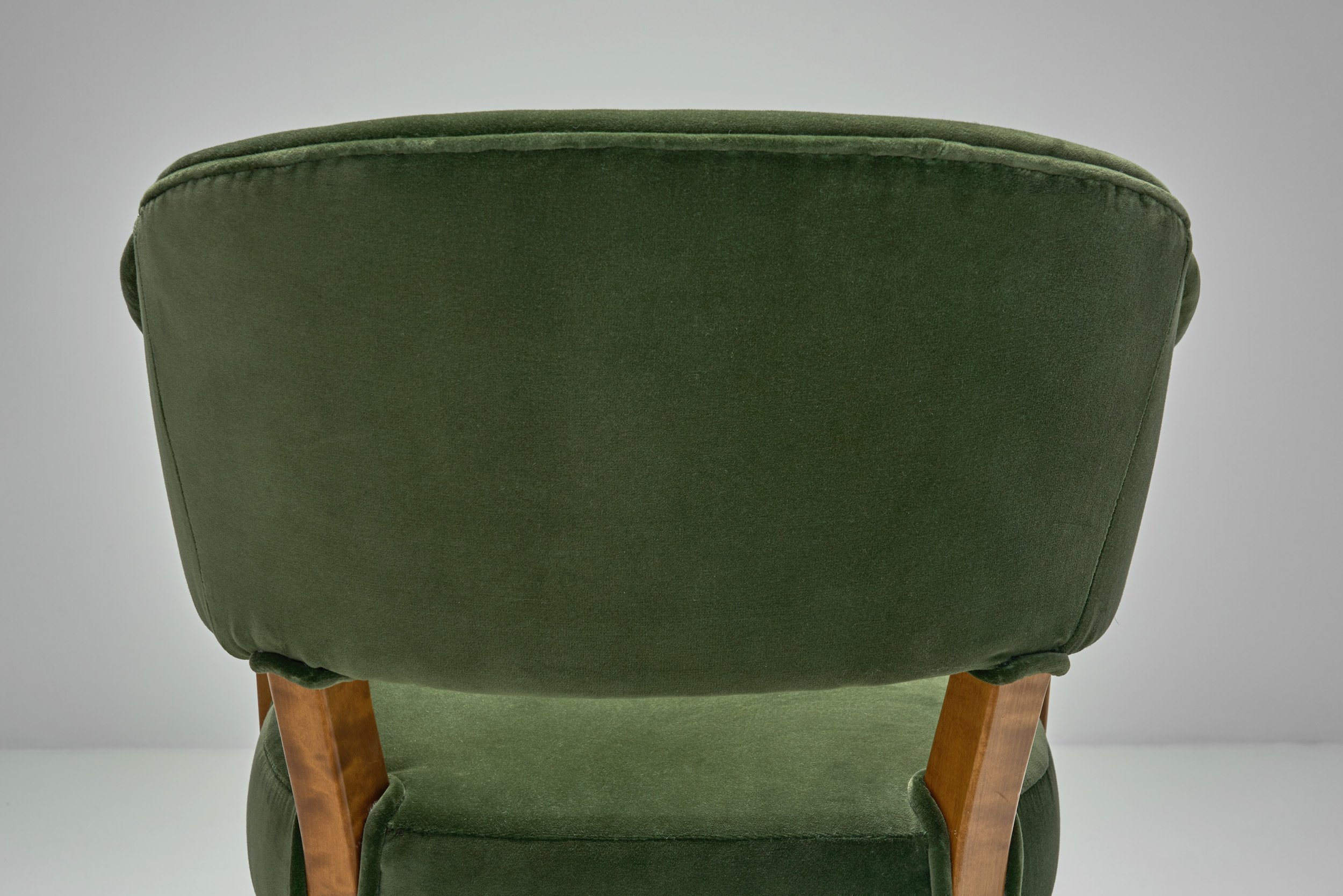
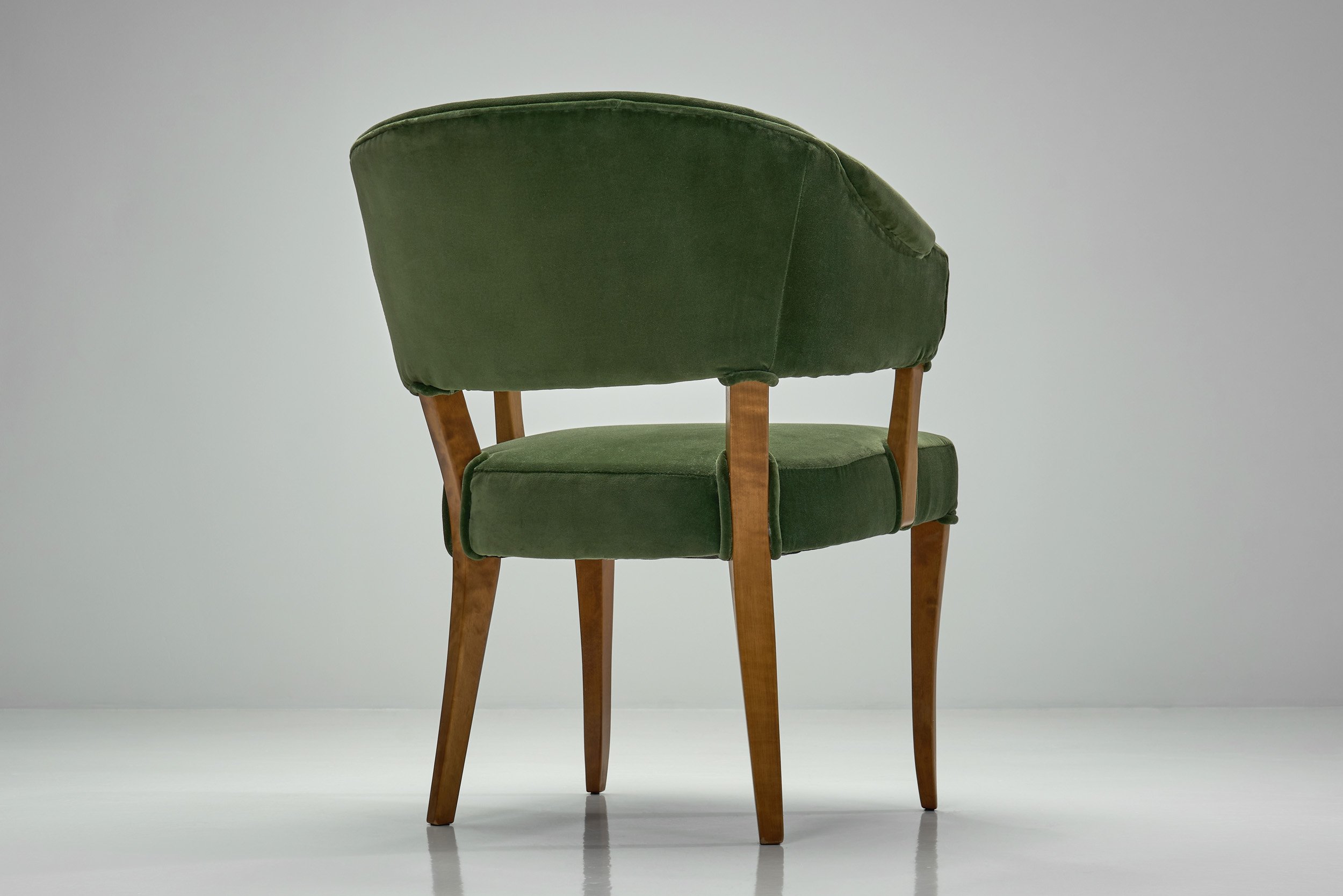
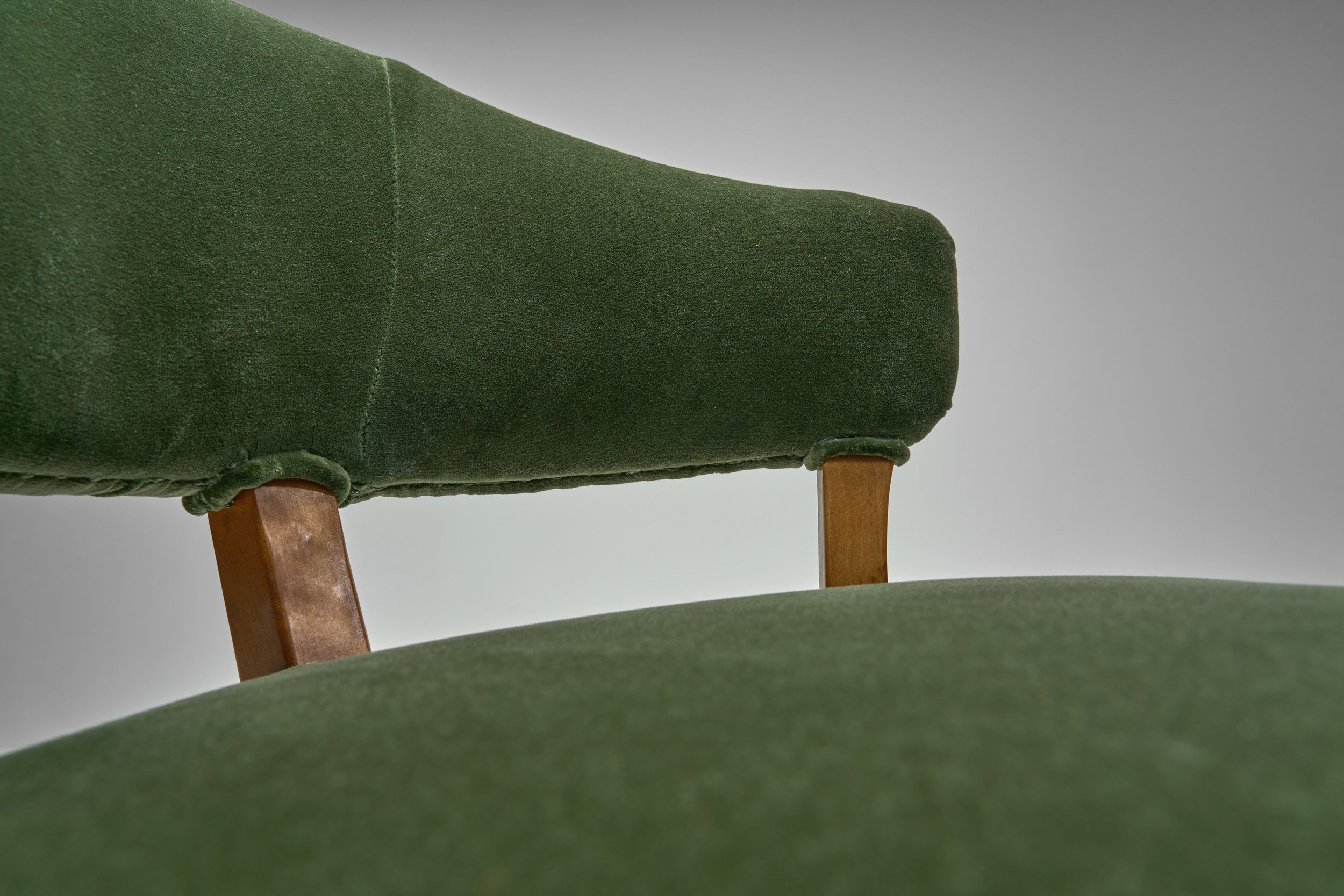
Pair of “Lata Greven” Armchairs by Carl Malmsten for O.H. Sjögren, Sweden 1950s (sold)
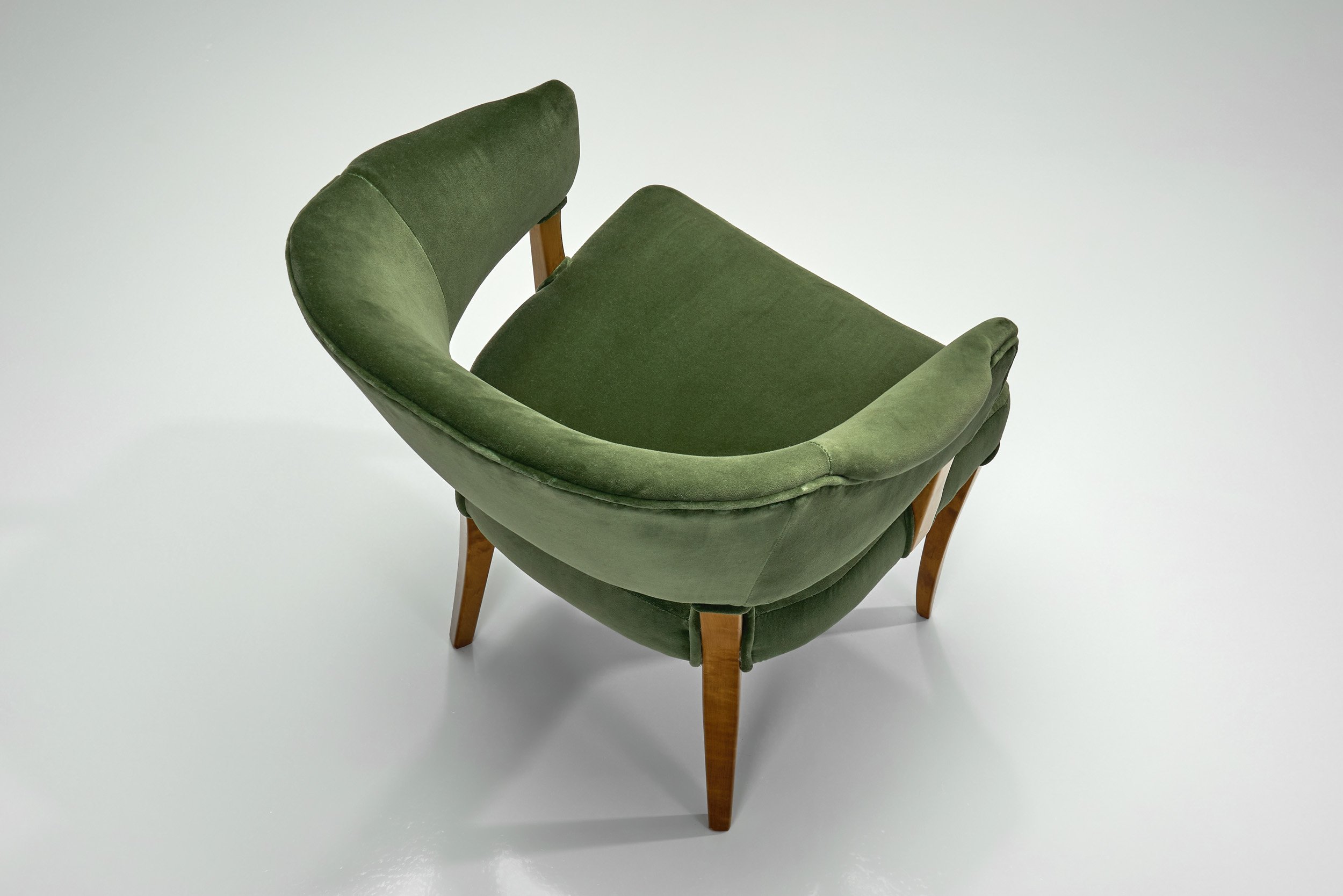
By the 1920s, Carl Malmsten became one of the most sought-after interior and furniture designers in all of Sweden. As a furniture maker he expressed the old, inherited forms as well as the new, bold ideas with his language of design. “Lata Greven”, Swedish for Lazy Count, is Carl Malmsten’s most successful “count chair”. With a klismos-style curved back, this model was produced at O.H. Sjögren, a manufacturer that Malmsten often worked with.
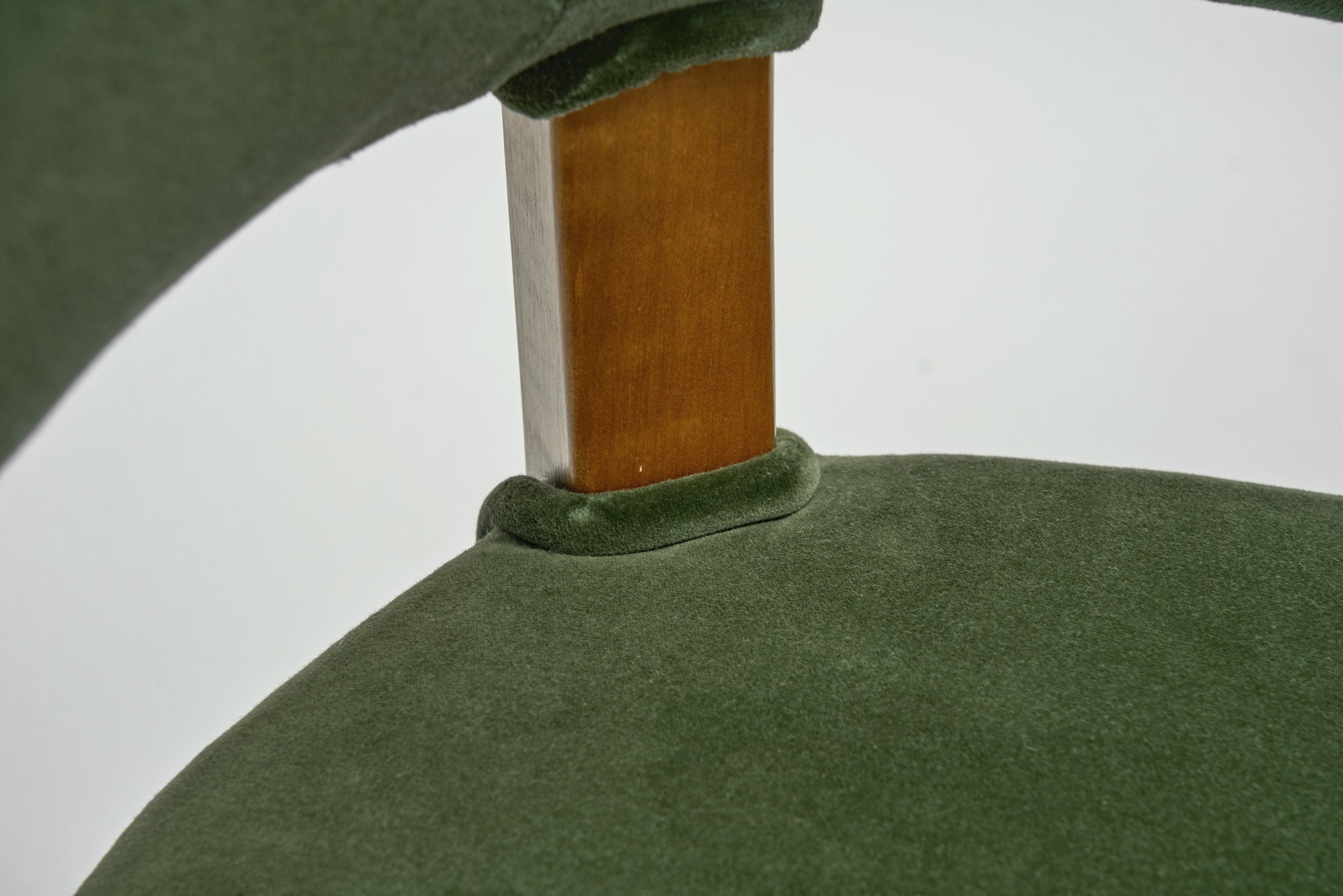
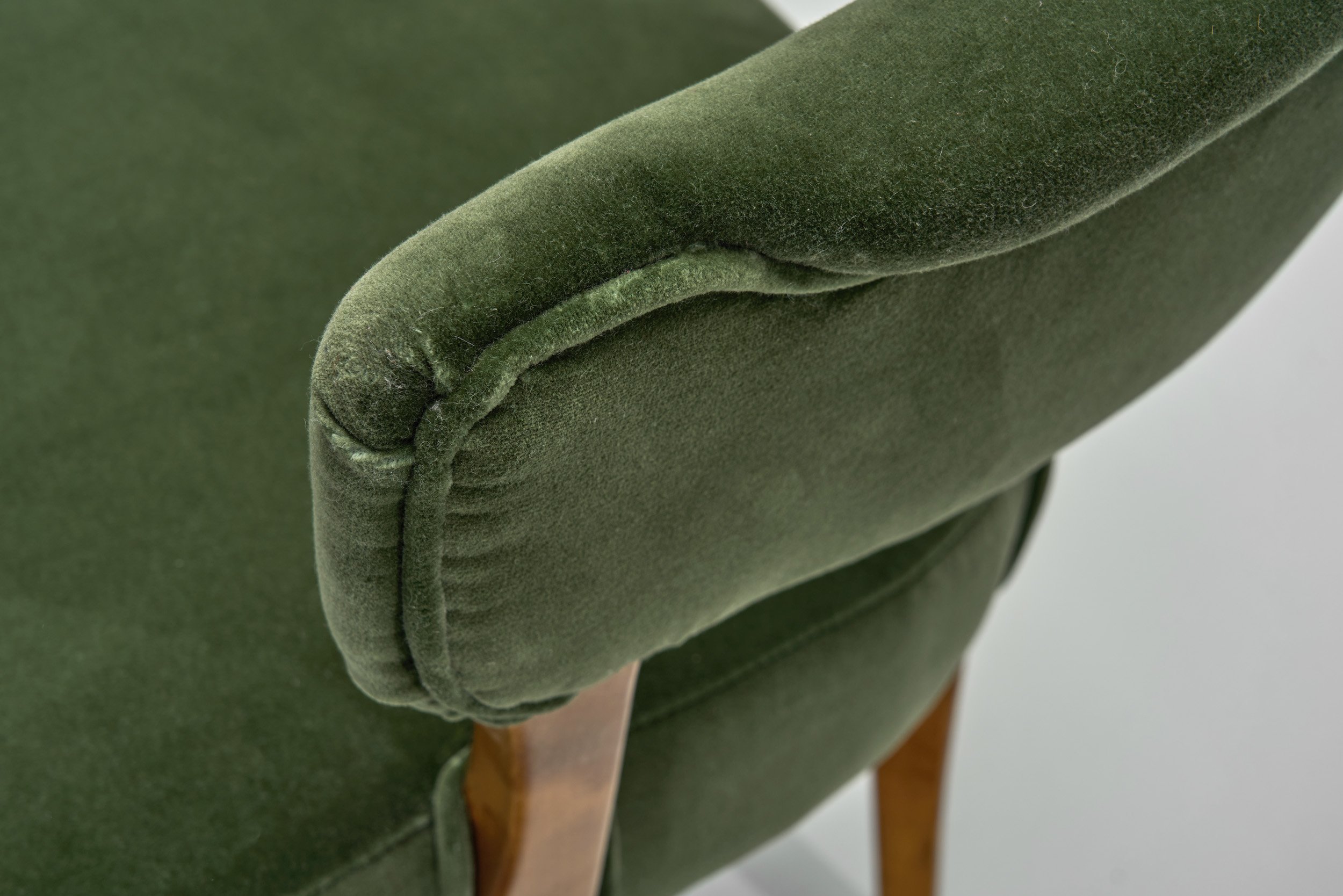
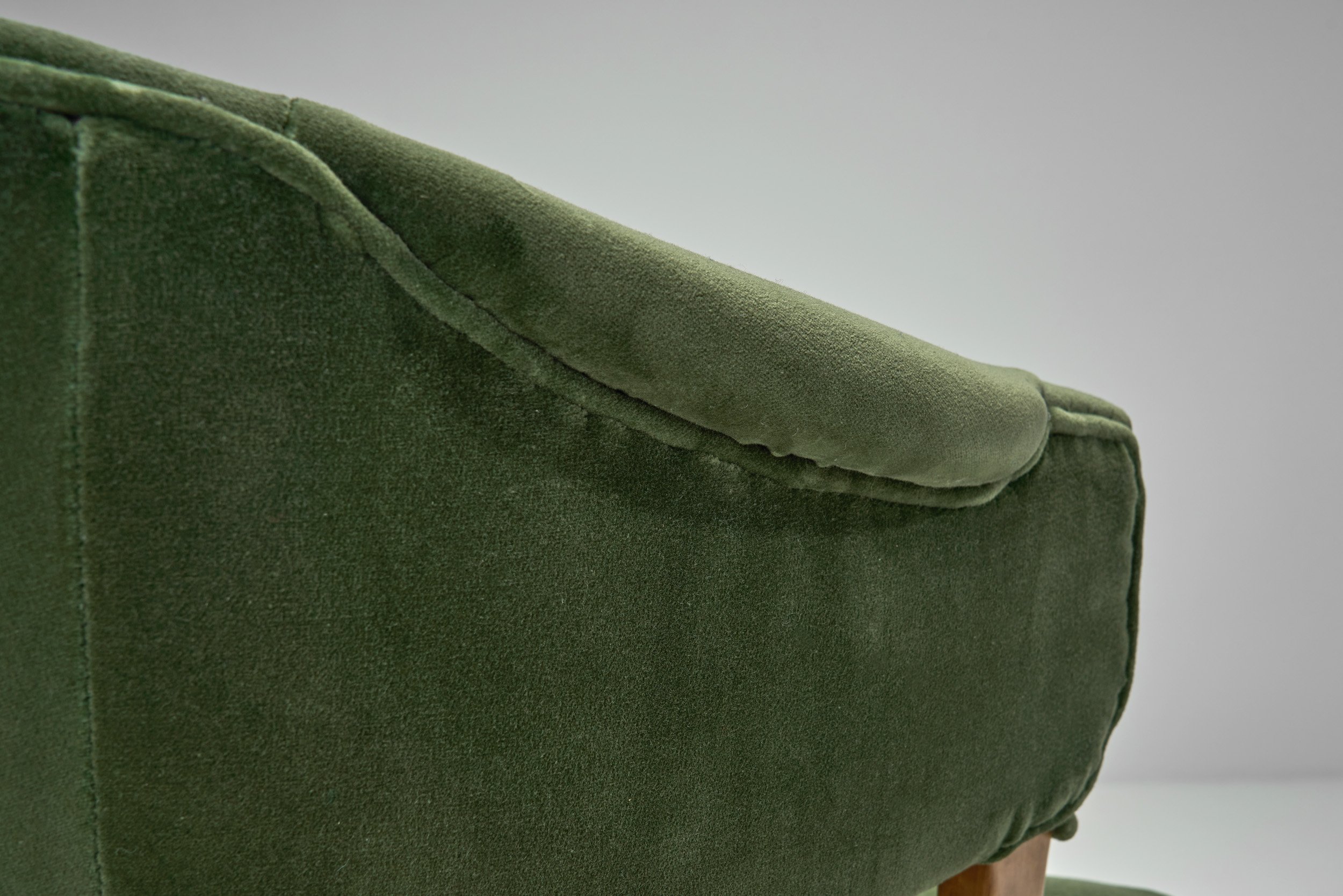
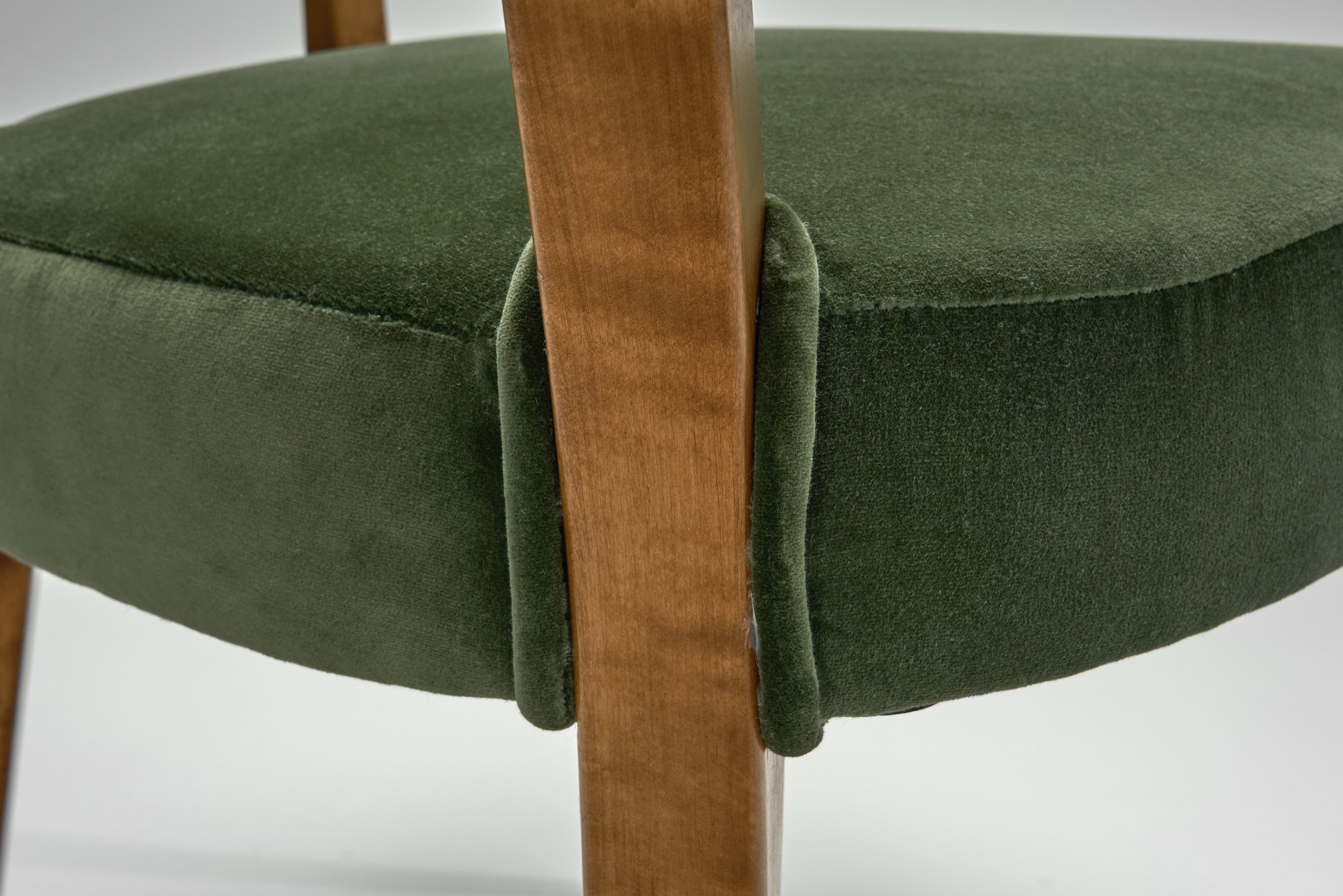
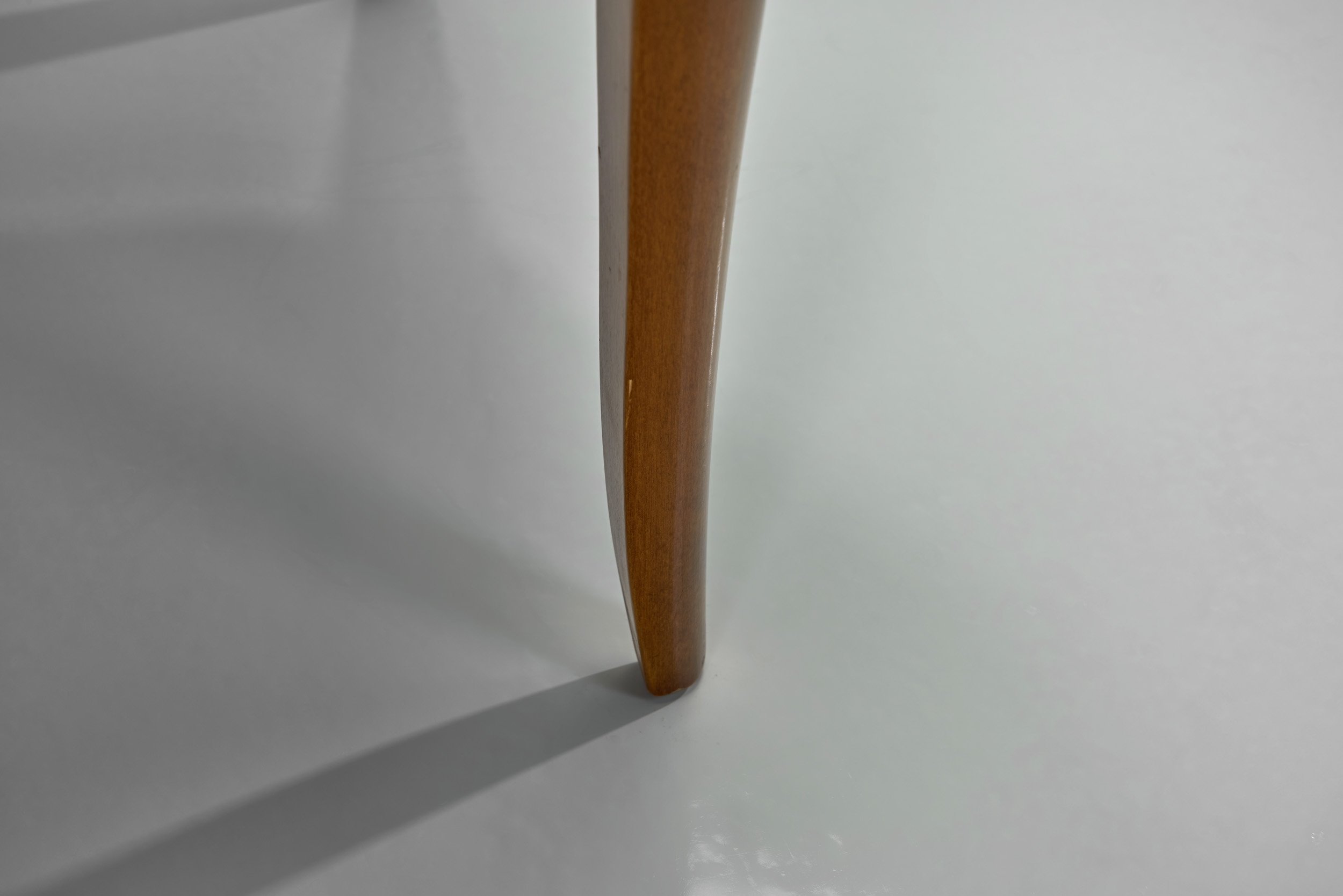
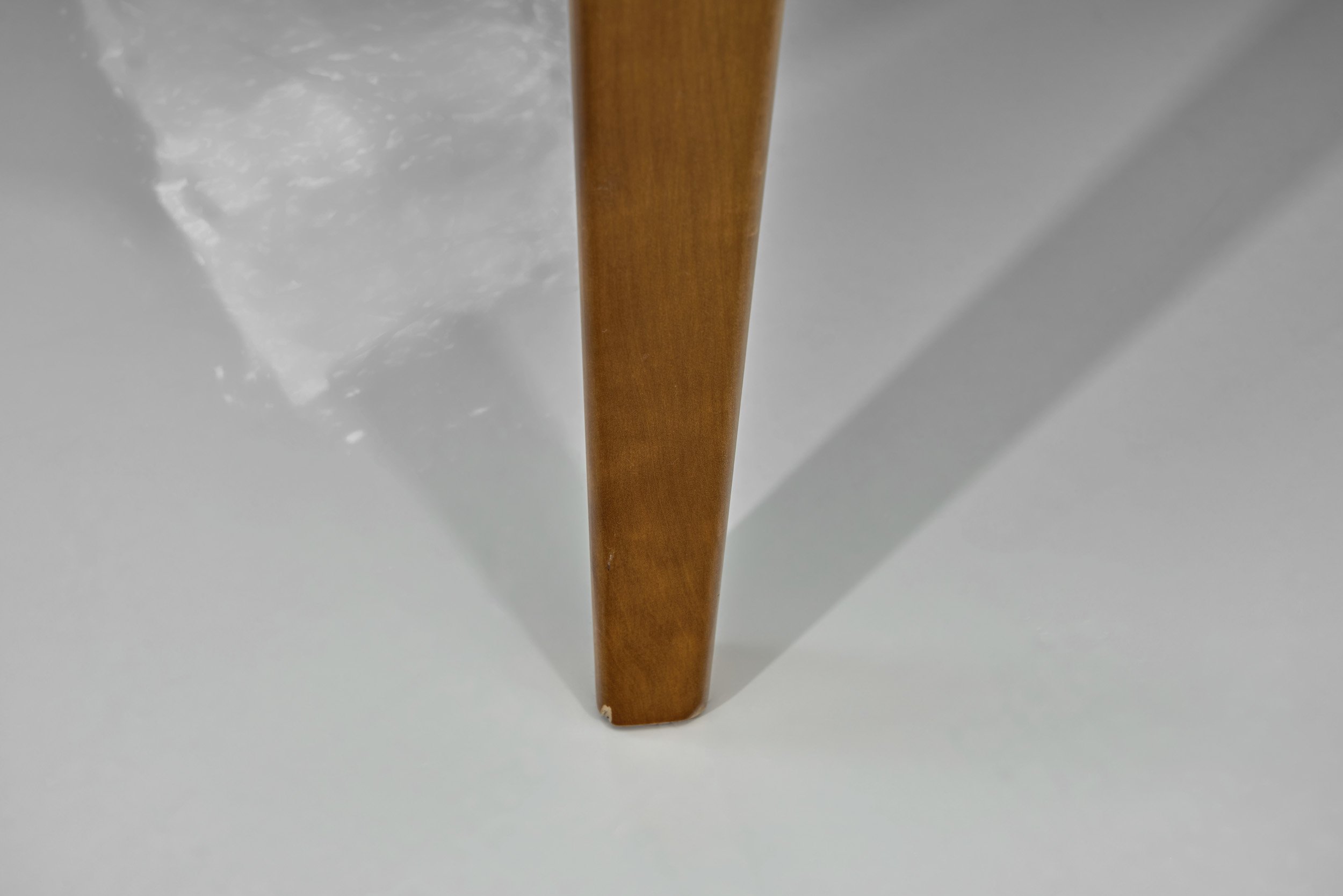
This model is a simplified version of the “Jonas Love” armchair, which Carl Malmsten designed for the New York World Fair 1939. Sweeping curves with an organic impression and utmost quality are the main characteristics that define this pair of chairs. Even as a young designer in the early 20th century, Malmsten advocated artisanal furniture design based on local materials and traditions. “Break all edges thoroughly” was a frequent instruction on his drawings and nature was his great source of inspiration, therefore sharp edges or corners can rarely be found in his designs. This “Lata Greven” model is no different, with round, outward curving edges on the back and arms, and an upholstered, cosy seat and back. The organicity of the design is not broken by ornamentation, instead the charming green upholstery is utilised to highlight the shape of the chairs. The chairs are supported by slim, tapered legs made of solid wood with a stunning grain.
Carl Malmsten designed a number of so called “Grevar” (Counts) between the 1930s and 1950s and they were often commissioned for special people or projects. The chairs’ manufacturer, O.H. Sjögren is a furniture factory in Tranås in Småland, and has been active for over 110 years and is thus one of the oldest active furniture manufacturing companies in Sweden. Since the 1950s, O.H. Sjögren manufactured furniture designed by Carl Malmsten, where in the 1950s and 60s, he spent a lot of time to develop his furniture designs.
SOLD
Condition:
In good vintage condition. Wear consistent with age and use. The chairs have been reupholstered by a previous owner. Each of our items can be reupholstered by our in-house atelier in a fabric of choice. Please reach out for more information.
Dimensions:
23.62 in W x 25.59 in D x 29.92 in H; Seat height 16.92 in; Seat depth 18.50 in; Arm height 25.59 in
60 cm W x 65 cm D x 76 cm H; Seat height 43 cm; Seat depth 47 cm; Arm height 65 cm
REQUEST PRICE HERE
Price category: 2,500 - 5,000 usd / eur
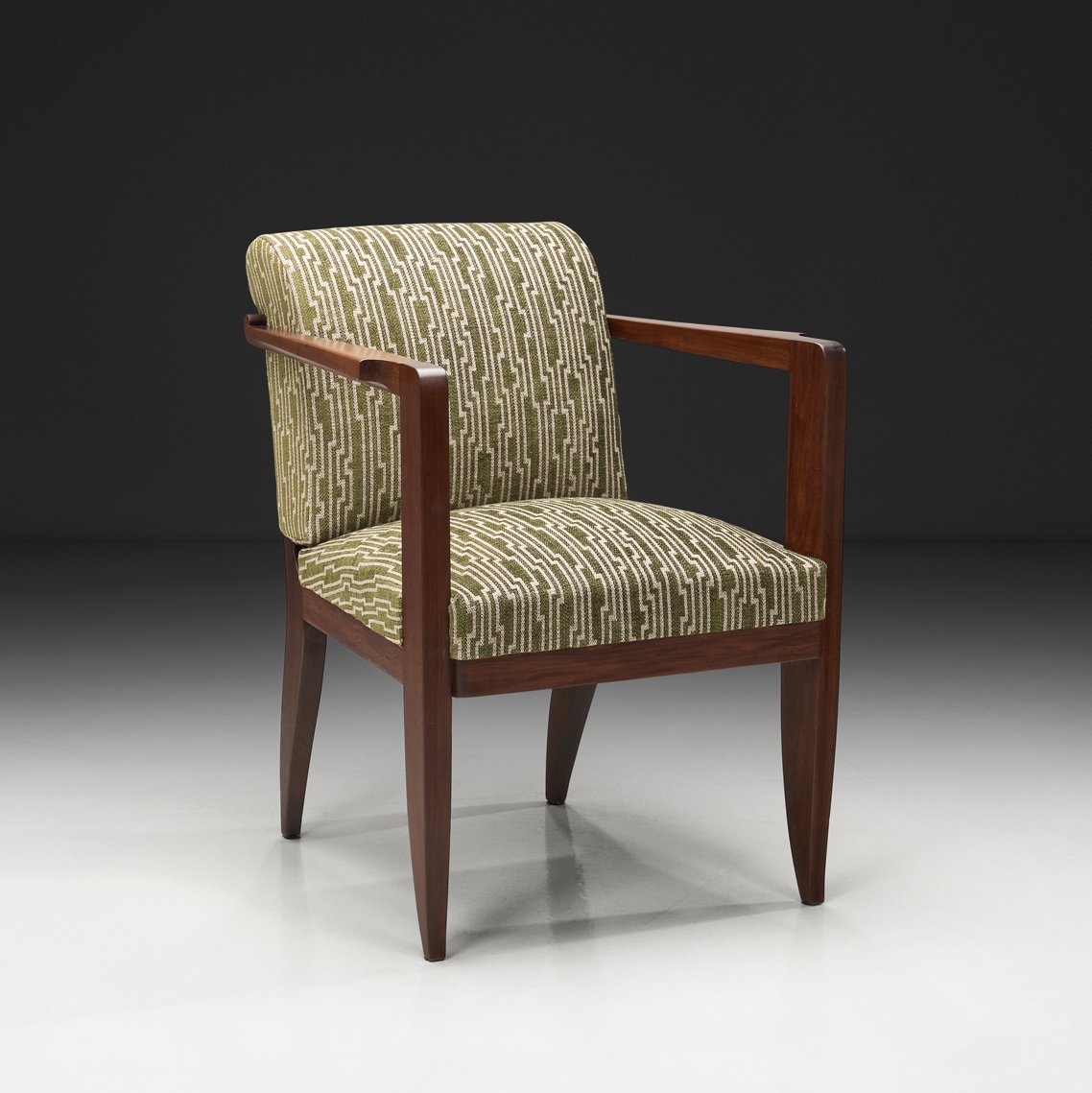
Christian Krass (1868–1957) was a French cabinetmaker and furniture designer based in Lyon, he became an important figure in the city’s decorative arts during the first half of the 20th century. His work included seating, tables, desks and cabinets, often combining carefully worked woods with the geometric forms and refined materials associated with Art Deco. This armchair, which dates back to circa 1930s, applies Krass’s skill to a compact and elegant seating design.
The armchair is defined by its exposed wooden frame, which combines straight lines with subtle curves. Four tapered legs support the upholstered seat, with the front legs continuing upward to meet the armrests and creating a clear structural outline. The armrests have a particularly interesting shape, extending horizontally into a carved element before turning downward. Their broad wooden surfaces and warm reddish-brown tone contrast with the patterned upholstery while keeping the construction clearly visible. The backrest is generously upholstered and slightly curved, with rounded upper corners that soften the otherwise geometric frame. Its shape follows naturally into the broad seat below, creating comfortable proportions within a relatively compact structure. The green and cream upholstery introduces a small repeating geometric pattern that complements the straight lines of the wood while adding texture and visual depth. The clean junctions between the legs, seat rails, arms, and back show the quality of the woodworking, with each element contributing equally to the overall composition.
The chair captures the more restrained side of French Art Deco, where decorative effect could be achieved through proportion, material and carefully controlled lines. Its scale makes it particularly suitable as a desk chair, side chair or additional seating in a living room or bedroom. It represents an interesting example of French furniture design from the 1930s.
Condition:
In good vintage condition. Wear consistent with age and use. The chair has recently been reconditioned. The armrests have minor marks and scratches. Due to the nature and age of the materials, the item may have some discolouration. The chair has recently been reupholstered in a premium fabric. Each of our items can be reupholstered by our in-house atelier in a fabric of choice. Please reach out for more information.
Dimensions:
23.42 in W x 25.98 in D x 30.70 in H; Seat height 18.70 in; Seat depth 17.12 in; Arm height 26.77 in
59.5 cm W x 66 cm D x 78 cm H; Seat height 47.5 cm; Seat depth 43.5 cm; Arm height 68 cm

REQUEST PRICE HERE
Price category: 12,500 - 15,000 usd / eur
Mid-century modern furniture introduced new approaches to seating, with designers exploring rounded silhouettes and chairs shaped closely around the sitter. This pair of European armchairs belongs to this direction, combining generous upholstery with a compact profile and short wooden legs.
Their continuous curved bodies give them a particularly soft appearance, while the low seating position creates the relaxed character associated with lounge furniture of the period. The shape of these armchairs creates an inviting and enveloping appearance. Each chair has a broad, deep seat framed by substantial upholstered arms that rise gently towards the backrest. The back is formed as a wide panel with softly rounded upper corners, curving around the sitter before flowing directly into the sides of the chair. This continuous transition between the back and arms is particularly effective when the chairs are viewed from behind, where the upholstery creates an uninterrupted curved silhouette. The olive-green fabric covers the entire body, allowing the proportions and shape to remain the focus of the design. Its textured surface gives the colour additional depth. A rectangular seat cushion sits within the upholstered body to ensure comfort for its user. Four short tapered wooden legs lift each chair just above the floor. Their warm brown tone of the wood provides a restrained contrast to the green upholstery, while their outward angle secures the broad stance of the chairs.
The designer ensured to make these chairs attractive from every direction, allowing the option to be positioned away from a wall and used more freely within a larger seating arrangement. Comfortable, compact and visually distinctive, the pair offers an appealing example of the softer forms found in European mid-century seating.
Condition:
In good vintage condition. Wear consistent with age and use. The armchairs have recently been reconditioned. Due to the nature and age of the materials, the items have marks, scratches, and discolouration. The pair have recently been reupholstered in a premium fabric. Each of our items can be reupholstered by our in-house atelier in a fabric of choice. Please reach out for more information.
Dimensions:
29.52 in W × 34.64 in D × 30.7 in H; Seat height 14.56 in; Seat depth 21.65 in; Arm height 18.5 in
75 cm W x 88 cm D x 78 cm H; Seat height 37 cm; Seat depth 55 cm; Arm height 47 cm
REQUEST PRICE HERE
Price category: 12,500 - 15,000 usd / eur
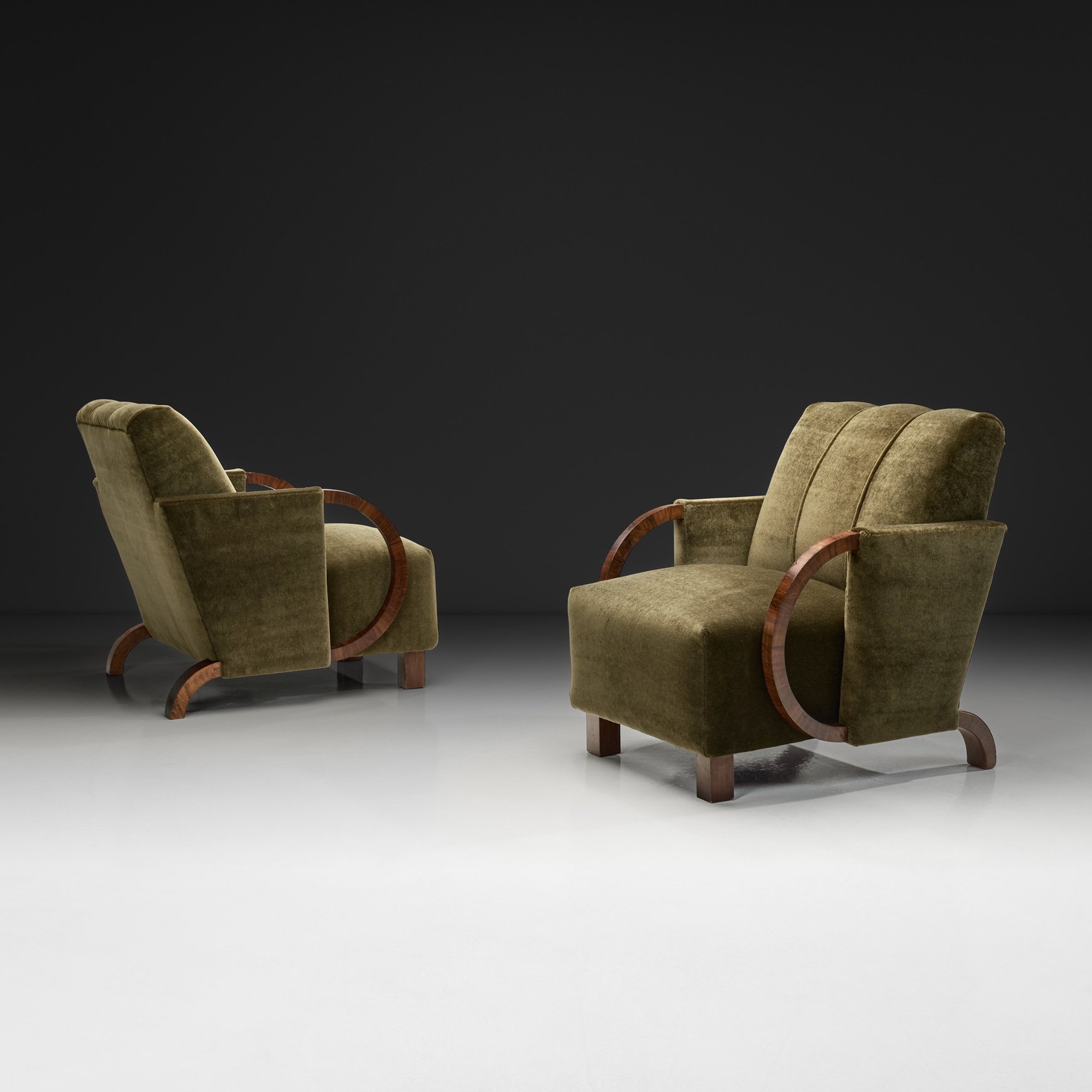
Art Deco seating from the first half of the 20th century brought together strong geometry, rich materials and interesting forms. Upholstered armchairs were particularly suited to this approach, as their larger surfaces could be shaped into bold silhouettes and contrasted with decorative wooden elements. This pair combines dark green upholstery with sweeping walnut-veneered details, creating a design in which wood becomes as visually important as the upholstered body.
The armchairs have substantial, slightly inclined backrests, giving them generous and comfortable proportions. Each backrest is divided into three vertical upholstered sections with a softly scalloped upper edge, adding definition to the broad surface and drawing the eye upward. The dark green upholstery continues across the seats, backs and side panels, giving the bodies a consistent colour and texture. The walnut veneer provides a striking contrast and forms a distinctive feature of the design. Large curved sections run along either side of each chair, forming part of the armrests before continuing downward towards the floor. Their continuous rounded shape complements the upholstered sides and gives the chairs a strong profile from every angle. At the same time, the wood creates gaps in the size, balancing the strong volume of the upholstered sections. The reddish-brown tone and visible grain of the walnut stand out against the muted green fabric, while the polished surface catches the light along each curve. Finally, short rectangular wooden feet support the front of the seats, while the back one mirror the curve of the armrests, tying the look together.
What makes these armchairs particularly appealing is the way the walnut veneer transforms an upholstered chair into a much more individual Art Deco design. Used together in a living room, library or conversation area, they offer both comfortable seating and the rich material character associated with European furniture at its best.
Condition:
In good vintage condition. Wear consistent with age and use. The chairs have recently been reconditioned. The armrests have visible repairs made by a previous owner. Due to the age and nature of the materials, the items have marks, scratches, dents and discolouration. The chairs have recently been reupholstered in in a premium fabric. Each of our items can be reupholstered by our in-house atelier in a fabric of choice. Please reach out for more information.
Dimensions:
28.74 in W x 31.10 in D x 31.88 in H; Seat height 17.51 in; Seat depth 20.86 in; Arm height 23.42 in
73 cm W x 79 cm D x 81 cm H; Seat height 44.5 cm; Seat depth 53 cm; Arm height 59.5 cm
REQUEST PRICE HERE
Price category: 2,500 - 5,000 usd / eur
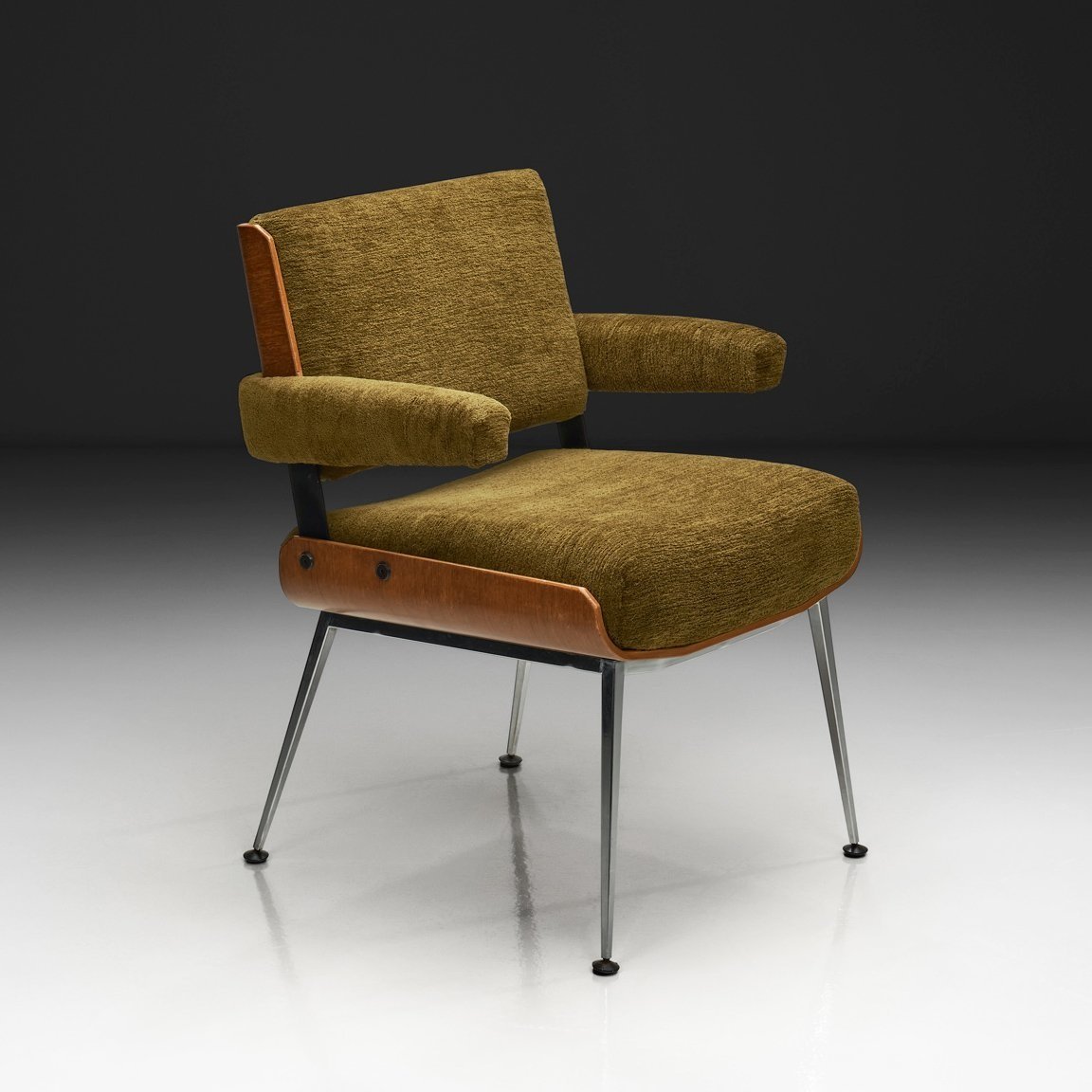
Alain Richard (1926–2017) was a French furniture and interior designer who graduated from the École Nationale Supérieure des Arts Décoratifs in 1949, where he studied under René Gabriel. He established his own agency in 1952 and became part of a generation of French designers developing furniture for serial production during the post-war period. His work included furniture for Meubles TV and lighting for Disderot, alongside increasingly large interior and architectural projects. This model “704” armchair from the 1960s shows his interest in clean construction, contrasting materials, and furniture designed around clear functional elements.
Model “704” combines a compact upholstered seat and backrest with exposed wood and metal elements. The thick seat cushion has a rectangular shape with softly rounded corners, while the backrest is slightly inclined to provide a comfortable sitting position. The piece is upholstered in a textured olive-green fabric that gives the chair a warm, tactile appearance. The armrests feature padded horizontal sections that appear almost suspended on either side of the seat. A shaped wooden frame runs beneath the seat and continues upward behind the backrest, its warm tone contrasting with the upholstery. Dark screws remain visible along the side of the wooden seat rail, adding a small technical detail to the construction. Four slender metal legs are splayed outward beneath the body, countering the volume of the upholstered sections and giving the chair a light stance. The combination of upholstery, wood, and metal creates a clear separation between each part of the chair while keeping the overall composition balanced.
Richard received several important distinctions throughout his career, including the Prix René Gabriel in 1964, and this chair is proof of his talent. Its combination of French modernist design and a balanced mix of materials makes it an interesting addition to a living room, study or reading area, particularly for collectors of post-war French furniture.
Condition:
In good vintage condition. Wear consistent with age and use. The chair has recently been reconditioned. Due to the nature and age of the materials, the chair has some marks, scratches, dents and discolouration. The seat cushion was newly produced and upholstered in a premium fabric. Each of our items can be reupholstered by our in-house atelier in a fabric of choice. Please reach out for more information.
Dimensions:
24.40 in W x 23.62 in D x 32.28 in H; Seat height 19.68 in; Seat depth 16.53 in; Arm height 25.59 in
62 cm W x 60 cm D x 82 cm H; Seat height 50 cm; Seat depth 42 cm; Arm height 65 cm
REQUEST PRICE HERE
Price category: 12,500 - 15,000 usd / eur
The 1950s and 1960s saw brilliant Italian designers working to create furniture of the highest quality that explored truly modern shapes and forms. These designers experimented with new materials and construction methods but, crucially, they kept the elegance inherent in Italian design.
These armchairs were crafted in the manner of Paolo Buffa, an impactful designer who made his mark in the Italian mid-century modern style alongside other renowned creators such as Gio Ponti. Gio Ponti and Paolo Buffa’s influence is clearly visible in these chairs. This pair with the upholstered bodies and polished wooden arms show the general mid-century modern characteristics with an ergonomic and functional design. The characteristic shape of the arms sets the tone of the overall look, creating dynamism. The seats are slightly raised, and the backs tilted, creating an angle that supports the sitter and the lounging experience. The overall design is focused on elegant and measured proportions, balanced compositions, and refined décor elements including the materials. From all angles, these chairs offer beautiful textures and eye-catching forms, combining Italian elegance and modern aesthetics to create a timeless look which is full of modern energy that will endure for generations. This is also thanks to the exceptional visual quality and uncompromising level of craftsmanship.
These chairs encapsulate the essence of Italian mid-century modern design, marrying uniting sophistication with artistry. They are a testament to the enduring allure of this design era, where form meets function, and beauty is eternally intertwined with utility. Whether placed in a contemporary, or a retro-inspired space, this pair is a timeless statement piece.
Condition:
In good vintage condition. Wear consistent with age and use. The chairs have recently been reconditioned. Due to the age and nature of the materials, the items have minor marks, scratches, and discolouration. The chairs have recently been reupholstered in a premium fabric. Each of our items can be reupholstered by our in-house atelier in a fabric of choice. Please reach out for more information.
Dimensions:
22.44 in W x 32.67 in D x 30.9 in H; Seat Height 15.35 in; Seat Depth 21.06 in; Arm Height 23.81 in
57 cm W x 83 cm D x 78.5 cm H; Seat Height 39 cm; Seat Depth 53.5 cm; Arm Height 60.5 cm
REQUEST PRICE HERE
Price category: 12,500 - 15,000 usd / eur
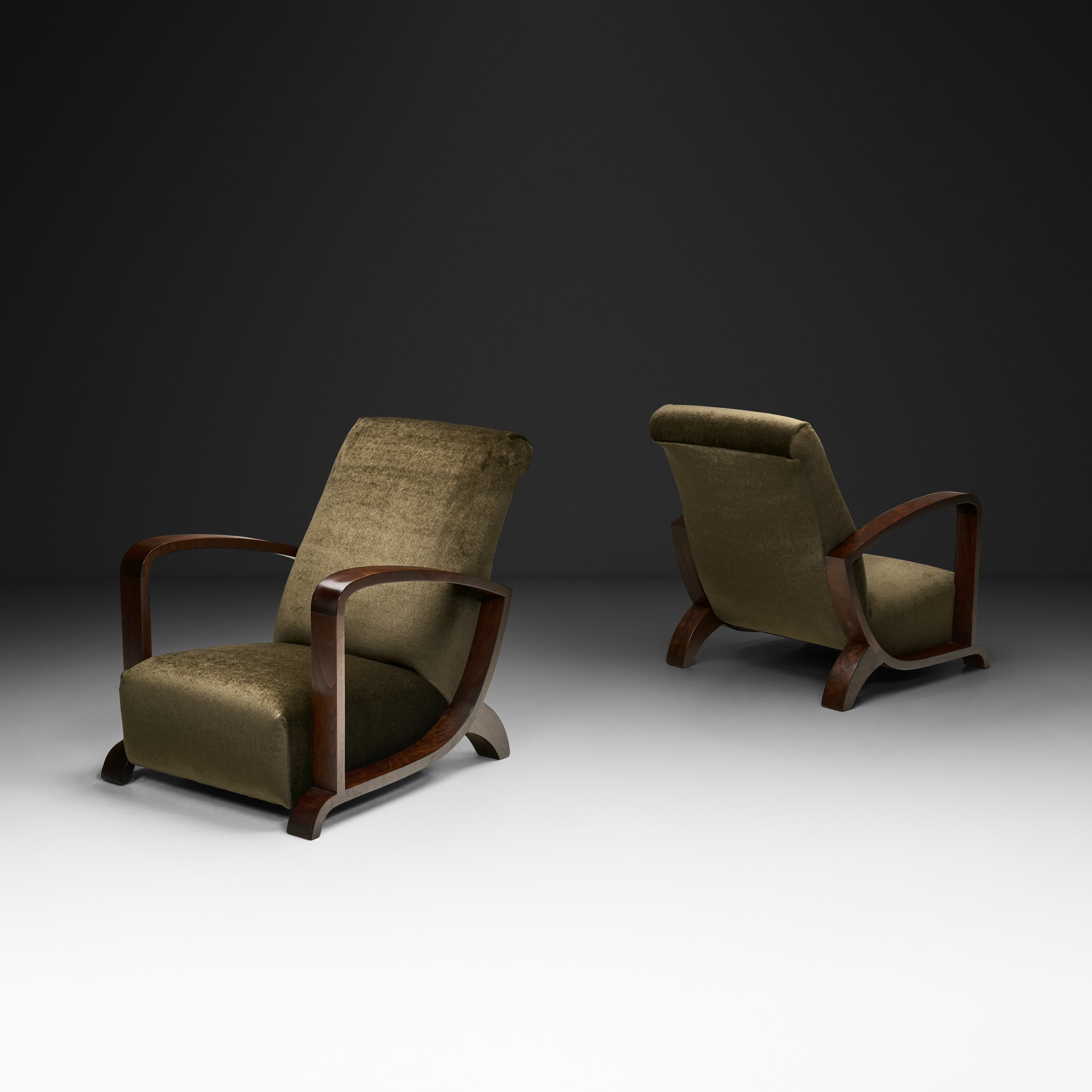
In an era marked by unprecedented cultural dynamism and bold artistic expression, the Art Deco movement emerged as a testament to modernity and sophistication. This period witnessed the creation of exquisite furniture pieces that epitomised the union of form and function, with this pair of armchairs standing out as a prime example.
In line with the Art Deco movement during which they were designed and manufactured, these chairs illustrate the bold, rich and luxurious aesthetic of the era. Before giving way to mid-century modernism and its focus on function over form, Art Deco pieces coupled geometry and craftsmanship to arrive as elegantly impressive additions to the era’s interiors. The upholstery is soft but controlled, with clean planes and subtle curves rather than excess padding. The seats are deep and inviting, designed for practical use, while the proportions remain compact enough to feel composed in a room. The wooden elements frame the upholstery and emphasise the chair’s structure, reinforcing its Art Deco character. Every detail works together, from the block-like legs to the precise transitions between wood and fabric, creating a chair model that feels deliberate, balanced, and quietly strong.
As a pair, this design captures the lasting appeal of Art Deco furniture: comfort shaped by discipline and elegance rooted in form rather than ornament. It works equally well as a statement chair in a living room or as a refined accent in a bedroom or study. Its presence offers visual weight without heaviness and comfort without excess, in true Art Deco fashion.
Condition:
In good vintage condition. Wear consistent with age and use. The armchairs have recently been reconditioned. Due to the age and nature of the materials, the items have marks and discolouration. The chairs have recently been reupholstered in a premium fabric. Each of our items can be reupholstered by our in-house atelier in a fabric of choice. Please reach out for more information.
Dimensions:
25.8 in W × 37.8 in D × 31.5 in H; Seat Height: 13.4 in; Seat Depth: 19.7 in; Arm Height: 22.0 in
65.5 cm W x 96 cm D x 80 cm H; Seat Height 34 cm; Seat Depth 50 cm; Arm Height 56 cm
REQUEST PRICE HERE
Price category: 12,500 - 15,000 usd / eur
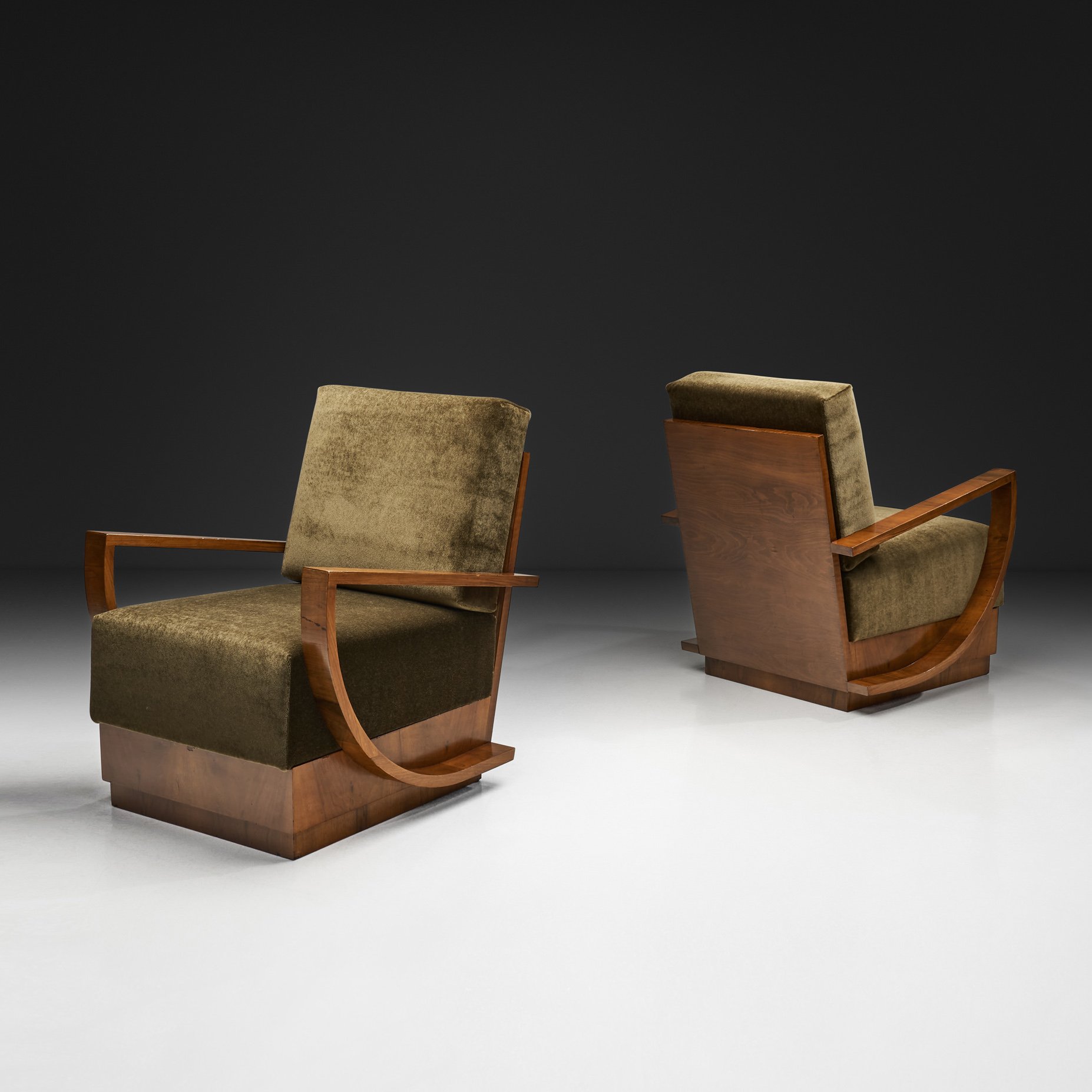
Art Deco, the glamorous and influential design movement that emerged in France during the early 20th century, left an indelible mark on the world of furniture design. Characterised by its bold geometric shapes, rich materials, and glamorous aesthetics, Art Deco transformed the way we perceive interior spaces. It was a testament to the fusion of form and function, and this ethos is beautifully exemplified in this pair of armchairs.
This pair demonstrates a confident silhouette in which every structural element contributes to the overall design. The chairs are built on substantial plinth bases that anchor the composition, while the upholstered seats and backrests provide comfort. Their defining feature is the sweeping curved wooden supports that rise from the base to form the armrests, creating a continuous structural line that contrasts with the strong angles of the back panel and base. This elegant curve introduces movement to the otherwise geometric design and highlights the craftsmanship required to shape the wood. The armrests are slender and smooth, preserving the visual lightness of the upper section despite the generous forms. Wooden veneers wrap the body, the warm grain complementing the muted olive upholstery with its soft texture. Viewed from the side, the combination of the curved supports, straight back panel, and block-like base creates a layered profile that is both sculptural and highly functional.
Comfort and craftsmanship are equally central to the design of this pair. They possess the quiet confidence characteristic of European Art Deco furniture, making them equally suited to vintage interiors and contemporary spaces that appreciate timeless design.
Condition:
In good vintage condition. Wear consistent with age and use. The chairs have recently been reconditioned. Due to the nature and age of the materials, the items may have some marks, scratches, and discolouration. The chairs have recently been reupholstered in a premium fabric. Each of our items can be reupholstered by our in-house atelier in a fabric of choice. Please reach out for more information.
Dimensions:
28.14 in W x 34.05 in D x 34.84 in H; Seat height 17.91 in; Seat depth 21.85 in; Arm height 23.81 in
71.5 cm W x 86.5 cm D x 88.5 cm H; Seat height 45.5 cm; Seat depth 55.5 cm; Arm height 60.5 cm
REQUEST PRICE HERE
Price category: 5,000 - 7,500 usd / eur
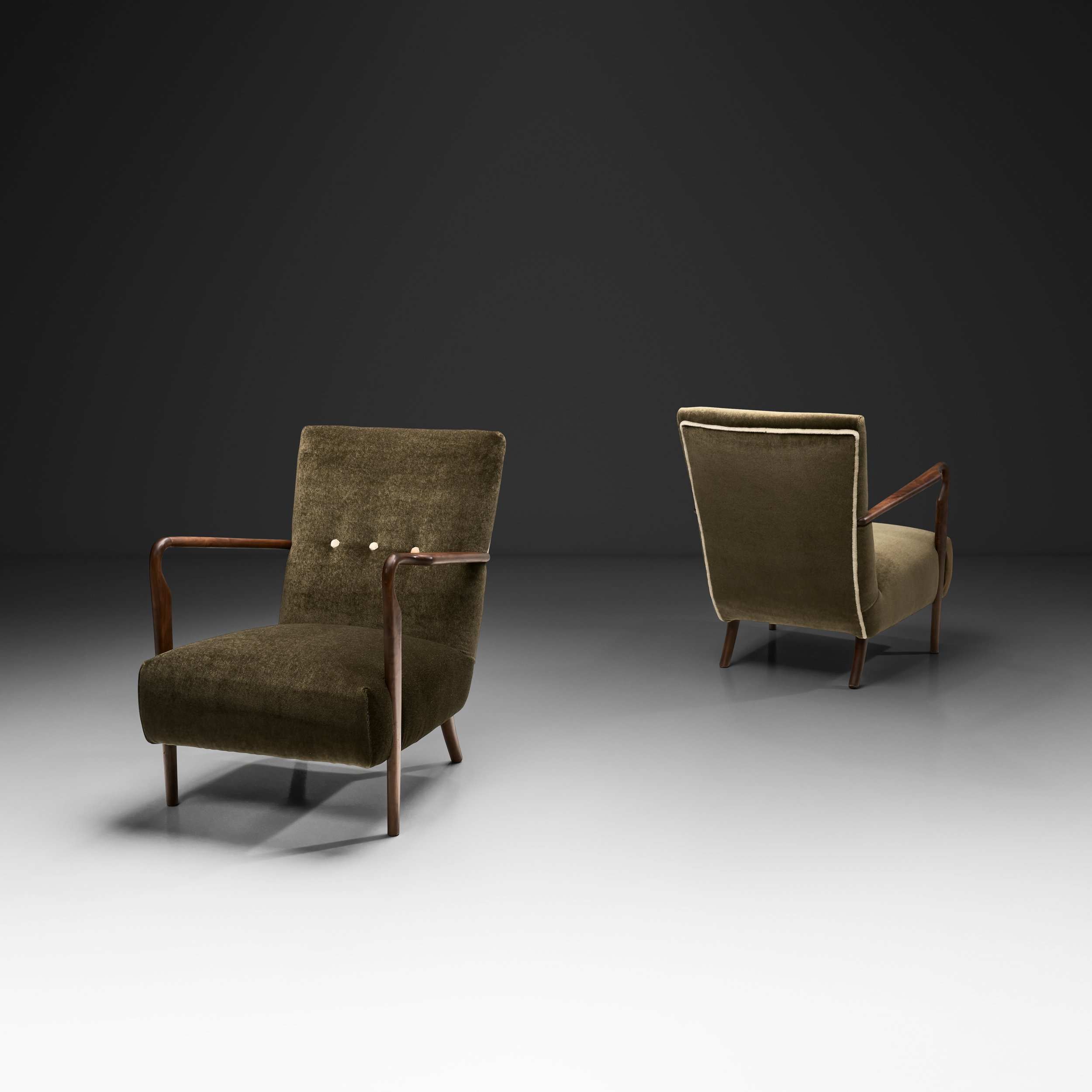
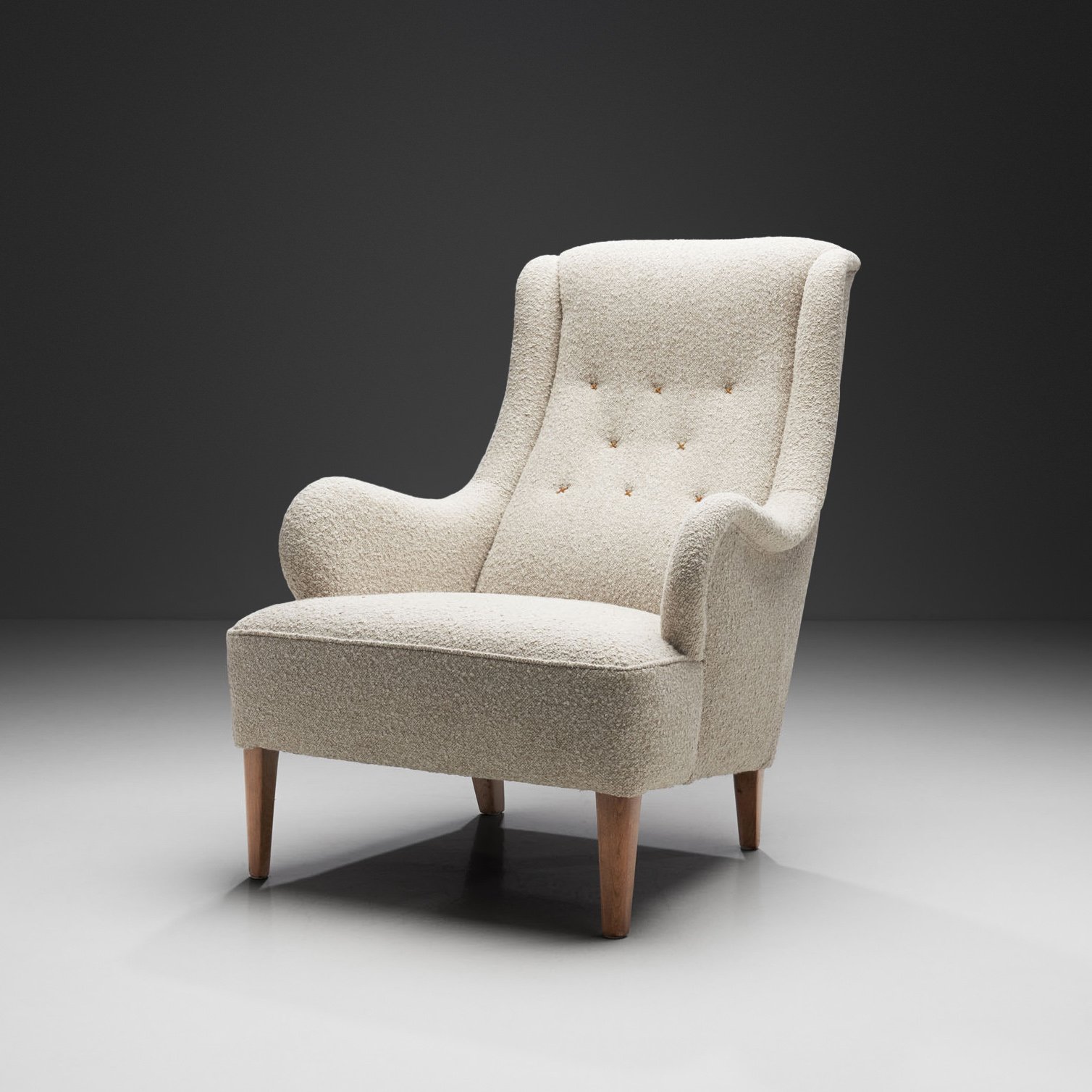
The ‘Oskar’ armchair was designed in 1939, the same year that Carl Malmsten participated in the New York World’s Fair. It was there that the expression “Swedish Modern” was coined, but Malmsten remained a traditionalist, mainly concerned with comfort in the home.
As with so many of Malmsten’s pieces of furniture, “Oskar” was modelled on an earlier design – his own or from previous generations. This armchair belongs to Carl Malmsten's earlier works, and the structure is traditionally made of solid pine from Swedish forests. As can be expected from the “Master of Wood”, the frame is expertly designed, with ergonomic and aesthetic principles at its core. While this armchair may seem less “Malmstenesque”, it already has the gentle curves that defined Malmsten’s later designs. This is especially visible in the flowing armrests that descend from the top, curling outwards to create a welcoming look. The gently bent backrest is tufted with dark yellow stitches that contrast with the light bouclé upholstery, both in colour and texture to create a stylish, visually interesting look. The structure is supported by the tapered, solid pine legs that add an organic touch to the design.
The design is reminiscent of the furnishings of the sitting room of Ulriksdal Palace, which was given to the crown prince and princess, Gustav and Louise, by the Swedish people in 1923. Malmsten was commissioned to create the decor for the room, and the ‘Oskar’ armchair may have been a template for this period, and perhaps that is why Carl Malmsten gave the chair a royal-sounding name. The company known today as O.H. Sjögren was established as early as the 1870s. Carl Malmsten, who had hitherto only produced the most exclusive and unique furniture for a limited and affluent clientele, sought manufacturers who were able to produce his furniture in larger volumes without compromising the high demands he placed on craftsmanship and quality. He chose O.H. Sjögren, and together they developed and marketed the many items of upholstered furniture that have become classics today.
Condition:
In good vintage condition. Wear consistent with age and use. The chair has been reupholstered recently in a premium bouclé fabric. Each of our items can be re-upholstered by our in-house atelier in a fabric of choice. Please reach out for more information.
Dimensions:
28.74 in W x 29.92 in D x 37.4 in H; Seat height 16.33 in
73 cm W x 76 cm D x 95 cm H; Seat height 41.5 cm
About the Designer:
Carl Malmsten (December 7, 1888 – August 13, 1972) was a Swedish furniture designer, architect, and educator. Malmsten was born in Stockholm, Sweden. Malmsten's career took off when he won a competition in 1916 to design furniture for the Stockholm City Hall and shortly after in 1917, he exhibited alongside well-known Swedish architects such as Gunnar Asplund and Uno Åhrén.
In the 1920s he was invited to furnish a room for the crown prince, Gustaf VI Adolf, and his wife Louise in Ulriksdal Palace. He was honoured with an inaugural Prince Eugen Medal for design in 1945. Already as a young designer in the early 20th century, Carl Malmsten advocated an artisanal furniture design based on local materials and traditions, available to a wide audience at a reasonable price.
Nature was Carl Malmsten's foremost teacher and source of inspiration. He conveyed his love of craftsmanship as a teacher in his own schools, at Olofskolan in Stockholm, Capellagården on Öland and the Carl Malmsten school on Lidingö, today a branch of Linköping University and one of the country's leading design colleges. As a debater, Malmsten stormed against functionalism, but in retrospect it can be seen that his ideas often coincided with the rational and frugal style ideals of function.
Malmsten has had a lasting influence on Swedish furniture design through the two schools he founded—the Carl Malmsten Furniture Studies (Carl Malmstensskolan), which has been a part of Linköping University since 2000, is situated on the island of Lidingö on the outskirts of Stockholm. Carl Malmsten spoke about the importance of tradition, craftsmanship and the nation. His furniture was in many ways a product of the thoughts and ideals of the time, they have a timeless quality that makes them just as relevant and loved today.
REQUEST PRICE HERE
Price category: 2,500 - 5,000 usd / eur
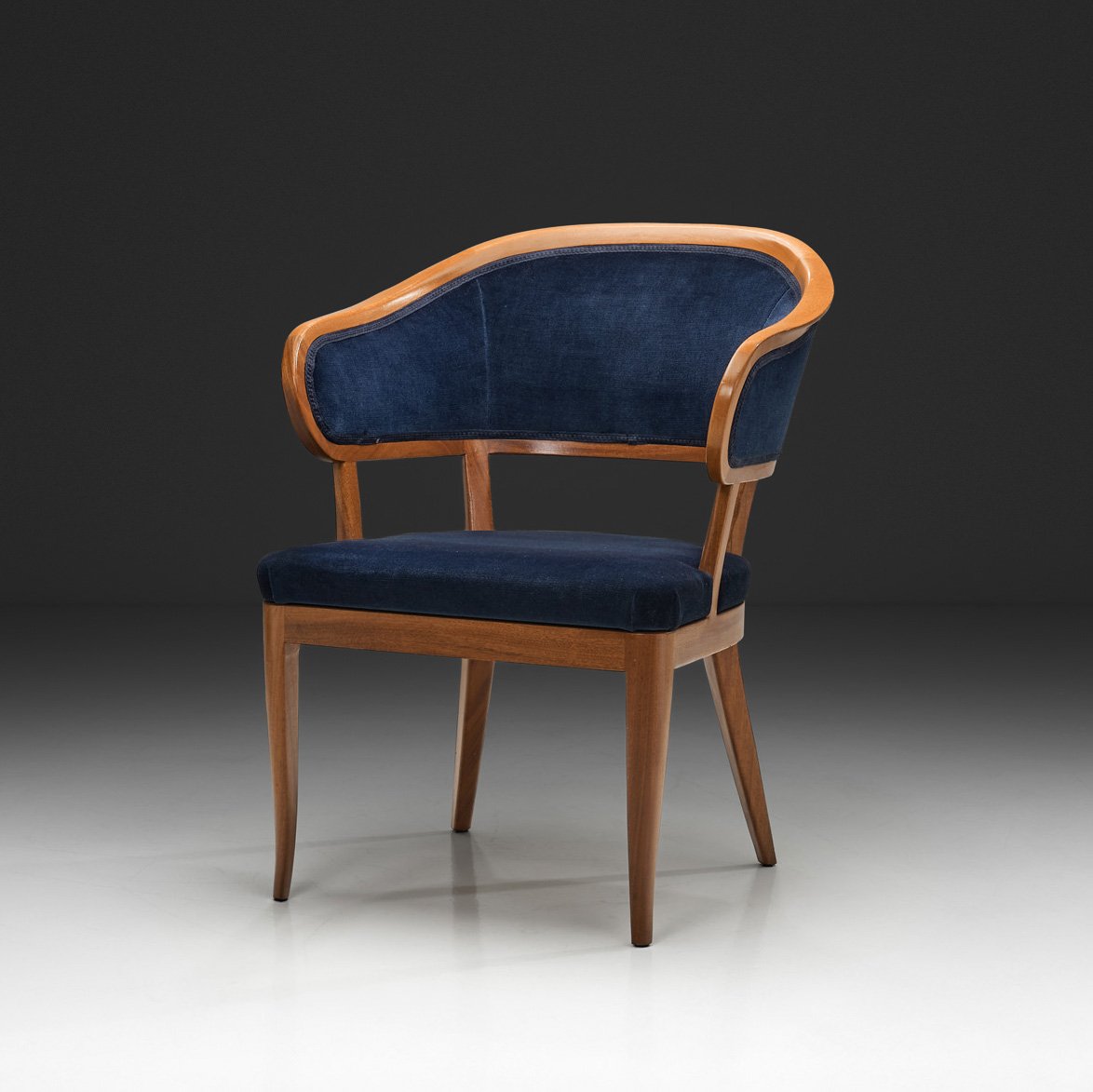
By the mid 20th century, Carl Malmsten became one of the most sought-after interior and furniture designers in all of Sweden. As a furniture maker he expressed the old, inherited forms as well as the new, bold ideas with his language of design.
“Jonas Love” is an iconic model that was the inspiration behind Malmsten’s several “count” chairs. With a klismos-style curved back, this armchair is timeless. Klismos chairs are known for sweeping lines and aesthetic beauty, as well as comfort offered by the concave back rest. These elements made this style popular with Carl Malmsten, who was outstandingly devoted to the Swedish culture he was brought up in. The “Jonas Love” model was originally designed by Malmsten for the New York World’s Fair 1939. “Break all edges thoroughly” was a frequent instruction on the designer’s drawings and nature was his great source of inspiration, therefore sharp edges or corners can rarely be found on his designs, including this chair. Moreover, wood was the most important material in Swedish mid-century design, therefore the dark blue upholstery highlights and complements the beauty of the wood rather than overpowering it. As this armchair exemplifies, blending functionality, good quality natural materials and organic colours with excellent craftsmanship is the key to the success of mid-century modernism. As an object, the chair reflects the mid-20th century pursuit of everyday beauty, objects designed not just to serve, but to enrich domestic environments.
The classic charm and versatility of this design allows it to be used as a desk chair, or in a curated corner. This chair can bring quiet sophistication to any setting. It is an ideal choice for a range of interior styles thanks to its thoughtful materials, and subtle craftsmanship.
Condition:
In good vintage condition. Wear consistent with age and use. The chair has recently been reconditioned. Due to the nature and age of the materials, the item has marks, scratches, and discolouration. This chair comes with its original upholstery or has been reupholstered by a previous owner. Each of our items can be re-upholstered by our in-house atelier in a fabric of choice. Please reach out for more information.
Dimensions:
24.41 in W x 24.02 in D x 31.50 in H; Seat height 16.54 in; Seat depth 19.69 in; Arm height 28.35 in
62 cm W x 61 cm D x 80 cm H; Seat height 42 cm; Seat depth 50 cm; Arm height 72 cm
REQUEST PRICE HERE
Price category: 9,000 - 12,500 usd / eur
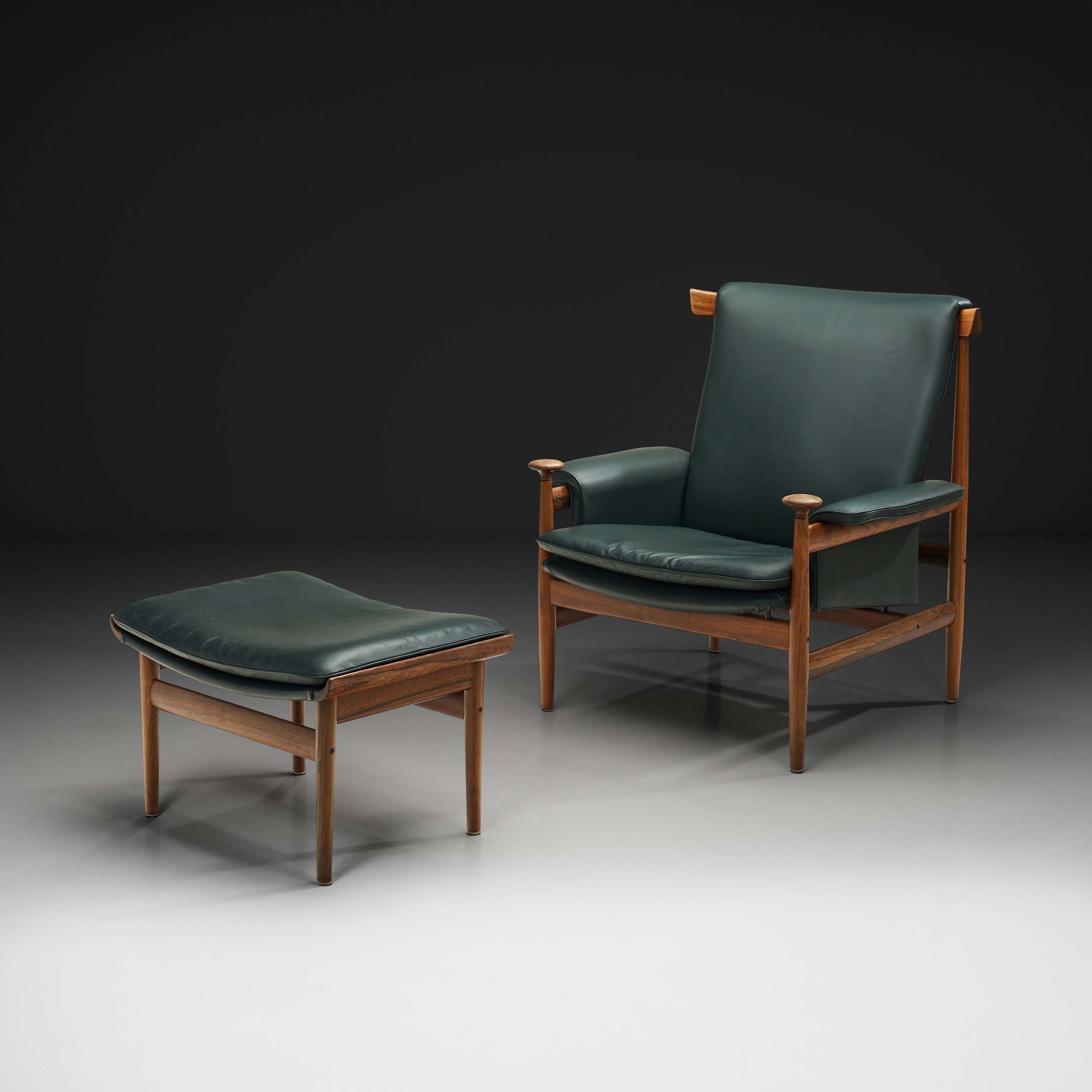
Finn Juhl is celebrated for his sculptural approach to furniture design. Rooted in the principles of modernism and influenced by the Scandinavian cultural emphasis on practicality and beauty, Juhl sought to create furniture that was both elegant and accessible. Danish design flourished in this era, embodying a timeless aesthetic that prioritised human comfort and sustainable practices, laying the foundation for its post-war international acclaim.
The “Bwana” model was produced in the 1960s by France & Son. The chair and footstool blend three main elements: craftsmanship, the clean lines of Modernism and the clear-eyed practicality of Functionalism. These elements combined with the use of exquisite materials create a piece that is both historical and modern visually. Unlike models from outside the continent, Danish furniture wasn’t flashy but rather well-made to fit a warm, comfortable and welcoming home. Crafted with meticulous attention to detail, its geometrically-inspired frame is constructed from a rich wood that exudes luxury. The deep shade and grain of the wood creates an impactful look while adding subtle decoration to the piece. The different tones of brown flow from the arms and form into the front legs of the armchair, creating depth and dynamism. The chair and footstool are upholstered in a green leather, adding vibrancy to any interior space.
Finn Juhl once said "One cannot create happiness with beautiful objects, but one can spoil quite a lot of happiness with bad ones", and this armchair and footstool will most definitely not spoil any happiness in the interior where they are placed.
Condition:
In good vintage condition. Wear consistent with age and use. Some minor scratches on the wood. Due to the nature and age of the materials, the items may have some marks, and discolouration. These items come with their original upholstery or has been reupholstered by a previous owner. Each of our items can be re-upholstered by our in-house atelier in a fabric of choice. Please reach out for more information.
Dimensions:
Chair:
33.66 in W x 22.83 in D x 36.02 in H; Seat height 15.74 in; Seat depth 21.85 in; Arm height 20.84 in
85.5 cm W x 58 cm D x 91.5 cm H; Seat height 40 cm; Seat depth 55.5 cm; Arm height 53 cm
Footstool:
25 in W x 17.51 in D x 15.15 in H
63.5 cm W x 44.5 cm D x 38.5 cm H
REQUEST PRICE HERE
Price category: 20,000 - 30,000 usd / eur
Finland and Helsinki are extremely important in mid-century modern design history, and one of the most famous designers of the period was Alvar Aalto. In contrast with the functionalism of the international style, Aalto brought a refreshing breath of humanism to modern design, as evidenced by this pair of Model “400” armchairs.
There is a saying that “Functionalism is a Finnish thing”, and it is hard to argue with that when looking at this pair of chairs. Functionality is without a doubt one of the most important aspects of Finnish design, however, there is also a demand for the highest quality, both in design and materials. Alvar Aalto is the Finnish icon of functionalism, and through this “400” or “Tank” model it is easy to see why. The design is first and foremost functional, combining practicality and aesthetics. These chairs feature a solid wooden frame with a striking silhouette. The arms are particularly distinctive thanks to their geometric look. They create a sculptural line that complements the simplicity of the overall form. The wood is painted black and pairs beautifully with the green upholstery, offering a restrained yet sophisticated material contrast. The choice of green allows for a sense of luxury and richness while still remaining grounded.
Aalto's free-form designs, in harmony with human needs and nature, anticipated the organic modernism of the 1950s and 1960s. This model can be a design statement in any space while also serving its functional purpose.
Condition:
In good vintage condition. Wear consistent with age and use. The armchairs have recently been reconditioned. Due to the nature and age of the materials, the items may have some marks, scratches, and discolouration. The pair has recently been reupholstered in a premium fabric. Each of our items can be reupholstered by our in-house atelier in a fabric of choice. Please reach out for more information.
Dimensions:
30.51 in W × 34.64 in D × 25.98 in H; Seat height 15.35 in; Seat depth 23.62 in; Arm height 19.29 in
77.5 cm W x 88 cm D x 66 cm H; Seat height 39 cm; Seat depth 60 cm; Arm height 49 cm