Upholstered Lounge Chairs with Sculptural Arms, Europe ca 1940s (sold)


Upholstered Lounge Chairs with Sculptural Arms, Europe ca 1940s (sold)
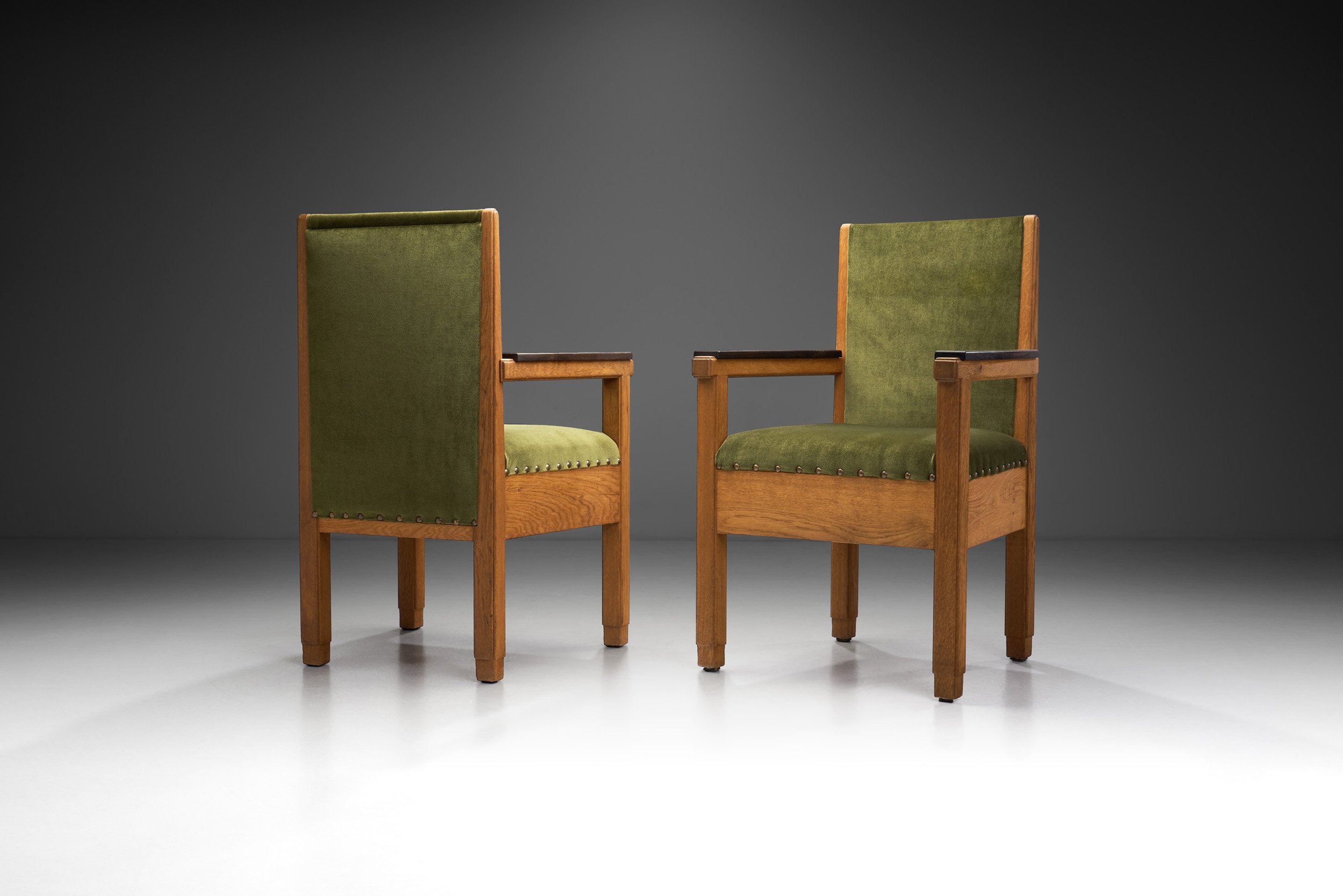
This elegant pair of lounge chairs is an interesting bridge between the 20th century’s earlier artistic movements like Art Deco, and the modernist movement that was about to shape most of Europe’s furniture design for the coming decades.
Inspired by the conspicuous curves and artistic use of wood that often defined Art Deco furniture, these chairs illustrate the perfect alliance of geometry and function combined with the world renowned craftsmanship and material choices of Modernism. Since these chairs carry design elements from Art Deco as well as early mid-century modernism, they have a unique and immediately recognizable look. Dominated by the heavily curved arms, the chairs have beautiful, almost sculptural structures that evoke the high-end craftsmanship of both design movements. Each chair features a reclined rectangular back over a deep seat. The thick seat cushions and button tufted backs further contribute to the comfort and cosiness. Still, the arms are in the focus of the design, with a highly distinctive shape and form in the front. The dark-toned upholstery complements the structure’s individuality. Resting on square shaped front legs and slightly splayed hind legs, the high level of sitting comfort is also supported structurally.
Strengthening the transition into a more minimalistic modern aesthetic even further, these chairs don’t have any embellishment, rather, the elegant upholstery and the beauty of the wood take on a decorative role. The design brings together the best of two style movements, resulting in a look that is, and will remain timeless.
SOLD
Condition:
In good vintage condition. Wear consistent with age and use. The chairs have been reupholstered recently in a premium velour fabric. Each of our items can be re-upholstered by our in-house atelier in a fabric of choice. Please reach out for more information.
Dimensions:
26.37 in W x 36.61 in D x 35.43 in H; Seat height 17.32 in; Arm height 23.62 in
67 cm W x 93 cm D x 90 cm H; Seat height 44 cm; Arm height 60 cm
REQUEST PRICE HERE
Price category: 2,500 - 5,000 usd / eur
Bridge Chairs - Fauteuil Bridge - from France are generally lightweight, often part of a set of matching chairs and bridge table. Bridge chairs were originally designed in the late 1930s for ladies for leisure activities, such as for games of bridge, afternoon tea, and gossiping. As this pair of bridge chairs exhibits, the models are stylish, of small proportions, well-made, and extremely comfortable.
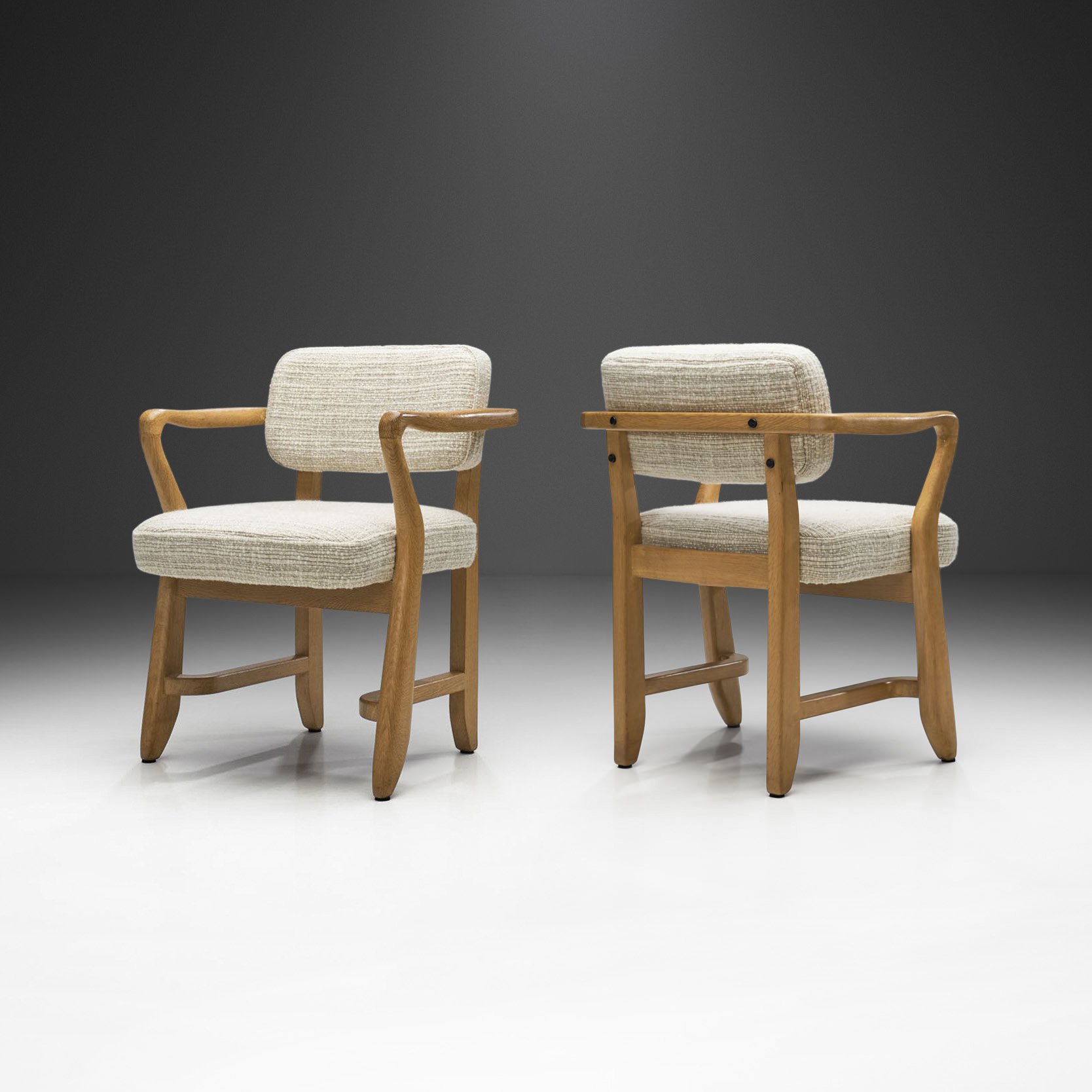
This solid oak “Fumay” pair is indeed, part of a dining group designed in 1965 by the world-famous French duo, Robert Guillerme and Jacques Chambron. As the version with arms, this pair’s frames are quite distinctive; the decorative elements on the backrests and armrests show and interesting curvature that is characteristic of the designer duo. These sculptural elements paired with the tapered legs are carved out of the blonde oak in an artistic way, testifying of the quality that the duo’s company, Votre Maison became famous for. The structures have unexpected details, such as the seats, with sides that are covered by the cushions, making them look invisible. Another such detail are the stretchers arranged between the legs at different heights in the fronts and sides. The genius of the design lies in these details that no matter how different, still complement each other. The sleek look is completed by the upholstered cushions in light bouclé fabric, that pairs beautifully with the colour of the blonde oak.
The French designers’ models are considered as a reference among the furniture of the 1950s through the 70s. This pair of dining chairs from the 60s gives a visual explanation why: the proportions, the subtle decorative elements, and the quality of woodworking is of the highest-quality, and the result is an immediately recognizable look that will never go out of style.
Condition:
In good vintage condition. Wear consistent with age and use. The chairs’ cushions have been reupholstered recently in a light bouclé fabric.
Dimensions:
21.85 in W x 19.68 in D x 32.08 in H; Seat height 18.5 in; Arm height 26.37 in
55.5 cm W x 50 cm D x 81.5 cm H; Seat height 47 cm; Arm height 67 cm
About the designer:
Robert Guillerme graduated in 1934 from the École Boule where he excelled in architecture and furniture design. After the Second World War he moved to Lille, in the north of France, where he decorated homes and designed furniture for the well regarded Rogier workshops.
In 1948, Guillerme was joined by his long-time friend, decorator Jacques Chambron in Lille. The following year Guillerme and Chambron met master cabinetmaker Émile Dariosecq, owner of a woodworking shop and the company Votre Maison was born. Together, they defined and imposed a new furniture concept. Thanks to their distinctive creativity, originality, and quality, the Votre Maison quickly became well-known.
The Votre Maison marked the history of French design. Guillerme drew the furniture designs while Chambron played the part of salesman, welcoming and advising clients. The power duo was complemented by Dariosecq, whose workshop took charge of the manufacturing. Together, they defined new furnishings concepts. Well-crafted chair back, polished wood and thick cushions make the reputation of their armchairs and sofas. Votre Maison continued to produce furniture right into the Twentieth Century, with Jacques’ son Hervé Chambron, a designer and graduate of the Ecole Boulle, having taken the reins in 1983. ~H.
REQUEST PRICE HERE
Price category: 7,500 - 10,000 usd / eur
The company Votre Maison is one that has left an indelible mark on the history of French design. The soul of Guillerme et Chambron’s work was in the company’s name (“Your House”). Their focus was as keenly attuned to functionality as to the creation of innovative design. The 'Denis' model chairs, designed by Robert Guillerme along with his sales partner Jacques Chambron, are a stunning examples of the works created at Votre Maison during the 1950s.
This type of “fauteuil bridge” (or, "bridge chairs") from France are generally lightweight, often part of a matching set of chairs and bridge table. "Bridge chairs" were originally designed in the late 1930s for leisure activities, such as card games, afternoon tea, and catching up. The typical models are stylish, of small proportions, well-made, and extremely comfortable - as this set greatly exemplifies. With an interesting open construction, this chair model's frame is very distinctive, with the armrests' curvature flowing into the chair’s front legs. Through this subtle, yet powerful detail, the straight lines of the legs and backrest are softened by the rounded shape of the arms. The gentle feel is further enhanced by the cushion’s rectangular shape with slightly rounded edges. The partially open backrest creates a light and open impression that is further amplified by the lighter coloured upholstery, which contrasts with the wood. Another distinctive feature is the pair of stretchers set parallel between the front and back legs, which join the legs together with an inward curve that mimics the curve of the backrest.
The elegant tones of both the upholstery and the wooden frame highlight the timeless allure of this set. From the refined wood color to the carefully thought-out structural details, this model is characteristic of Robert Guillerme and Jacques Chambron’s unique style and manufacturing skills.
Condition:
In good vintage condition. Wear consistent with age and use. Due to the nature and age of the materials, items may have some marks, scratches, and discolouration. Each of our items can be re-upholstered by our in-house atelier in a fabric of choice. Please reach out for more information.
Dimensions:
23.63 in W x 23.22 in D x 29.92 in H; Seat height 17.71 in; Seat depth 19.48 in; Arm height 25.59 in
60 cm W x 59 cm D x 76 cm H; Seat height 45 cm; Seat depth 49.5 cm; Arm height 65 cm
REQUEST PRICE HERE
Price category: 7,500 - 10,000 usd / eur
Art Deco, the glamorous and influential design movement that emerged in France during the early 20th century, left an indelible mark on the world of furniture design. Characterised by its bold geometric shapes, rich materials, and luxurious aesthetics, Art Deco transformed the way we perceive interior spaces. It was a testament to the fusion of form and function, and this ethos is beautifully exemplified in this pair of exquisite Art Deco armchairs.
This timeless pair of European Art Deco club chairs boasts a beautiful, almost sculptural frame with generous curves evoking the high-end craftsmanship of the movement that is steeped in old-school luxury and glamour. These armchairs are a true embodiment of the Art Deco style. Crafted with meticulous attention to detail, their geometrically inspired frames are constructed from rich, stained birchwood that exudes opulence through its rich and versatile patterns and colours. The upholstery is equally striking, featuring sumptuous velour fabric in an earthly and elegant brown tone. The streamlined, round armrests and similarly rounded backs showcase the movement's commitment to modernity. The "fauteuil de style", also known as the armchair. In France, the history of furniture closely follows the history of kings, Furniture like armchairs could only be found in the rich homes of the high nobility, closely linked to the reigning monarch whose taste dictated fashion. This is why we talk about Louis XIII, Louis XIV, Régence, Louis XV, Louis XVI, Directory, Empire armchairs… To live up to the seating style’s rich history rooted in style and comfort, this pair has thick seat cushions, sides, and backs fully upholstered. Instead of traditional tapered legs, these chairs stand on rectangular wooden feet with an especially rich grain, that give them extra personality while also highlighting the curve of the arms.
Like club chairs, armchairs - perhaps the most quintessential pieces of furniture - were embraced during the Art Deco era for their comfort and timeless appeal. They were favoured in upscale clubs and lounges across Europe, providing an inviting haven for relaxation and socialising. These chairs symbolise an era of sophistication and luxury, and their enduring popularity is a testament to the enduring allure of Art Deco design.
Condition:
In good vintage condition. Wear consistent with age and use. The chairs have been reupholstered recently in a premium brown velour fabric. Each of our items can be re-upholstered by our in-house atelier in a fabric of choice. Please reach out for more information.
Dimensions:
25 in W x 33.07 in D x 30.7 in H; Seat height 17.32 in; Arm height 24.8 in
63.5 cm W x 84 cm D x 78 cm H; Seat height 44 cm; Arm height 63 cm
REQUEST PRICE HERE
Price category: 12,500 - 15,000 usd / eur
This pair of rare oak easy chairs showcases the homely curviness that defined the design of the 1950s in the Nordic countries. Hiort af Ornäs developed the model for his own furniture company, ‘Hiort Tuote Valmistaja Puunveisto Helsinki’, or ‘Hiort Product Manufacturer Puunveisto (woodcarver) Helsinki’.
This chair model’s body has a soft, sculptural shape paired with an ergonomic and firm construction. Hiort af Ornäs was very firm about two things regarding his chair designs: the sitting comfort and that the model must look good from every single angle. Much like the “Pedro” model, these easy chairs easily fulfil these principles, as even from the bottom, they showcase the expertly carved oak structure. The removable seat cushions, framed by the open bodies ensure the sitting comfort. The seats, back- and armrests are all formed from a single piece that has an organic, outward curving look that is highly inviting and stylish. Especially on the armrests, the curves highlight the texture of the velvet upholstery and vice versa. The fabric is most appealing on rounded, curving forms, therefore it is a perfect match for this pair of easy chairs. The legs on the other side have a more straightforward design, creating an interesting contrast with the upholstered bodies. They are gently splayed and bent to support the seats and display the oak’s beautiful, darker shade. The craftsmanship and quality that is to be expected from original Hiort af Ornäs chairs is very apparent.
The seating designs of the architect/designer have been gradually more and more recognized world-wide, which resulted in a recent exhibition titled “Forgotten Ornäs”. Form follows function is a principle of design associated with early and mid-20th century architecture and furniture design, stating that the shape of a building or object should primarily relate to its intended function or purpose. This was evidently an important principle for the designer, seen in the design of both the structure and aesthetic elements.
Condition:
In good vintage condition. Wear consistent with age and use. The chairs have been reupholstered recently in premium velvet. Each of our items can be re-upholstered by our in-house atelier in a fabric of choice. Please reach out for more information.
Dimensions:
34.05 in W x 31.49 in D x 30.31 in H; Seat height 18.11 in
86.5 cm W x 80 cm D x 77 cm H; Seat height 46 cm
About the designer:
Carl-Gustaf Vilhelm (nicknamed “Nalle”) Hiort of Ornäs was born on 27 February 1911 and lived most of his life in Tapiola/Espoo in Finland and in his later life moved to Spain. He is remembered as a Finnish interior architect and designer known to be uncompromising.
Before the Finnish wars (1939-1944), Hiort af Ornäs spent his time in Pori, working at Björneborgs Mekaniska Verkstad. He studied at the Helsinki University of Technology to become an architect but never graduated. He did, however, become known as an interior designer, and eventually even more known as a furniture designer.
In 1945, Hiort af Ornäs founded the furniture company Puunveisto Oy, for which he developed versatile techniques for shaping plywood. He started the furniture manufacturing shop on Lauttasaari in Helsinki (Veneentekijäntie 14) together with his brother. The wood shop, showroom, and office were all located in the same building in Helsinki. Rolf Mesterton was the man in charge of producing the furniture, but there were several other carpenters at work in the woodshop. Hiort af Ornäs’s furniture was exhibited and sold by the shop Nupponen who also distributed Olavi Hänninen’s designs, while Puunveisto’s furniture were also sold by Gösta Westerbergs Möbler in Stockholm, Sweden but, in spite of a good selection of chairs, tables and shelves, did not do too well. Since production costs were high, Hiort af Ornäs faced economic troubles. The company was later sold to Nupponen after which Hiort af Ornäs’s interest in the company waned.
Hiort af Ornäs spent his retirement in Spain, and designed several buildings for Fuengirola’s Los Pacos neighbourhood, which has a large Finnish population. His house that he drew and built in Tapiola, Espoo, Finland, ‘Villa Hiort’, still stands and houses some of the designer’s original drawings. It is a beautiful example of 1950s Modernism and the talent of Hiort af Ornäs that brought him recognition that lasts to this day. ~H.
REQUEST PRICE HERE
Price category: 2,500 - 5,000 usd / eur
In the unique design style, “Amsterdamse School”, was an influential Dutch architectural and design movement that emerged in the early 20th century, and left an indelible mark on the cultural landscape of the Netherlands and on Europe on a larger scale. Beyond its architectural achievements, the Amsterdamse School also extended its influence to interior design and furniture, giving rise to a distinctive style that reflects a harmonious blend of craftsmanship, artistic expression, and social ideals exemplified by this pair of chairs with an enduring appeal, quality, and style.
The Amsterdamse School movement arose in response to the predominant influence of Art Nouveau and Jugendstil in the late 19th and early 20th centuries. This movement, which took root in Amsterdam, sought to create a uniquely Dutch style that embraced traditional craftsmanship and celebrated the spirit of the current times. The Amsterdamse School extended its influence across various artistic disciplines, including architecture, decorative arts, and furniture design.
The styles’ main characteristics are reflected in the design of this pair beautifully : expressive, art deco-reminiscent shapes and forms aided by functionality. Amsterdamse School furniture is renowned for its expressive and sculptural qualities. Designers sought to integrate form and functionality seamlessly, resulting in furniture pieces that were not only visually striking but also practical. Subtle, intricate detailing can be observed in this pair as well, from the tightly fit, riveted upholstery to the carved wooden arms and legs, and, before all else, a strong emphasis on craftsmanship.Further reflecting a commitment to renowned Dutch craftsmanship, Amsterdamse School furniture frequently utilized locally sourced materials such as quality woods. The choice of materials not only highlighted the movement's dedication to authenticity but also contributed to the desired durability and longevity of the pieces. The craftsmanship of Amsterdamse School furniture is exemplified by its intricate woodwork and joinery. Pieces often showcased decorative detailing through carvings, inlays, and geometric patterns. These elements added a touch of individuality and artistry to each piece, setting them apart from the mass-produced furniture of the time. Finally, The Amsterdamse School was not merely a design movement; it also embraced social ideals. Furniture designed during this period typically featured elements that conveyed a sense of solidarity and unity. Decorative motifs, such as were often incorporated to symbolize the interconnectedness of nature and society.
Despite the passing of decades, the Amsterdamse School furniture style continues to captivate enthusiasts and collectors worldwide. The enduring appeal lies in its unique combination of artistic innovation, craftsmanship, and a commitment to cultural identity. The pieces from this era are not merely functional items but also works of art that convey the spirit of a transformative period in Dutch history.
In conclusion, the Amsterdamse School furniture style remains a testament to the creative vision and social consciousness of its designers. As we continue to appreciate and preserve these timeless pieces, we celebrate a chapter in design history that has left an indelible mark on the world of furniture aesthetics.
Condition:
In good vintage condition. Wear consistent with age and use. These chairs come with their original upholstery or have been reupholstered by a previous owner. Each of our items can be re-upholstered by our in-house atelier in a fabric of choice. Please reach out for more information.
Dimensions:
24.6 in W x 23.42 in D x 39.37 in H; Seat height 21.06 in; Arm height 7.75 in
62.5 cm W x 59.5 cm D x 100 cm H; Seat height 53.5 cm; Arm height 70.5 cm
REQUEST PRICE HERE
Price category: 15,000 - 20,000 usd / eur
This pair of oaken “Grand Repos” lounge chairs deserves its title of iconic, both in terms of quality and design. This model visually represents the very reason Votre Maison, the French duo, Guillerme et Chambron’s company significantly influenced French design history.
Guillerme and Chambron are known for their high-quality, solid oak furniture and the “Grand Repos” model is without a doubt their most distinctive seating design thanks to its spindle backrest and distinctive frame with plenty of curvature. With a solid wooden frame, the support for the back of each chair consists of six, symmetrically arranged wooden spindles extending upwards. The backrests are slightly tilted for comfort, aided by the generous seats and back cushions. The back cushions are adorned with tufted buttons that add depth to the textured bouclé upholstery. The standout feature of this model are the creative overarching spindles that create an almost throne-like, grandiose effect. The curvature of the arms follows the lines of the backs, and gently curve outwards. “Grand Repos” stands for “great rest” in French, and with a well-though out, elegant design, this pair is sure to provide exactly that. The elegant light colour of the upholstery of the seat and back cushions beautifully compliments the light oak frames. The back cushions are secured with loops that attach to the back spindles, ensuring that the cushions stay in position.
The woodworking truly shows the overall quality of this pair, the frames are refined and the attention to the smallest detail shows the design and manufacturing skills of Robert Guillerme and Jacques Chambron. Since each chair was created by hand, they differ marginally in size and shape visible in the backs and legs, making them even more unique.
Condition:
In good vintage condition. Wear consistent with age and use. The chairs’ cushions have been reupholstered recently in a premium bouclé fabric. Each of our items can be re-upholstered by our in-house atelier in a fabric of choice. Please reach out for more information.
Dimensions:
Chair 1
31.69 in W x 35.43 in D x 42.32 in H; Seat height 15.15 in; Arm height 21.65 in
80.5 cm W x 90 cm D x 107.5 cm H; Seat height 38.5 cm; Arm height 55 cm
Chair 2
31.1 in W x 38.58 in D x 41.14 in H; Seat height 15.35 in; Arm height 21.85 in
79 cm W x 98 cm D x 104.5 cm H; Seat height 39 cm; Arm height 55.5 cm
About the Designer:
Robert Guillerme graduated in 1934 from the École Boulle where he excelled in architecture and furniture design. After the Second World War he moved to Lille, in the north of France, where he decorated homes and designed furniture for the well regarded Rogier workshops.
In 1948, Guillerme was joined by his long-time friend, decorator Jacques Chambron in Lille. The following year Guillerme and Chambron met master cabinetmaker Émile Dariosecq, owner of a woodworking shop and the company Votre Maison was born. Together, they defined and imposed a new furniture concept. Thanks to their distinctive creativity, originality, and quality, the Votre Maison quickly became well-known.
The Votre Maison marked the history of French design. Guillerme drew the furniture designs while Chambron played the part of salesman, welcoming and advising clients. The power duo was complemented by Dariosecq, whose workshop took charge of the manufacturing. Together, they defined new furnishings concepts. Well-crafted chair back, polished wood and thick cushions make the reputation of their armchairs and sofas. Votre Maison continued to produce furniture right into the 20th century, with Jacques’s son Hervé Chambron, a designer and graduate of the École Boulle, having taken the over in 1983. ~H.