
Nordic Art Deco Wall Lamp by Lyfa (Attr.), Denmark ca 1930s


Nordic Art Deco Wall Lamp by Lyfa (Attr.), Denmark ca 1930s
REQUEST PRICE HERE
Price category: 2,500 - 5,000 usd / eur
Manufacturers such as Lyfa reflect the iconic movement of Danish lighting design. Founded in 1924, Lyfa produced lighting that combined craftsmanship with a growing interest in functional clarity. During the 1930s, Scandinavian designers adopted influences from both Art Deco and Bauhaus, resulting in pieces that balanced ornament with structural logic. While Art Deco introduced elegance and refined detailing, the modernist movement encouraged simplification and a focus on functionality.
This wall lamp is defined by its compact yet expressive composition, where each element contributes to a clear visual message. The softly rounded opaline glass shade forms the focal point, its spherical shape diffusing light evenly in all directions. This creates a warm, ambient glow that enhances the surrounding space while softening the overall appearance of the fixture. Supporting the globe is a curved brass arm that extends outward from the wall mount in a smooth, controlled arc. This introduces a sense of movement, contrasting with the more rigid geometry of the vertical back-plate. The brass structure carries a subtle patina, emphasizing the material’s age and adding depth to the surface. The vertical wall plate itself is understated, allowing the projecting arm and illuminated globe to define the lamp’s presence. This interplay between curved and straight lines reflects the period, where decorative softness met architectural discipline.
Together, the spherical shade and curved arm create a gentle, composition that feels both deliberate and restrained. This allows the lamp to integrate easily into a variety of interiors, from more traditional spaces to modern settings, without losing its character. As a result, the piece remains not only a functional source of light, but a subtle architectural accent, reflecting the enduring relevance of early Scandinavian design principles.
Condition:
In good vintage condition. Wear consistent with age and use. The lamp has recently been rewired and reconditioned. Due to the nature and age of the materials, the item may have marks, scratches, and discolouration. Minor imperfections on the glass may be present due to manufacturing inconsistencies and age. This lamp is compatible with an E26 / E27 (standard) fitting. All lighting can be converted for US usage.
Dimensions:
7.09 in W x 8.66 in D x 13.38 in H
18 cm W x 22 cm D x 34 cm H
REQUEST PRICE HERE
Price category: 2,500 - 5,000 usd / eur
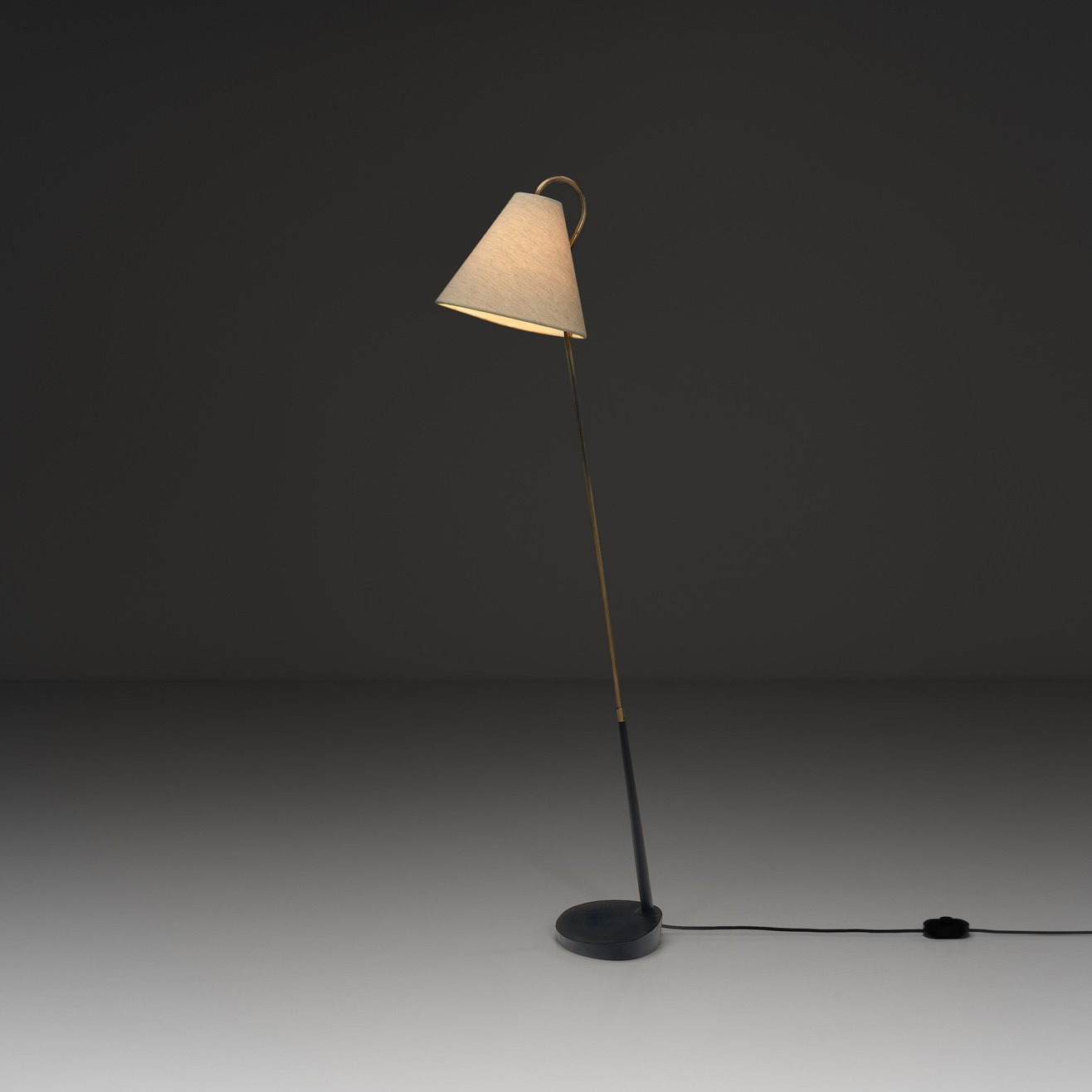
Jo Hammerborg was closely associated with the transformation of Danish lighting manufacturer Fog & Mørup during the post-war period. He joined the company as head of design in 1957 and remained there until 1980, developing numerous lighting models during those years. Under his direction, Fog & Mørup grew as one of the largest lighting manufacturers in Denmark in the 20th century, creating great models, such as this floor lamp.
The “Kardinal” lamp was designed in 1960s, placing it within Hammerborg’s productive time as a director of Fog & Mørup. The piece has a slender construction, with a vertical stem rising from a geometrical square base. Wood is the dominant material, giving both the base and stem a warm surface, that shows the natural grain of the material. Copper elements intertwine with the wood in interrupted sections and create a lovely juxtaposition of materials, tied in by the similar tonal palette. The square base is bold enough to provide visual weight that anchors the otherwise narrow structure. At the top, the stem terminates in a compact textile shade. The simple geometry of the form continues the effect created by the base. Rather than using an elaborate structure, Hammerborg kept the components visually straightforward, allowing visual proportion and material quality to define the lamp.
With over a century of heritage, Fog & Mørup continues to illuminate homes with its unique blend of Danish ingenuity and timeless elegance, and the “Kardinal” lamp demonstrate why. Its design is clear and elegant, while its simplicity allows it to integrate seamlessly into a variety of spaces.
Condition:
In good vintage condition. Wear consistent with age and use. The floor lamp has recently been rewired and reconditioned. The shade was custom made by our in-house atelier. Due to the age and nature of the materials, the lamp may have marks, scratches, dents, and discolouration. This lamp is compatible with an E26 / E27 standard fitting. All lighting can be converted for US usage.
Dimensions:
12.01 in W x 12.01 in D x 62.40 in H
30.5 cm W x 30.5 cm D x 158.5 cm H
About the designer:
Danish designer Jo Hammerborg (1920–1982) was one of the defining figures of mid-century Scandinavian lighting. Originally trained as a silversmith, Hammerborg studied at the Royal Danish Academy of Fine Arts before spending eight years at Georg Jensen, where his understanding of metalwork, proportion and craftsmanship took shape. In 1940-45 he participated in Denmark’s resistance and struggle for freedom as a saboteur.
Afterwards, Hammerborg returned to design, and in 1957, became chief designer at Danish lighting manufacturer Fog & Mørup. Under his direction, the company entered its most creative and commercially successful period. A prolific designer with a sharp eye for detail, Hammerborg created more than 180 lamps, combining sculptural forms with a careful understanding of how light interacts with metal and space. His silversmith background is evident throughout his work. Clean silhouettes, organic curves and precisely worked surfaces in materials such as brass, copper and aluminium gave his lamps a distinctly refined character. Designs such as the Orient pendant capture this approach particularly well: elegant and understated, yet unmistakably sculptural.
Hammerborg was as adventurous outside the studio as he was inventive within it. He was an active and very versatile athlete who, was also a pioneer in parachuting and flying. He died in a skydiving accident in 1982 at the age of 62. Today, his lighting remains highly sought after, securing his place among the most distinctive names in Danish mid-century design.