John Norelius Dirigold Art Nouveau Candelabra for AB Alco, Sweden 1920s


John Norelius Dirigold Art Nouveau Candelabra for AB Alco, Sweden 1920s
REQUEST PRICE HERE
Price category: 500 - 1,000 usd / eur
The artists of Nordic Art Nouveau took inspiration from organic and natural forms, resulting in elegant designs with sinuous curves and lines. As this clever candelabra clearly demonstrates, hey also injected the style with their traditional design ideals such as functionality and an uncluttered look.
This model has a lot more to offer than it would seem at first glance with unique and clever solutions. Firstly, the mysterious material itself, dirigold. Dirigold was invented by two Swedish engineers, C. Molin and C. A. von Malmborg, and the alloy would consist of 90% copper and 10% aluminium. The two engineers were in charge of the Metal company Alco in Örebro in the 1920s. Newspaper articles around Sweden soon praised the material, Gothenburg Dagblad wrote in 1922: “Dirigold maintains its high shine even after long-standing use unlike silver.” It also quickly became popular for as it withstood discolouration. As this candelabra showcases, the light gold colour is especially effective on round, carved shapes with diverse angles. The structure is rather traditional with a round base, long column and three arms with cups and so-called chambersticks, small pans to catch dripping wax. And then the not so obvious element: the top part is removable, converting the design into a vase. This ingenious feature praises John Norelius as a designer and immediately distinguishes this model from all other candelabras. Norelius became a trainee at AB Alcometaller around 1920, and eventually came to lead the dirigold production in the new factory in Mosås.
The composition of the alloy was kept secret, and because of a shortage in materials, the production of dirigold items ceased, making this stately candelabra a museum quality piece.
Condition:
In good vintage condition. Wear consistent with age and use. The dirigold has some marks and patina.
Dimensions:
12.79 in W x 4.72 in D x 14.76 in H
32.5 cm W x 12 cm D x 37.5 cm H
REQUEST PRICE HERE
Price category: 2,500 - 5,000 usd / eur
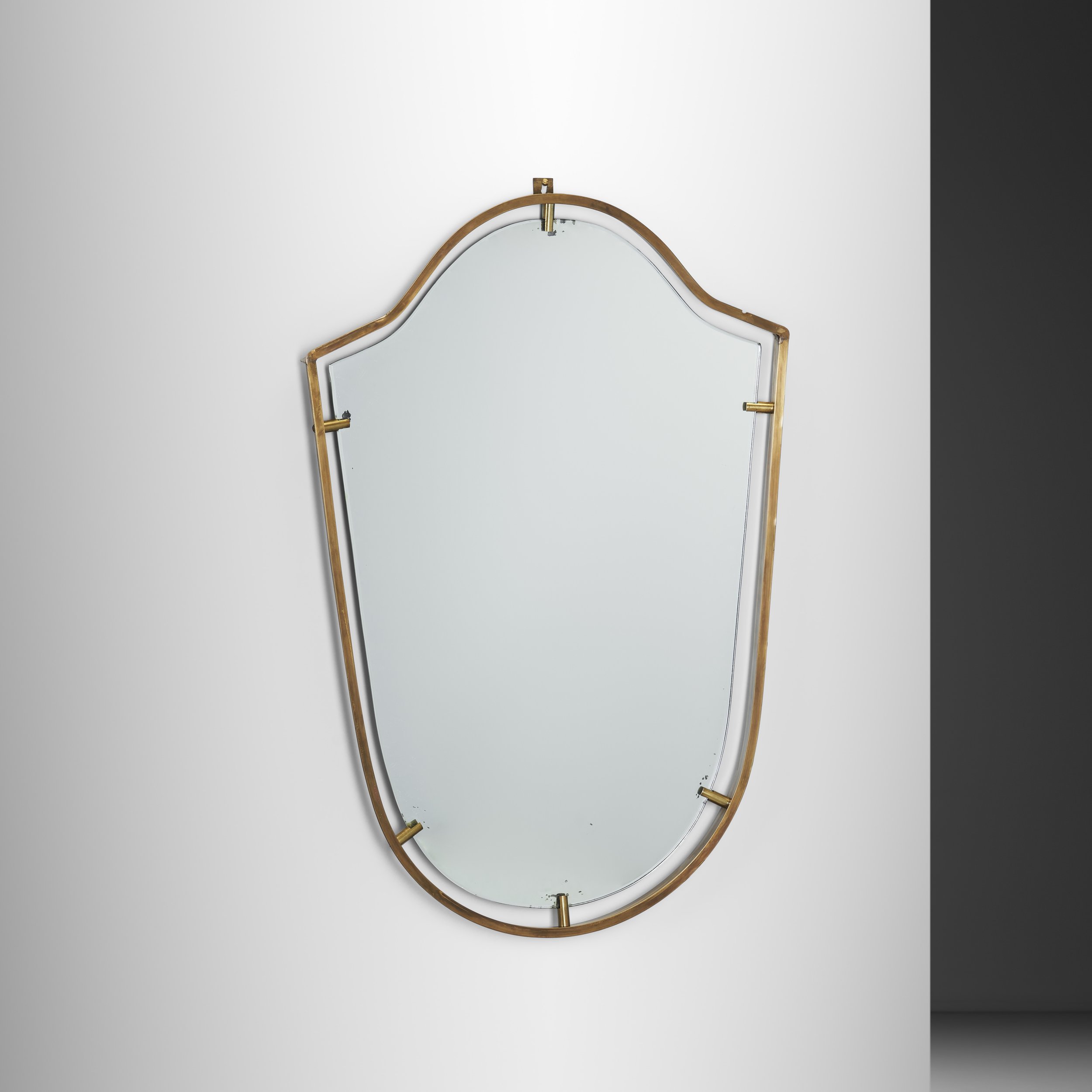
Mirrors are versatile pieces of interior décor with several functions and advantages; they create depth, increase light coverage, and add a statement to any space. Fusing function and form, mirrors offer useful reflection while also providing an eye-catching focal point in any room. This rare and beautiful Italian mirror has a stylish, defined look that is sure to stand out in any space.
In the early days, mirrors were made from obsidian, a smooth black stone, and metals, such as copper and bronze. The use of glass in mirror-making was initially developed during the rise of the glass industry, and later revolutionised by Murano glass-makers. This Italian model has a stylish, refined look that is certain to add refinement to any room’s ambiance. Wall mirrors, such as this one, are practical at their core, while also adding personality wherever they are placed. The play on materials and geometry, with the mirror’s clean and symmetrical lines, creates a neat, modern look. The patinated brass, the ultimate material of 20th century design is balanced out by the glass surface. Mirrors have long been used to make rooms feel bigger and brighter by reflecting light and creating an illusion of additional space, but there is much more beyond functionality. As this model shows, an accent mirror can incorporate a classic touch into a home, while reflecting timeless Italian style.
The design and materials provide simple elegance, making this mirror perfect to bring some understated modernism to any interior. It can serve equally well in a hallway, bathroom or living room, either mounted on a wall or spontaneously leaned against it. It adds depth, reflects light, and expands horizons as a statement piece.
Condition:
In good vintage condition. Wear consistent with age and use. Marks, scratches, and imperfections may be present on the glass due to manufacturing inconsistencies and the age of the item.
Dimensions:
19.68 in W x 0.98 in D x 29.33 in H
50 cm W x 2.5 cm D x 74.5 cm H
REQUEST PRICE HERE
Price category: 1,000 - 2,500 usd / eur
In 1934, Josef Frank made his first attempt at modernizing the classic candelabra. With softly swaying forms, he eliminated the base in the middle, placing the branches of this model directly on the tabletop. This candelabra emits a pleasant light and its special design makes it a perfect centrepiece.
Candlesticks and candle holders are appreciated decoration details that bring warmth and spread a soft glow in the room. In the case of this model, the body itself spreads a soft glow thanks to its bright brass structure. This model predates the famous Knot of Friendship, but already showcases the looping calligraphic design. The six branches share the same curve but are arranged asymmetrically so that the candles stand at different heights. This allows the design to look different from each angle. The candles elongate the otherwise busy design and keep the upper part light and airy while also highlighting the elaborate brass structure. The candles are held by brass cups that have so-called chambersticks, small pans to catch dripping wax. The cups have removable extra cups in an organic, flower-like shape. The glass has a golden rim to accentuate the shape and elevate the aesthetic of the whole candle holder.
The Austrian designer and architect, Josef Frank was the most prestigious designer in the Stockholm design company Svenskt Tenn (Swedish Pewter), recruited by the founder of the company, Estrid Ericson herself. Svenskt Tenn hired Josef Frank in 1934, the same year he created the design of this model, making it one of his earliest designs at the company.
Condition:
In good vintage condition. Wear consistent with age and use. The brass has a beautiful patina with some marks.
Dimensions:
11.81 in W x 11.81 in D x 8.66 in H
30 cm W x 30 cm D x 22 cm H
About the designer:
Josef Frank (July 15, 1885 – January 8, 1967) was an Austrian-born architect, artist, and designer who adopted Swedish citizenship in the latter half of his life. Together with Oskar Strnad, he created the Vienna School of Architecture, and its concept of Modern houses, housing, and interiors.
Josef Frank was one of early Vienna modernism’s foremost figures, but already in the beginning of the 1920s he started to question modernism’s growing pragmatism. He had little appreciation for the French architect Le Corbusier’s belief that a house should be “a machine for living in”. He was against puritanical principles and on the contrary, feared that standardized interiors would make people all too uniform. Josef Frank represented a freer, more artistic style ideal, and he developed his own type of modernism where values like comfort, hominess, and a wealth of colour were at its core. He resisted limitations and models for his furniture and textiles came from across all boundaries both in time and space.
Josef Frank began working at Svenskt Tenn in 1934 and just a few years later, the Frank-Ericson duo made their international breakthrough. Svenskt Tenn’s exhibition room at the World Expositions in Paris in 1937 and New York in 1939 was completely contrary to the ideal of the time with its bold contrasts in materials, colours, and prints. The duo received a great deal of attention and became, somewhat paradoxically, the model for the expression “Swedish Modern”. Although he was already 50 years old when he left Vienna for Sweden, Frank is considered one of Sweden’s most important designers.
REQUEST PRICE HERE
Price category: 500 - 1,000 usd / eur
Gunnar Ander was an industrial designer and architect, and one of the brightest stars of 20th-century Swedish metal, wood, and glass design. His most well-known models are the innovative designs for Ystad Metall, such as this unique candle holder. His designs are represented in numerous museums in Sweden.
This black lacquered wrought iron and brass “Sonata” candle holder has an intrinsically modern, sculptural look. The versatile shape and form come alive thanks to the modern materials and the colour choice. Like with lamps, it says a lot about a design when it stands out even without its source of light, in this case, candles. With home improvements on the upswing, candlesticks and holders have found a resurgence, as they are rather impactful additions to any space despite their size. This candle holder can also serve as a centrepiece on a table, as it is sure to draw attention. The smooth black lacquered iron body rest on a hollow circle base and curve upwards. It has four brass cups with so-called chambersticks, small pans to catch dripping wax. The last cups have an elongated lower part ending in a brass sphere. This ingenious feature creates perfect balance as well as a focal point. The design is also customizable in the sense that any type and colour of candles can be placed in the cups to match the interior and personal preferences.
Gunnar Ander was a long-time employee at Ystad-Metall, where he designed utility and art objects in brass, silver, and other materials. The company was founded in 1919 in the south of Sweden. It was active until 1969 and was highly successful thanks to its stylistically pure objects of various metals. Many well-known Swedish designers like Ivar Ålenius-Björk, Carl-Einar Borgström also worked alongside Gunnar Ander during the company’s heyday.
Condition:
In good vintage condition. Wear consistent with age and use. The brass has a beautiful patina with some marks.
Dimensions:
8.66 in Ø x 9.44 in H
22 cm Ø x 24 cm H
REQUEST PRICE HERE
Price category: 1,000 - 2,500 usd / eur
This candelabra was designed by the well-know Finnish designer Paavo Tynell. Widely referred to as the "the man who illuminated Finland", Paavo Tynell was a true master of light. Born in Helsinki, Finland in 1890, he started his career as a tin and blacksmith at the company Kory Oy. Simultaneously, he studied at the Helsinki University of Industrial Arts, to which he graduated as a ‘master craftsman’ in 1913. Through his works, he embraced timeless beauty, sustainability and a deep connection to the natural world. His favourite material to work with was brass, and he formed the material into shapes that are very characteristic and unique to his style.
This “162” candelabra model showcases Paavo Tynell’s expertise when it comes to brass. The candles standing at the same height evoke an elegant symmetry. They are each held by brass cups that have so-called chambersticks, which are small pans to catch dripping wax. The brass arms follow a beautiful curvature, giving this piece a sculptural dimension. The arms intertwine with each other and connect at the shoulder, beautifully held by the stem and base. Candelabra and candle holders are appreciated decorative pieces that bring warmth and spread a soft glow in the room; this candelabra can serve both as a focus piece, with its eye-catching design, as well as add to the overall atmosphere with soft candle light.
This candelabra was manufactured by the famous Finnish manufacturer Taito Oy, one of the most innovative Scandinavian lighting design companies of the modern era. Paavo Tynell was the co-founder and chief designer of the company until 1953. At first, the company focused mostly on interior and exterior metalwork. From the 1930s onward, Taito also began producing lamps for the lighting sector. The “162” candelabra model is an esteemed example of the excellent artistry of Paavo Tynell and of the quality produced by Taito Oy.
Condition:
In good vintage condition. Wear consistent with age and use. The brass has a nice patina.
Dimensions:
19.88 in W x 5.51 in D x 14.57 in H
50.5 cm W x 14 cm D x 37 cm H
REQUEST PRICE HERE
Price category: 1,000 - 2,500 usd / eur
Josef Frank designed Vänskapsknuten (the Knot of Friendship) as a symbol of friendship and peace at a time when Europe was filled with turmoil. The very first sketch of the candelabra dates back to 1938, just a year before the outbreak of the Second World War, but it is as relevant now as it was then.
The Austrian designer and architect may be best known for his vivid textiles for Swedish firm Svenskt Tenn, but his artistic touch reached far beyond textiles and created iconic objects such as this candle holder. The elaborate brass structure intertwines at multiple points, but the brass rods only meet in the middle where a small sphere connects them. Each of the three brass cup have so-called chambersticks, small pans to catch dripping wax. The looping calligraphic design gives this piece a weightless grace that is stunning even without the symbolism behind it. The body’s busy look is completed and balanced by the long candles. The design changes from angle to angle and shows Frank’s sensitive touch. The Knot of Friendship has become an iconic object not only in Svenskt Tenn’s range, but also of Sweden. The production traditionally required a process of thorough methodology and great craftsmanship. Josef Frank was the most prestigious designer in the Stockholm design company Svenskt Tenn (Swedish Pewter), recruited by the founder of the company, Estrid Ericson herself.
Since 2018, after a careful assessment of Josef Frank’s original drawing, the candelabra regained its original form from 1938 under the hands of Svenskt Tenn. However, the production of this well-known and widely-loved candle holder now takes place at Humstorp Metal in Västergötland. This piece however, is from the original production from the post-war era.
Condition:
In good vintage condition. Wear consistent with age and use. The brass has a beautiful patina with some marks. Due to the nature and age of the material, the item may have some scratches and discolouration.
Dimensions:
8.85 in W x 7.48 in D x 6.29 in H
22.5 cm W x 19 cm D x 16 cm H
About the designer:
Josef Frank (July 15, 1885 – January 8, 1967) was an Austrian-born architect, artist, and designer who adopted Swedish citizenship in the latter half of his life. Together with Oskar Strnad, he created the Vienna School of Architecture, and its concept of Modern houses, housing, and interiors.
Josef Frank was one of early Vienna modernism’s foremost figures, but already in the beginning of the 1920s he started to question modernism’s growing pragmatism. He had little appreciation for the French architect Le Corbusier’s belief that a house should be “a machine for living in”. He was against puritanical principles and on the contrary, feared that standardized interiors would make people all too uniform. Josef Frank represented a freer, more artistic style ideal, and he developed his own type of modernism where values like comfort, hominess, and a wealth of colour were at its core. He resisted limitations and models for his furniture and textiles came from across all boundaries both in time and space.
Josef Frank began working at Svenskt Tenn in 1934 and just a few years later, the Frank-Ericson duo made their international breakthrough. Svenskt Tenn’s exhibition room at the World Expositions in Paris in 1937 and New York in 1939 was completely contrary to the ideal of the time with its bold contrasts in materials, colours, and prints. The duo received a great deal of attention and became, somewhat paradoxically, the model for the expression “Swedish Modern”. Although he was already 50 years old when he left Vienna for Sweden, Frank is considered one of Sweden’s most important designers.