Olle Hermansson Cast Iron Sculpture for Husqvarna, Sweden ca 1960s


Olle Hermansson Cast Iron Sculpture for Husqvarna, Sweden ca 1960s
REQUEST PRICE HERE
Price category: 1,000 - 2,500 usd / eur
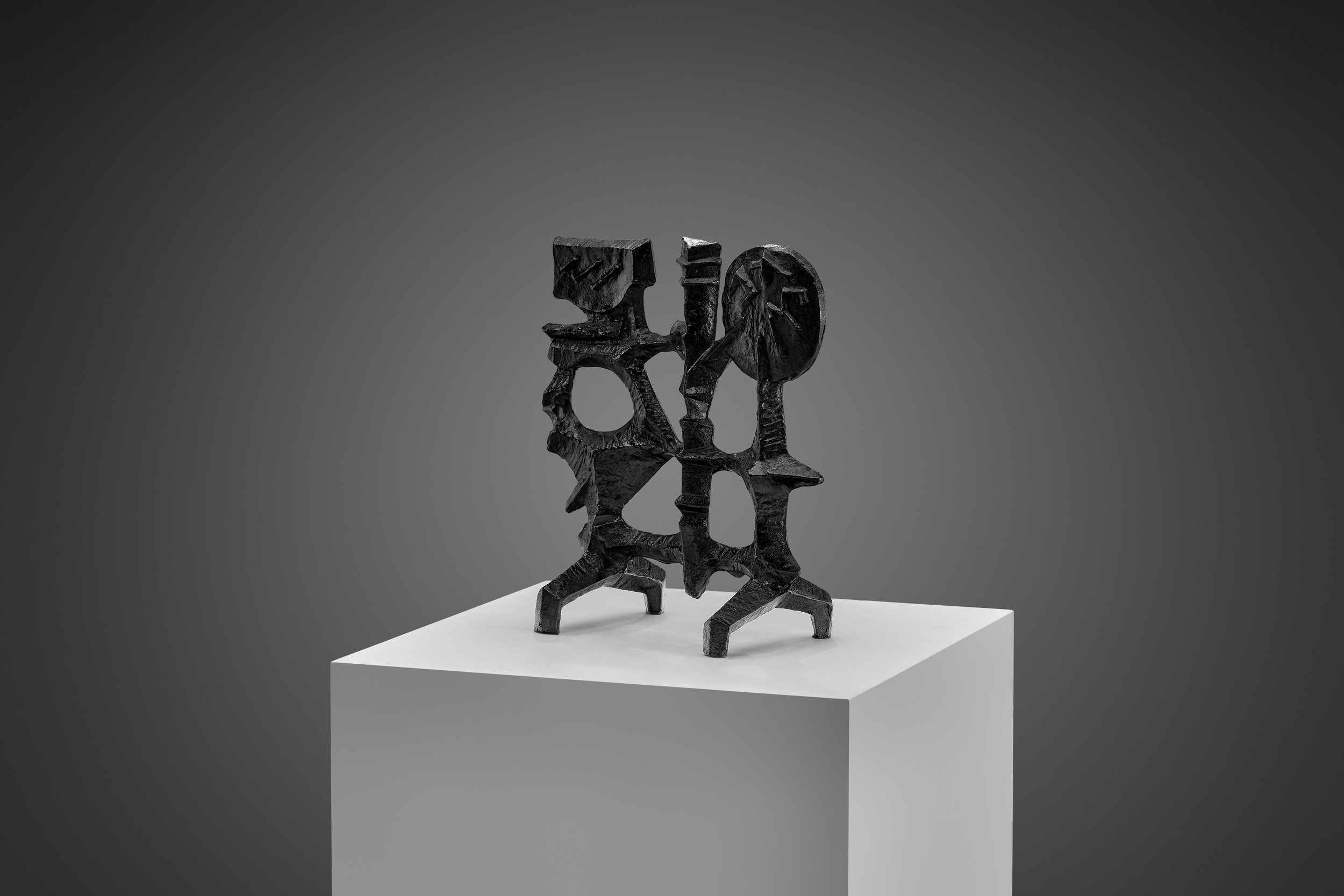
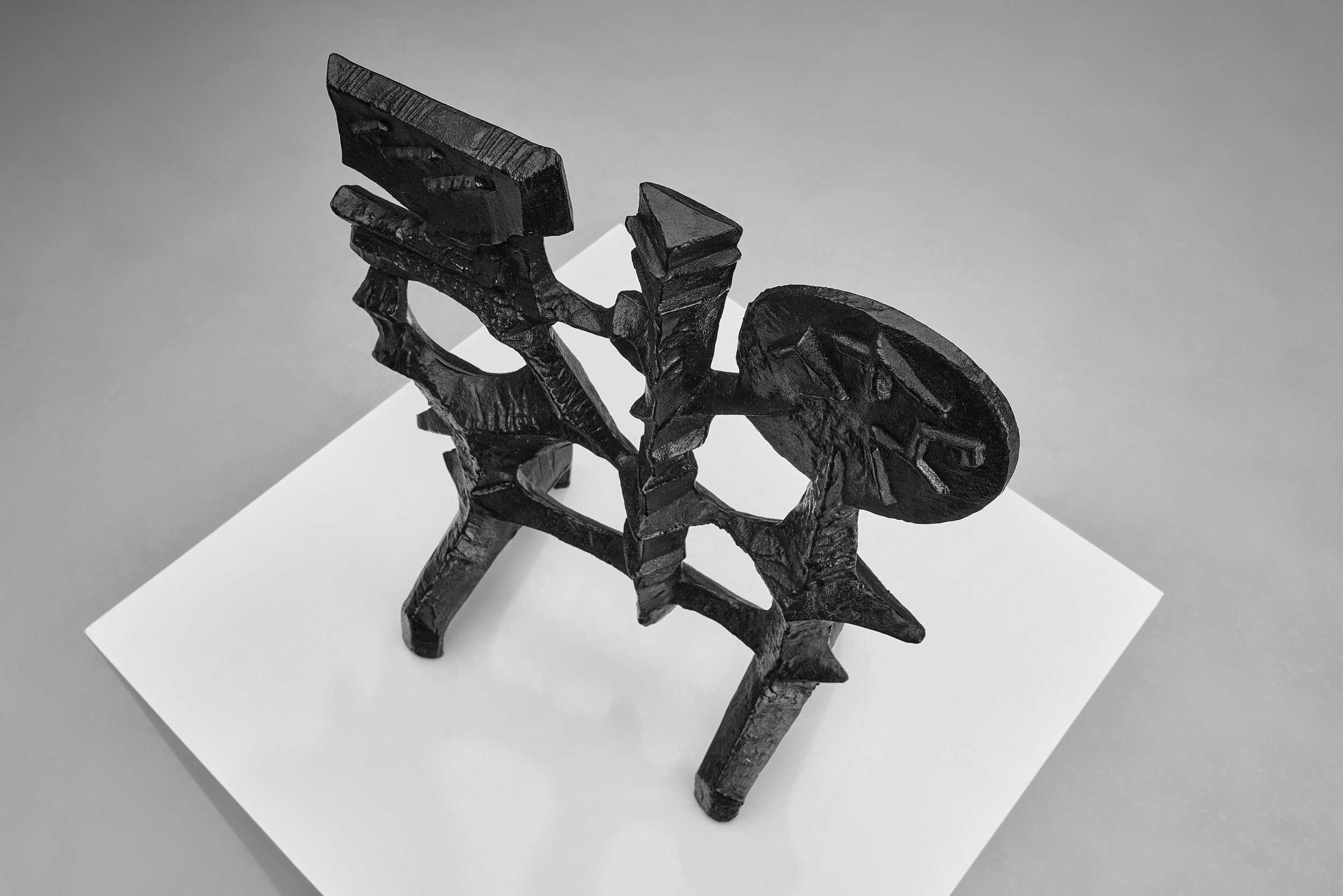
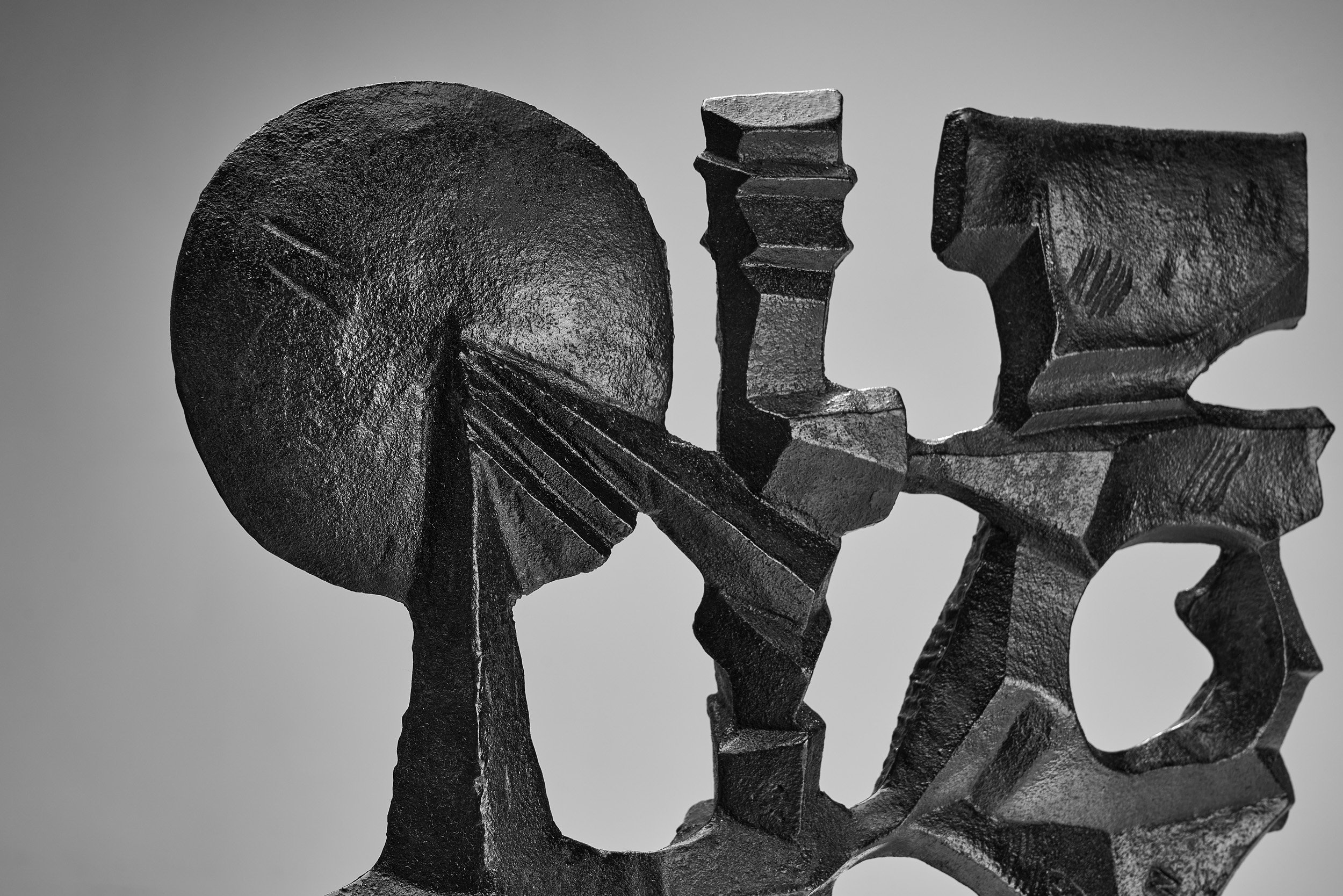
Swedish sculptor, Olle Hermansson is primarily known for his cast iron sculptures and fire screens in his signature Brutalist style. The characters and shapes appearing in his works are often inspired by Nordic mythology.
In this piece, Hermansson uses the robust and weighty medium of cast iron to create a dynamic form that stands as both a piece of art and a reflection of Sweden’s industrial heritage. The sculpture is characterised by bold geometric shapes and textured surface, which provide both visual interest and tactile appeal. Hermansson’s mastery of form is evident in the way the sculpture plays with negative space, light, and shadow, creating an ever-changing visual experience which changes depending on the viewer's perspective. The design reflects the Brutalist ethos of the 1960s, emphasising ruggedness, and the exploration of materials. At the same time, it speaks to the organic qualities of nature, with curves and contours that soften the otherwise rigid structure of the cast iron. As a unique intersection of art and functionality, this sculpture stands as a testament to the collaborative spirit between artists and industry. The integration of modern design with industrial materials like cast iron not only celebrates the aesthetic possibilities of the material but also speaks to the cultural and economic climate of Sweden in the 1960s. Whether displayed indoors or outdoors, this work encapsulates the innovative energy of the era.
This Brutalist sculpture, with its distinctive design and robust materials, becomes a statement, a conversation starter, and a timeless addition that will elevate the aesthetics of any space it occupies.
Condition:
In good vintage condition. Wear consistent with age and use.
Dimensions:
13.38 in W x 6.49 in D x 14.37 in H
34 cm W x 16.5 cm D x 36.5 cm H
REQUEST PRICE HERE
Price category: 1,000 - 2,500 usd / eur
Josef Frank designed Vänskapsknuten (the Knot of Friendship) as a symbol of friendship and peace at a time when Europe was filled with turmoil. The very first sketch of the candelabra dates back to 1938, just a year before the outbreak of the Second World War, but it is as relevant now as it was then.
The Austrian designer and architect may be best known for his vivid textiles for Swedish firm Svenskt Tenn, but his artistic touch reached far beyond textiles and created iconic objects such as this candle holder. The elaborate brass structure intertwines at multiple points, but the brass rods only meet in the middle where a small sphere connects them. Each of the three brass cup have so-called chambersticks, small pans to catch dripping wax. The looping calligraphic design gives this piece a weightless grace that is stunning even without the symbolism behind it. The body’s busy look is completed and balanced by the long candles. The design changes from angle to angle and shows Frank’s sensitive touch. The Knot of Friendship has become an iconic object not only in Svenskt Tenn’s range, but also of Sweden. The production traditionally required a process of thorough methodology and great craftsmanship. Josef Frank was the most prestigious designer in the Stockholm design company Svenskt Tenn (Swedish Pewter), recruited by the founder of the company, Estrid Ericson herself.
Since 2018, after a careful assessment of Josef Frank’s original drawing, the candelabra regained its original form from 1938 under the hands of Svenskt Tenn. However, the production of this well-known and widely-loved candle holder now takes place at Humstorp Metal in Västergötland. This piece however, is from the original production from the post-war era.
Condition:
In good vintage condition. Wear consistent with age and use. The brass has a beautiful patina with some marks. Due to the nature and age of the material, the item may have some scratches and discolouration.
Dimensions:
8.85 in W x 7.48 in D x 6.29 in H
22.5 cm W x 19 cm D x 16 cm H
About the designer:
Josef Frank (July 15, 1885 – January 8, 1967) was an Austrian-born architect, artist, and designer who adopted Swedish citizenship in the latter half of his life. Together with Oskar Strnad, he created the Vienna School of Architecture, and its concept of Modern houses, housing, and interiors.
Josef Frank was one of early Vienna modernism’s foremost figures, but already in the beginning of the 1920s he started to question modernism’s growing pragmatism. He had little appreciation for the French architect Le Corbusier’s belief that a house should be “a machine for living in”. He was against puritanical principles and on the contrary, feared that standardized interiors would make people all too uniform. Josef Frank represented a freer, more artistic style ideal, and he developed his own type of modernism where values like comfort, hominess, and a wealth of colour were at its core. He resisted limitations and models for his furniture and textiles came from across all boundaries both in time and space.
Josef Frank began working at Svenskt Tenn in 1934 and just a few years later, the Frank-Ericson duo made their international breakthrough. Svenskt Tenn’s exhibition room at the World Expositions in Paris in 1937 and New York in 1939 was completely contrary to the ideal of the time with its bold contrasts in materials, colours, and prints. The duo received a great deal of attention and became, somewhat paradoxically, the model for the expression “Swedish Modern”. Although he was already 50 years old when he left Vienna for Sweden, Frank is considered one of Sweden’s most important designers.
REQUEST PRICE HERE
Price category: 1,000 - 2,500 usd / eur
Magazine racks have been around since the middle ages, but as literacy rates increased around the world, and printed media became more accessible, they rose in popularity. By the mid-20th century, they represented an iconic piece of design that adapted to the style of the time. Pieces like this wooden rack reflect the Brutalist movement of the time, while still serving a functional purpose in an era before the widespread adoption of computers.
This wooden rack shows how designers paid great attention to small domestic items that served everyday life, while still contributing to a visually appealing interior. The piece has a highly architectural construction and hand-worked surface. The rack is built entirely from solid wood and composed through an arrangement of intersecting vertical and diagonal supports. The central handle rises upward in a tapering rectangular form, anchoring the composition visually while also functioning as a practical grip for moving the piece. Thin supports extend outward to hold the printed material. Along the lower section, the horizontal base introduces a strong Brutalist character through its organic look and visibly worked surface. The wood retains a rich natural grain throughout, while the slight natural variation of the structural elements prevent the composition from feeling rigid despite its geometric construction.
Rather than treating storage as purely functional, many designers of the mid-century managed to create pieces like magazine stands, newspaper holders, and side tables that additions to a room while maintaining their use. Even when empty, this magazine rack catches the eye, not through excess but through its masterful use of wood and unique form.
Condition:
In good vintage condition. Wear consistent with age and use. The magazine rack has recently been reconditioned. Due to the nature and age of the materials, the item may have some marks, scratches, and discolouration.
Dimensions:
16.54 in W x 12.01 in D x 20.87 in H
42 cm W x 30.5 cm D x 53 cm H
REQUEST PRICE HERE
Price category: 1,000 - 2,500 usd / eur
Carved wooden vessels occupy a unique position between utility and sculpture. Across many African woodworking traditions, everyday objects such as bowls, trays, and serving vessels were shaped directly from solid trunks, allowing the natural characteristics of the timber to determine both the appearance and final form. The resulting pieces often possess a quiet power, where simple gestures and careful craftsmanship create a lasting visual impact.
The silhouette of this tray is bold and compact. Hollowed from a single section of wood, the bowl rests on four short feet that lift it subtly from the surface below. Cylindrical handles project from either side, introducing a horizontal dimension that balances the rounded volume of the vessel. The uninterrupted grain flows across the piece, revealing shifts in colour due to the single-trunk construction. Subtle tool marks and natural variations in the wood lend depth to the surface, while the smooth interior highlights the skill required to create such a form from a solid block of timber. Despite its modest scale, the tray possesses a distinctly architectural quality, built from a combination of shapes and carefully proportioned volumes.
Objects of this kind demonstrate how functional forms can achieve a sculptural presence through material alone. Whether used as a catchall or decorative centrepiece, the tray draws attention to the richness of the wood and the clarity of its construction. Its enduring appeal lies not in elaborate decoration but in the confidence of its form, where every element serves a purpose and contributes to a sense of permanence.
Condition:
In good vintage condition. Wear consistent with age and use. The accent tray has recently been reconditioned. Due to the nature and age of the material, the item may have minor marks, scratches, and discolouration. The piece features an exceptional wood grain.
Dimensions:
14.56 in W x 10.23 in D x 4.33 in H
37 cm W x 26 cm D x 11 cm H
REQUEST PRICE HERE
Price category: 1,000 - 2,500 usd / eur
Finn Juhl is celebrated for his sculptural approach to furniture and household design. Rooted in the principles of modernism and influenced by the Scandinavian cultural emphasis on practicality and beauty, Danish designers like Juhl and Grethe Kornerup-Bang, sought to create furniture and household objects that were both elegant and accessible. Danish design flourished in this era, embodying a timeless aesthetic that prioritised human comfort and sustainable practices, laying the foundation for its post-war international acclaim.
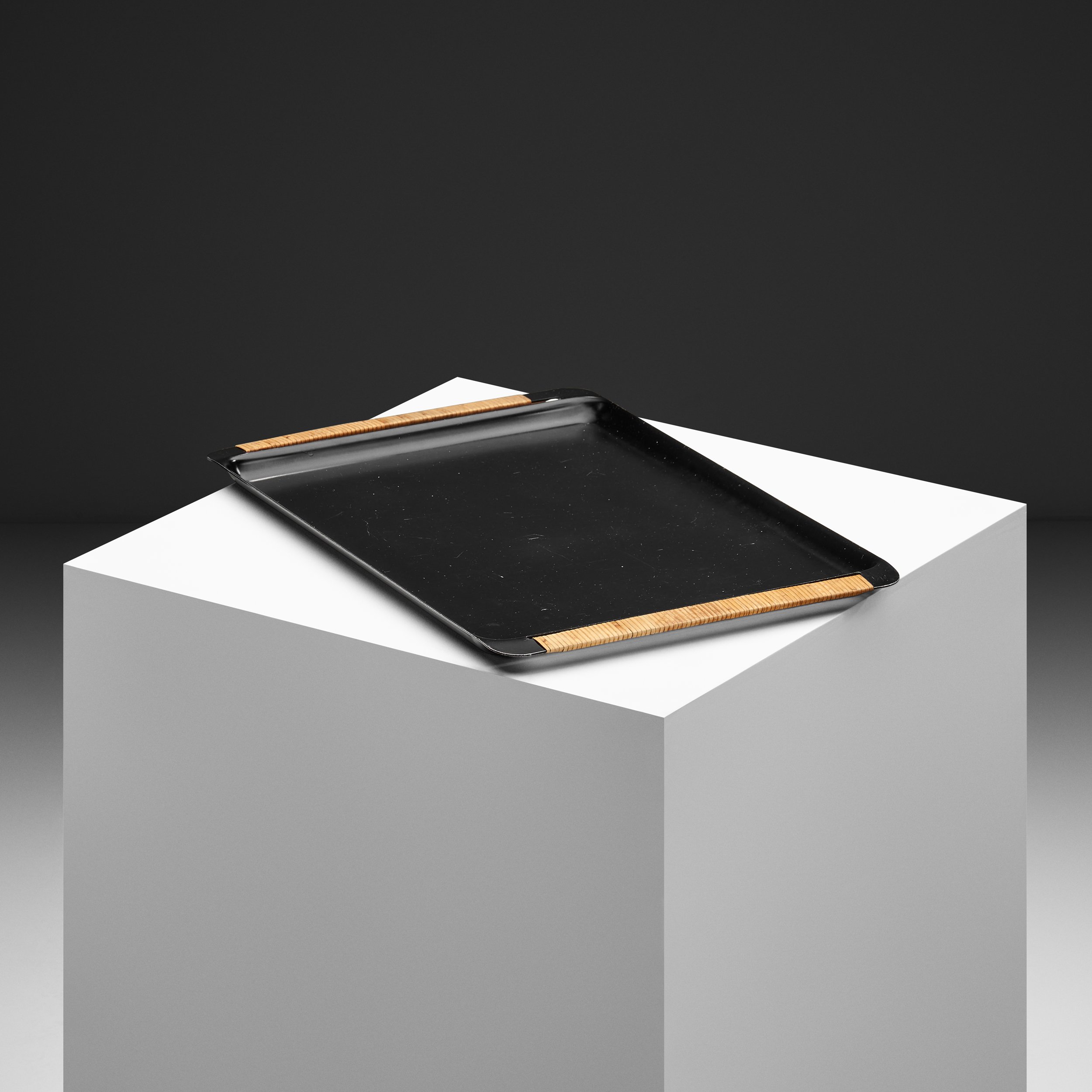
This tray by Finn Juhl and Grethe Kornerup-Bang, is a refined example of Danish Modern design at its most understated. Crafted from folded sheet metal with a matte black finish, the tray is elevated by its distinctive hand-wrapped wicker handles, which introduce warmth, texture, and a tactile quality to an otherwise minimalist form. The thoughtful contrast between industrial and natural materials reflects the enduring Danish design philosophy of balancing functionality with organic beauty. Both functional and decorative, the tray can be used at home serving drinks or displayed as a sculptural object. Its clean architectural lines, softened by the wicker-wrapped handles, embody the timeless appeal of mid-century Danish design. Pieces like this are increasingly sought after for their rarity and quiet sophistication.
Whether it is displayed as a centerpiece or used for everyday purposes, this tray encapsulates the timeless appeal of mid-century modern Danish design and the unparalleled craftsmanship of its era.
Condition:
In good vintage condition. Wear consistent with age and use. The tray has recently been reconditioned. Due to the age and nature of the materials, the item has marks, scratches, and discolouration.
Dimensions:
17.72 in W × 12.40 in D × 0.59 in H
45 cm W x 31.5 cm D x 1.5 cm H
REQUEST PRICE HERE
Price category: 1,000 - 2,500 usd / eur
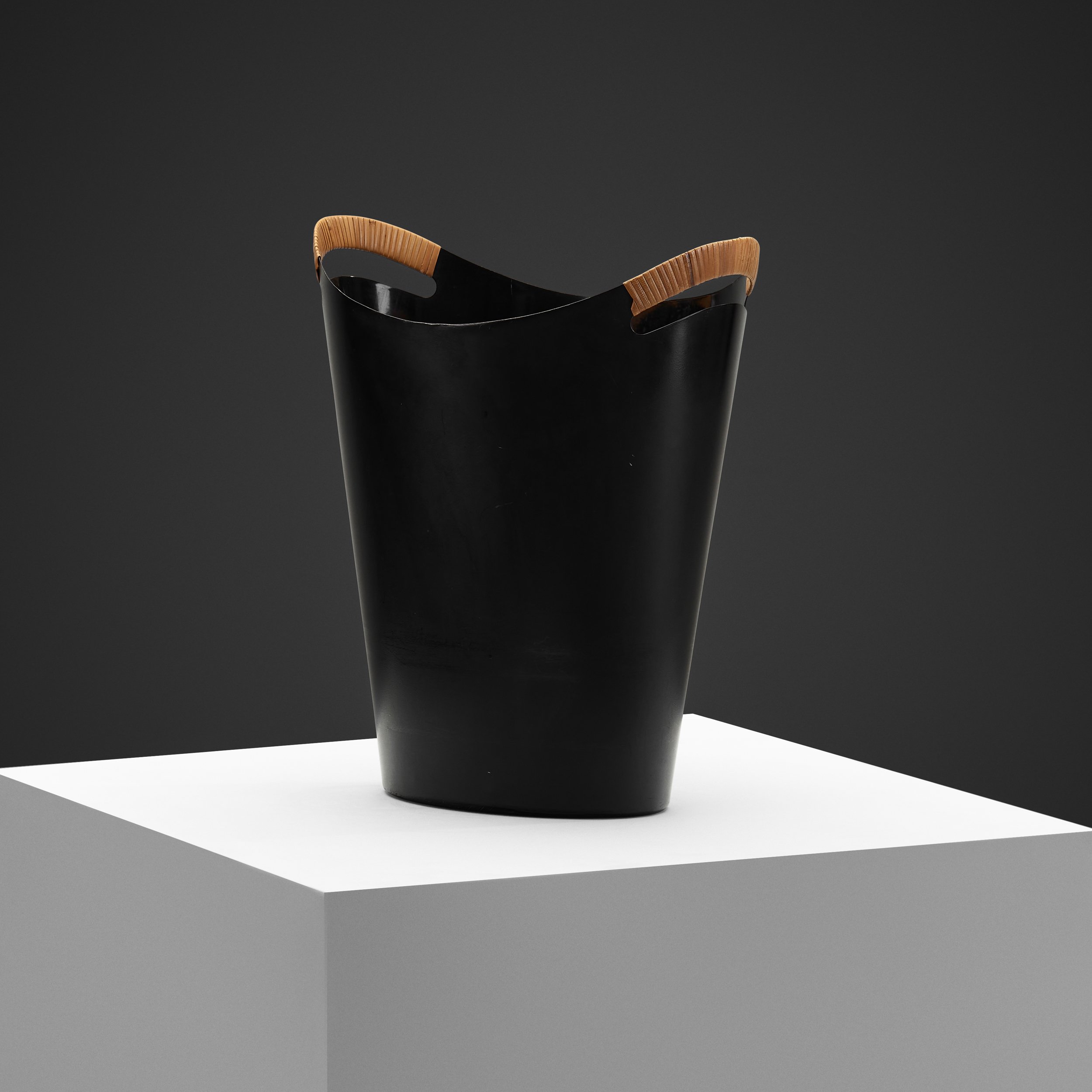
Finn Juhl (1912 – 1989) was an architect, interior and industrial designer from Denmark. He is regarded as one of the leading figures of Danish design in the 1940s and was the first to successfully introduce the “Danish Modern” design style to America. Danish design flourished in this era, embodying a timeless aesthetic that prioritised human comfort and sustainable practices, laying the foundation for its post-war international acclaim.
Rooted in the principles of modernism and influenced by the Scandinavian cultural emphasis on practicality and beauty, this basket by Finn Juhl and Grethe Kornerup-Bang, is a refined example of Danish Modern design at its most understated. Crafted from folded sheet metal in a refined matte black finish, this stand-out piece is elevated by hand-wrapped wicker handles that add warmth, texture, and tactile appeal to its minimalist silhouette. The juxtaposition of industrial metal and natural wicker reflects the timeless Danish design tradition of combining functionality with organic beauty. The basket balances smooth lines with the softness of its woven handles. Its understated character and mid-century Danish aesthetic make it a timeless addition to the home, while its quiet sophistication and deep ties to danish design history make pieces of this kind increasingly sought after.
Designers like Juhl and Grethe Kornerup-Bang, sought to create furniture and household objects that were both elegant and accessible. Whether it is displayed as a centerpiece or used for everyday purposes, this basket encapsulates the timeless appeal of mid-century modern Danish design and the unparalleled craftsmanship of its era.
Condition:
In good vintage condition. Wear consistent with age and use. The basket has recently been reconditioned. Some scratches are present. Due to the age and nature of the materials, the item may have marks and discolouration.
Dimensions:
11.81 in W x 8.26 in D x 13.38 in H
30 cm W x 21 cm D x 34 cm H
REQUEST PRICE HERE
Price category: 5,000 - 7,500 usd / eur
“Breathing'“ by Dutch sculptor Ineke van Zuuren is an exploration of organic abstraction. Van Zuuren transforms a dense block of wood into a form that feels remarkably fluid and alive. Rather than depicting the human figure directly, van Zuuren suggests its presence through graceful curves, balanced proportions, and an elegant sense of movement.
The rich, dark tones of the sculpture are complemented by the wood’s striking natural grain, which becomes an integral part of the composition. Smoothly sculpted convex and concave surfaces catch the light beautifully, emphasising the subtle transitions in the form while highlighting the warmth and tactile quality of the material. The result is a work that feels both monumental and intimate, celebrating the expressive possibilities of solid wood. This sculpture is undoubtedly as captivating from afar as it is up close. This work invites viewers to engage with the interplay of tradition and innovation, celebrating the enduring appeal of solid wood as a medium for artistic expression.
This piece is also a rare representation of Dutch Post-Modernist design, an interesting phase of cultural, social impacts with artists and designers trying to figure out their way towards leaving their marks.
Condition:
In good vintage condition. Wear consistent with age and use. Due to the nature and age of the material, the sculpture may have marks, scratches, and discolouration.
Dimensions:
23.62 in W x 13.38 in D x 33.46 in H
60 cm W x 34 cm D x 85 cm H