
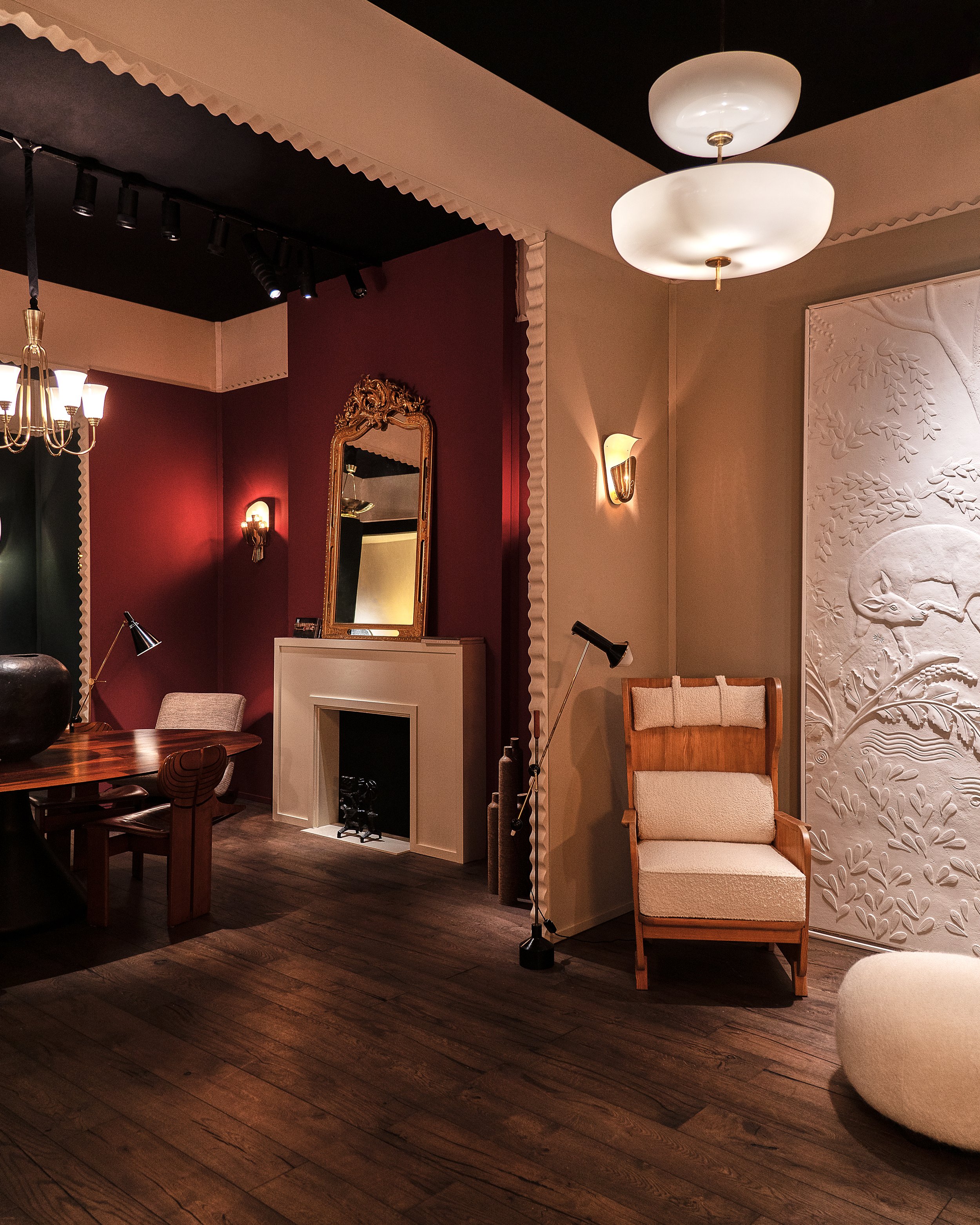
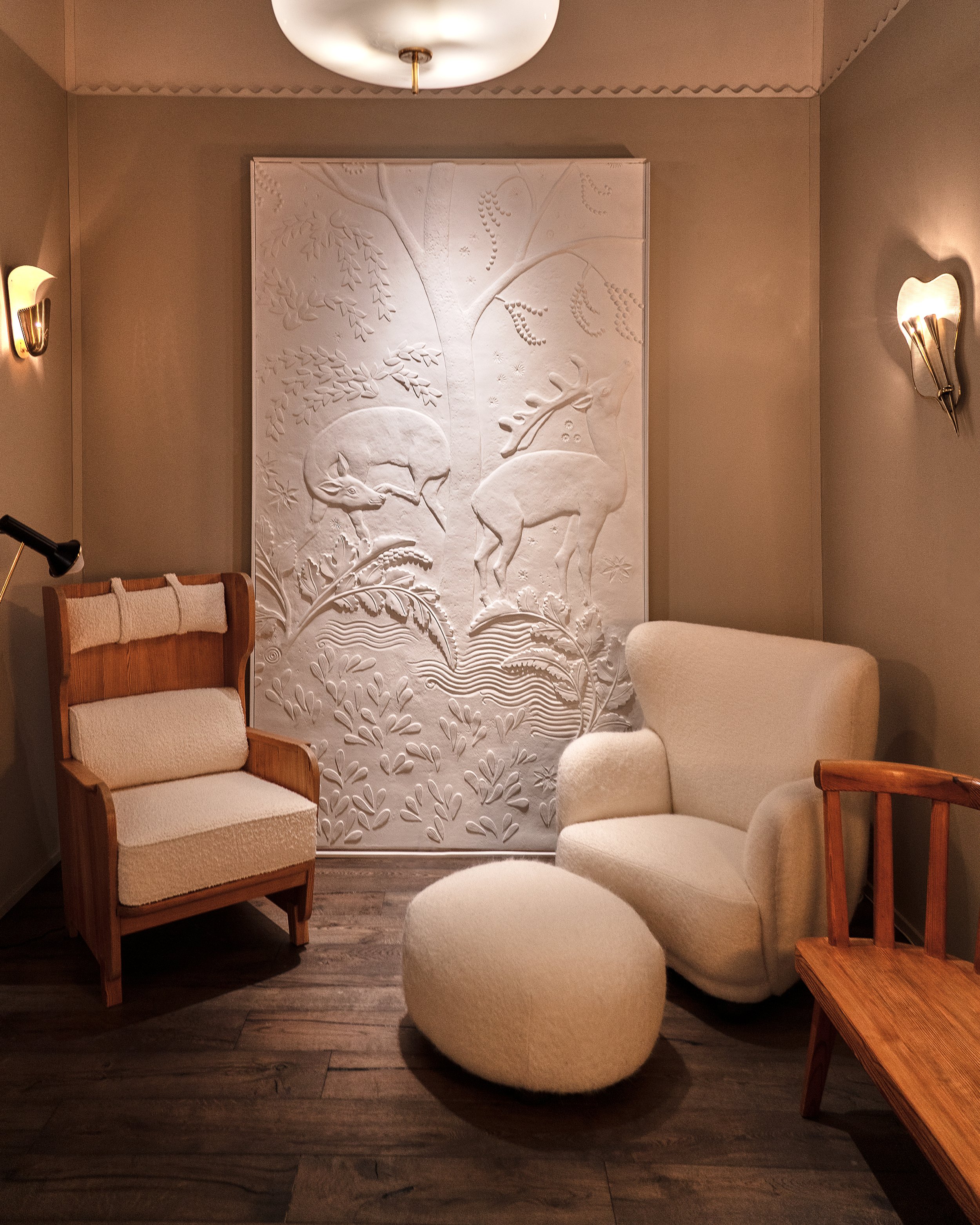
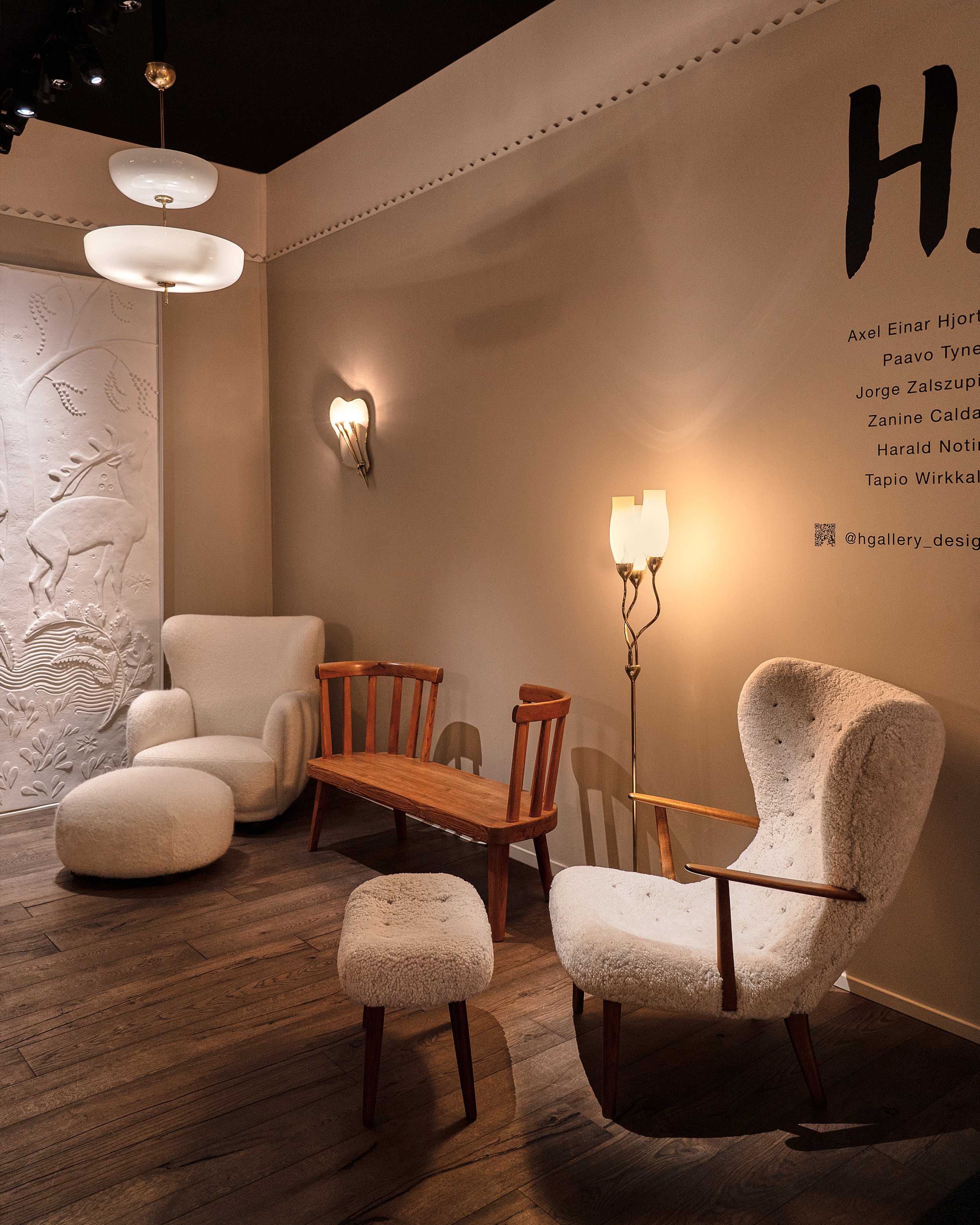
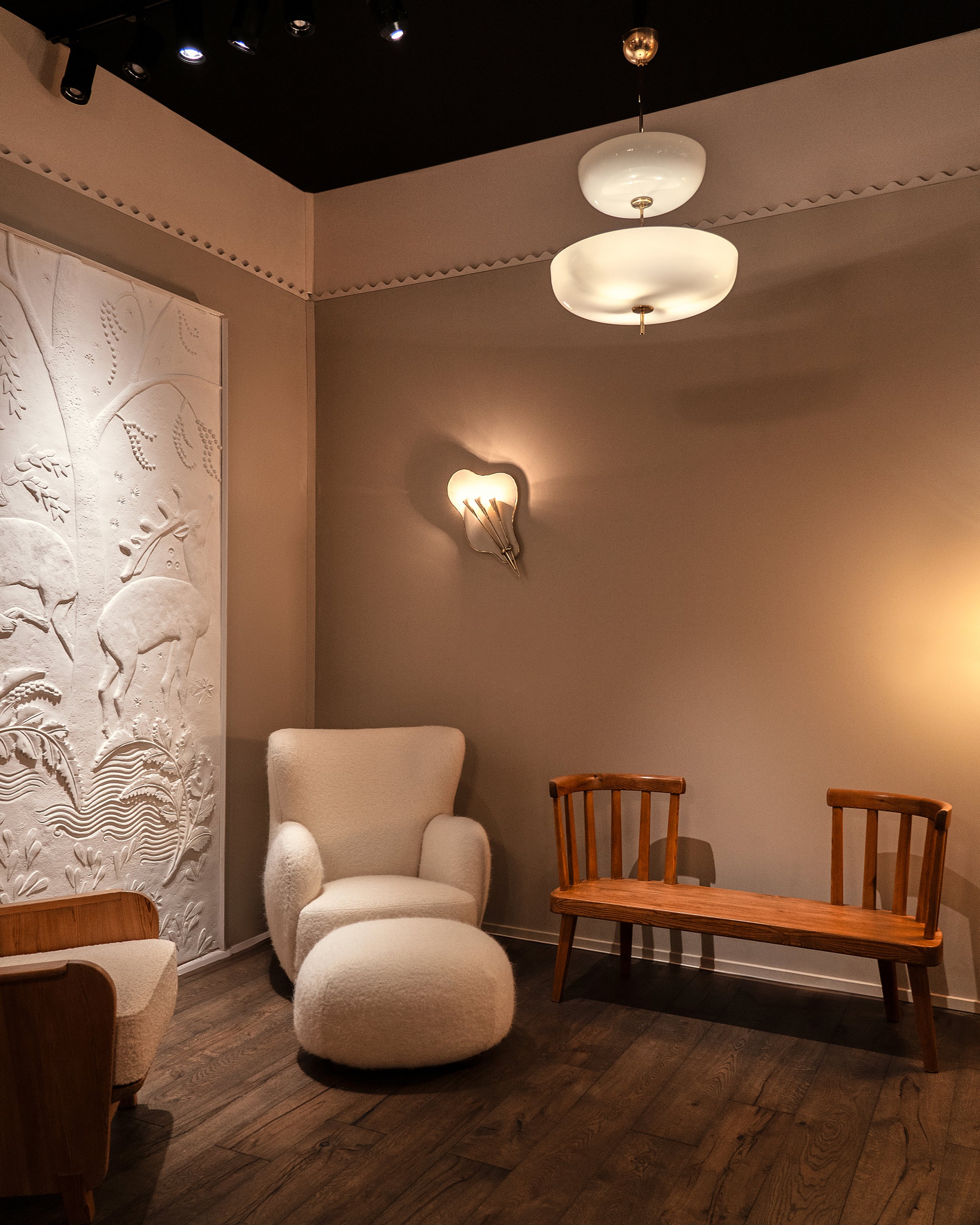
HIGHLIGHTS
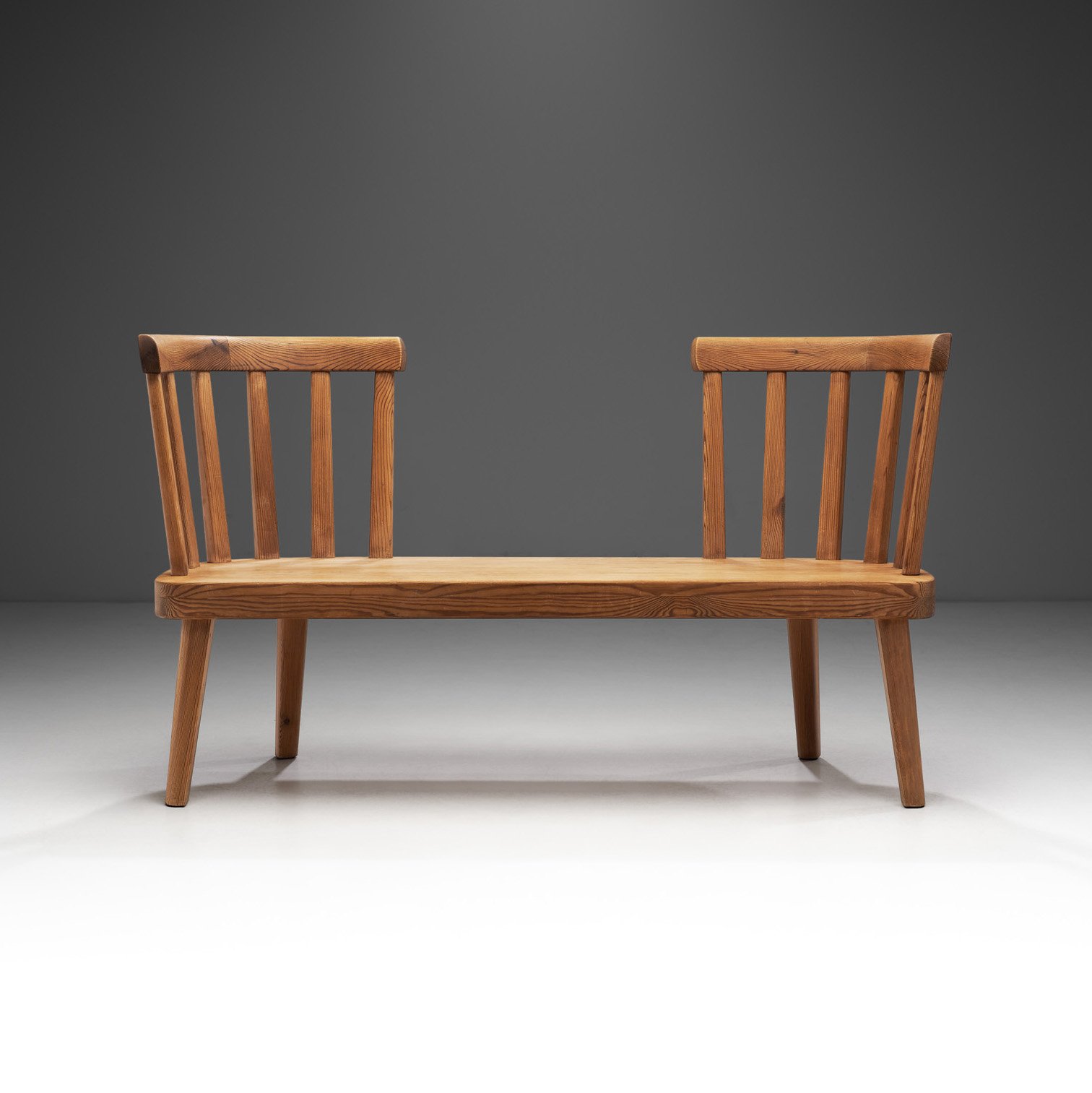
This “Utö” bench is from the Swedish designer, Axel Einar Hjorth’s Sportstugemöble furniture line.
This bench has a rather simple, yet well-thought out design. The frame is made of pine, mixing the aesthetics of rural, traditional handcraft with international modernism. Produced by AB Nordiska Kompaniet, this bench belongs to Hjorth's line of modernistic cabin furniture from the 1930's. The seat of the bench is thick and robust, with an oval shaped pine board, assuring sturdiness and stability. The symmetrically carved back with a gap in the middle offers comfort and functionality.
The four tapered legs of the bench follow the shape of the backrests on both sides, accentuating the geometrical aspect, and highlighting the symmetry of this piece.
SOLD
Condition:
In good vintage condition. Wear consistent with age and use.
Dimensions:
54.92 in W x 18.7 in D x 31.3 in H ; Seat height 15.55 in
139.5 cm W x 47.5 cm D x 79.5 cm H; Seat height 39.5 cm
Literature:
Christian Björk, Thomas Ekström and Eric Ericson, Axel Einar Hjorth: Möbelarkitekt, Stockholm, 2009, pp. 130, 133.
Christian Björk, Thomas Ekström and Eric Ericson, Axel Einar Hjorth: (Svenska arkitekter och formgivare), Stockholm, 2011, pp. 124, 137.
About the designer:
Hjorth’s designs, from the luxury of neo-classicism to the severity of functionalism, are sharply distinctive in style, materials, and character. Unlike many of his contemporaries, Hjorth did not conform to the socially oriented ideas produced by Svensk Form (the Swedish Society of Crafts and Design). He often incorporated playful ornamentation from different historical periods by which he was inspired, such as the French Art Déco which was characterised by the use of mixed exotic woods, bright colors, and textiles.
In the 1930s, Hjorth designed a furniture collection out of pine meant for serial production known as Sportstugemöbler: ‘furniture for holiday houses’. The collection is based on Swedish rural traditions mixed with international modernism, and had its pieces named after Stockholm's archipelago islands including Blidö, Sandhamn, Toro and Lovö. The pieces are well renowned for being very modern and displaying strong proportions, simplicity in construction, and a brilliant union between tradition and modernism. ~H.
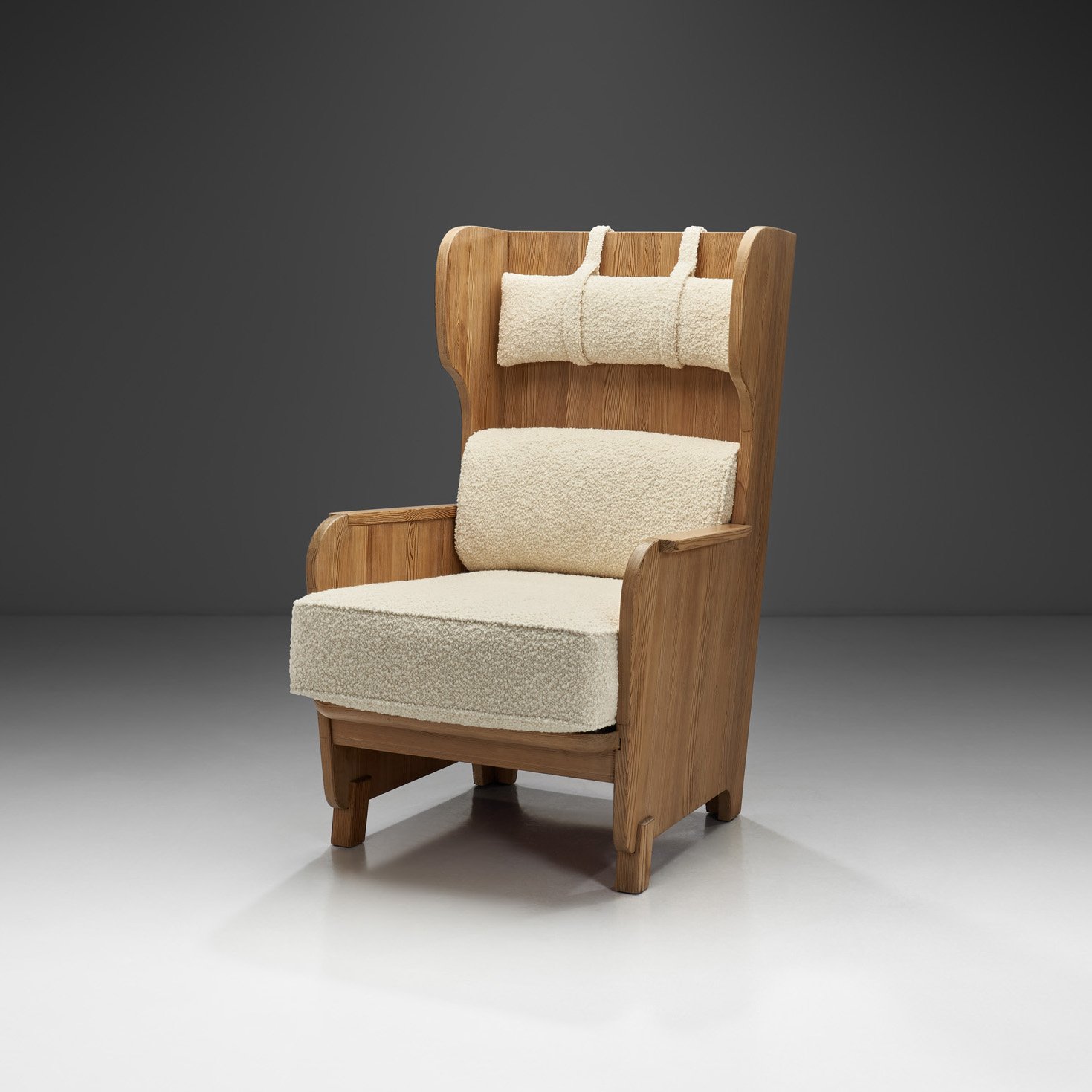
Swedish architect and furniture maker Axel Einar Hjorth worked as the lead designer for Sweden’s Nordiska Kompaniet department store from 1926 to 1938. While combining the simple, honest forms of the traditional nordic “allmoge” furniture common in Swedish rural culture, with the international 20th century Modernist movement, Hjorth designed the “Sportstugemöbler” series, (“sports cabin furnishings”) a collection of wooden furniture designed for country homes.
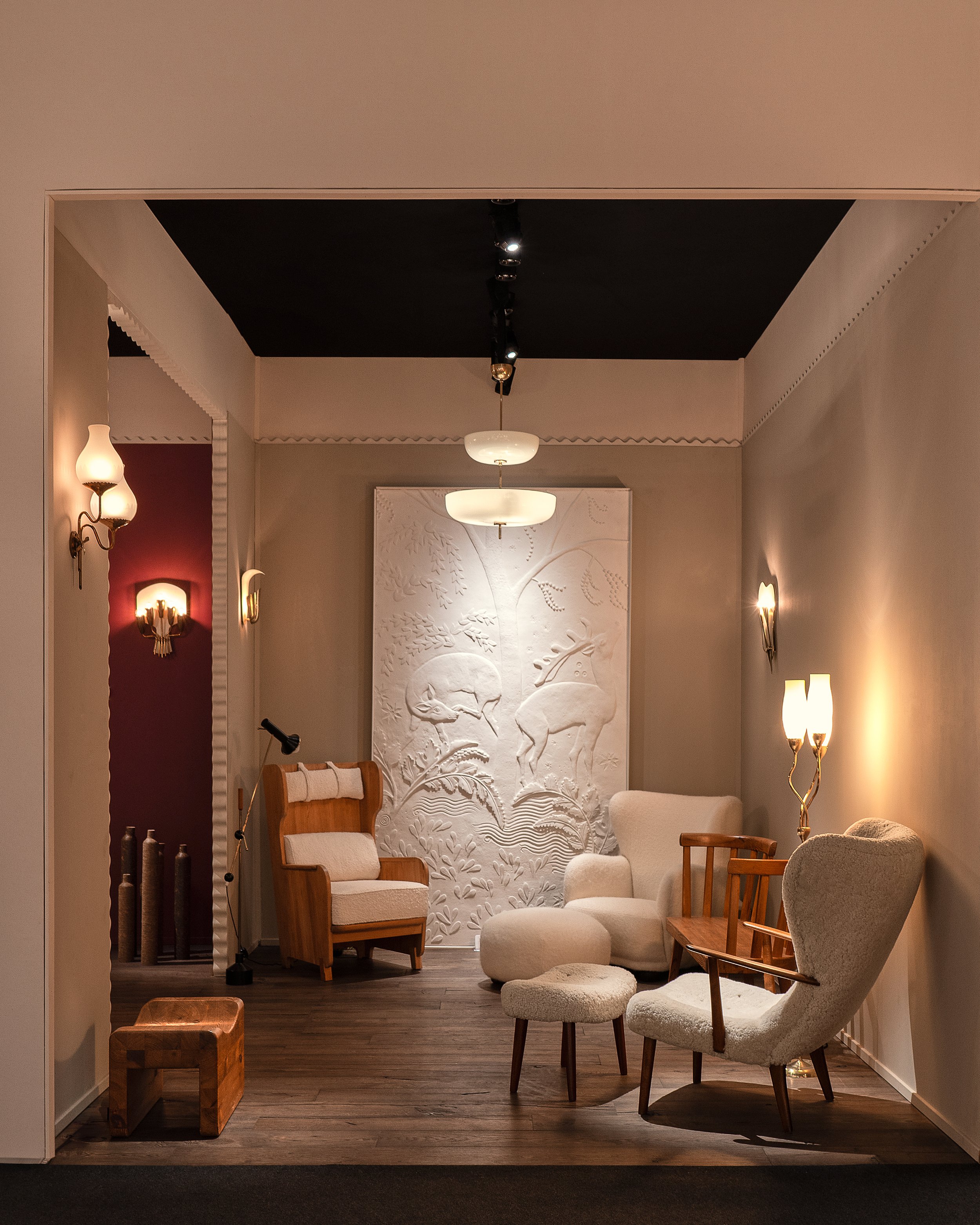
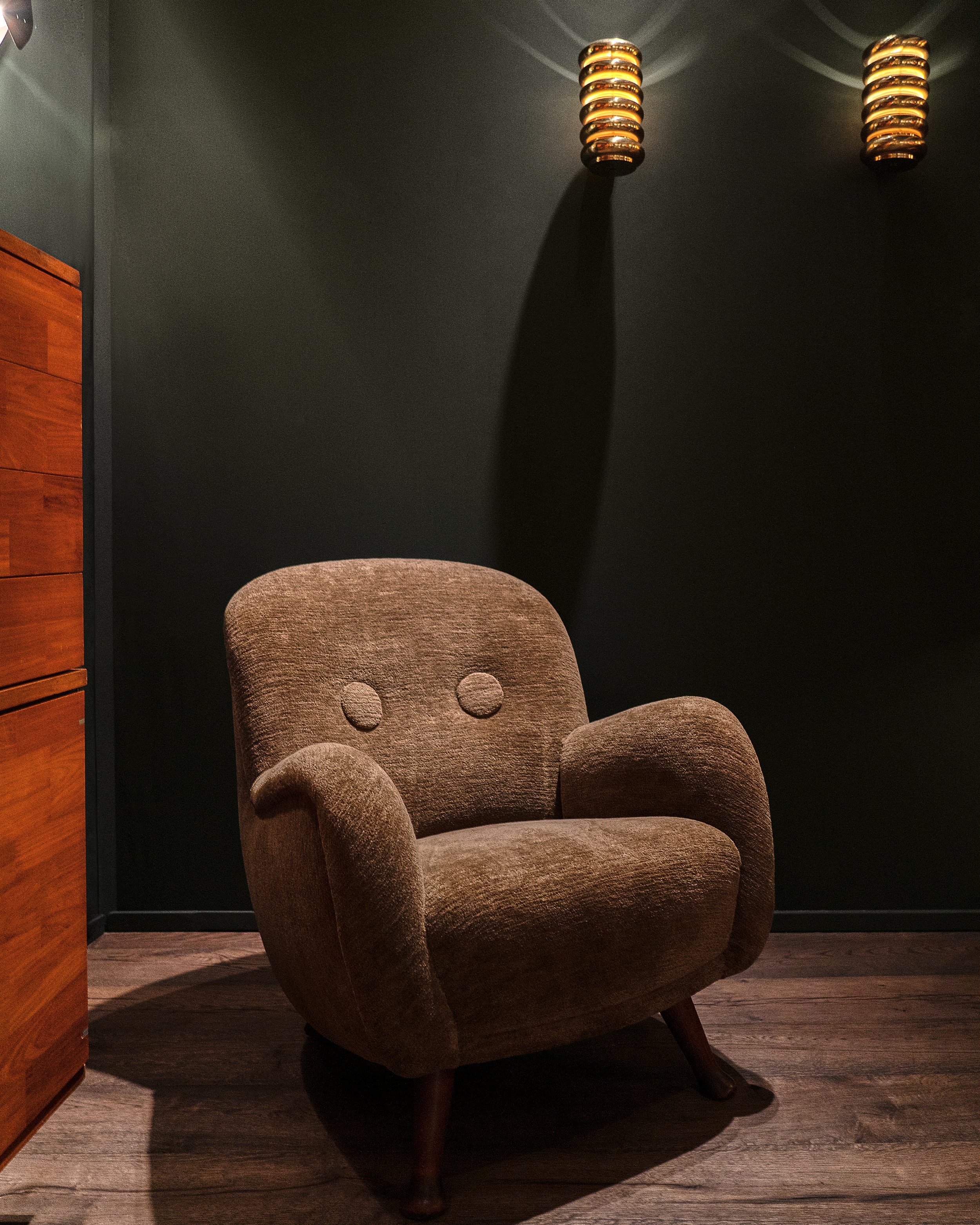
The “Lovö” chair, part of the series of chalet furnishings, was initially launched by Nordiska Kompaniet in 1932. The series was a response to a new, growing demand for furnishings for leisure houses, thus Hjorth used local pine to create a model that unites the robust and straightforward Nordic style with skilful handcrafting. The result is a modest, yet visually interesting presence with a strong graphic outline. From the welcoming winged body and the solid wood frame to the cosy bouclé upholstery, this chair expresses a quality of cosiness and comfortable conviviality that provokes a feeling of contentment. The distinctive shape is a result of the two “ears” that encompass the sitter. The overall construction is quite angular but due to Hjorth’s master craftsmanship, the rounded side profile of the “ears” and armrests allow for a softer look, ensuring the chair would fit seamlessly into a living room. The chair also offers comfortable padding through the loose, removable plush cushions and headrest. Upholstered in a cream boucle fabric, these pillows complete the design both textually, and visually, harmonising with the warm tone of the pine wood. The design is completed by the short legs - while the back ones are constructed from the same piece of wood as the rest of the body, the front legs show the mark of a master cabinetmaker through their joinery.
Axel Einar Hjorth’s “Sportstugemöbler” series that this armchair is part of had an influence on the design world, inspiring both his contemporaries, such as Carl Malmsten, as well as fore-running international designers like Charlotte Perriand. This chair stands as proof of Hjorth’s characteristic style, and as an iconic piece of “primitive modernism”.
SOLD
Condition:
In good vintage condition. Wear consistent with age and use. The cushions have been newly produced. Each of our items can be reupholstered by our in-house atelier in a fabric of choice. Please reach out for more information.
Dimensions:
27.55 in W x 33.85 in D x 44.09 in H; Seat height 19.68 in; Seat depth 22.83 in; Arm height 23.81 in
70 cm W x 86 cm D x 112 cm H; Seat height 50 cm; Seat depth 58 cm; Arm height 60.5 cm
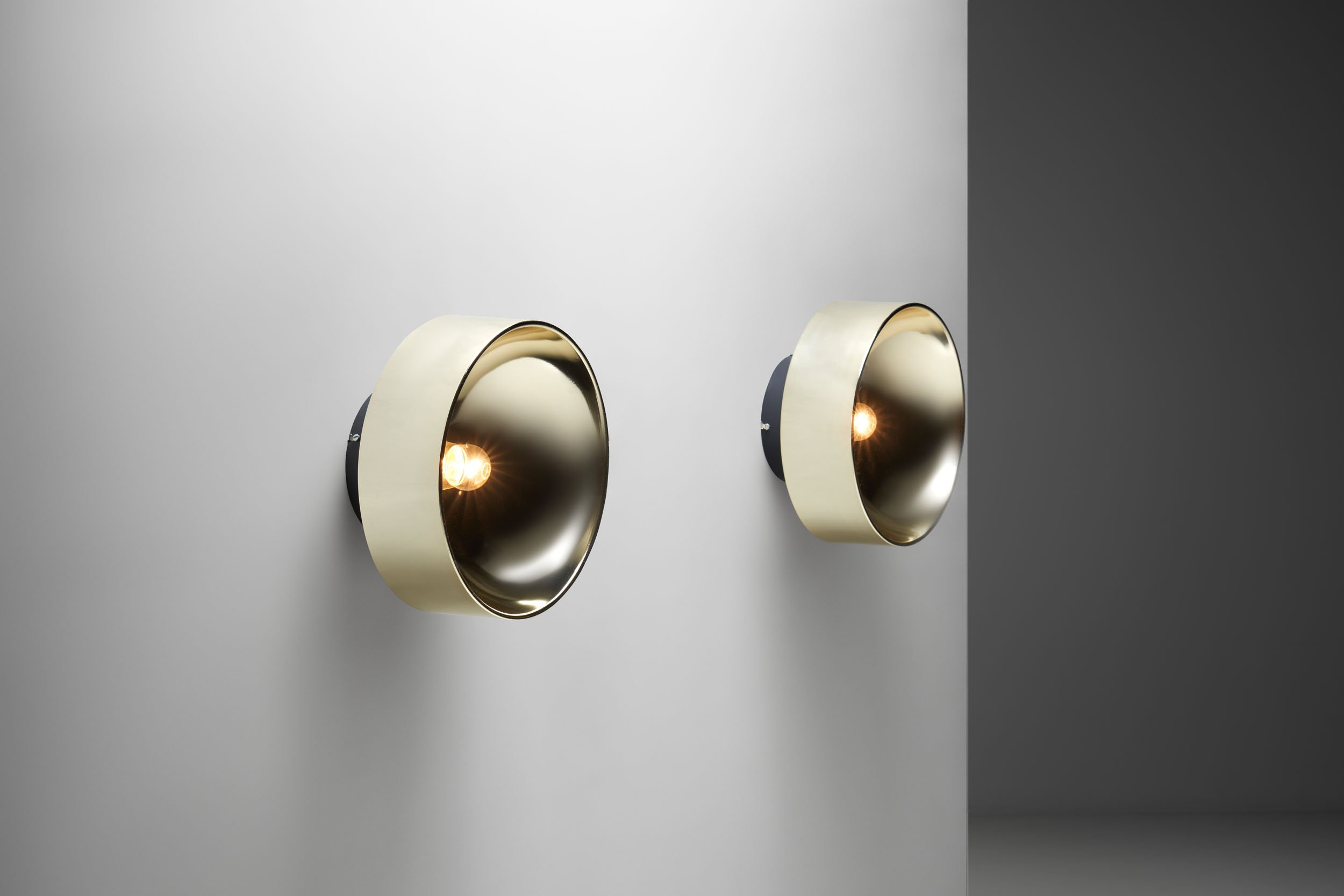
This pair of Peter Celsing wall sconces are celebrated for their iconic design, bringing modernity into any setting. Being a visual representation of “Svensk design”, this model projects a powerful, concrete rendering of a sort of essentialized “Swedishness”.
These stylish brass wall sconces were designed by Celsing for Falkenberg in 1966 for the cultural center Kulturhuset in Stockholm. The modernistic look is achieved by the simple and smart design of the silhouette. The yellow brass bodies of this pair gently reflect the light, which can be elevated even more with diverse lightbulbs. The concave bowls are slightly lifted from the wall by the matte, black lacquered rings, giving them a floating appearance. The bulbs are placed directly in the centre of the bowls, reflecting the warm, subdued light evenly across the room. This model is equally attention grabbing placed vertically on a wall or on the ceiling.
The Swedish Falkenbergs Belysning was an excellent manufacturer of various lighting designs, with some models exhibited in museums to this day. Kalmar Läns Museum is among the Swedish institutions where the manufacturer’s lamps and their history is exhibited as part of the country’s cultural design heritage.
SOLD
Condition:
In good vintage condition. Wear consistent with age and use. The lamps have some small marks and scratches.
Dimensions:
11.41 in Ø x 6.29 in D
29 cm Ø x 16 cm D
About the designer:
Peter Elof Herman Torsten Folke von Celsing (January 29, 1920 – March 16, 1974) was a Swedish modernist architect.
He was born in Stockholm, Sweden and studied at the architectural school of the Royal Institute of Technology in Stockholm, and at the Royal Swedish Academy of Arts. Celsing has been the assistant of the widely known Swedish architect Sigurd Lewerentz. According to Adam Caruso, it was Celsing that helped Lewerentz to win the design competition for the Church of St. Mark (Markuskyrkan). This building and the later St. Petri Church (Olaus Petri kyrka) are now known as a starting point of brutalist architecture.
He later became professor of architecture at the Royal Institute of Technology. After working for some time in Beirut, he became head of the architectural office of AB Stockholms Spårvägar, the Stockholm tram and local railway authority, and designed a number of suburban metro stations. He also designed several churches: in Härlanda (Gothenburg), Almtuna (Uppsala), and Vällingby, a much-publicized modernist suburb of Stockholm.
Celsing often worked in a brutalist style with large exposed grey concrete surfaces, but occasionally combined this with large glass panes exposing the structure of the building from the outside, and interior details in wood. The best-known example of this are the Kulturhuset (House of Culture) at Sergels torg in central Stockholm (1966–1971). While he is mostly remembered as an architect, Celsing also designed furniture, mainly lighting, which reflects his talent in both architectural and furniture design. ~H.
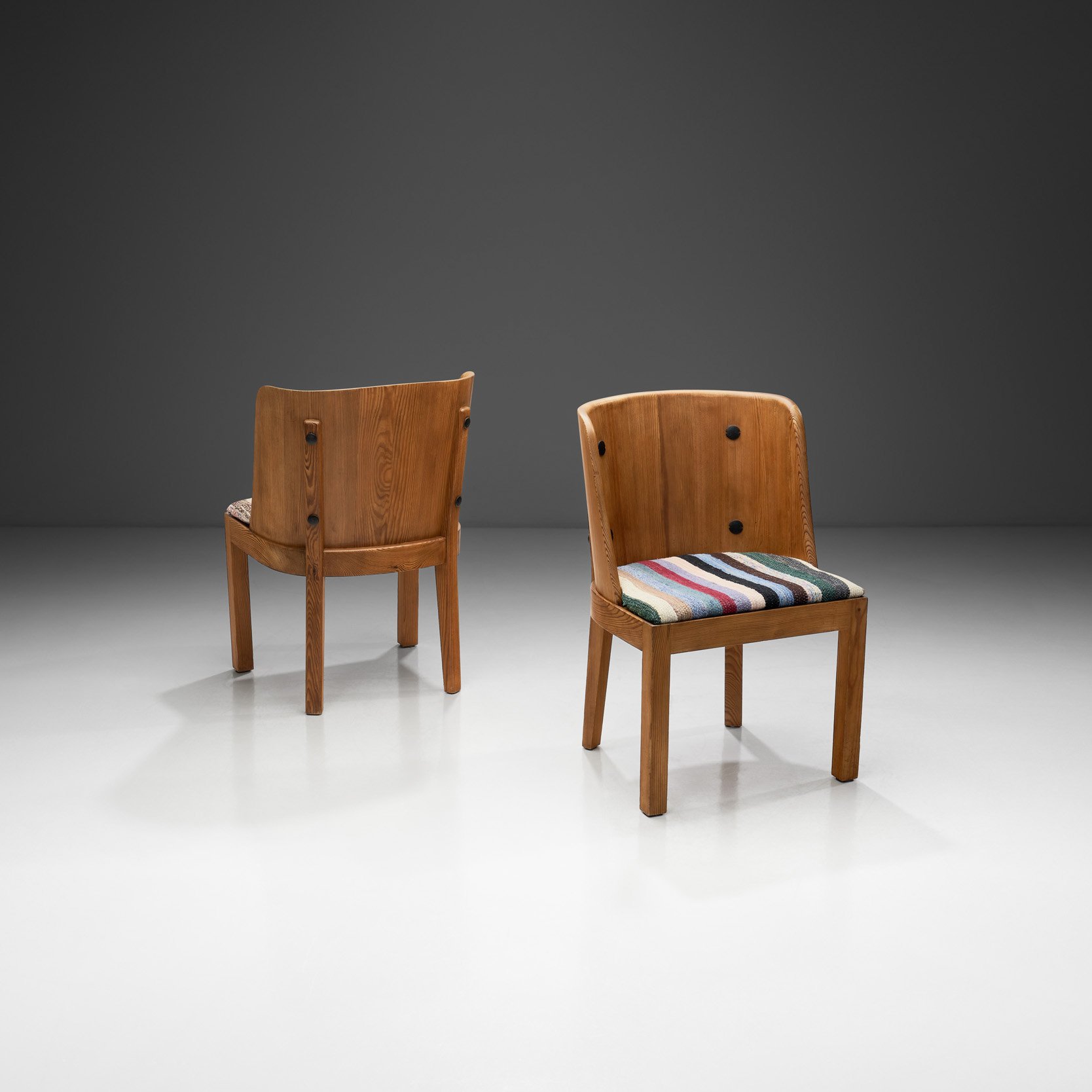
Swedish architect and furniture maker Axel Einar Hjorth worked as the lead designer for Sweden’s Nordiska Kompaniet department store from 1926 to 1938. During this time, Hjorth designed the “Sportstugemöbler” series, (which translates to “sports cabin furnishings”) a collection of wooden furniture designed for country homes. The various models in the sportstugemöbler series took their names from locations in the Stockholm archipelago – including Blidö, Lovö, and Utö.
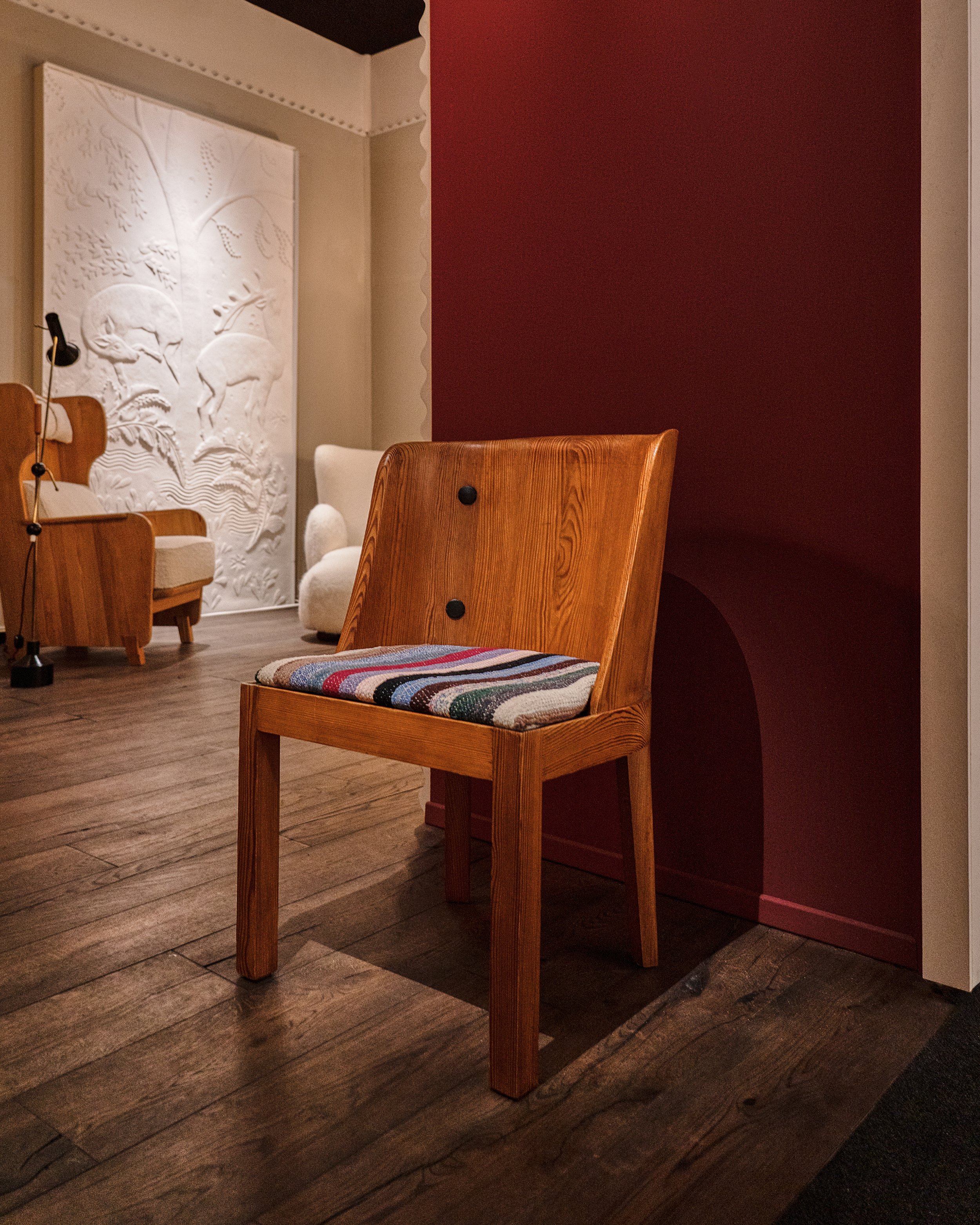
The “Lovö” model, designed within the series of chalet furnishings, was initially launched by Nordiska Kompaniet in 1932. The series was a response to a new and growing demand for furnishings for leisure houses where the style was more informal. These chairs are crafted from local pine wood, while the backrests feature iron rivets. The juxtaposition between the pine and iron provides a rustic, sturdy and resilient feel, elevating the timeless look of the model. The chairs combine simple and honest forms of the handcrafted style of traditional Nordic “allmoge” furniture, and the international 20th century Modernist movement. The result is a modest yet visually interesting design with a strong silhouette. The pine bodies are composed of a low, curved back that is slightly tilted in order to increase the sitter’s comfort— highlighting the functional nature of the pair. The seats feature loose, removable cushions, upholstered in a textural, striped fabric. Not only is the design of the chairs unique, but the colourful, cushions further increase their special character, ensuring remarkable charm. The design is completed by four square, straight legs, offering the pair sturdiness.
The “Sportstugemöbler” series had a lasting influence on Hjorth’s contemporaries, inspiring other big names within Nordic design, such as Carl Malmsten. From an international perspective, this series is the forerunner of later pioneering designs, so it comes as no surprise that these “Lovö” chairs became part of modernist design history.
SOLD
Condition:
In good vintage condition. Wear consistent with age and use.
Dimensions:
20.86 in W x 20.07 in D x 31.49 in H; Seat height 18.50 in; Seat depth 16.92 in
53 cm W x 51 cm D x 80 cm H; Seat height 47 cm; Seat depth 43 cm
About the designer:
Axel Einar Hjorthwas born in a small Swedish village named Krokek, just outside Norrköping, on March 7, 1888. At the age of 20, he moved to Stockholm to study architecture and design at the Högre Konstindustriella Skolan.
Although he never graduated, in the 1920s Hjorth started working as a furniture designer for various manufacturers, such as H. Joop & Co., Myrestedt & Stern, Jonssons, and Nordiska Kompaniet. Hjorth’s designs from this period had neoclassical features combined with Swedish Grace. This romantic national style of Sweden was elegant and refined, yet simple. The anniversary exhibition of 1923 in Gothenburg marked the breakthrough of Swedish decorative arts, and made Axel Einar Hjorth a well-respected artist. From October 1926, Hjorth became the chief designer and architect of Nordiska Kompaniet department store in Stockholm. In the 1930s, Hjorth designed a furniture collection out of pine meant for serial production known as Sportstugemöbler (furniture for holiday houses).
Hjorth’s designs, from the luxury of neoclassicism to the severity of functionalism, are sharply distinctive in style, materials, and character. Unlike many of his contemporaries, Hjorth did not conform to the socially oriented ideas produced by Svensk Form (the Swedish Society of Crafts and Design). He played a significant role in the development of Swedish society as a whole, and particularly in Swedish industrial art.
Today Hjorth is often viewed as a precursor to the modern designs popularized by Charlotte Perriand, Jean Royére, Pierre Chapo, or Josef Frank. Recently, there has been a revival of appreciation for his work, showing his genius in a new light.
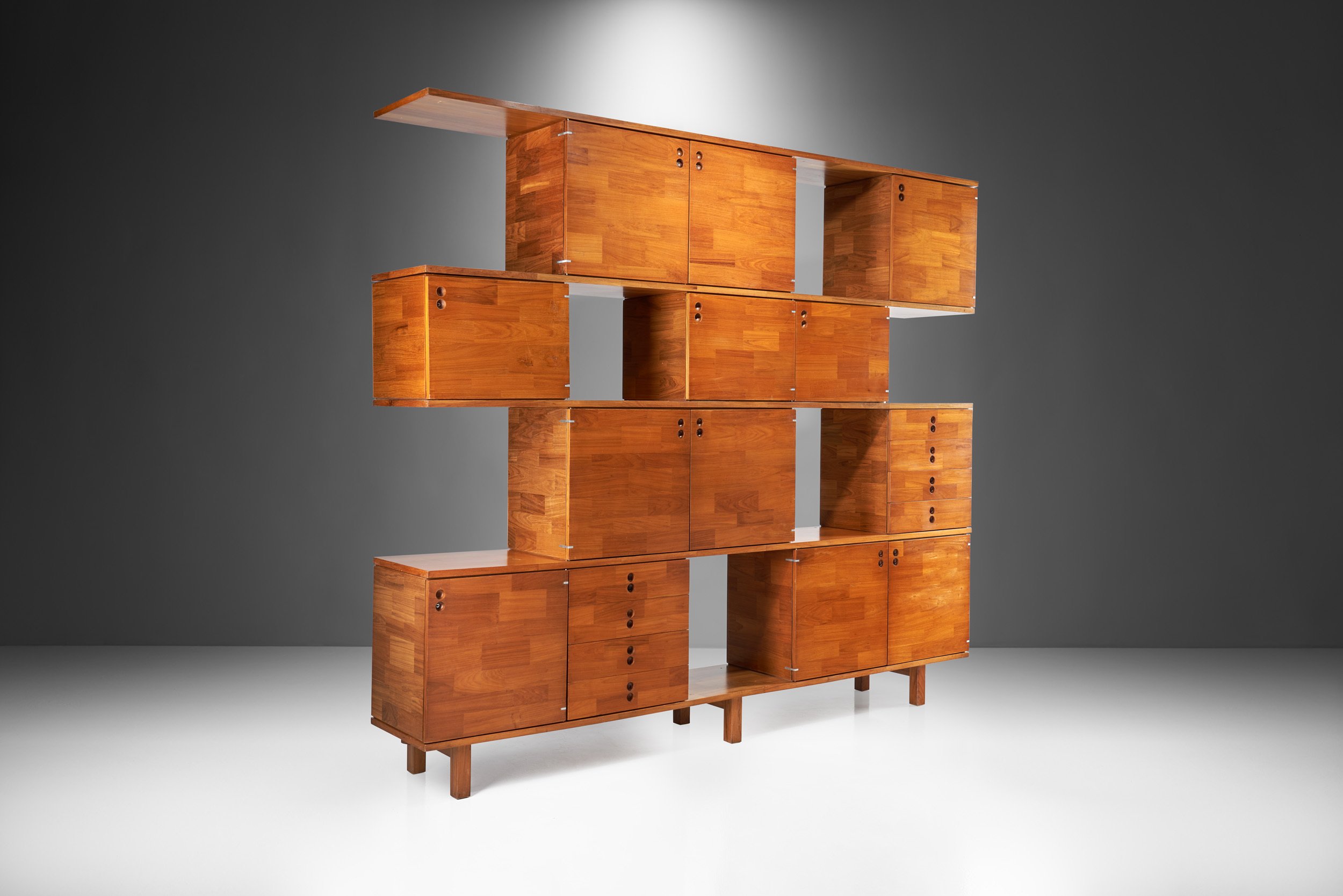
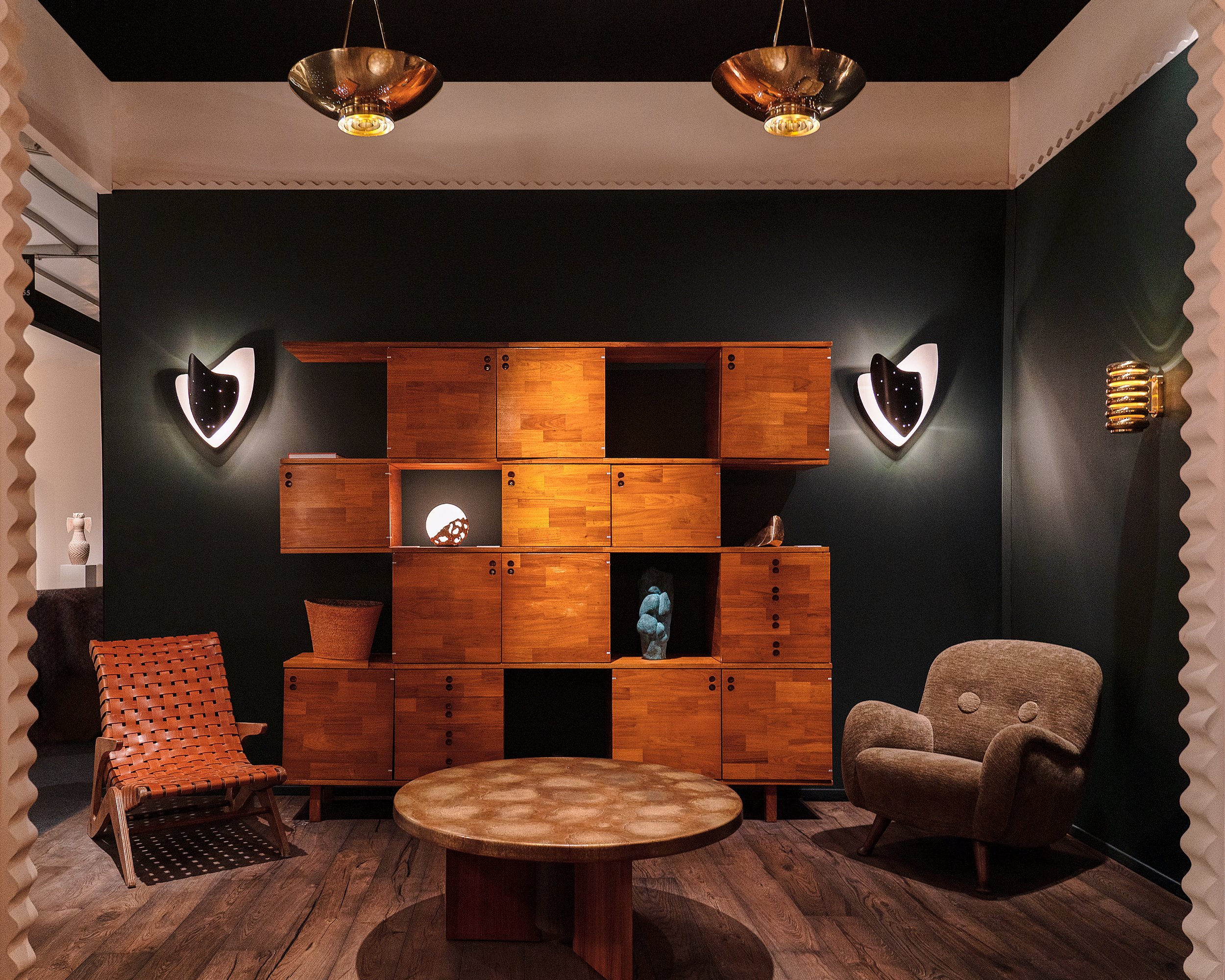
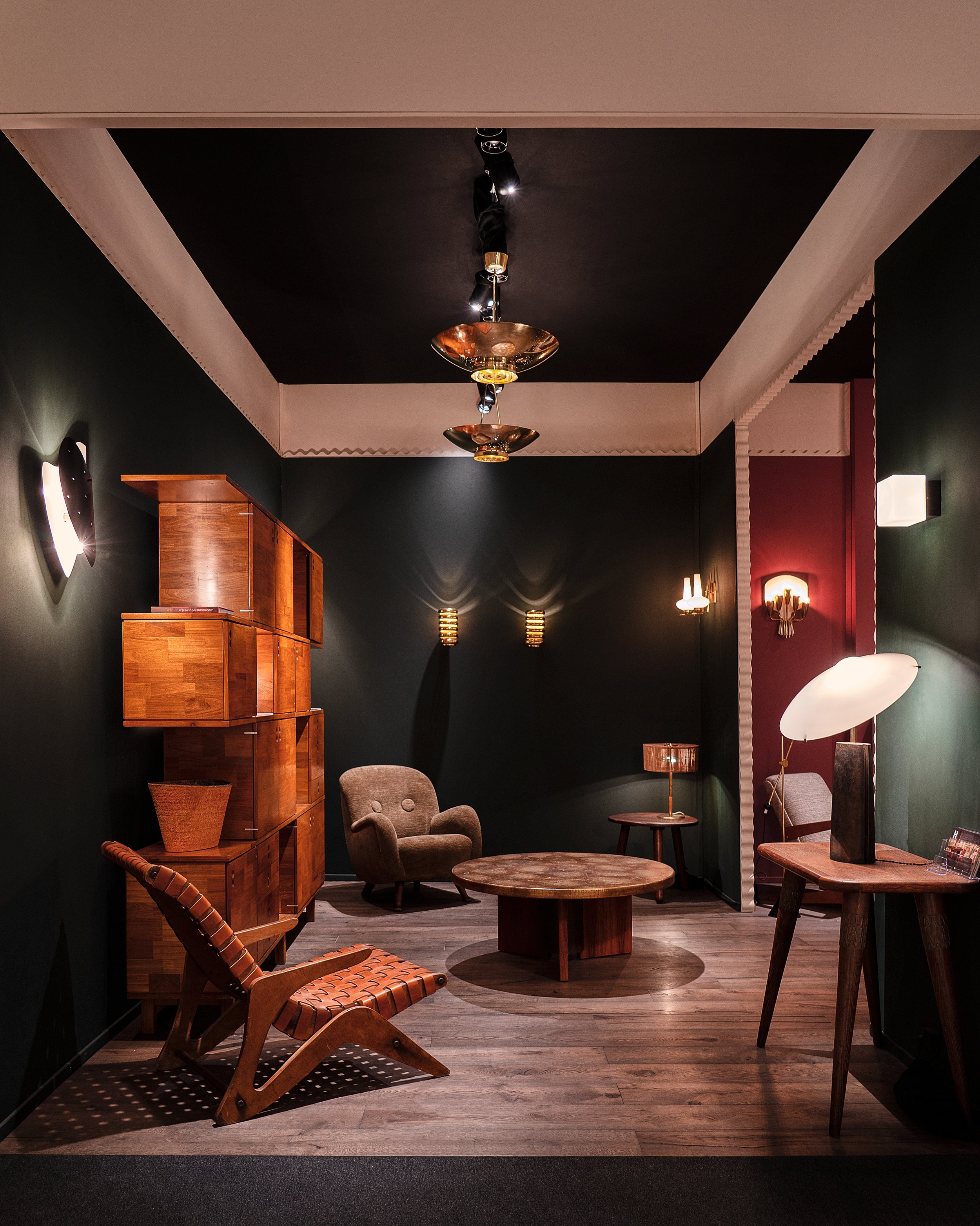
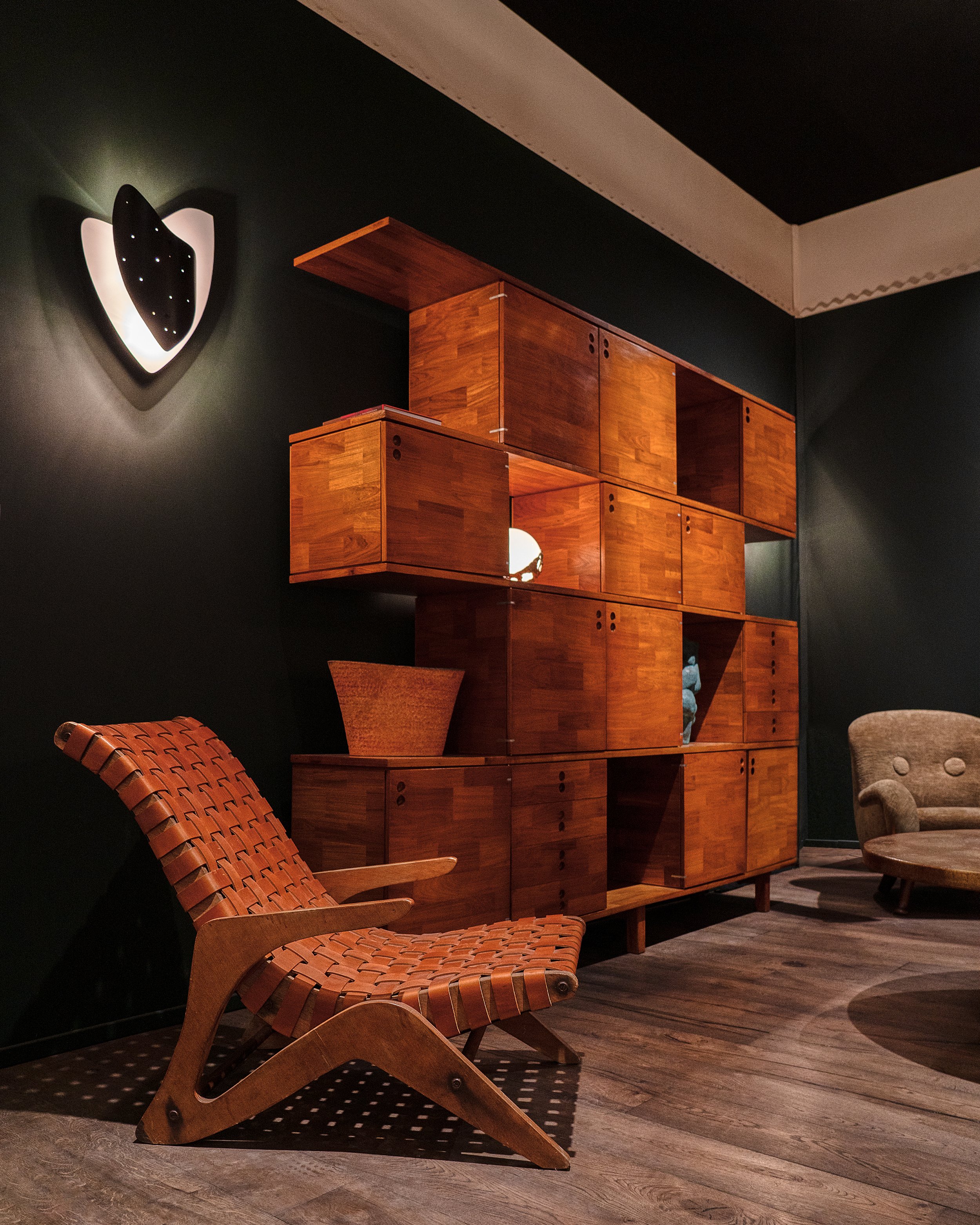
This gorgeous multi-level shelving system was designed and manufactured by the Brazilian design icon, Jorge Zalszupin and his company, L’Atelier.
When it comes to Zalszupin’s line of modular pieces (Modulados Compiníveis), simplicity and clarity are the main characteristics. Similarly to Danish production, treating the wood with special care was a core concept for Zalszupin. The versatile industrial design of these pieces offers a variety of typologies and combinations of modules that can be creatively combined to satisfy every need and interest. The pieces include drawers as well as diverse consoles with doors that feature locks.
These modular pieces made by L’Atelier follow the idea of Louis Sullivan: “form follows functions”, which is exemplified by this piece. The modules are made of the Brazilian wood ‘caviuna’ with a beautiful finish in wood-block collage. The six wooden legs support the units in an understated way, leaving the units to be the main visual pieces. The pieces feature “inverted” handles in pairs, that are distinctive of Zalszupin, and contribute to the elegant and modern look of this shelving system.
SOLD
Condition:
In good vintage condition. Wear consistent with age and use. Some modules have some small scratches and marks.
Dimensions:
98.42 in W x 15.95 in D x 104.33 in H
250 cm W x 40.5 cm D x 265 cm H
About the designer:
Jorge Zalszupin was born in Warsaw, Poland, in 1922. He graduated as an architect in Romania in 1945. His importance for Brazilian design has been articulated in several publications so far. In addition to being the owner of the l'Atelier furniture factory of modern furniture, Zalszupin led a unique initiative: he coordinated a team of designers working for four different factories in the same business group, the Forsa Group.
Zalszupin immigrated to Brazil in 1949 and after a brief stay in the capital, he settled in São Paulo, a city that was then entering a cycle of great industrial growth and great cultural transformations. In the first half of the 1950s, he opened an architecture office, having José Gugliota as a partner. When he got tired of designing exclusive furniture manufactured for his clients' homes, he decided to join a group of woodworkers and started to produce smaller series. This was how l'Atelier came into being, which eventually began to manufacture office furniture and went from a carpentry shop with handcrafted products to an industry with serial production. The first piece in this series was an armchair nicknamed 'Danish' by employees. It was first created in 1959.
In the early 1970s, because of serious financial problems, l'Atelier was sold to a business group. The sale was finalized with Zalszupin's 'pass' as director of product research and development. Thus, Zalszupin expanded the team of designers - which already had Oswaldo Mellone - incorporating Paulo Jorge Pedreira and Lílian Weimberg permanently. The designers named the new group Forsa, and started to act as a sort of creative laboratory.
The technical possibilities offered by four distinct industrial plants were enhanced by the team of designers. In this way, Hevea, which produced plastic commodities, won a very sophisticated product line in design and established a brand: Eva, for household items, sold in supermarkets. L'Atelier itself started using injected plastic, producing partition panels for offices and licensing the polypropylene shell chair Hille designed by Robin Day. In addition to the products that went on the market, the design team of the Forsa group tested dozens of new ones ideas, which form an extraordinary collection to be researched and which, certainly, had a great influence on the performance base of Oswaldo Mellone and Paulo Jorge Pedreira.
The crisis of the 1980s profoundly affected the performance of the Forsa group companies. The design team dissolved at the end of the decade. Oswaldo Mellone and Paulo Jorge Pedreira opened their individual offices and Jorge Zalszupin dedicated himself exclusively to architecture, an activity he had never abandoned. From 2005, the company Etel Marcenaria started to produce several of the items designed by Zalszupin for l'Atelier - among them the 'Danish' armchair -, privileging the objects of the company's artisanal phase. ~H.
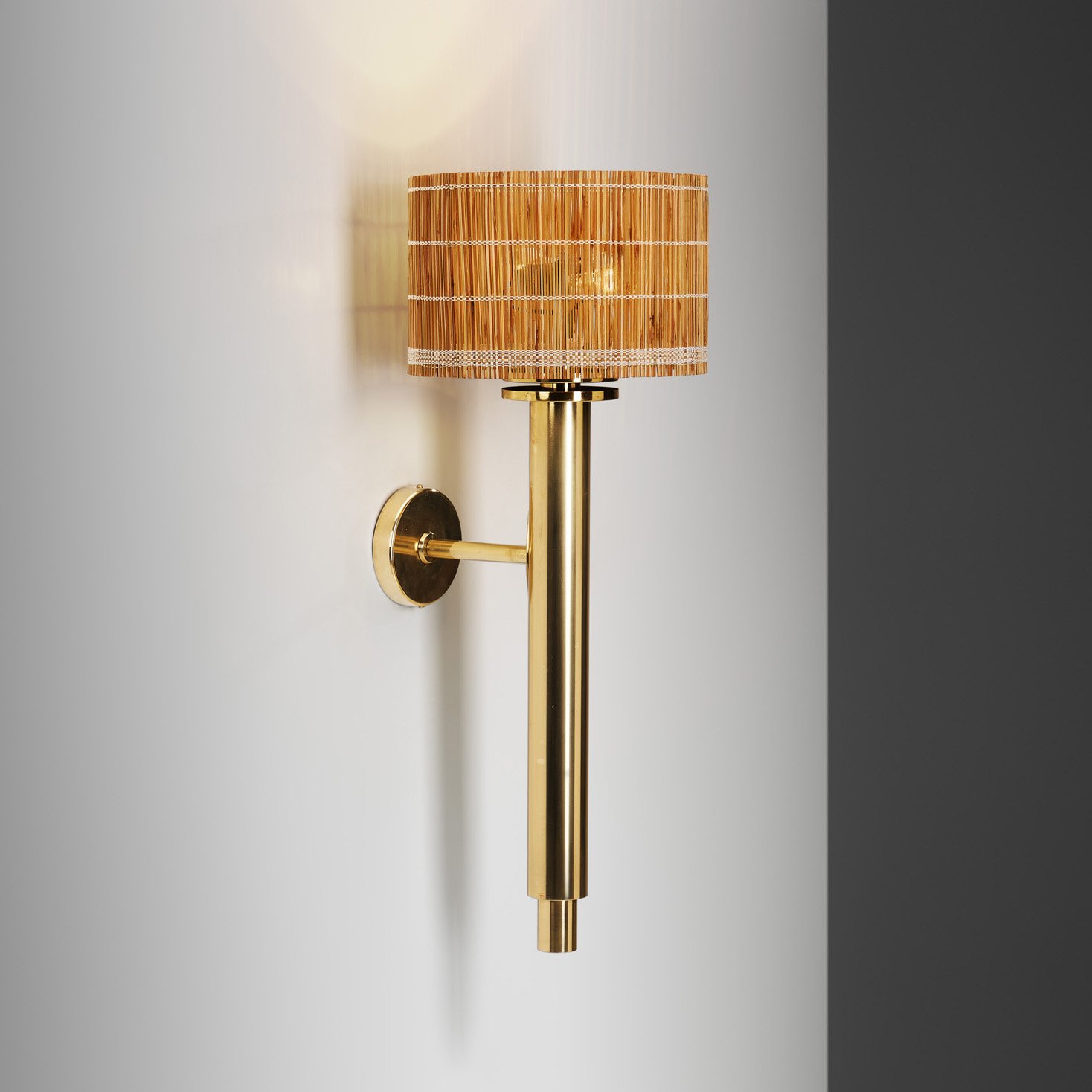
Finnish mid-century design is characterised by simple, elegant forms, which Paavo Tynell was a master of. Like Finnish culture, he embraced timeless beauty, sustainability, and a deep connection to the natural world. His favourite material to work with was brass, and he formed it into distinctive and unique shapes.
Paavo Tynell is one of Finland's best-known and most collected mid-century designers; he pioneered European lighting design and founded the first lighting manufacturing company in Finland, Taito Oy. Functionality, a pared-down, simple style, and a thoughtful colour palette are key principles for the Finnish icon, whose present wall lamp model features modern elements and focuses on the characteristics of the brass itself paired with a unique rattan shade. The design features Tynell's unique linear shape, giving a clean impression to the whole model. The use of rattan here veers away from the usual brass shades by Tynell's models. Rattan is a material traditionally associated with folk craftsmanship that reflects Tynell's commitment to preserving cultural roots while embracing contemporary design trends, making for a lovely effect when the light is lit and the white thread breaks the pattern’s verticality. The lampshade looks to be suspended from the brass rod, which has an elongated form that reduces to a smaller section at the lower endpoint. The backplate is especially beautiful paired with the main body of this model, with a circular construction and support that allows the lamp to stand organically and freely. In the spirit of Finnish mid-century design and culture, this lamp stands proudly on the wall while flexible to the user's needs.
Paavo Tynell, the co-founder and chief designer of Taito Oy, was a key figure in the Finnish mid-century design scene. His designs, including this wall lamp, are highly sought after to this day. Taito Oy, the company he co-founded, was one of the most innovative Scandinavian lighting design companies of the mid-century era. The influence of Tynell's designs on the Finnish mid-century era is undeniable, and this wall lamp is a testament to his enduring legacy.
SOLD
Condition:
In good vintage condition. Wear consistent with age and use. The rattan shade is a later replacement by a previous owner.
Dimensions:
11.81 in W x 15.75 in D x 32.09 in H
30 cm W x 40 cm D x 81.5 cm H
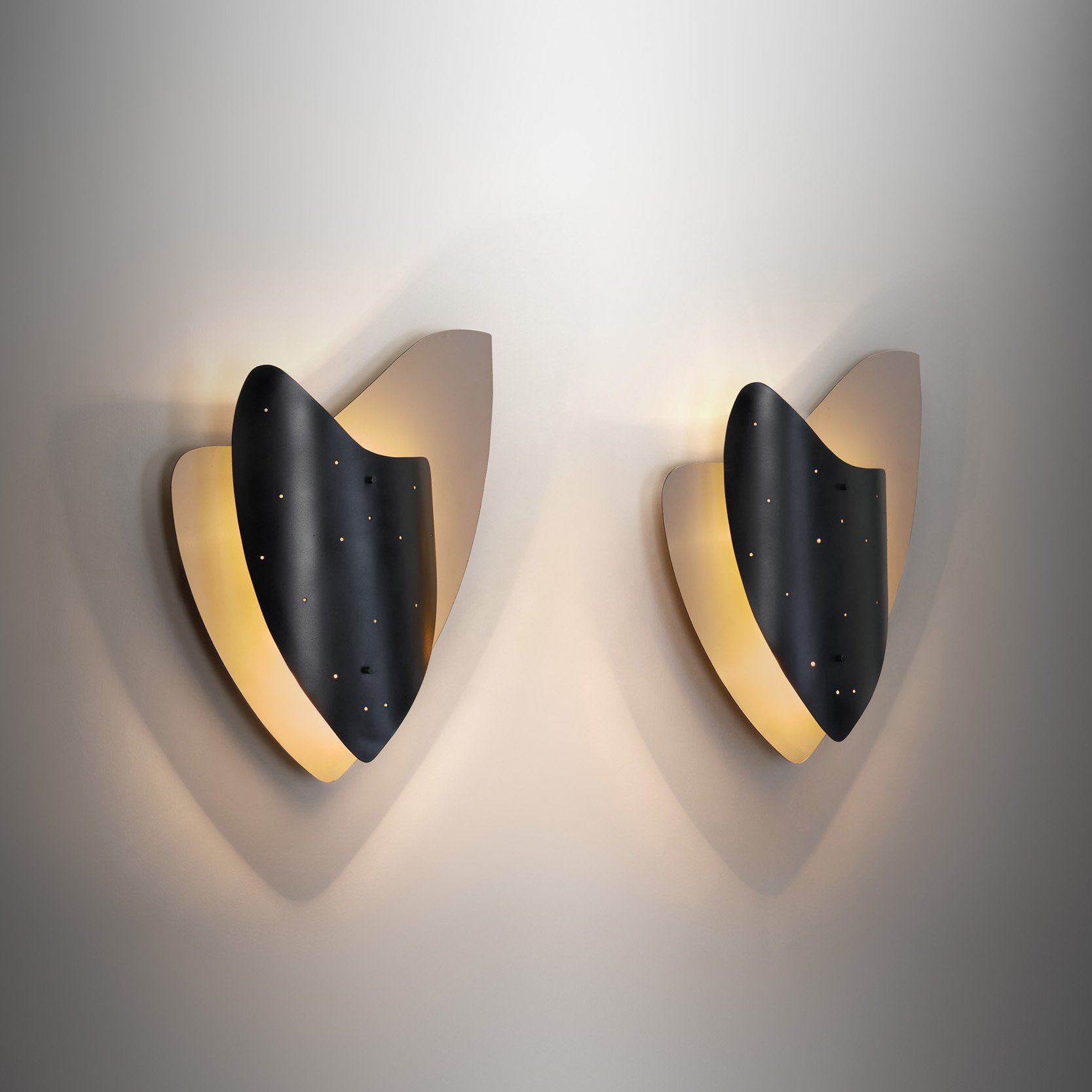
Throughout history, architecture and interior design has mirrored societal changes and artistic movements. Crafted in the 1950s, this unique lighting model is entirely in the vein of Modernism. The movement became one of the most important design eras of the 20th century, characterised by an emphasis on volume, asymmetrical compositions, and minimal ornamentation.
The modernist look of these lamps is achieved by the simple, yet smart design of the black lacquered front plate hovering asymmetrically over the back plate. This makes for a neat optical effect, creating a sense of magnetism that draws each half towards the other. Most mid-century designers prized the marriage of form and function, done with a poise that is hard to imitate or force. It is this effortless element that sets the era’s design apart. The shape and material of the shades determine the overall aesthetic of these lamps. The design encapsulates a harmonious interplay of light and shadow, casting a gentle glow that will be sure to enhance the ambiance of any space. The 1950s was a period of renewal, prosperity, and optimism following the world wars. This resulted in lighting designers seeking to create pieces that embodied the spirit of the age, reflecting the fast-paced and industrialised world. Today, mid-century lighting fixtures have become more than sources of illumination - they have emerged as functional art pieces that engage with the viewer on a visceral level.
These wall lamps originate from the now-defunct Camera Cinema in Groningen, which opened in 1958. They are perfect to add a touch of modernism to any space without being overwhelming. Their expert craftsmanship, and visually unique character, make them timeless evidence of the golden age of mid-century lighting design.
SOLD
Condition:
In good vintage condition. Wear consistent with age and use. The front plates have been repainted. The lamps have recently been rewired.
Dimensions:
14.17 in W x 4.72 in D x 18.89 in D
36 cm W x 12 cm D x 48 cm H

The mid-20th century brought about a revolution in design throughout Europe, where function and form merged in the most intriguing ways. One such example of this era’s creativity is this exceptionally unique wall lamp attributed to the French luminary designer, Jacques Biny. This exceptional piece, characterized by its distinctive combination of materials and aesthetics, is a rare find.
Crafted during the 1960s, this lamp features a marriage of brass and white lacquered metal in a way that is emblematic of the era's fascination with contrasting textures. Its focal point is a trio of lights, delicately resembling reeds, with exposed light bulbs at the end. When lit, they accentuate the texture of the white metal backplate with an asymmetrical shape. It resembles mesh with a perforated surface featuring small pierced holes. This creates a stunning effect that is organic and essentially modern at the same time. The soft and welcoming glow that is created when the lamp is illuminated further contributes to the gentle, organic lines that define this model. These lines offset the rigidity of the metal material, creating a harmonious blend of nature-inspired artistry and industrial design. The innovative use of materials and the play between positive and negative spaces make this model a true work of art. It not only casts a soft, ambient light but also creates captivating shadows and patterns on the wall, transforming any room into a gallery of light and shadow. The era’s commitment to both form and function is evident in this luminaire. Its practicality and aesthetics are in perfect harmony and the design is a testimony to the mid-20th century's dedication to pushing the boundaries of creativity and innovation.
This unique mid-century piece, attributed to Jacques Biny, with ties to the French manufacturer, Lunel, remains an object of exceptional design. Its timeless appeal is a reminder of an era when creativity knew no bounds, and designers were free to explore new horizons in crafting unique and captivating lighting fixtures that continue to inspire and illuminate our lives today.
SOLD
Condition:
In good vintage condition. Wear consistent with age and use. The brass has a beautiful patina with some marks.
Dimensions:
12.4 in Wx 2.95 in D x 23.62 in H
31.5 cm W x 7.5 cm D x 60 cm H
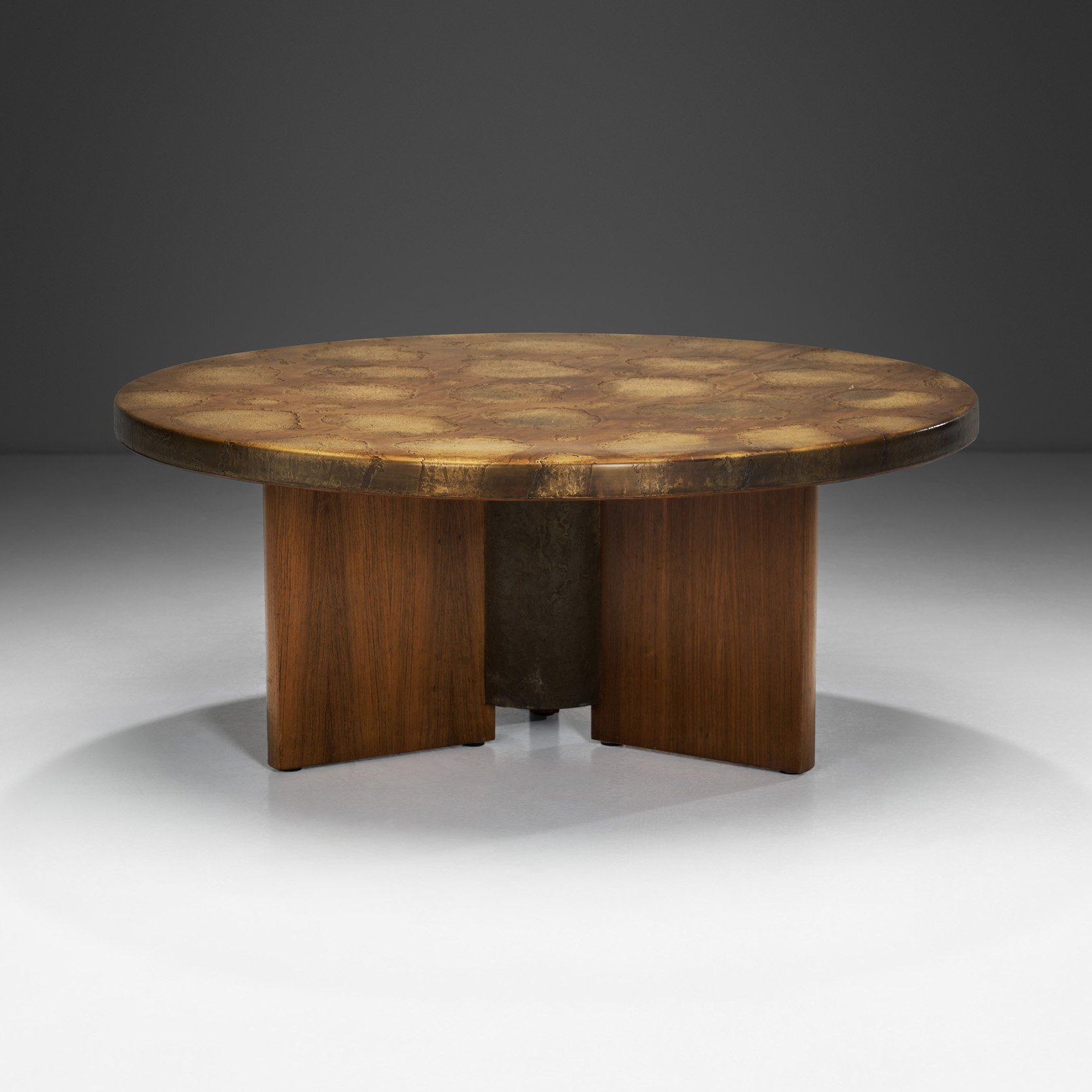
This characteristic coffee table is a nod to modernist design with traditional European mid-century craftsmanship. The design relays an insight about the society and culture in which it was produced: closeness to nature, the appreciation of a clutter-free environment and the value of quality handiwork.
In mid-century modern design, the use of wood held a special significance; it was not merely a material choice, but a philosophy that emphasized the natural and organic over the ornate and extravagant. This table is inspired by the mid-century penchant for elemental shapes. The tabletop is constructed with a brass veneer finish that showcases a unique, spotty design, adding a dynamic and textured visual appeal. The distinctive pattern on the surface brings an honest, almost playful element to the piece, catching the eye with its light and dark variations. This unexpected detail contrasts beautifully with the otherwise understated design, making the table not only functional but also an artistic statement in a room. Furthermore, round tables, such as this model, held a special place in mid-century design. The absence of sharp corners enhances the flow within a space, promoting a harmonious environment. This table has a humble but well-thought-out structure that relies on the material for its aesthetic.
Perfect for both modern and eclectic interiors, this coffee table is versatile enough to complement a range of decor styles. Whether placed in a living room or a more formal setting, it offers a touch of retro charm and sophistication. Its durable veneer finish ensures longevity, while the distinctive pattern solidifies its role as a conversation starter for years to come.
SOLD
Condition:
In very good vintage condition. Wear consistent with age and use.
Dimensions:
43.30 in ⌀ x 17.71 in H
110 cm ⌀ x 45 cm H

Design wise the 1970s may conjure images of wood surfaces, plush sofas, warm bright shades, and patterned wallpapers. In Finland, it was also an era of streamlined lighting design, with sculptural appearances, geometric shapes, and shiny details. Finnish designers broke the mould of highly ornate and decorative designs in favour of sleek and elegant pieces, as this pair of lamps showcases.
Like most late mid-century Finnish lighting designs, these models are dominated by their brass structure. The popularity of brass can be attributed to its golden hue that added warmth to the style's modern aesthetic. These wall sconces further emulate the mid-century modern movement's guiding principles through their clean lines and geometric shape. The structure is composed of a back-plate and two small poles holding the brass body. The main point of visual interest is the pair’s rounded design. The term “louvered” refers to the arrangement of slats or layers in a parallel fashion, constituting a series of openings. In the context of these lights, the louvered shades not only diffuse light in a captivating manner, but also imbue the fixtures with a distinct geometric elegance. The play of light through the precisely spaced louvers creates a mesmerising interplay of shadows, adding depth and sophistication to its surroundings. Although not much is known about Kai Ruokonen, it is evidenced by this unique pair that he was an expert designer who paid great attention to detail. Sconces are a timeless type of lighting fixture that can easily elevate their surroundings. These fixtures never go out of style, and have been in use for centuries. This is especially true for mid-century brass models like this.
The warm elegance and the “form follows function” ethos inherent in Finnish design is upheld, as well as high-quality craftsmanship. This pair becomes more and more charming with each moment spent on discovering its features, making them ideal accent pieces.
SOLD
Condition:
In good vintage condition. Wear consistent with age and use.
Dimensions:
5.51 in W x 7.67 in D x 10.23 in H
14 cm W x 19.5 cm D x 26 cm H

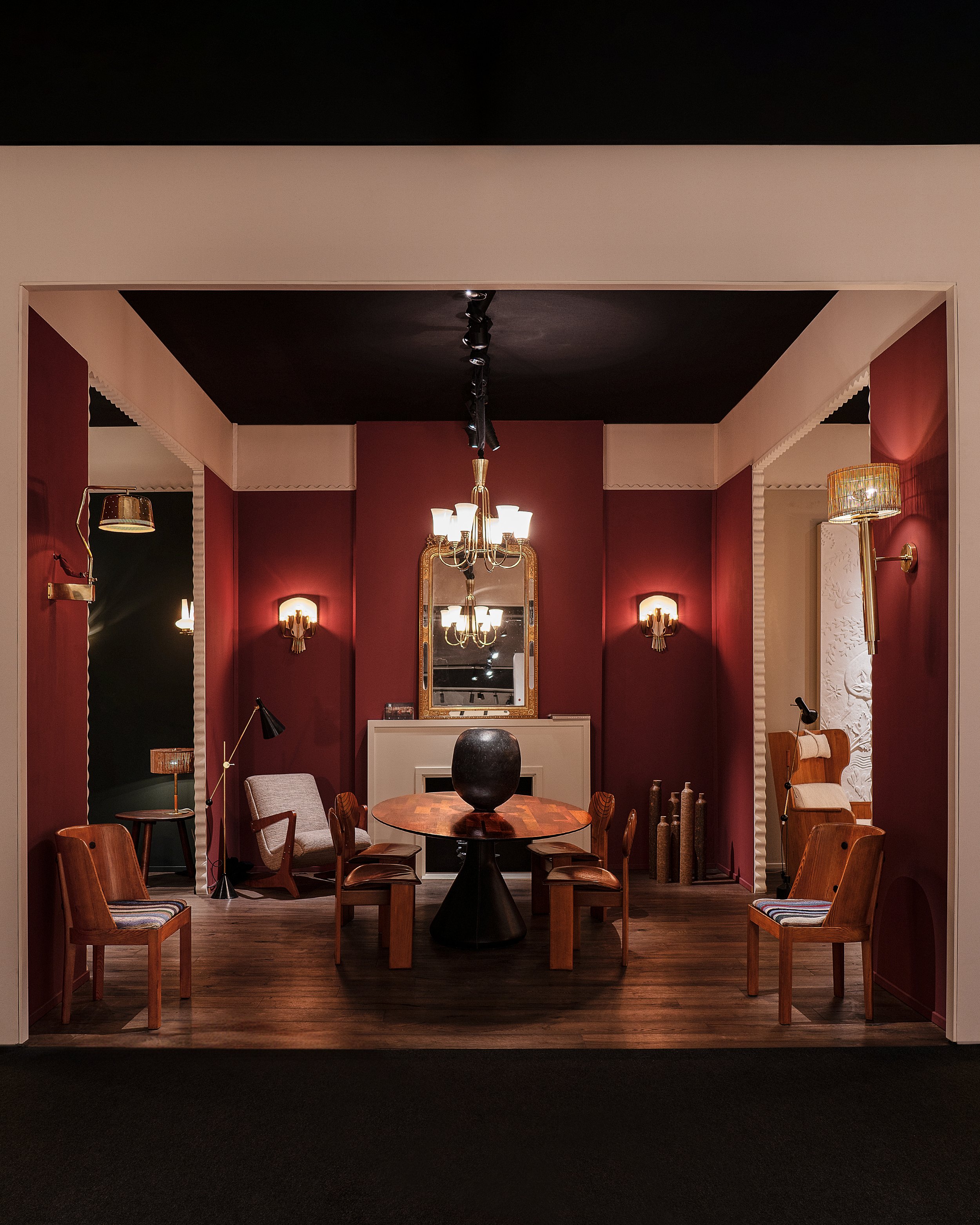
This famous model, known as the “Pragstolen or Pragh” (literally: The Prague Chair) by Danish designer duo Madsen & Schubell was designed by Henry Hans Schubell and was produced until 1961.
This chair model is what even the most sceptic and restrained art and design historian would address as “iconic”, it is one of “those” chair designs that are immediately recognizable and ever coveted. The frame is made of oak, teak and stained beech wood. The seat is slightly raised towards the front and the armrests follow its curves to ensure sitting comfort. The back is angled and has little “wings” on top, providing an ergonomic and welcoming look. To elevate its aesthetic dimension even further, this Prague Chair is upholstered in soft sheepskin and features dark button tufting to highlight the back’s shape and the upholstery’s luxuriously rich texture. The footstool is visually connected to the chair in multiple ways, both in its shape and upholstery. The dark stained, tapered wood legs are also quite similar, contrasting to the sheepskin’s creamy colour and texture. The gorgeous stained beech frame of the chair and teak wood comprising the stool truly pop against the upholstery. The “Prague” stool together with the chair is a rare find, and they truly stand out together, enhancing each other's best qualities.
The majority of Madsen & Schubell’s chair models were designed by Henry Hans Schubell, including the Pragstolen, and produced in the joint company with Arnold Madsen in Copenhagen. Under licence, some models were produced by Vik & Blindheim in Norway, and Bovenkamp in the Netherlands.
SOLD
Condition:
In good vintage condition. Wear consistent with age and use. The chair and stool have been reupholstered recently in premium sheepskin. Each of our items can be reupholstered by our in-house atelier in a fabric of choice. Please reach out for more information.
Dimensions:
Chair:
29.92 in W x 38.18 in D x 39.37 in H; Seat height 16.14 in; Arm height 24 in
76 cm W x 97 cm D x 100 cm H;Seat height 41 cm; Am height 61 cm
Footstool:
23.62 in W x 15.15 in D x 16.33 in
60 cm W x 38.5 cm D x 41.5 cm H
Literature:
The magazine “Møbler” no. 11, 1954, page 20.
About the designer:
Henry Hans Schubell was born on February 23. 1906 in Elsinore, Denmark. After completing school, he became an apprentice cabinetmaker in Elsinore. After 5 years he finished his apprenticeship, and was awarded a medal for his work. When he turned 20, he moved to Copenhagen, where he worked for various cabinetmakers. In 1929, at the age of 23, he was employed as a foreman at the cabinetmakers “Winter & Winding”, where he supervised the production of furniture until 1945.
In 1944, the firm received a request from an upholsterer named Arnold Madsen, who had an idea for a chair. Madsen was having difficulties finding a cabinetmaker with the required skills to do the woodwork based on Madsen’s little plaster model. Henry Schubell succeeded in producing the wooden frame, making it possible for the chair to be put into production. Arnold Madsen was so impressed by his work that he suggested forming a partnership where Henry Schubell would design the furniture and produce the wooden frames, which Arnold Madsen would then upholster and market. The workshop was realized in the inner city of Copenhagen, and their joint venture was named “Madsen & Schubell”.
The cooperation between Henry Schubell and Arnold Madsen was so successful that they purchased a factory building on the outskirts of Copenhagen. Over the next 20 years, the company produced several successful models, most of which were designed by Henry Schubell. Some of these chairs were licensed to the Norwegian company Vik & Blindheim and to the Dutch company Bovenkamp.
The cooperation between the two ended in 1963, and by mutual agreement, Arnold Madsen established his new upholstery firm under the name “Madsen og Schubell”, in cooperation with his son, Ib Madsen. In the 1970s, Ib took over the company which still ran under the name Madsen & Schubell causing some confusion about the attribution of Madsen & Schubell models. ~H.
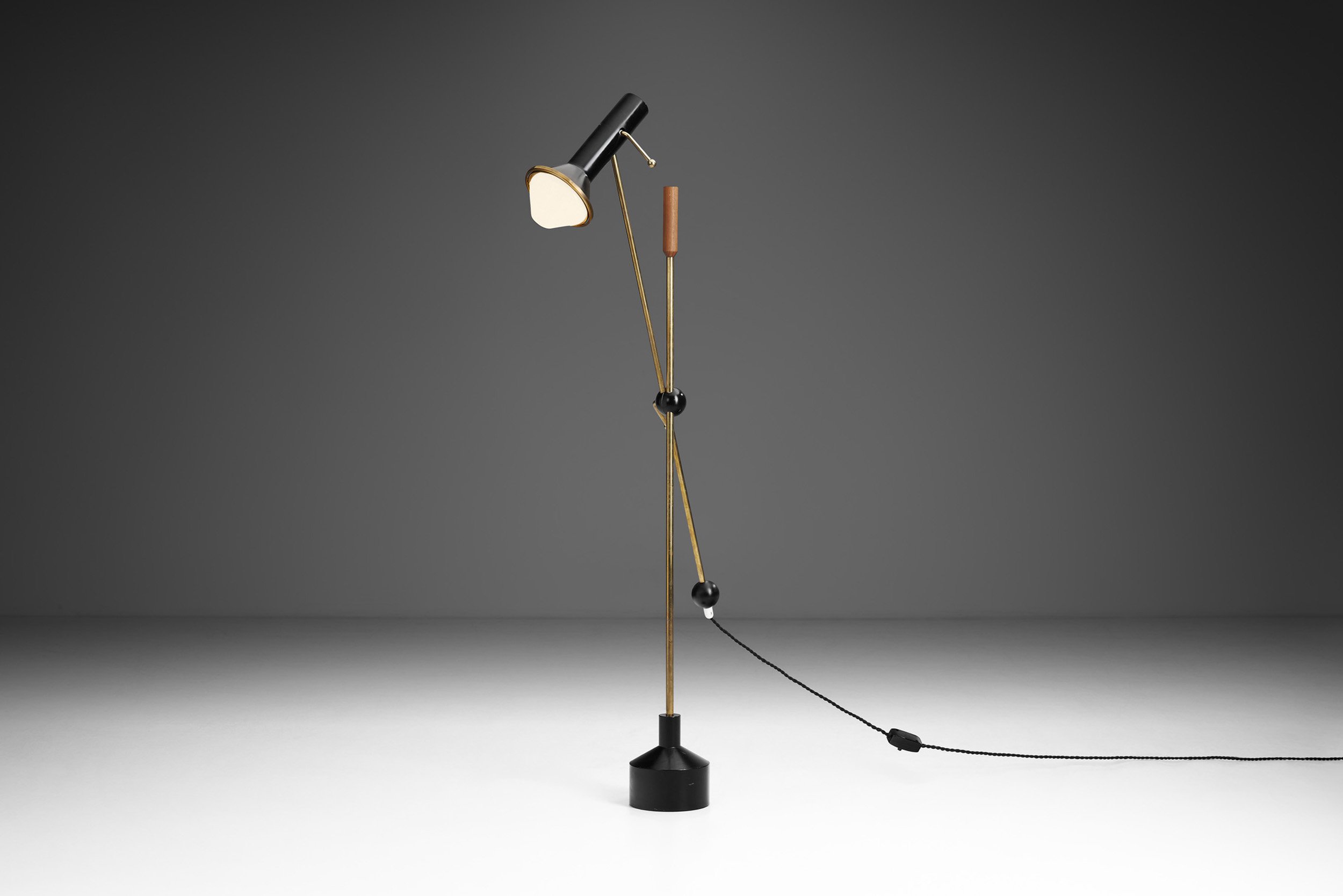
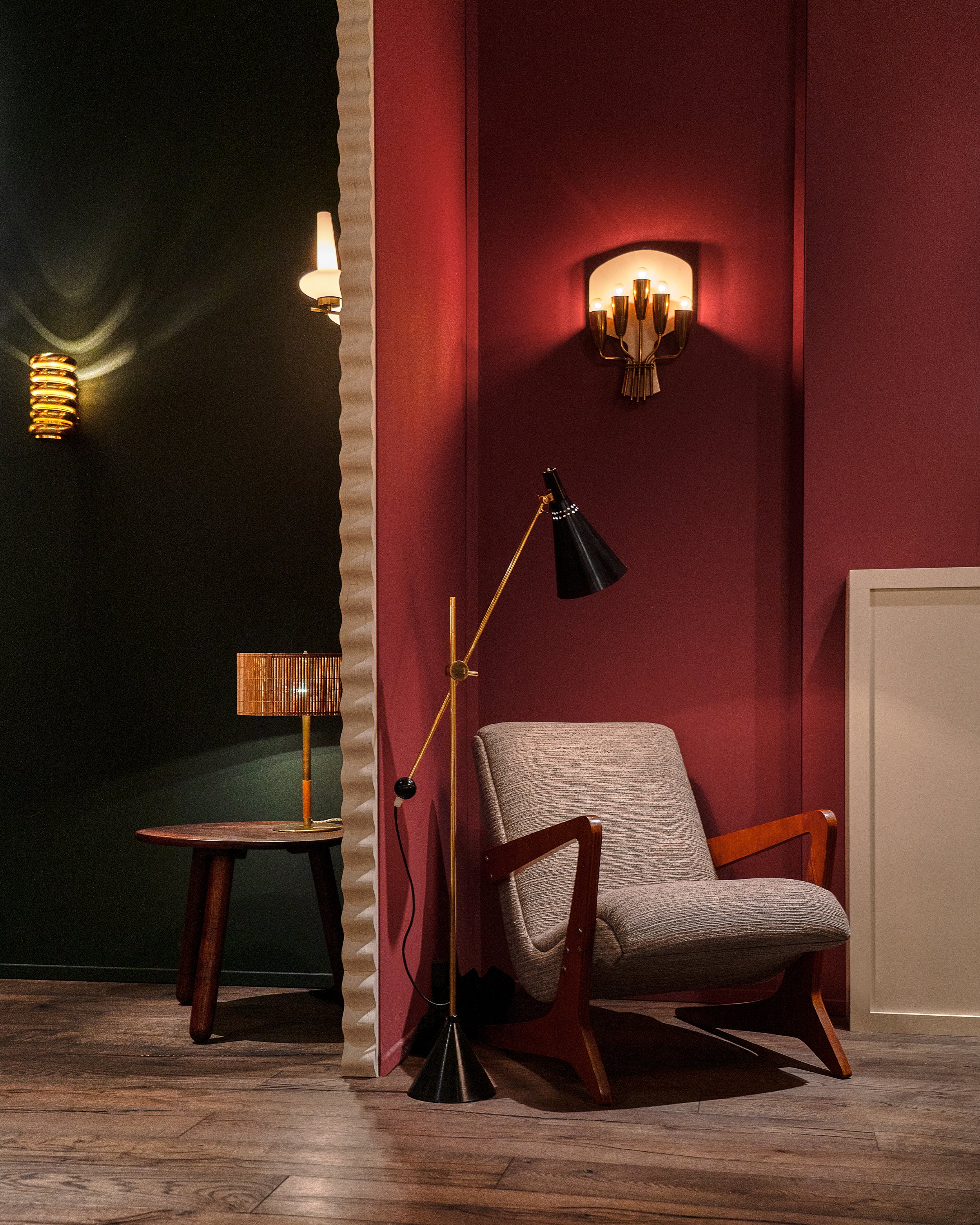
Tapio Wirkkala (1915-1985) was a multitalented design genius, widely considered a leading figure of modern Finnish industrial art. This lamp model is one of the cornerstones of Tapio Wirkkala´s repertoire; this groundbreaking piece is one of the original adjustable lamps with angular opal light bulbs that launched a series of lamps with different designs, that were in production for 30 years from the late 1950s until the late 1970s.
This specific model is very hard to come by, truly a holy grail for any collector and design aficionado. The structure shows Wirkkala’s genius in every line, joint, and idea. Showing the designer’s great consideration for functionality besides the aesthetic dimension, the height, width, and depth are all adjustable in different directions. This is the result of the ingenious ball joint on the brass pole that ends in a teak handle. Besides the unique structural solutions, the design also features a versatile medley of shapes and materials with a black lacquered cast iron base, brass poles, and a black lacquered metal shade. While the structure, with its dual brass poles is similar to the “crane” model, there are a number of details that make this lamp even more distinctive, starting with the lightbulb. It was designed by Tapio Wirkkala himself and is still in production. Its unique shape adds to the inherently modernistic look of this mode. The designer’s sticker can be found on the shade. Idman Oy produced the models of some of the most renowned Finnish lighting designers of the time, including Tapio Wirkkala, Mauri Almari and Maria Lindeman.
Wirkkala's present “K10-47” floor lamp remains an enduring emblem of Finnish design history, celebrated for its unique solutions and elemental style. Its ability to harmonize with diverse aesthetics while providing efficient lighting makes it a coveted and iconic piece, attesting to the enduring appeal of Finnish mid-century lighting design.
SOLD
Condition:
In good vintage condition. Wear consistent with age and use. The brass has a beautiful patina.
Dimensions:
17.32 in W (lamp stand is adjustable) x 5.51 in D x 46.25 in H
44 cm W (lamp stand is adjustable) x 14 cm D x 117.5 cm H
Literature:
Bibliography : 'Idman: Decorative lamps list', Catalogue de Sales, no. 143, Helsinki, 1961. pp. 60, 84
M. Av, 'Tapio Wirkkala : Eye Hand and Thought', Edition WSOY Finland, Museum of Art and Design Helsinki, 2002. p.387
About the designer:
Tapio Wirkkala (1915-1985) can be described as one of the icons of Finnish design and a symbol of the international success of postwar Finnish design. He was a versatile designer and artist who could shift fluently between different materials and crossed established professional boundaries: he worked on everything from refrigerators to banknotes and from furniture to striking jewels. The most important materials for Wirkkala were wood and glass – he never ceased to explore the possibilities they offer.
Tapio Wirkkala studied sculpture at the Helsinki Central School of Industrial Design from 1933 until 1936, but he was also a self-studied artist in many areas, including glass design. His success as a glass artist began in 1946 when he designed one of his most famous works, the Kantarelli vase, for Iittala. Wirkkala gained worldwide success in 1951 at the Milan Triennial, where he received three Grand Prix awards: for the exhibition architecture, glass design and wooden sculptures. Many of his glass works for Iittala were also awarded later in the 1950s at the Milan Triennial.
Tapio Wirkkala was also a renowned furniture designer. He started his career as a sculptor in the 1930s, but abandoned the traditional sculpture in the post-war years. The result was a series of unique plywood sculptures which combined form and movement in the vibrant, densely lineated surface of plywood. Wirkkala’s sculptures represented exceptional abstractionism and gave Finnish sculpture art a new direction at a time when the official line preferred monuments and heroic sculptures.
Tapio Wirkkala is also renowned for his innovative use of wood in furniture design. The eye-catcher X-frame table was designed by Wirkkala in 1958 and is today manufactured by Artek. Tapio Wirkkala was also a sculptor. He started his career as sculptor in the 1930s, but abandoned the traditional sculpture in the post-war years. At the beginning of the 1950s, alongside with other works, he started to develop an entirely new relationship with sculpture and a new technique to be used.
One of Wirkkala’s most significant commissions abroad was the work at the Rosenthal porcelain factory in Germany: he worked as a freelance designer for Rosenthal for almost 30 years, and the most influential result was the Paper Bag vase (1977), still today one of Rosenthal’s best-selling products.
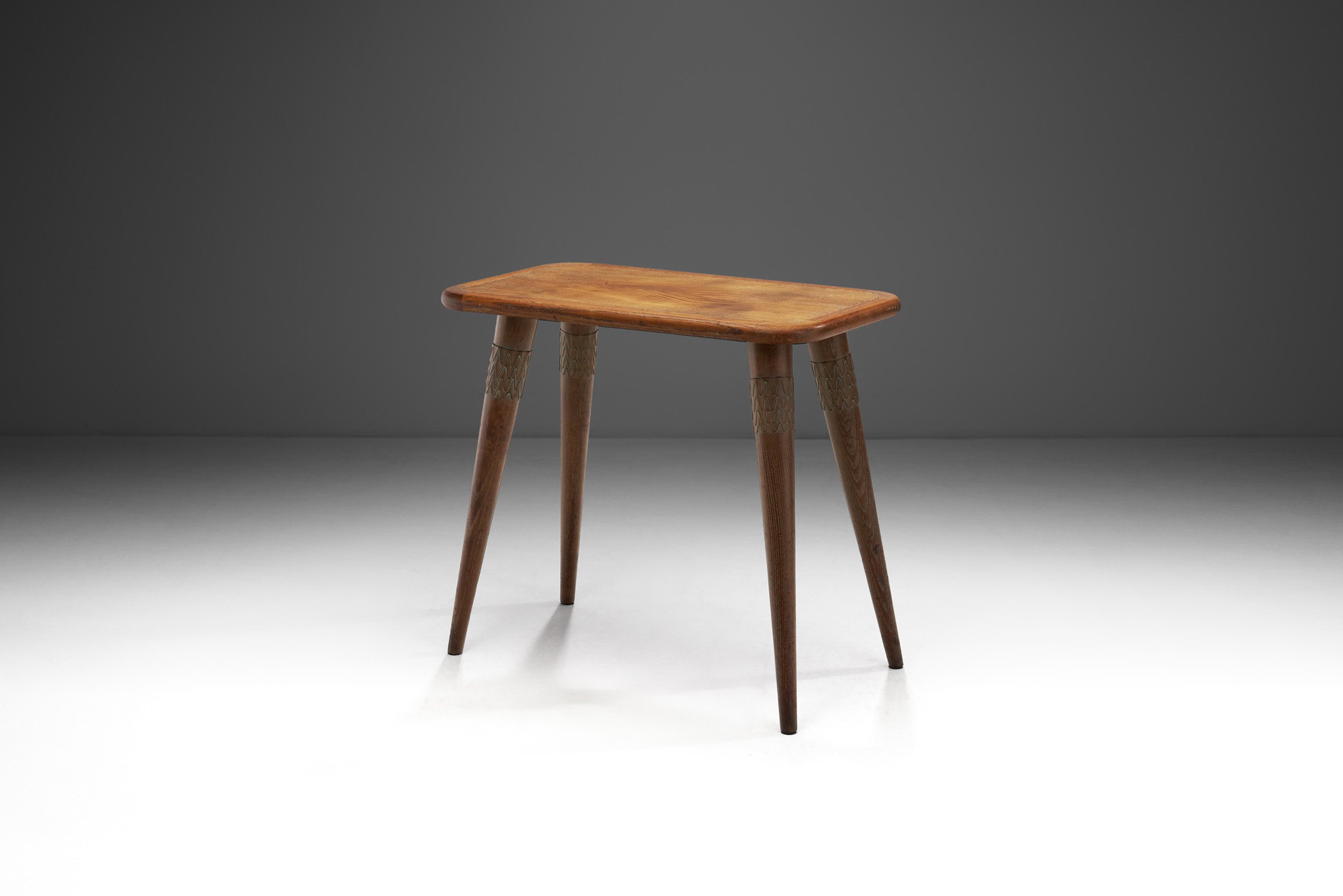
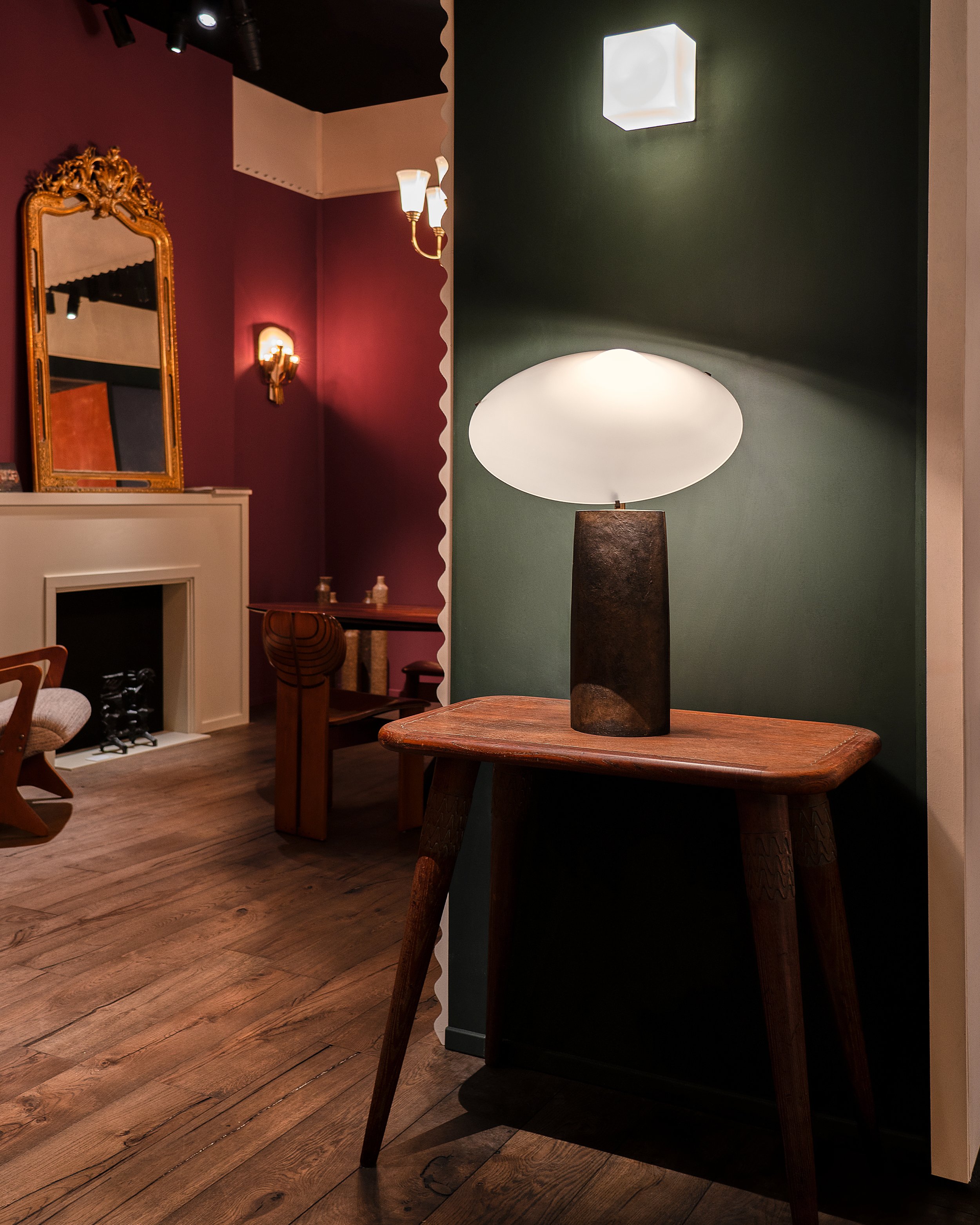
An artisan is someone that works with their hands to create unique, functional and/or decorative items using traditional techniques. Artisans are masters of their craft and create exceptional pieces of the highest quality. An artisan piece is characterized by these features, exemplified by this table.
Artisan style shuns mass-produced decor in favour of handmade pieces that are one-of-a-kind. This is most evident in the hand carvings on this table’s legs and on its top. Four rings of waves are carved into each leg’s top with a decorative blue colour stain that enhances the curves. The splayed, tapered legs create a classic mid-century modern look and besides providing structural stability, they are also perfect to show off the unique pattern. The rectangular tabletop has gently rounded edges and the same wave pattern framing it with a blueish colour. The wood was treated with lime, a technique in woodworking that is meant to bring out the best qualities of the raw material. Unlike traditional paint that leaves a topical plastic finish on top of wood, lime wash absorbs into the wood leaving a natural contour. The top showcases the wood’s versatile patterns and grain, adding natural decoration to the design.
To fill a home with artisan pieces is to fill it with stories. This side table carries in it the European mid-century design history that defined not only its era’s aesthetic, but still influences contemporary furniture design as well. However, it is the artisan craftsmanship that provides the core of this table’s soul and uniqueness.
SOLD
Condition:
In good vintage condition. Wear consistent with age and use. Some marks and scratches on the wood.
Dimensions:
33.26 in W x 19.68 in D x 30.11 in H
84.5 cm W x 50 cm D x 76.5 cm H
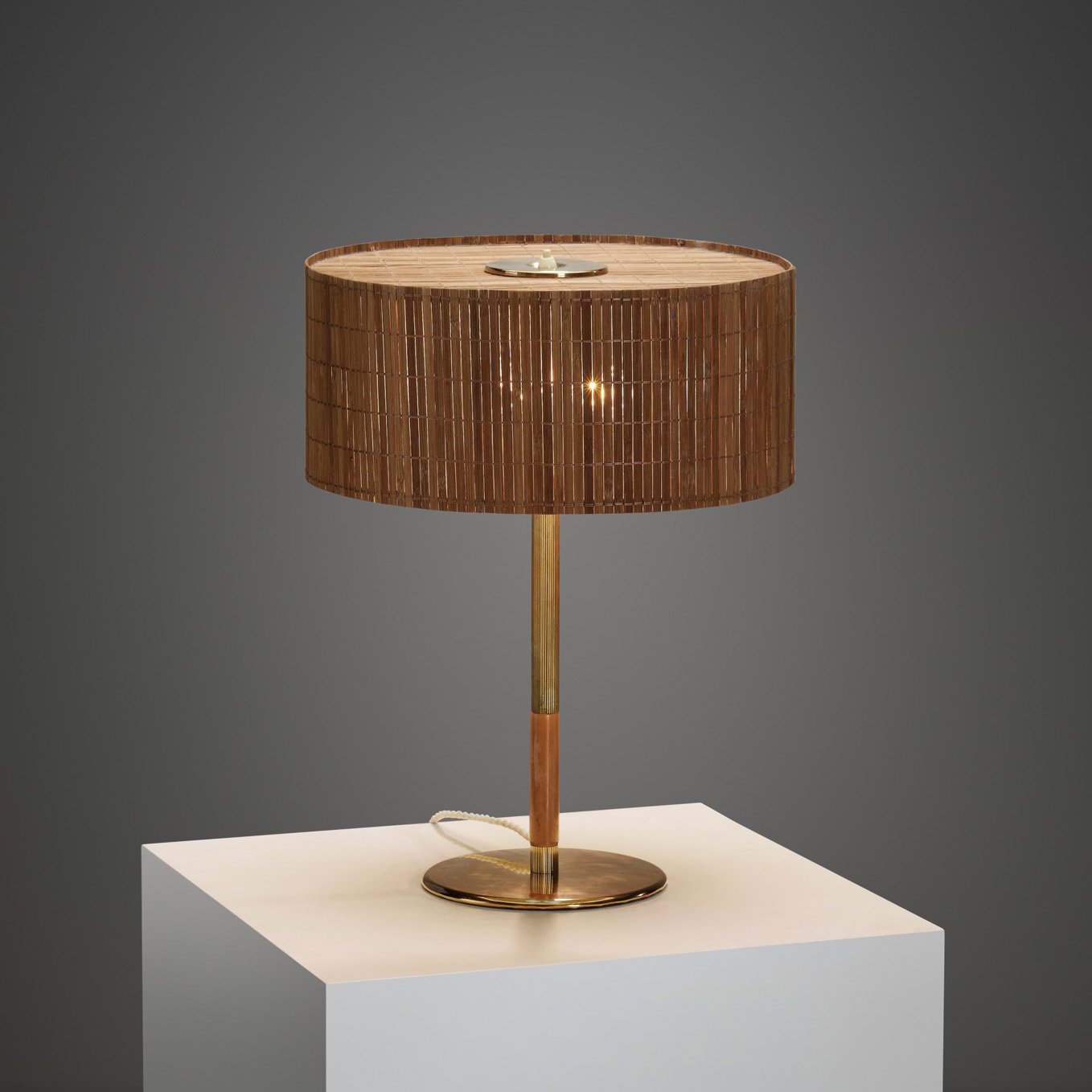
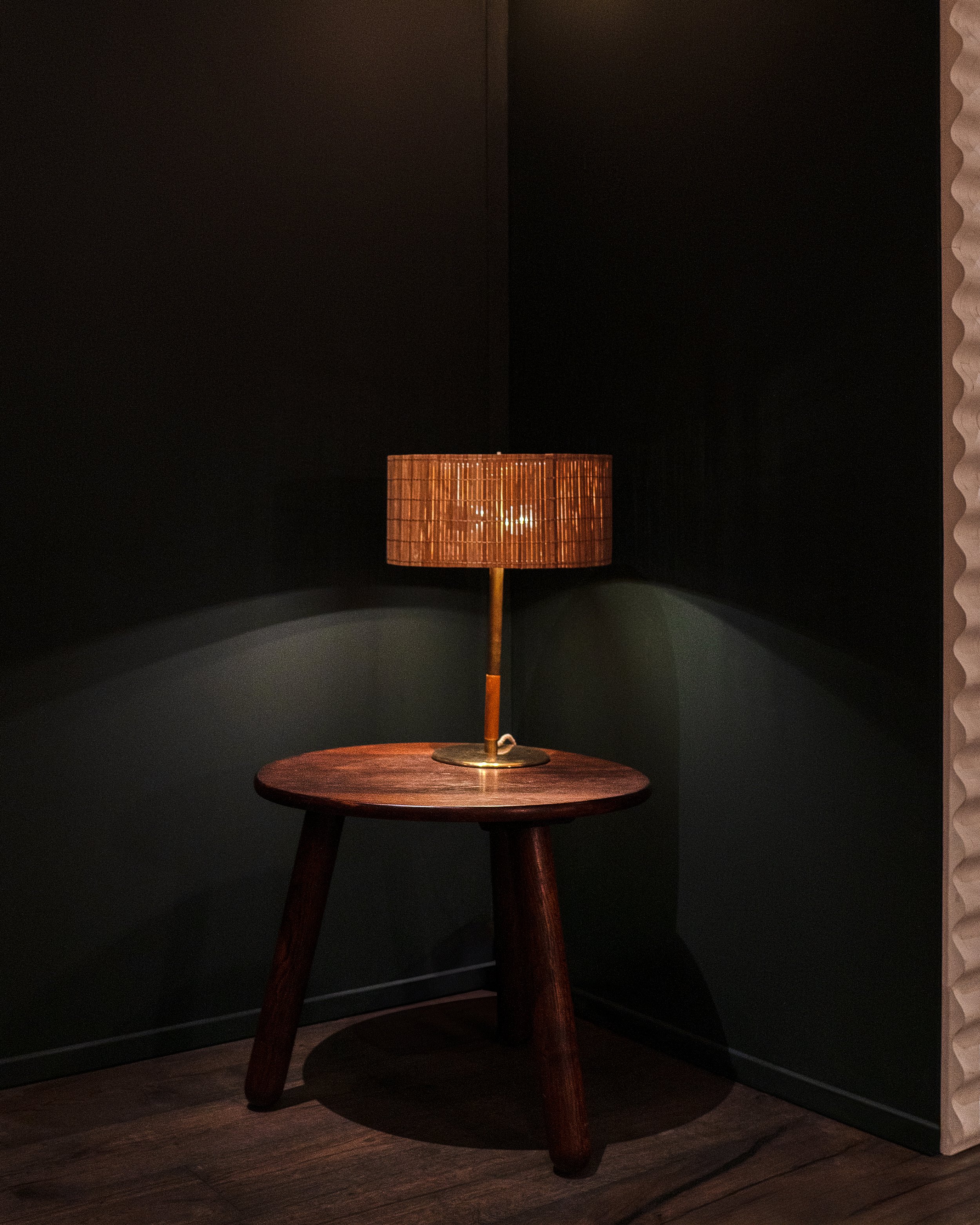
Paavo Tynell was a master of light earning the title “man who illuminated Finland”. Renowned for his craftsmanship, Tynell’s work was inspired by a traditional aesthetic with a modern sensibility. His influence on the Finnish mid-century era is undeniable, in part due to the innovative work he did as co-founder and chief designer at Taito, where this model “9206” table lamp was made.
This lamp is characterised by a simple, elegant form, while highlighting classic beauty, and a deep connection with the natural world. The design features a slender stem and circular base, allowing for a clean, straightforward form. The use of rattan veers away from the usual brass shades of Tynell's models. Crafted from splints tied together, the shade elevates the lamp, offering both uniqueness, and an organic feel. Rattan is a material traditionally associated with folk craftsmanship that reflects the commitment to preserving cultural roots while embracing contemporary design trends, making for a lovely effect when the light is lit. Distinctive in numerous ways, this lamp showcases the versatility that characterised the mid-century era. Surpassing the strict functionality many designers were concerned with, this model is a whimsical representation of Tynell’s innovative experimentation in lighting design. The craftsmanship involved in creating this piece is evident in the seamless construction and attention to detail. The brass base provides stability, while still maintaining the overall aesthetic. This piece, with its minimalist elegance, not only serves as a functional source of light but also as a sculptural element in a room, embodying the Nordic design principles of form, function, and beauty.
Finnish designers like Paavo Tynell pushed the boundaries of design, combining materials and manufacturing techniques to create standout pieces. At the same time, the strong emphasis on simplicity and functionality resulted in both beautiful and practical objects, testaments of Tynell’s legacy - this lamp is the perfect example, iconic through its distinctive design.
SOLD
Condition:
In good vintage condition. Wear consistent with age and use. Some minor marks on the brass. The shade was replaced by a previous owner.
Dimensions:
14.56 in ⌀ x 19.09 in H
37 cm ø x 48.5 cm H
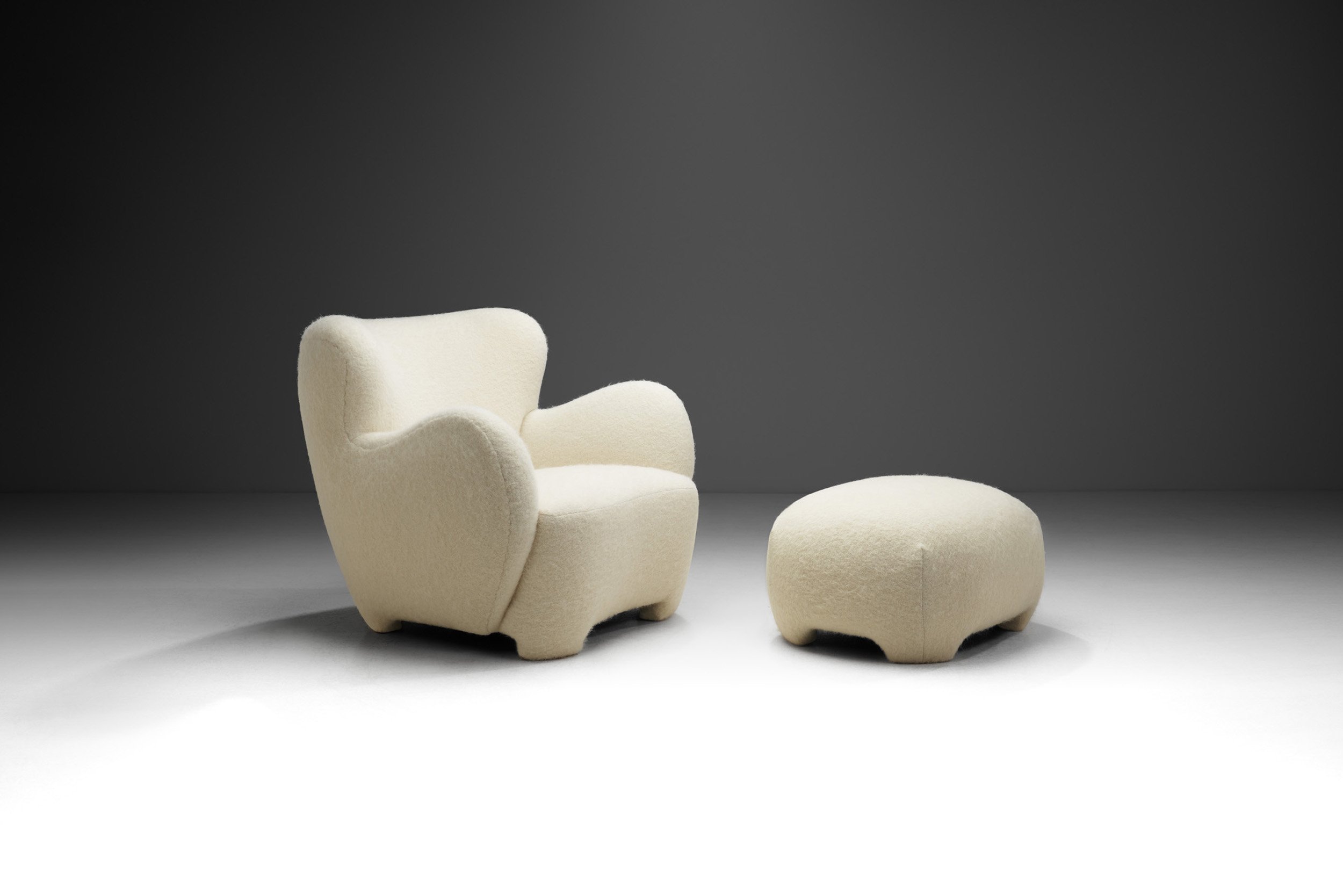
Mid-century modern is to-the-point and no-nonsense, much like the straightforward interior style, which championed notions of functionality, ease and modern simplicity. This set of a lounge chair and ottoman, with their perfectly balanced aesthetic is a beautiful example of the movement.
This lounge chair is focused on the aesthetics of modern design whilst employing the exquisite technique and material familiarity of highly skilled craftsmen known as cabinetmakers. The design in many ways transcends the word ‘modern’, as it can be incorporated into contemporary and traditional interiors, lending itself to a timeless and universal appeal. The curved and organic lines of the design create an elegant silhouette for both the chair and ottoman. The crisp lines “disappear” into the soft wool blend upholstery that uniquely covers the entire bodies, including the legs as well. This creates an almost ethereal impression, pushing the design into the realm of art. At the same time, mid-century European cabinetmakers held functionality above all else, therefore the enveloping back, and the ergonomic curves are in service of the ultimate lounging experience. The chair’s generous proportions and upholstery provide great sitting comfort, further aided by the ottoman. The upholstery dominates the look and the visible absence of ornamentation serves the purpose of highlighting the luxurious texture of the material and the cosy outline of the design.
The historic movement of mid-century modern continues to permeate our sense of what’s contemporary. With a classic look, storied design and solid quality, this lounge chair and ottoman are truly elegant and timeless.
SOLD
Condition:
In good vintage condition. Wear consistent with age and use. The ottoman is a later addition. The chair and ottoman have been reupholstered recently in a light, premium wool blend fabric. Each of our items can be re-upholstered by our in-house atelier in a fabric of choice. Please reach out for more information.
Dimensions:
Lounge Chair
33.85 in W x 35.03 in D x 30.31 in H; Seat height 17.32 in; Arm height 23.62 in
86 cm W x 89 cm D x 77 cm H; Seat height 44 cm; Arm height 60 cm
Ottoman
26.77 in W x 22.83 in D x 13.97 in H
68 cm W x 58 cm D x 35.5 cm H
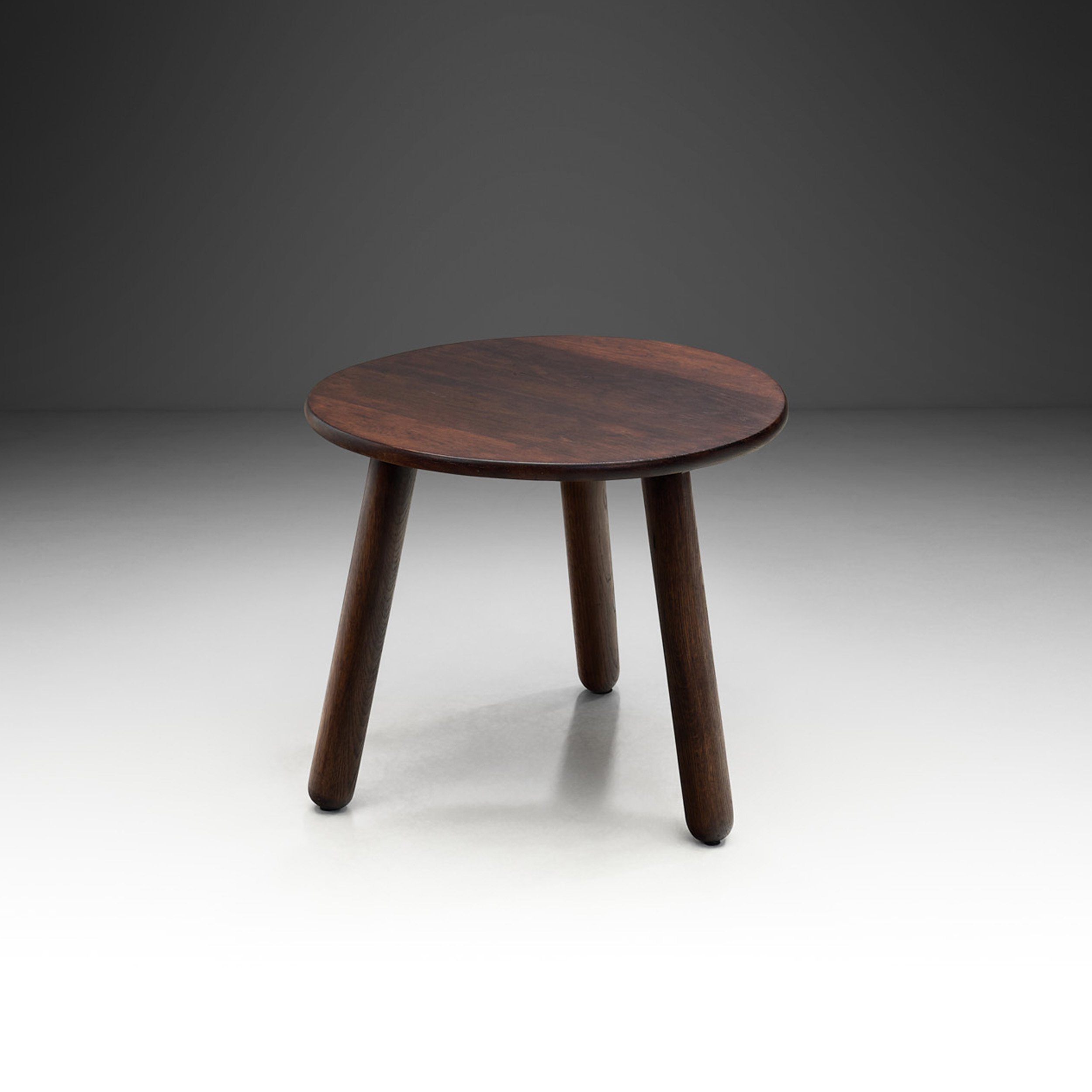
Danish modern, the popular movement that took over the design world, is characterised by clean lines, organic forms, and emphasis on functionality over unnecessary ornamentation. This oak side table beautifully showcases the era’s interest in simplicity.
This design featured simple, geometrical shapes and offers an uncomplicated silhouette, which serves a clear functional purpose; a quality that is quintessentially mid-century modern. The straightforward shape of the table highlights the understated beauty of the oak, allowing the beautiful grain of the wood to stand out. Oak, as a material, adds a touch of sophistication to the design while fulfilling its purpose through the sturdiness, durability and density. The table top is set on three splayed club feet, stained in the same dark, rich colour lending a more dramatic presence to the piece. The tripod base is ideal for ensuring the sturdiness needed for a classic piece of furniture made to withstand the passage of time. Through both its silhouette and solid colour, this side table showcases versatility, while maintaining character. The interplay of a simple structure and refined detailing evokes a sense of harmony, aligning with the era’s focus on blending beauty with utility.
This side table carries the Danish mid-century design history that defined not only the era’s aesthetic, but still influences contemporary furniture. This piece sets itself apart thanks to the beautiful shape and stain, rather than excessive ornamentation, making it the perfect addition to any interior space.
SOLD
Condition:
In good vintage condition. Wear consistent with age and use.
Dimensions:
22.04 in ø x 20.07 in H
56 cm ø x 51 cm H
Paavo Tynell is one of Finland’s best known and most collected mid-century designers, a true pioneer of Nordic lighting. This lamp was made by the famous Finnish manufacturer Taito Oy, one of the most innovative lighting companies of Finland, which Tynell co-founded and where he worked as chief designer until 1953.
During the interwar period, Tynell created both Art Deco-style and Functionalist lamps. For his more Functionalist pieces, like this one, he took into account how the lamp was to be used, the colour of the light, and the opal glass's nuances. This “1024” model is a perfect example of how the combined materials of opal glass and brass can create an elegant and classic look. Brass, with its warm and timeless radiance complements any interior, exuding opulence, while opal glass diffuses light with a soft, ethereal glow. The milky, opal glass was a popular material for lighting fixtures in the mid-century era, due in part to its ability to soften harsh light, creating ambiance. As this pendant lamp demonstrates, it was also prized for its lustrous, opaque finish, which gives it a sophisticated and refined look. Tynell was a master of working with this material, and his opal glass lamps are some of his most sought-after designs. This harmonious pairing of materials endures as a hallmark of sophistication, blending seamlessly into contemporary design aesthetics. Furthermore, the lamp is composed of a slender stem, which the glass shades hang from. The shades are arranged in a tiered fashion reminiscent of a fountain. The design’s main characteristic is its effective simplicity, free of unnecessary ornamentation. The uncluttered look leaves the attention on the materials and on its functionality that the form is in service of. In addition, while the design is quite succinct with clear lines and precision in the smallest details, it still possesses a luxuriously stylish impression.
Overall, the composition of the shapes and clever design elements give this lamp a personality that isn’t loud but still stands out. By the end of the 1930s, Finland’s international reputation for great design was established, thanks in no small part to the work of Paavo Tynell who had pushed the boundaries of what was possible with new materials and manufacturing techniques.
SOLD
Condition:
In good vintage condition. Wear consistent with age and use. The lamp has been recently rewired. Thin crack on large shade that is covered by brass stem piece; damage is not visible when lamp is mounted.
Dimensions:
21.45 in ⌀ x 37.59 in H
54.5 cm ⌀ x 95.5 cm H
Shade dimensions:
Small shade
13.58 in ⌀ x 18.50 in H
34.5 cm ⌀ x 47 cm H
Large shade
21.45 in ⌀ x 18.50 in H
54.5 cm ⌀ x 47 cm H