
Two-Seater Sofa by Otto Schulz (Attr.) for Boet, Sweden 1940s






Two-Seater Sofa by Otto Schulz (Attr.) for Boet, Sweden 1940s
REQUEST PRICE HERE
Price category: 9,000 - 12,500 usd / eu
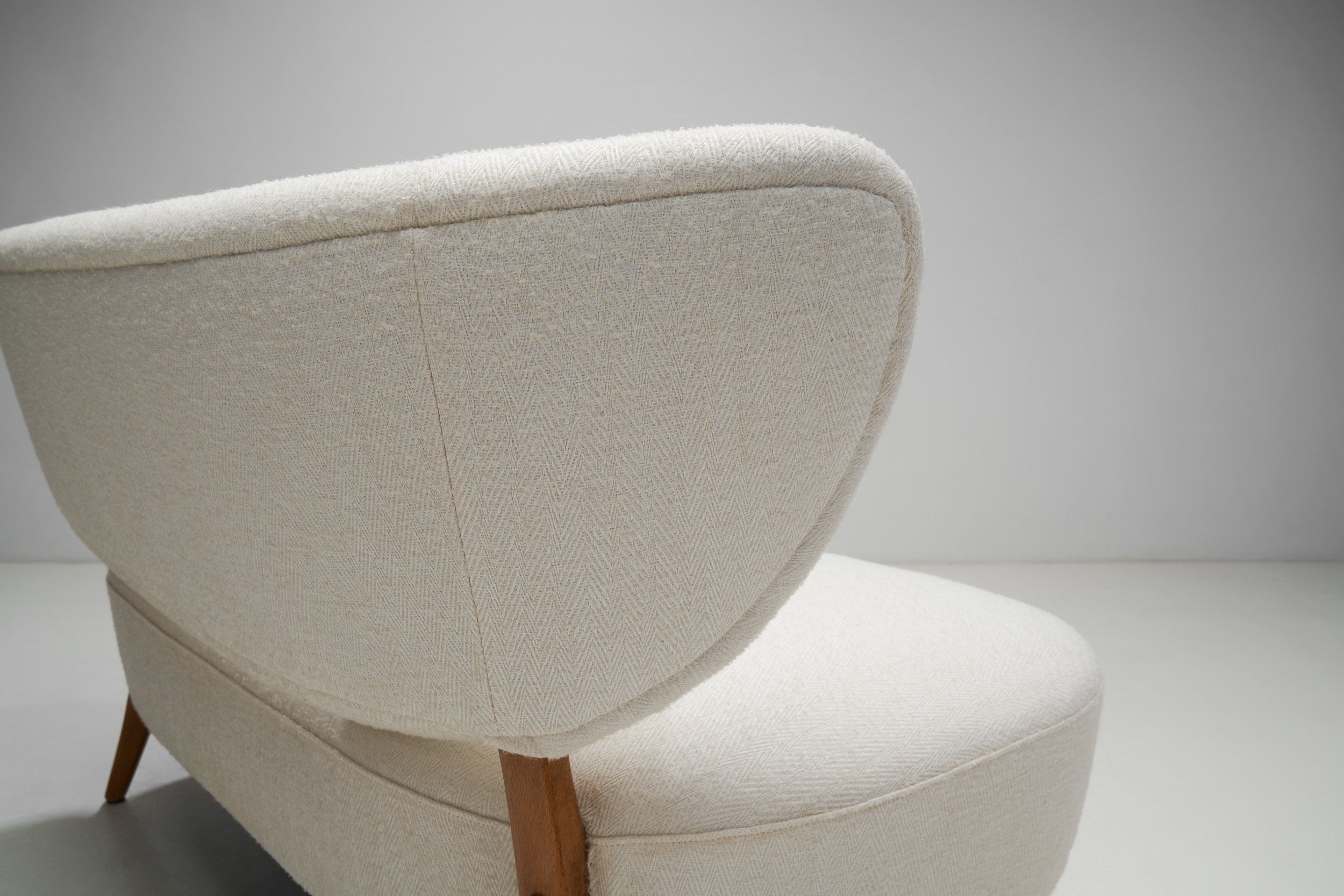
This spectacular two-seater sofa by Swedish designer, Otto Schulz, is a beautiful example of the furniture designer’s repertoire of cleverly constructed pieces. With a creative and masterfully crafted wooden structure and fully upholstered body, this model truly deserves its place in Swedish design history.
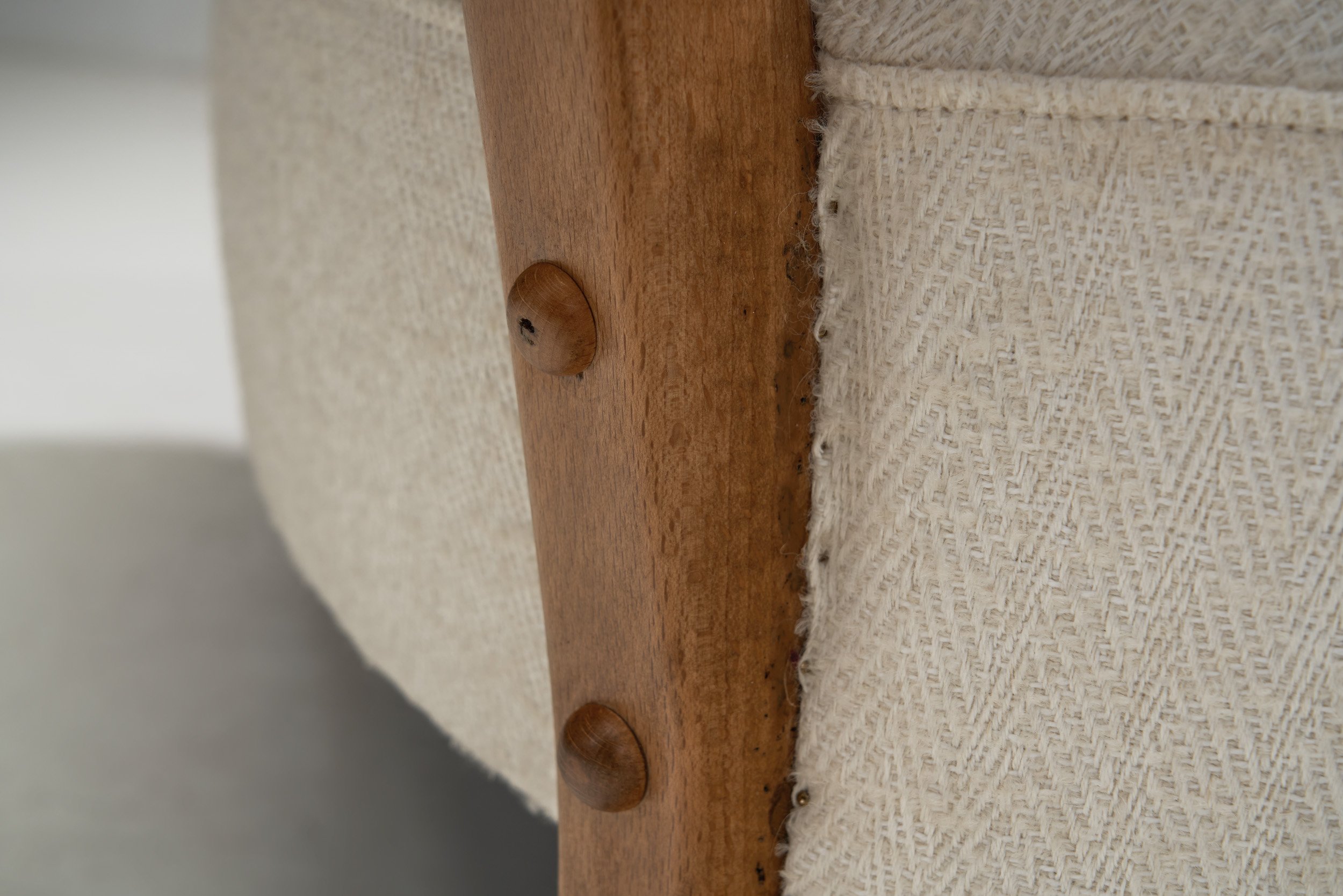
The design of this 1940s sofa combines function and aesthetics, keeping the form in service of the user while keeping it elegant and modern. The curved back immediately stands out, attached to the seat solely by the elongated back legs. This is a signature technique of Schulz’s, resulting in a floating look that is especially stunning from the back and the sides. The wooden frame contrasts beautifully with the textured fabric’s light colour. The exposed wood features visible joinery with decorative wooden screw caps, which showcases the Swedish “honest design” ideal. In Sweden, “svensk design” (Swedish design) in particular operates as a set of relations linking the everyday world - composed of objects, spaces, people - to the cultural ideologies that motivate the persistence of a social democratically infused “way of life.” Thanks to this sentiment, cabinetmakers, like at Boet, put an emphasis on soft elegance and functionality, making this sofa model timeless in every sense of the word. Schulz founded the Swedish company Boet and an eponymous magazine that became an extremely influential design publication during the 1930s and 40s.
As this sofa shows, Schulz was not only a brilliant designer and architect, but also excelled in producing his designs that came to be part of Swedish design history. The artisanal production quality shows throughout this sofa and takes the Swedish idea of furniture that last for generations seriously.
Condition:
Wear consistent with age and use. The sofa has been reupholstered recently in a premium fabric. Each of our items can be re-upholstered by our in-house atelier in a fabric of choice. Please reach out for more information.
Dimensions:
57.08 in W x 26.77 in D x 31.49 in H; Seat height 16.53 in
145 cm W x 68 cm D x 80 cm H; Seat height 42 cm
About the Designer:
Otto Schulz (1882-1970) was a Swedish interior designer, furniture designer, publisher, and founder of the furniture company BOET in Gothenburg.
Schulz was born in Germany and moved to Sweden in 1907. He mainly produced opulent upholstered furniture, as well as lavishly inlaid, decorative box furniture style-wise between functionalism and traditionalism. He has some of his own invented techniques patented, including the use of decorative nails as part of the design, called Bopoint. After establishing his own furniture company, BOET, he used it as a showroom to exhibit his designs as well.
In the 1920s he started publishing the eponymous magazine BOET, which was also a platform for his own collection. The magazine was at the time the most influential, appearing in regular editions in Sweden and often included interviews with well-known designers and architects. ~H.
REQUEST PRICE HERE
Price category: 9,000 - 12,500 usd / eur
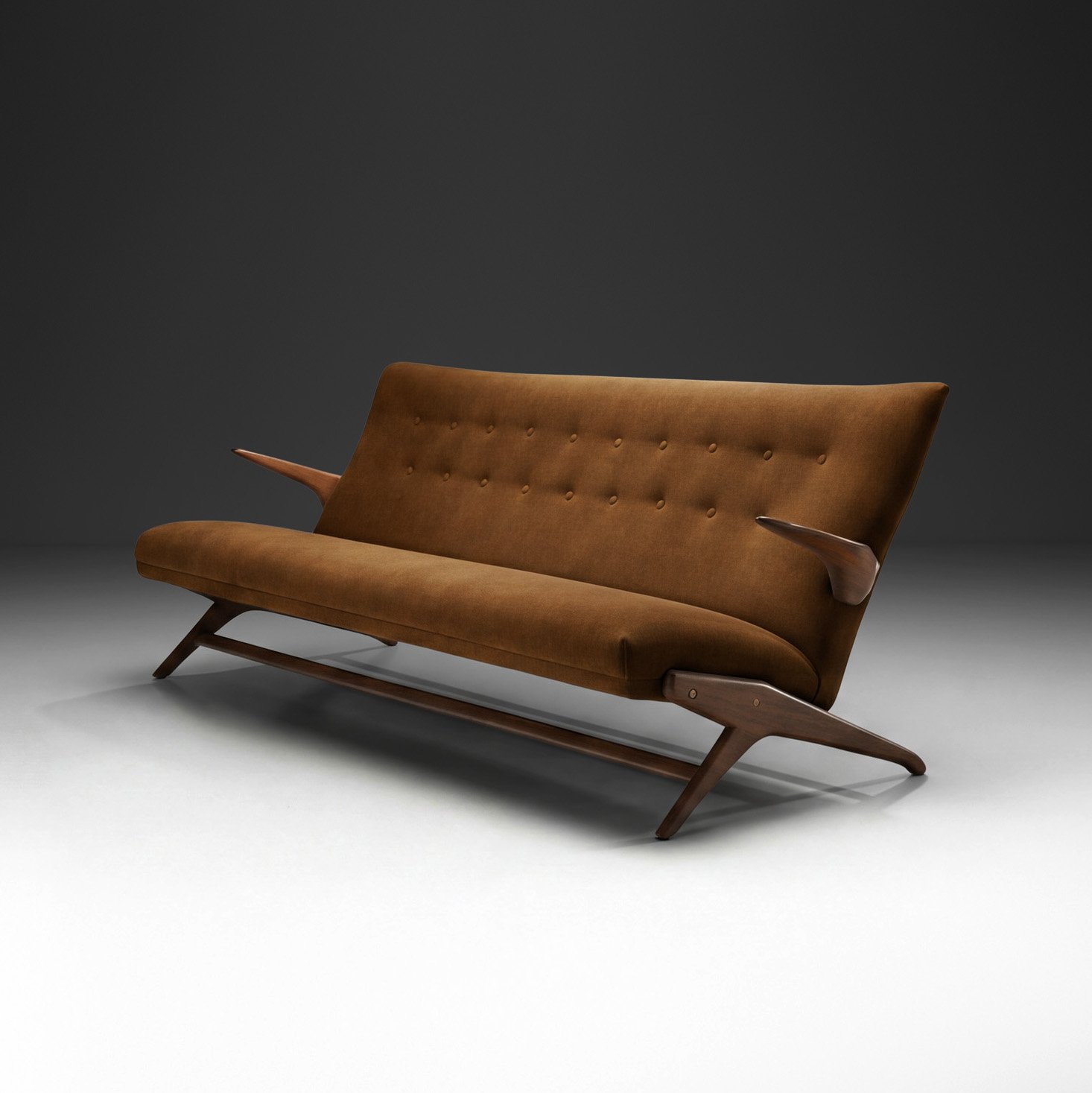
Though the advent of new materials like plastic, foam, and fibreglass revolutionized the production process, Scandinavian designers still valued craft over industrialization. This sculptural sofa is a beautiful evidence of this heritage and the mastery of Danish cabinetmakers.
Many of the most renowned Danish designers were trained architects as well. This knowledge and training can be clearly traced in the structure of this stunning sofa. Many elements emblematic of mid-century design are also apparent: sleek lines, simple geometries, an open layout, and the impeccable quality of the materials and craftsmanship. The design is defined by its angles, starting with the tilted back and the raised seat towards the front. The sculptural wooden arms and legs follow these lines, creating visual balance. The mostly rounded edges are broken by the pair of straight stretchers set between the front and the back legs. The button tufting on the backrest rhymes greatly with the long horizontal lines, and is a stylish feature in itself as well. Though mid-century Danish manufacturers may not have the name recognition as designers do in the mass market, they were evidently just as integral in developing a modern aesthetic in Europe. The sleek and stylish look of this sofa, from the unique wooden frame to the upholstered body and the visible joinery, embodies this aesthetic.
The designer of this model clearly prized the marriage of form and function. Young Scandinavian designers still look to the mid-century masters for inspiration, which should come as no surprise looking at this sofa.
Condition:
In good vintage condition. Wear consistent with age and use. Due to the nature and age of the materials, the item may have some marks, scratches, and discolouration. The sofa has been reupholstered recently in premium mohair. Each of our items can be reupholstered by our in-house atelier in a fabric of choice. Please reach out for more information.
Dimensions:
72.44 in W x 33.85 in D x 29.92 in H; Seat height 13,77 in
184 cm W x 86 cm D x 76 cm H; Seat height 35 cm
REQUEST PRICE HERE
Price category: 5,000 - 7,500 usd / eur
Henning Kjærnulf was a Danish mid-century designer and architect whose work is associated with the broader Scandinavian modern movement. Although relatively little is known about his personal biography, his furniture designs reveal a strong commitment to craftsmanship and carefully structured forms. Kjærnulf worked with several Danish manufacturers and developed pieces that combined traditional woodworking with modern lines and sculpted forms.
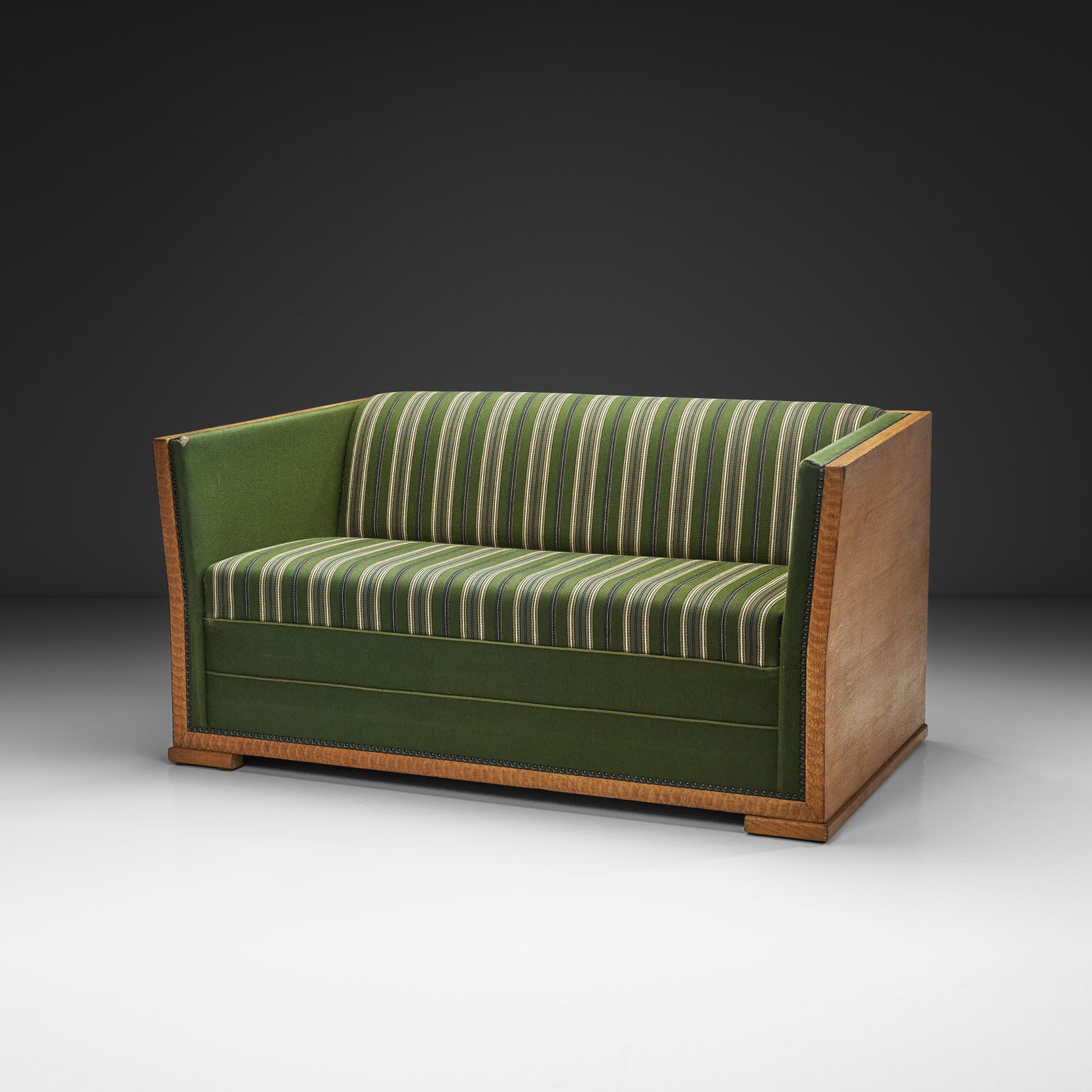
This two-seater sofa reflects those qualities through its solid oak frame and clearly defined architectural presence. The most striking feature is the wooden side and back panels that come together to form a frame for the piece. The frame acts as both a structural support and a visual boundary for the seating area. These panels give the sofa a grounded, natural feel through the deep grain of the oak. The upholstery contrasts with this structure through a layered composition. The seat, backrest, arms are covered in green textile, while the cushions are upholstered in a striped fabric that introduces rhythm across the surface. The pattern emphasizes the geometric shape of the sofa constructed on straight lines. The combination of exposed oak structure and patterned upholstery produces a clear dialogue between rigid frame and soft interior. At the same time, the carving details as well as the metal studs placed alongside the frame provide another dimension of interest, proving the complexity and attention to detail of the maker.
Together, these elements create a piece that is both functional and visually distinctive. Through the use of different materials and balanced clarity of structure, this sofa offers a great example of mid-twentieth-century Nordic seating.
Condition:
In good vintage condition. Wear consistent with age and use. The item has recently been reconditioned. The fabric has some imperfections. The wood has some scratches and dents. Due to the nature and age of the materials, the item may have some marks and discolouration. The item comes with its original upholstery or has been reupholstered by a previous owner. Each of our items can be reupholstered by our in-house atelier in a fabric of choice. Please reach out for more information.
Dimensions:
57.48 in W x 34.64 in D x 29.92 in H; Seat height 17.12 in; Seat depth 22.44 in; Arm height 29.52 in
146 cm W x 88 cm D x 76 cm H; Seat height 43.5 cm; Seat depth 57 cm; Arm height 75 cm
REQUEST PRICE HERE
Price category: 12,500 - 15,000 usd / eur
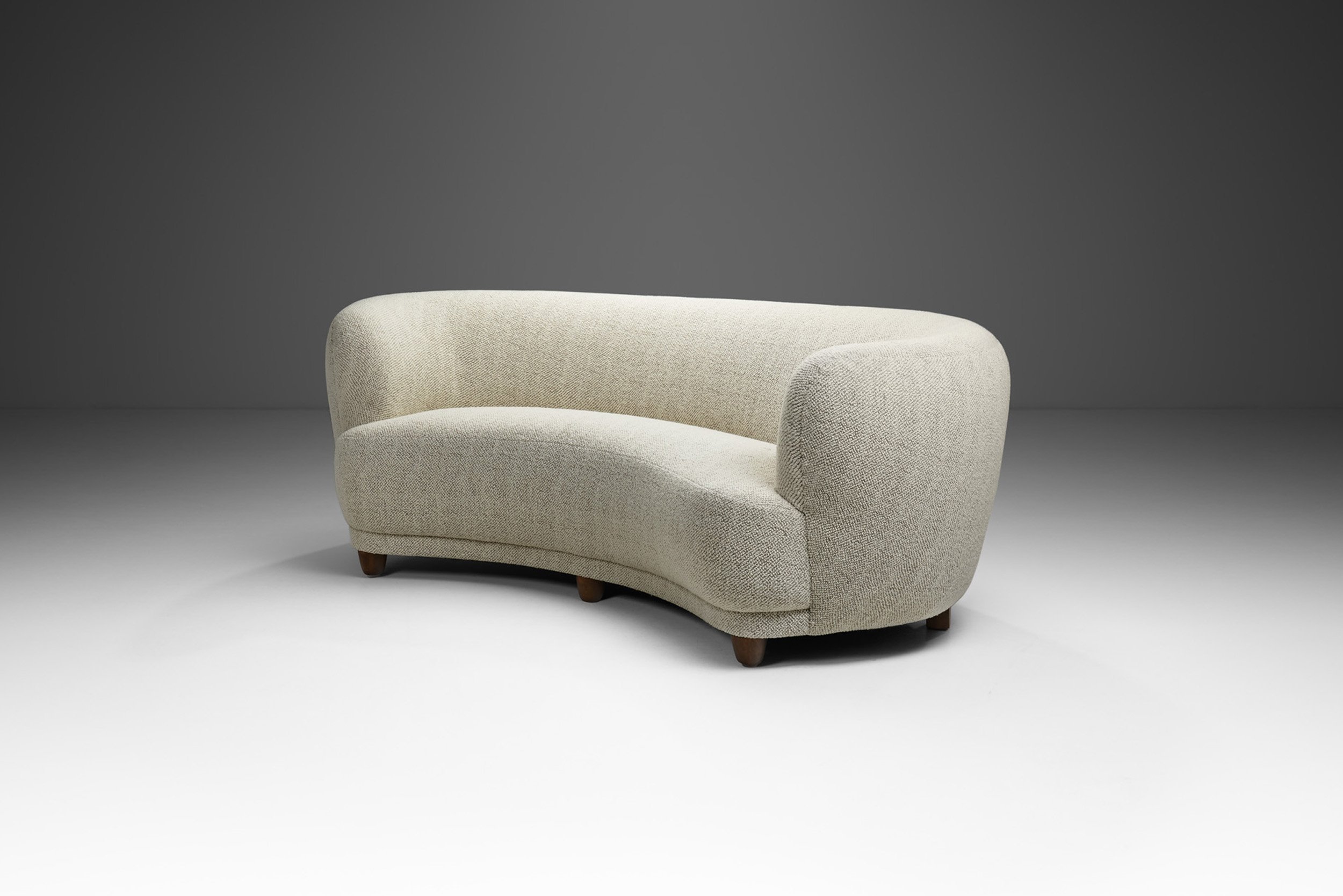
This beautiful Danish three-seater sofa features the recognizable touch of Danish Modernism: exquisite materials, craftsmanship, and an elegantly curved shape, because of which this type of sofa is often referred to as the “banana” or “boomerang” style.
The visual appearance of this sofa echoes Danish design and directs the eyes to the voluptuous body, that is the result of the exquisite craftsmanship. Many of the well-known Danish architects of the era felt the urge to try their hand at three-seater sofas, adhering to the period’s streamlined modernism. In combination with the unadorned styles of mid-century design, this sofa brings together the best attributes of the era. The rounded conical wood legs add an organic feel, while also matching the rounded profile of the sofa. The back legs differ from the front ones as they are tapered to reinforce the sofa’s stability. The masterful sense of proportions, the curved back and the soft upholstery guarantee functionality and comfort. While most curved sofas of the era feature tufting and other forms of decoration, this model is free from unnecessary ornamentation, resulting in a sleek, elegant and modern look. This sofa has been reupholstered in a premium light bouclé fabric, accentuating the stained wooden legs and the luxurious feel and look.
Derived from the French word meaning “curled” or “ringed,” bouclé provides a unique range of benefits; it is abundant in texture yet breathable. This durable fabric makes for an easy way to add instant texture and interest to any modern space, and despite its resurgence around 2020, is a timeless trend with longevity that will stand the test of time. Bouclé pairs incredibly well with curvilinear shapes as demonstrated by this sofa.
Condition:
In good vintage condition. Wear consistent with age and use. The sofa has been reupholstered recently in a premium bouclé fabric. Each of our items can be re-upholstered by our in-house atelier in a fabric of choice. Please reach out for more information.
Dimensions:
78.14 in W x 43.50 in D x 29.13 in H
200 cm W x 110,5 cm D x 74 cm H
About the Designer:
This Danish-made sofa reflects the core traditions and ideals of Danish design, while recalling the shapes of the Art Deco movement. What both movements valued highly is the highest level of craftsmanship and attention to details.
Mid-century pieces such as this early sofa were of great design, using fantastic wood like teak or beech. The mid-century was the heyday of the production by master craftsmen. Mid-century Danish design is world-famous for the partnership between designer and manufacturer, resulting in ground-breaking creations. The Danish design idiom was centred on warm woods, quality fabrics and gentle yet robust support for the spine - qualities that engender contentment and well-being, a defining characteristic of Danish culture. The “Great Danes” believed furniture should be shorn of aesthetic detail and be an amalgam of form and function.
A master cabinet-maker is not a carpenter, as this was a rare breed of craftsman who had to be recognized by the Danish government after several years of toiling at his craft, as well as having to ace gruelling design competitions before becoming a master cabinet-maker. Since Denmark was a special instance of tempered industrialization, it managed to preserve sound traditions and continue to safeguard values of craftsmanship, materiality and usability.
Today, Danish furniture is sought after by collectors for classic looks, storied designs and solid quality, works that are truly soulful and timeless. ~H.
REQUEST PRICE HERE
Price category: 9,000 - 12,500 usd / eur
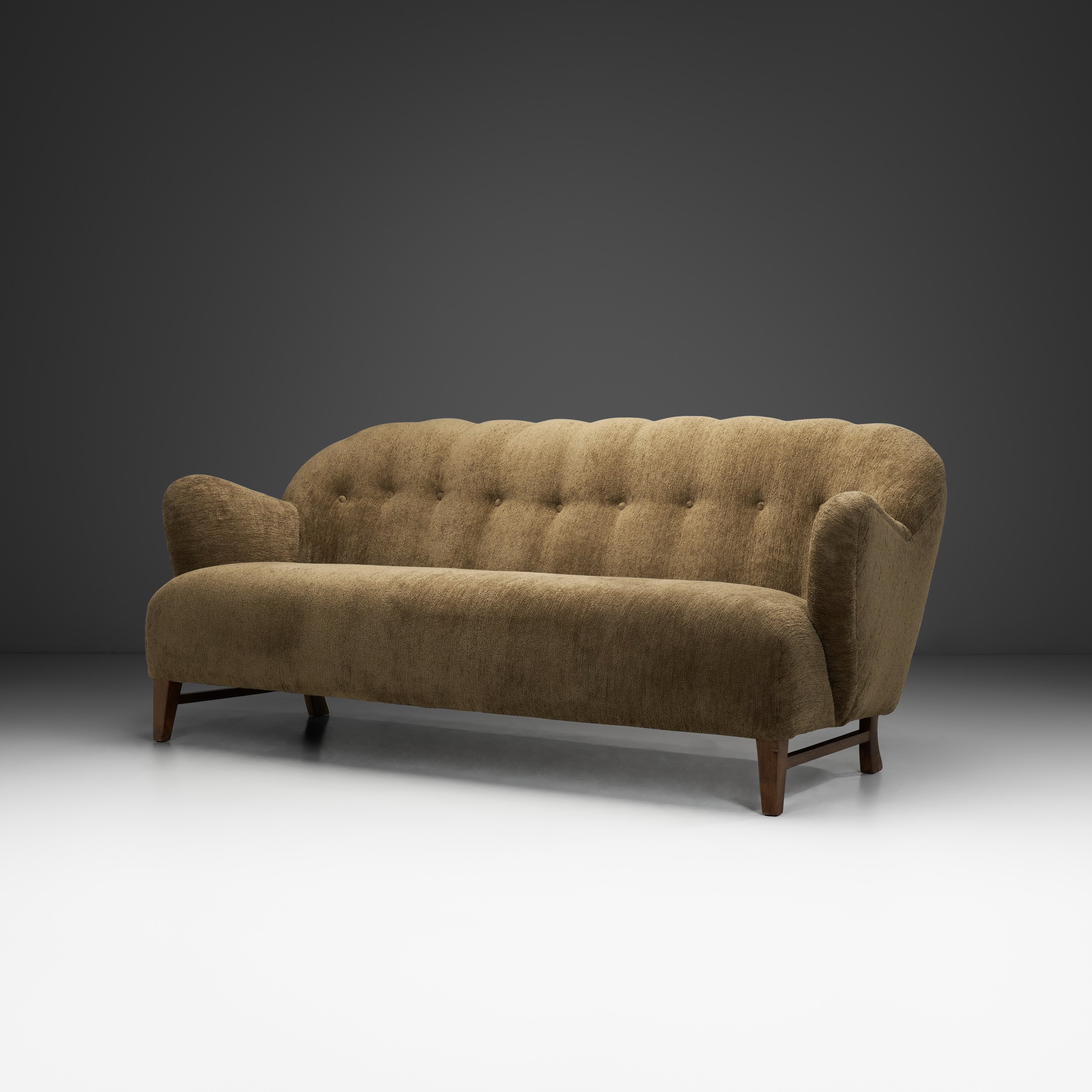
This Danish cabinetmaker sofa comes from a moment in mid-20th-century Denmark when craftsmanship and comfort were treated with equal seriousness. Cabinetmakers played an important role in shaping the country’s design identity, working to produce furniture that balanced sculptural presence with daily usability. Their work often resulted in pieces with thoughtful proportions, careful joinery, and a level of detail that signaled true mastery. This sofa clearly reflects that tradition.
This mid-20th century piece carries the quiet confidence of an object made by hand, where every curve, and every seam has been shaped with intention. The sofa’s form is soft and inviting, defined by a long, gently scalloped backrest and a subtly rounded silhouette that seems to hold the sitter rather than merely support them. The deep, rhythmic tufting across the back introduces texture without overwhelming the form, creating a sense of movement that brings the whole piece to life. Its arms curve outward slightly, opening the composition. The upholstery, a warm and tactile fabric in an earthy tone, enhances the sense of comfort, allowing the light to move delicately across its surface. Below, the wooden legs ground the piece and ensure sturdiness. Their clean lines and warm tone balance the softness above. From every angle, this piece reveals the quality work of its cabinetmaker, combining a sensitivity to form, proportion and material.
As a whole, this sofa carries a calm, understated beauty that fits seamlessly into both traditional and contemporary settings. It speaks to the Danish approach to living, where simplicity is enriched by craftsmanship and comfort. It is a reminder of why mid-century Danish design endures: its ability to balance refinement and warmth in a way that still resonates today.
Condition:
In good vintage condition. Wear consistent with age and use. Due to the nature and age of the materials, the item may have some marks, scratches, and discolouration. The sofa has recently been reupholstered in a premium fabric. Each of our items can be reupholstered by our in-house atelier in a fabric of choice. Please reach out for more information.
Dimensions:
68.70 in W x 35.82 in D x 29.33 in H; Seat height 16.14 in; Seat depth 21.25 in; Arm height 24 in
174.5 cm W x 91 cm D x 74.5 cm H; Seat height 41 cm; Seat depth 54 cm; Arm height 61 cm
REQUEST PRICE HERE
Price category: 12,500 - 15,000 usd / eur
In the years after the Second World War, Danish designers quietly transformed the language of modern furniture. Moving away from the austerity of early functionalism, they explored a softer, more organic approach to furniture making, balancing clean geometry with inviting tactility. Designers experimented with sculptural silhouettes that felt approachable yet sophisticated, often pairing fine craftsmanship with innovative upholstery techniques to achieve furniture that was elegant but deeply comfortable.
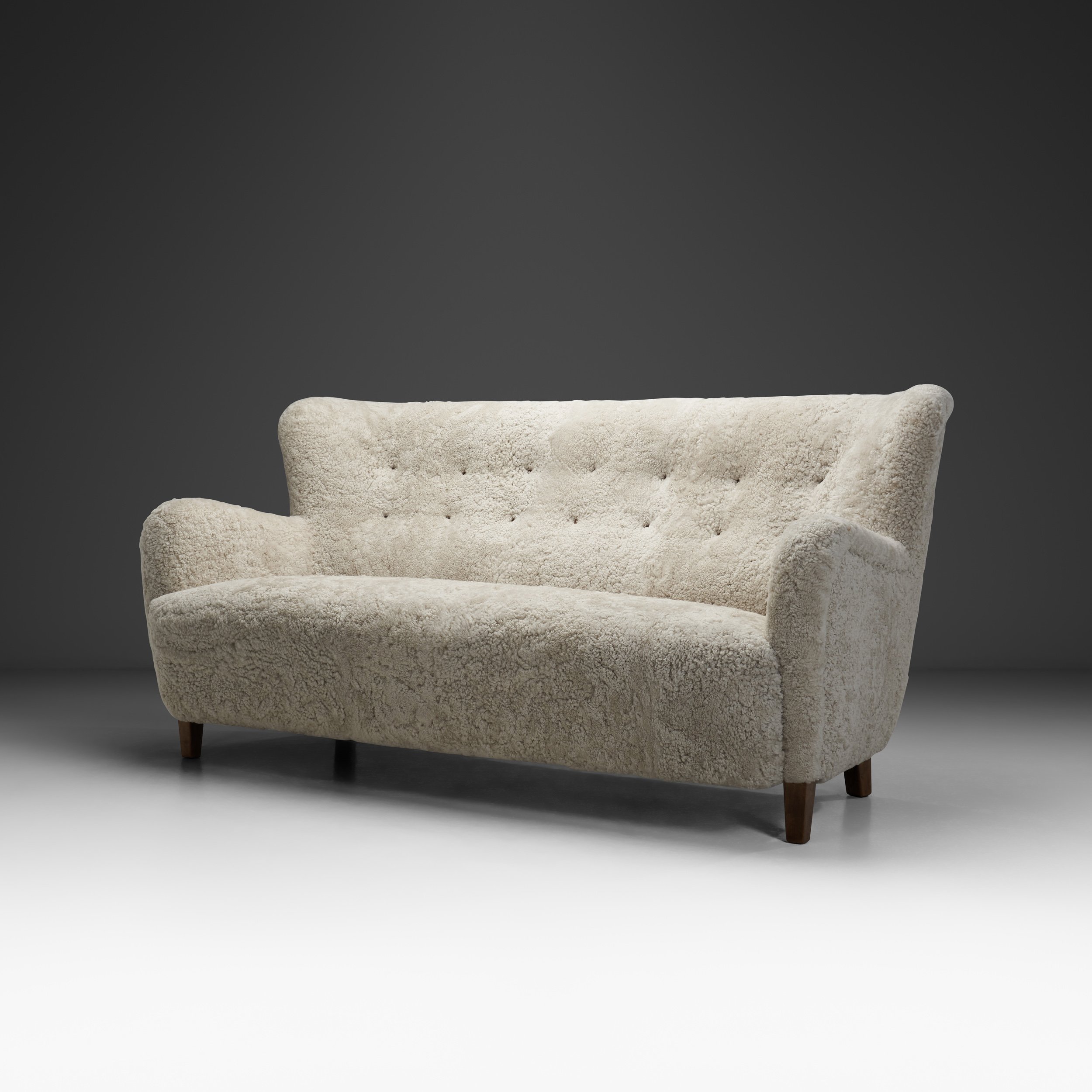
This three-seater sofa from the 1950s beautifully embodies that ethos. Its gently flared arms and subtly tilted backrest give the piece a graceful, almost embracing profile, while the deep seat promises true comfort. The upholstery, a textured, off-white fabric, adds warmth and tactile richness, complementing the restrained lines of the frame. Tufted button detailing across the backrest introduces a sense of rhythm and craftsmanship, elevating the sofa from purely functional seating to a thoughtfully composed piece. The proportions are carefully judged: generous enough for lounging yet visually light, with raised wooden legs that lift the form and prevent it from feeling heavy. It is a design that invites long hours of conversation or quiet rest without sacrificing visual elegance.
Timeless yet unmistakably mid-century, this Danish sofa carries a quiet sophistication that transcends trends. Both practical and poetic, it stands as a reminder that modernism at its best is deeply attuned to the rhythms of everyday living. Danish makers became masters at this balance, producing pieces that could be both understated and richly expressive.
Condition:
In good vintage condition. Wear consistent with age and use. Item may have some marks, scratches, and discolouration. The sofa has recently been reupholstered in premium sheepskin. Each of our items can be reupholstered by our in-house atelier in a fabric of choice. Please reach out for more information.
Dimensions:
75.59 in W x 37.79 in D x 37 in H; Seat height 20.86 in; Seat depth 22.44 in; Arm height 25.19 in
192 cm W x 96 cm D x 94 cm H; Seat height 53 cm; Seat depth 57 cm; Arm height 64 cm

REQUEST PRICE HERE
Price category: 15,000 - 20,000 usd / eur
This free-standing sofa, better known as “Model V11” is considered among the masterpiece designs of Illum Wikkelsø. The Danish designer created the “V11” series in 1965 whilst working with master cabinetmaker Holger Christiansen in Aarhus.
Wikkelsø’s three-seater sofa combines a rectangular shape and long lines with rounded out edges. The low back and deep seat give the sofa a modern and elegant look. The Brazilian rosewood legs are cone-shaped, a stand-out design element of the sofa. Three loose seat cushions contrast well with the tight edges of the frame, while also guaranteeing sitting comfort. Along with the cushions, the sides, back- and armrests are upholstered in a brown-green leather with beautiful patina.
The sofa was manufactured by Danish manufacturer Holger Christiansen Møbelfabrik in Aarhus in the 1960s. The leather is in a desirable vintage condition. This model has a good sense of balance and a classic look, which makes it a timeless design.
Condition:
In good vintage condition. The legs show minor wear. The leather has some marks and scratches and a beautiful patina. Each of our items can be re-upholstered by our in-house atelier in a fabric of choice. Please reach out for more information.
Dimensions:
91.33 in W x 32.87 in D x 27.55 in H; Seat height 17.32 in
232 cm W x 83.5 cm D x 70 cm H; Seat height 44 cm
Literature:
300 Danske Designmøbler By Per H. Hansen and Klaus Petersen. 2015. Unpaginated.
About the designer:
Kristian Illum Wikkelsø (1919-1999), by his full name, is best known for his seating designs. Like most Danish designers at the time, Wikkelsø trained as a carpenter until 1938 and then followed in the footsteps of many of his later colleagues and continued his studies at the Copenhagen School of Arts and Crafts, graduating on 1941.
In 1944, Wikkelsø moved to Århus to work as an interior designer He was then employed at the carpentry master and architect Jacob Kjær's drawing room and then at Peter Hvidt & Orla Mølgaard Nielsen’s architectural firm, where he worked until 1954. The same year, Illum Wikkelsø began designing his own furniture and a few years later, he established his own workshop. A number of Danish manufacturers produced Wikkelsø’s designs, such as C.F. Christensen, Holger Christiansen and Søren Willadsen.
Like many of his Danish contemporaries, including Arne Jacobsen, Finn Juhl, and Hans Wegner, Wikkelsø’s designs emphasize formal simplicity and biomorphic silhouettes. Wikkelsø’s background in cabinetry engendered in him a profound understanding of materials and an excellent attention to detail. Working with teak and rosewood, he captured delicately sculptural forms. Wikkelsø believed that furniture should be built to last while cradling the body and pleasing the eye.
Though little biographical information survives, the quality of Illum Wikkelsø’s designs affirms his status as an active proponent of Scandinavian modernism in the post-war era. ~H.
REQUEST PRICE HERE
Price category: 5,000 - 7,500 usd / eur
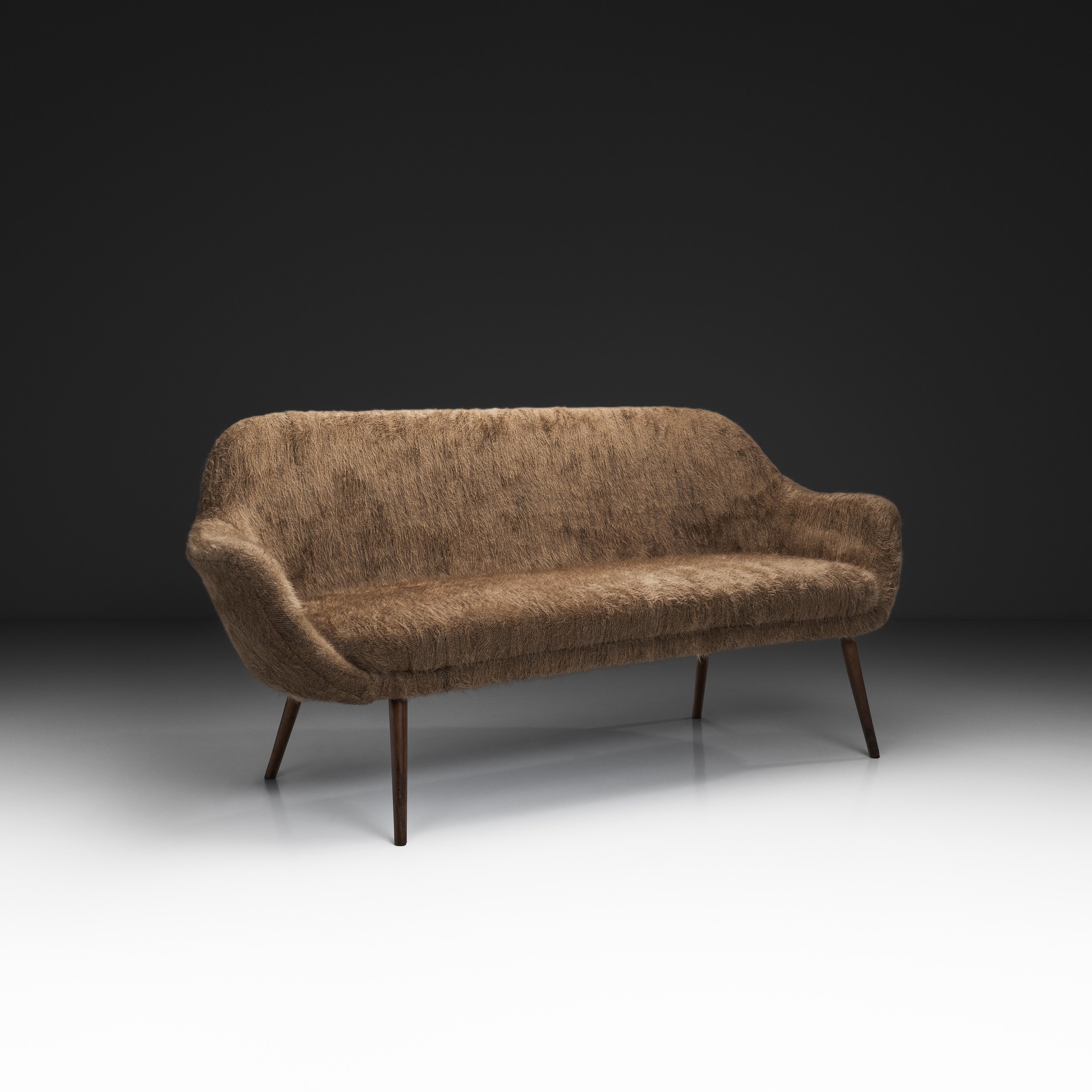
This beautiful Danish two-seater sofa is an example of Danish Modern design. With a classic mid-century look, this model is the perfect piece to bring the coveted style into any interior. Modernism was an escape from the rigidity of Realism, and a multitude of cultural and aesthetic movements grew from it. Modernism in Denmark incorporated Scandinavia’s core values into the movement, including praising nature, human creativity and faithfulness to traditional materials and craftsmanship.
These traits can be traced in the form of this sofa. The backrest flows directly into the arms in one uninterrupted line, wrapping around the seating area and creating a protective, cocoon-like shape. Rather than projecting outward as separate components, the arms flow naturally from the body of the sofa, giving the piece a sense of cohesion. The result is a piece of furniture that appears soft and sculptural from every angle. The brown upholstery reinforces these curves, allowing light to move gently across the rounded surfaces. Slender tapered legs lift the body from the floor, introducing a sense of lightness and preventing the silhouette from feeling heavy. The slightly reclined back further contributes to the relaxed character of the design.
Timeless yet unmistakably mid-century, this sofa carries a quiet sophistication that transcends trends. It stands as a reminder that Danish modernism at its best is deeply attuned to the rhythms of everyday living. Danish designers and cabinetmakers became masters at this balance, producing pieces that could be both understated and richly expressive.
Condition:
In good vintage condition. Wear consistent with age and use. The sofa has recently been reconditioned. Due to the nature and age of the materials, the item may have some marks, scratches, and discolouration. The sofa has recently been reupholstered in a premium fabric. Each of our items can be reupholstered by our in-house atelier in a fabric of choice. Please reach out for more information.
Dimensions:
70.87 in W x 26.38 in D x 31.89 in H; Seat height 16.54 in; Seat depth 19.69 in; Arm height 22.45 in
180 cm W x 67 cm D x 81 cm H; Seat height 42 cm; Seat depth 50 cm; Arm height 57 cm

REQUEST PRICE HERE
Price category: 5,000 - 7,500 usd / eur
It was in Denmark that Modernism reigned between the 1920s and 1960s and produced some of the most iconic pieces of furniture to this day. The Danish modernist movement was shaped by two influences. The first was the German Bauhaus; from it, Danish Modernism adopted the trend towards functionalism and this is why one of the hallmarks of Danish furniture is its simplicity. The second was an even earlier influence found in the Funkis style, an aesthetic based on softer lines and rounded shapes.
Choosing to abandon ornamentation to benefit the form, the maker of this sofa maintained the beauty and warmth inherent in traditional Danish cabinetmaking. This sofa has the characteristic “open armrest” design that showcases the high level craftsmanship and the beautiful oak structure. While the design of the sofa’s body is uncomplicated, with a straight back and clean lines, the details and pairing of materials create visual interest and charm. One visually intriguing part of the structure is the way in which the arms “hug” the seat. While another striking detail is the use of the metal studs outlining the edges of the piece. The red colour of the leather upholstery compliments the tone of the oak beautifully and highlights the design movement’s characteristic use of natural materials. Danish cabinetmaker pieces like this are timeless thanks to their expert craftsmanship, their visual and material quality. In Danish design, pieces are made to last rather than to be routinely replaced, as the home is meant to enhance an unburdened lifestyle. Living well is in itself a form of art, and the furnishings of the home are supposed to complement it. This piece serves its purpose in an elegant manner, bringing the beauty of mid-century Danish design to modern interiors.
While Danish creators had many principles, above all, they believed that design could certainly be used to improve people's lives. Elegant and functional, this sofa model is certain to do exactly that.
Condition:
In good vintage condition. Wear consistent with age and use. Minor scratches and marks. This sofa comes with its original upholstery or has been reupholstered by a previous owner. Each of our items can be reupholstered by our in-house atelier in a fabric of choice. Please reach out for more information.
Dimensions:
57.08 in W x 24.80 in D x 31.29 in H; Seat height 16.92 in; Seat depth 20.86 in; Arm height 23.81 in
145 cm W x 63 cm D x 79.5 cm H; Seat height 43 cm; Seat depth 53 cm; Arm height 60.5 cm

REQUEST PRICE HERE
Price category: 15,000 - 20,000 usd / eur
Eva and Nils Koppel met while she was studying at the Danish Academy, Copenhagen. Together they studied architecture and later worked in design icon Alvar Aalto’s office. Their furniture pieces are representative of Scandinavian design - featuring organic shapes, architectural structure, and cosy upholstery.
Mid-century design is typically characterized by clean, simple lines and honest use of quality materials. It also generally includes minimal, tasteful use of decorative embellishments. These sofas are a lovely example from this design period. The main decorative element is the stair-like gradation of the armrests that starts from the top of the backrest and extends to the seat, creating a continuous and flowing line. The rounded-out edges contribute to the soft feel of the sofas. The design directs the eyes to the voluptuous, fully upholstered bodies that is the result of the exquisite craftsmanship and smart design. In combination with the unadorned styles of mid-century modernism, this pair of sofas bring together the best attributes of the era. The four solid wood legs add an organic feel, balancing out the voluptuous profiles. The pairs of tapered legs assure great structural stability, while also enhancing the width of the sofas visually. This pair is ideal for any space, as it utilizes its size in a smart and stylish manner. Furthermore, the form follows function principle of mid-century design is maintained, creating a cosy atmosphere while offering plenty of functional surface as well.
The Danish design idiom was centred around warm woods, quality fabrics and gentle but robust support for the spine - qualities that engender contentment and well-being, a defining characteristic of Danish culture. The Koppels’ exceptional architectural talent is evident even in these sofas.
Condition:
In good vintage condition. Wear consistent with age and use. The sofas have been reupholstered recently in a premium fabric. Each of our items can be reupholstered by our in-house atelier in a fabric of choice. Please reach out for more information.
Dimensions:
69.68 in W x 30.11 in D x 33.85 in H; Seat Height 19.29 in
177 cm W x 76.5 cm D x 86 cm H; Seat Height 49 cm
About the designer:
Eva Koppel, born Eva Ditlevsen (1916-2006) and Nils Adolf Koppel (1914-2009) were a Danish functionalist architect couple who characterized the post-war era and the public building of the welfare society.
Nils and Eva Koppel met during their shared lectures at the Danish Polytechnic Teaching Institute in 1935, where Eva studied mathematics and Nils studied engineering. The same year, they applied to the Academy of the Arts' School of Architecture, where they were both admitted. The year after, in 1936, they got married.
During their studies between 1938 and 1939, they worked together in Finland at Alvar Aalto's design studio. In 1940, they had their first child and the following year they both graduated from the School of Architecture. Since Nils Koppel's father was Jewish, in 1943 they had to flee because of the Jewish persecution. They fled to Finland and resumed working at Aalto's design studio. In the years following the war, the couple designed a number of single-family homes, and set up a home of their own in 1946. Initially, they erected houses for family and friends, designed wallpaper, chairs, watches, light fixtures, and other art-industrial objects.
In 1954, their joint studio won the architectural competition for the Langelinie Pavilion, which was erected in 1958 and has been preserved. The pavilion's rigorous shape, slim profiles and its design as a 'floating' box are indebted to Ludwig Mies van der Rohe's school and the international style. The couple got their first big task in 1954 via family relations: The settlement Søllerød Park. Their house design managed to preserve the scenic parkland, and is now one of the great architectural classics for this time period.
The Koppel couple has received numerous awards and honours, including: The Wood Prize 1960, the Natural Stone Prize 1966 and the Eckersberg Medal 1955. Nils Koppel was also awarded the Knud V. Engelhardt Scholarship 1951. ~H.

REQUEST PRICE HERE
Price category: 7,500 - 10,000 usd / eur
It was in Denmark that Modernism reigned between the 1920s and 1960s and produced the most iconic pieces of furniture. The Danish modernist movement was shaped by two influences. The first was the German Bauhaus. From it, Danish Modernism adopted the trend towards functionalism. That is why one of the hallmarks of Danish furniture is its simplicity. The second was an even earlier influence found in the Funkis style, an aesthetic based on softer lines and rounded shapes.
This sofa fits within the realm of both modernist influences, thanks to its use of rounded, yet clean lines and its functional design. This sofa has the characteristic ‘open armrest’ design that showcases the high level craftsmanship and the beautiful wooden structure as well. Clean and pure lines define this model, coupled with expert craftsmanship and delicate research into proportions, materials and the requirements of the human body, adapting the design to modern-day needs. This three-seater sofa has an elegant but still warm look thanks to its rounded edges and open execution. The six tapered legs add an organic feel, balancing out the voluptuous seat of the sofa. The only form of ornamentation - apart from the bent armrests - is the luxurious blue mohair upholstery. The clean and elegant lines of the design let the upholstery and the wooden outline stand out. This is especially apparent in the front, where the wooden accent accentuates the backrest giving the illusion of cushions.
This sofa embodies the timeless elegance and innovative spirit of Danish design. Perfectly suited for a vintage or contemporary interior, this piece represents a marriage of artistry and comfort. Its blue mohair upholstery captures attention, adding warmth and vibrancy to any space, while the wooden accents are grounding, together making this piece into an ideal statement piece.
Condition:
In good vintage condition. Wear consistent with age and use. Some marks and scratches on the wood. The sofa has been reupholstered recently in a premium fabric. Each of our items can be re-upholstered by our in-house atelier in a fabric of choice. Please reach out for more information.
Dimensions:
62.99 in W x 28.93 in D x 31.49 in H; Seat height 19.29 in; Seat depth 22.44 in; Arm height 25.59 in
160 cm W x 73.5 cm D x 80 cm H; Seat height 49 cm; Seat depth 57 cm; Arm height 65 cm

REQUEST PRICE HERE
Price category: 9,000 - 12,500 usd / eur
20th century Denmark was a mid-century design hotspot. Simplicity, functionality, and elegance - these are the basic principles of Danish design. From furniture, to architecture, fashion and jewellery, 20th century Danish designers excelled in their craft. The design of this three-seater mid-century modern Danish sofa encompasses its era’s ethos.
Visually, this sofa represents Danish modernism by rejecting the common design choices of styles from the past, such as heavy ornamentation and the prioritisation of form over function. The soft, tan coloured upholstery stands out, adding to the modern elegance and cosiness of this piece. The design elements of this sofa - from the curved lines, to the dark wood and luxurious upholstery - not only create an intimate gathering place, but also define the look of a room whilst keeping the warmth and cosiness that is often associated with mid-century design. The design of this sofa aims to maximise comfort while putting an emphasis on elegance and refinement. This is most visible in the round, welcoming body that remains visually arresting with the added two lines of nine tufted buttons, enhanced by the luxurious fabric the sofa is covered in. The short stained beech wood legs add a modern, organic feel, balancing out the voluptuous profile of the sofa. In Danish design, pieces are made to last rather than to be routinely replaced, as the home is meant to enhance an unburdened lifestyle. Living well is in itself a form of art, and the furnishings of the home are supposed to complement it.
This three-seater sofa is proof of Nordic designers’ craft, aided by the master cabinetmakers’ skill, who helped manifest their ideas. This piece serves its purpose in an elegant, comfortable, and stylish manner, bringing the beauty of mid-century Danish design to modern interiors.
Condition:
In good vintage condition. Wear consistent with age and use. The sofa has been reupholstered recently in a premium fabric. Each of our items can be re-upholstered by our in-house atelier in a fabric of choice. Please reach out for more information.
Dimensions:
78.94 in W x 32.28 in D x 33.66 in H; Seat height 18.90 in; Seat depth 19.88 in; Arm height 24.21 cm
200.5 cm W x 82 cm D x 85.5 cm H; Seat height 48 cm; Seat depth 50.5 cm; Arm height 61.5 cm
REQUEST PRICE HERE
Price category: 5,000 - 7,500 usd / eur
It was in Denmark that Modernism reigned between the 1920s and 1960s and produced some of the most iconic pieces of furniture to this day. The Danish modernist movement was shaped by two influences. The first was the German Bauhaus; from it, Danish Modernism adopted the trend towards functionalism and this is why one of the hallmarks of Danish furniture is its simplicity. The second was an even earlier influence found in the Funkis style, an aesthetic based on softer lines and rounded shapes.
This beautifully crafted sofa features impeccable edges, sleek minimalism, and subtle curves. The quality of the design is matched by the outstanding workmanship of the maker. The lower wooden frame of this sofa offers a striking contrast to the supple black leather upholstery, creating a visually captivating aesthetic. Its gently flared upholstered arms give the piece a graceful, almost embracing profile, while the deep seat promises true comfort. Throughout the 20th century, solid wood had been the most important furniture material in Scandinavia. This is especially true for the mid-century, during which natural wood was a staple material to enhance both the structural and visual aspect of furniture, as is the case with this three-seater sofa. This piece not only reflects the craftsmanship and design ethos of the 1960s Danish design movement, but also serves as a timeless addition to any modern living space, combining form and function with enduring style. Unlike other designs, Danish products weren’t flashy but rather made to be of high quality and fit a warm, comfortable and welcoming home. Moreover, Danish makers were of the firm belief that beautiful and functional objects should be accessible to everyone.
As a whole, this sofa carries a calm, understated beauty that fits seamlessly into both traditional and contemporary settings. It speaks to the Danish approach to living, where simplicity is enriched by craftsmanship and comfort. It is a reminder of why mid-century Danish design endures: its ability to balance refinement and warmth in a way that still resonates today.
Condition:
In good vintage condition. Wear consistent with age and use. The sofa has recently been reconditioned. Due to the nature and age of the materials, the item may have some marks, scratches, and discolouration. The sofa comes with its original upholstery, we advise reupholstery. Each of our items can be reupholstered by our in-house atelier in a fabric of choice. Please reach out for more information.
Dimensions:
70.86 in W x 31.69 in D x 31.49 in H; Seat height 18.7 in; Seat depth 18.89 in; Arm height 22.63 in
180 cm W x 80.5 cm D x 80 cm H; Seat height 47.5; Seat depth 48 cm; Arm height 57.5 cm