
Lisa Johansson-Pape Brass Floor Lamp for Stockmann Orno, Finland 1950s


Lisa Johansson-Pape Brass Floor Lamp for Stockmann Orno, Finland 1950s
REQUEST PRICE HERE
Price category: 2,500 - 5,000 usd / eur
Finnish designer, Carin Lisa Johansson-Pape, was among the most significant Finnish lighting designers in the second half of the 1900s. She designed furniture for Stockmann from 1937 and from 1942, she designed for the Stockmann owned lighting factory, Orno. Her attention eventually turned towards lighting, and she co-founded the Illuminating Engineering Society of Finland.
Sharing the visual language of the model “Ihanne”, this model also has a brass shaft with a twisted dark brown plastic band wrapped tightly around it and a round foot plate in brass. This floor lamp has an essentially Nordic modern look, with a combination of classic and interesting material choices and design. The main materials of the tube, base, and socket are brass and plastic. The winding on the tube is especially impressive, connecting the brass base and the socket. The fabric lampshade has a classic empire shape, and is supported by an acrylic reflector. The light fabric is ruched all over the lampshade. Ruching is a fabric manipulation technique used to give a fabric texture and dimension by repeatedly pleating and folding the material. The classic empire shade has a white lacquered metal wire structure supporting its shape gradually widening towards the bottom. The light linen fabric has an elegant and stylish look that stands out even more when the lamp is lit. Combined with the dark pipe and brass stem, the design offers a variety of points of visual interest.This rare model is most likely model “2061” from Orno’s Lighting Catalogue from 1951.
This model is no longer in production unlike some of Johansson-Pape’s other designs.The manufacturer, Stockmann Orno A.B. was a major lighting factory, founded in 1921 in Helsinki, Finland. In 1936, Stockmann became the owner of Orno and the company moved to Kerava in 1937. Orno’s main lighting designers were Lisa Johansson-Pape and Yki Nummi. Since the factory closed its business in 2001, thismodel is no longer in production, making it a rare collectors’ piece.
While Lisa Johansson-Pape was also active as a furniture designer, her lighting designs brought her world-wide fame. Her work was presented in New York’s World Fair of 1939 and the Milan Triennial IX, where she won an award in 1951.
Condition:
In good vintage condition. Wear consistent with age and use.Some minor damage. Some parts are replaced, later lampshade.
Dimensions:
17.91 in ⌀ x 61.81 in H
45.5 cm ⌀ x 157 cm H
About the designer:
Lisa Johansson-Pape graduated as a furniture designer in 1927. Her career as a designer was long and wide-ranged. Johansson-Pape's furniture was very functional. After graduating in 1927 from the Central School of Arts and Crafts she went on to work for Kylmäkoski designing furniture. In 1933, she joined the Friends of Finnish Handicraft. She designed furniture for Stockmann in 1937 and in 1942 she designed for the Stockmann owned lighting factory Orno. The materials of the luminaires were enamelled metal, acrylic, and glass. The technical functionality and practicality of the luminaire was a priority in Johansson-Pape's design.
Her attention turned towards lighting, and she co-founded the Illuminating Engineering Society of Finland, and she became the artistic director of the Friends of Finnish Handicraft from 1951 to 1985. She designed the lumières and lighting solutions for several large spaces in Finland, such as hospitals, churches, and ships. Johansson-Pape served as the artistic director of ‘Friends of Finnish Handicrafts’. She was also known as a designer of textiles, rugs, and carpets. Johansson-Pape also created installations for 150 churches, including Eckerö Church, Helsinki Children’s Hospital, a rheumatic clinic, and for the ships Ilmatar, Aallotar, Finnpartner, Finnhansa and the icebreaker Karhu.
Lisa Johansson-Pape's works have represented Finland in numerous international exhibitions since the 1930s. At the Milan Triennial in 1951, her lamps received a silver medal and at the 1954 Triennial a gold medal. Johansson-Pape was awarded the ProFinlandia Medal in 1957. ~H.



REQUEST PRICE HERE
Price category: 1,000 - 2,500 usd / eur
In 1918, Paavo Tynell, “the man who illuminated Finland” co-founded the metalwork and lighting company Taito Oy, the first industrial producer of lighting fixtures in Finland. He worked as the company’s CEO and chief designer until 1953, during which time his creativity brought the world numerous iconic designs. Tynell created lighting models for various public spaces, such as Helsinki’s Parliament House and the office of the Secretary-General of the United Nations.
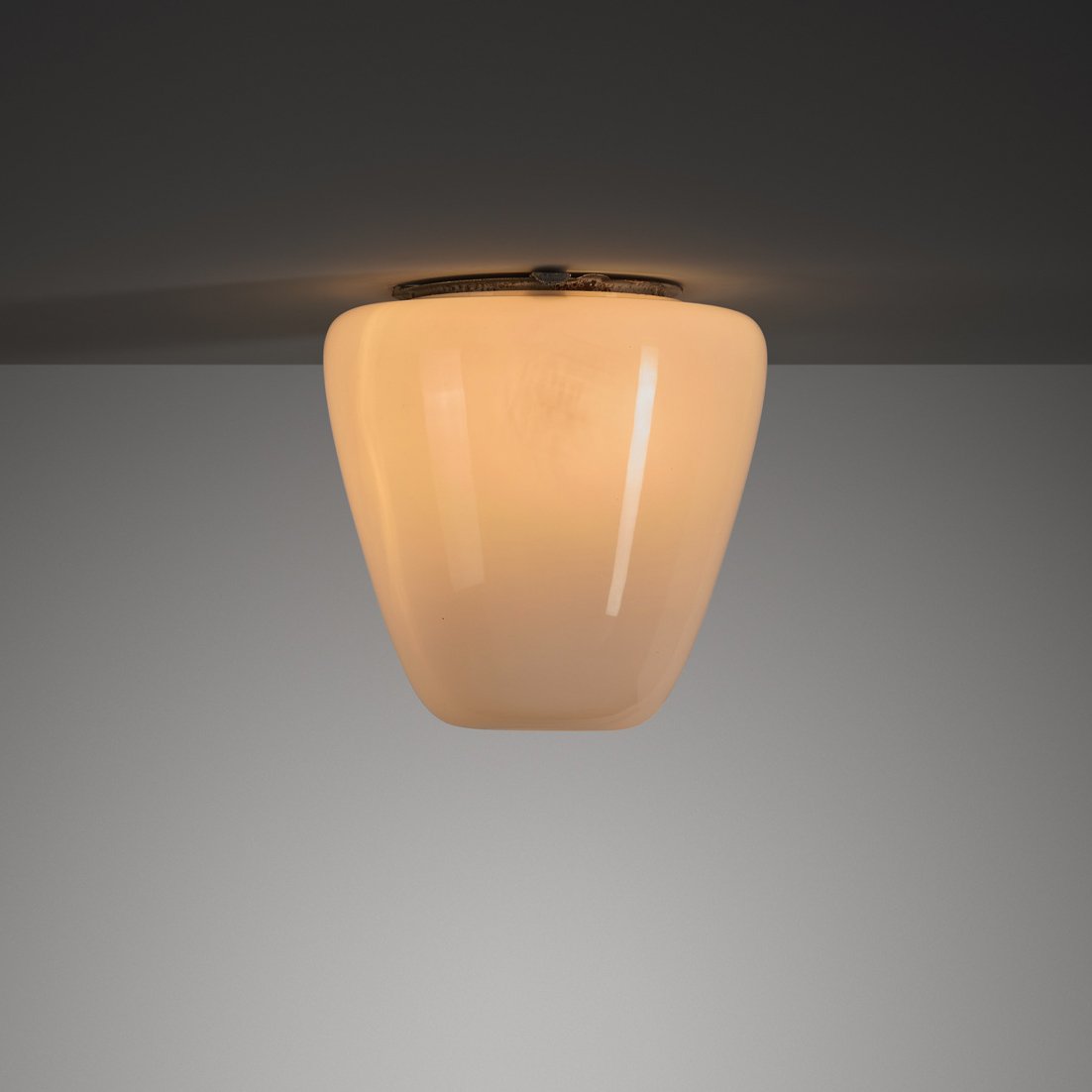
In the early to mid-20th century, he designed a number of iconic lamps that are still sought after today, including this 1937 model “2016” milk glass ceiling lamp. This piece embodies the sleek and simple aesthetic that characterised early modern Finnish design. Still, even in the absence of ornamentation or elaborate shapes and forms, there was always an emphasis on interesting materials. Milk glass, appropriately named for its opaque or transparent pure ivory white tone, was first created in Venice in the 16th century, known as Lattimo. At that time, it was widely used for decorative purposes and continued to be popular during the 20th century when the material was used to decorate households as home accents. To complement the glass, a nickel-plated base connects the shade to the ceiling, offering the lamp a cool sheen even when unlit. This lamp has a gentle, round shape that is just as soft as the light it diffuses. Milk glass was popular in the 1950s, due in part to its ability to soften and diffuse light, as this model demonstrates.
The 20th century was a time of great innovation in Finnish design, as designers pushed the boundaries of what was possible with new materials and manufacturing techniques. Model “2016” is a modernist design to its core with a look that can integrate and complement any space.
Condition:
In good vintage condition. Wear consistent with age and use. The lamp has recently been rewired and reconditioned. The metal structure has some marks and scratches. Due to the nature and age of the materials, the item may have discolouration and imperfections. All lighting can be converted for US usage.
Dimensions:
6.49 in W x 6.49 in D x 4.33 in H
16.5 cm W x 16.5 cm D x 11 cm H