
Teak and Metal Serving Cart by B.R.S.-Pava, Italy ca 1950s


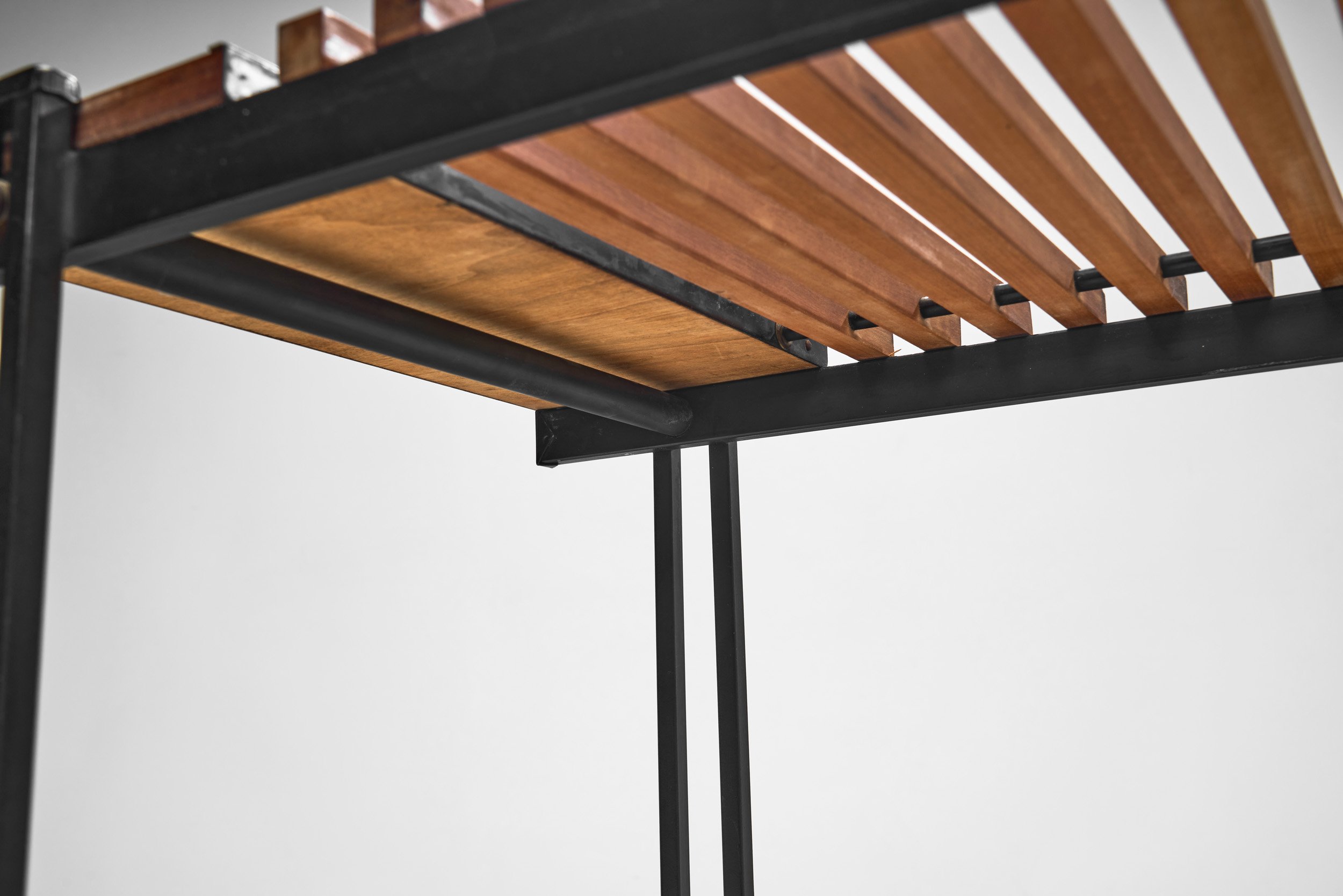


Teak and Metal Serving Cart by B.R.S.-Pava, Italy ca 1950s
REQUEST PRICE HERE
Price category: 2,500 - 5,000 usd / eur
Adding a beautifully designed, styled, and stocked bar cart to a home—preferably next to a comfy lounge chair and accompanied by candles or mood lighting—is a lovely way to build a ritual of daily de-stressing into life. Bar carts can be so much fun to decorate; they can be changed up with each season and incorporated into just about any space where serving serious style is as important as serving delicious drinks.
This “B.R.S.-Pava” marked serving cart from Italy stands as a visual testimony to the fusion of form and function. Crafted with precision and marked with excellence, this Italian piece boasts a distinctive combination of teak and black metal, elevating its aesthetic allure to new heights. The choice of materials is a stroke of design prowess, as the teak's warm, natural hues meet the sleek, industrial style of black metal. Together, they merge in perfect harmony, creating a visual symphony that captures the essence of modern sophistication. The contrast between the two elements is not just apparent; it's deliberate, adding depth and character to this serving cart. The structure of the cart is a study in thoughtful design: comprising two levels, it seamlessly blends thin teak slats with larger solid wood surfaces. This combination ensures not only a striking visual appeal but also optimal functionality. The airy design allows for a light and open feel, making the cart an unobtrusive yet stylish addition to any space. Furthermore, the four patinated metal wheels beneath the cart not only enhance its mobility but also contribute to its overall aesthetic charm. The wheels add a touch of vintage charm to the cart while ensuring practicality in its usage. Moving effortlessly across a room, this serving cart is a truly versatile companion for any space. Serving carts, once overlooked, have experienced a resurgence in popularity among interior designers and aficionados. The newfound appreciation for these functional pieces lies in their ability to seamlessly integrate into various design styles while providing a practical solution for serving guests. This B.R.S.-Pava produced serving or bar cart, with its blend of materials, exemplifies this trend, proving that practicality and style can coexist effortlessly.
This Italian serving cart, with its modern and timeless design, is a symbol of the evolving tastes in interior design. Its sleek lines and thoughtful composition make it a piece that transcends trends, standing as a contemporary icon in interior design. As interior designers continue to explore innovative ways to marry form and function, this B.R.S.-Pava serving cart remains a prime example of how craftsmanship and design can come together to create a truly remarkable piece. Whether in a bathroom to hold towels, soaps and a pretty plant or used as a sideboard to hold plates, bowls and other serve ware, bar carts are versatile, stylish accessories to any space.
Condition:
In good vintage condition. Wear consistent with age and use. Some scratches and marks on the structure.
Dimensions:
24.21 in W x 14.96 in D x 31.88 in H
61.5 cm W x 38 cm D x 81 cm H


REQUEST PRICE HERE
Price category: 1,000 - 2,500 usd / eur
Josef Frank designed Vänskapsknuten (the Knot of Friendship) as a symbol of friendship and peace at a time when Europe was filled with turmoil. The very first sketch of the candelabra dates back to 1938, just a year before the outbreak of the Second World War, but it is as relevant now as it was then.
The Austrian designer and architect may be best known for his vivid textiles for Swedish firm Svenskt Tenn, but his artistic touch reached far beyond textiles and created iconic objects such as this candle holder. The elaborate brass structure intertwines at multiple points, but the brass rods only meet in the middle where a small sphere connects them. Each of the three brass cup have so-called chambersticks, small pans to catch dripping wax. The looping calligraphic design gives this piece a weightless grace that is stunning even without the symbolism behind it. The body’s busy look is completed and balanced by the long candles. The design changes from angle to angle and shows Frank’s sensitive touch. The Knot of Friendship has become an iconic object not only in Svenskt Tenn’s range, but also of Sweden. The production traditionally required a process of thorough methodology and great craftsmanship. Josef Frank was the most prestigious designer in the Stockholm design company Svenskt Tenn (Swedish Pewter), recruited by the founder of the company, Estrid Ericson herself.
Since 2018, after a careful assessment of Josef Frank’s original drawing, the candelabra regained its original form from 1938 under the hands of Svenskt Tenn. However, the production of this well-known and widely-loved candle holder now takes place at Humstorp Metal in Västergötland. This piece however, is from the original production from the post-war era.
Condition:
In good vintage condition. Wear consistent with age and use. The brass has a beautiful patina with some marks. Due to the nature and age of the material, the item may have some scratches and discolouration.
Dimensions:
8.85 in W x 7.48 in D x 6.29 in H
22.5 cm W x 19 cm D x 16 cm H
About the designer:
Josef Frank (July 15, 1885 – January 8, 1967) was an Austrian-born architect, artist, and designer who adopted Swedish citizenship in the latter half of his life. Together with Oskar Strnad, he created the Vienna School of Architecture, and its concept of Modern houses, housing, and interiors.
Josef Frank was one of early Vienna modernism’s foremost figures, but already in the beginning of the 1920s he started to question modernism’s growing pragmatism. He had little appreciation for the French architect Le Corbusier’s belief that a house should be “a machine for living in”. He was against puritanical principles and on the contrary, feared that standardized interiors would make people all too uniform. Josef Frank represented a freer, more artistic style ideal, and he developed his own type of modernism where values like comfort, hominess, and a wealth of colour were at its core. He resisted limitations and models for his furniture and textiles came from across all boundaries both in time and space.
Josef Frank began working at Svenskt Tenn in 1934 and just a few years later, the Frank-Ericson duo made their international breakthrough. Svenskt Tenn’s exhibition room at the World Expositions in Paris in 1937 and New York in 1939 was completely contrary to the ideal of the time with its bold contrasts in materials, colours, and prints. The duo received a great deal of attention and became, somewhat paradoxically, the model for the expression “Swedish Modern”. Although he was already 50 years old when he left Vienna for Sweden, Frank is considered one of Sweden’s most important designers.