
Model 2464 "Marketta" Chair by Asko, Finland 1950s





Model 2464 "Marketta" Chair by Asko, Finland 1950s
REQUEST PRICE HERE
Price category: 5,000 - 7,500 usd / eur
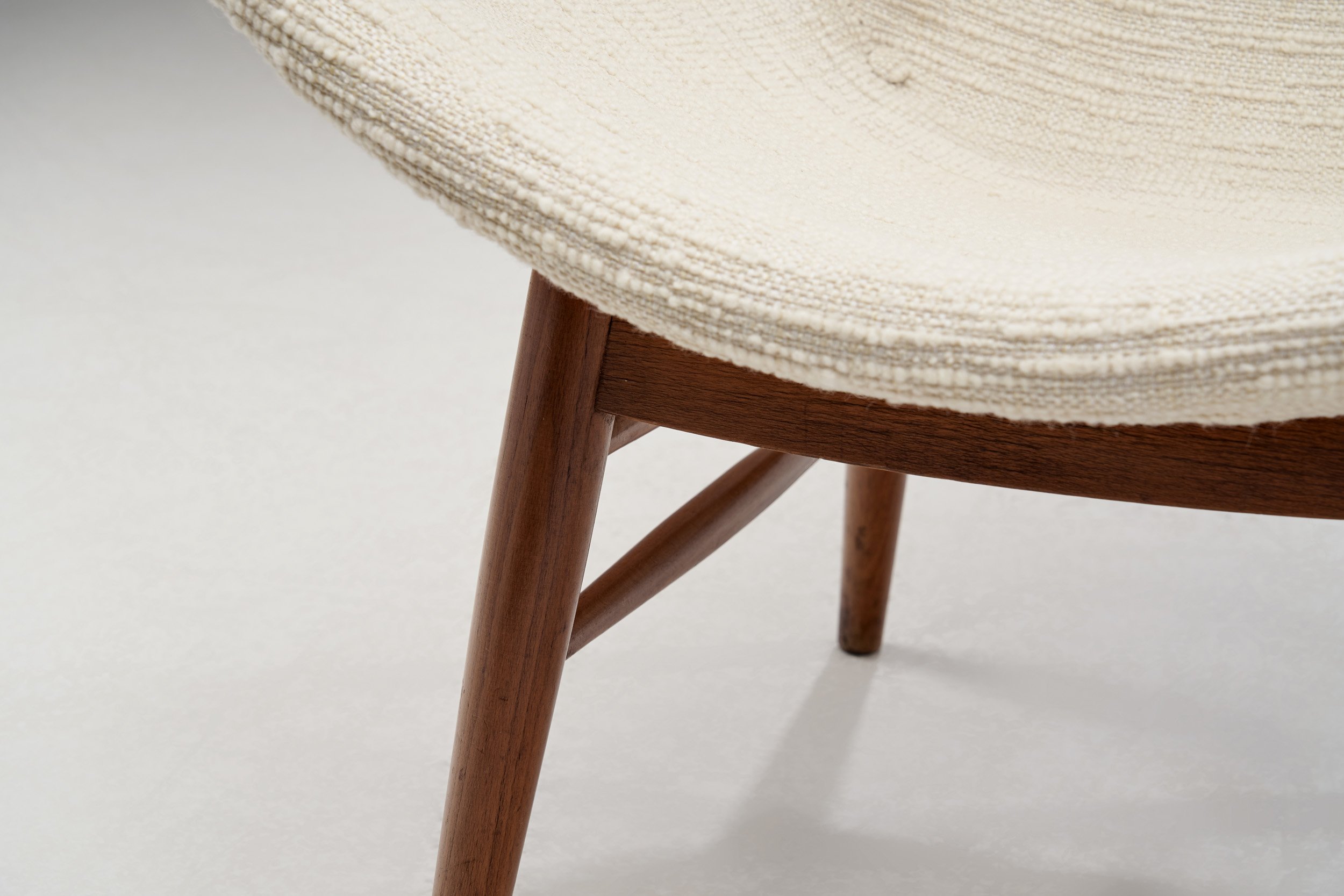
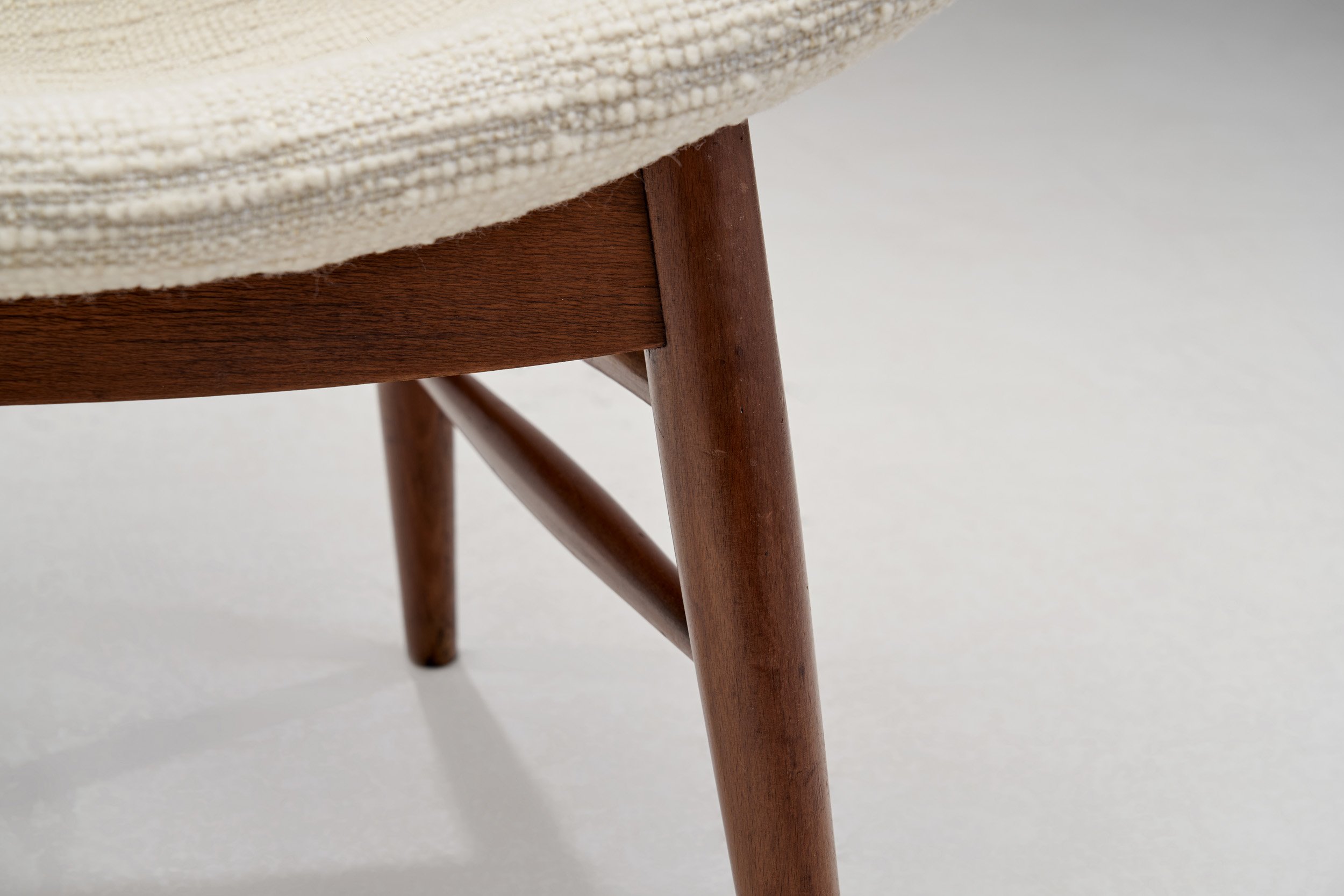
Asko's present model “2464” chair charms with its curved shape. Better known as Marketta, this rare piece features a beech frame and a padded, upholstered seat. This chair makes a statement in any space as a stand-alone piece in any room.
The Marketta chair was put into Asko's production on December 9 in 1959 and was manufactured until the early 1960s. Its design famously bears a striking resemblance to Harry Bertoia's iconic Diamond chair from 1952. While the designer of this model had been unknown for decades, as Asko’s archive mentions that it is a “factory conversion”, the magazine, Kaunis Koti, has linked the design to Finnish designer, Aulis Leinonen. The designer may remain a mystery, but the design speaks for itself. The silhouette of this chair is highly artistic with a sculptural shell seat upholstered in a light, textured bouclé fabric. The wide armrests blend into the bodies and form a shell with lines that curve outwards. The back has a beautiful arch and subtle tufted buttons, details that draw the eye to the body. Supporting the body is the beech structure that assures the permanently reclined position, and the firm hold. The gently tapered and splayed legs and double stretchers on each side create a perfect balance for the curved body and textured fabric with their smooth finish and clean lines.
Asko originated from the Lahti Carpentry Factory, founded by carpenter Aukusti Avonius in 1918. The operation of the factory immediately stood out among the other carpentry workshops of the time, with Avonius investing in innovation to create timeless pieces with quality in mind.
Condition:
In good vintage condition. Wear consistent with age and use.
Dimensions:
33.85 in W x 27.55 in D x 27.36 in H; Seat height 14.56 in; Arm height 19.68 in
86 cm W x 70 cm D x 69.5 cm H; Seat height 37 cm; Arm height 50 cm
Literature:
Revue Asko, January 1961
REQUEST PRICE HERE
Price category: 2,500 - 5,000 usd / eur
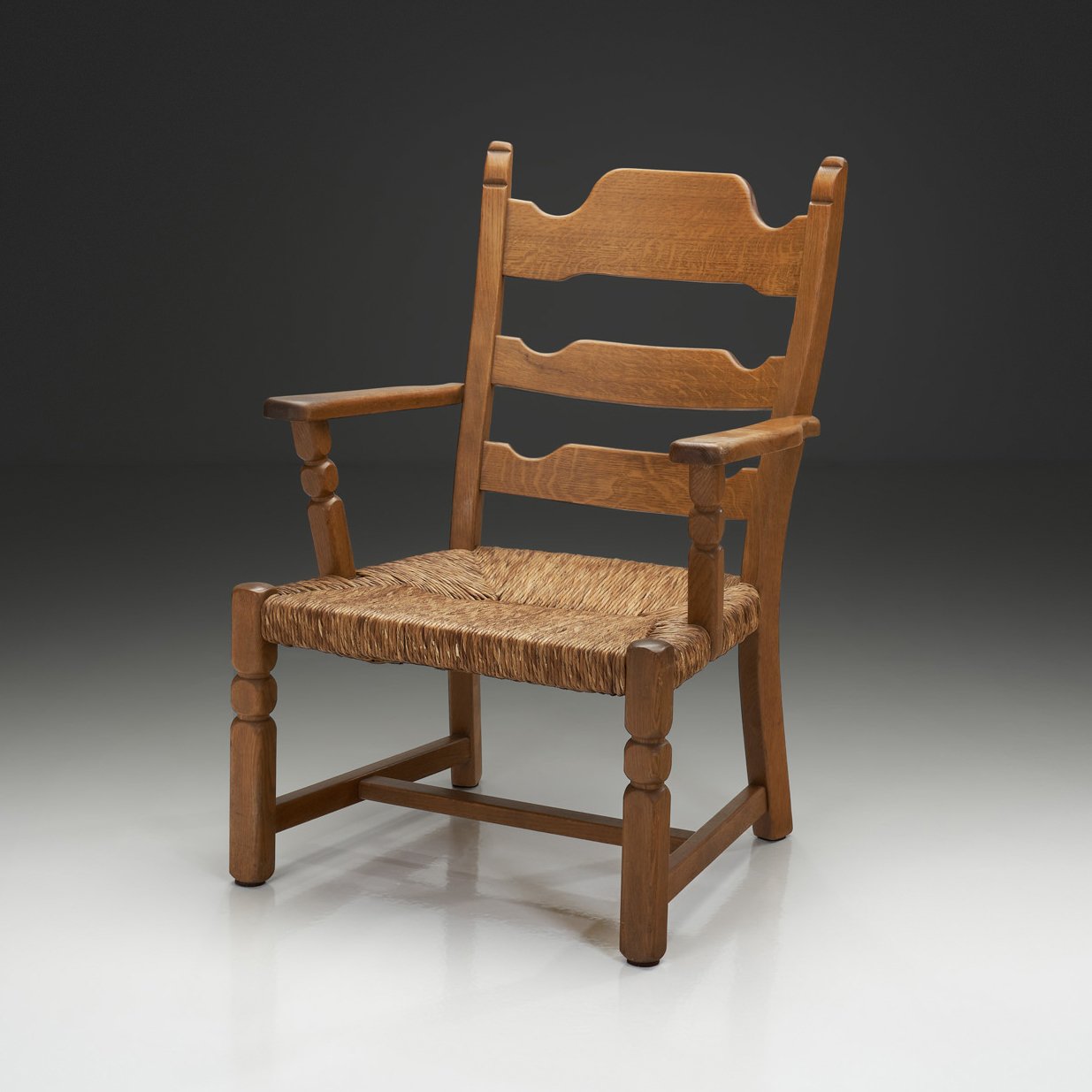
Danish armchairs reflect a strand of mid-20th century design that is expressive while also maintaining the minimal decor of the period. While much Scandinavian furniture from this period is associated with restraint and lightness, artists such as Henning often introduced a more sculptural character, combining solid oak construction with carved or shaped elements. His “razorblade” backrests became a defining feature, giving otherwise simple chairs a distinctive identity.
This armchair, in the manner of Kjærnulf’s work, follows that direction through its solid oak frame and clearly defined silhouette. The structure is built with thick elements, with the legs and arm supports featuring turned details. The backrest is composed of three horizontal slats with gently curving edges, creating a layered effect that adds depth without complicating the form. The woven seat introduces a counterpoint to the rigid wooden frame. Made from natural fibres, it has an organic texture that contrasts with the smoother surfaces of the oak. This material choice offers breathability while remaining durable over time. The combination of solid wood and woven seating reflects traditional craftsmanship, where each material is valued, and comes together to create enduring pieces.
What makes the chair stand out is the way it balances weight and detail within Danish design. It feels solid and deliberate, able to anchor a space, while still being functional for everyday use.
Condition:
In good vintage condition. Wear consistent with age and use. The item has recently been reconditioned. Minor dents and scratches are present. Due to the nature of the materials, the item may have some marks and discolouration.
Dimensions:
25.19 in W x 26.37 in D x 36.61 in H; Seat height 14.96 in; Seat depth 20.47 in; Arm height 24.80 in
64 cm W x 67 cm D x 93 cm H; Seat height 38 cm; Seat depth 52 cm; Arm height 63 cm
REQUEST PRICE HERE
Price category: 7,500 - 10,000 usd / eur
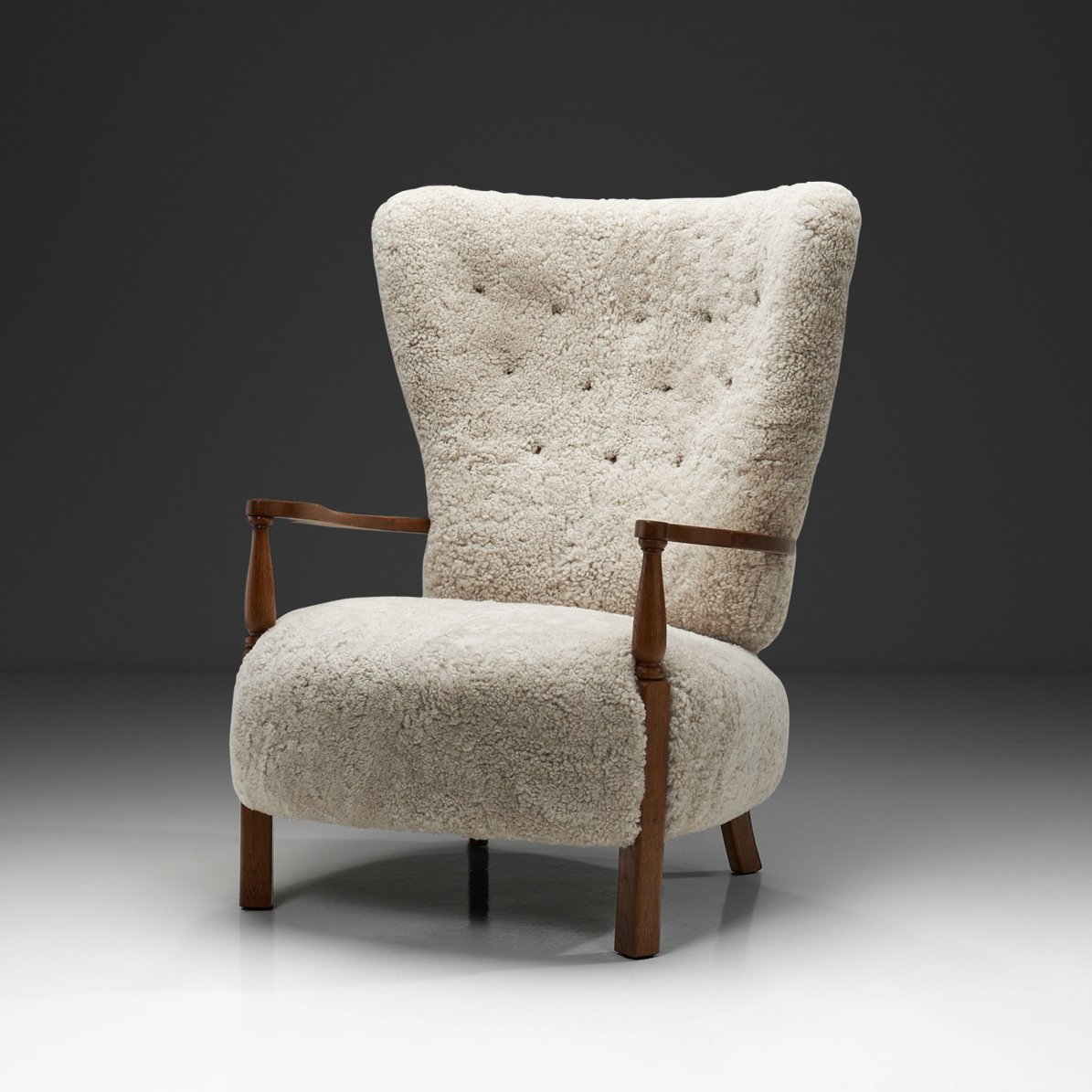
Danish Modernism can be visually described by this beautiful wing-back chair: sleek, organic and timeless. These attributes are met with high quality materials and the famous craftsmanship of the country’s cabinetmakers. This chair is a testament to the quality and craftsmanship of Villy Sørensen.
From the welcoming winged body and the solid wood frame to the cosy sheepskin upholstery, this chair expresses a quality of hygge and a feeling of contentment. The distinctive shape is a result of the two “ears” that encompass the sitter. One of the most notable chair styles that embodies Scandinavian modern design is the wing-back chair. The history of this type of chair can be traced back to the 17th century when they were originally designed to provide protection from drafts in grandiose, often chilly, European homes. With high backs and "wings" on each side to shield the sitter from cold air, these chairs were originally a symbol of prestige and comfort. To balance the sculptural, upholstered body is the beautiful solid wood frame that is left exposed on the sides as it also functions as a decorative element with its geometric angles and curves. The arms and tapered legs are formed from the same piece of wood resulting in a sleek impression. The wood’s colour and smooth surface contrast brilliantly with the sheepskin’s light colour and texture. Thanks to the properties of the sheepskin, this chair provides great, soft comfort as well.
Villy Sørensen had a unique design idiom, which is clearly visible in this model: function, durability, timeless design, and perhaps above all, comfort. This traditional yet playful chair combines all of these attributes, which makes it ideal to be the stylish focal point of any space.
Condition:
In good vintage condition. Wear consistent with age and use. Due to the nature of the wood, the item may have some marks, scratches, and discolouration. The chair has recently been reconditioned and has recently been reupholstered in premium sheepskin. Each of our items can be reupholstered by our in-house atelier in a fabric of choice. Please reach out for more information.
Dimensions:
29.92 in W x 32.28 in D x 38.98 in H; Seat height 14.96 in; Seat depth 22.83 in
76 cm W x 82 cm D x 99 cm H; Seat height 38 cm; Seat depth 58 cm
REQUEST PRICE HERE
Price category: 12,500 - 15,000 usd / eur
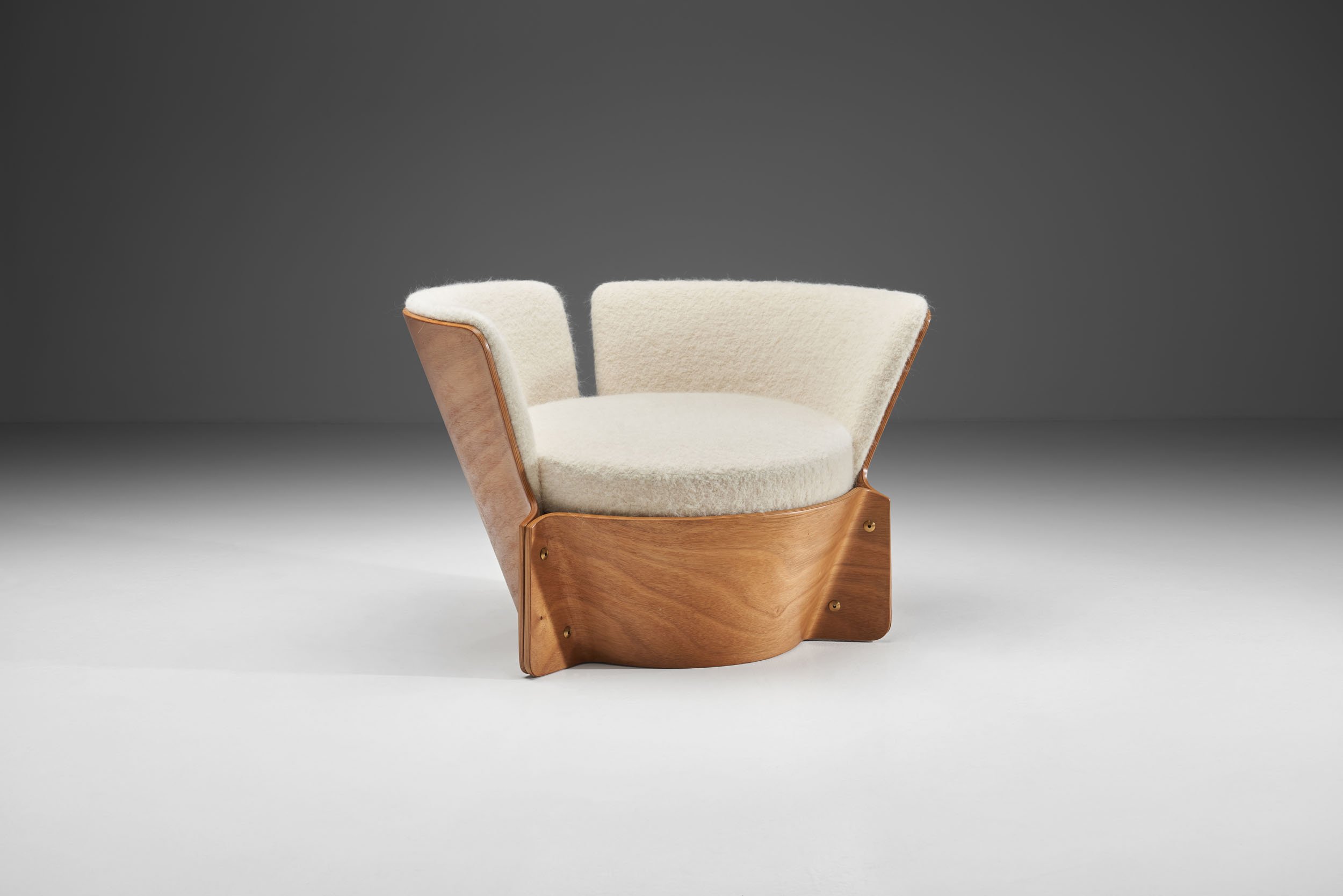
This rare "Roset" chair is a striking creation by the Danish designer duo Ole Gjerløv-Knudsen and Torben Lind, manufactured by Mogens Kold in Denmark in the early 1970s. Introduced in 1972, the “Roset” model stands out for its sculptural form and innovative construction, embodying the spirit of Danish modernism with a playful and organic twist.
The chair’s design is both functional and deeply expressive. Its unusual shape evokes the comfort of a nest, welcoming the sitter into a softly embracing form. The chair’s broad circular seat and gently curved split backrest encourage a relaxed lounging posture, creating an intimate and cocoon-like experience for the user. The feet, resembling fins, not only provide visual dynamism but also ensure stability, giving the piece a grounded yet airy presence. The body is constructed from three laminated plywood panels, precisely joined with visible brass screws that lend a subtle industrial touch while highlighting the craftsmanship and attention to structural detail. The model is upholstered in a premium wool and alpaca blend fabric, chosen for its softness, warmth, and luxurious texture. The light, tactile quality of the upholstery enhances the chair's inviting character and complements the warm natural tones and grain of the plywood shell.
The “Roset” model remains a rare piece that offers both sculptural impact and everyday warmth. It is an ideal statement chair capturing the balance between innovation, comfort, function, and aesthetics, that defines the best of Danish design from the period.
Condition:
Wear due to age and use. Some scratches and marks. Recently reupholstered in premium alpaca - wool blend fabric.
Dimensions:
35.63 in W x 31.50 in D x 23.43 in H; Seat Height 14.17 in
90.5 cm W x 80 cm D x 59.5 cm H; Seat Height 36 cm
About the designer:
Ole Gjerløv-Knudsen (1930-2009) was a Danish furniture architect. He studied at the School of Crafts, graduating in 1952 and then at the Academy of Fine Arts in Copenhagen until 1955. Gjerløv-Knudsen designed furniture series for both carpentry and industrial production in collaboration with fellow Danish furniture designer Torben Lind (1928-2016) from 1962.
Lind’s works showed a commitment to using the finest materials and extraordinary precision to create one-of-a-kind designs. Together, they became well-known for their light furniture in beech and plywood. The duo worked together at PP Møbler, creating furniture that became a trademark of Danish design.
During their long collaboration, Gjerløv-Knudsen and Lind designed numerous successful chair designs representing Danish mid-century modern, with special attention to outstanding comfort and ensuring long-lasting value by using quality materials. Many of their designs were produced by France & Son and Mogens Kold Møbelfabrik. The latter produced some of the most coveted furniture of the mid- 20th century. ~H.
REQUEST PRICE HERE
Price category: 5,000 - 7,500 usd / eur
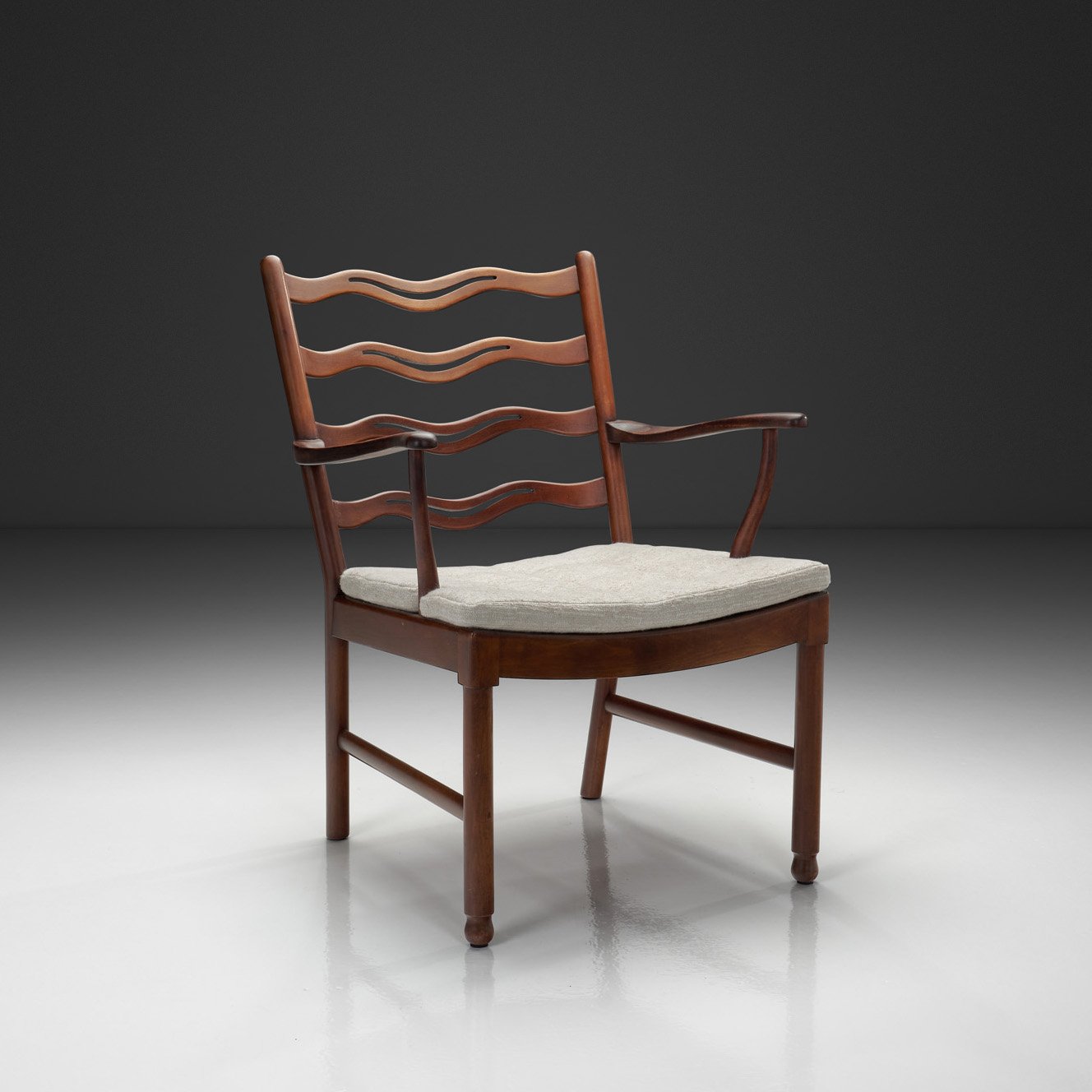
Ole Wanscher was one of the leading figures of 20th century Danish design. Trained as an architect and later a professor at the Royal Danish Academy of Fine Arts, Wanscher’s work is characterised by restraint, clarity, and a deep respect for craftsmanship. Makers like him believed that good furniture should feel appropriate in its proportions, neither excessive nor incomplete, and that belief is evident throughout his designs.
Model “1755” exemplifies this disciplined yet elegant approach. The chair’s back is composed of three gently undulating horizontal slats that introduce movement without disrupting the overall symmetry of the frame. These shaped rails provide ergonomic support while creating a subtle decorative rhythm across the backrest. The uprights are slightly tapered, lending lightness to the silhouette and preventing the form from feeling heavy. The arms extend from the back, curving forward in a subtle arc that supports the sitter while maintaining visual continuity with the backrest. Transitions and joinery are seamless and organic, demonstrating careful attention to structural flow. The legs are slender and proportioned with precision, connected by thin stretchers that reinforce stability without drawing attention away from the main lines. Every element feels considered, from the thickness of the rails to the spacing between slats, resulting in a chair that is visually calm yet structurally assured. The upholstered seat introduces a measured softness that balances the architectural clarity of the wooden frame. Its tailored form provides comfort while maintaining the light, refined character of the design.
Suitable for use at a dining table, desk, or as an occasional armchair, model “1755” reflects Wanscher’s enduring commitment to proportion, craftsmanship, and the thoughtful reinterpretation of historical furniture making within a modern context.
Condition:
In good vintage condition. Wear consistent with age and use. The chair has recently been reconditioned. Due to the nature and age of the wood, the chair may have some marks, scratches, and discolouration. The seat cushion was newly produced and upholstered in a premium fabric. Each of our items can be reupholstered by our in-house atelier in a fabric of choice. Please reach out for more information.
Dimensions:
24.60 in W x 26.37 in D x 33.85 in H; Seat height 17.12 in; Seat depth 19.68 in; Arm height 25.19 in
62.5 cm W x 67 cm D x 86 cm H; Seat height 43.5 cm; Seat depth 50 cm; Arm height 64 cm
REQUEST PRICE HERE
Price category: 12,500 - 15,000 usd / eur
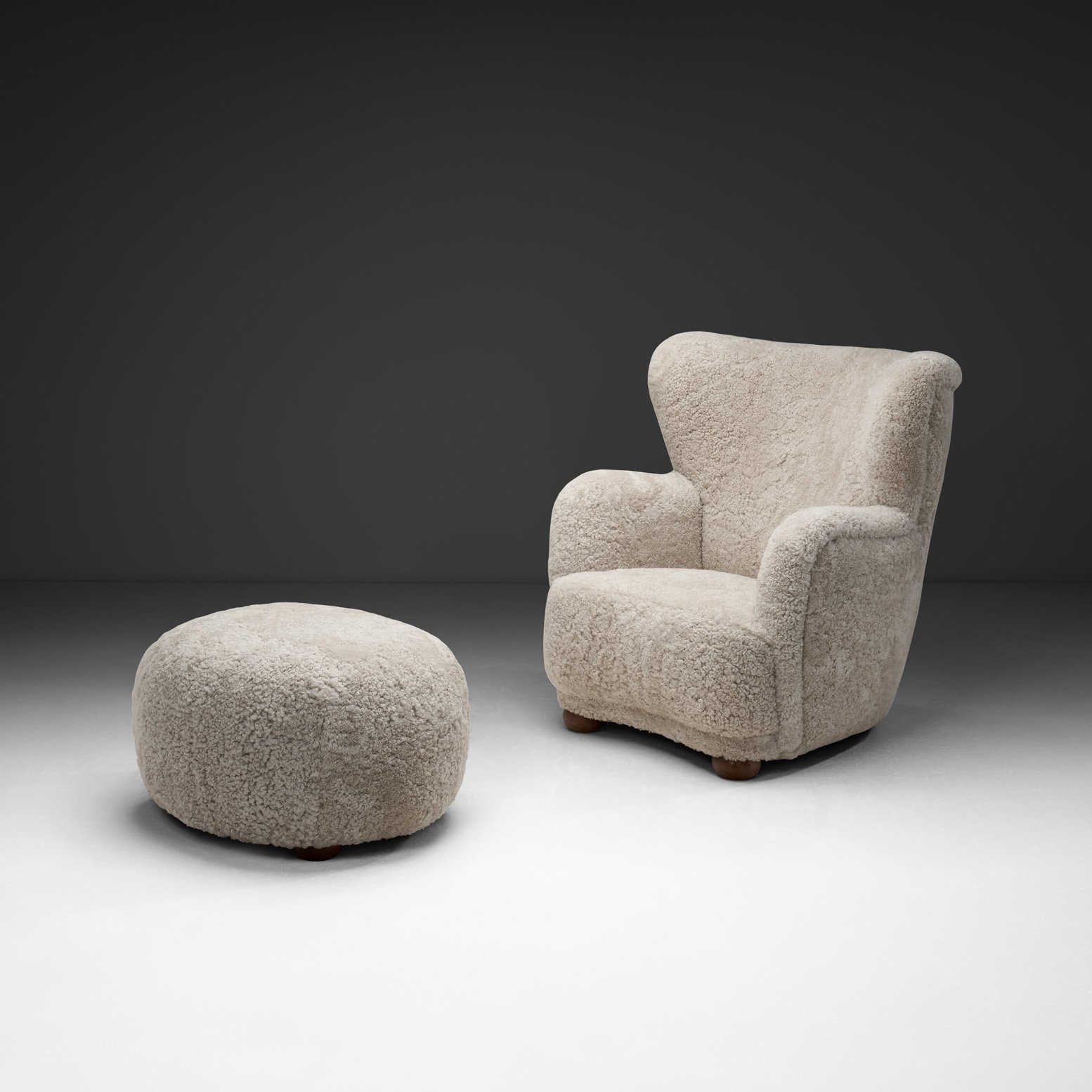
This armchair and footstool exudes quality and personality from all angles. The basic Danish design principles are all present - the pair is functional, simple at its core, well-crafted, and free of unnecessary ornamentation. During the 1950s, Danish makers led the way in furniture design, with seating pieces to this day being some of the most iconic of their time, and this model is no exception.
The generous seat and back of the armchair are welcoming, with the latter curving in such an angle that the sitter is gently “hugged”. This type of backrest style is called a wingback, originally, it was created as a way to help shield a person from drafts of cold air, and to trap the heat from a fireplace. That is why wingback chairs are sometimes called fireside chairs, as it was a popular style of chair to have pulled up in front of or flanking a fireplace. The embracing back and the curved arms create a welcoming impression, while the back’s elongated corners create visual interest. The generous padded armrests add another layer of relaxation for the sitter, and the luxurious, soft sheepskin upholstery provides great comfort in the name of functionality, while also transforming the chair into a beautiful addition to any interior space. Sheepskin is the ultimate material for comfort, warm in the winter and cool in the summer. The production quality is evident throughout this pair and takes the mid-century idea of “furniture that last for generations” seriously.
The design of this armchair and footstool promotes relaxation and contentment, inviting one to sit back and enjoy a moment of peace. The understated elegance and natural tones create an alluring atmosphere, making it perfect for the purpose of evoking a hyggelig (cosy) environment in any home.
Condition:
In good vintage condition. Wear consistent with age and use. The items have recently been reconditioned. The chair has been reupholstered recently in a premium sheepskin; the footstool is a later addition, upholstered in the same fabric as the chair. Each of our items can be reupholstered by our in-house atelier in a fabric of choice. Please reach out for more information.
Dimensions:
Chair:
34.64 in W x 35.03 in D x 38.77 in H
88 cm W x 89 cm D x 98.5 cm H
Footstool:
24.40 in W x 21.26 in D x 15.16 in H
62 cm W x 54 cm D x 38.5 cm H

REQUEST PRICE HERE
Price category: 9,000 - 12,500 usd / eu
Danish Mid-Century Modern furniture reflected Scandinavian materials and craftsmanship and mixed them with a modern style, and the period from roughly 1940 through 1960 was a high point for Danish furniture makers. This set shows why.
This particular chair silhouette has been popular since the 1930s, from around the time Flemming Lassen designed the overstuffed easy chair, the “Tired Man”, for The Copenhagen Cabinetmakers’ Guild Competition in 1935. The curved and organic lines of the design create an elegant silhouette for both the chair and ottoman. The design of this chair is characterized by organic, curved shapes that create a cosy and welcoming sensation. Since the enveloping back forms the arms as well but doesn’t reach all the way to the beginning of the seat, the design is very open and appears light. The gentle lines are highlighted by the soft wool blend upholstery that uniquely covers the entire bodies of the chair and footstool, including the legs as well. As a representation of early modernist seating, there is a profound focus on comfort and cosiness, that invokes a pleasant homelike feeling. Master cabinetmakers were highly aware of body proportions, prioritizing comfort just as much as the visual qualities, therefore this lounge chair provides support for the back and great sitting comfort.
We have added a newly produced matching, upholstered footstool to provide additional comfort and visual interest. Its design matches the chair with its round shape and soft wool blend upholstery. Together, they form a cosy and luxurious set that exudes Danish design and craftsmanship.
Condition:
In good vintage condition. Wear consistent with age and use. The chair has been reupholstered recently in a premium wool blend fabric; the ottoman is a later addition, upholstered in the same fabric as the chair. Each of our items can be reupholstered by our in-house atelier in a fabric of choice. Please reach out for more information.
Dimensions:
Chair
30.31 in W x 30.31 in D x 26.77 in H; Seat height 16.53 in
77 cm W x 77 cm D x 68 cm H; Seat height 42 cm
Footstool
27.16 in W x 22.63 in D x 14.76 in H
69 cm W x 57.5 cm D x 37.5 cm H
About the Designer:
Thepractical and comfortable designs of Danish cabinetmakers defined mid-20th century modern seating. The Danish Cabinetmakers focused on minimalist design executed by expertly skilled craftsmen.
Works from the Danish Cabinet-Makers' Guild is a concept of its own in collectible design. The Cabinet-Makers' Guild began annual exhibitions in 1927 in Copenhagen. The group formed an exhibit showing each year in October the quality furniture made to drawings by gifted architects. The exhibition took place each year, without interruption, for forty years. A number of successful Danish Design collaborations were formed during this time between cabinetmakers and architects.
Danish Modernism has influenced Scandinavian furniture to a great degree, defined by minimalism, simplicity, and functionality. The muted colours and gentle designs make Danish mid-century furniture an ideal addition to contemporary living spaces. Additionally, master cabinetmakers were highly aware of body proportions, prioritizing comfort just as much as the visual qualities.
The works of master cabinetmakers – such as this chair – are of the highest quality, both in terms of materials and craftsmanship. Cabinetmakers take the art of working with wood one step further, and focus on the finer details of what can be created with the material. Therefore, it comes as no surprise that numerous master cabinetmakers are part of the renowned Danish Culture Canon (Danish: Kulturkanonen). The canon contains no more than 108 works of cultural excellence, based on works with a useful function and that are still recognizable today. This small armchair is the perfect illustration of Danish design, and the work of a true cabinetmaker. ~H.

REQUEST PRICE HERE
Price category: 9,000 - 12,500 usd / eur
Designed in 1952 by Jørgen Høj and Poul Kjærholm for Thorald Madsen Cabinetmakers, this easy chair in ash and flag halyard is a true modernist masterpiece.
Removing everything that was not strictly necessary for its shape and function, the designers created a geometrical and transparent work, that is subdued, yet attention drawing at the same time.
The work was presented at the Copenhagen Cabinetmakers' Guild Exhibition at the Designmuseum Danmark in 1952, the only time Kjærholm participated in this event. Although the design was daring for its time, it was welcomed as a breath of fresh air at the exhibition. As a reviewer wrote at the time:⠀
"The most ‘progressive’ interior… was no doubt the one made by architects Jørgen Høj and Poul Kjærholm in collaboration with Thorald Madsen. {…} One has to admit that it provided a refreshing change from the pervading solemnity. It is the duty of all exhibitions to present experiments of this kind which are delightful to some and outrageous to others.”⠀
The work comes with its original flag halyard, and the ash frame has a beautiful, light patina.
Condition:
In good vintage condition. Wear due to age and use. Item has some marks and scratches.
Dimensions:
25.99 in W x 20.32 in D x 23.63 in H; seat height 7.88 in
66 cm W x 77 cm D x 60 cm H; seat height 20 cm
Exhibitions:
Model presented at The Copenhagen Cabinetmakers' Guild Exhibition at Designmuseum Danmark, 1952.
Literature:
Grete Jalk: “40 Years of Danish Furniture Design”, vol. 3. p. 220–221.
The Furniture of Poul Kjaerholm: Catalogue Raisonné, Sheridan, pp. 24-25
Danish Chairs, Oda, p. 173
REQUEST PRICE HERE
Price category: 5,000 - 7,500 usd / eur
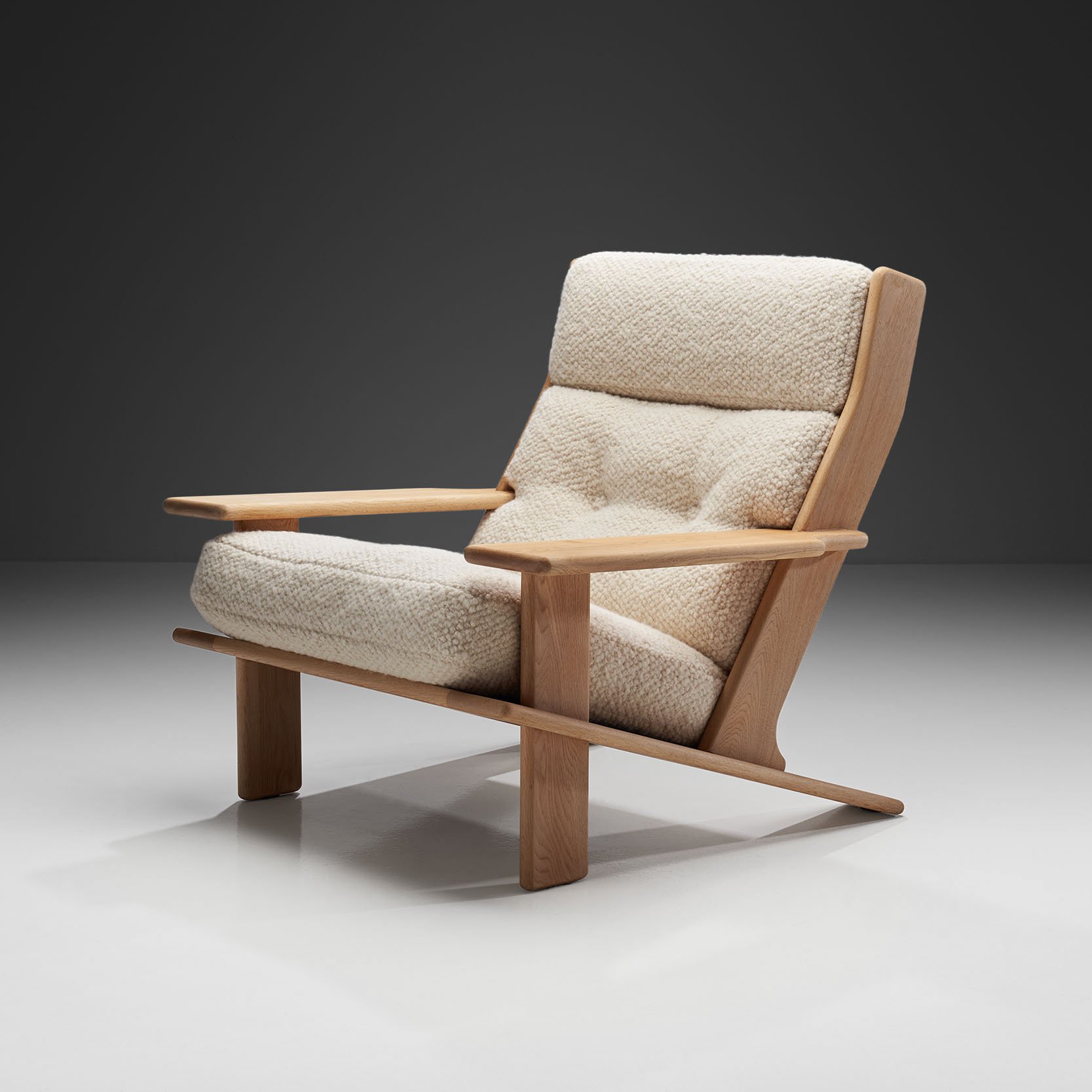
Rare “Pele” lounge chair by Finnish designer Esko Pajamies, manufactured by the Finnish furniture company, Lahden Lepokalusto Oy in the 1970s.
This “Pele” lounge chair is made from solid oak. The wooden frame has a beautiful matte finish, while the cushions are upholstered in a premium bouclé fabric.
The wooden frame provides a firm base with rounded edges. The elongated seat and the back legs of the armchair form one elongated piece of wood, which is the Pele’s most unique element. The ergonomic design with the bent backrest and wide armrests makes this chair an exceptionally comfortable piece. Therefore, it is no surprise that this line of recliners first gained popularity as a TV chair for homes. Later it became a popular choice for fireplace rooms as well as public spaces, like several of Pajamies’s designs.
Condition:
In very good vintage condition. The wood only has minor wear, some discolouration and small stains. Recently reupholstered in a premium bouclé fabric.
Dimensions:
35.24 in W x 37 in D x 34.65 in H
89,5 cm W x 94 cm D x 88 cm H
About the designer:
Esko Lauri Alvari Pajamies (1931-1990) was a Finnish designer, primarily known for his upholstered furniture designs for both private and public spaces.
Pajamies graduated as an interior architect in 1954 and established his own design studio in 1961. Pajamies designed his first series of furniture for Lepokalusto in 1965, and their fruitful collaboration lasted well into the 1970s. Pajamies designed for a handful of other manufacturers and his designs proved to be lucrative throughout the 1960s and 1970s. Interestingly, Esko Pajamies was the first to design a sofa (Bonanza for Asko 1965) that had an exposed wooden frame. The sofa was named after the 1960s television series and had extra wide armrests to accommodate glasses and plates.
His “Polar 1001” and “1003” chairs could be found on luxury liners sailing the Black Sea, while some of his other designs furnished the Helsinki-Vantaa Airport's passenger terminal in 1975. The versatile designer also played trumpet in the jazz band Jaakko Salo Modern Band. He played with many famous singers in the 1960s.
Pajamies was awarded the State Art Prize in 1979 and is still known as one of the leading interior architects of Finland. ~H.
REQUEST PRICE HERE
Price category: 9,000 - 12,500 usd / eur
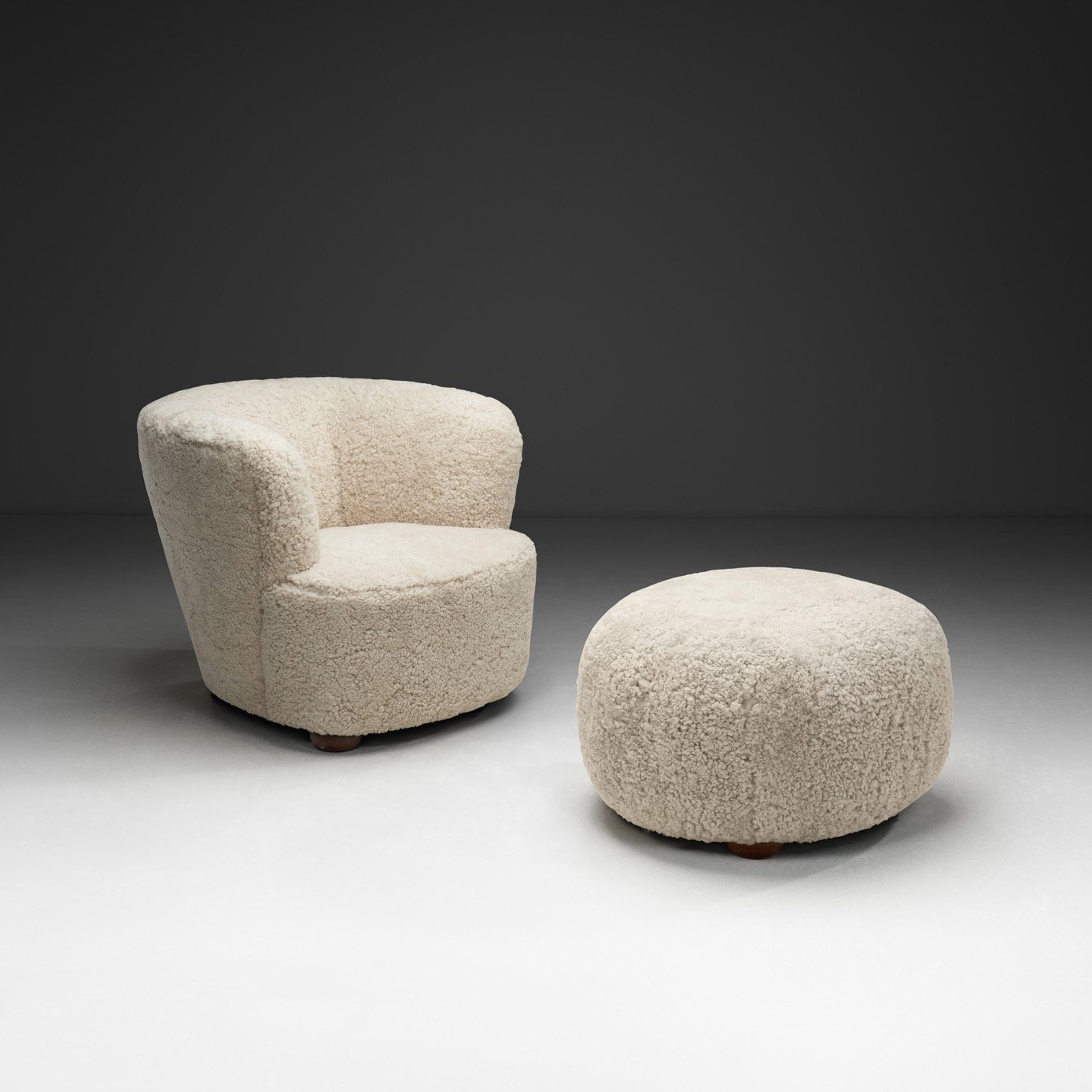
Around the middle of the 20th century Danish furniture design began blending the streamlined elegance of modernism with the inviting charm of skilled craftsmanship. This period celebrated functionality, comfort, and organic forms by creating pieces that were as practical as they were beautiful.
This chair and ottoman pair showcases an organic look which is grounded and cosy. To keep the pair from being overcrowded visually, the design is kept simple with gently rounded lines and no other form of decoration. An impressive aspect of this chair and ottoman is that the craftsmanship expected from Danish cabinetmakers is still visible despite the full coverage of the fabric. The shape of the chair resembles that of a club chair with a wide and open profile where the arms and back are on the same level. Thanks to this, the sheepskin upholstery truly stands out; the colour and texture pairs very well with the smooth outlines of both pieces. This effect is further enhanced when the chair and ottoman are placed together as a set. The overall design values simplicity in both form and function, leaving the emphasis on the upholstery.
The most traditional use for this type of pair is in the living room, but they work especially well in an open floor plan. The early mid-century modern aesthetic lends itself well to most styles as it is timelessly elegant and high-quality in terms of materials and execution. In the case of this chair and ottoman, they are guaranteed to stand out no matter their placement or surroundings.
Condition:
In good vintage condition. Wear consistent with age and use. Due to the nature and age of the materials, items may have marks, scratches, and discolouration. The ottoman is a later addition. The items have been reupholstered recently in premium sheepskin. Each of our items can be reupholstered by our in-house atelier in a fabric of choice. Please reach out for more information.
Dimensions:
Chair:
31.10 in W x 31.49 in D x 28.34 in H; Seat height 15.35 in; Seat depth 21.65 in
87 cm W x 86 cm D x 69 cm H; Seat height 38 cm; Seat depth 55 cm
Footstool:
24.40 in W x 21.26 in D x 15.16 in H
62 cm W x 54 cm D x 38.5 cm H
REQUEST PRICE HERE
Price category: 5,000 - 7,500 usd / eur
During the 1950s, Danish designers led the way in furniture design, with Danish mid-century seating pieces to this day being some of the most iconic of their time.
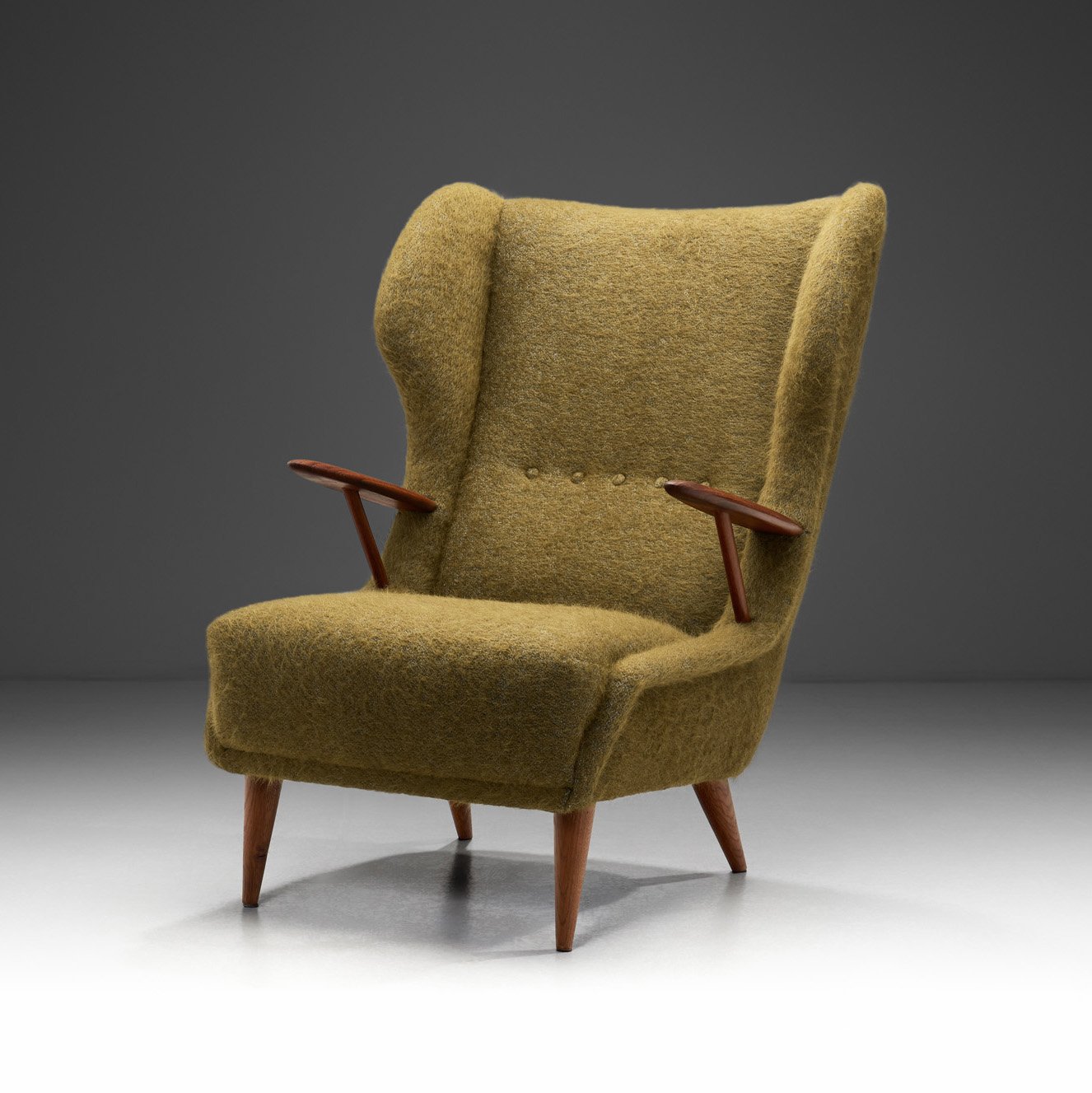
This armchair embodies the characteristics and ethos of its period. Georg Thams designed this chair in line with his minimalistic, yet functional style for Danish manufacturer Vejen Polstermøbelfabrik, showcasing attention to detail through qualities such as the shape and mix of materials used in the construction. Oak and teak wood are amongst the most durable and naturally beautiful choices of material, making this armchair into a long-lasting and classically elegant piece. Originally, wingback chairs were designed to protect occupants from drafts and offer a touch of privacy, and have since become synonymous with comfort and timeless style. The traditional wingback design is reinterpreted in the mid-century fashion of this piece, moving from the classic rounded and closed structure to a more modern silhouette. The curved sides of the chair maintain their winged look, while the teak armrests feature an open construction. The high, curved back of this piece ensures comfort, transforming the chair into a statement piece of decor with additional subtle details such as the five tufted buttons placed horizontally on the backrest. The brown tones of the angled teak arms and tapered oak legs combine with the soft green coloured upholstery to give the piece a natural, earthy feel.
The quality materials of this armchair ensure durability, while the shape intertwines the traditional design with a quintessential Danish mid-century touch. The beauty of this piece is evident through both its form and function, making it a great addition to a modern interior.
Condition:
In good vintage condition. Wear consistent with age and use. This chair has been reupholstered recently in a premium fabric. Each of our items can be re-upholstered by our in-house atelier in a fabric of choice. Please reach out for more information.
Dimensions:
30.31 in W x 37.80 in D x 39.37 in H; Seat height 17.12 in; Seat depth 21.26 in; Arm height 23.42 in
77 cm W x 96 cm D x 100 cm H; Seat height 43.5 cm; Seat depth 54 cm; Arm height 59.5 cm
Literature:
Mobilia no. 2, February 1956, p. 10, in the advertisement.
REQUEST PRICE HERE
Price category: 5,000 - 7,500 usd / eur
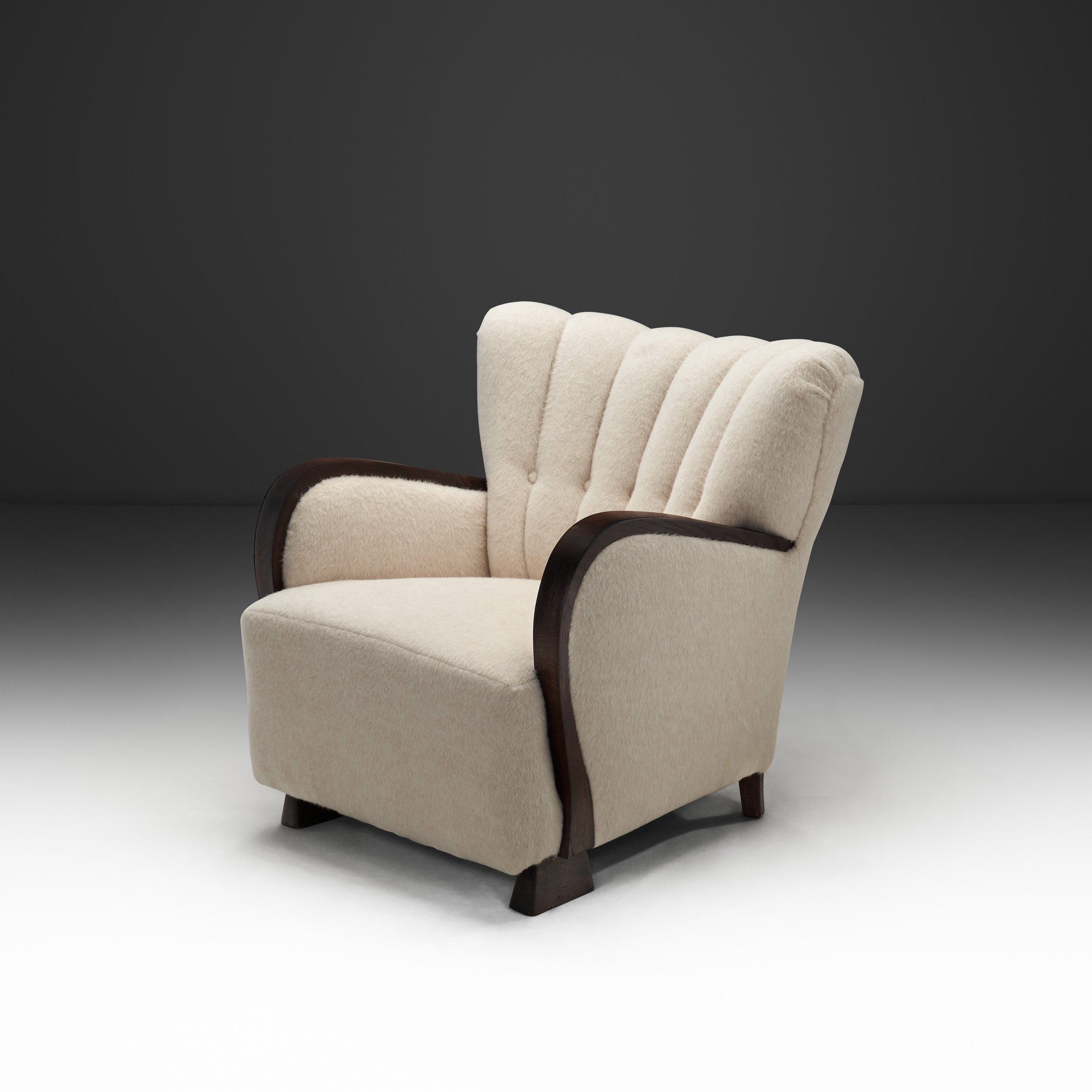
Danish Modernism found its beginnings in the roots of the Bauhaus and Functionalist movements. Bauhaus design emphasized clean, pure lines, while Functionalism sought to prioritise an object’s function over its form. These two principles, along with the rich Danish tradition of careful craftsmanship, shaped Danish Modern design and this armchair.
This Danish armchair features a robust yet elegant oak frame that showcases the natural richness of the wood, lending the piece a comforting warmth. The curving armrests, which showcase the skilfully shaped and polished oak overlays, flowing gracefully into the generous backrest and seat, emphasizing the fluidity of the form. The body’s gentle, rounded lines are highlighted by the luxurious upholstery that adds depth with its soft textured fabric. The seat and back are ideal for a great lounging experience aided by the wooden legs that also provide an organic contrast to the light upholstery. This chair strikes a balance between the boldness of modernism and the cosiness of classic comfort. Its form follows function, while also exuding timeless quality, which sets it apart from the fleeting trends of the era.
This armchair is a design classic that goes beyond trends, a product of a deep-rooted desire to showcase impeccable craftsmanship and a stylish aesthetic, without compromising the quality of production or materials. The chair ensures both a level of quality and visual appeal, a testament to the skill and dedication of its maker.
Condition:
In good vintage condition. Wear consistent with age and use. Due the nature and age of the wood, the item may have minor marks, scratches and discolouration. The armchair has recently been reconditioned and reupholstered in a premium fabric. Each of our items can be re-upholstered by our in-house atelier in a fabric of choice. Please reach out for more information.
Dimensions:
29.92 in W x 34.25 in D x 30.90 in H; Seat height 16.73 in; Seat depth 20.86 in; Arm height 23.03 in
76 cm W x 87 cm D x 78.5 cm H; Seat height 42.5 cm; Seat depth 53 cm; Arm height 58.5 cm
REQUEST PRICE HERE
Price category: 7,500 - 10,000 usd / eur
This beautiful Danish lounge chair is an early example of Scandinavian mid-century modern design as well as outstanding craftsmanship with a quality that honours the materials and users. The period from roughly the 1940s through the 1960s was a high point for Danish furniture makers, and this chair shows why.
Designed in the early phase of what we know today as mid-century modern, this lounge chair is a Danish delicacy with a unique look. With its classic shape paired with modern design elements, it combines the best design characteristics of the 1940s. The large, enveloping backrest dictates the shape of this chair, as it forms most of the structure, including the armrests. The curvature creates an inviting and open look, enhanced by the soft sheepskin upholstery. The inside of the upholstered back is sectioned which creates a shell-like look. The thick, bun feet-like front legs are a pleasant touch. The warm brown colour of the stained wood nicely contrasts to the off-white sheepskin, not to mention the thick wooden feet make a long-lasting, rock solid foundation for any chair. The chair’s back legs differ, they are straight, which is an eccentric detail that adds visual interest. Master cabinetmakers were highly aware of body proportions, prioritising comfort just as much as the visual qualities, therefore this lounge chair provides support for the back and great sitting comfort.
Perfectly suited for a vintage or contemporary interior, this chair represents a marriage of artistry and comfort. Its upholstery captures attention, adding warmth and vibrancy to any space, while the wooden feet are grounding, together making this piece into an ideal statement piece.
Condition:
In good vintage condition. Wear consistent with age and use. The wood has some scratches and marks. Due to the nature and age of the materials, the chair may have additional discolouration. The chair has recently been reupholstered in premium sheepskin. Each of our items can be re-upholstered by our in-house atelier in a fabric of choice. Please reach out for more information.
Dimensions:
34.25 in W x 33.46 in D x 27.55 in H; Seat height 14.56 in
87 cm W x 85 cm D x 70 cm H; Seat height 37 cm