Axel Einar Hjorth Pair of "Lovö" Armchairs, Sweden 1930s (sold)


Axel Einar Hjorth Pair of "Lovö" Armchairs, Sweden 1930s (sold)
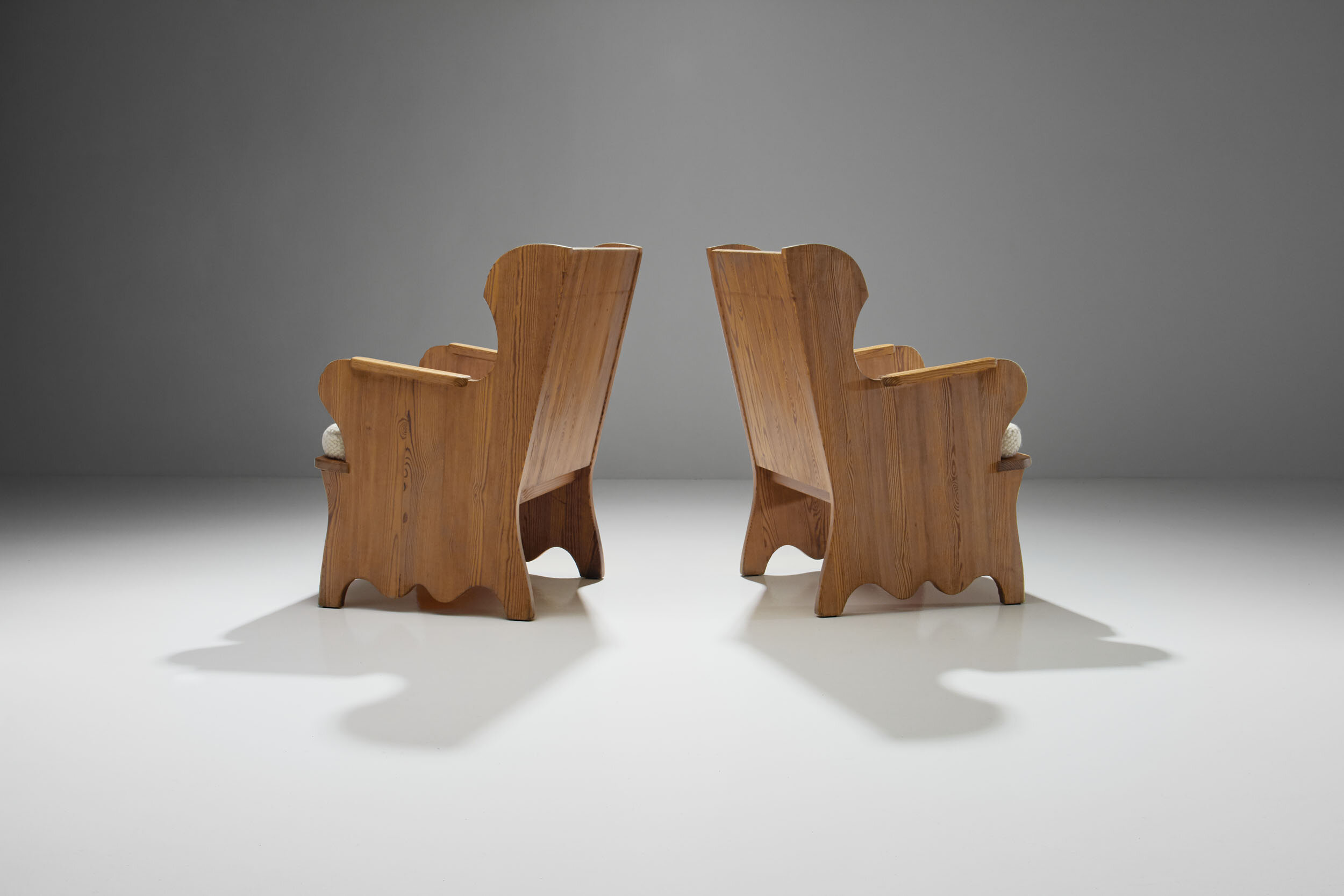
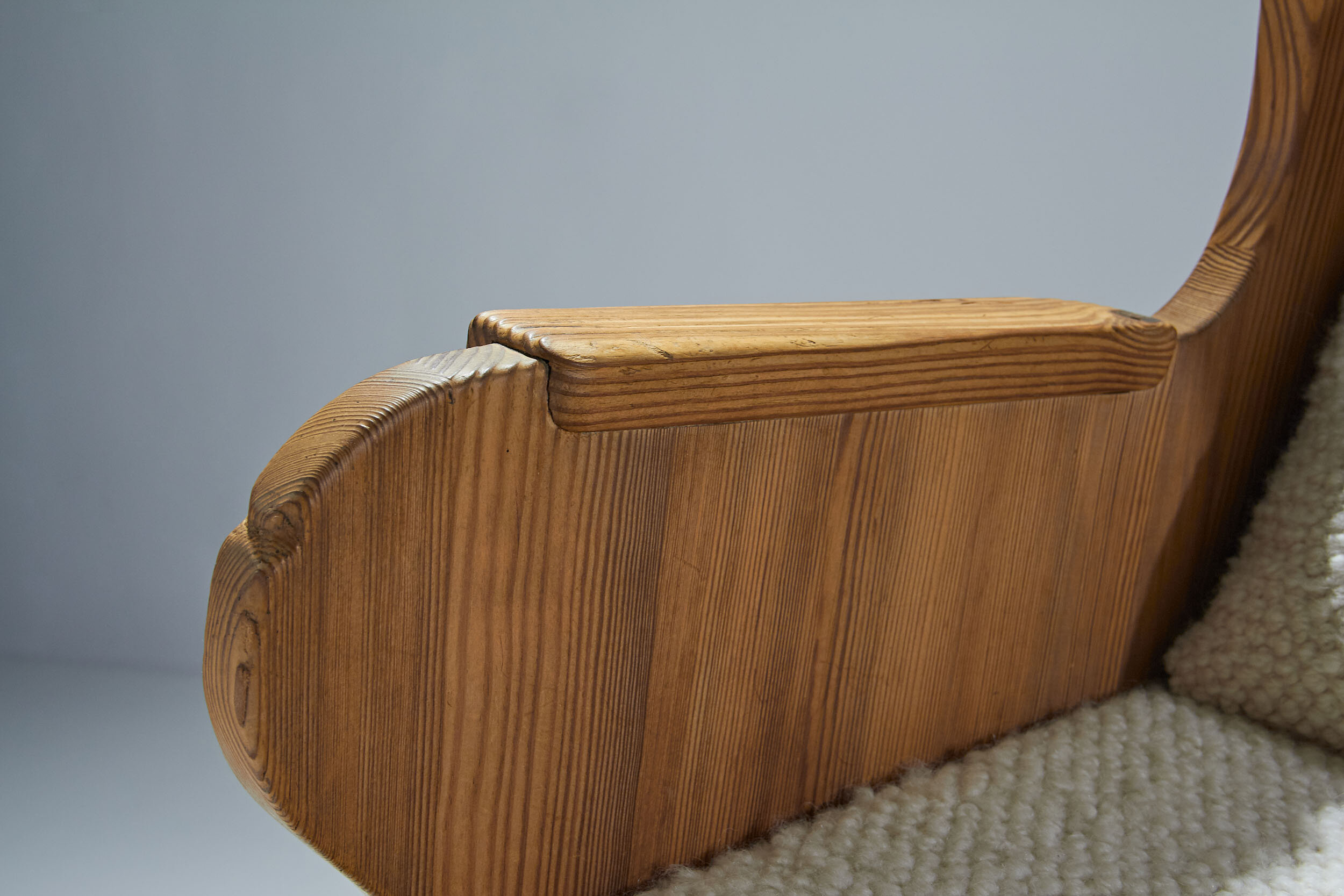
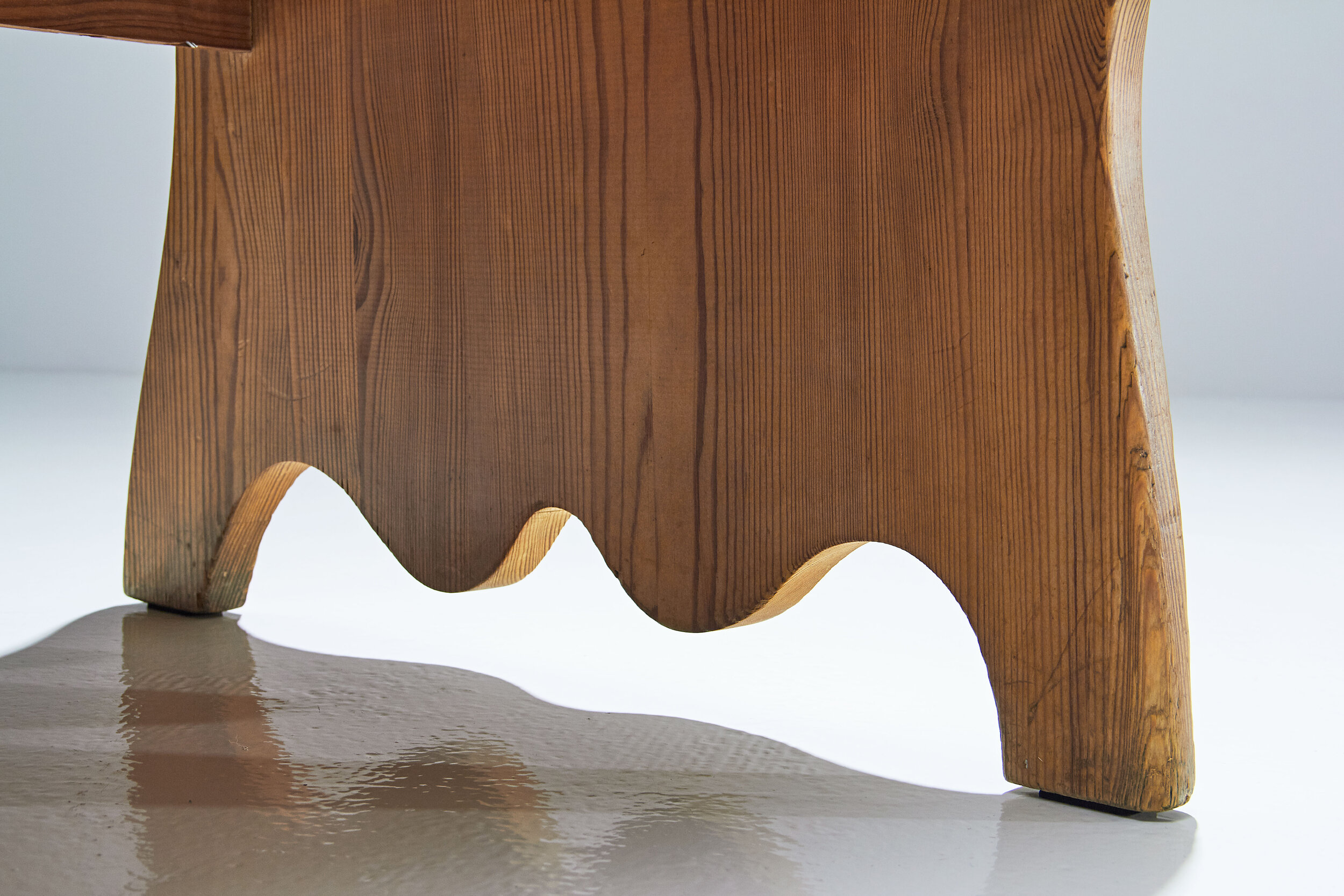
This iconic set of armchairs was designed by Axel Einar Hjorth in the 1930s and belong to his Lovö series. Combining both straight lines with round curves, these armchairs ensure an aerial and balanced effect, this effect is further highlighted with an elevated seat. With heightened armrests and curved panels on either side of the back, these chairs bestow a sense of privacy and comfort while sitting. An intricate grain can be seen in the wood, giving both armchairs an authentic and subtle appearance. The loose reupholstered pillows add a soft and delicate touch to the chair yet provide for an elegant and sophisticated appeal. Produced by AB Nordiska Kompaniet.
Condition:
In very good vintage condition. Wear consistent with age and use.
Dimensions:
23.63 in W. x 25.6 in. D x 36.23 in. H ; Seat height: 18.5 in.
60 cm W x 65 D x 92 cm H ; Seat height: 47 cm
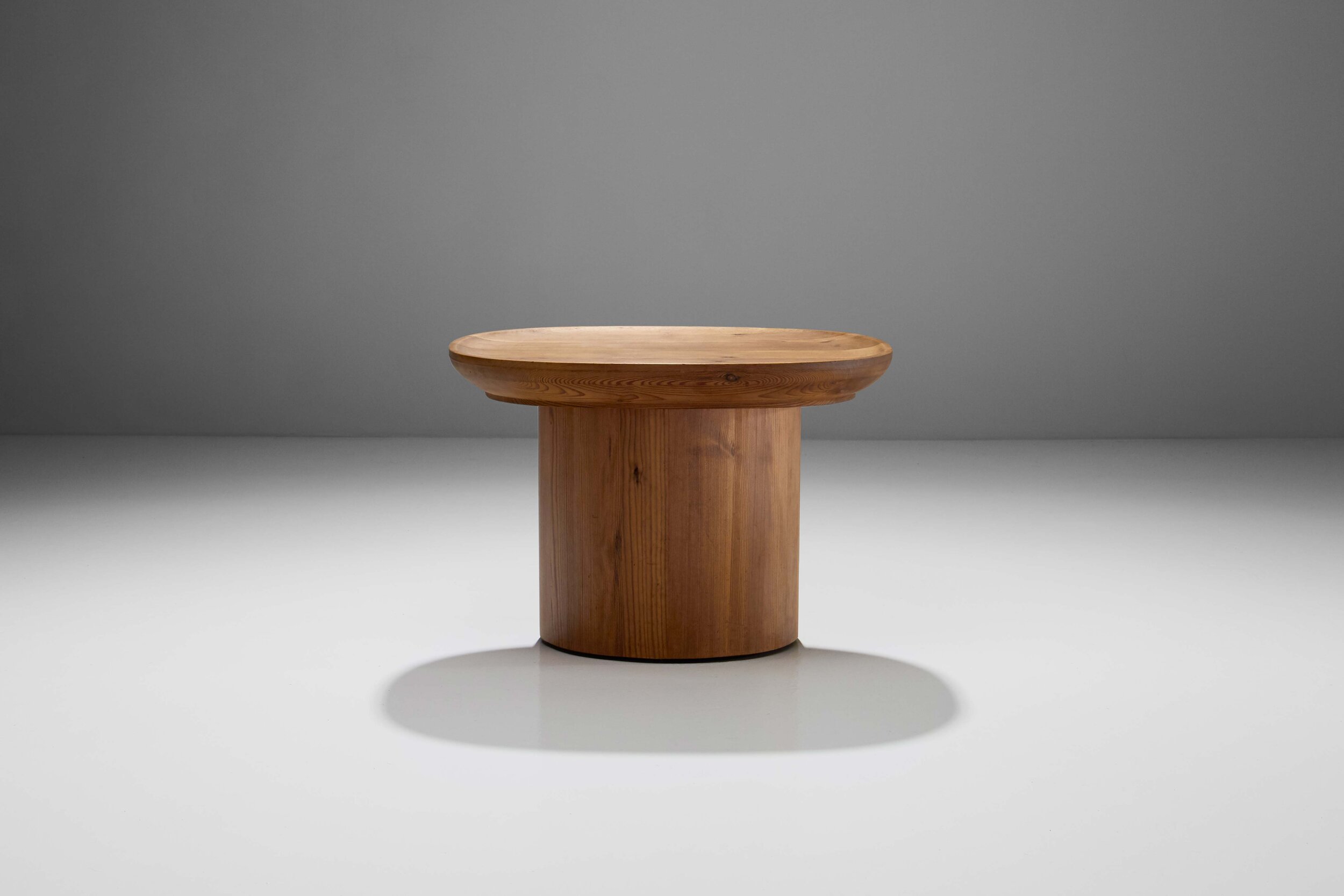
The ‘Utö’ coffee table designed by Axel Einar Hjorth is striking in balancing large volumes with clean geometrical lines. The tabletop has a thick and oval shaped shallow bowl with a well-defined rim on the top and bottom. The pine wood has aged beautifully and displays a strong patina. The wide and robust foot follows the shape of the tabletop and encompasses a beautiful grain within the wood. The coffee table was also known as the Brancusi table, a name found on a drawing in the Nordiska Kompaniet archive and refers to Hjorth’s admiration of the modernist sculptor. Produced by Nordiska Kompaniet, Sweden 1930s ~ H.
About the designer:
The work of Swedish architect and designer Axel Einar Hjorth was an early example of contemporary Swedish design, with its emphasis on minimalism and functionality. The sculptural quality of his work is easy to be seen in the Utö coffee table which originated from the Sportstugemöbler line, or weekend house furniture. The designs consisted of simple lines and construction rendered in pine that mixed aesthetics from rural handicraft with international modernism. Hjorth named these furniture lines after islands in the archipelago near Stockholm: ‘Utö’, ‘Blidö’, and ‘Torö’. ~ H.
Condition:
In good vintage condition. Wear consistent with age and use.
Dimensions:
27.72 in. W x 21.46 in. D x 19.1 in. H
70,4 cm W x 54,5 cm D x 48,5 cm H
Literature:
Axel Einar Hjorth (Svenska arkitekter och formgivare), Eric Ericson, Christian Björk, Thomas Ekström, 2011, p. 123.
This iconic set of armchairs was designed by Axel Einar Hjorth in the 1930s and belong to his Lovö series. Combining both straight lines with round curves, these armchairs ensure an aerial and balanced effect, this effect is further highlighted with an elevated seat. With heightened armrests and curved panels on either side of the back, these chairs bestow a sense of privacy and comfort while sitting. An intricate grain can be seen in the wood, giving both armchairs an authentic and subtle appearance. The loose reupholstered pillows add a soft and delicate touch to the chair yet provide for an elegant and sophisticated appeal. Produced by AB Nordiska Kompaniet.
Condition:
In very good vintage condition. Wear consistent with age and use.
Dimensions:
23.63 in W. x 25.6 in. D x 36.23 in. H ; Seat height: 18.5 in.
60 cm W x 65 D x 92 cm H ; Seat height: 47 cm
This rare coffee table was designed by Axel Einar Hjorth in January 1937 and was manufactured by Nordiska Kompaniet (lit. The Nordic Company) in Stockholm, Sweden.
Stockholm based furniture manufacturer and department store, Nordiska Kompaniet (1902-) produced many of the 20th century’s now iconic Swedish works, including many of Hjorth’s furniture designs. Hjorth was the head of the furniture department and designed this table for the 1937 "Spring Show" of the department store.
The table base is made of solid wood. The round tabletop is veneered and is supported by four spider-like legs in the style of Swedish Grace. Elegant and refined, yet delightfully simple is the core of this style. The brief, but remarkable period in Swedish design history, Swedish Grace’s pieces were all hand-made with extraordinary craftsmanship. The most representative designs of Swedish Grace include Hjorth’s designs such as this table. It is one of Hjorth’s most slender works and together with his more common “Utö” and “Lovö” series belongs to the best of his oeuvre.
Along with Bruno Mathsson, Hjorth was one of few designers to be honoured with the privilege to be an exhibitor at the Swedish Pavilion during the 1937 “Exposition Internationale des Arts et Techniques dans la Vie Moderne, Paris”. It is suggested that this table was part of the Swedish Pavilion’s interior, but unfortunately very few photos were taken by officials at the time, so for now, this shall stay a hypothesis.
The table has a label marked NK R 40275 - C 7637.
SOLD
Condition:
In good vintage condition. Wear consistent with age and use. The top has some marks, light scratches and discolouration.
Dimensions:
27.56 in Ø x 21.86 in H
70 cm Ø x 55.5 cm H
Literature:
Nordiska Museet’s Digital Catalogue
About the designer:
Axel Einar Hjorth was born March 7, 1888 in Krokek outside Norrköping. From 1908, he studied in Stockholm at the Högre Konstindustriella Skolan (University of Arts, Crafts and Design later to be "Konstfack"). His career in furniture design started around 1920, when Hjorth started working at Nordiska Kompaniet under the architect and designer Carl Bergsten.
Hjorth worked as the head of the assembly section of Jubileumsutställningen (the Jubilee Exhibition) in Gothenburg 1923. The English critic P. Morton Shand has characterized this exhibition as the be- ginning of the breakthrough of Swedish decorative arts. "The Gothenburg Exhibition of 1923 revealed [...] that [Sweden was] almost the only one that really counted as far as design and craftmanship were concerned."
For more than 10 years, from October 1927, Axel Einar Hjorth acted as the chief designer/architect at Nordiska Kompaniet. During the years between the wars, Nordiska Kompaniet was one of the most important furniture producers in Sweden and above all, the most exclusive one. Nordiska Kompaniet and Axel Einar Hjorth took part in most of the important national as well as international exhibitions of that time.
The position as chief architect at Nordiska Kompaniet also meant that he received quite a few commissions to create interiors although the company had a separate department for this purpose. Among the most striking commissions performed by Axel Einar Hjorth were the railway trains of the Shah of Persia and Nordiska Kompaniet's Paris shop. Axel Einar Hjorth left Nordiska Kompaniet in order to start his own business in February 1938.
Hjorth’s work that oftentimes mixed Art Deco and Modernist influences, remains highly relevant even sixty years after his death. ~H.
Four Axel Einar Hjorth Utö Chairs , Sweden 1930s
The ‘Utö’ chairs from Axel Hjorth Sportstugemöble furniture line consists of a simple composition made of pine that mixes the aesthetics of rural handicraft with international modernism. Produced by AB Nordiska Kompaniet, the chairs belongs to Hjorth's line of modernistic cabin furniture from the 1930's.
About the designer:
Hjorth’s designs, from the luxuriousness of neo-classicism to the severity of functionalism, are sharply distinctive in style, materials, and character. Unlike many of his contemporaries, however, Hjorth did not conform to the socially oriented ideas produced by Svensk Form (the Swedish Society of Crafts and Design). He often incorporated playful ornamentation from different historical periods from which he was inspired, such as French Art Déco, using mixed exotic woods, bright colors, and textiles.
In the 1930s, Hjorth designed a furniture collection out of pine meant for serial production known as Sportstugemöbler: ‘furniture for holiday houses’. The collection is based on Swedish rural traditions mixed with international modernism, and had its pieces named after Stockholm's archipelago islands including Blidö, Sandhamn, Toro and Lovö. The pieces are well renowned for being very modern and displaying strong proportions, simplicity in construction, and a brilliant union between tradition and modernism.
Condition:
In good vintage condition. Wear consistent with age and use. Item have marks and scratches and a beautiful patina.
Dimensions:
19.6 in. W x 18.5 in. D x 32.2 in. H ; Seat height 17.3 in.
50 cm W x 47 cm D x 82 cm H ; Seat height 44 cm