
Handmade Large Rhinoceros Toy by Renate Müller for H. Josef Leven KG, Germany 1968 (sold)


Handmade Large Rhinoceros Toy by Renate Müller for H. Josef Leven KG, Germany 1968 (sold)
The work of Renate Müller can be described best by the artist herself—her first slogan was the wonderfully succinct: "Therapeutic toys—coarse but cute…". Honouring the tradition of German toymakers from the 1800s, she is renowned for her handmade jute-and-leather animals, which she began creating in the early 1960s.
Müller’s works are created for a reason and serve their function—to help young children with physical disabilities improve and strengthen their motor skills. Müller is a true original, having created this loveable rhino independent of outside influences in design. Her toys are simple, solid, and palpably irresistible to anyone with even the slightest design sensibility or love of childhood imagination-energy. Like her other creations, this rhinoceros invites interaction and adventurous narrative plot lines, while embodying the patient personalities of story-book pets. Like all great design, for children or adults, there is a sophistication to this creation. This rhino is visually graphic, made in rough natural burlap combined with brightly coloured leather accents and saddle in red and blue. Then there is the feel of it: surprisingly voluminous and strong, yet soft and playful at the same time with a solidity of the form. Müller has a strong connection with each piece as she hand-makes them, and the individuality each one holds in its posture or expression is evident in this model.
Working from her own home since taking back the rights to her designs in the early 1990s after the reunification of Germany, Müller chooses to work alone and has staved off countless offers from manufacturers to produce her designs for larger distribution. At one time, these toys could have been found in kindergarten play areas throughout Germany. This rhino is an original, classic design dating to 1968 and was hand-produced in very limited quantities.
SOLD
Condition:
In good vintage condition. Wear consistent with age and use. More visible traces of wear on the head. Original materials.
Dimensions:
13.77 in W x 33.46 in D x 14.56 in H
35 cm W x 85 cm D x 37 cm H
Literature:
Renate Müller: Toys & Design, R & Company/Whitehaus Media, 2011.
About the Designer:
Renate Müller is renowned for her handmade jute-and-leather toys—typically animals—which she began designing and producing in the early 1960s.
Müller has spent her life in Sonneberg, Germany, which was once the epicentre of world toy manufacture. From an early age, she helped out in her family’s toy factory and later became a student at the Sonneberg Polytechnic for Toy Design, where she was encouraged by a teacher to create toy animals that could be used therapeutically for children with physical and mental handicaps.
She began designing and producing toys in the early 1960s as part of an endeavour launched by Helene Haeusler at the College. Haeusler wanted to produce large, bright, exceptionally made toy animals that could be used in a therapeutic setting for children. The toys were used for balance training and orthopaedic exercise as well as for sensory exercises and hand-eye coordination. Inspired by this endeavour, Müller began to create the brightly coloured, multi-sized menagerie she is known for today, such as seals, elephants, giraffes, and bears. Müller, trained in toy design and working as a designer for the H. Josef Leven Company, brought Haeusler’s ideas into production.
Her works debuted at the 1967 Leipzig Trade Fair and continued annually. The toys were tested by psychiatric hospitals and clinics throughout Germany and proved hugely successful. Each year Müller added new animals and objects to the collection. In 1990, Renate Müller took over the rights to her designs and continues to hand-produce very limited quantities of the classic designs as well as new designs. ~H.
REQUEST PRICE HERE
Price category: 2,500 - 5,000 usd / eur
Made upon order. Lead time ca 8–10 weeks
This organic sculpture by contemporary artist Domingos Tótora is a visual expression of the artist’s view of design. Tótora creates objects and sculptures where beauty is inseparable from function, lifting common everyday objects and injecting them with the spirit of Minas Gerais, the beautiful mountainous region he grew up in.
Domingos Tótora’s present sculpture represents nature in Maria da Fé, Brazil. More specifically, it is an abstraction of the majestic termite hills that characterize the landscape in this region. Handmade from repurposed cardboard and coloured with natural pigments and dried in the Brazilian sun, this model is a perfect sustainable design piece to awe any design aficionado. Made of repurposed cardboard, this sculpture shows the characteristic theme in Tótora’s work, sustainability. For the designer, exploring ways to produce objects with respect for our environment is of outmost importance, which also translates visually in his creations. As such, this model has a beautiful, organic look that resembles natural forms. In his own studio, the cardboard collected with the community’s help is broken up into small pieces and turned into a pulp, which serves as the base for his art pieces, including this model. In this careful and labor-intensive process, the cardboard, which originated from wood, essentially is brought back full cycle by taking on a wood quality again. Tótora’s design breathes sustainability, timelessness, and serenity. The rich earth tones represent the colour of the rural areas of the designer’s home country.
Naturally, Tótora’s creations are made by hand and inherently open to little imperfections and differences, purposely adding to the wabi-sabi aesthetic. As exemplified by this model, beauty is sought through stillness, and inspired by nature. The rich texture is guaranteed to stand out in any space, making this sculpture an ideal accent piece.
Condition:
New.
Dimensions:
8.66 in W x 8.26 in W x 25.19 in H
22 cm W x 21 cm D x 64 cm H
About the designer:
Domingos Tótora (1960-) is a contemporary Brazilian designer whose work falls between art and design. Born and raised in the mountainous region of Maria da Fé, nature is an essential part of Tótora’s aesthetic. Being true to nature means that imperfections are a welcome part of Tótora’s designs, embracing asymmetry and unevenness in the spirit of wabi-sabi.
Following his studies in São Paulo, Tótora found inspiration on the streets in the form of discarded cardboards. He created a process in which cardboard can be recycled by breaking it down to small pieces, transforming it to cellulose plaster. With the addition of water, glue and natural pigments, the cardboard can be shaped into new forms. Through this sustainable process, waste cardboards are turned into a wood-like material. Tótora and his small team believe sustainability happens through actions and not words.
His studio, Domingos Tótora Estúdio de Artes Design, was founded in 2005 in his hometown, Maria da Fé. The beauty of his work manifests itself in its philosophy of creation and respect for the environment. The production process of Tótora’s designs is 100% manual and the cardboard he uses is fully recycled. Domingos Tótora is a true mixture of artist, designer, and craftsman. In recent years, the originality and elegance of his creations have been recognized in several exhibitions. ~H.

REQUEST PRICE HERE
Price category: 9,000 - 12,500 usd / eur
Made upon order. Lead time ca 8-10 weeks
This Água table by contemporary artist Domingos Tótora, is an exceptional piece. The name, meaning water in Portuguese speaks for itself.
The Água table comprises of three pebble-like shapes under a glass top that resemble water washing over stones. The “pebbles” are made of recycled cardboard, making this table close to nature not only in its appearance, but also in its materials and production.
Domingos Tótora creates objects and sculptures where beauty is inseparable from function, lifting common everyday objects and injecting them with the spirit of Minas Gerais, the beautiful mountainous region he grew up in. Although Totora’s team follows his designs closely, his creations are made by hand and inherently open for little imperfections and differences, purposely adding to the Wabi-Sabi aesthetic of the work.
Condition:
New.
Dimensions:
59.06 in Ø x 11.82 in H
150 cm Ø x 30 cm H
Literature:
Domingos Tótora - Maria Sonia Madureira de Pinho, Brazil 2013, unpaginated
REQUEST PRICE HERE
Price category: 2,500 - 5,000 usd / eur
Made upon order. Lead time ca 8–10 weeks
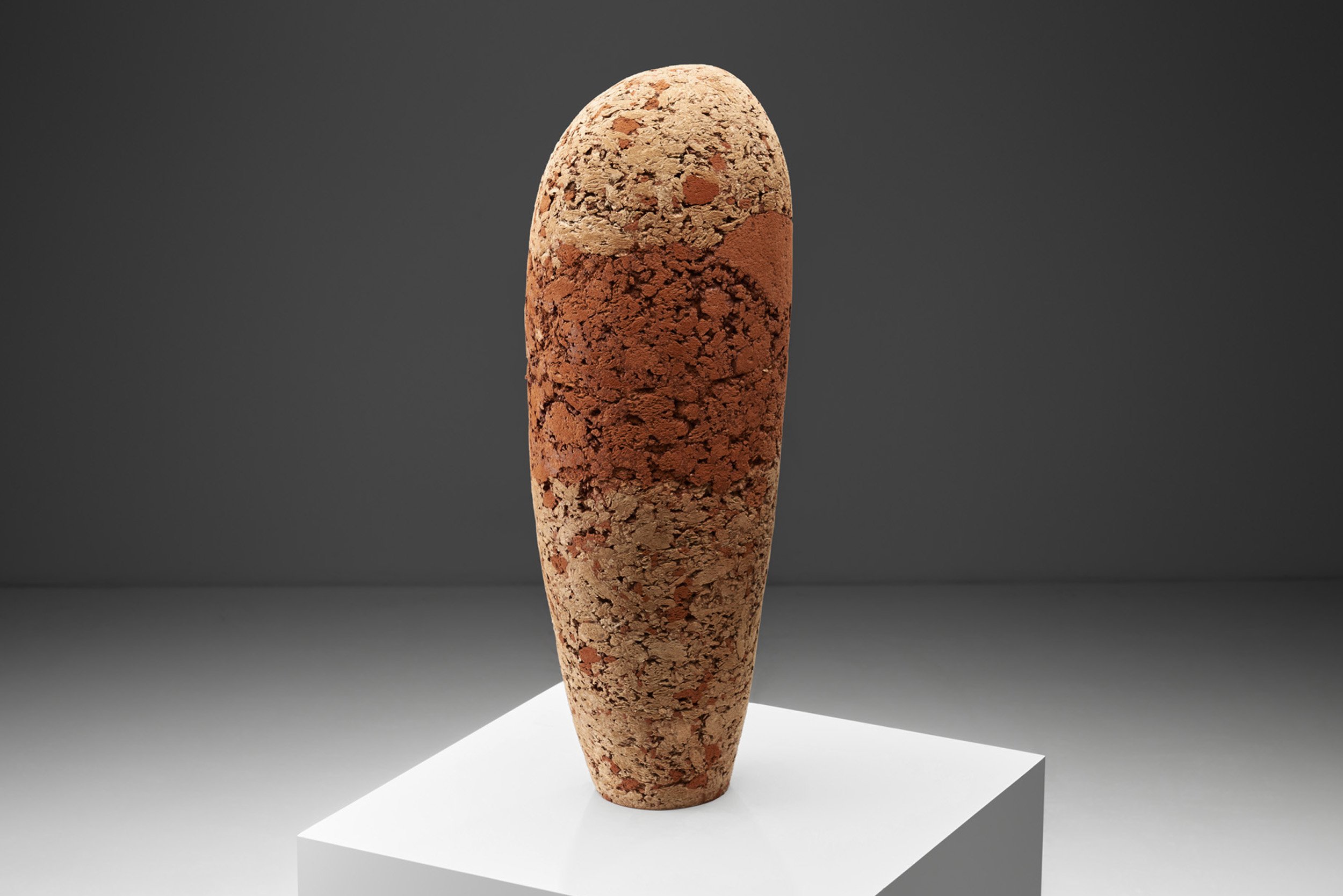
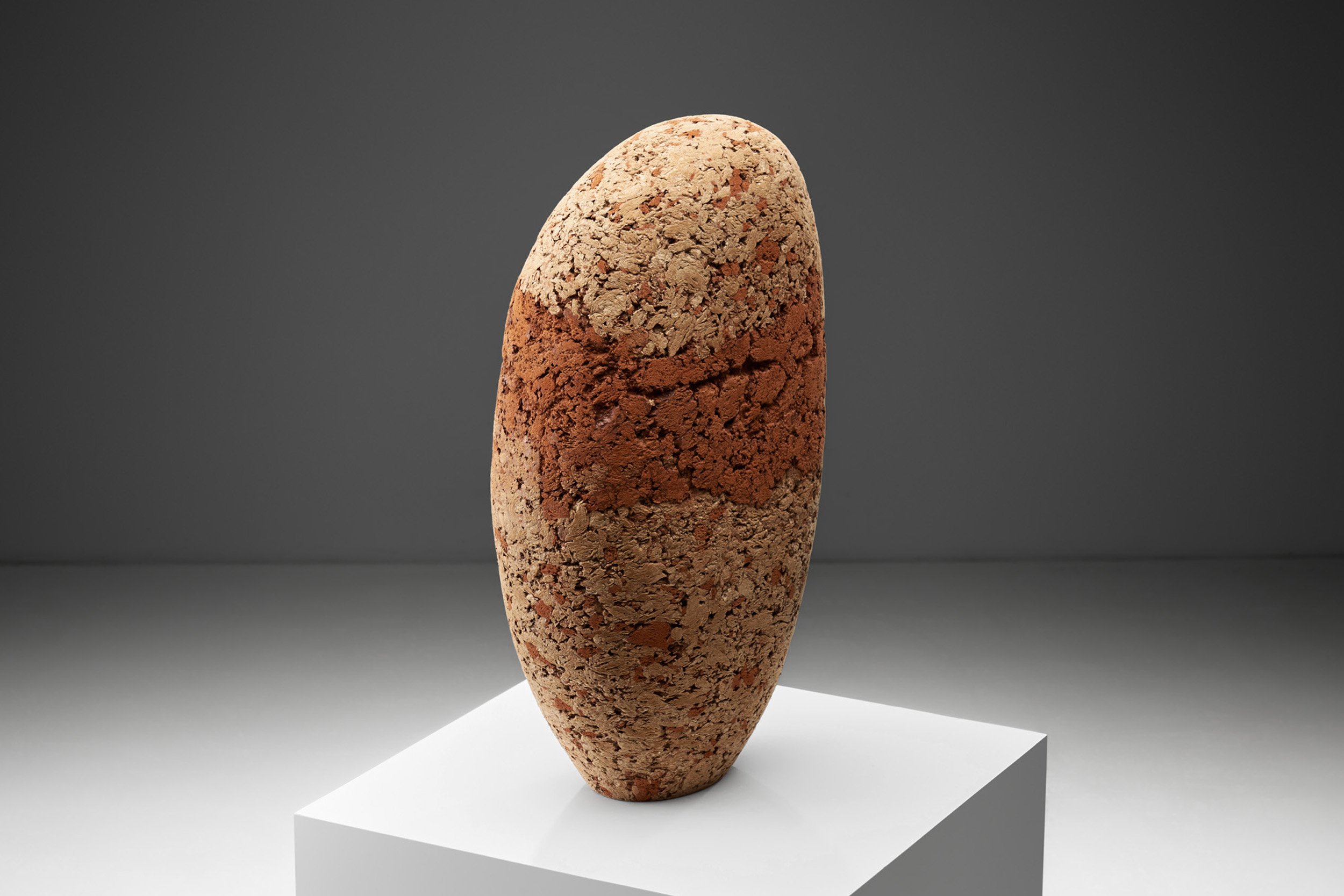
This organic sculpture by contemporary artist Domingos Tótora is a visual expression of the artist’s view of design. Tótora creates objects and sculptures where beauty is inseparable from function, lifting common everyday objects and injecting them with the spirit of Minas Gerais, the beautiful mountainous region he grew up in.
Domingos Tótora’s present sculpture represents nature in Maria da Fé, Brazil. More specifically, it is an abstraction of the majestic termite hills that characterize the landscape in this region. Handmade from repurposed cardboard and coloured with natural pigments and dried in the Brazilian sun, this model is a perfect sustainable design piece to awe any design aficionado. Made of repurposed cardboard, this sculpture shows the characteristic theme in Tótora’s work, sustainability. For the designer, exploring ways to produce objects with respect for our environment is of outmost importance, which also translates visually in his creations. As such, this model has a beautiful, organic look that resembles natural forms. In his own studio, the cardboard collected with the community’s help is broken up into small pieces and turned into a pulp, which serves as the base for his art pieces, including this model. In this careful and labor-intensive process, the cardboard, which originated from wood, essentially is brought back full cycle by taking on a wood quality again. Tótora’s design breathes sustainability, timelessness, and serenity. The rich earth tones represent the colour of the rural areas of the designer’s home country.
Naturally, Tótora’s creations are made by hand and inherently open to little imperfections and differences, purposely adding to the wabi-sabi aesthetic. As exemplified by this model, beauty is sought through stillness, and inspired by nature. The rich texture is guaranteed to stand out in any space, making this sculpture an ideal accent piece.
Condition:
New
Dimensions:
11.81 in W x 7.48 in W x 22.44 in H
30 cm W x 19 cm D x 57 cm H
About the designer:
Domingos Tótora (1960-) is a contemporary Brazilian designer whose work falls between art and design. Born and raised in the mountainous region of Maria da Fé, nature is an essential part of Tótora’s aesthetic. Being true to nature means that imperfections are a welcome part of Tótora’s designs, embracing asymmetry and unevenness in the spirit of wabi-sabi.
Following his studies in São Paulo, Tótora found inspiration on the streets in the form of discarded cardboards. He created a process in which cardboard can be recycled by breaking it down to small pieces, transforming it to cellulose plaster. With the addition of water, glue and natural pigments, the cardboard can be shaped into new forms. Through this sustainable process, waste cardboards are turned into a wood-like material. Tótora and his small team believe sustainability happens through actions and not words.
His studio, Domingos Tótora Estúdio de Artes Design, was founded in 2005 in his hometown, Maria da Fé. The beauty of his work manifests itself in its philosophy of creation and respect for the environment. The production process of Tótora’s designs is 100% manual and the cardboard he uses is fully recycled. Domingos Tótora is a true mixture of artist, designer, and craftsman. In recent years, the originality and elegance of his creations have been recognized in several exhibitions. ~H.

REQUEST PRICE HERE
Price category: 12,500 - 15,000 usd / eur
Robin Berrewaerts’s black oak bench is hand-sculpted and made of ebonized oak with an oil finish. Each piece is a unique expression, attacking the wood with the appropriate tools and finding by slow sensuous manipulation the best aesthetic effect, in form and surface quality. This exploration results in a balance between seriousness and playfulness.
During Robin Berrewaerts’s creation process, each piece gets its own, unique characteristics with different textures, shapes, and details. Essentially, each piece is carrying the same DNA with different personalities. Berrewaerts is a Belgian designer exploring different materials and techniques combined with craftsmanship, technology and a hands-on approach. His work is situated between furniture and sculpture with a strong emphasis on materiality and craftsmanship. Ranging from private commissions to exhibitions, products and sculptures, creating objects with or without any typological or functional constraint. Like his other unique pieces, this bench is made of ebonized oak with an oil finish. Ebonized wood can be created with a chemically reactive process or other means to colour the wood black, like ebony, while still allowing the wood grain to show through. As a result, the wood’s grain stands out even more, giving the design a striking appearance. In his own words: “The experience of a black surface is of a physical type, the absorption of light drawn away from the eye, the pupil opens and there is a sense of being pulled into the surface.” While this bench follows no symmetry, there is still an evident order and masterful balance to the design. The organic lines possess an elemental quality, balancing the design between furniture and sculpture. The rawness of this bench and its material are what make it one-of-a-kind in all senses of the expression.
For Robin Berrewaerts wood is not just a material or decorative element, instead, it is much more about the transformation from a tree to an object. This process resembles a conversation, a journey, looking for the right way to use time and tools. This attitude results in unique, artistic objects that have grown into something that arouses curiosity.
Condition:
In new condition.
Dimensions:
54.33 in W x 25 in D x 25 in H; Seat Height 17.51 in
138 cm W x 63.5 cm D x 63.5 cm H; Seat height 44.5 cm
About the designer:
Robin Berrewaerts was born in 1991, he works and lives in Brussels, Belgium. He graduated as an interior designer at the LUCA School of Arts in Brussels followed by a postgraduate degree in furniture design at the Thomas More School in Mechelen.
He shares his time between his own atelier and guiding students at the LUCA School of Arts where he is managing the wood and metal workshop. His work is situated between furniture and sculpture with a strong emphasis on materiality and craftsmanship. Ranging from private commissions to exhibitions, products and sculptures, creating objects with or without any typological or functional constraint.
Whether straight from a tree or industrially processed, wood manifests itself in a large variety. For Robin, this creates a huge interest in using it as a material. He sees working with wood as a physical interaction between material and artist. It comes with its own processes, techniques and peculiarities of language and vocabulary. The transformation from a tree to an object resembles a conversation, a journey, looking for the right way to use time and tools. The identity of the wood acts as a guideline from branch, stem or sawn lumber. Each type needs different approaches which results in unique objects that have grown into something that arouses curiosity.
Many of Robin’s works make use of black. The act of making the piece black, whether oxidizing, burning or painting finalizes the work he has put into the material. It marks the end of the journey. The experience of a black surface is of a physical type, the absorption of light drawn away from the eye, the pupil opens and there is a sense of being pulled into the surface. Experiencing form and details before recognizing the material so the wood itself is not becoming a decorative element.

REQUEST PRICE HERE
Price category: 2,500 - 5,000 usd / eur
These diverse organic shell vases by contemporary Brazilian artist Domingos Tótora are prime examples of the artist’s ars poetica: “I’m a mix of artist, designer, and craftsman.” Additionally, the environmentally conscious artist creates his sculptural vases out of recycled cardboard.
These organic “Carbono” vases are made from recycled cardboard with added graphite pigmen. A smooth, matte surface and the organic shapes characterize the designer’s work and are witness to his extensive experience in object design. During the creation process Tótora reduces the cardboard to a semi-liquid pulp, hand moulds it into the desired shape and dries the almost finished product in the Brazilian sun. He creates his sculptures so that beauty is inseparable from function, lifting common everyday objects and injecting them with the spirit of Minas Gerais, the beautiful mountainous region he grew up surrounded by. Sustainability is essential for the Brazilian artist and accordingly, these vases were made in a certified sustainable way, a beautiful and labour-intensive process, in which the cardboard that originated as wood is essentially brought back a full cycle by taking on a wood-like quality again. For Tótora “sustainability happens through actions and not words”.
Although Tótora’s team follows his designs closely, his creations are made by hand and inherently open to little imperfections and differences, making each piece unique. These vases are for indoor use and are not suitable for water.
Dimensions:
Mod. 1
11.81 in W x 5.9 in D x 20.67 in H
30 cm W x 15 cm D x 52.5 cm H
Mod. 2
8.26 in W x 6.29 in D x 23.62 in H
21 cm W x 16 cm D x 60 cm H
Mod. 3
9.84 in W x 6.69 in D x 20.28 in H
25 cm W x 17 cm D x 51.5 cm H
About the designer:
Domingos Tótora (1960-) is a contemporary Brazilian designer whose work falls between art and design. Born and raised in the mountainous region of Maria da Fé, nature is an essential part of Tótora’s aesthetic. Being true to nature means that imperfections are a welcome part of Tótora’s designs, embracing asymmetry and unevenness in the spirit of wabi-sabi.
Following his studies in São Paulo, Tótora found inspiration on the streets in the form of discarded cardboards. He created a process in which cardboard can be recycled by breaking it down to small pieces, transforming it to cellulose plaster. With the addition of water, glue and natural pigments, the cardboard can be shaped into new forms. Through this sustainable process, waste cardboards are turned into a wood-like material. Tótora and his small team believe sustainability happens through actions and not words.
His studio, Domingos Tótora Estúdio de Artes Design, was founded in 2005 in his hometown, Maria da Fé. The beauty of his work manifests itself in its philosophy of creation and respect for the environment. The production process of Tótora’s designs is 100% manual and the cardboard he uses is fully recycled. Domingos Tótora is a true mixture of artist, designer, and craftsman. In recent years, the originality and elegance of his creations have been recognized in several exhibitions. ~H.
REQUEST PRICE HERE
Price category: 2,500 - 5,000 usd / eur
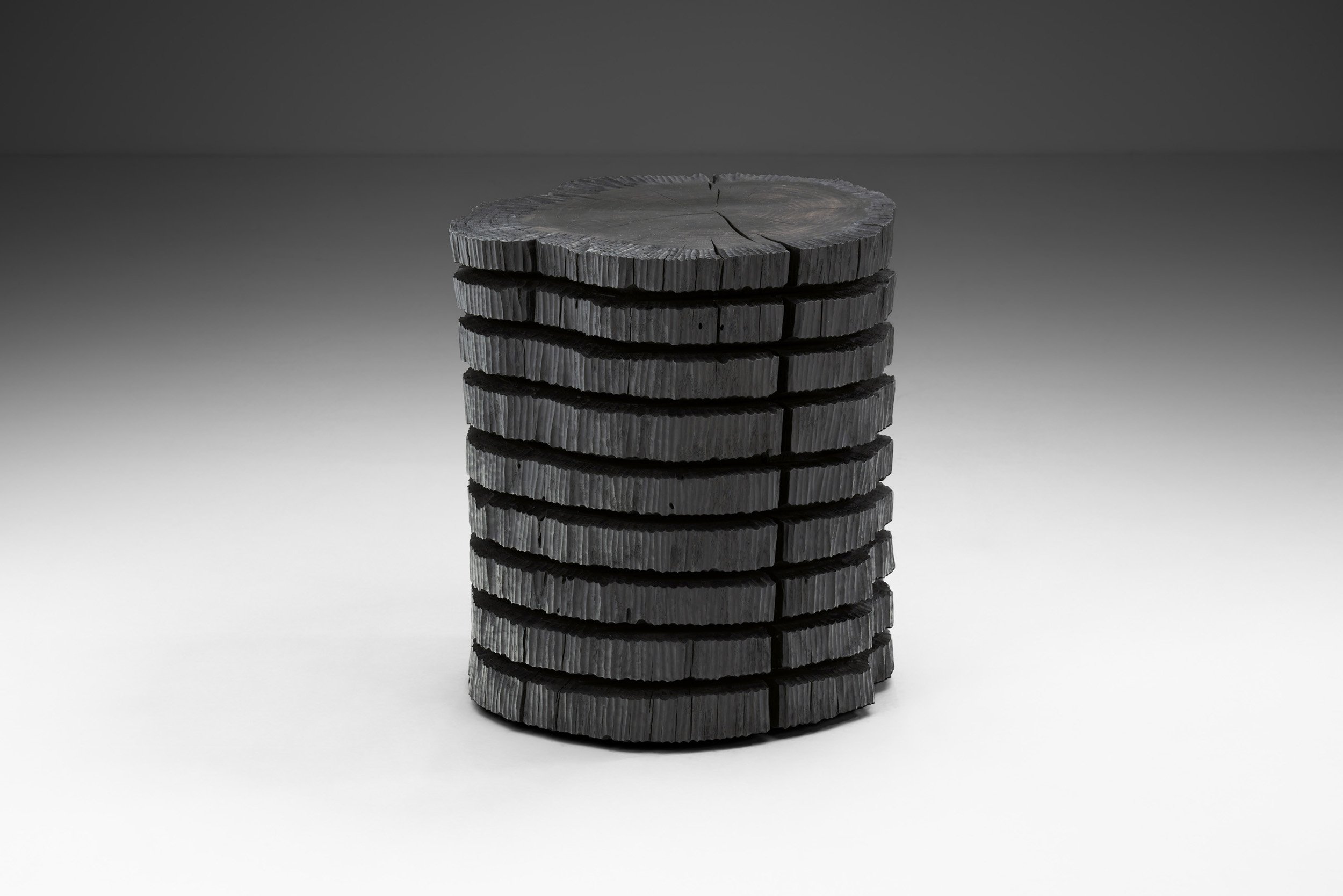
This black side table is hand-sculpted with manual tools and made of reclaimed oak with an oil finish. The aim for this object is to explore the manipulation of wood without losing the truth of the material and to keep its full three-dimensionality of form. Each chisel stroke is applied by hand and helps to reinforce the distinct character of the original tree.
The “SP” series’ sole table model is made of reclaimed oak, ebonized and stained with Indian ink with an oil finish. Probably the most renowned ink, Indian ink is a permanent, opaque black that mixes well with other colours, adding a cool, dense tint. It is also used to ebonize wood and as this side table shows, the result still allows the wood grain to show through. As a result, the wood’s grain stands out even more, giving the design a striking appearance. In his own words: “The experience of a black surface is of a physical type, the absorption of light drawn away from the eye, the pupil opens and there is a sense of being pulled into the surface.” Berrewaerts’s work is situated between furniture and sculpture with a strong emphasis on materiality and craftsmanship, which is very evident in his “P60” and “SP” series, especially in this table. Yet, the design is not overworked, the organic lines possess an elemental quality, balancing the design between furniture and sculpture. The brutalist simplicity of this table and its material are what make it one-of-a-kind in all senses of the expression. It embraces the cracks, the natural shape and texture, while also transforming it in an unmistakeable way.
For Robin Berrewaerts wood is not just a material or decorative element, instead, it is much more about the transformation from a tree to an object. This process resembles a conversation, a journey, looking for the right way to use time and tools. This attitude results in unique, artistic objects that have grown into something that arouses curiosity.
Condition:
In new condition.
Dimensions:
15.75 in Ø x 16.93 in H
40 cm Ø x 43 cm H
About the designer:
Robin Berrewaerts was born in 1991, he works and lives in Brussels, Belgium. He graduated as an interior designer at the LUCA School of Arts in Brussels followed by a postgraduate degree in furniture design at the Thomas More School in Mechelen.
He shares his time between his own atelier and guiding students at the LUCA School of Arts where he is managing the wood and metal workshop. His work is situated between furniture and sculpture with a strong emphasis on materiality and craftsmanship. Ranging from private commissions to exhibitions, products and sculptures, creating objects with or without any typological or functional constraint.
Whether straight from a tree or industrially processed, wood manifests itself in a large variety. For Robin, this creates a huge interest in using it as a material. He sees working with wood as a physical interaction between material and artist. It comes with its own processes, techniques and peculiarities of language and vocabulary. The transformation from a tree to an object resembles a conversation, a journey, looking for the right way to use time and tools. The identity of the wood acts as a guideline from branch, stem or sawn lumber. Each type needs different approaches which results in unique objects that have grown into something that arouses curiosity.
Many of Robin’s works make use of black. The act of making the piece black, whether oxidizing, burning or painting finalizes the work he has put into the material. It marks the end of the journey. The experience of a black surface is of a physical type, the absorption of light drawn away from the eye, the pupil opens and there is a sense of being pulled into the surface. Experiencing form and details before recognizing the material so the wood itself is not becoming a decorative element.
REQUEST PRICE HERE
Price category: 15,000 - 20,000 usd / eur
Made upon order. Lead time ca 20-24 weeks
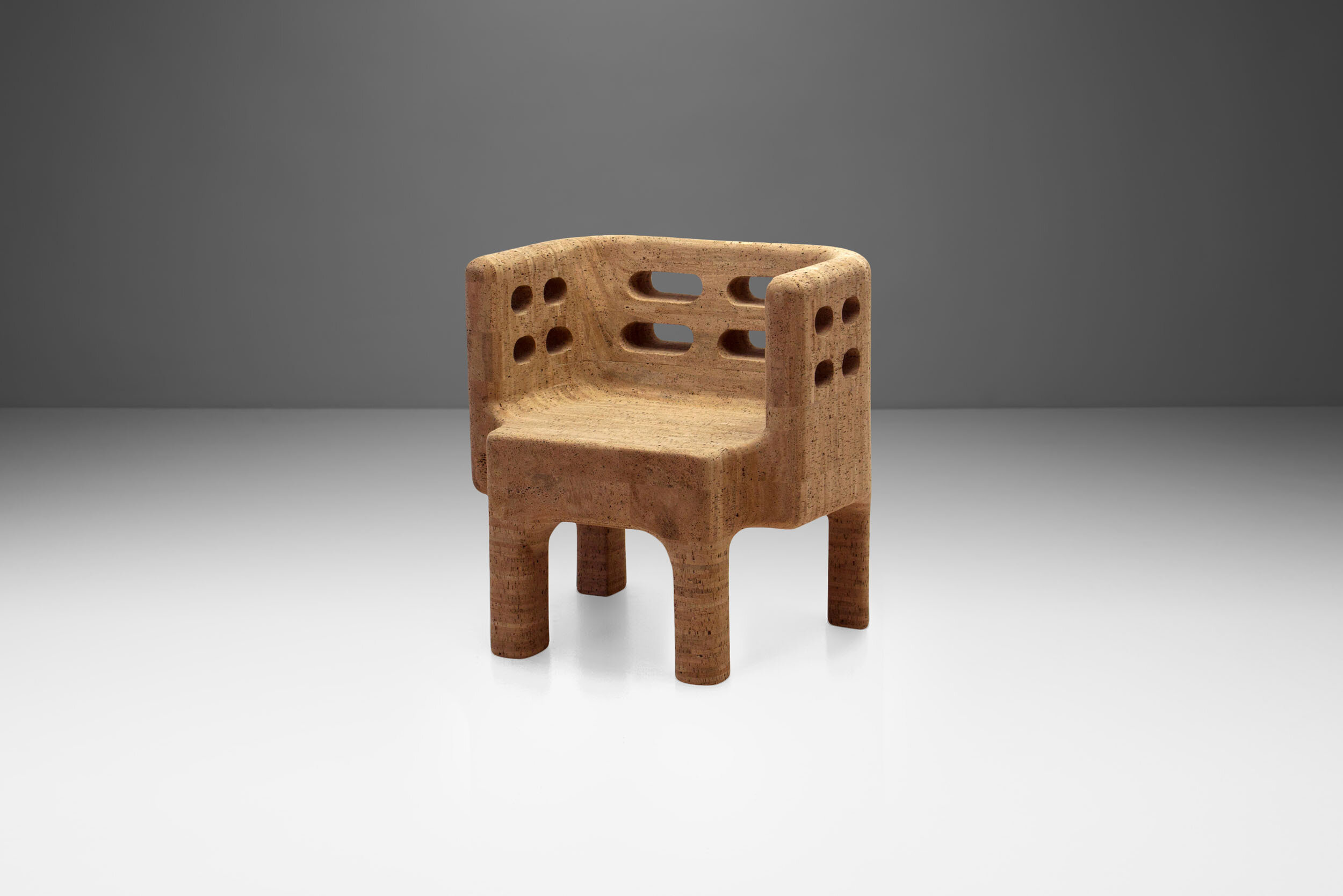
Made in limited edition of only 150, the “Sobreiro” (Portuguese for cork oak tree) armchair is part of the small exclusive Sobreiro Collection of cork furniture designed by the Campana Brothers.
This armchair – the only chair in the collection – is made from natural cork alone. The rectangular shape is appealing in its rawness, the understated design lets the unique material stand out. Such a creative, culturally inspired and sustainable piece like this armchair is a great addition to any contemporary space. In this armchair’s case, using the expression “one of a kind” is warranted.
The pieces in the collection were created to show the potential of cork as a design material that can be versatile, attractive and sustainable. This collection marks the first time the Campana Brothers have worked with cork, a material that is not only ecological, but also light. Thanks to the texture, variety of applications and its insulation properties, cork is like “marble that can be sculpted” as Humberto Campana explained. The original pieces were developed with the support of Corticeira Amorim, who played an advisory role and supplied the different types of cork used in the collection.
Condition:
New. Because this is a handmade artistic work made of a natural product, each item is one-of-a-kind and minor variations in colour, texture, shape, grain, and sizing can occur.
Dimensions:
22.63 in W x 29.14 in D x 29.53 in H; Seat height 17.72 in
75 cm W x 60 cm D x 75 cm H; Seat height 45 cm
About the designer:
The Campana Brothers, Humberto and Fernando, are among the icons of contemporary furniture design. Since 1983, the Brazilian siblings have achieved both national and international recognition and popularity.
Their studio, Estudio Campana, is based in São Paulo, and often collaborates with local communities, factories, and industries. There is a huge emphasis on handcrafted and artisanal work. Via their pieces, the Campana Brothers institute conversation around ethical production, sustainability and social awareness into some of the world’s most alluring interiors.
Their unique designs have earned them numerous awards, including the Ordre des Arts et Lettre from the Ministry of Culture in France and the Order of Cultural Merit in Brazil. Their work has been the subject of several exhibitions, including the 2008 exhibition at the Cooper Hewitt Smithsonian Design Museum in New York. ~H.

REQUEST PRICE HERE
Price category: 2,500 - 5,000 eu/usd
Made upon order. Lead time ca 8-10 weeks
These diverse “Anfora” vases by contemporary Brazilian artist Domingos Tótora are prime examples of the artist’s ars poetica: “I’m a mix of artist, designer, and craftsman.” Additionally, the environmentally conscious artist creates his sculptural vases out of recycled cardboard.
Domingos Tótora creates objects and sculptures where beauty is inseparable from function, lifting common everyday objects and injecting them with the spirit of Minas Gerais, the beautiful mountainous region he grew up surrounded by. Sustainability is essential or the Brazilian artist and accordingly, these vases are made of recycled cardboard that looks like it was made out of wood.
These vases were made in a certified sustainable way, a beautiful and labour-intensive process, in which the cardboard which originated as wood is essentially brought back a full cycle by taking on a wood-like quality again. For Tótora “sustainability happens through actions and not words”.
Although Tótora’s team follows his designs closely, his creations are made by hand and inherently open to little imperfections and differences, making each piece unique.
Not suitable for water.
Condition:
New.
Dimensions:
Small ribbed
3.22 in Ø x 19.29 in H
8.2 cm Ø x 49 cm H
Small with spout
3.22 in Ø x 5.51 in W x 19.29 in H
8.2 cm Ø x 14 cm W x 49 cm H
Medium ribbed
3.22 in Ø x 25.59 in H
8.2 cm Ø x 65 cm H
Medium with spout
3.22 in Ø x 5.51 in W x 25.59 in H
8.2 cm Ø x 14 cm W x 65 cm H
Large ribbed
3.22 in Ø x 29.53 in H
8.2 cm Ø x 75 cm H
Large with spout
3.22 in Ø x 5.51 in W x 29.13 in H
8.2 cm Ø x 14 cm W x 74 cm H
Literature:
Domingos Tótora - Maria Sonia Madureira de Pinho, Brazil 2013, unpaginated
About the designer:
Domingos Tótora (1960-) is a contemporary Brazilian designer whose work falls between art and design. Born and raised in the mountainous region of Maria da Fé, nature is an essential part of Tótora’s aesthetic. Being true to nature means that imperfections are a welcome part of Tótora’s designs, embracing asymmetry and unevenness in the spirit of wabi-sabi.
Following his studies in Sao Paulo, Tótora found inspiration on the streets in the form of discarded cardboards. He created a process in which cardboard can be recycled by breaking it down to small pieces, transforming it to cellulose plaster. With the addition of water, glue and natural pigments, the cardboard can be shaped into new forms. Through this sustainable process, waste cardboards are turned into a wood-like material. Tótora and his small team believe sustainability happens through actions and not words.
His studio, Domingos Totora Estúdio de Artes Design, was founded in 2005 in his hometown, Maria da Fé. The beauty of his work manifests itself in its philosophy of creation and respect for the environment. The production process of Tótora’s designs is 100% manual and the cardboard he uses is fully recycled. Domingos Tótora is a true mixture of artist, designer, and craftsman. In recent years, the originality and elegance of his creations have been recognized in several exhibitions. ~H.
REQUEST PRICE HERE
Price category: 2,500 - 5,000 usd / eur
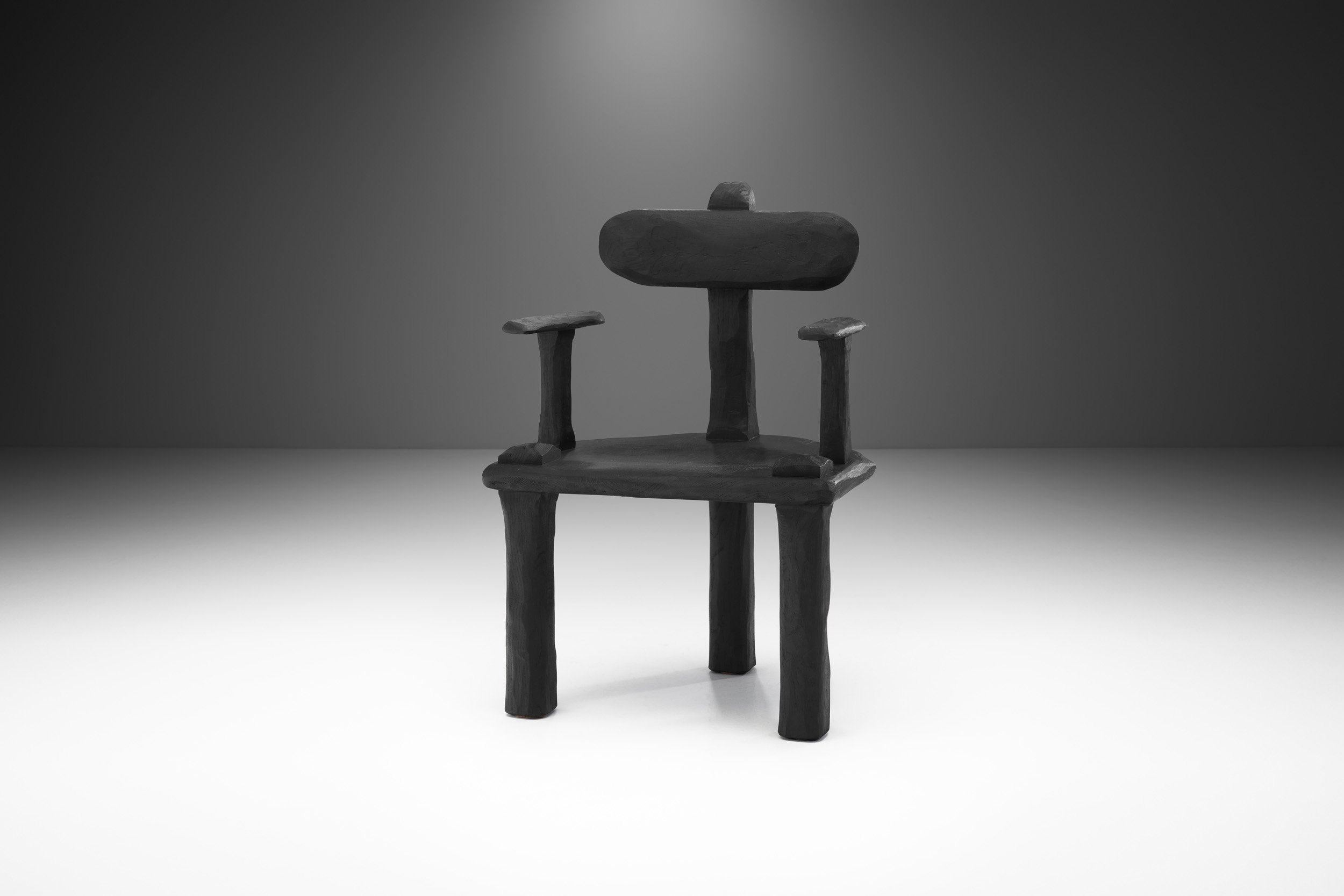
Three legs, a seating and a backrest are the basic principles to form the base for each chair of the “P60” series. During the creation process, each piece gets its own, unique characteristics with different textures, shapes and details. Essentially, each piece is carrying the same DNA with different personalities. Robin Berrewartes is a Belgian designer exploring different materials and techniques combined with craftsmanship, technology and a hands-on approach.
This “P60 A” armchair model is made of ebonized oak with an oil finish. Ebonized wood can be created with a chemically reactive process or other means to colour the wood black, like ebony, while still allowing the wood grain to show through. As a result, the wood’s grain stands out even more, giving the design a striking appearance. In his own words: “The experience of a black surface is of a physical type, the absorption of light drawn away from the eye, the pupil opens and there is a sense of being pulled into the surface.” Berrewaerts’s work is situated between furniture and sculpture with a strong emphasis on materiality and craftsmanship, which is very evident in this “P60” series, especially in this chair. Yet, the forms are not overworked, these organic lines possess an elemental quality, balancing the design between furniture and sculpture. The brutalist simplicity of this chair and its material are what make it one-of-a-kind in all senses of the expression.
For Robin Berrewaerts wood is not just a material or decorative element, instead, it is much more about the transformation from a tree to an object. This process resembles a conversation, a journey, looking for the right way to use time and tools. This attitude results in unique, artistic objects that have grown into something that arouses curiosity.
Condition:
In new condition.
Dimensions:
23.82 in W x 22.05 in D x 35.43 in H; Seat Height 16.93 in, Arm Height 26.38 in
60.5 cm W x 56 cm D x 90 cm H; Seat Height 43 cm, Arm Height 67 cm
About the designer:
Robin Berrewaerts was born in 1991, he works and lives in Brussels, Belgium. He graduated as an interior designer at the LUCA School of Arts in Brussels followed by a postgraduate degree in furniture design at the Thomas More School in Mechelen.
He shares his time between his own atelier and guiding students at the LUCA School of Arts where he is managing the wood and metal workshop. His work is situated between furniture and sculpture with a strong emphasis on materiality and craftsmanship. Ranging from private commissions to exhibitions, products and sculptures, creating objects with or without any typological or functional constraint.
Whether straight from a tree or industrially processed, wood manifests itself in a large variety. For Robin, this creates a huge interest in using it as a material. He sees working with wood as a physical interaction between material and artist. It comes with its own processes, techniques and peculiarities of language and vocabulary. The transformation from a tree to an object resembles a conversation, a journey, looking for the right way to use time and tools. The identity of the wood acts as a guideline from branch, stem or sawn lumber. Each type needs different approaches which results in unique objects that have grown into something that arouses curiosity.
Many of Robin’s works make use of black. The act of making the piece black, whether oxidizing, burning or painting finalizes the work he has put into the material. It marks the end of the journey. The experience of a black surface is of a physical type, the absorption of light drawn away from the eye, the pupil opens and there is a sense of being pulled into the surface. Experiencing form and details before recognizing the material so the wood itself is not becoming a decorative element.

REQUEST PRICE HERE
Price category: 2,500 - 5,000 usd / eur
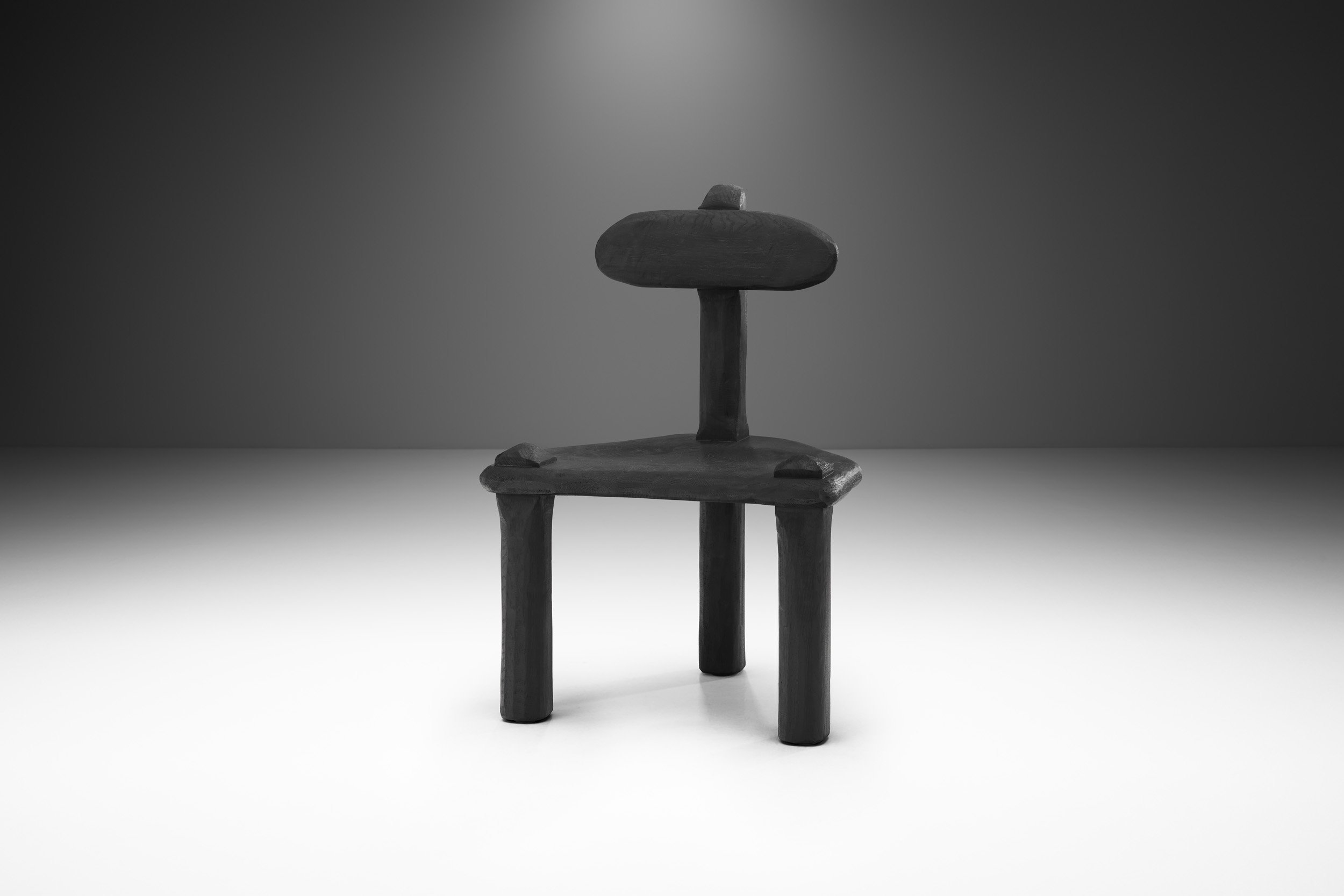
Three legs, a seating and a backrest are the basic principles to form the base for each chair of the “P60” series. During the creation process, each piece gets its own, unique characteristics with different textures, shapes and details. Essentially, each piece is carrying the same DNA with different personalities. Robin Berrewartes is a Belgian designer exploring different materials and techniques combined with craftsmanship, technology and a hands-on approach.
This “P60” chair model - eponymous with the series’ name - is made of ebonized oak with an oil finish. Ebonized wood can be created with a chemically reactive process or other means to colour the wood black, like ebony, while still allowing the wood grain to show through. As a result, the wood’s grain stands out even more, giving the design a striking appearance. In his own words: “The experience of a black surface is of a physical type, the absorption of light drawn away from the eye, the pupil opens and there is a sense of being pulled into the surface.” Berrewaerts’s work is situated between furniture and sculpture with a strong emphasis on materiality and craftsmanship, which is very evident in this “P60” series, especially in this chair. Yet, the forms are not overworked, these organic lines possess an elemental quality, balancing the design between furniture and sculpture. The brutalist simplicity of this chair and its material are what make it one-of-a-kind in all senses of the expression.
For Robin Berrewaerts wood is not just a material or decorative element, instead, it is much more about the transformation from a tree to an object. This process resembles a conversation, a journey, looking for the right way to use time and tools. This attitude results in unique, artistic objects that have grown into something that arouses curiosity.
Condition:
In new condition.
Dimensions:
23.82 in W x 22.04 in D x 35.23 in H; Seat Height 17.32 in
60.5 cm W x 56 cm D x 89.5 cm H; Seat Height 44 cm
About the designer:
Robin Berrewaerts was born in 1991, he works and lives in Brussels, Belgium. He graduated as an interior designer at the LUCA School of Arts in Brussels followed by a postgraduate degree in furniture design at the Thomas More School in Mechelen.
He shares his time between his own atelier and guiding students at the LUCA School of Arts where he is managing the wood and metal workshop. His work is situated between furniture and sculpture with a strong emphasis on materiality and craftsmanship. Ranging from private commissions to exhibitions, products and sculptures, creating objects with or without any typological or functional constraint.
Whether straight from a tree or industrially processed, wood manifests itself in a large variety. For Robin, this creates a huge interest in using it as a material. He sees working with wood as a physical interaction between material and artist. It comes with its own processes, techniques and peculiarities of language and vocabulary. The transformation from a tree to an object resembles a conversation, a journey, looking for the right way to use time and tools. The identity of the wood acts as a guideline from branch, stem or sawn lumber. Each type needs different approaches which results in unique objects that have grown into something that arouses curiosity.
Many of Robin’s works make use of black. The act of making the piece black, whether oxidizing, burning or painting finalizes the work he has put into the material. It marks the end of the journey. The experience of a black surface is of a physical type, the absorption of light drawn away from the eye, the pupil opens and there is a sense of being pulled into the surface. Experiencing form and details before recognizing the material so the wood itself is not becoming a decorative element.
REQUEST PRICE HERE
Price category: 2,500 - 5,000 usd / eur
Three legs, a seating and a backrest are the basic principles to form the base for each chair of the “P60” series. During the creation process, each piece gets its own, unique characteristics with different textures, shapes and details. Essentially, each piece is carrying the same DNA with different personalities.
This “P60 L” low chair model is made of ebonized oak with an oil finish. Ebonized wood can be created with a chemically reactive process or other means to colour the wood black, like ebony, while still allowing the wood grain to show through. As a result, the wood’s grain stands out even more, giving the design a striking appearance. In his own words: “The experience of a black surface is of a physical type, the absorption of light drawn away from the eye, the pupil opens and there is a sense of being pulled into the surface.” Berrewaerts’s work is situated between furniture and sculpture with a strong emphasis on materiality and craftsmanship, which is very evident in this “P60” series, especially in this chair. Yet, the forms are not overworked, these organic lines possess an elemental quality, balancing the design between furniture and sculpture. The brutalist simplicity of this chair and its material are what make it one-of-a-kind in all senses of the expression.
For Robin Berrewaerts wood is not just a material or decorative element, instead, it is much more about the transformation from a tree to an object. This process resembles a conversation, a journey, looking for the right way to use time and tools. This attitude results in unique, artistic objects that have grown into something that arouses curiosity.
Condition:
New. Made to order.
Dimensions:
27.95 in W x 27.76 in D x 27.17 in H; Seat Height 11.02 in
71 cm W x 70.5 cm D x 69 cm H; Seat Height 28 cm
About the designer:
Robin Berrewaerts was born in 1991, he works and lives in Brussels, Belgium. He graduated as an interior designer at the LUCA School of Arts in Brussels followed by a postgraduate degree in furniture design at the Thomas More School in Mechelen.
He shares his time between his own atelier and guiding students at the LUCA School of Arts where he is managing the wood and metal workshop. His work is situated between furniture and sculpture with a strong emphasis on materiality and craftsmanship. Ranging from private commissions to exhibitions, products and sculptures, creating objects with or without any typological or functional constraint.
Whether straight from a tree or industrially processed, wood manifests itself in a large variety. For Robin, this creates a huge interest in using it as a material. He sees working with wood as a physical interaction between material and artist. It comes with its own processes, techniques and peculiarities of language and vocabulary. The transformation from a tree to an object resembles a conversation, a journey, looking for the right way to use time and tools. The identity of the wood acts as a guideline from branch, stem or sawn lumber. Each type needs different approaches which results in unique objects that have grown into something that arouses curiosity.
Many of Robin’s works make use of black. The act of making the piece black, whether oxidizing, burning or painting finalizes the work he has put into the material. It marks the end of the journey. The experience of a black surface is of a physical type, the absorption of light drawn away from the eye, the pupil opens and there is a sense of being pulled into the surface. Experiencing form and details before recognizing the material so the wood itself is not becoming a decorative element.