
Carl Malmsten "Samspel" Sofa for AB Record Bollnäs, Sweden 1950s (sold)




Carl Malmsten "Samspel" Sofa for AB Record Bollnäs, Sweden 1950s (sold)
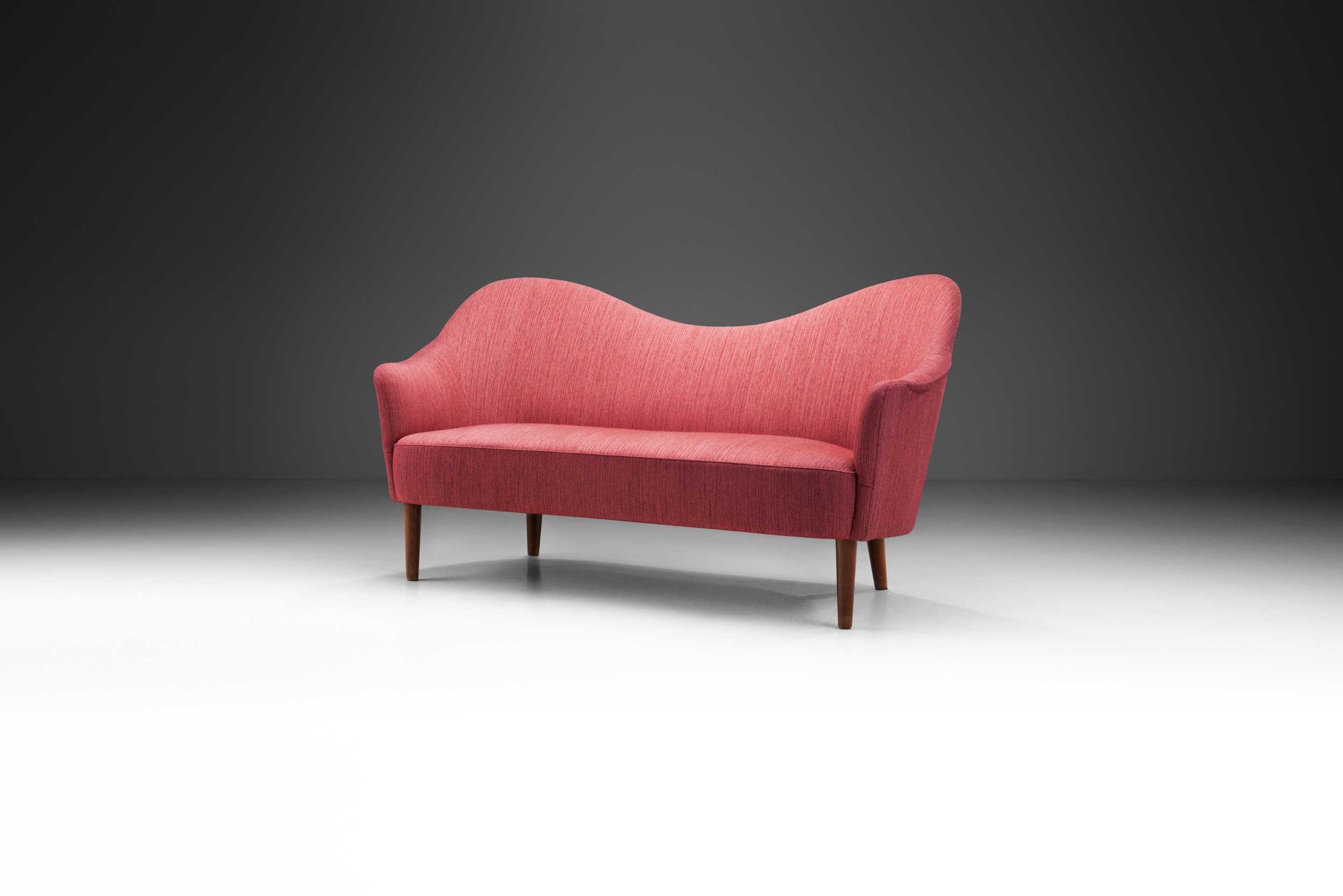
The “Samspel”, or “Interaction” sofa model was first introduced at the exhibition at Röhsska Museet (the Swedish Museum of Design and Crafts) in Gothenburg in 1956. The model’s name means ‘interaction’ in Swedish, which refers to not only Carl Malmsten’s design philosophy, but also to mid-century Swedish society.
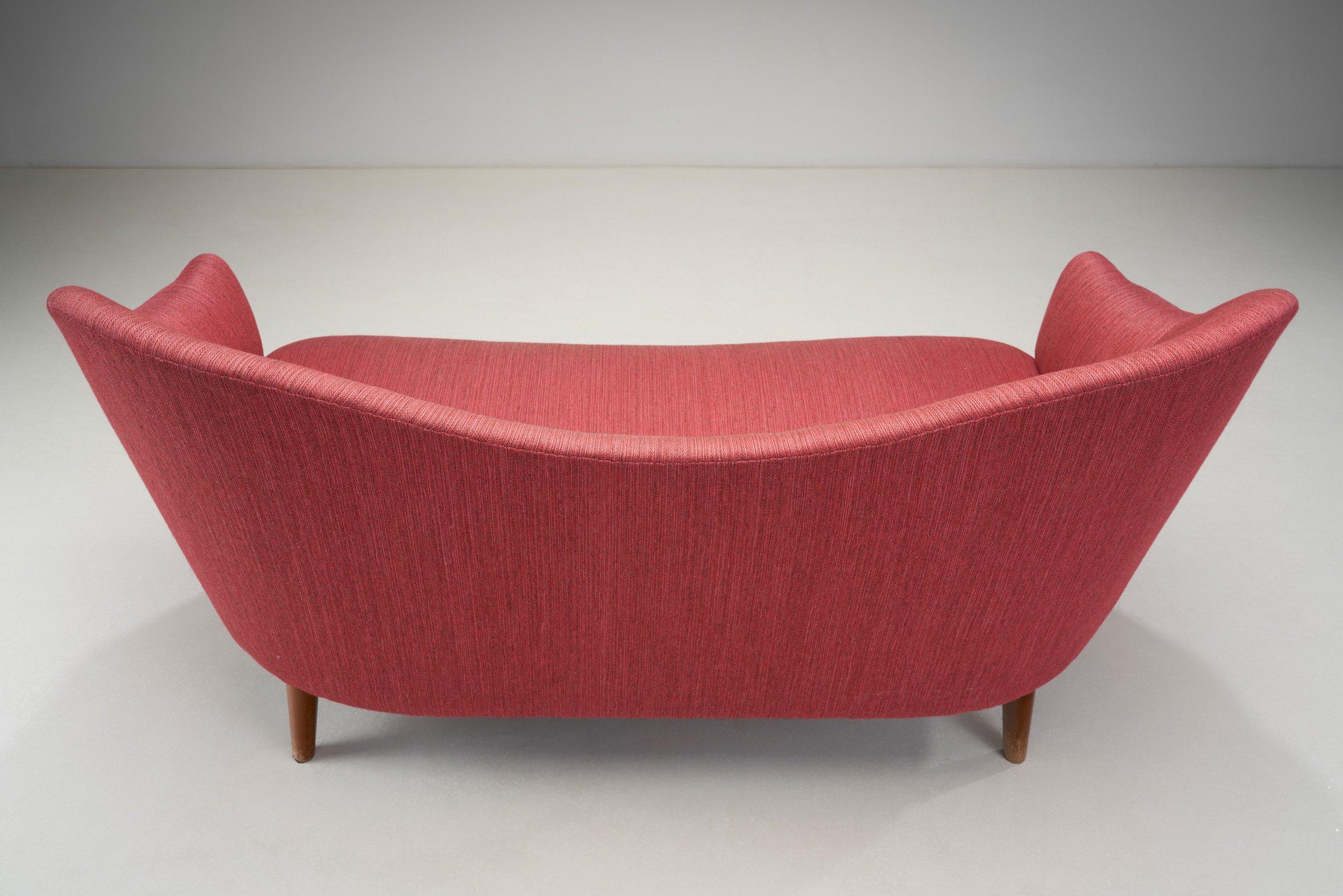
Samspel is an honest classic in Swedish design history, as comfortable as it is fastidious in the expression. Sweeping curves with an organic impression and outmost quality: these are the main characteristics that define this sofa. Even as a young designer in the early 20th century, Carl Malmsten advocated an artisanal furniture design based on local ingredients and traditions, accessible to a wide audience. The main curvature is on the top of the back and continues to the sides forming one, flowing line. The armrests have subtle, outward curving “wings” that enhance the open and welcoming impression. The organicity of the design is not broken by any heavy ornamentation, instead the stylish upholstery is utilized to further highlight the shape of the sofa. The design is completed by tapered, solid wood legs with a dark colour that pairs nicely with the eye-catching pink upholstery.
Although Carl Malmsten’s furniture was very much a product of the thoughts and ideals of the time, they have a timeless quality that makes them equally up-to-date and loved today. This is especially true for this Samspel sofa, a much loved and coveted model that, after many years of rest, was put back into production by O.H Sjögren in 2016.
SOLD
Condition:
In good vintage condition. Wear consistent with age and use. The upholstery is in vintage condition. Each of our items can be re-upholstered by our in-house atelier in a fabric of choice. Please reach out for more information.
Dimensions:
61.81 in W x 29.13 in D x 31.49 in H; Seat height 15.74 in; Arm height 22.83 in
157 cm W x 74 cm D x 80 cm H; Seat height 40 cm; Arm height 58 cm
About the designer:
Carl Malmsten (December 7, 1888 – August 13, 1972) was a Swedish furniture designer, architect, and educator. Malmsten was born in Stockholm, Sweden. Malmsten's career took off when he won a competition in 1916 to design furniture for the Stockholm City Hall and shortly after, in 1917, he exhibited alongside well-known Swedish architects such as Gunnar Asplund and Uno Åhrén.
In the 1920s he was invited to furnish a room for the crown prince, Gustaf VI Adolf, and his wife Louise in Ulriksdal Palace. He was honoured with an inaugural Prince Eugen Medal for design in 1945. Already as a young designer in the early 20th century, Carl Malmsten advocated an artisanal furniture design based on local ingredients and traditions, available to a wide audience at a reasonable price.
Nature was Carl Malmsten's foremost teacher and source of inspiration. He conveyed his love of craftsmanship as a teacher in his own schools, at Olofskolan in Stockholm, Capellagården on Öland and the Carl Malmsten school on Lidingö, today a branch of Linköping University and one of the country's leading design colleges. As a debater, Malmsten stormed against functionalism, but in retrospect it can be seen that his ideas often coincided with the rational and frugal style ideals of function.
Malmsten has had a lasting influence on Swedish furniture design through the two schools he founded—the Carl Malmsten Furniture Studies (Carl Malmstensskolan), which has been a part of Linköping University since 2000, is situated on the island of Lidingö on the outskirts of Stockholm. Carl Malmsten spoke about the importance of tradition, craftsmanship, and the nation. His furniture was in many ways a product of the thoughts and ideals of the time, they have a timeless quality that makes them just as relevant and loved today. ~H.



REQUEST PRICE HERE
Price category: 5,000 - 7,500 usd / eur
In the 1950s, Italian design took a crucial turn from the technical, formal and artistic point of view. Designers took tips from names in contemporary art and architecture like Alvar Aalto, Marcel Breuer and F. L. Wright. A natural fit, considering that most of the Italian designers were architects and engineers.
This sofa aesthetically predates the great industrial era, with a more classic look and materials. With elegance and functionality at the core of the design, there is an unmistakeable Italian vibe to this piece. Like Scandinavian mid-century design, Italian design liked to blend form with function, which is evident here as well. The body is gently curved, with the three seats sectioned with the seat cushions. These give the sofa a cosy and modern look, while also emphasizing the main curve. The design is quite ‘social’ in the sense that it encourages interaction thanks to its shape. At the same time, the design is also very open, which is the result of the absence of armrests and its sheer size. The body is supported by six, symmetrically arranged tapered legs. The wooden legs add a detail that is characteristic of mid-century modernism.
Generally, Italian designers like shapes that are very fluid and pleasant. Because of their emotional and suggestive charge, they appear simple and yet complex at the same time. Here, the so-called banana shape, the tapered wooden legs, and the elegant, green velvet upholstery create this charge that is explicitly Italian.
Condition:
In vintage condition. Wear consistent with age and use. Traces of wear and use. This sofa comes with its original upholstery or has been reupholstered by a previous owner. Although the upholstery looks good at first glance, we would recommend reupholstering. Each of our items can be re-upholstered by our in-house atelier in a fabric of choice. Please reach out for more information.
Dimensions:
94.48 in W x 28.14 in D x 33.07 in H; Seat height 17.71 in
240 cm W x 71.5 cm D x 84 cm H; Seat height 45 cm