
Pierre Chapo "S10" Cognac Leather Easy Chair, France 1960s (sold)


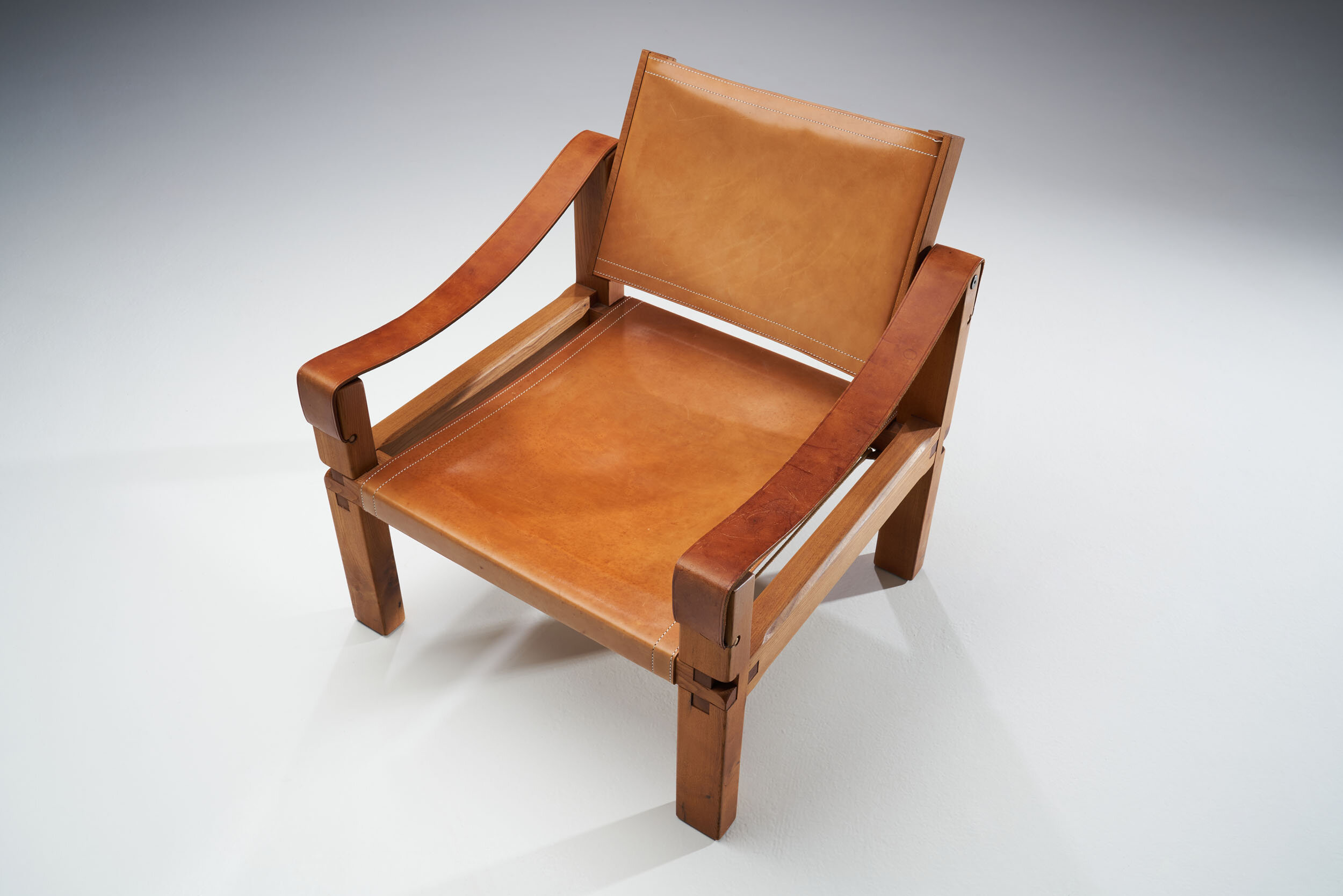


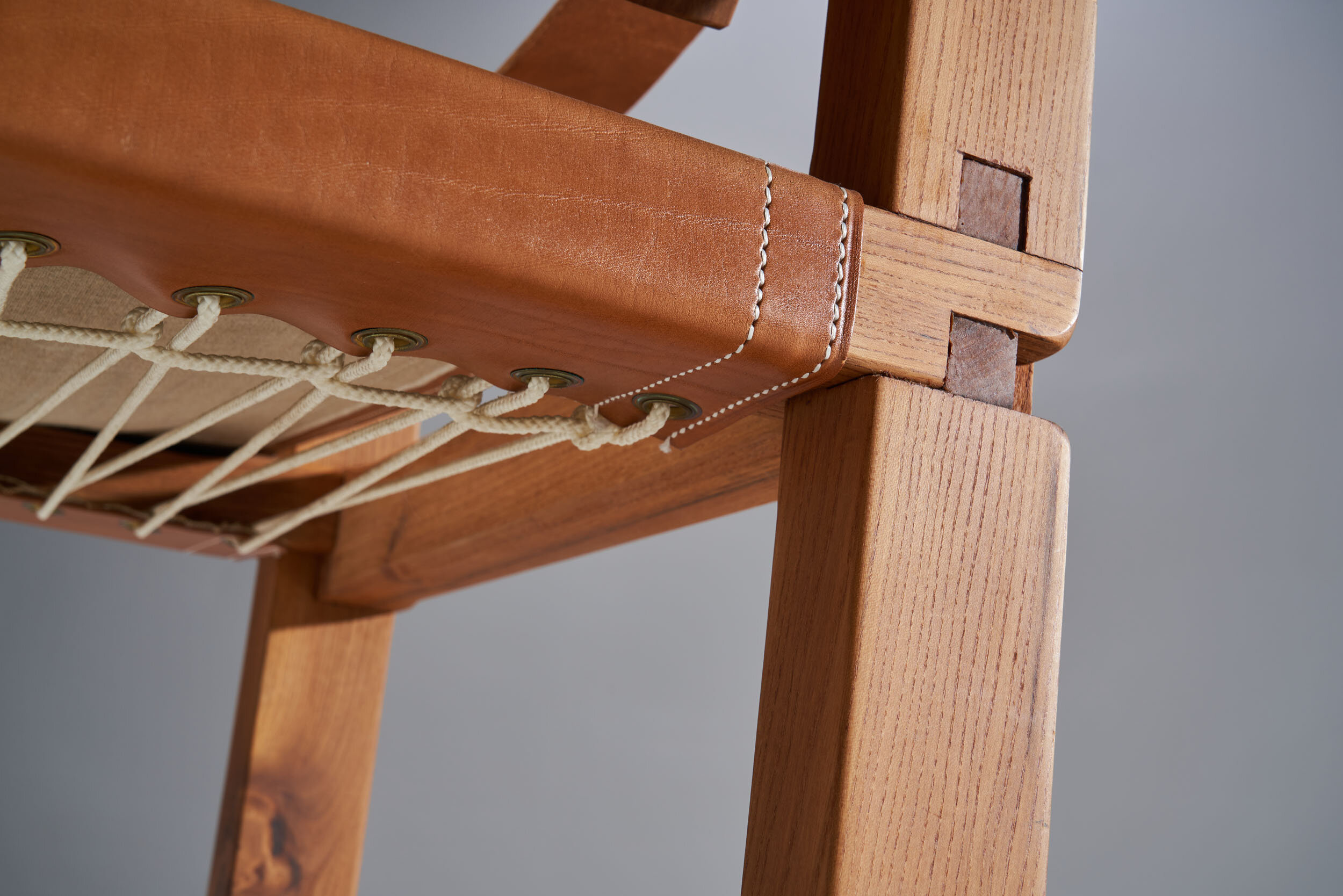


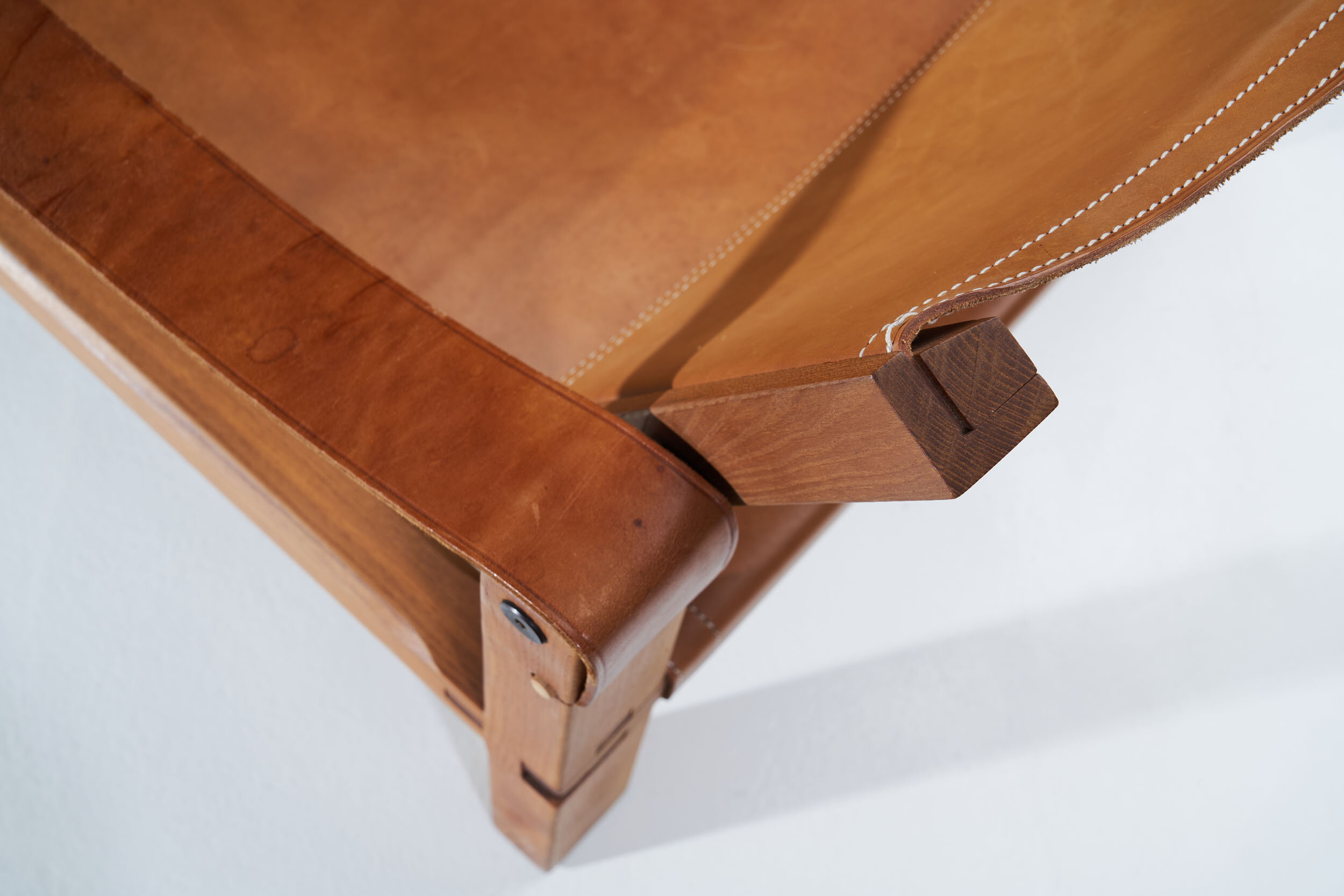
Pierre Chapo "S10" Cognac Leather Easy Chair, France 1960s (sold)
Designed in the 1960s and produced in solid elm and cognac leather, the “S10” model is one of the most elemental works in Chapo's oeuvre. The chair combines a complex assembly in Chapo’s signature "48x72" technique, with a straight forward, simple design, resulting in a timeless work.
This specific piece comes from a summer house in the South of Germany, where due to very light use it was preserved in an amazing condition.
SOLD
Condition:
In very good condition. Leather has a light patina and some light scratches. Wood has some light marks and scratches.
Dimensions:
26.78 in W x 26.78 in D x 29.53 in H; seat height 11.82 in
68 cm W x 68 cm D x 75 cm H; seat height 30 cm
Literature:
Pierre Chapo, Magen H. Gallery, New York 2017
About the designer:
Pierre Chapo, who was born in Paris on July 1927, initially was interested in becoming a professional painter. However after a chance meeting with a shipbuilder who introduced him to wood and woodcrafts, Chapo changed his focus and decided to study architectural studies at the prestigious École nationale supérieure des Beaux-Arts in Paris. After graduating Chapo and his wife, the sculptor and painter Nicole Lormier, started to travel extensively through Scandinavia and Central America. Among the many places the couple visited was the home and studio of Frank Lloyd Wright in Taliesin West. A visit that had a lasting influence on Chapo’s future work and designs. Read more about Pierre Chapo. ~H.

REQUEST PRICE HERE
Price category: 15,000 - 20,000 usd / eur
This beloved José Zanine Caldas lounge chair from the “Linha Z” or “Z Line” is an exceptional example of Brazilian design of the 1950s. The design dates to 1949, The woven leather straps and the organic shape is unmatched.
This chair model is made of plywood and features a distinctive shape, distinguished by its legs. The legs and arms are connected and form one unit and their shape inspired the name of the line, “Linea Z”. The edges are softly rounded, which matches the versatile curvature of the body, which enhances the organic feel of the chair. Besides the plywood frame, the original leather upholstery is the stand-out element of this chair both in terms of visual and technical terms. The leather strap seat and back are tightly secured to the plywood, completing the great graphic expression this is widely known for. The bolts of the joinery are left visible, a detail that adds to the rawness of the design. The bent seat is perfectly angled for lounging, supporting the sitter’s whole body.
The pioneering Brazilian designer, José Zanine Caldas’s present design was created by Mòveis Artisticos Z, the factory Zanine Caldas founded in São José dos Campos in 1948. Most of Zanine Caldas’s designs - especially this armchair - tap into the modernist aesthetic while bearing exceptionally unique shapes: form and function revisited with a twist.
Condition:
In good vintage condition. Wear consistent with age and use. Some scratches and discoloration on the wood. This chair comes with its original leather or has been reupholstered by a previous owner.
Dimensions:
24.21 in W x 40.94 in D x 32.48 in H; Seat height 12.4 in
61.5 cm W x 104 cm D x 82.5 cm H; Seat height 31.5 cm
Literature:
Movel Moderno Brasileiro, published by Olhares editores, São Paulo 2017 by Alberto Vicente and Marcelo Vasconcellos
Aric Chen, Brazil Modern, Monaclli Press, New York City 2016
Ruy Teixeira e Jayme Vargas, Desenho da Utopia, Olhares, São Paulo 2016
About the designer:
José Zanine Caldas was born in Belmonte, at the southern coast of Bahia, in 1919. Son of a doctor, Zanine was an autodidact who, from a young age, was fascinated with his environment, especially with trees.
While most architects of his generation studied extensively, Zanine developed his own style through doing and making, and at the age of 20 decided to exchange Bahia for Rio de Janeiro. There he opened up a workshop for architectural scale-models and had the chance to work with pioneering modern architects like Lucio Costa and Oscar Niemeyer.
Large scale furniture with modern design and affordable prices. This was the great advantage of the joinery Móveis Artístico Z founded in 1948 by the architect Zanine Caldas, in partnership with Sebastião Pontes and Paulo Mello, was a great success at the time. Headquartered in São José dos Campos (SP), it maintained its production for almost two decades. The form of creation, idealized by Zanine, was opposed to the market of the time, which was either based on the production of handmade furniture, in solid wood, or in pieces produced in series with an unattractive design. Breaking these paradigms, Móveis Artísticas Z revolutionized manufacturing pieces with improved design and great popular appeal.
Inspired by the local craftsmen who carved boats and furniture from fallen trees, Zanine began experimenting with chiselling and carving large, sculptural works, which became the focus of his later career. Zanine became a big advocate for preservation and in the 1980s, he established the Foundation Center for the Development of the Application of Brazilian Woods (DAM), in an effort to educate and attempt to reverse the rampant destruction of Brazilian rainforests.
Up until his death in 2001, Zanine kept his natural visions alive, and would plant a new tree in place of any tree that was taken down for one of his projects. ~H.
REQUEST PRICE HERE
Price category: 5,000 - 7,500 usd / eur
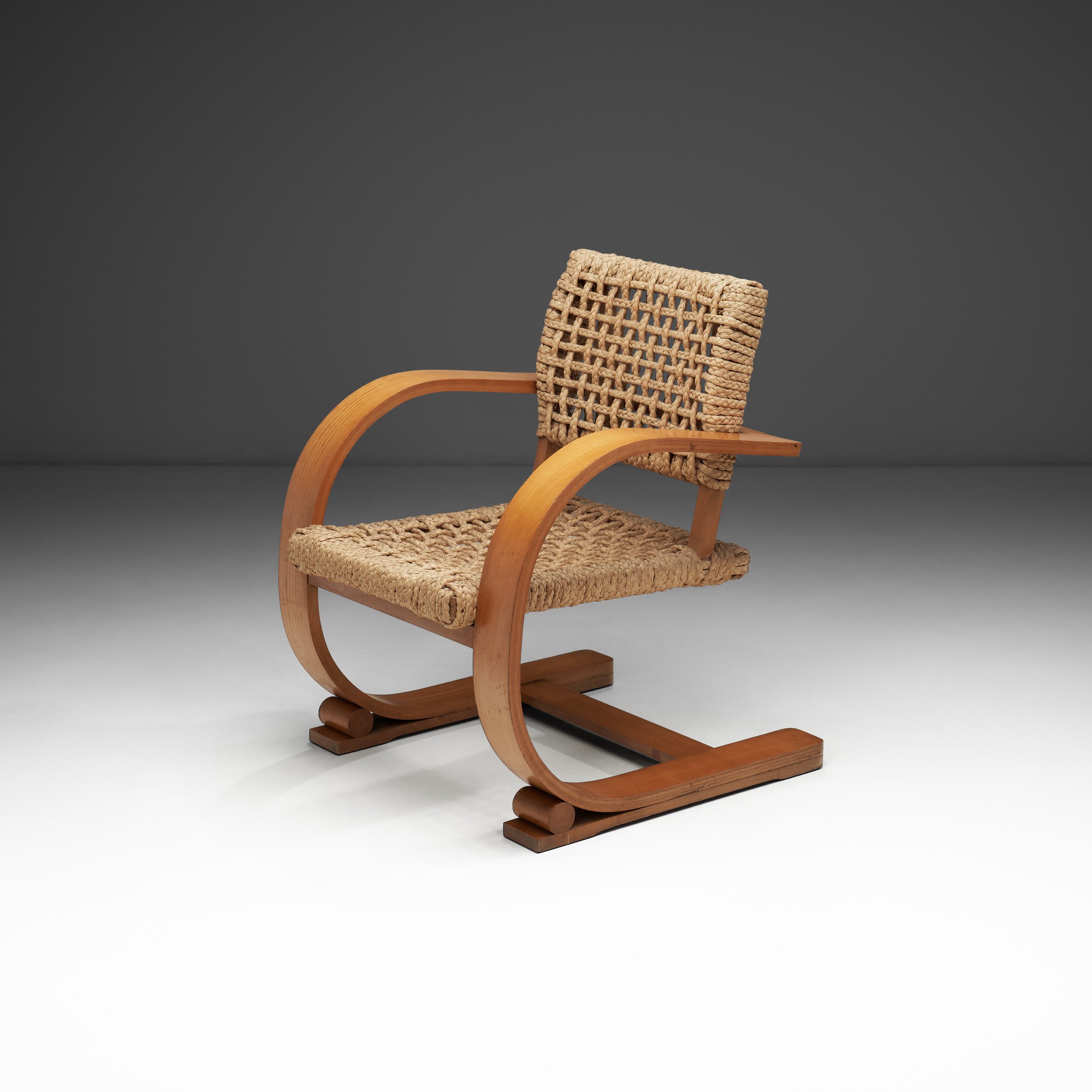
This armchair is a compelling embodiment of the French design duo Adrien Audoux and Frida Minet. Their design philosophy was centered around a commitment to accessible furnishing made out of natural materials that suit the rhythms of modern life. Active in mid-20th century France, they played a crucial role in shaping post-war design. Drawing inspiration from modernist movements, they steered the view of design towards a more functional, refined, and streamlined aesthetic.
This chair showcases excellent craftsmanship, care, and precision, visible in the smallest details of the design. The woven seat and backrest, composed of finely braided natural fibres, offer both support and comfort, gently adapting to the shape of the body for a relaxed resting experience. Unlike most chairs, this unique design does not utilise the typical four legs - instead, the structure flows seamlessly into a wide curve that comprises the frame and is the visual highlight of the chair’s form. The armrests appear to be curving down and back in two smooth lines, partially creating a supporting base. The structure of the base is further enforced by a stretcher between the two pieces of bentwood, enhancing stability. Another interesting design detail are the cylinder supports at the front where the arms and base meet, which act as a reinforcement while still maintaining harmony with the rest of the piece. This clever element helps to create a scooped base that supports the entire seat. The bent wood creates a fluid connection, giving the seat a sense of suspension - a light, almost floating presence - with the open surface of the seating and back further enhancing the airy characteristic of the armchair. Though the back rail is a separate piece between the two large curved elements it visually continues the line of the arms, creating the sense of a frame that gracefully encloses the seat.
The impressive silhouette of the armchair is defined by the choice of solid bentwood and woven rope as materials, and techniques that require expert skill, all poured into the final result to create this graceful form. The timeless appeal of this piece complements a wide range of interior styles, capable of transforming any environment with its organic appearance in both form and medium.
Condition:
In good vintage condition. Wear consistent with age and use.
Dimensions:
25 in W x 27.55 in D x 31.88 in H; Seat height 16.14 in
63.5 cm W x 70 cm D x 81 cm H; Seat height 41 cm
REQUEST PRICE HERE
Price category: 12,500 - 15,000 usd / eur
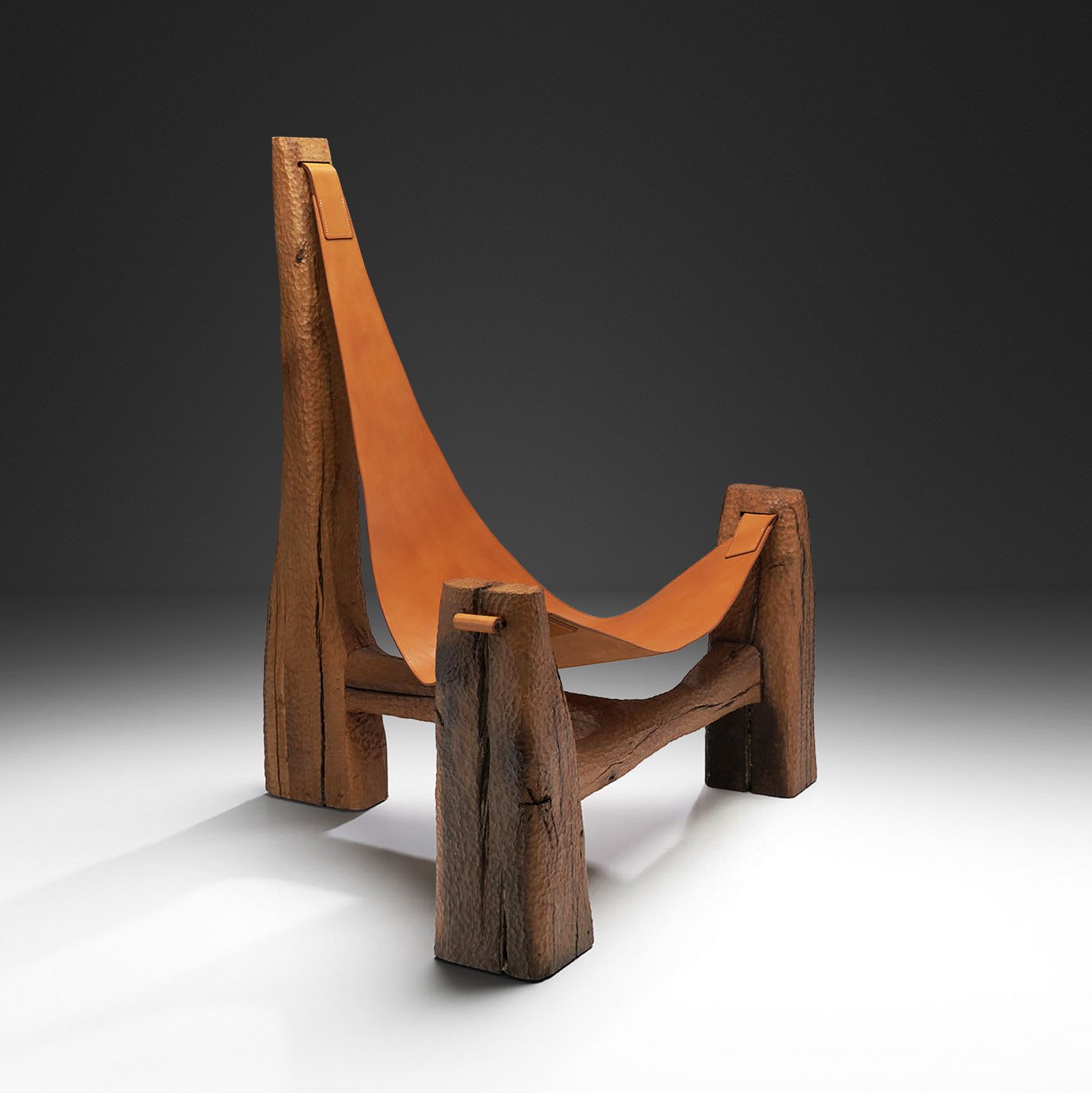
Generally, Czech mid-century modern designs tend to be more sober than their French, German, American, and even Scandinavian counterparts. However, works by Pavel Novak are an exception - as evidenced by chair. The Czech designer’s repertoire is finally starting to surface, and as this chair shows, we are lucky to witness it.
Novak often worked with a gouge, that originally never had any other vocation than to furnish his farm. This piece is made of hand gouged oak, which is in itself a time-consuming and rare woodcarving technique. While most woodworkers offer help with fixing gouges in wood, Novak used the technique to create this rustic looking body that can be considered to be a functional sculpture. Thanks to the unique, hand-carved texture, the lounge chair is one of a kind, with a unique pattern. The leather seat is suspended between the three legs, one of which is elongated to serve as a backrest. The joinery technique is seamless and shows the outstanding craftsmanship and vision of Novak. The leather straps are inset into the legs in a rough, yet sophisticated way.
In fact, rough yet sophisticated are the adjectives that best define the overall aesthetic of this chair, reflected in the pairing of the materials as well. The patinated leather’s smooth surface contrasts beautifully with the gouged, coarse look of the oak. With its straightforward design, this oiece is a seminal work of Pavel Novak.
Condition:
In good vintage condition. Wear consistent with age and use. Some minor cracks. Due to the nature and age of the materials, the chair may have some marks, scratches, and discolouration.
Dimensions:
40.94 in W x 30.71 in D x 48.82 in H; Seat depth 20.08 in
104 cm W x 78 cm D x 124 cm H; Seat height 51 cm
REQUEST PRICE HERE
Price category: 9,000 - 12,500 usd / eur
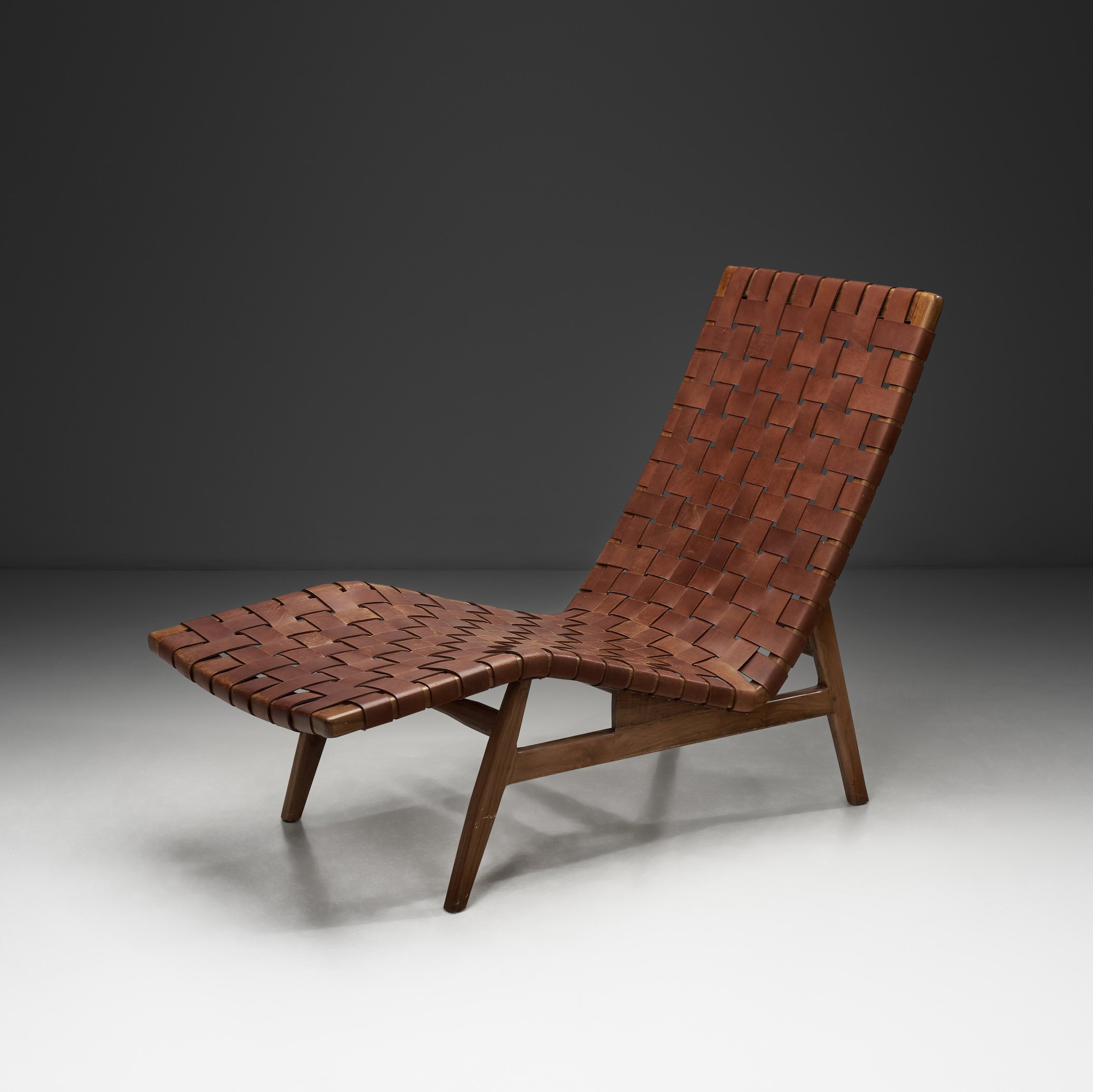
The mid-20th century saw brilliant designers working to create furniture of the highest quality that explored modern shapes and forms. These artists experimented with new materials and construction methods. This stunning chaise longue revolves around the use of high-quality materials, comfort, and craftsmanship. It’s clean lines and angular shape is reminiscent of works by Danish designer, Arne Vodder.
This chaise blends three main elements: craftsmanship, the clean lines of Modernism and the clear-eyed practicality of Functionalism. These elements combined with the use of exquisite materials creates a piece that is both historical and modern visually. The chaise is defined by its woven seat and the patinated leather. The seat is composed of leather straps woven in a so-called basket weave pattern and stretched over the solid wood frame. Thanks to the material’s qualities, the seat is very ergonomic, adapting to the sitter’s shape. This piece combines the beauty and innovation of its era’s design movement with the classic qualities of a chaise longue. With its rhythmic motion, it invites contemplation and relaxation. This piece has the power to transform a seat into a safe haven, a place to unwind and reflect.
This chaise longue is a prime example of mid-century modern’s design ideology. The maker of this model effortlessly transformed a historical archetype into a modern, yet timeless chair. It’s sophisticated, lightweight look is defined by its signature craftsmanship, well-conceived proportions, and remarkable material choices.
Condition:
In good vintage condition. Wear consistent with age and use. The item has recently been reconditioned. Due to the nature and age of the materials, the item may have some marks, scratches, and discolouration.
Dimensions:
52.55 in W x 23.22 in D x 37.40 in H; Seat height 16.92 in; Seat depth 34.64 in
133.5 cm W x 59 cm D x 95 cm H; Seat height 43 cm; Seat depth 88 cm
REQUEST PRICE HERE
Price category: 2,500 - 5,000 usd / eur
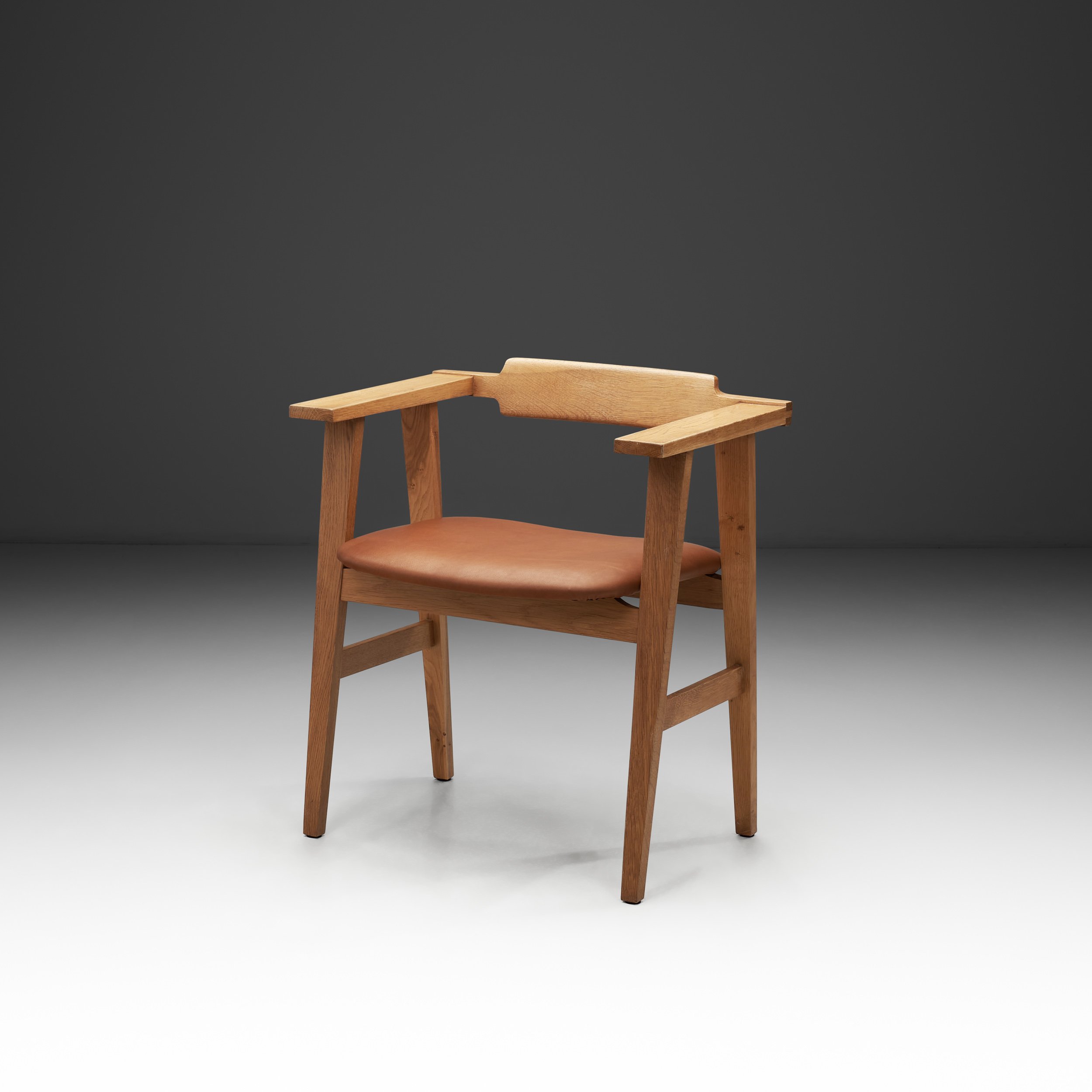
Saying mid-century modernism had a revival would be a serious understatement. In reality, the designs have never gone out of style completely, especially in Scandinavia. Danish cabinetmaker pieces are timeless thanks to their expert craftsmanship, their visual, and the material quality. This armchair showcases this timelessness with its modern form.
This elegantly constructed chair combines comfort with style. From as early as the 1920s, cabinetmakers and architects frequently collaborated to produce exceptional pieces like this. The chairs’ elegant curves, precise angles and structure all testify of this partnership’s success. Thanks to its low back the design appears very grounded. With straight and curving lines following each other, the model has a dynamism rooted in organicity. Unlike pieces from outside the continent, Danish designers’ products weren’t flashy but rather well-made to fit a warm, comfortable and welcoming home. As this armchair exemplifies, blending functionality, good quality natural materials and organic colours with excellent craftsmanship is the key to the success of mid-century modernism. As an object, the chair reflects the mid-20th century Danish pursuit of everyday beauty, objects designed not just to serve, but to enrich domestic environments.
The classic charm and versatility of this design allows it to be used as a desk chair, an occasional piece in a curated corner, or part of a formal dining set, this chair can bring quiet sophistication to any setting. It is an ideal choice for a range of interior styles thanks to its thoughtful materials, and subtle craftsmanship.
Condition:
In good vintage condition. Wear consistent with age and use. Due to the nature and age of the materials, the chair may have some marks, scratches, and discolouration. The chair has recently been reconditioned and reupholstered in premium leather. Each of our items can be reupholstered by our in-house atelier in a fabric of choice. Please reach out for more information.
Dimensions:
25.19 in W x 18.89 in D x 28.14 in H; Seat height 19.09 in; Seat depth 17.32 in; Arm height 26.57 in
64 cm W x 48 cm D x 71.5 cm H; Seat height 48.5 cm; Seat depth 44 cm; Arm height 67.5 cm
REQUEST PRICE HERE
Price category: 2,500 - 5,000 usd / eur
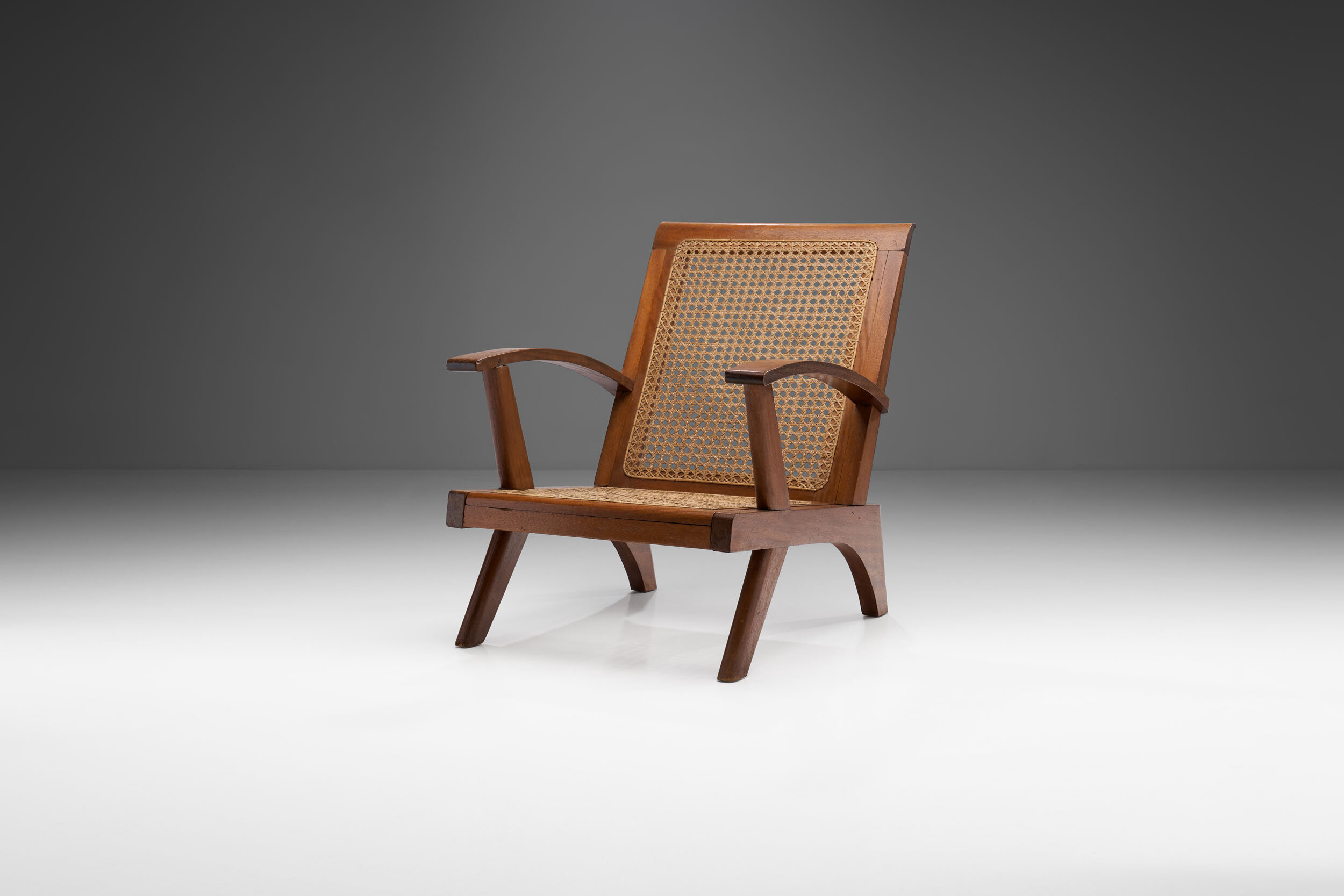
This mid-century French armchair combines a visually stunning structural body with expert caning technique and high-quality materials.
As with the UK and much of Europe, there was something of a design renaissance in France in the 1950s, due to developments in materials and technology after the war. In France, designers were often also architects, whose focus on functionality and quality resulted in sculptural models, such as this armchair. This model is all about the gorgeous teak structure and the cane panels. Pure, sleek forms, free from artifice or decoration characterise the aesthetic; a style that is commonly referred to as reconstructivism. A reconstructivist design builds upon prior, deconstructionist models and techniques, but adapts them to classic themes and structures, with the goal of creating works of genuine emotion and significance. This armchair in particular recalls the chairs of Swiss architect, Pierre Jeanneret’s designs for Chandigarh in India.
The body features octagonal mesh cane webbing, which is an elegant material that enhances quality and complements the teak wood. Cane webbing is strong enough to support the weight of a sitting person and flexible enough to bend around the sharp corners of wooden frames. Production of cane webbing requires a lot of labour, attention and craftsmanship and every production step involves repetitive careful hand selection. The cane panels are original and in great condition, testifying to the outstanding quality of this armchair and the skill of its maker. ~H.
Condition:
In good vintage condition. Wear consistent with age and use. Original cane panels. Some minor scratches and marks on the wood.
Dimensions:
25.59 in W x 32.87 in D x 31.1 in H; Seat height 11.41 in
65 cm W x 83.5 cm D x 79 cm H; Seat height 29 cm
REQUEST PRICE HERE
Price category: 5,000 - 7,500 usd / eur
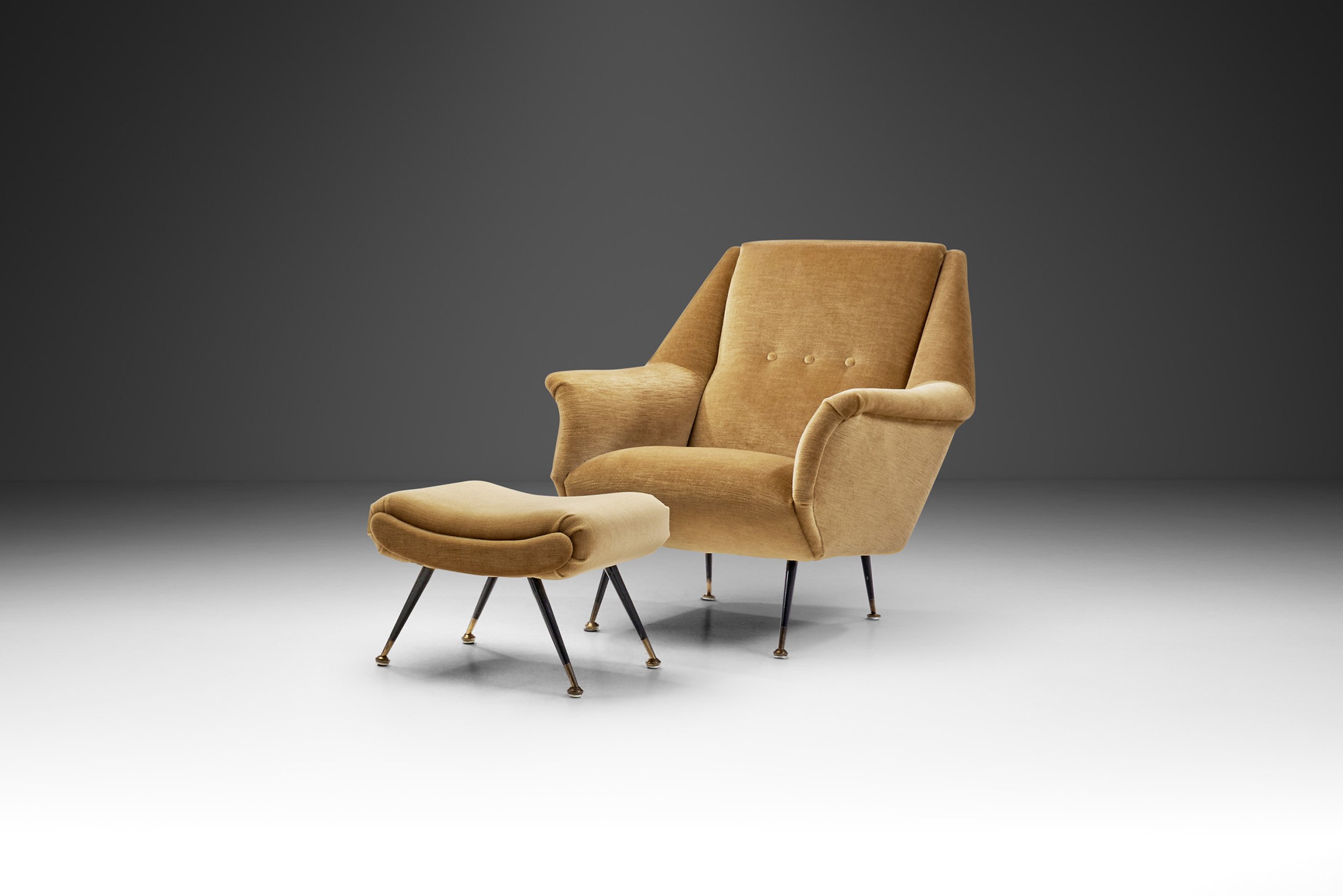
The post-war period in France saw a wide array of inventive and creative contributions to the history of design. What made this particular period so prolific and influential is that French designers’ creations were woven into the fabric of French identity. These designers and ‘ensembliers’ were skilled at bringing together the many artisanal trades for which France has long been famous, thus communicating a broad picture of French skill and style.
As this lounge chairs and footstool set shows, they put their rigour – but also their imagination – at the service of furniture. While the 1960s saw the emergence of colourful styles and eras such as pop art and the mobi boom, this set preserves the understated elegance of the mid-century modern movement. Aside from some floral wallpaper and curtains, the colours of the 1960s were rather subdued, and earthy colours were the most common. French furniture and interior designers of the mid-century are known as masters of elegantly organic forms. As such, this set is characterized by clean lines and a free spirit. With their fully upholstered bodies supported by metal structures, the design is focused on sinuous curves, especially on the contoured arms. The unexpected curves in combination with the velour upholstery of the chair and footstool are very effective in creating a stylish, elegant look. The deep stitches accentuate the shapes and forms. The most unusual element however, are the splayed black lacquered legs with brass caps. Their thin, straight lines are perfect to counter the volume of the bodies, while the materials accentuate each other in perfect harmony.
Though many mid-century French designers may not have the name recognition as some of their Scandinavian counterparts, they were integral to developing a modern aesthetic in Europe. The appreciation for their contribution is still growing today making outstanding pieces like this lounge chair and footstool set highly sought after.
Condition:
In good vintage condition. Wear consistent with age and use. The chair and footstool have been reupholstered recently in a premium velour fabric. Each of our items can be re-upholstered by our in-house atelier in a fabric of choice. Please reach out for more information.
Dimensions:
Chair:
32.67 in W x 35.43 in D x 33.26 in H; Seat height 16.14 in; Arm height 21.65 in
83 cm W x 90 cm D x 84.5 cm H; Seat height 41 cm; Arm height 55 cm
Footstool:
20.07 in W x 15.35 in D x 13.38 in H
51 cm W x 39 cm D x 34 cm H

REQUEST PRICE HERE
Price category: 5,000 - 7,500 usd / eur
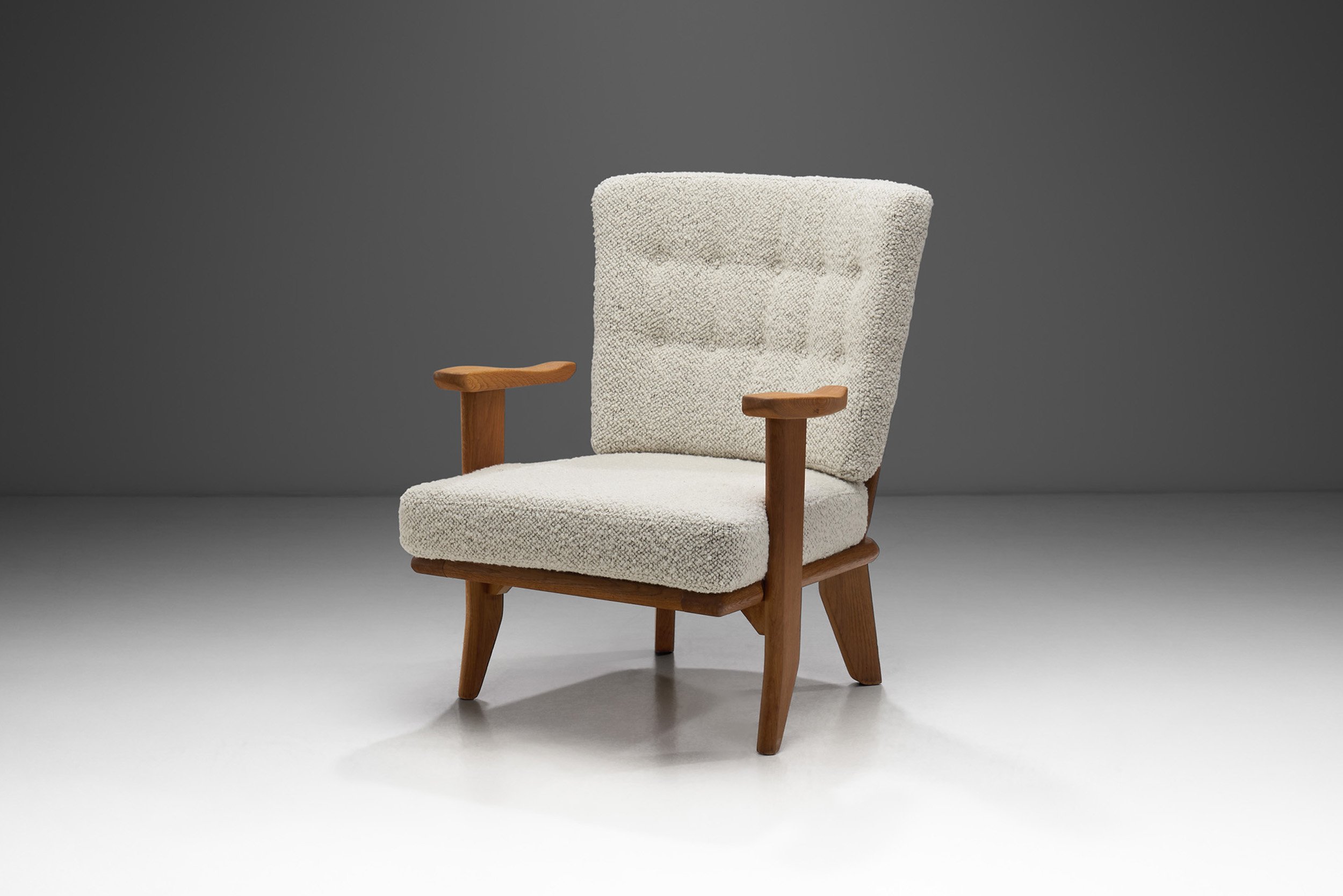
The duo of Robert Guillerme and Jacques Chambron and their company, Votre Maison denote a landmark of French mid-century design history. Their focus was as keenly attuned to functionality as to the creation of innovative design. For the pair of designers, the home was envisioned as a place where the family could live both comfortably and in aesthetic harmony. Robert Guillerme, who designed most of the work, possessed a limitless creative ambition, producing designs for everything from grand dressers and sideboards to sculptural armchairs like this model.
This chair’s aesthetic is elegantly expressed through clean lines and geometric precision, while creating a harmonious balance between form and function. The oak construction showcases the skillful artistry of the design duo while highlighting great balance of lines. The careful execution of the oak frame, with the gently curved and sculptural armrests is the most apparent visual feature of the chair, while the more subtle details, such as the back frame and upholstered seat and back cushions, make this model visually interesting. The very subtly curved armrests serve a double purpose: on one hand functional, on the other one aesthetic. The chair promises a comfortable and relaxed seating experience, while visually breaking the continuity of the outer line. The soft seat and back cushions, upholstered in a cream fabric, provide plenty of comfort paired with the slightly reclined backrest. This armchair truly exemplifies the thoughtful design and timeless appeal of Guillerme et Chambron’s work, blending natural materials with mid-century modern aesthetics.
Not only did Votre Maison produce over two thousand models during the latter half of the twentieth century, its output also served as a model for a vast field of liveable contemporaneous design. This steady output of beautiful furniture bucked convention not merely in the equal emphasis Guillerme et Chambron placed on function and aesthetics, but in the almost paradoxical creation of a consistent style that was as staid as it was arresting.
Condition:
In good vintage condition. Wear consistent with age and use. The chair has recently been reupholstered in a premium fabric. Each of our items can be reupholstered by our in-house atelier in a fabric of choice. Please reach out for more information.
Dimensions:
27.95 in W x 35.03 in D x 37.40 in H; Seat height 179.13 in; Seat depth 27.5591 in; Arm height 24.01 in
71 cm W x 89 cm D x 95 cm H; Seat height 45,5 cm; Seat depth 70 cm; Arm height 61 cm

REQUEST PRICE HERE
Price category: 1,000 - 2,500 usd / eur
Bridge Chairs - Fauteuil Bridge - from France are generally lightweight, often part of a set of matching chairs and bridge table. They were originally designed in the late 1930s for ladies for leisure activities, such as for games of bridge, afternoon tea, and gossiping. As this bridge chair exhibits, the models are stylish, well-made, and comfortable.
This solid oak “Fumay” is part of a dining group designed in 1965 by the world-famous French duo, Robert Guillerme and Jacques Chambron. As the version with arms, this chair’s frame is quite distinctive; the decorative elements on the backrest and armrest show an interesting curvature that is characteristic of the designer duo. These sculptural elements paired with the tapered legs are carved out of the blonde oak in an artistic way, testifying of the quality that the duo’s company, Votre Maison became famous for. The stretchers arranged between the legs at different heights in the fronts and sides are another clever detail. The genius of the design lies in these details that no matter how different, still complement each other. The sleek look is completed by the upholstered cushion in light bouclé fabric, that pairs beautifully with the colour of the blonde oak.
The French designers’ models are considered as a reference among the furniture of the 1950s through the 70s. This dining chair from the 60s gives a visual explanation why: the proportions, the subtle decorative elements, and the quality of woodworking is of the highest-quality, and the result is an immediately recognisable look that will never go out of style.
Condition:
In good vintage condition. Wear consistent with age and use. This chair has been reupholstered recently in a premium fabric. Each of our items can be reupholstered by our in-house atelier in a fabric of choice. Please reach out for more information.
Dimensions:
22.04 in W x 20.86 in D x 32.28 in H; Seat height 18.11 in
56 cm W x 53 cm D x 82 cm H; Seat height 46 cm
About the designer:
Robert Guillerme graduated in 1934 from the École Boule where he excelled in architecture and furniture design. After the Second World War he moved to Lille, in the north of France, where he decorated homes and designed furniture for the well regarded Rogier workshops.
In 1948, Guillerme was joined by his long-time friend, decorator Jacques Chambron in Lille. The following year Guillerme and Chambron met master cabinetmaker Émile Dariosecq, owner of a woodworking shop and the company Votre Maison was born. Together, they defined and imposed a new furniture concept. Thanks to their distinctive creativity, originality, and quality, the Votre Maison quickly became well-known.
The Votre Maison marked the history of French design. Guillerme drew the furniture designs while Chambron played the part of salesman, welcoming and advising clients. The power duo was complemented by Dariosecq, whose workshop took charge of the manufacturing. Together, they defined new furnishings concepts. Well-crafted chair back, polished wood and thick cushions make the reputation of their armchairs and sofas. Votre Maison continued to produce furniture right into the Twentieth Century, with Jacques’ son Hervé Chambron, a designer and graduate of the Ecole Boulle, having taken the reins in 1983.
REQUEST PRICE HERE
Price category: 5,000 - 7,500 usd / eur
This rare oak lounge chair is a delightfully unique piece even if measured against the other seating models in the repertoire of the French designer duo, Robert Guillerme and Jacques Chambron. This curving, spindle back model truly deserves the title of iconic, both in terms of quality and design. It visually represents the very reason Votre Maison, the duo’s company, significantly influenced French design history.
From every angle, the lounge chair’s design has unique solutions that are unmistakeable and blur the line between furniture and sculpture. From the oak frame to the sculptural legs, arms and backrest, this model is characteristic of the designers’ unique style, while also featuring details that are one-of-a-kind. Such a detail are the freestanding, sculpted armrests that form the front legs as well. This design element shows expert craftsmanship and creativity. The unusual backrest emerges from the seat like a throne. The spindles enhance this appearance, especially with the back cushion’s loops attached to them. The legs are similarly sculpted with great precision to serve a double purpose: an aesthetic role, and a functional one. Thanks to the ergonomic curves and thick, comfortable seat and back cushions, this chair is perfect for cosy lounging. The light bouclé fabric is a great choice, as it highlights the oak’s smooth surface and colour as well.
Guillerme drew the furniture designs for Votre Maison while Chambron played the part of salesman. The pair worked with master cabinetmaker, Émile Dariosecq, whose workshop took charge of the manufacturing. Together, they defined new furnishings concepts. As this brilliant chair shows, well-crafted structures, polished wood and thick cushions created the now world-famous reputation of their seating designs.
Condition:
In good vintage condition. Wear consistent with age and use. Some minor scratches on the wood. The cushions have been reupholstered recently in a premium bouclé fabric. Each of our items can be re-upholstered by our in-house atelier in a fabric of choice. Please reach out for more information.
Dimensions:
28.14 in W x 30.51 in D x 34.05 in H; Seat height 15.94 in; Arm height 22.04 in
71.5 cm W x 77.5 cm D x 86.5 cm H; Seat height 40.5 cm; Arm height 56 cm
About the Designer:
Robert Guillerme graduated in 1934 from the École Boulle where he excelled in architecture and furniture design. After the Second World War he moved to Lille, in the north of France, where he decorated homes and designed furniture for the well regarded Rogier workshops.
In 1948, Guillerme was joined by his long-time friend, decorator Jacques Chambron in Lille. The following year Guillerme and Chambron met master cabinetmaker Émile Dariosecq, owner of a woodworking shop and the company Votre Maison was born. Together, they defined and imposed a new furniture concept. Thanks to their distinctive creativity, originality, and quality, the Votre Maison quickly became well-known.
The Votre Maison marked the history of French design. Guillerme drew the furniture designs while Chambron played the part of salesman, welcoming and advising clients. The power duo was complemented by Dariosecq, whose workshop took charge of the manufacturing. Together, they defined new furnishings concepts. Well-crafted chair back, polished wood and thick cushions make the reputation of their armchairs and sofas. Votre Maison continued to produce furniture right into the 20th century, with Jacques’s son Hervé Chambron, a designer and graduate of the École Boulle, having taken the over in 1983.
REQUEST PRICE HERE
Price category: 7,500 - 10,000 usd / eur
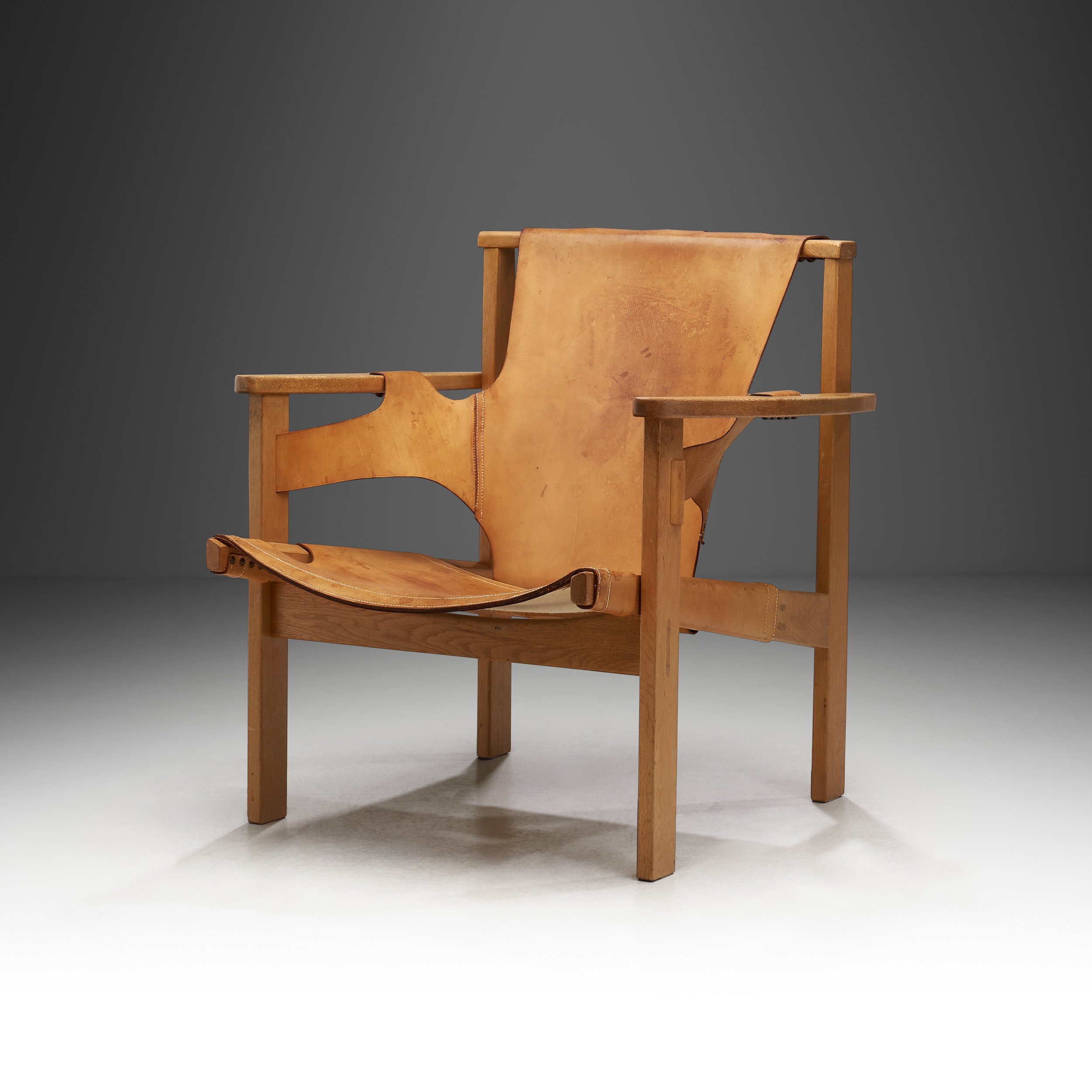
Carl-Axel Acking was a Swedish architect, author and furniture designer, winner of the Lunning Prize in 1952. This “Trienna” model was designed in 1957 and was presented at the Milano Triennial that year, as part of the Swedish exhibit. The chair was made by NK (Nordiska Kompaniet), and was originally named "Acking", but this was later changed to “Trienna” because of where it was first exhibited.
This chair is crafted from leather and oak. The leather features a unique patina, giving the chair even more depth and character to its already wonderful, sculptural nature. It is one of Carl-Axel Acking’s best known and most sought after designs. Although the chair bears some resemblance to Børge Mogensen's iconic "Spanish Chair", Acking's design predates Mogensen's by two years. This chair blends three main elements: Swedish craftsmanship, the clean lines of modernism and the clear-eyed practicality of functionalism. The design blends these elements with the use of exquisite materials to create a chair that is both visually historical and modern. Thanks to the material’s qualities, the seat is very ergonomic, adapting to the sitter’s shape. The seat is raised and the back reclined for comfort, making this chair perfect for lounging as well. The exposed screws and stitches provide an almost rustic look that recalls this style’s historic origin. The slim legs support the armrests and the backrest, which allows the design to look sleek and airy even with a solid wood construction. This is a truly special piece that is sure to impress anyone with an appreciation for mid-century modern design. Whether used as a statement piece in a living room, or as a comfortable and functional addition to a home office, the "Trienna" armchair is a true representation of the best of Scandinavian design and craftsmanship.
The Swedish architect and furniture designer, Carl-Axel Acking, made a name for himself thanks to his innovative modern furniture designs for Nordiska Kompaniet in the 1950s. The company was founded in Stockholm in 1902, and was built on international models and had, among other things, Sweden's first escalator. By the end of the 1950s, most public environments - such as restaurants, banks, hotels, embassies, steamships, etc. - had been decorated by NK.
Condition:
In good vintage condition. Wear consistent with age and use. Minor marks and scratches on wood. Wood has some water marks. The leather has a beautiful patina.
Dimensions:
27.56 in W x 29.92 in D x 29.92 in H; Seat height 15.35 in; Seat depth 18.70 in; Arm height 22.64 in
70 cm W x 76 cm D x 76 cm H; Seat height 39 cm; Seat depth 47.5 cm; Arm height 57.5 cm
REQUEST PRICE HERE
Price category: 7,500 - 10,000 usd / eur
This stunning armchair, designed by the renowned French duo Guillerme et Chambron, showcases an exquisite blend of elegant aesthetics and rustic design elements. Crafted in the mid-20th century by Votre Maison, the model reminds us how form and elegance blend together in the duo's exceptional distinctive craftsmanship style.
The solid oak wood frame provides a sturdy yet elegant structure, showcasing the beautiful material. The sculptural form allows for a dynamic visual movement between the different accents of this model. The back is composed of seven oak spindles, standing detached from the arms. The armrests are carved with great precision to serve a double purpose: an aesthetic role, and a functional one thanks to the cushioning. The frame is striking through its composition, yet the look is enhanced even further thanks to the upholstered cushions, which immediately draw the eye with their playful geometry. Like most of their designs, this chair model displays a beautiful contrast between the wooden frame and the elegant light fabric. The material is not only visually appealing but also selected for its comfort and durability, ensuring that the chair is as practical as it is beautiful. This model also shows how Guillerme et Chambron pieces possess an unusual flare.
Guillerme et Chambron’s work not only represents the fusion of function and form, but also exemplifies the mid-century modern and brutalist aesthetic - which they played a pivotal role in shaping. Their emphasis on quality craftsmanship and the use of noble materials like oak has undeniably left a lasting imprint in the world of furniture making, solidifying their legacy in the French design landscape during the mid-century era.
Condition:
In good vintage condition. Wear consistent with age and use. The item has been reconditioned. Due to the nature of the materials, the item may have some marks, scratches, and discolouration. The chair has recently been reupholstered in a premium fabric. Each of our items can be reupholstered by our in-house atelier in a fabric of choice. Please reach out for more information.
Dimensions:
29.92 in W x 35.03 in D x 37.79 in H; Seat height 15.35 in; Seat depth 20.86 in; Arm height 22.24 in
76 cm W x 89 cm D x 96 cm H; Seat height 39 cm; Seat depth 53 cm; Arm height 56.5 cm