
Upholstered Barrel Occasional Chairs with Wood Bases, Europe ca 1950s (sold)




Upholstered Barrel Occasional Chairs with Wood Bases, Europe ca 1950s (sold)
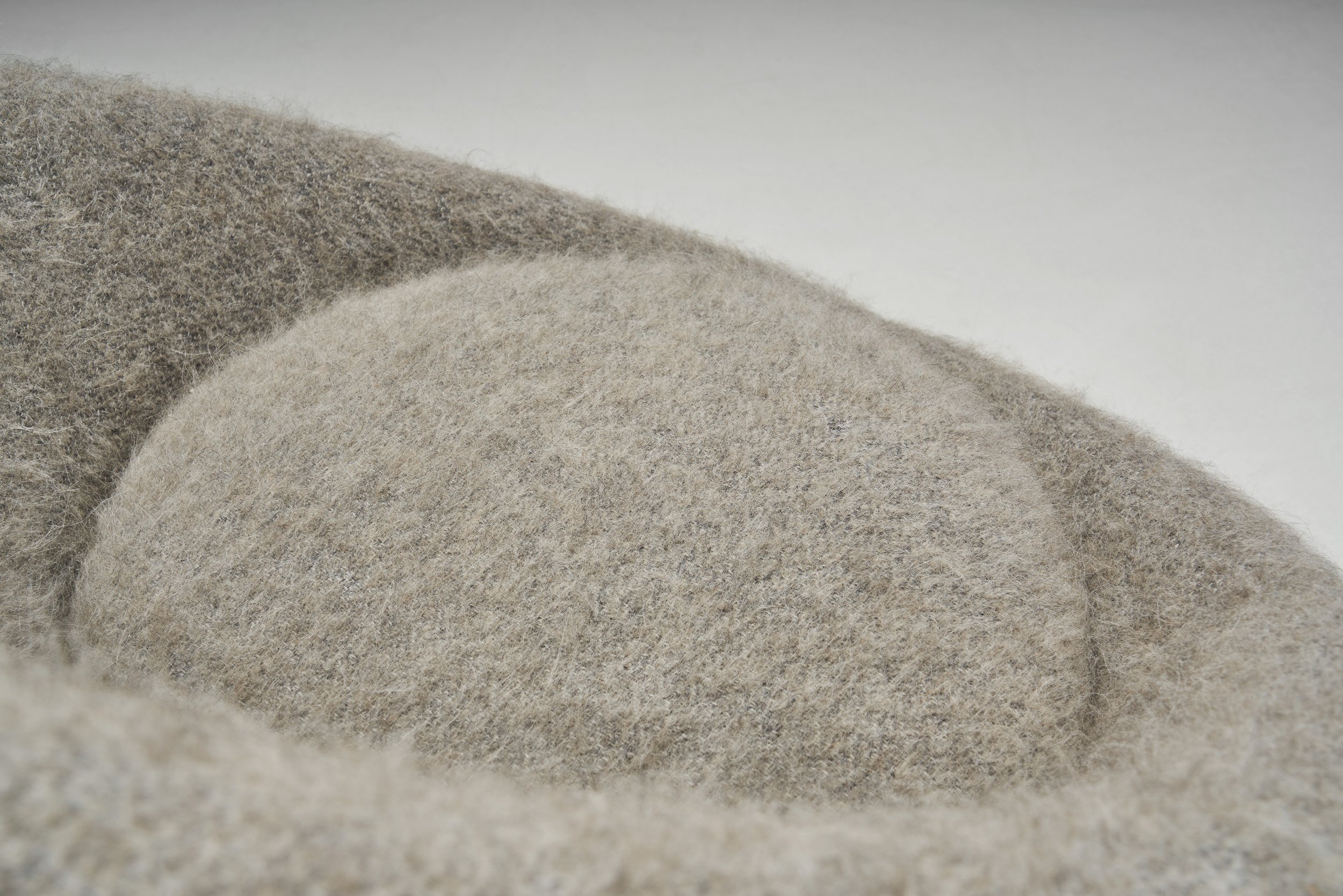
Cosy shapes and elegant hues come together to make this pair of occasional chairs a stylish accent piece that cannot go overlooked. Boasting strong curved lines and luxurious upholstery, the chairs’ tactile details add a soft textural element that is essential to a true mid-century European design.
This delightfully eccentric pair is quite simplistic in its design, featuring a combination of a round bodies and slender wooden bases. Like most barrel chairs, this pair has an armless design that brings a contemporary look to a space. Named for the rounded sides and back that resemble a barrel, barrel chairs offer a cosy look and feel and are often overstuffed for comfort. The rotund bodies embrace the sitter comfortably with ample support for the human body. These chairs make the rounds with bodies covered entirely in a textural wool blend fabric. The tight tailoring creates a clean look that allows both the upholstery and the bases to stand out. Mounted on equally striking patinated wood bases with slim lines, the pairing of materials recalls the Nordic aesthetic. The light, soft premium upholstery enhances this impression, and the beautiful colour and patina of the wood bases, while also giving the chairs an elegant appearance.
Barrel chairs are generally considered among the best accent chair types as their unique shapes immediately draw the eye. Simply styled and elegant had always been European mid-century designers’ speciality, and there is no better example than this pair of unique barrel chairs.
SOLD
Condition:
In good vintage condition. Wear consistent with age and use. The pair has been reupholstered recently in a premium wool blend fabric.
Dimensions:
27.95 in W x 25.78 in D x 27.75 in H; Seat height 17.71 in
71 cm W x 65.5 cm D x 70.5 cm H; Seat height 45 cm
REQUEST PRICE HERE
Price category: 12,500 - 15,000 usd / eur
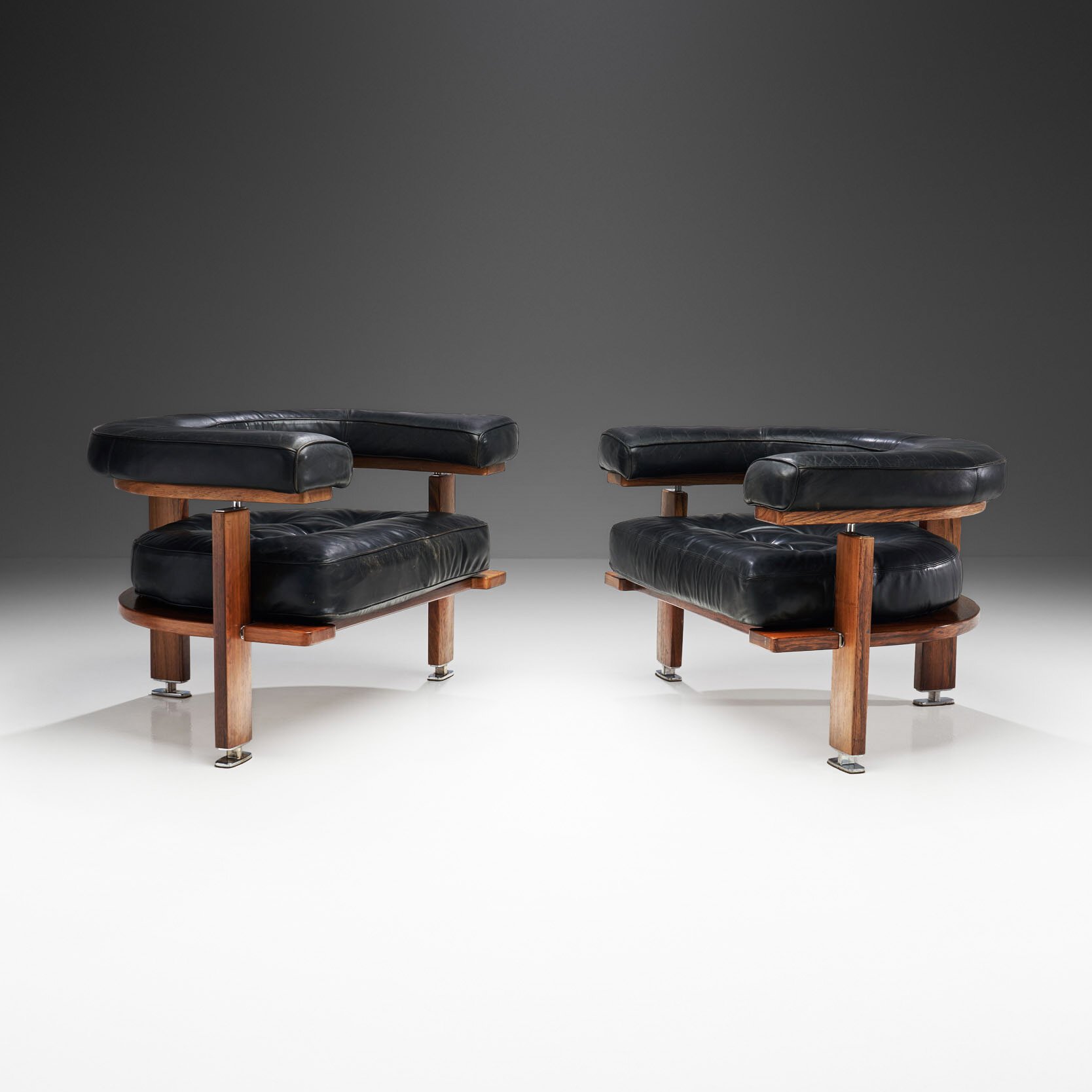
This pair of “Polar” lounge chairs was designed by the eminent Finnish designer, Esko Pajamies, and produced by Lahden Lepokalusto Oy Finland during the 1960s.
These leather chairs feature a half moon shaped backrest and comfortable, aesthetically pleasing cushions. The sitting cushions are tufted, and along with the upholstered armrests, have a beautiful patina. The strong and sturdy wooden frame provides a beautiful contrast to the black leather, and with the chrome plated steel connections supporting the curved armrests, it gives these chairs a modern look.
The legs have similar chrome plated steel details, which provide the chairs with an almost floating appearance. The open wooden frame further contributes to the spacious feel of the design. The chairs have their original black leather upholstery.
Condition:
In good vintage condition. Wear consistent with age and use. Piping has some minor repairs. Leather has some minor marks. Note: Although from the same source, the items differ a little bit in height. These chairs come with their original leather or have been reupholstered by a previous owner. Each of our items can be re-upholstered by our in-house atelier in a fabric of choice. Please reach out for more information.
Dimensions:
29.53 in W x 40.56 in D x 25.99 in H; seat height 16.34 in
75 cm W x 103 cm D x 66 cm H; seat height 41.5 cm
Literature:
Arkkitehti-lehti magazine, 1965.
About the designer:
Esko Lauri Alvari Pajamies (born August 20, 1931 Helsinki - September 26, 1990, Eloúnta, Greece) was a Finnish designer, especially known for his upholstered livingroom and public furniture.
Pajamies graduated as an interior architect in 1954, and established his own design studio in 1961. In the 1960s, Pajamies designed the “Bonanza” couch, which combined leather and solid oak, starting the line of his characteristic mixture of materials. The “Koivutaru” armchair made of bent birch at the end of the 1970s. Pajamies’ workshop also designed furniture for the Helsinki-Vantaa Airport's passenger terminal.
The Finnish designer and architect was awarded the State Art Prize in 1979. Besides being active as a designer, Pajamies was an avid Jazz Trumpeter. ~H.

REQUEST PRICE HERE
Price category: 15,000 - 20,000 usd / eur
This pair of oaken “Grand Repos” lounge chairs deserves its title of iconic, both in terms of quality and design. This model visually represents the very reason Votre Maison, the French duo, Guillerme et Chambron’s company significantly influenced French design history.
Guillerme and Chambron are known for their high-quality, solid oak furniture and the “Grand Repos” model is without a doubt their most distinctive seating design thanks to its spindle backrest and distinctive frame with plenty of curvature. With a solid wooden frame, the support for the back of each chair consists of six, symmetrically arranged wooden spindles extending upwards. The backrests are slightly tilted for comfort, aided by the generous seats and back cushions. The back cushions are adorned with tufted buttons that add depth to the textured bouclé upholstery. The standout feature of this model are the creative overarching spindles that create an almost throne-like, grandiose effect. The curvature of the arms follows the lines of the backs, and gently curve outwards. “Grand Repos” stands for “great rest” in French, and with a well-though out, elegant design, this pair is sure to provide exactly that. The elegant light colour of the upholstery of the seat and back cushions beautifully compliments the light oak frames. The back cushions are secured with loops that attach to the back spindles, ensuring that the cushions stay in position.
The woodworking truly shows the overall quality of this pair, the frames are refined and the attention to the smallest detail shows the design and manufacturing skills of Robert Guillerme and Jacques Chambron. Since each chair was created by hand, they differ marginally in size and shape visible in the backs and legs, making them even more unique.
Condition:
In good vintage condition. Wear consistent with age and use. The chairs’ cushions have been reupholstered recently in a premium bouclé fabric. Each of our items can be re-upholstered by our in-house atelier in a fabric of choice. Please reach out for more information.
Dimensions:
Chair 1
31.69 in W x 35.43 in D x 42.32 in H; Seat height 15.15 in; Arm height 21.65 in
80.5 cm W x 90 cm D x 107.5 cm H; Seat height 38.5 cm; Arm height 55 cm
Chair 2
31.1 in W x 38.58 in D x 41.14 in H; Seat height 15.35 in; Arm height 21.85 in
79 cm W x 98 cm D x 104.5 cm H; Seat height 39 cm; Arm height 55.5 cm
About the Designer:
Robert Guillerme graduated in 1934 from the École Boulle where he excelled in architecture and furniture design. After the Second World War he moved to Lille, in the north of France, where he decorated homes and designed furniture for the well regarded Rogier workshops.
In 1948, Guillerme was joined by his long-time friend, decorator Jacques Chambron in Lille. The following year Guillerme and Chambron met master cabinetmaker Émile Dariosecq, owner of a woodworking shop and the company Votre Maison was born. Together, they defined and imposed a new furniture concept. Thanks to their distinctive creativity, originality, and quality, the Votre Maison quickly became well-known.
The Votre Maison marked the history of French design. Guillerme drew the furniture designs while Chambron played the part of salesman, welcoming and advising clients. The power duo was complemented by Dariosecq, whose workshop took charge of the manufacturing. Together, they defined new furnishings concepts. Well-crafted chair back, polished wood and thick cushions make the reputation of their armchairs and sofas. Votre Maison continued to produce furniture right into the 20th century, with Jacques’s son Hervé Chambron, a designer and graduate of the École Boulle, having taken the over in 1983. ~H.

REQUEST PRICE HERE
Price category: 2,500 - 5,000 usd / eur
Bridge Chairs - Fauteuil Bridge - from France are generally lightweight, often part of a set of matching chairs and bridge table. Bridge chairs were originally designed in the late 1930s for ladies for leisure activities, such as for games of bridge, afternoon tea, and gossiping. As this pair of bridge chairs exhibits, the models are stylish, of small proportions, well-made, and extremely comfortable.
This solid oak “Fumay” pair is indeed, part of a dining group designed in 1965 by the world-famous French duo, Robert Guillerme and Jacques Chambron. As the version with arms, this pair’s frames are quite distinctive; the decorative elements on the backrests and armrests show and interesting curvature that is characteristic of the designer duo. These sculptural elements paired with the tapered legs are carved out of the blonde oak in an artistic way, testifying of the quality that the duo’s company, Votre Maison became famous for. The structures have unexpected details, such as the seats, with sides that are covered by the cushions, making them look invisible. Another such detail are the stretchers arranged between the legs at different heights in the fronts and sides. The genius of the design lies in these details that no matter how different, still complement each other. The sleek look is completed by the upholstered cushions in light bouclé fabric, that pairs beautifully with the colour of the blonde oak.
The French designers’ models are considered as a reference among the furniture of the 1950s through the 70s. This pair of dining chairs from the 60s gives a visual explanation why: the proportions, the subtle decorative elements, and the quality of woodworking is of the highest-quality, and the result is an immediately recognizable look that will never go out of style.
Condition:
In good vintage condition. Wear consistent with age and use. The chairs’ cushions have been reupholstered recently in a light bouclé fabric.
Dimensions:
21.85 in W x 19.68 in D x 32.08 in H; Seat height 18.5 in; Arm height 26.37 in
55.5 cm W x 50 cm D x 81.5 cm H; Seat height 47 cm; Arm height 67 cm
About the designer:
Robert Guillerme graduated in 1934 from the École Boule where he excelled in architecture and furniture design. After the Second World War he moved to Lille, in the north of France, where he decorated homes and designed furniture for the well regarded Rogier workshops.
In 1948, Guillerme was joined by his long-time friend, decorator Jacques Chambron in Lille. The following year Guillerme and Chambron met master cabinetmaker Émile Dariosecq, owner of a woodworking shop and the company Votre Maison was born. Together, they defined and imposed a new furniture concept. Thanks to their distinctive creativity, originality, and quality, the Votre Maison quickly became well-known.
The Votre Maison marked the history of French design. Guillerme drew the furniture designs while Chambron played the part of salesman, welcoming and advising clients. The power duo was complemented by Dariosecq, whose workshop took charge of the manufacturing. Together, they defined new furnishings concepts. Well-crafted chair back, polished wood and thick cushions make the reputation of their armchairs and sofas. Votre Maison continued to produce furniture right into the Twentieth Century, with Jacques’ son Hervé Chambron, a designer and graduate of the Ecole Boulle, having taken the reins in 1983. ~H.

REQUEST PRICE HERE
Price category: 9,000 - 12,500 usd / eur
This pair of armchairs is what we consider a timeless Danish Modern classic. The “ND83” was designed in 1952 by Nanna and Jørgen Ditzel for the exhibition 'Today’s Furniture, Home Equipment' in the Forum Hall Copenhagen in 1952.
Chairs are often considered especially revealing of a designer's skill because of the strict limits placed on their design by the demands of the human body. With this model, the Ditzels arrive at a clearly-structured solution in which a high degree of coherence is maintained while the chair appears visually light and open. The structure of the chairs is made entirely of solid oak. Each sculpted leg is made of a single piece of timber that ascend gently, giving stability to the curved backs. Rounded oak dowels plug the holes in which the fastenings for the back can be found -these help to create the elegant simplicity and honesty of the frame. The large curved backs extend up to the front, forming the armrests for a cosy and elegant profile similar to that of a tub chair. The elegance is further enhanced by the premium bouclé upholstery which complements the oak gracefully.
Cabinetmaker Søren Willadsen handcrafted these chairs, while them company Selig Co., imported them to the U.S. market from Denmark in 1952. The “ND83” model is still made to order today, however chairs – like these - from the original production show Ditzel and Willadsen’s true genius. The original marking on the wood is retained.
Condition:
In good vintage condition. Wear consistent with age and use. The chairs have been recently reupholstered in a premium bouclé fabric. Each of our items can be reupholstered by our in-house atelier in a fabric of choice. Please reach out for more information.
Dimensions:
30.9 in W x 25.98 in D x 26.96 in H; Seat height 14.76 cm
78.5 cm W x 66 cm D x 68.5 cm H; Seat height 37.5 cm
Literature:
Hanne Horsfeld Danske Designere, 'Nanna Ditzel', p.86
Oda Noritsugu, Danish Chairs, p.164
Per H. Hansen, Klaus Petersen, Den Store Danske Møbelguide, p.77
REQUEST PRICE HERE
Price category: 12,500 - 15,000 usd / eur
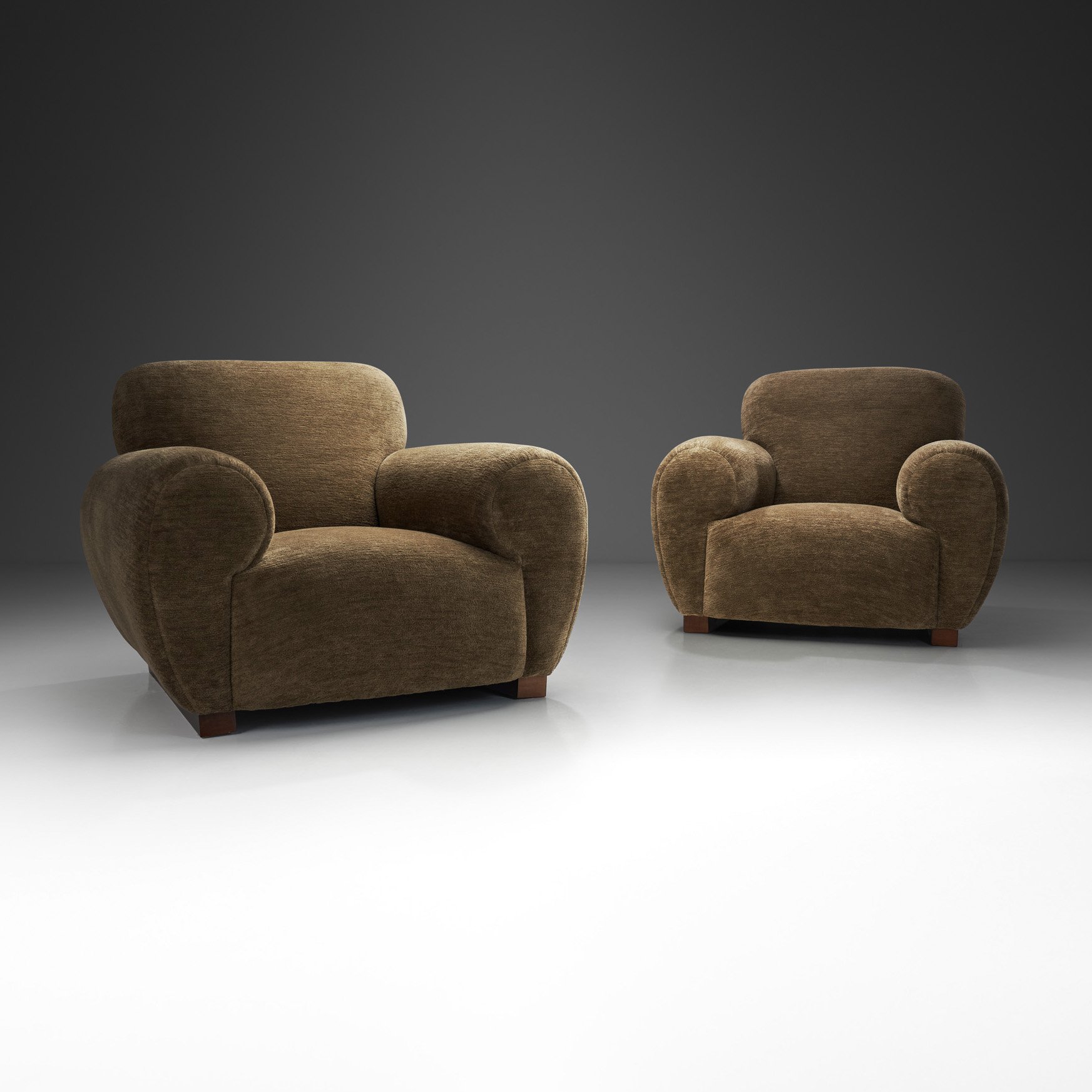
Belgium is often overlooked when thinking about Art Deco design, even though some of the most defining pieces of the era were created in the country. De Coene Frères dates back to the late 1800s, and has collaborated with many of Belgium’s renowned designers. These club chairs are exemplary of the quality and aesthetic knowledge that the company possessed.
These club chairs feature rounded, voluminous armrests and padded, upholstered bodies creating a bold and inviting silhouette. The design is curvilinear, with flowing outlines that soften the structure, giving the armchairs an approachable and relaxed feel. The upholstery, a textured brown fabric, contributes to the pair’s overall plush aesthetic, offering the sitter a tactile experience. Club chairs were created for cosiness and relaxation, and typically featured full-body upholstery and sturdy frames that allowed club members to enjoy sitting for extended periods of time. For this reason, the designer of this pair ensured a perfect level of firmness. The design is completed by a pair of wooden runners at the base, offering stability without overpowering the armchairs. This pair is reflective of a time when design was as much about craftsmanship as it was about luxury living.
These armchairs not only embody the Art Deco movement’s focus on luxurious materials and sophisticated forms but also serve as a symbol of the period's merging of utility with elegance. As an exceptional example of 20th Century design, these chairs continue to offer a perfect blend of style, form, and function, making them a distinguished addition to any modern or classic interior.
Condition:
In good vintage condition. Wear consistent with age and use. The chairs have been reupholstered recently in a premium fabric. Each of our items can be reupholstered by our in-house atelier in a fabric of choice. Please reach out for more information.
Dimensions:
44.09 in W x 42.12 in D x 33.07 in H; Seat height 16.92 in; Seat depth 25.59 in; Arm height 24.40 in
112 cm W x 107 cm D x 84 cm H; Seat height 43 cm; Seat depth 65 cm; Arm height 62 cm

REQUEST PRICE HERE
Price category: 12,500 - 15,000 usd / eur
This rare pair of “Pele” lounge chairs by Finnish designer Esko Pajamies is, without a doubt, his most stunning chair design. It is seldom we see a chair model and immediately recognise it, but Pajamies managed to design such a piece. His unconventional design was strongly characterised by durability and functionality as well as insightful technical solutions.
In Finland, the 1970s saw the use of new materials like plastic, synthetics, and fibreglass being combined with advances in manufacturing technologies, allowing designers to expand their range of colours and forms in mass production. However, this lounge chair model still gives preference to natural materials, primarily to its solid oak structure. The wooden frame provides a firm base with rounded edges. Undeniably, the most eye-catching and distinctive element of this design is the way in which the seat and the back legs of the armchairs are formed by one elongated piece of wood. The ergonomic design with the bent backrest, wide armrests, and upholstered cushions make this pair of lounge chairs exceptionally comfortable. It therefore comes as no surprise, that this model first gained popularity as a TV chair for homes. Later it became a popular choice for fireplace rooms as well as public spaces, similarly to several other designs of Pajamies.
This model was manufactured by the Finnish furniture company, Lahden Lepokalusto Oy in the 1970s. The Lahti-based company has been furnishing public spaces for almost 70 years, and gained worldwide recognition through the iconic furniture designs of Professor Yrjö Kukkapuro and later, Esko Pajamies.
Condition:
In good vintage condition. Wear consistent with age and use. The cushions have recently been reupholstered in a premium fabric. Each of our items can be reupholstered by our in-house atelier in a fabric of choice. Please reach out for more information.
Dimensions:
92 cm W x 94 cm D x 88 cm H
REQUEST PRICE HERE
Price category: 12,500 - 15,000 usd / eur
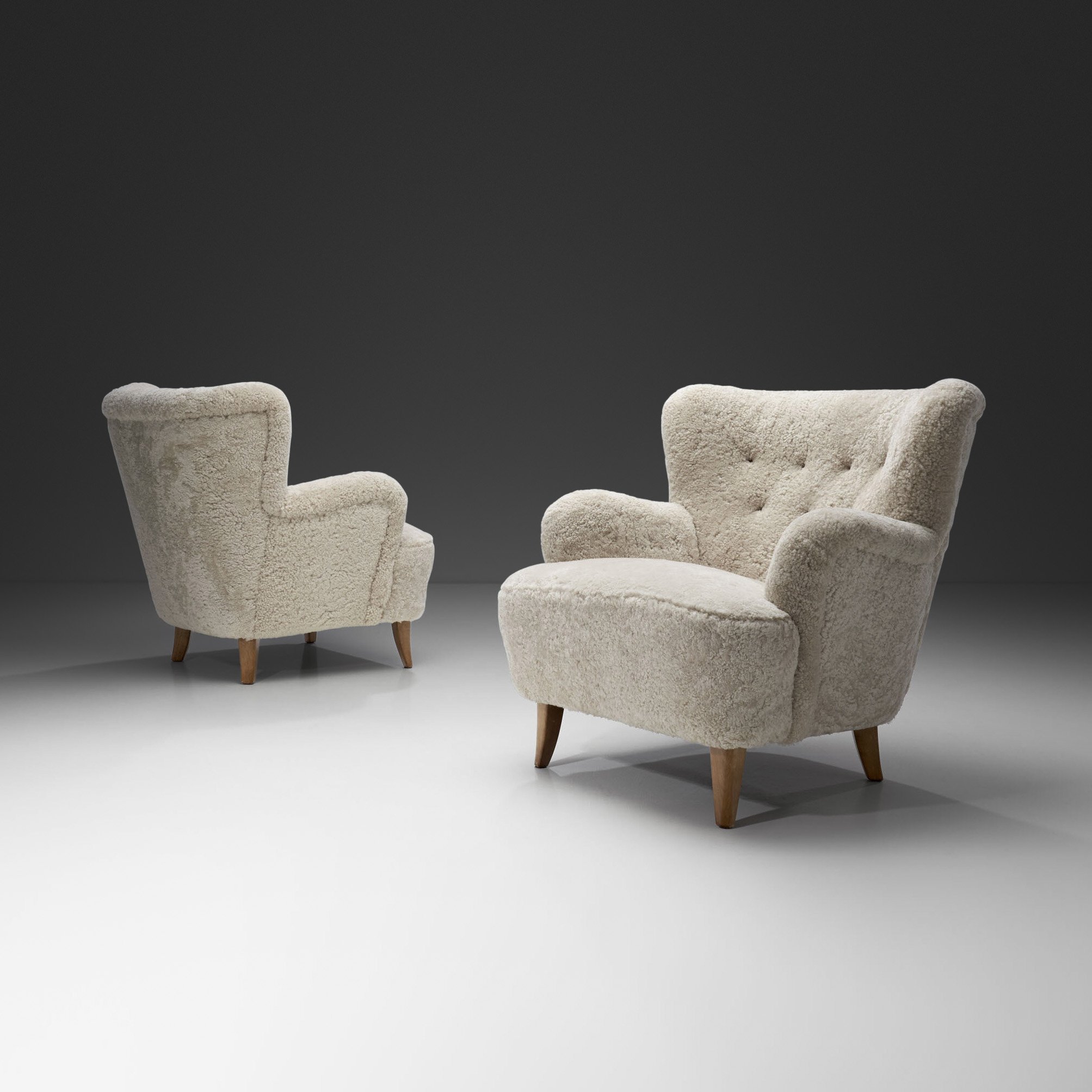
The “Laila” model by the Finnish designer, Ilmari Lappalainen, originates from 1948, with the earliest original drawings kept in the Lahti City Museum in their Lappalainen Collection.
This pair of “nr. 238” armchairs are from the Finnish designer’s most famous series called “Laila”. The design became sought after by collectors even in its production time, which is quite rare in the case of Nordic mid-century modern furniture. Lappalainen was a renowned designer, famous for his designs’ comfort. Some of his designs even received medical approval because they had such a good seating, that it prevented back problems. These armchairs have a cosy modern style, modelled on the Swedish and Danish furniture of the time, including the round edges and generous seat cushions and back with five tufted buttons. The bodies have the classic Nordic look, which explains the contemporary popularity of these armchairs both among the public and museums. The modern aesthetic is further elevated by the soft sheepskin upholstery that complements the shape and the wooden, tapered legs as well.
Wood is omnipresent in the Nordics, and Finnish woodworking is world-famous for its traditions. These chairs were created for Asko, the Finnish furniture manufacturing company founded in 1918 by Aukusti Asko Avonius, known for the production of high-quality furniture. By 1930, the company had developed into the largest furniture chain in Finland and the largest supplier of furniture in the Scandinavian countries. Favourites of this time included Ilmari Lappalainen’s present Laila armchairs.
Condition:
In good vintage condition. Wear consistent with age and use. The chairs have been reupholstered recently in premium sheepskin. Each of our items can be reupholstered by our in-house atelier in a fabric of choice. Please reach out for more information.
Dimensions:
32.87 in W x 32.87 in D x 32.48 in H; Seat height 17.51 in
83.5 cm W x 83.5 cm D x 82.5 cm H; Seat height 44.5 cm
Literature:
Riitta Miestamo "The Form and Substance of Finnish Furniture", Askon Säätiö, Esan Kirjapaino oy, Lahti 1981.p 65.
About the Designer:
Ilmari Lappalainen (1918 - 2006) was a great Finnish designer whose most active working years were from the end of the 1940s until the end of the 1970s.
Lappalainen first graduated as a teacher of woodworking in 1939, followed by a degree in interior design in 1947. By the end of the school of interior design, he was already working as an intern in Asko and after graduating he got a permanent design position at the company. Lappalainen worked as a teacher and as an interior designer for Asko's department stores, public spaces and hotels.
Lappalainen's most popular products / series are the Laila sofa set, the Seija rocking chair, the lazy castle Rex and the Pulkka armchair. Interestingly, the chairs from the Columna series were sold as health chairs for a long time, because they had such a good ergonomic design, that it prevented back problems. The chairs eventually received medical approval as well. ~H.
REQUEST PRICE HERE
Price category: 9,000 - 12,500 usd / eur
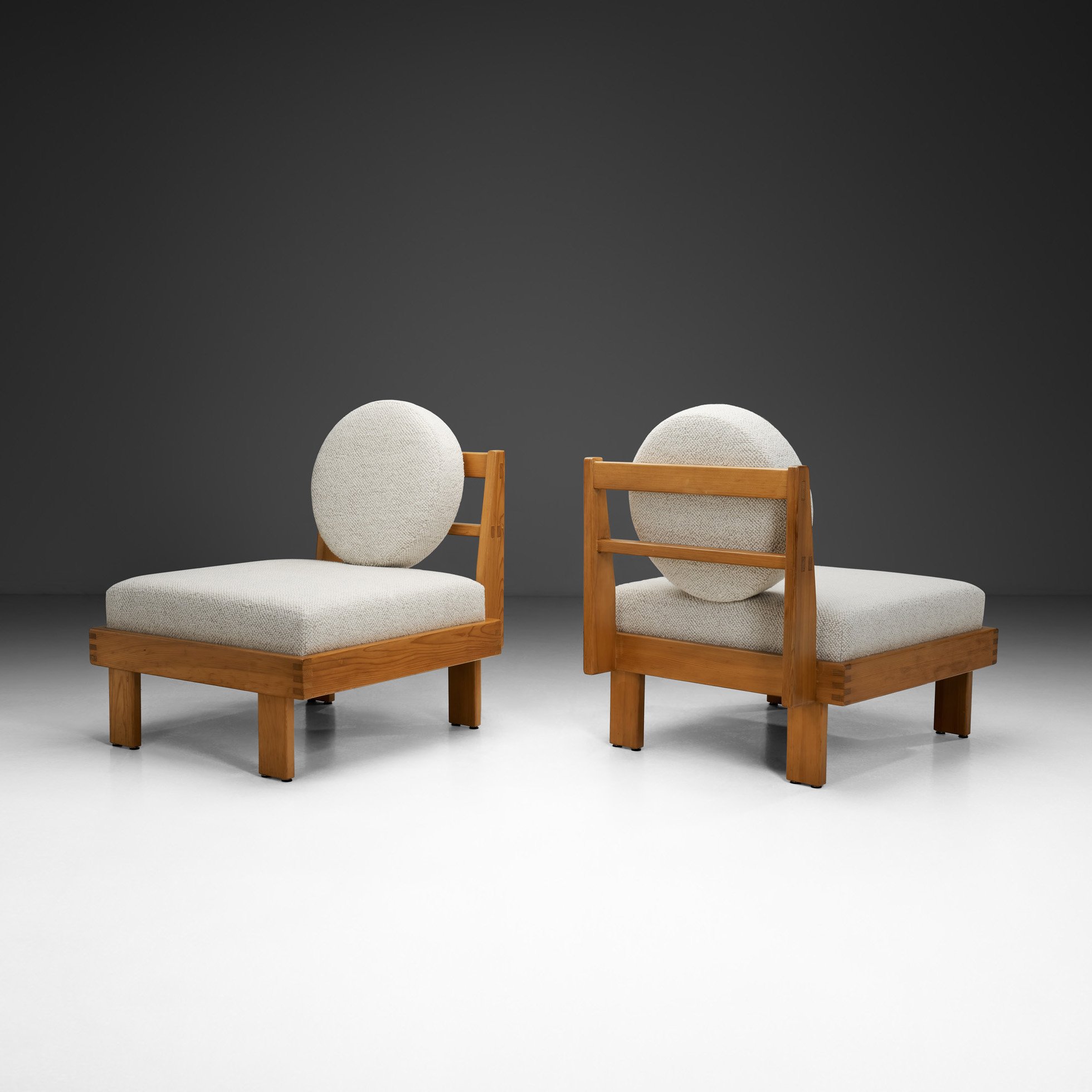
During the mid-20th century, European designers turned their attention to rethinking domestic comfort, and explored how new ideas of form and proportion could transform the experience of sitting and living. Moving away from traditional ornament and into a culture of experimentation, they began focusing on honest materials, balanced lines, and structure. This was a period when modernism evolved into a human-centered vision of modern living.
This pair of lounge chairs captures that spirit with its thoughtful interplay of geometry and tactility. The frames, crafted in solid wood with box joinery, celebrate craftsmanship while maintaining a striking simplicity. The low, grounded stance gives the pieces a quiet strength, while the broad seats invite relaxed, informal lounging. To complement the solid frame, the backrests feature a circular cushion, an unexpected sculptural element that softens the chairs’ rectilinear frames and adds visual interest without unnecessary embellishment. Upholstered in richly textured bouclé, the chairs pair a tactile, inviting surface with the clean lines of their timber base, achieving a compelling balance between warmth and restraint. The traditional joinery details are left visible, underscoring the mid-century belief in structural honesty and the inherent beauty of well-made construction.
As a pair, the chairs are both understated and iconic, a reminder that modern design is not about excess, but about clarity and intention. More than just a functional pair, they reflect a postwar European ethos that embraced innovation while remaining deeply connected to craft and the human experience of comfort.
Condition:
In good vintage condition. Wear consistent with age and use. Minor scratches and dents in the wooden frames. The chairs have been recently reupholstered in a premium fabric. Each of our items can be reupholstered by our in-house atelier in a fabric of choice. Please reach out for more information.
Dimensions:
27.36 in W x 31.10 in D x 31.50 in H (including cushion); Seat height 16.93 in; Seat depth 20.47 in
69.5 cm W x 79 cm D x 80 cm H (including cushion); Seat height 43 cm; Seat depth 52 cm

REQUEST PRICE HERE
Price category: 12,500 - 15,000 usd / eur
The “Laila” model by the Finnish designer Ilmari Lappalainen originates from 1948, with the earliest original drawings kept in the Lahti City Museum in their Lappalainen Collection.
This pair of “nr. 238” armchairs are from the Finnish designer’s most famous series called “Laila”. The design became sought after by collectors even in its production time, which is quite rare in the case of Nordic mid-century modern furniture. Lappalainen was a renowned designer, famous for his designs’ comfort. Some of his designs even received medical approval because they had such a good seating that it prevented back problems. These armchairs have a cosy modern style, modelled on the Swedish and Danish furniture of the time, including the round edges and generous seat cushion and back with tufted buttons. The bodies have the classic Nordic look, which explains the contemporary popularity of these armchairs both among the public and museums. The modern aesthetic is further elevated by the textured, premium upholstery that complements the shape and the wooden, tapered legs as well. Sheepskin is the ultimate material for comfort, warm in the winter and cool in the summer. It elevates the sheer size and shape of the chair, especially its back.
Wood is omnipresent in the Nordics, and Finnish woodworking is world-famous for its traditions. These chairs were created for Asko, the Finnish furniture manufacturing company founded in 1918 by Aukusti Asko Avonius, known for the production of high-quality furniture. By 1930 the company had developed into the largest furniture chain in Finland and the largest supplier of furniture in the Scandinavian countries. After the war, the damage it caused and the new homes of Karelian migrants concentrated production on essential furniture, which the Finnish Ministry of Public Affairs ordered to sell at an affordable price. Favourites of this time included Ilmari Lappalainen’s Laila series.
Condition:
In good condition. Wear consistent with age and use. The chairs have been reupholstered recently in a premium sheepskin.
Dimensions:
32.67 in W x 34.64 in D x 34.44 in H; Seat height 17.71 in
83 cm W x 88 cm D x 87.5 cm H; Seat height 45 cm
Literature:
Riitta Miestamo "The Form and Substance of Finnish Furniture", Askon Säätiö, Esan Kirjapaino oy, Lahti 1981.p 65.
About the Designer:
Ilmari Lappalainen (1918 - 2006) was a great Finnish designer whose most active working years were from the end of the 1940s until the end of the 1970s.
Lappalainen first graduated as a teacher of woodworking in 1939, followed by a degree in interior design in 1947. By the end of the school of interior design, he was already working as an intern in Asko and after graduating he got a permanent design position at the company. Lappalainen worked as a teacher and as an interior designer for Asko's department stores, public spaces and hotels.
Lappalainen's most popular products / series are the Laila sofa set, the Seija rocking chair, the lazy castle Rex and the Pulkka armchair. Interestingly, the chairs from the Columna series were sold as health chairs for a long time, because they had such a good ergonomic design, that it prevented back problems. The chairs eventually received medical approval as well. ~H.

REQUEST PRICE HERE
Price category: 9,000 - 12,500 usd / eur
Italian Modern furniture is defined by unique design, perfect execution, and exclusivity. Modernist Italian designers’ language was always coherent with current times and congenial to the wisdom of furniture manufacturing, representing an outpost of strong innovation in the panorama of Italian craftsmanship.
This pair is focused on elegant and measured proportions, balanced compositions, and refined décor elements including the exclusive materials. The versatile shapes, from the rounded edges on the top to the square, unattached armrests and tapered legs make these chairs stand out. The V-shaped high backs are visually defining thanks to their sheer size and unusual shape. The enveloping backs become narrower towards the seat, like elegant, slim necks, with the sides flowing into the armrests, creating a structured, but still flowing angle and impression. The beautiful, richly textured bouclé fabric brings out the versatility of the shapes even further, and contrasts the solid wood legs as well. The backs are decorated with seven, yellow cross stitches arranged symmetrically, which further adds to the modern edge.
The 1960s’ Italy was especially passionate about furniture and product design, an area where the country remained faithful to a figurative repertoire of substantial classicism, while not disdaining impulses of authentic modernity. Similar designs are commonly attributed to Paolo Buffa, who - like many of his contemporaries - was extremely active in the Milanese design scene that was just as vibrant as these chairs. In an atmosphere committed to the reinterpretation of the Lombard classicism and Milanese architecture, exceptional pieces were created as this pair shows.
Condition:
In good vintage condition. Wear consistent with age and use. The chairs have been reupholstered recently in a premium bouclé fabric. Each of our items can be re-upholstered by our in-house atelier in a fabric of choice. Please reach out for more information.
Dimensions:
24.8 in W x 24.4 in D x 40.55 in H; Seat height 14.17 in; Arm height 23.22 in
63 cm W x 62 cm D x 103 cm H; Seat height 36 cm; Arm height 59 cm

REQUEST PRICE HERE
Price category: 12,500 - 15,000 usd / eur
This pair of rare oak easy chairs showcases the homely curviness that defined the design of the 1950s in the Nordic countries. Hiort af Ornäs developed the model for his own furniture company, ‘Hiort Tuote Valmistaja Puunveisto Helsinki’, or ‘Hiort Product Manufacturer Puunveisto (woodcarver) Helsinki’.
This chair model’s body has a soft, sculptural shape paired with an ergonomic and firm construction. Hiort af Ornäs was very firm about two things regarding his chair designs: the sitting comfort and that the model must look good from every single angle. Much like the “Pedro” model, these easy chairs easily fulfil these principles, as even from the bottom, they showcase the expertly carved oak structure. The removable seat cushions, framed by the open bodies ensure the sitting comfort. The seats, back- and armrests are all formed from a single piece that has an organic, outward curving look that is highly inviting and stylish. Especially on the armrests, the curves highlight the texture of the velvet upholstery and vice versa. The fabric is most appealing on rounded, curving forms, therefore it is a perfect match for this pair of easy chairs. The legs on the other side have a more straightforward design, creating an interesting contrast with the upholstered bodies. They are gently splayed and bent to support the seats and display the oak’s beautiful, darker shade. The craftsmanship and quality that is to be expected from original Hiort af Ornäs chairs is very apparent.
The seating designs of the architect/designer have been gradually more and more recognized world-wide, which resulted in a recent exhibition titled “Forgotten Ornäs”. Form follows function is a principle of design associated with early and mid-20th century architecture and furniture design, stating that the shape of a building or object should primarily relate to its intended function or purpose. This was evidently an important principle for the designer, seen in the design of both the structure and aesthetic elements.
Condition:
In good vintage condition. Wear consistent with age and use. The chairs have been reupholstered recently in premium velvet. Each of our items can be re-upholstered by our in-house atelier in a fabric of choice. Please reach out for more information.
Dimensions:
34.05 in W x 31.49 in D x 30.31 in H; Seat height 18.11 in
86.5 cm W x 80 cm D x 77 cm H; Seat height 46 cm
About the designer:
Carl-Gustaf Vilhelm (nicknamed “Nalle”) Hiort of Ornäs was born on 27 February 1911 and lived most of his life in Tapiola/Espoo in Finland and in his later life moved to Spain. He is remembered as a Finnish interior architect and designer known to be uncompromising.
Before the Finnish wars (1939-1944), Hiort af Ornäs spent his time in Pori, working at Björneborgs Mekaniska Verkstad. He studied at the Helsinki University of Technology to become an architect but never graduated. He did, however, become known as an interior designer, and eventually even more known as a furniture designer.
In 1945, Hiort af Ornäs founded the furniture company Puunveisto Oy, for which he developed versatile techniques for shaping plywood. He started the furniture manufacturing shop on Lauttasaari in Helsinki (Veneentekijäntie 14) together with his brother. The wood shop, showroom, and office were all located in the same building in Helsinki. Rolf Mesterton was the man in charge of producing the furniture, but there were several other carpenters at work in the woodshop. Hiort af Ornäs’s furniture was exhibited and sold by the shop Nupponen who also distributed Olavi Hänninen’s designs, while Puunveisto’s furniture were also sold by Gösta Westerbergs Möbler in Stockholm, Sweden but, in spite of a good selection of chairs, tables and shelves, did not do too well. Since production costs were high, Hiort af Ornäs faced economic troubles. The company was later sold to Nupponen after which Hiort af Ornäs’s interest in the company waned.
Hiort af Ornäs spent his retirement in Spain, and designed several buildings for Fuengirola’s Los Pacos neighbourhood, which has a large Finnish population. His house that he drew and built in Tapiola, Espoo, Finland, ‘Villa Hiort’, still stands and houses some of the designer’s original drawings. It is a beautiful example of 1950s Modernism and the talent of Hiort af Ornäs that brought him recognition that lasts to this day. ~H.
REQUEST PRICE HERE
Price category: 12,500 - 15,000 usd / eur
The “Laila” model by the Finnish designer, Ilmari Lappalainen, originates from 1948, with the earliest original drawings kept in the Lahti City Museum in their Lappalainen Collection.
This pair of armchairs are from the Finnish designer’s most famous series called “Laila”. The design became sought after by collectors even in its production time, which is quite rare in the case of Nordic mid-century modern furniture. Lappalainen was a renowned designer, famous for his designs’ comfort. Some of his designs even received medical approval because they had such a good seating, that it prevented back problems. These armchairs have a cosy modern style, modelled on the Swedish and Danish furniture of the time, including the round edges and generous seat cushions and back with five tufted buttons. The bodies have the classic Nordic look, which explains the contemporary popularity of these armchairs both among the public and museums. The modern aesthetic is further elevated by the soft sheepskin upholstery that complements the shape and the wooden, tapered legs as well.
Wood is omnipresent in the Nordics, and Finnish woodworking is world-famous for its traditions. These chairs were created for Asko, the Finnish furniture manufacturing company founded in 1918 by Aukusti Asko Avonius, known for the production of high-quality furniture. By 1930, the company had developed into the largest furniture chain in Finland and the largest supplier of furniture in the Scandinavian countries. Favourites of this time included Ilmari Lappalainen’s present Laila armchairs.
Condition:
In good condition. Wear consistent with age and use. Due to the nature and age of the material, the chairs may have some marks, scratches, and discolouration. The chairs have been reupholstered recently in premium sheepskin. Each of our items can be reupholstered by our in-house atelier in a fabric of choice. Please reach out for more information.
Dimensions:
32.67 in W x 34.64 in D x 34.44 in H; Seat height 17.71 in
83 cm W x 88 cm D x 87.5 cm H; Seat height 45 cm