
Sequoia Burl Coffee Table, North America 1970s (sold)
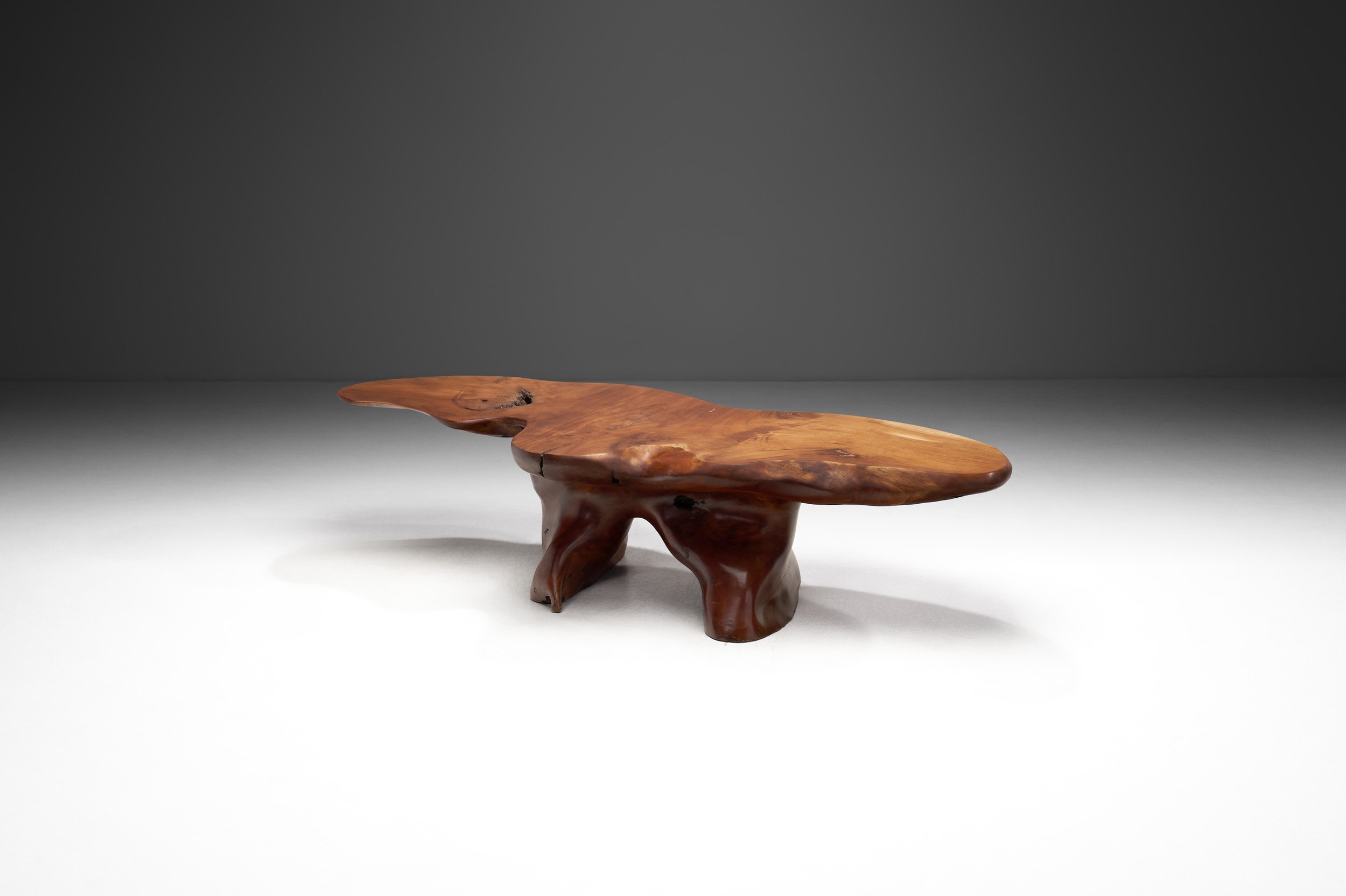


Sequoia Burl Coffee Table, North America 1970s (sold)
Burl wood furniture is one of those design moments that seems to last forever—and with good reason. Popularized in the Art Deco and Hollywood Regency eras (and again in the 1970s), burl wood is having a major resurgence in modern interior design.
The beautiful coffee table is a stunning example of nature's artistry showcasing the inherent beauty of wood in its organic state. Wood burls are external knots or growths on trees that form intricate wood grain patterns as seen on the tabletop. The random wood grains create denser, stronger wood that is sturdy and highly prized for its beauty. This model evokes intrigue and drama, and like a precious geode, the appeal of its burl wood body is apparent. On its body, especially on the top, it features swirling, knotted, kaleidoscopic and other organic wood grain shapes that catch the eye and add a unique look, making each piece one of its kind. One of the main reasons why interior designers love burl wood is because no two pieces are exactly alike. Strikingly bold, yet natural and fresh, burl wood furniture makes a statement unlike any other. Turning the material into such a polished, but organic shape evidently required artisan work that adds to the beauty. The smooth and shiny finish enhances the natural beauty of the wood, without being overly showy. The finish adds a touch of sophistication and durability to the table, ensuring it will stand the test of time. This model exudes a sense of harmony and balance, as if it was meant to be a part of the surrounding environment.
From most angles, this low coffee table could easily be mistaken for a sculpture with an elemental impression. Burl wood isn’t just rare - it is proof that imperfections can be gorgeous. The intricate wood grain patterns add rich character and an element of surprise to any room.
SOLD
Condition:
In vintage condition. Wear consistent with age and use. Some marks and cracks due to the wood’s natural qualities.
Dimensions:
64.17 in W x 27.55 in D x 14.37 in H
163 cm W x 70 cm D x 36.5 cm H


REQUEST PRICE HERE
Price category: 2,500 - 5,000 usd / eur
This coffee table is a stunning example of Modernism in design: clear forms without exaggeration with the high-quality work of a Danish cabinetmaker. Humble in its material and size, this table still draws attention thanks to its distinctive look and personality.
Early on, many of the Danish cabinetmakers’ workshops had been producing historical furniture; master cabinetmakers had been renowned for their solid wooden furniture rendered in various styles of the past. This coffee table, while not specifically historical in style, shows some restrained decorative elements that are generally rather sparse in Scandinavian mid-century furniture. However, accordingly to the design ideals of Danish designers, the scalloping pattern is not overwhelming the table, nor does it demand attention, rather, it is an understated but clever addition to the design. The scalloped patterns on the tabletop and legs differ slightly; the scallops on the legs are more pronounced with straight lines between each scallop, while under the tabletop, it is in a more traditional, round shape.
The wavy effect is even more pronounced thanks to the beautiful grain and colour of the solid oak that is most apparent on the wide, circular top. As it can be expected from Danish design and craftsmanship, visually appealing elements usually serve a functional role as well. In this case, the wooden elements under the table reinforce the stability of the structure in this ingenious manner.
Condition:
In good vintage condition. Wear consistent with age and use. Due to the nature and age of the material, the item may have some marks, scratches, and discolouration.
Dimensions:
35.03 in W x 35.03 in D x 22.04 in H
89 cm W x 89 cm D x 56 cm H
About the Designer:
The practical and comfortable designs of Danish cabinetmakers defined mid-20th century modern seating. The Danish Cabinetmakers focused on minimalist design executed by expertly skilled craftsmen.
Works from the Danish Cabinetmakers' Guild is a concept of its own in collectible design. The Cabinet-Makers' Guild began annual exhibitions in 1927 in Copenhagen. The group formed an exhibit showing each year in October the quality furniture made to drawings by gifted architects. The exhibition took place each year, without interruption, for forty years. A number of successful Danish Design collaborations were formed during this time between cabinetmakers and architects.
Danish Modernism has influenced Scandinavian furniture to a great degree, defined by minimalism, simplicity, and functionality. The muted colours and gentle designs make Danish mid-century furniture an ideal addition to contemporary living spaces. Additionally, master cabinetmakers were highly aware of body proportions, prioritizing comfort just as much as the visual qualities.
The works of master cabinetmakers – such as this chair – are of the highest quality, both in terms of materials and craftsmanship. Cabinetmakers take the art of working with wood one step further, and focus on the finer details of what can be created with the material. Therefore, it comes as no surprise that numerous master cabinetmakers are part of the renowned Danish Culture Canon (Danish: Kulturkanonen). The canon contains no more than 108 works of cultural excellence, based on works with a useful function and that are still recognisable today. These lounge chairs are the perfect illustrations of Danish design, and the work of a true cabinetmaker. ~H.