
Solid Oak Coffee Table with Sculptural Legs by Danish Cabinetmaker, Denmark ca 1950s


Solid Oak Coffee Table with Sculptural Legs by Danish Cabinetmaker, Denmark ca 1950s
REQUEST PRICE HERE
Price category: 2,500 - 5,000 usd / eur
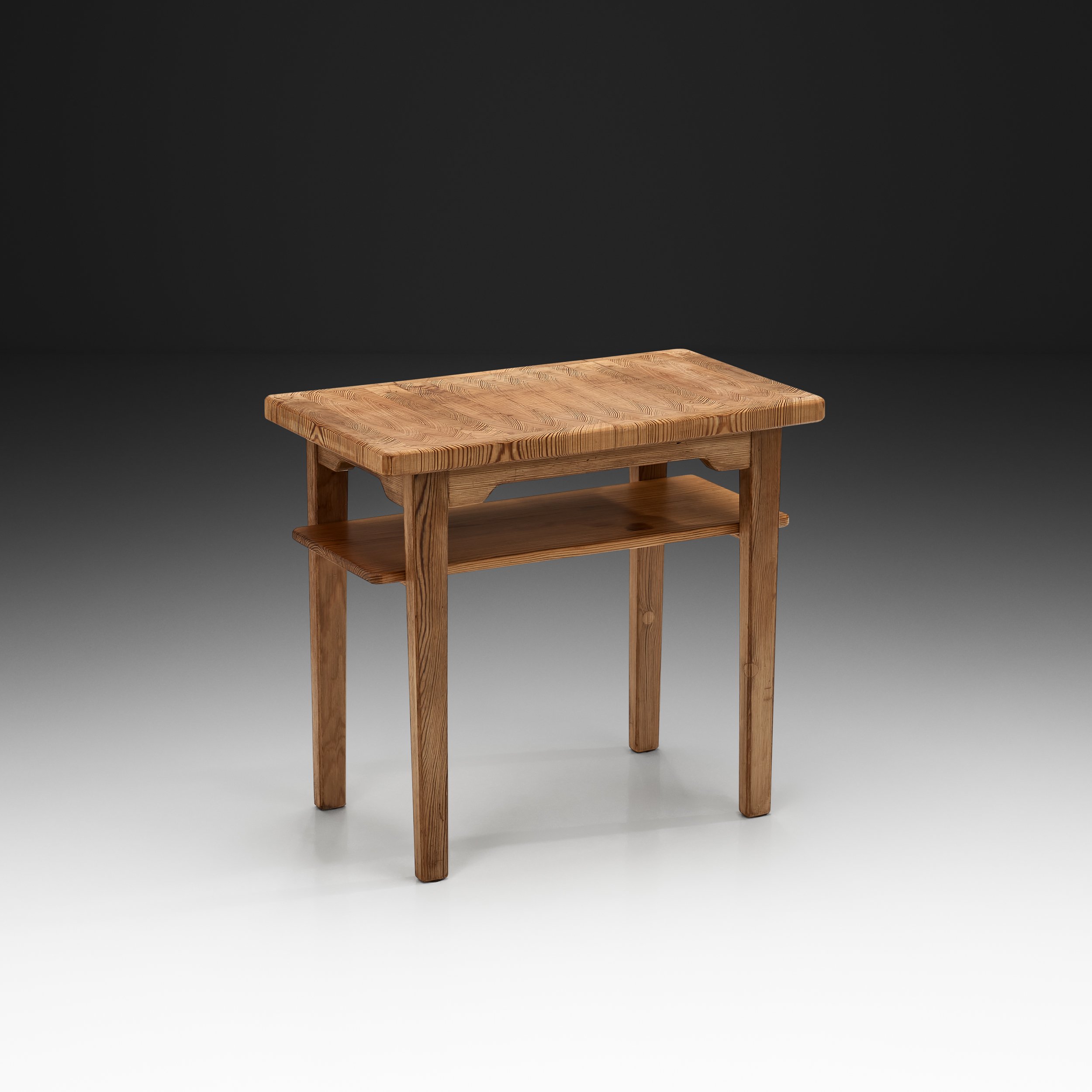
This coffee table is a stunning example of Modernism in design: clear forms without exaggeration with the high-quality work of a Danish cabinetmaker. Humble in its material and size, this table still draws attention thanks to its distinctive look and personality.
Early on, many of the Danish cabinetmakers’ workshops had been producing historical furniture; master cabinetmakers had been renowned for their solid wooden furniture rendered in various styles of the past. This coffee table, while not specifically historical in style, shows some restrained decorative elements that are generally rather sparse in Scandinavian mid-century furniture. However, accordingly to the design ideals of Danish designers, the scalloping pattern is not overwhelming the table, nor does it demand attention, rather, it is an understated but clever addition to the design. The scalloped patterns on the tabletop and legs differ slightly; the scallops on the legs are more pronounced with straight lines between each scallop, while under the tabletop, it is in a more traditional, round shape.
The wavy effect is even more pronounced thanks to the beautiful grain and colour of the solid oak that is most apparent on the wide, circular top. As it can be expected from Danish design and craftsmanship, visually appealing elements usually serve a functional role as well. In this case, the wooden elements under the table reinforce the stability of the structure in this ingenious manner.
Condition:
In good vintage condition. Wear consistent with age and use. Due to the nature and age of the material, the item may have some marks, scratches, and discolouration.
Dimensions:
35.03 in W x 35.03 in D x 22.04 in H
89 cm W x 89 cm D x 56 cm H
About the Designer:
The practical and comfortable designs of Danish cabinetmakers defined mid-20th century modern seating. The Danish Cabinetmakers focused on minimalist design executed by expertly skilled craftsmen.
Works from the Danish Cabinetmakers' Guild is a concept of its own in collectible design. The Cabinet-Makers' Guild began annual exhibitions in 1927 in Copenhagen. The group formed an exhibit showing each year in October the quality furniture made to drawings by gifted architects. The exhibition took place each year, without interruption, for forty years. A number of successful Danish Design collaborations were formed during this time between cabinetmakers and architects.
Danish Modernism has influenced Scandinavian furniture to a great degree, defined by minimalism, simplicity, and functionality. The muted colours and gentle designs make Danish mid-century furniture an ideal addition to contemporary living spaces. Additionally, master cabinetmakers were highly aware of body proportions, prioritizing comfort just as much as the visual qualities.
The works of master cabinetmakers – such as this chair – are of the highest quality, both in terms of materials and craftsmanship. Cabinetmakers take the art of working with wood one step further, and focus on the finer details of what can be created with the material. Therefore, it comes as no surprise that numerous master cabinetmakers are part of the renowned Danish Culture Canon (Danish: Kulturkanonen). The canon contains no more than 108 works of cultural excellence, based on works with a useful function and that are still recognisable today. These lounge chairs are the perfect illustrations of Danish design, and the work of a true cabinetmaker. ~H.
REQUEST PRICE HERE
Price category: 20,000 - 30,000 usd / eur
Adrien Audoux and Frida Minet were a French design duo who worked together during the 20th century. They were known for their innovative use of natural, sustainable materials, including rope, wicker, and bamboo. The duo’s work was heavily influenced by the Modernist movement, which sought to create functional and streamlined designs that were accessible to a wider audience.
Audoux & Minet’s pieces are characterised by a strong sense of craftsmanship, with each piece being handmade by the designers themselves or by skilled artisans. This dining table showcases a long rectangular top finished in warm wood veneer, its broad uninterrupted surface displays the grain. The top sits above thick base covered in a tightly woven natural fibre that introduces an immediate depth of tone and texture. The fibre flows across the supports in beautiful braided patterns, emphasising the bold and solid look. The rope is made into a geometric pattern which breaks up the woven surface to create a beautiful rhythm within the structure. The contrast of materials is central to the table’s character: the smooth, richly grained wooden top stands out against the coarse, rough and natural fibre below, allowing two very different surfaces to define the piece.
Today, Audoux and Minet's designs are highly sought after by collectors and are considered important examples of mid-century modern design. Furniture pieces like this table stand out through their unique textures, and their materials, as well as their classic charm.
Condition:
In good vintage condition. Wear consistent with age and use. The table has recently been reconditioned. Due to the nature and age of the material, the item has some marks and scratches on the tabletop. Additional imperfections like chips, dents or discolouration may be present.
Dimensions:
67.12 in W x 33.46 in D x 29.13 in H
170.5 cm W x 85 cm D x 74 cm H