
"Guanabara" Pedestal Table by Jorge Zalszupin for L'Atelier, Brazil 1960s

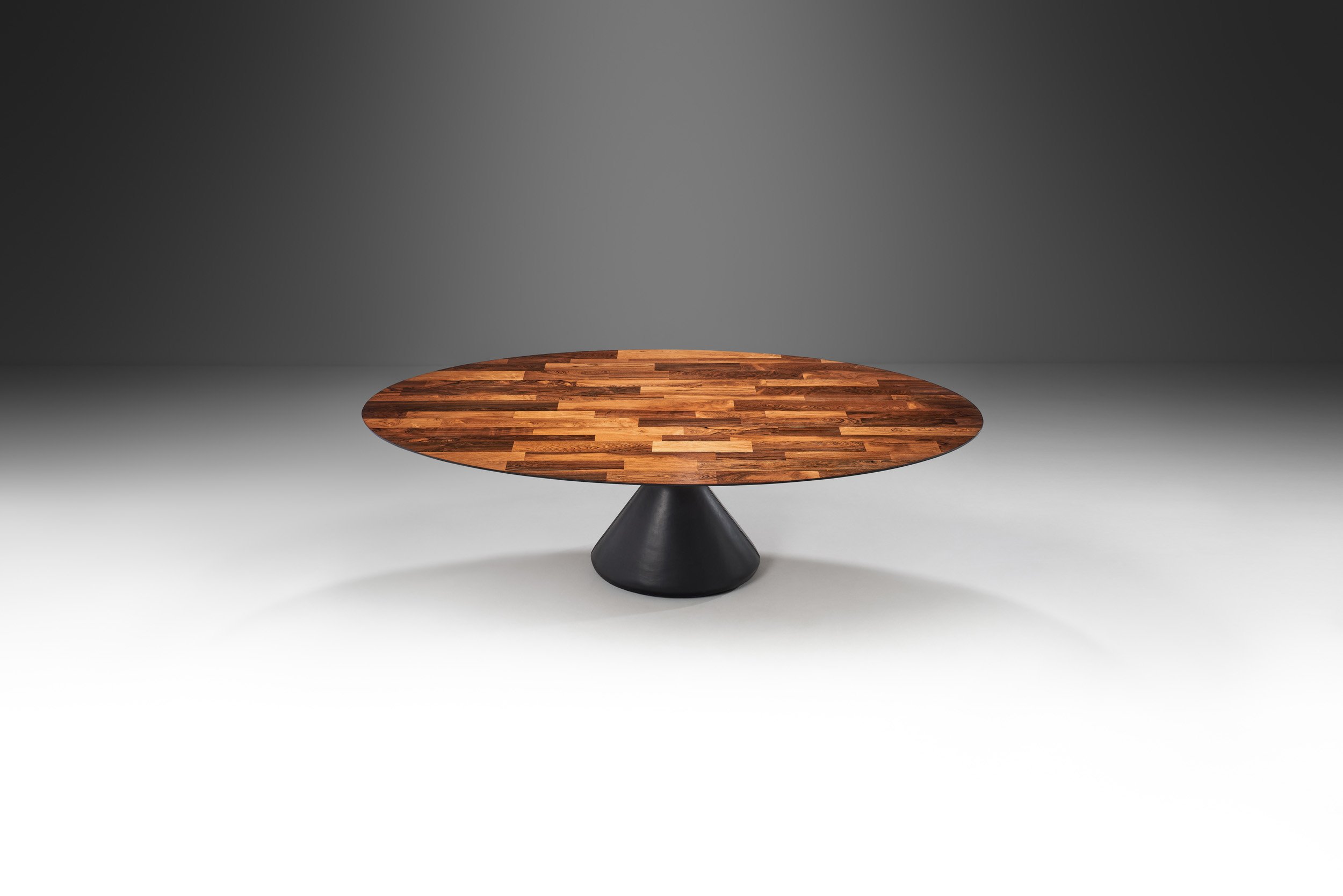


"Guanabara" Pedestal Table by Jorge Zalszupin for L'Atelier, Brazil 1960s
REQUEST PRICE HERE
Price category: 50,000+ usd / eur
"I can't live well with too much rigidity. The 90-degree angle, for example, is something I love, but I can't do it. The things I do end up being a little lyrical, a little sensual, in short, there is always an element that does not come from purity or cleanliness."
This beautiful pedestal table visualizes the above quote from Jorge Zalszupin. It was designed in 1959 and produced by his own company, L'atelier. Essentially, the sizeable top rests on one concrete base finished with soft leather. The solid wood patchwork on the tabletop is mesmerizing, showcasing the many shades of Brazilian hardwood. This was not a purely aesthetic choice, but also an initiative for the rationalization and use of leftover scraps of wood available at the factory, allowing at the same time a combination of their different colourings. The way the large top is supported by the thick metal structure shows architectural precision and the use of materials of the highest quality. At the time of its creation, this table was presented as a dynamic piece that could be used in both the corporate and the domestic places thanks to its casual elegance. Today, its versatility is still recognized, a mark of good design. Zalszupin’s L’Atelier was a design collective comprised of architects, engineers, craftsmen and a full-scale team of professionals who did everything from researching materials to finalizing the product. Therefore, the quality of L’Atelier furniture has transcended time and his pieces have become timeless.
The name is said to be a reference to the famous Baia de Guanabara, a traditional postcard image of Rio de Janeiro. Zalszupin's production established a dialogue very close to the artisanal traditions of working with wood, ensuring quality in the aesthetics and manufacturing of his work.
Condition:
In good vintage condition. Wear consistent with age and use. Some minor scratches on the wooden tabletop. The leather covering on the base is a later replacement.
Dimensions:
98.82 in W x 49.21 in D x 29.13 in H
251 cm W x 125 cm D x 74 cm H
Literature :
Jorge Zalszupin, Design Moderno no Brasil – Maria Cecilia Loschiavo dos Santos, Olhares Edition, São Paulo, 2014, p. 142
About the designer:
Jorge Zalszupin was born in Warsaw, Poland, in 1922. He graduated as an architect in Romania in 1945. His importance for Brazilian design has been articulated in several publications so far. In addition to being the owner of the l'Atelier furniture factory of modern furniture, Zalszupin led a unique initiative: he coordinated a team of designers working for four different factories in the same business group, the Forsa Group.
Zalszupin immigrated to Brazil in 1949 and after a brief stay in the capital, he settled in São Paulo, a city that was then entering a cycle of great industrial growth and great cultural transformations. In the first half of the 1950s, he opened an architecture office, having José Gugliota as a partner. When he got tired of designing exclusive furniture manufactured for his clients' homes, he decided to join a group of woodworkers and started to produce smaller series. This was how l'Atelier came into being, which eventually began to manufacture office furniture and went from a carpentry shop with handcrafted products to an industry with serial production. The first piece in this series was an armchair nicknamed 'Danish' by employees. It was first created in 1959.
After the crisis of the 1980s, Jorge Zalszupin dedicated himself exclusively to architecture, an activity he had never abandoned. From 2005, the company Etel Marcenaria started to produce several of the items designed by Zalszupin for l'Atelier - among them the 'Danish' armchair -, privileging the objects of the company's artisanal phase. ~H.
REQUEST PRICE HERE
Price category: 1,000 - 2,500 usd / eur
Created with mobility and flexibility in mind, nesting tables can be organized in an unlimited variety of stylish and functional configurations. Scandinavian models of the mid-century era – as these tables showcase – combined their functionality with the unmistakeable touch of Nordic design.
The triangular shape of the tabletops immediately stands out. This silhouette, resembling a guitar pick, was particularly favoured by Danish designers, such as Poul Thorsbjerg Jensen. The pieces of this unique set of tables contain three individual tables that are graduated in size so that they may be stacked on top of one another. Each piece is made of solid wood with beautiful grain and pattern that is even more noticeable when the individual tables are next to each other. The different sizes of these nesting tables serve both functional and visual goals; they can conveniently be used individually or nested together to form a coffee table, or they can be separated and laid around the room to form a cohesive interior style. Additionally, a trio of nesting tables bring added depth and cosiness, and it also follows the revered rule of three – a Feng Shui principle that encourages 'groups of three' to open and relax a space. The versatility and functionality of this set is completed by the Scandinavian design: soft, rounded edges and craftsmanship characterize the tables, supported by the sturdy legs.
The versatility of nesting tables makes them incredibly practical and functional. They are a perfect choice for small spaces as they allow maintaining a clean and open interior design without giving up comfort. Whether nested together or placed next to each other, this set is sure to bring functional style and quality to any space.
Condition:
In good vintage condition. Wear consistent with age and use. The tables have recently been reconditioned. Due to the nature and age of the material, minor marks and scratches are present.
Dimensions:
Largest: 47 cm W x 46.5 cm D x 40 cm H
Middle: 39 cm W x 40 cm D x 34 cm H
Smallest: 29 cm W x 29 cm D x 28 cm H