
Unique Wooden French Accent Chair, France 1960s (sold)




Unique Wooden French Accent Chair, France 1960s (sold)
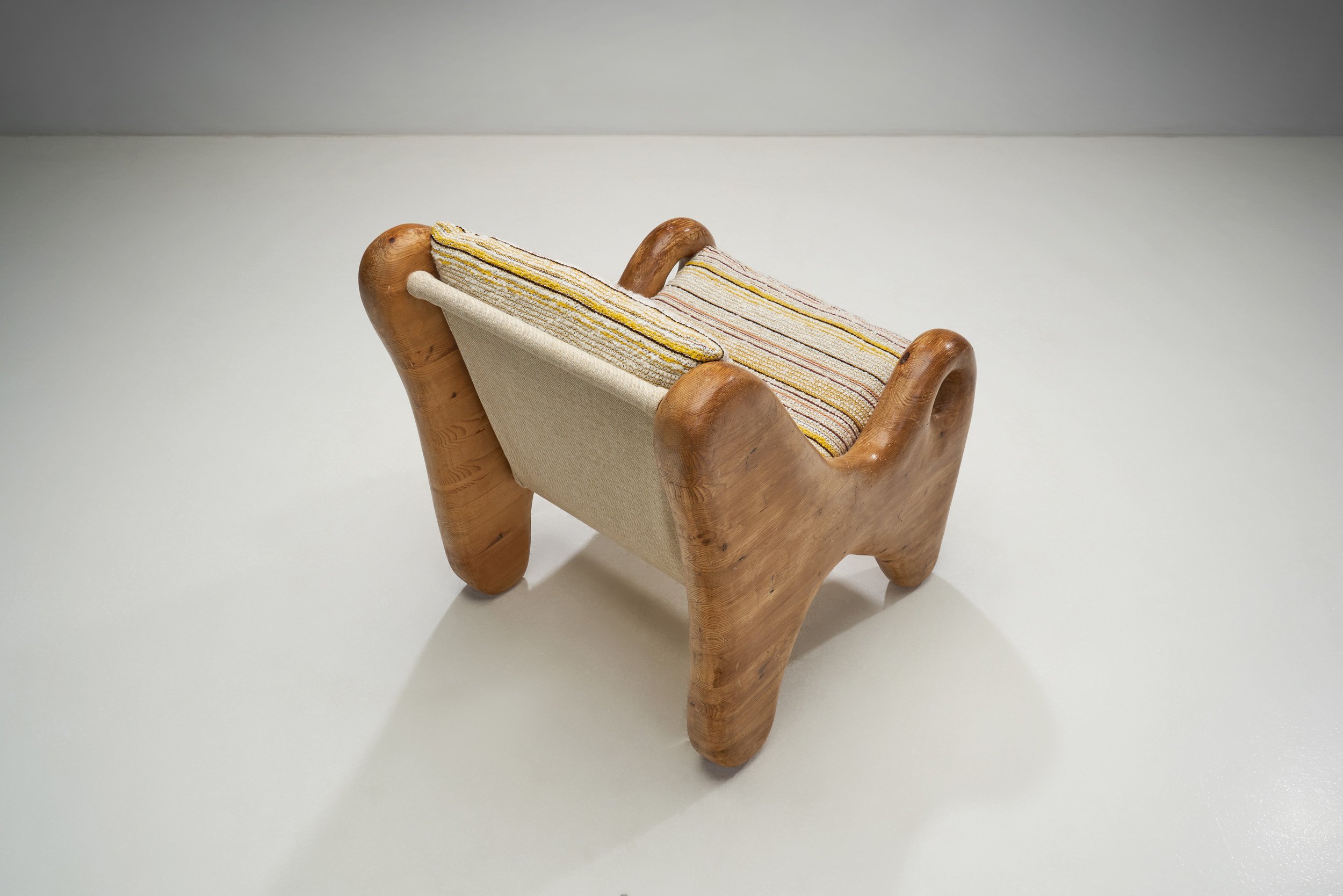
The 1960s were a decade of artistic experimentation in design, and this uniquely shaped eccentric wooden French chair stands as a testament to that creative spirit. This chair is a true fusion of form and function, blurring the line between furniture and art.
What sets this chair apart is its bohemian shape; boasting a frame that resembles an intricate work of sculpture, hand-carved with exquisite details. The sinuous curves and unexpected angles of the chair's wooden sides draw the eye, creating an unusual, yet undeniably captivating aesthetic. The frame is composed of two nearly identical sides crafted from large individual pieces of wood and joined by the attractive dovetail joinery technique. The linen back and seat is held between the sides by horizontal poles. A loose seat and a back cushion dressed in a colourful striped fabric is placed on the stretched linen, which adds to the artistic overall impression. The large holes towards the front of the chair accentuate the deep curve of the seat that is raised toward the front. Functionally, the chair offers a surprisingly comfortable seating experience, despite its eccentric appearance. Its ergonomic design moulds to the body, providing comfort and support. It's a perfect illustration of how mid-century modern French design married form with function, creating pieces that are both aesthetically pleasing and comfortable to use.
This unique piece exemplifies the versatility of mid-century modern French design and is the definition of a conversation starter piece. This chair’s design reflects the era's fascination with organic forms and innovative materials, while the commitment to artisanal craftsmanship pays homage to centuries of French woodworking tradition.
SOLD
Condition:
In good vintage condition. Wear consistent with age and use. The chair has newly upholstered cushions in a premium fabric by the exclusive French atelier, Toyine Sellers. The textile used for this chair is a work of art in itself. Each of our items can be re-upholstered by our in-house atelier in a fabric of choice. Please reach out for more information.
Dimensions:
26.77 in W x 32.08 in D x 31.88 in H; Seat height 21.25 in; Arm height 23.03 in
68 cm W x 81.5 cm D x 81 cm H; Seat height 54 cm; Arm height 58.5 cm
REQUEST PRICE HERE
Price category: 15,000 - 20,000 usd / eur
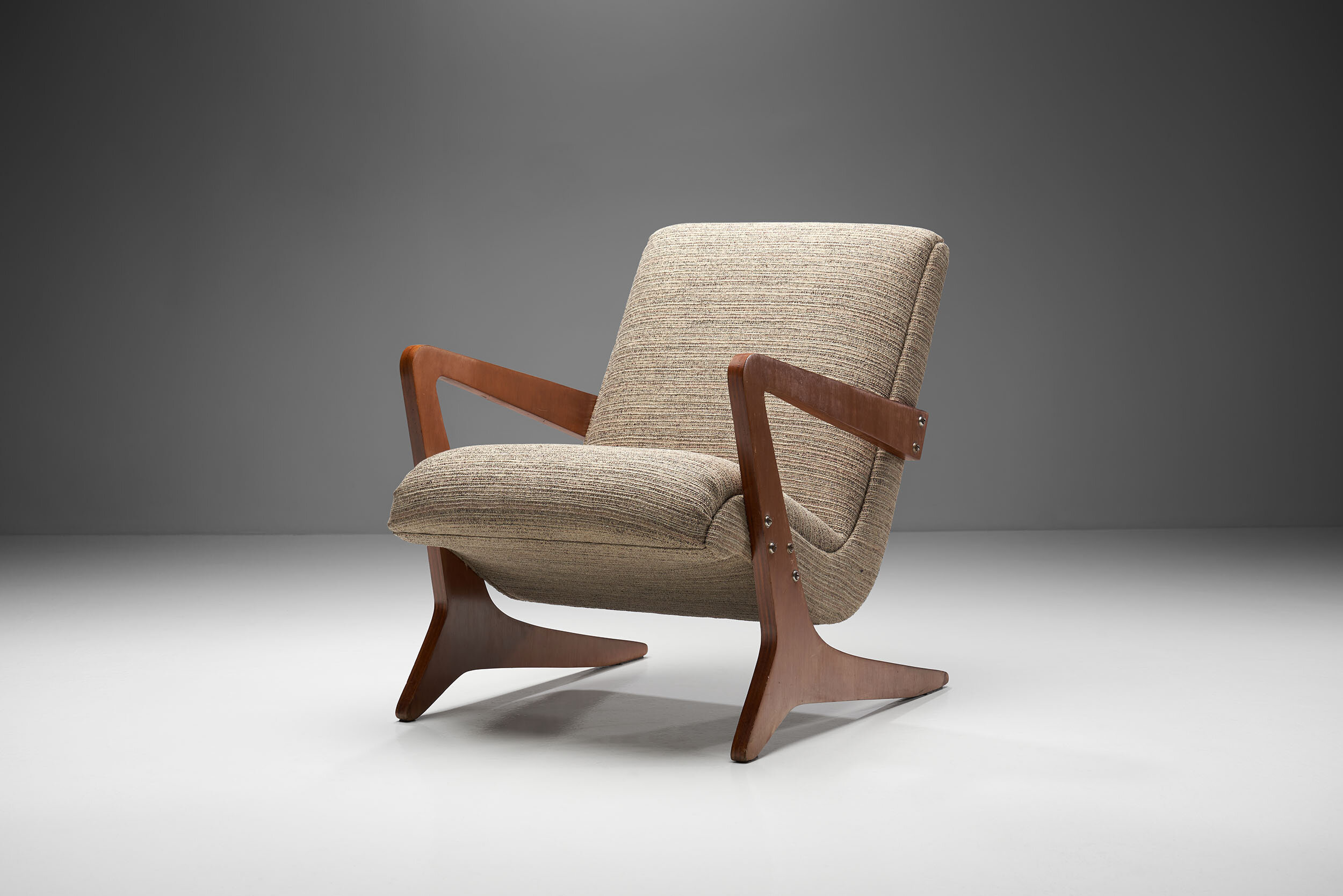
This beloved José Zanine Caldas lounge chair from the “Linha Z” or “Z Line” is an exceptional example of Brazilian design of the 1950s. The design dates to 1949, The woven leather straps and the organic shape is unmatched.
This chair model is made of plywood and features a distinctive shape, distinguished by its legs. The legs and arms are connected and form one unit and their shape inspired the name of the line, “Linea Z”. The edges are softly rounded, which matches the versatile curvature of the body, which enhances the organic feel of the chair. Besides the plywood frame, the original leather upholstery is the stand-out element of this chair both in terms of visual and technical terms. The leather strap seat and back are tightly secured to the plywood, completing the great graphic expression this is widely known for. The bolts of the joinery are left visible, a detail that adds to the rawness of the design. The bent seat is perfectly angled for lounging, supporting the sitter’s whole body.
The pioneering Brazilian designer, José Zanine Caldas’s present design was created by Mòveis Artisticos Z, the factory Zanine Caldas founded in São José dos Campos in 1948. Most of Zanine Caldas’s designs - especially this armchair - tap into the modernist aesthetic while bearing exceptionally unique shapes: form and function revisited with a twist.
Condition:
In good vintage condition. Wear consistent with age and use. Some scratches and discoloration on the wood. This chair comes with its original leather or has been reupholstered by a previous owner.
Dimensions:
24.21 in W x 40.94 in D x 32.48 in H; Seat height 12.4 in
61.5 cm W x 104 cm D x 82.5 cm H; Seat height 31.5 cm
Literature:
Movel Moderno Brasileiro, published by Olhares editores, São Paulo 2017 by Alberto Vicente and Marcelo Vasconcellos
Aric Chen, Brazil Modern, Monaclli Press, New York City 2016
Ruy Teixeira e Jayme Vargas, Desenho da Utopia, Olhares, São Paulo 2016
About the designer:
José Zanine Caldas was born in Belmonte, at the southern coast of Bahia, in 1919. Son of a doctor, Zanine was an autodidact who, from a young age, was fascinated with his environment, especially with trees.
While most architects of his generation studied extensively, Zanine developed his own style through doing and making, and at the age of 20 decided to exchange Bahia for Rio de Janeiro. There he opened up a workshop for architectural scale-models and had the chance to work with pioneering modern architects like Lucio Costa and Oscar Niemeyer.
Large scale furniture with modern design and affordable prices. This was the great advantage of the joinery Móveis Artístico Z founded in 1948 by the architect Zanine Caldas, in partnership with Sebastião Pontes and Paulo Mello, was a great success at the time. Headquartered in São José dos Campos (SP), it maintained its production for almost two decades. The form of creation, idealized by Zanine, was opposed to the market of the time, which was either based on the production of handmade furniture, in solid wood, or in pieces produced in series with an unattractive design. Breaking these paradigms, Móveis Artísticas Z revolutionized manufacturing pieces with improved design and great popular appeal.
Inspired by the local craftsmen who carved boats and furniture from fallen trees, Zanine began experimenting with chiselling and carving large, sculptural works, which became the focus of his later career. Zanine became a big advocate for preservation and in the 1980s, he established the Foundation Center for the Development of the Application of Brazilian Woods (DAM), in an effort to educate and attempt to reverse the rampant destruction of Brazilian rainforests.
Up until his death in 2001, Zanine kept his natural visions alive, and would plant a new tree in place of any tree that was taken down for one of his projects. ~H.