
Swedish Modern Stained Beech Coffee Table with Travertine Top, Sweden 1940s (sold)




Swedish Modern Stained Beech Coffee Table with Travertine Top, Sweden 1940s (sold)
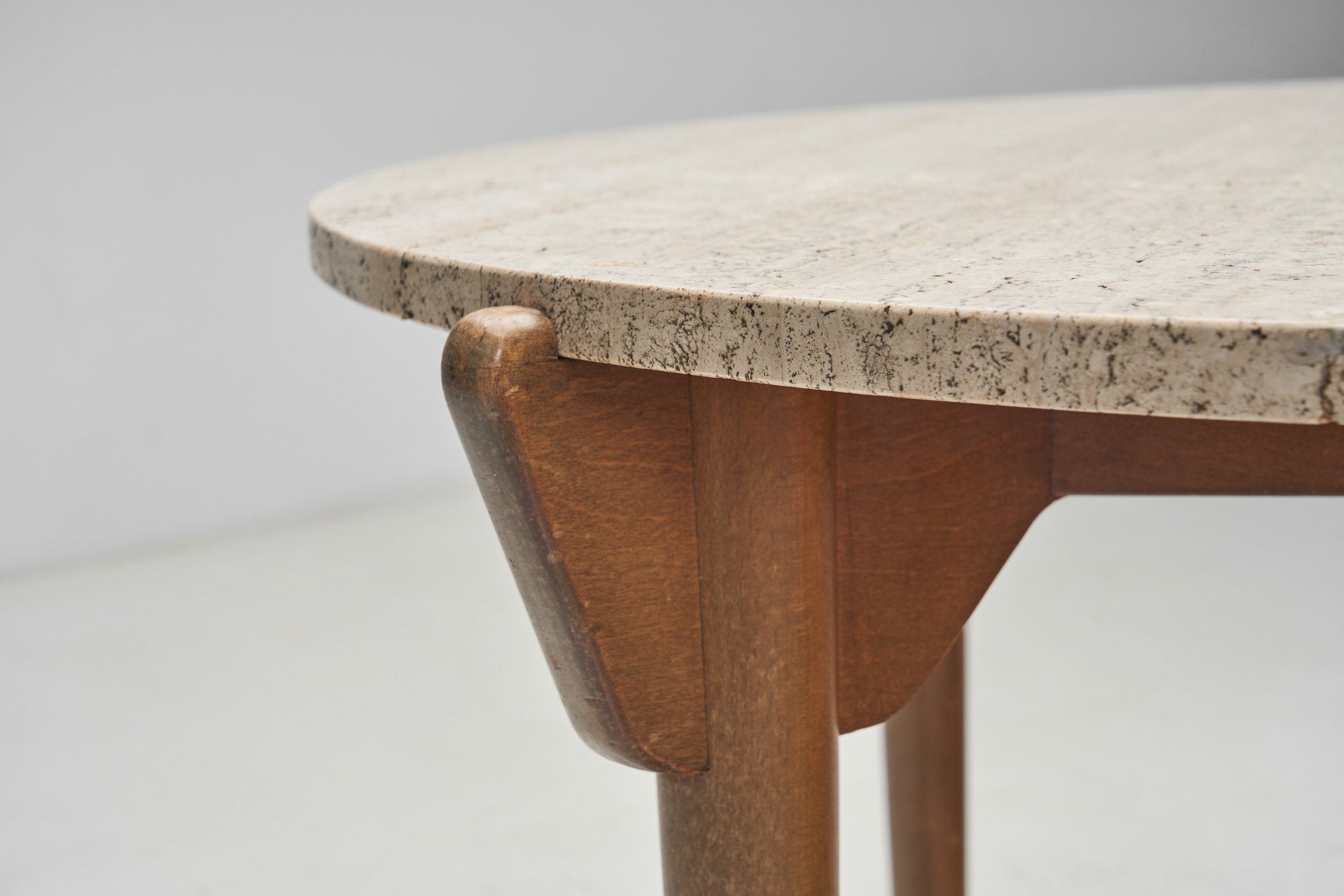
This Swedish Modern 1940s coffee table represents an exquisite blend of functionality, craftsmanship, and aesthetic appeal. Its base, crafted from stained beech, provides a sturdy foundation, while the round table-top in travertine adorned with brass footings adds a touch of sophistication.
Travertine is a form of limestone, and here it brings a distinctive character to the table. Known for its unique, porous surface, travertine showcases natural variations in colour and texture, consequently making each piece one-of-a-kind. The combination of travertine and the brass footings not only enhances the table's visual allure but also ensures this model’s high visual quality. The Swedish Modern design movement emerged in the early to mid-20th century, emphasizing simplicity, clean lines, and functionality. While it shares commonalities with Scandinavian design, Swedish Modern stands out with its emphasis on light colours, natural materials, and an overall sense of understated elegance. This coffee table exemplifies these principles, capturing the essence of Swedish Modern furniture design. Broadly, Swedish furniture design in the 1940s was influenced by a combination of factors, including the aftermath of World War II and a desire for simplicity in the face of adversity. The result was a style that prioritized functionality without compromising on aesthetics. This coffee table perfectly encapsulates the design ethos of the era, showcasing the beauty in simplicity and practicality through employing organic materials and unique details and solutions. Beech wood's prevalence in Scandinavian furniture making, including Swedish designs, can be attributed to its many perks; beech is valued for its light colour, durability, and versatility, making it an ideal choice for crafting furniture. In the context of the 1940s, the use of stained beech in the coffee table's base reflects a commitment to utilizing organic, local resources while maintaining a timeless and warm aesthetic. Another noteworthy aspect of Swedish furniture design, including this coffee table, is the emphasis on intricate wood joinery. Craftsmen often employed techniques such as dovetail joints and mortise-and-tenon connections to ensure the structural integrity of their creations. This attention to detail not only enhances the furniture's durability but also adds a touch of artistry to the overall design.
This Swedish Modern 1940s coffee table is an appealing visual testament to the enduring appeal of Swedish design principles. Its combination of stained beech, travertine, and brass highlights the beauty of natural materials while showcasing the craftsmanship and innovation that define Swedish Modern furniture design, particularly during the transformative period of the 1940s.
SOLD
Condition:
In very good vintage condition. Wear consistent with age and use. Some marks and scratches on the wood. The brass fittings on the legs have a beautiful patina. The undercarriage has repairs and bears the inscription: 1736/2336"
Dimensions:
38.78 in Ø x 22.05 in H
98.5 cm Ø x 56 cm H


REQUEST PRICE HERE
Price category: 5,000 - 7,500 usd / eur
Ole Wanscher was a leading figure in Danish and Scandinavian design, as was his mentor, the legendary Kaare Klint, renowned to be the “father” of modern Danish furniture design. Together, they made significant achievements in redefining classic forms. Drawing inspiration from human anatomy, his developments influenced the concept of Scandinavian modernism as we know it today. Wanscher’s contribution to the field is widely acknowledged as he acquired his skills at the esteemed Det Kongelige Danske Kunstakademi - Billedkunst Skolerne in Copenhagen.
The post-war era, especially the period spanning from 1940 to 1960 resembled the golden age of Danish furniture, and was when Wanscher created his most well known works. This model "1762" coffee table retains the cherished Danish modernist traits, such as simplicity and functionality, while also reflecting an ongoing precise focus on quality materials. This minimalist approach combined with solid wood creates a timeless appearance that resonates with any design style. The stunning grain pattern of the table top enhances the visual appeal, yet the most eye-catching design (and functional) element remains the curving cross stretchers connecting the legs. Albeit simple, its uncommon overlap - as opposed to bisecting - design catches the eye, and contrasts effectively with the top.
The design of this table encapsulates a rich moment in furniture design history. It is a tangible embodiment of the mid-20th century era’s focus on materiality and craftsmanship, while also reflecting the innovative spirit of Danish designers like Ole Wanscher.
Condition:
In good vintage condition. Wear consistent with age and use. The table has recently been reconditioned. Due to the nature and age of the wood, the item has visible marks and scratches, and may show slight discolouration.
Dimensions:
35.44 in W × 21.66 in D × 21.66 in H
90 cm W x 55 cm D x 55 cm H