
Two-Tiered Sliding Coffee Table with Hidden Bar by Aldo Tura, Italy 1970s (sold)




Two-Tiered Sliding Coffee Table with Hidden Bar by Aldo Tura, Italy 1970s (sold)
One of the most enigmatic and polarizing figures to emerge in Italian design history, Aldo Tura is an outlier in the world of mid-century furniture. The designer’s glamorous furniture pieces resist categorization and draw inspiration from Art Deco, Art Nouveau, Baroque, Surrealist and modernist styles.
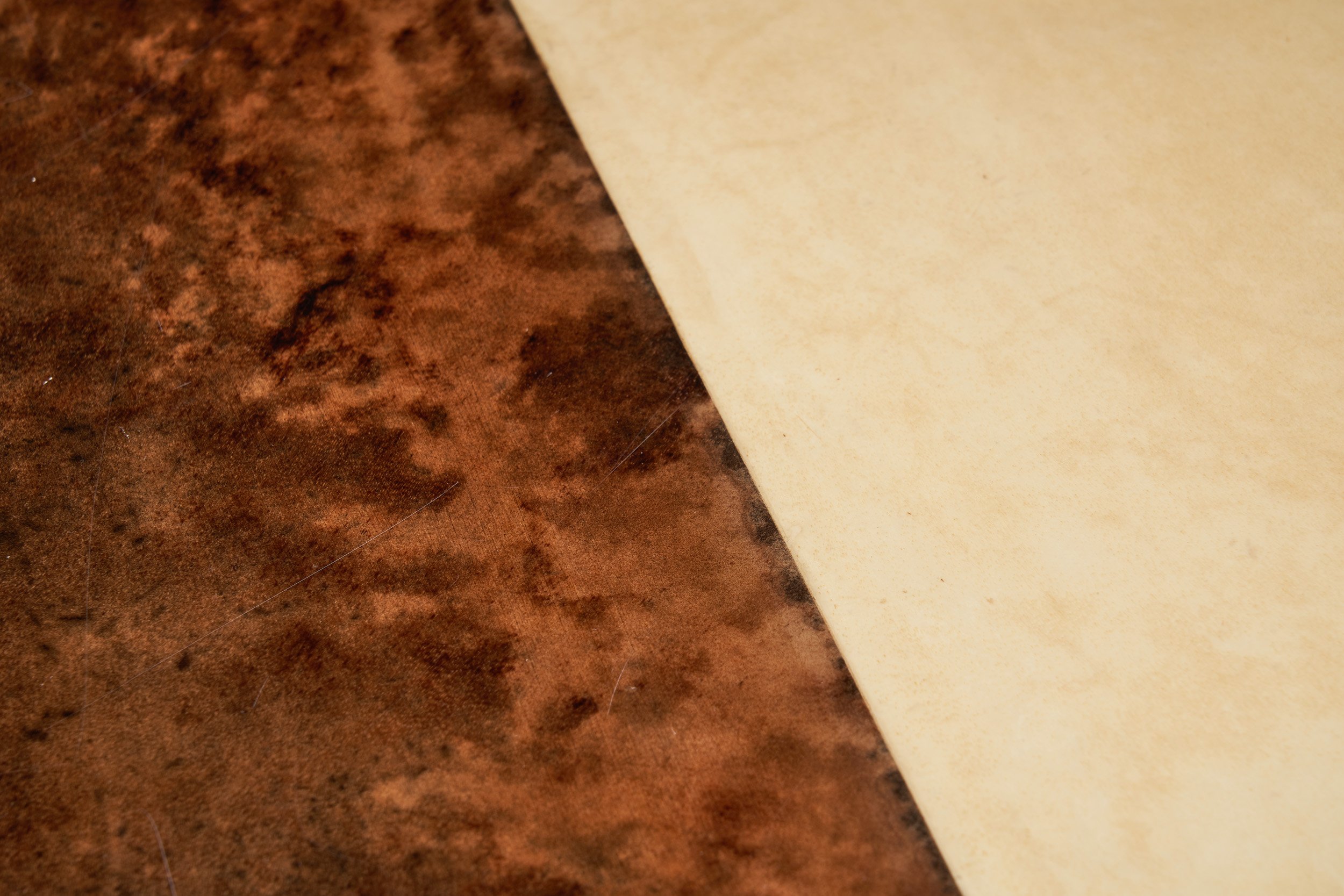
Whether inspected from a purely material or aesthetic point of view, this coffee table is an outstanding piece in design history. Combining his interest in Art Deco and Art Nouveau with low-slung minimalist design of the 1940s and 50s, Tura created this coffee table by utilizing unusual materials including parchment and goat skin. The visually striking duality of the materials’ colour scheme and texture immediately draws the eye, just like the two-tiered arrangement. The top slides open to expose a hidden mirrored bar, adding to the numerous ingenious design elements. The rectangular, lacquered parchment and goat skin tiers are supported by wooden bases, adding to the interesting mix of materials. The luxurious overall aesthetic is reminiscent of the Hollywood regency style, characterized by the bold use of colour and contrast often with metallic and glass accents meant to signify both opulence and comfort. Blocks of contrasting colour are highly favoured, typically in different textures as seen in this model. This lacquered extendable coffee table was produced in the early 1970s, by the Tura company in Lazzate, Italy, that continues to produce furniture based on the style and designs of the designer who died in 1963. The Tura company began manufacturing the designer’s signature furniture in the 1930s, focusing on limited production of handcrafted designs produced within the confines of traditional craftsmanship.
Even as the world began to switch to mass-production, they produced items that were so intricate and labor-intensive that they were not able to be replicated with a large factory system, making many of his items rare or difficult to find today.
SOLD
Condition:
In good vintage condition. Wear consistent with age and use. Some marks and scratches on the surface.
Dimensions:
55.11 in W x 31.49 in D x 11.02 in H
140 cm W x 80 cm D x 28 cm H
About the designer:
Not much is known in literature about Tura's life. The artist was born in 1909, and established a furniture production house in Lombardy in 1939. The experimental furniture designer has been dealing with the manual production of tables, cupboards, and lamps since the 1930s. In 1939, he founded his own furniture workshop in Lombardia near Milano.
His mix of styles from Art Deco, Art Nouveau, and minimal. Tura went beyond the limits of traditional craftsmanship. Following the Art Deco movement, which focused on straight lines and angles, Tura's designs now included flowing lines and free forms. The limited edition of Tura's works is of high quality, some pieces only existed as prototypes. In his designs, he used a large selection of unusual materials such as eggshells, parchment, goatskin and wood veneers.
When many furniture manufacturers opted for mass production in the post-war years, Tura’s company remained committed to traditional craftsmanship. Its preferred complicated and complex forms brought with it labor-intensive processes that did not allow the industrial production of large quantities. In the 1950s, Tura also produced hand-painted seating with motifs of architectural or Venetian landscapes.
The Brooklyn Museum in NYC shows some of Tura's works that were originally part of the travelling exhibition Italy at Work: Her Renaissance in Design Today 1950–53.


REQUEST PRICE HERE
Price category: 2,500 - 5,000 usd / eur
During the 1950s, Danish Modern furniture placed equal emphasis on structural clarity and refined craftsmanship. Rather than treating tables as purely functional objects, designers created furniture that integrated beauty into day-to-day life. Thanks in great part to an early emphasis on wood and a resistance to certain modernist currents by influential designers, Danish Modern has avoided associations with cold industrialisation and machine aesthetics.
The movement's preference for fine cabinetmaking and expressive timber is evident in this coffee table, whose elegant silhouette is achieved through a restrained combination of curves and expressive wood. The long, rectangular top displays a dramatic grain pattern, with tonal variations across the surface. Supporting it is an elegant, trestle-like base. The designer strayed away from the bulky, robust versions of this iconic base style, opting instead for two sweeping curved side supports connected by a single stretcher, creating an open architectural framework beneath the tabletop. The contrast between the crisp horizontal plane of the top and the flowing curves of the base creates a dynamic, yet balanced, composition. Danish modern designs are, at their core, utilitarian objects; as a result, this table’s form follows function, offering both a generous surface area and great stability. The absence of unnecessary detailing directs attention to the quality of the timber, the precision of the joinery, and the graceful geometry of the structure.
Elegant from every angle, the table demonstrates why Danish Cabinetmakers and their designs are some of the most thoughtful pieces of furniture. Its understated design and versatile character allow it to complement a wide range of interiors while showcasing the enduring appeal of the Danish modern period.
Condition:
In good vintage condition. Wear consistent with age and use. The table has recently been reconditioned. Due to the nature and age of the material, the item has some marks and scratches on the tabletop.
Dimensions:
59.25 in W x 25.59 in D x 21.65 in H
150.5 cm W x 65 cm D x 55 cm H