Pair of Haagse School Armchairs, Netherlands Early 20th century (sold)


Pair of Haagse School Armchairs, Netherlands Early 20th century (sold)
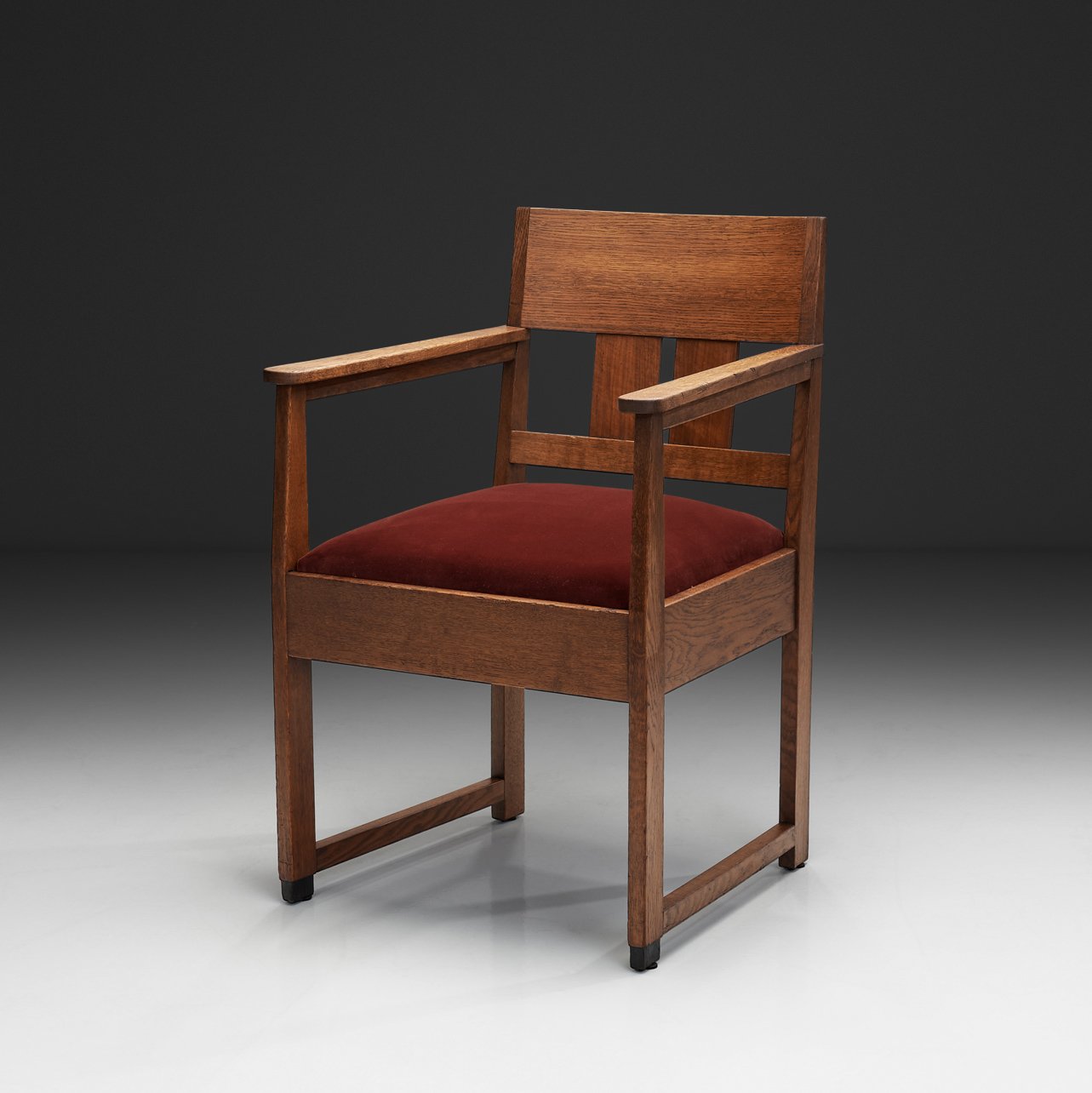
This elegant pair of armchairs embody the distinctive design principles of the Haagse School (The Hague School) movement, which emerged in the Netherlands during the early 20th century. Renowned for its blend of modernist and traditional influences, this style emphasizes clean lines, functional form, and quality craftsmanship.
The Hague School style is closely related to the Amsterdam School and the Bauhaus movement, but has more-so been influenced by Art Deco, and drew a great deal of inspiration from Berlage's rationalism, the Arts and Crafts movement, and De Stijl. As this pair showcases, the Hague School generally made use of strict and clean lines. The construction of this pair is quite traditional and robust. Each armchair features a solid yet graceful frame, crafted from rich, dark wood, which highlights the natural grain of the material. The solid wood frames recall modernist influences, such as Cubism and De Stijl in its forms and lines. The horizontal lines crafting the frames leave open spaces, emphasising the openness of the design, yet the construction of the base is grounding.
These Haagse School armchairs are not just pieces of furniture but reflections of the era's shift towards modernist ideals, embracing understated sophistication without sacrificing comfort. These chairs, with their timeless appeal, would make a distinguished addition to any interior, from classic to contemporary spaces.
SOLD
Condition:
In good vintage condition. Wear consistent with age and use. The chairs come with their original upholstery or have been reupholstered by a previous owner. Each of our items can be re-upholstered by our in-house atelier in a fabric of choice. Please reach out for more information.
Dimensions:
26.77 in W x 28.34 in D x 34.64 in H; Seat height 18.50 in; Seat depth 21.46 in; Arm height 24.01 in
68 cm W x 72 cm D x 88 cm H; Seat height 47 cm; Seat depth 54.5 cm; Arm height 61 cm
REQUEST PRICE HERE
Price category: 2,500 - 5,000 usd / eur
This dining chair, designed by the Amsterdam-based company N.V. Jac Levee, is a beautiful piece of furniture design that embodies the essence of the Amsterdam School style. This movement, which emerged in the Netherlands during the early twentieth century, sought to unite expressive craftsmanship with modern design, resulting in furniture that was both functional and visually distinctive. Its influence extended from architecture to interiors and furnishings, where rich materials and carefully considered decorative details became defining characteristics.
Crafted from high-quality wood, the frame of the chair exudes a sense of strength and durability, while the wicker seating offers a comfortable and tactile sitting experience. The eight stretchers that make up the lower part of the frame provide a sense of balance and stability to the overall structure, while also creating a pleasing geometric rhythm when viewed from different angles. One of the most striking features of this chair is the use of black circular accents positioned along the legs and back. These details not only introduce a subtle graphic contrast against the warm tone of the wood but also reinforce the construction and highlight the chair's architectural character. The restrained ladder-back design further complements the overall composition, balancing the solidity of the frame with an open and elegant silhouette.
Over time, the chair has acquired a beautiful patina that adds to its charm and character. The tone of the wood and the gently aged wicker speak to decades of history, enhancing the authenticity of the piece without diminishing its functionality. More than simply a dining chair, it reflects the enduring quality of Dutch craftsmanship, combining honest materials, thoughtful construction, and understated decorative refinement.
Condition:
In good vintage condition. Wear consistent with age and use. The chair has recently been reconditioned. Some marks, scratches and discolouration are present.
Dimensions:
19.29 in W x 15.74 in D x 34.84 in H; Seat height 18.11 in; Seat depth 15.15 in
49 cm W x 40 cm D x 88.5 cm H; Seat height 46 cm; Seat depth 38.5 cm
REQUEST PRICE HERE
Price category: 5,000 - 7,500 usd / eur
Wim den Boon was a Dutch designer and architect associated with the post-war modernist movement in the Netherlands. After studying interior design at the Academy of Fine Arts in The Hague, he worked alongside artists like Hein Stolle and Pierre Kleykamp to contribute to a number of important post-war interiors, including projects for Schiphol Airport. Den Boon later established himself independently in The Hague, where he designed furniture characterised by restrained compositions, careful spatial treatment, and a preference for unadorned everyday materials.
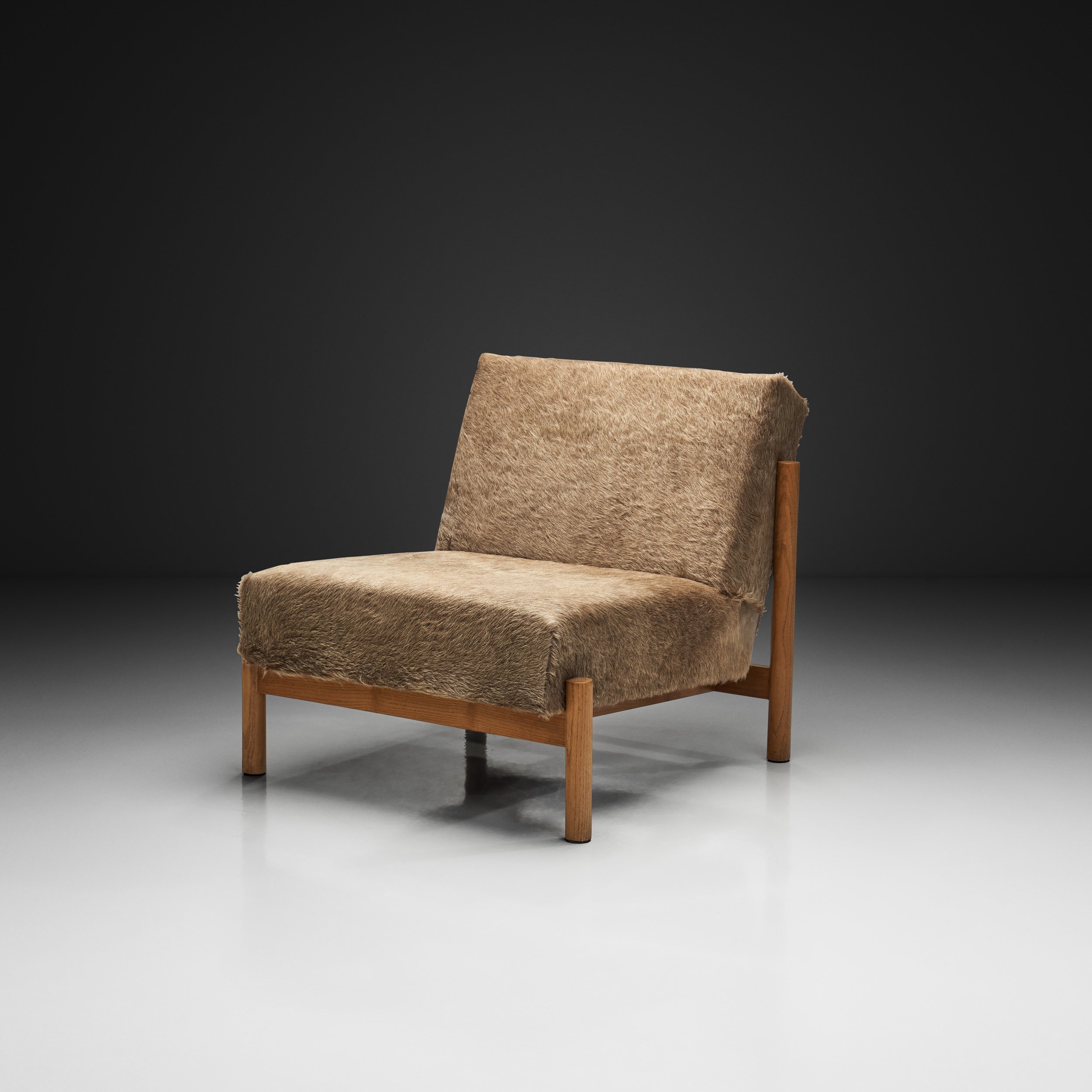
Influences from De Stijl and Scandinavian modernism remained visible throughout his work, particularly in the balance between strict structure and warmth. This lounge chair reflects that sensibility through its reduced oak construction and tactile ponyskin upholstery. The frame is composed of cylindrical supports and straight horizontal rails, creating a clear geometric outline around the upholstered body. The proportions are low and generous, giving the piece a relaxed, grounded posture. The seat and backrest form a wide lounging space upholstered entirely in champagne-coloured ponyskin. The material introduces a textured surface, giving the otherwise minimal form a sense of movement and depth. Still, the oak remains visible throughout the design, outlining the silhouette and through its slim slats it prevents the chair from appearing overly heavy. The tilt of the backrest softens the strict geometry and contributes to the lounge-like comfort of the piece.
Den Boon was part of the generation of Dutch designers who helped shape post-war modernism in the Netherlands through a restrained and architectural approach to furniture. This chair is proof of his talent. It feels architectural in structure, yet tactile and warm in appearance, reflecting the balance that made Dutch modernist furniture so distinctive during the period.
Condition:
In good vintage condition. Wear consistent with age and use. The lounge chair has recently been reconditioned. Due to the age and nature of the materials, the item may have marks, scratches, and discolouration. The piece has recently been reupholstered in premium ponyskin. Each of our items can be reupholstered by our in-house atelier in a fabric of choice. Please reach out for more information.
Dimensions:
25.79 in W x 34.26 in D x 27.56 in H; Seat height 14.97 in; Seat depth 20.67 in
65.5 cm W x 87 cm D x 70 cm H; Seat height 38 cm; Seat depth 52.5 cm
REQUEST PRICE HERE
Price category: 2,500 - 5,000 usd / eur
In 1920, the term "Nieuwe Haagse School" was first mentioned by the architect C.J. Blaauw. "Typical of The Hague" - that was how the designer spoke of the style. The movement blossomed between 1925 and 1940 and brought uniformity to the cityscape. The Hague School style is closely related to the Amsterdam School and the Bauhaus movement, but has more-so been influenced by Art Deco, and it drew a great deal of inspiration from Berlage's rationalism, the Arts and Crafts movement, and De Stijl.
This chair showcases a robust solid wood construction, with a warm, slightly patinated surface that highlights the natural grain and depth of the material. The frame is deliberately straightforward yet bold, giving the chair a grounded presence that feels both honest and enduring. The design is defined by a subtle architectural quality achieved through wooden slats and panels, characteristic of Dutch seating. From every angle, the chair reveals thoughtful joinery and a careful balance, with no unnecessary embellishment, only purposeful design choices that emphasise durability, comfort, and visual cohesion. The seat is upholstered in a fabric with a deep tone, which allows the focus to remain on the wooden frame. The squared legs are connected by stretchers that reinforce the structure while maintaining a clean visual rhythm.
Haagse School furniture wasn’t flashy but instead focused on being well-made and to fit a warm, comfortable and welcoming home. As this chair exemplifies, blending functionality, good quality natural materials and organic colours with excellent craftsmanship is the key to the success of this design period.
Condition:
In good vintage condition. Wear consistent with age and use. The chair has recently been reconditioned. Minor dents and scratches are present. Due to the nature and age of the wood, the item has some marks and discolouration. The item has recently been reupholstered in a premium fabric. Each of our items can be reupholstered by our in-house atelier in a fabric of choice. Please reach out for more information.
Dimensions:
21.86 in W x 22.64 in D x 34.45 in H; Seat height 21.66 in; Seat depth 20.08 in; Arm height 27.56 in
55.5 cm W x 57.5 cm D x 87.5 cm H; Seat height 55 cm; Seat depth 51 cm; Arm height 70 cm
REQUEST PRICE HERE
Price category: 2,500 - 5,000 usd / eur
The Amsterdamse School movement arose in response to the influence of Art Nouveau and Jugendstil in the late 19th and early 20th centuries. This movement, which took root in Amsterdam, sought to create a uniquely Dutch style that embraced traditional craftsmanship and celebrated the spirit of the current times. The Amsterdamse School extended its influence across various artistic disciplines, including architecture, decorative arts, and furniture design.
The styles’ main characteristics are reflected in the design of this chair beautifully: expressive, art deco-reminiscent, and functional. Amsterdamse School furniture is renowned for its sculptural qualities. Designers like Jac Levee sought to integrate form and functionality seamlessly, resulting in furniture pieces that were not only visually striking but also practical. The craftsmanship of Amsterdamse School furniture is exemplified by its intricate woodwork and joinery. Pieces often showcased decorative detailing through carvings, inlays, and geometric patterns. These elements add a touch of individuality and artistry to a piece, setting them apart from the mass-produced furniture of the time. In this chair, the backrest’s clean, symmetrical lines reflect the simple, yet sophisticated aesthetics of the era. The use of black round accents not only adds an element of visual interest to the design, but also serve to reinforce the structure and enhance the overall strength. To further add to the charm of the piece, the woven seat, made from durable natural fibres, highlights the attention to both function and form, by creating visual and textural interest. The beautifully symmetrical pattern showcases the timeless artistry of artisanal furniture.
Whether placed in a farmhouse or used to add an organic element to a modern interior, this chair provides both history and utility. More than just functional seating, this chair represents a moment in design history where furniture was built to last, to be used daily, and to shape the atmosphere of a room.
Condition:
In good vintage condition. Wear consistent with age and use. The chair has recently been reconditioned. Minor scratches and discolouration. Due to the nature of the wood, the item may have some additional marks.
Dimensions:
25.59 in W x 20.86 in D x 37.40 in H; Seat height 18.50 in; Seat depth 16.92 in; Arm height 28.14 in
65 cm W x 53 cm D x 95 cm H; Seat height 47 cm; Seat depth 43 cm; Arm height 71.5 cm
REQUEST PRICE HERE
Price category: 2,500 - 5,000 usd / eur
The design philosophy in Germany in the second half of the 20th century was often focused on functionality and ergonomics, but with a playful twist. There was a tendency to mix and match styles and materials, resulting in eclectic and sometimes whimsical pieces, like this prototype chair by Stefan Wewerka.
German designers were influenced by the broader contemporary European trends, including the Danish and Italian modernist movements. There was also a strong influence from the avant-garde and the counterculture movements, which encouraged experimentation and the breaking of traditional design norms. This striking chair epitomises the bold and innovative design ethos of the era. This chair’s frame is quite distinctive even beyond its arms. The shape and construction of this model shows the modern edge that Stefan Wewerka’s designs often have thanks to its sculptural look. The backrest is visually “unattached” to the arms which creates an impression of weightlessness. The chair has an overall flow to it, which is a result of the pointed arms that continue to form the front legs. The cushioned seat, upholstered in a light textured fabric compliments the colour of the wood and provides a calm yet inviting feel. The four legs balance the chair, preserving the open design, while maintaining structure and stability.
With its bold geometry and exceptional craftsmanship, this prototype chair is a testament to German design and a perfect addition for those seeking to infuse their interiors with a touch of vintage futuristic style. Whether used as a standout accent piece or as functional seating in a modern setting, it promises to be a lasting symbol of mid-20th century design innovation.
Condition:
In good vintage condition. Wear consistent with age and use. The chair has recently been reconditioned and reupholstered in a premium fabric. Each of our items can be reupholstered by our in-house atelier in a fabric of choice. Due to the nature of the beech, the chair may have some marks, scratches, and discolouration. Please reach out for more information.
Dimensions:
22.44 in W x 18.11 in D x 33.66 in H; Seat height 18.89 in; Seat depth 15.74 in; Arm height 26.37 in
57 cm W x 46 cm D x 85.5 cm H; Seat height 48 cm; Seat depth 40 cm; Arm height 67 cm
REQUEST PRICE HERE
Price category: 2,500 - 5,000 usd / eur
This remarkable armchair was designed by German artist, Willi Ohler. The so-called “Worpsweder” either denote chairs made at the Worpsweder Kunsthütten (Worpsweder arts huts) in Germany, or a specific style of German chairs with solid wood frames, broad armrests, often from tall wood, with woven seats and backs. This piece features all of those characteristics.
Crafted during a time when movements like Modernism were reshaping design worldwide, this early 20th-century armchair reflect a transitional style rooted in both simplicity and elegance. This era emphasises clean lines, unique shapes, and high-quality craftsmanship to achieve timeless pieces like this one. The honey-toned wood highlights the warm patina that has developed over decades. The softly sculpted armrests framing the chair bring both elegance and ergonomic comfort to the overall form. Woven wicker is the main highlight of the piece. The material is used to construct the seat and tall backrest. The beautifully symmetrical pattern showcases the timeless artistry of artisanal furniture. The rectangular, slim legs create a sleek structure while not abandoning sturdiness. This chair preserves the value and beauty of master craftsmanship and exquisite materials.
Worpswede in Lower Saxony is famous nationwide for its long tradition as an artists' colony. Nowadays, about 130 artists and craftsmen and women live there permanently. The artists who created the so called "Worpsweder Kuentlerkolonie" were looking for the simple and original in art and life. The traditional reed and rush woven chairs of this region were greatly appreciated by the artists of the colony, and some of them were still produced around 1900-1920. They have become collectors’ pieces thanks to the craftsmanship that went into each chair’s creation.
Condition:
In good vintage condition. Wear consistent with age and use. The chair has recently been reconditioned. Due to the nature and age of the materials the item has minor scratches and discolouration.
Dimensions:
34.64 in W x 33.07 in D x 46.45 in H; Seat height 16.53 in; Seat depth 19.68 in; Arm height 24.80 in
88 cm W x 84 cm D x 118 cm H; Seat height 42 cm; Seat depth 50 cm; Arm height 63 cm